
 Exam
Exam
Area of Rectangle
Quick Summary The area of rectangle equals its length multiplied by its width (A = l × w), and it is always written in square units such as cm², m² or sq ft. A rectangle 15 units long and 8 units wide has an area of 15 × 8 = 120 square units.
- Formula: A = l × w (also written as l × b or b × h)
- Missing side: length = area ÷ width, and width = area ÷ length
- Perimeter: P = 2(l + w), which measures the distance around the rectangle, not the space inside it
- Diagonal: d = √(l² + w²), found with the Pythagorean theorem
- Surface area of a box: SA = 2(lw + lh + wh)
- Golden rule: convert both sides to the same unit before multiplying, since 1 m² equals 10,000 cm², not 100 cm²
From floors and walls to screens and sheets of paper, rectangles are everywhere. Knowing their area helps us work out how many tiles a floor needs, how much paint a wall requires, or whether furniture will fit in a space.
For students, rectangle area is a foundation of geometry. The simple idea of counting equal rows of squares leads to triangles, parallelograms, squares, surface area, and even algebra.
In this guide, you’ll learn the basics of rectangle area, understand why the rectangle area formula works, and work through 12 solved examples and practice questions along the way.
What Is Area?
Area is the amount of flat, two-dimensional space a shape covers, measured by counting how many unit squares fit inside it. If 20 squares, each 1 cm by 1 cm, exactly cover a shape, its area is 20 square centimetres (20 cm²).
Think of area as the answer to the question "how much surface is there?" It is the amount of carpet needed to cover a floor, paint needed to cover a wall, or grass seed needed to cover a lawn.
Area is easiest to understand next to the other two ways we measure size:
| Measurement | Dimensions | What it measures | Unit example | Everyday example |
|---|---|---|---|---|
| Length | 1D (one direction) | Distance along a line | cm, m, ft | The edge of a table |
| Area | 2D (two directions) | Flat space covered | cm², m², ft² | The top of a table |
| Volume | 3D (three directions) | Space filled | cm³, m³, ft³ | Water that fills a tank |
The small "²" in cm² is a reminder that area always involves two measurements multiplied together, one in each direction. When people say the area of a rectangle is "squared", they mean this unit (cm², read as "centimetres squared"), not that the answer itself is squared.
The Reason Area Is Measured in Unit Squares
We measure area in squares because squares tile a flat surface perfectly, with no gaps and no overlaps, and every square is identical. That makes them a fair, countable unit, in the same way a centimetre is a fair unit for length.
Circles would leave gaps between them, and triangles would need to be flipped to fit together. A square of side 1 unit is the simplest possible "tile", so mathematicians agreed to use it as the standard unit of area.
What Is a Rectangle?
A rectangle is a flat, four-sided shape (a quadrilateral) with four right angles (90°), in which opposite sides are equal in length and parallel. Doors, phone screens, sheets of paper, windows and football fields are everyday rectangles.
The formal definition of a rectangle in geometry is a parallelogram with one right angle; once one angle is 90°, the parallel sides force the other three to be 90° as well. So when someone asks "what is a rectangle in math?", the short answer is a four-sided shape with four right angles. In mathematics, a rectangle that is not a square is sometimes called an oblong.
Six Key Properties of a Rectangle
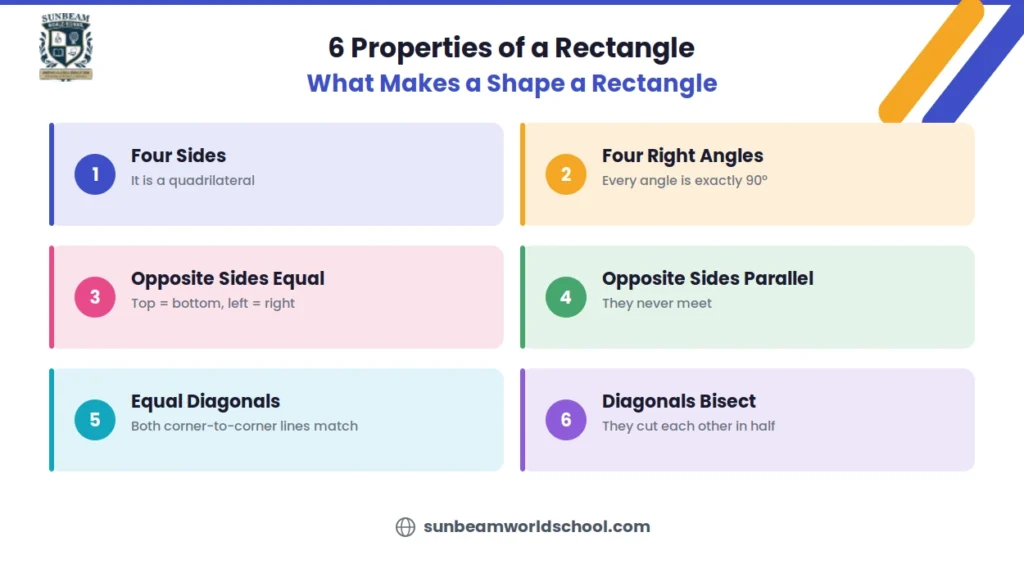
The 6 properties that make a shape a rectangle.
A rectangle has 6 key properties that let you recognise it and solve problems with it:
- Four sides. It is a quadrilateral.
- Four right angles. Every interior angle is exactly 90°, and they add up to 360°.
- Opposite sides are equal. The top equals the bottom, and the left side equals the right side.
- Opposite sides are parallel. They never meet, however far you extend them.
- Equal diagonals. The two lines joining opposite corners are the same length.
- Diagonals bisect each other. They cut each other exactly in half at the centre.
Vertices, Adjacent Sides and Opposite Sides of a Rectangle
A rectangle has 4 vertices (corners) and 4 sides, and any two sides that meet at a vertex are called adjacent sides. In rectangle ABCD, the vertices are A, B, C and D, and AB and BC are adjacent sides that meet at a right angle at B.
Adjacent sides are exactly the pair you multiply to find the area. Opposite sides (such as AB and DC) are equal, so multiplying them would just square one side and give the wrong answer.
| Part | How many | In rectangle ABCD |
|---|---|---|
| Vertices (corners) | 4 | A, B, C, D |
| Sides | 4 | AB, BC, CD, DA |
| Pairs of adjacent sides | 4 | AB & BC, BC & CD, CD & DA, DA & AB |
| Pairs of opposite sides | 2 | AB & DC, AD & BC |
| Diagonals | 2 | AC and BD |
Rectangle vs Square vs Parallelogram
A square is a rectangle whose four sides are all equal, while a parallelogram has equal, parallel opposite sides but no requirement for right angles. So every square is a rectangle, and every rectangle is a parallelogram, but not the other way round.
| Property | Parallelogram | Rectangle | Square |
|---|---|---|---|
| Opposite sides equal | Yes | Yes | Yes |
| Opposite sides parallel | Yes | Yes | Yes |
| All angles 90° | Not always | Yes | Yes |
| All four sides equal | Not always | Not always | Yes |
| Diagonals equal | Not always | Yes | Yes |
| Area formula | base × height | length × width | side × side |
This matters for area: a square uses the same idea as a rectangle, just with one number (s × s). A slanted parallelogram uses base × perpendicular height, since the parallelogram area formula always measures height at a right angle to the base rather than along the slanted side.
Length and Width of a Rectangle Explained
The length and width of a rectangle, together called its dimensions, are the measurements of two adjacent sides: by convention, length is the longer side and width (also called breadth) is the shorter side. These two numbers are all you need to find the rectangle's area, perimeter and diagonal.
A few points that often confuse students:
- The names are a convention, not a rule. Some textbooks call the sides "base" and "height", or "length" and "breadth". They all mean the two different side lengths.
- Orientation does not matter. A rectangle turned on its side has the same length, width and area. A 3 × 5 rectangle and a 5 × 3 rectangle are the same shape.
- Height is the same idea. When a rectangle stands upright, its vertical side is often called the height of the rectangle, and area becomes base × height.
- You only need two sides. Because opposite sides are equal, measuring one horizontal side and one vertical side tells you all four.
What Is the Formula for the Area of Rectangle?
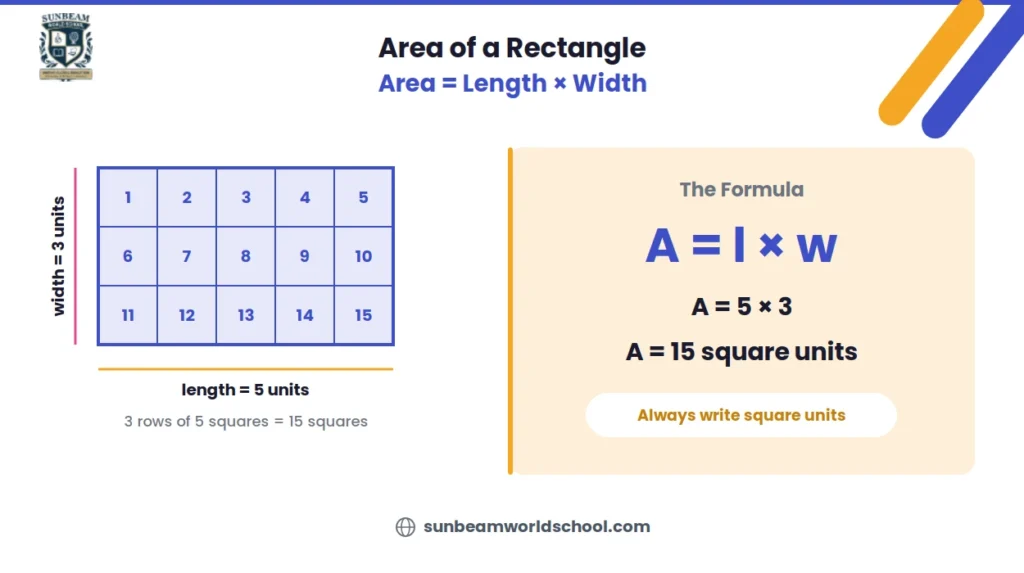
The area of a rectangle equals length × width
The area of rectangle formula is A = l × w, where A is the area, l is the length and w is the width. Multiply the two side lengths, making sure they are in the same unit, and write the answer in square units.
| Symbol | Stands for | Example |
|---|---|---|
| A | Area | 120 square units |
| l | Length (usually the longer side) | 15 units |
| w | Width or breadth (usually the shorter side) | 8 units |
This rectangle area formula, sometimes called the area of rectangle equation or the rectangular area formula, is the formula for area of a rectangle in every textbook, but it is written in several equivalent forms:
| Form | Where you will see it |
|---|---|
| A = l × w | US textbooks (length × width) |
| A = l × b | UK and Indian textbooks (length × breadth) |
| A = b × h | When a rectangle is treated like a parallelogram (base × height) |
| A = lw | Algebra, where the multiplication sign is dropped |
Because multiplication can be done in any order, l × w and w × l always give the same answer. You never need to worry about which side you call "length".
In short, if you are asking "what is the formula for area of a rectangle?" or "how do you get the area of a rectangle?", the answer is the same: area is length x width.
Why the Area Equation Length × Width Works
The equation for area, length times width, works because a rectangle is made of equal rows of unit squares, and multiplication counts equal rows. A rectangle 5 units long and 3 units wide contains 3 rows of 5 squares, which is 5 + 5 + 5 = 5 × 3 = 15 squares.
Here is the reasoning step by step:
- Lay unit squares along the length. A length of 5 units holds exactly 5 squares in one row.
- The width tells you how many of those rows fit. A width of 3 units holds exactly 3 rows.
- Every row has the same number of squares, because opposite sides of a rectangle are equal.
- Counting 3 equal rows of 5 is multiplication: 3 × 5 = 15.
This is why the formula only works for shapes with right angles and equal opposite sides. For a triangle or a circle, the rows would not be equal, so different formulas are needed.
The same logic holds for sides that are not whole numbers. A rectangle 2.5 units by 2 units holds 2 full rows of 2.5 squares each, giving 5 square units. The grid is harder to draw, but the multiplication still counts the covered space exactly.
What Units Is the Area of Rectangle Measured In?
The area of a rectangle is always measured in square units, which come from multiplying two lengths in the same unit. Centimetres × centimetres gives square centimetres (cm²), metres × metres gives square metres (m²), and feet × feet gives square feet (ft² or sq ft).
Choosing a sensible unit depends on the size of what you are measuring:
| Unit | Symbol | Good for |
|---|---|---|
| Square millimetre | mm² | Tiny parts, microchips |
| Square centimetre | cm² | A book cover, a phone screen |
| Square inch | in² | A photo, a picture frame |
| Square foot | ft² or sq ft | A room, a house (US) |
| Square metre | m² | A room, a flat (metric countries) |
| Acre / hectare | ac / ha | Farms, parks, land plots |
| Square kilometre / mile | km² / mi² | Cities, countries |
Converting Square Units Correctly
To convert square units, square the ordinary length conversion factor, because area involves two dimensions. Since 1 m = 100 cm, 1 m² equals 100 × 100 = 10,000 cm², not 100 cm².
This is the single most common source of wrong answers in area problems. The table below shows the correct conversions:
| Length conversion | Area conversion | Why |
|---|---|---|
| 1 cm = 10 mm | 1 cm² = 100 mm² | 10 × 10 |
| 1 m = 100 cm | 1 m² = 10,000 cm² | 100 × 100 |
| 1 km = 1,000 m | 1 km² = 1,000,000 m² | 1,000 × 1,000 |
| 1 ft = 12 in | 1 ft² = 144 in² | 12 × 12 |
| 1 yd = 3 ft | 1 yd² = 9 ft² | 3 × 3 |
| 1 m ≈ 3.281 ft | 1 m² ≈ 10.764 ft² | 3.281 × 3.281 |
| Land | 1 hectare = 10,000 m²; 1 acre = 43,560 ft² | Standard land units |
Tip: The safest approach is to convert the side lengths first, while they are still ordinary lengths, and then multiply. It is much easier to remember that 50 cm = 0.5 m than to remember square-unit conversion factors.
Cross-Sectional Area of a Rectangle
The cross-sectional area of a rectangular beam, pipe or block is the area of the flat rectangle you would see if you sliced straight through it, calculated with the same A = l × w formula. A wooden beam 4 in wide and 6 in deep has a cross-sectional area of 24 in², which engineers use when calculating how much load it can carry.
How Do You Calculate the Area of Rectangle?
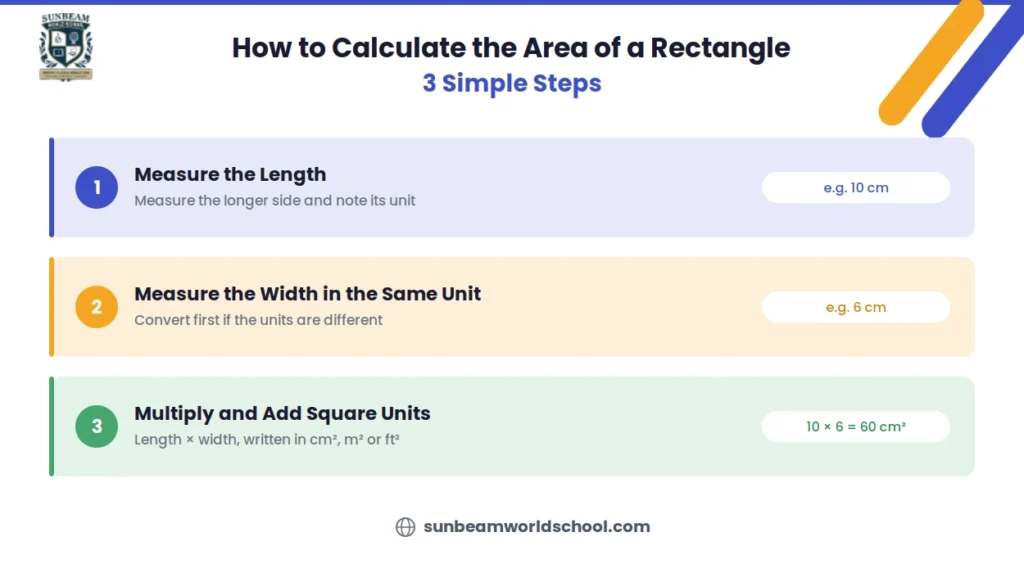
Three simple steps to calculate the area of any rectangle
You calculate the area of a rectangle in three steps: measure the length, measure the width in the same unit, then multiply the two numbers and write the answer in square units. For a rectangle 10 cm by 6 cm, that is 10 × 6 = 60 cm².
The same steps work whether you need to find, determine or calculate the area of a rectangle by hand, on a worksheet or in real life.
Step 1: Identify or Measure the Length
Find the length of one side of the rectangle, usually the longer one, and write down its unit. In a textbook problem, the length is labelled on the diagram or given in the question. On a real object, measure along one edge with a ruler or tape measure, keeping it straight and flat.
Example: A notice board measures 10 cm along its bottom edge. Length = 10 cm.
Step 2: Identify or Measure the Width in the Same Unit
Find the length of a side that meets the first side at a right angle, and make sure it uses the same unit as the length. If one side is in metres and the other in centimetres, convert one of them before going further.
Example: The side edge of the board measures 6 cm. Width = 6 cm. Both are in centimetres, so no conversion is needed.
Step 3: Multiply and Write the Answer in Square Units
Multiply length by width, then attach the square unit that matches the side units. The number tells you how many unit squares fit inside; the unit tells you how big each square is.
Example: A = 10 cm × 6 cm = 60 cm². Sixty squares, each 1 cm by 1 cm, would exactly cover the board.
Checking That Your Area Answer Makes Sense
Check your answer by estimating with rounded numbers and by confirming the units are squared. For a room 11.8 ft by 9.7 ft, round to 12 × 10 = 120, so an exact answer near 114 sq ft makes sense, while 1,144 or 11.4 would signal a mistake.
A quick three-point check:
- Estimate: Does the answer match a rounded calculation?
- Units: Is the unit squared (cm², m², ft²)?
- Size: Is the area bigger than either side length (when both sides are more than 1)? If a 9 × 7 rectangle gives 16, you have added instead of multiplied.
What Is the Rectangle Area Model in Math?
The rectangle area model (also called the rectangle model in math) is a way to multiply two numbers by drawing a rectangle, splitting it into smaller rectangles by place value, and adding the areas of the parts. It turns a hard multiplication like 23 × 14 into four easy ones.
Here is how it works for 23 × 14:
- Split each number by place value. 23 = 20 + 3 and 14 = 10 + 4.
- Draw a rectangle and divide it. Split the width into 20 and 3, and the height into 10 and 4. This makes four smaller rectangles.
- Find each smaller area. 20 × 10 = 200, 3 × 10 = 30, 20 × 4 = 80, 3 × 4 = 12. These are called partial products.
- Add the parts. 200 + 30 + 80 + 12 = 322, so 23 × 14 = 322.
Using the Area Model in Algebra
The area model matters because it shows the distributive property visually, and that same picture is later used to multiply algebraic expressions. Splitting a rectangle and adding its parts is exactly what happens when you expand (x + 3)(x + 2).
- x × x = x²
- 3 × x = 3x
- x × 2 = 2x
- 3 × 2 = 6
- Total: x² + 3x + 2x + 6 = x² + 5x + 6
Students who learn the area model in Grade 3 or 4 often find algebra much easier later, because they already "see" multiplication as area, and the same picture later makes algebraic identities like the (a + b)³ formula much easier to follow.
How Do You Find the Length or Width of a Rectangle?
You find a missing side of a rectangle, whether it is the length, the width or the height, by dividing the area by the side you know: length = area ÷ width, and width = area ÷ length. A rectangle with an area of 96 m² and a width of 8 m has a length of 96 ÷ 8 = 12 m.
Why Dividing the Area Gives the Missing Side
Dividing works because division undoes multiplication. If A = l × w, then dividing both sides of the equation by w leaves l = A ÷ w. In grid terms, you know the total number of squares and the number of rows, so dividing tells you how many squares sit in each row.
| You know | You want | Rearranged formula |
|---|---|---|
| Length and width | Area | A = l × w |
| Area and width | Length | l = A ÷ w |
| Area and length | Width | w = A ÷ l |
Check your answer by multiplying back: 12 × 8 = 96, which matches the given area.
To calculate the width of a rectangle, the steps mirror the length: divide the area by the length. For a rectangle with an area of 54 cm² and a length of 9 cm, the width is 54 ÷ 9 = 6 cm. The same method gives the height of a rectangle when the sides are called base and height.
Possible Dimensions of a Rectangle From Its Area Alone
The area alone does not fix a single rectangle, because many different length and width pairs multiply to the same number. List the factor pairs of the area to find every possible rectangle with whole-number sides.
For a rectangle with an area of 36 square units:
| Length | Width | Area | Perimeter | Shape |
|---|---|---|---|---|
| 36 | 1 | 36 | 74 | Very long and thin |
| 18 | 2 | 36 | 40 | Long |
| 12 | 3 | 36 | 30 | Moderate |
| 9 | 4 | 36 | 26 | Close to square |
| 6 | 6 | 36 | 24 | Square |
All five rectangles cover exactly the same space, but they look very different and have very different perimeters. To pin down one answer, a question must give you a second piece of information, such as the perimeter or a ratio.
Dimensions From the Area and Perimeter Together
When you know both the area and the perimeter, find the factor pair of the area whose sum equals half the perimeter. For an area of 24 and a perimeter of 20, half the perimeter is 10, and the only factor pair of 24 that adds to 10 is 4 and 6, so the rectangle is 6 by 4.
Why half the perimeter? Because P = 2(l + w), so l + w = P ÷ 2. You are looking for two numbers that multiply to the area and add to half the perimeter.
| Factor pair of 24 | Sum | Matches 10? |
|---|---|---|
| 1 and 24 | 25 | No |
| 2 and 12 | 14 | No |
| 3 and 8 | 11 | No |
| 4 and 6 | 10 | Yes |
Dimensions When the Sides Are in a Ratio
When one side is a multiple of the other, write both sides using one letter, set up the area equation, and solve. If the length is 3 times the width and the area is 48 cm², then width = w and length = 3w, so 3w × w = 48, which gives w² = 16, w = 4 cm and length = 12 cm.
Check: 12 × 4 = 48 cm², and 12 is three times 4.
How Do You Find the Diagonal of a Rectangle?
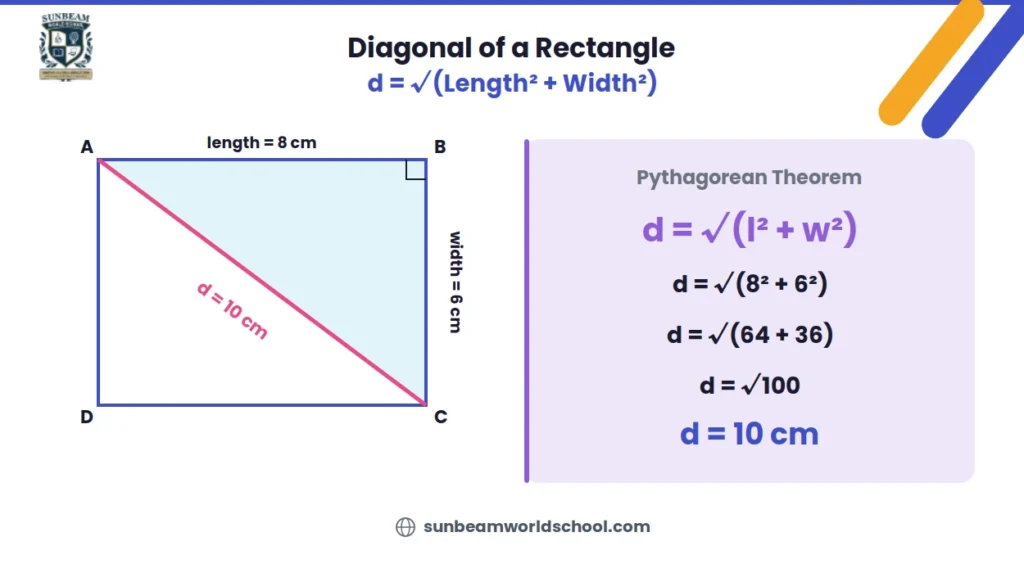
Use d = √(l² + w²) to find the diagonal of a rectangle.
The diagonal of a rectangle is found with the Pythagorean theorem: d = √(l² + w²). A rectangle 8 cm long and 6 cm wide has a diagonal of √(64 + 36) = √100 = 10 cm.
Why Pythagoras Works for a Rectangle's Diagonal
A diagonal cuts a rectangle into two identical right-angled triangles, where the length and width are the two shorter sides and the diagonal is the longest side (the hypotenuse). The Pythagorean theorem says that in any right triangle, a² + b² = c², so l² + w² = d².
Step by step for an 8 cm by 6 cm rectangle:
- Square the length: 8² = 64
- Square the width: 6² = 36
- Add them: 64 + 36 = 100
- Take the square root: √100 = 10 cm
Common Rectangle Diagonal Values
Some side pairs give whole-number diagonals, and these "Pythagorean triples" appear constantly in textbook problems. Recognising them saves time and helps you spot mistakes.
| Length | Width | Diagonal |
|---|---|---|
| 4 | 3 | 5 |
| 8 | 6 | 10 |
| 12 | 5 | 13 |
| 12 | 9 | 15 |
| 15 | 8 | 17 |
When the sides are not a triple, the diagonal is usually a decimal. A 7 × 4 rectangle has a diagonal of √(49 + 16) = √65 ≈ 8.06 units.
People sometimes search for the "diameter of a rectangle", but only circles have a diameter. The longest straight line across a rectangle is its diagonal, which is what they usually mean.
Length of Each Diagonal in Rectangle ABCD
In rectangle ABCD, both diagonals AC and BD are always equal, so you only need to calculate one. If AB = 12 and BC = 5, then AC = √(12² + 5²) = √169 = 13, and BD is also 13 units.
Diagonals of a rectangle also bisect each other, so each half-diagonal from a corner to the centre is 13 ÷ 2 = 6.5 units. Questions sometimes give the diagonals as algebraic expressions and ask you to set them equal to find x.
Area of a Rectangle From Its Diagonal
To find the area from a diagonal, use one known side and Pythagoras to find the other side, then multiply. With a diagonal of 13 cm and a length of 12 cm, the width is √(13² − 12²) = √25 = 5 cm, so the area is 12 × 5 = 60 cm².
Note that the diagonal alone is not enough: a 12 × 5 rectangle and a roughly 9.2 × 9.2 square both have a diagonal of 13, but very different areas. You always need one side, or another fact, as well.
How Do You Find the Area of a Rectangle With Fractions?
You find the area of a rectangle with fraction side lengths by multiplying the fractions: multiply the numerators together and the denominators together, then simplify. A rectangle ¾ m long and ⅔ m wide has an area of (3 × 2) ÷ (4 × 3) = 6/12 = ½ m².
Why Multiplying Fractions Gives the Area
Multiplying fractions gives area for the same reason whole numbers do: you are counting the part of a unit square that the rectangle covers. You can see this by imagining a unit square shaded in two directions.
- Draw a 1 × 1 unit square.
- Split it into 4 columns and shade 3 to show ¾ of the length.
- Split it into 3 rows and shade 2 to show ⅔ of the width.
- The square now has 4 × 3 = 12 small cells (the denominator).
- The overlap covers 3 × 2 = 6 cells (the numerator).
- So the rectangle covers 6/12 = ½ of the unit square.
Area of a Rectangle With Mixed Numbers
With mixed numbers, convert each one to an improper fraction first, multiply, then convert back. For a rectangle 2½ units by 1⅓ units:
- Convert: 2½ = 5/2 and 1⅓ = 4/3
- Multiply: 5/2 × 4/3 = 20/6
- Simplify: 20/6 = 10/3 = 3⅓ square units
Common mistake: Multiplying the whole numbers and fractions separately (2 × 1 plus ½ × ⅓) gives 2⅙, which is wrong. Always convert first.
Area of a Rectangle With Decimals
With decimal side lengths, multiply as if they were whole numbers, then place the decimal point by counting the total decimal places in both factors. For a rectangle 2.4 m by 1.5 m, 24 × 15 = 360, and there are 2 decimal places in total, so the area is 3.60 m² (3.6 m²).
How Do You Find the Area of a Rectangle With Variables?
When the sides of a rectangle are algebraic expressions, multiply them exactly as you would numbers. A rectangle with sides x and x + 3 has an area of x(x + 3), which expands to x² + 3x square units. That is the expression that represents the area of a rectangle with those sides.
Expressing the Area of the Entire Rectangle
You express the area of the entire rectangle in two equivalent ways: multiply the total length by the total width, or split it into smaller rectangles and add their areas. Both routes must give the same expression, which is a useful self-check.
- Method 1 (whole rectangle): A = x × (x + 3) = x² + 3x
- Method 2 (sum of parts): A = x² + 3x
- Both methods agree.
Expression That Represents the Area of a Rectangle
The expression that represents the area of a rectangle is the product of its two side expressions, usually expanded and simplified. For sides 2x and x + 4, the area expression is 2x(x + 4) = 2x² + 8x.
Multiple-choice questions often include the perimeter expression, 2(2x + x + 4) = 6x + 8, as a trap. Remember that area multiplies the sides, while perimeter adds them.
Expression That Represents the Length of a Rectangle
The length is the area expression divided by the width expression. If a rectangle's area is x² + 5x and its width is x, the length is (x² + 5x) ÷ x = x + 5. Check by multiplying back: x(x + 5) = x² + 5x.
Finding x When the Area Is Known
When the area is given, set the area expression equal to the number and solve the equation. If a rectangle has sides x and x + 3 and an area of 40, then x(x + 3) = 40, which becomes x² + 3x − 40 = 0. Factorising gives (x + 8)(x − 5) = 0, so x = 5 (we reject x = −8 because a length cannot be negative).
Check: the sides are 5 and 8, and 5 × 8 = 40. ✓
Value of x That Makes the Figure a Rectangle
A figure is a rectangle only when its opposite sides are equal and its angles are 90°, so set the expressions for two opposite sides equal and solve for x. If opposite sides are 3x + 2 and 5x − 4, then 3x + 2 = 5x − 4, which gives 6 = 2x and x = 3. Both sides then measure 11.
Another common version uses diagonals. A parallelogram is a rectangle only when its diagonals are equal, so if the diagonals are 2x + 6 and 4x − 2, set 2x + 6 = 4x − 2 to get x = 4, making each diagonal 14.
How Do You Find the Area of an L-Shaped Rectangle?
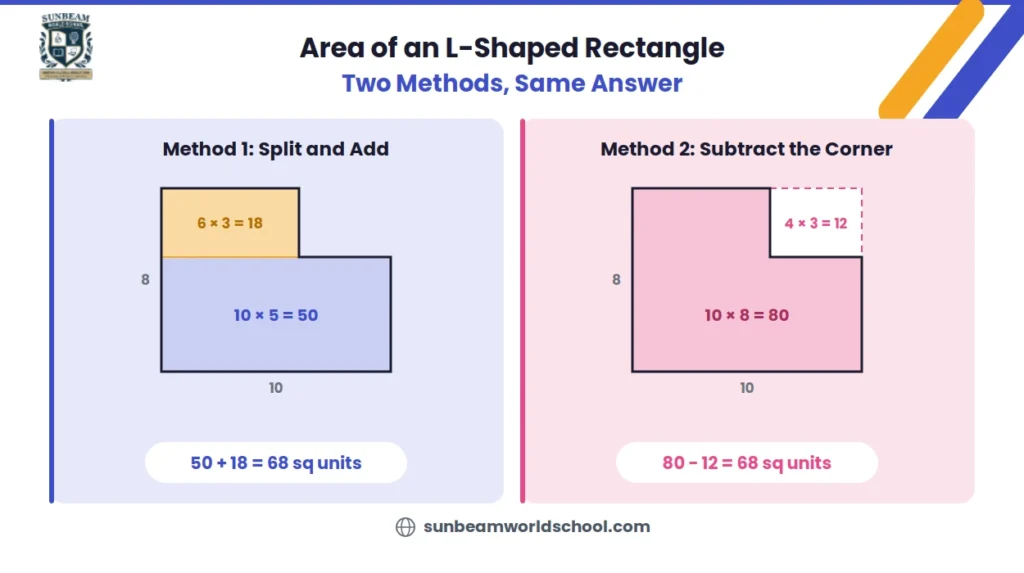
Two methods for L-shaped figures, both giving the same answer.
You find the area of an L-shaped figure, or any figure formed from rectangles (sometimes called a piecewise rectangular figure), by splitting it into rectangles and adding their areas, or by treating it as a large rectangle and subtracting the missing corner. Both methods give the same answer, so use one and check with the other.
Method 1: Split and Add
The split method divides the L-shape into two rectangles and adds their areas, giving 50 + 18 = 68 square units here.
- Draw a line to divide the L-shape into two rectangles.
- Work out any missing side lengths from the ones you know. The height of the bottom part is 8 − 3 = 5, and the width of the top part is 10 − 4 = 6.
- Find each area: 10 × 5 = 50 and 6 × 3 = 18.
- Add: 50 + 18 = 68 square units.
Method 2: Whole Rectangle Minus the Missing Corner
The subtract method finds the full rectangle's area and removes the missing corner, giving 80 − 12 = 68 square units here.
- Imagine the complete rectangle around the L-shape: 10 × 8 = 80.
- Find the area of the missing corner: 4 × 3 = 12.
- Subtract: 80 − 12 = 68 square units.
Tip: The subtract method is usually faster when the missing piece is small. The split method is better when the shape has several steps, like a staircase.
Total Area of Combined Rectangles
To find the total area when a figure is formed from rectangles, split it along its edges into separate rectangles, find each area, and add them. This is the "splitting rectangles to find area" method taught in Grade 3, often through activity-based learning with grid paper and paper cut-outs, and it works for staircase shapes, T-shapes and U-shapes.
For a T-shape made of a 12 × 2 bar on top of a 4 × 6 stem, the combined area is 24 + 24 = 48 square units. Only include overlapping parts once.
Area Between Two Rectangles
The area between two rectangles, where one sits inside the other, is the outer area minus the inner area. A 10 × 8 picture frame around a 7 × 5 photo has a frame area of 80 − 35 = 45 square units.
Area of a Path or Border Around a Rectangle
To find the area of a border, subtract the inner rectangle's area from the outer rectangle's area. A 20 m × 15 m garden with a 2 m path all the way around has an outer size of (20 + 4) × (15 + 4) = 24 × 19 = 456 m², so the path covers 456 − 300 = 156 m².
Note that the path adds 2 m on both sides, so each dimension grows by 4 m, not 2 m. Forgetting this is the most common error in border problems.
What Is the Surface Area of a Rectangle?
A flat rectangle has only area, so "surface area of a rectangle" almost always means the surface area of a rectangular prism (also called a rectangular solid, box or cuboid). Its surface area is the total area of its 6 rectangular faces: SA = 2(lw + lh + wh).
Why the Surface Area Formula Is 2(lw + lh + wh)
A box has 6 faces that come in 3 identical pairs: top and bottom, front and back, and left and right. Each pair is a rectangle, so you find one area from each pair using A = l × w, add them, and double the total.
To calculate the surface area of a rectangular box 5 cm long, 3 cm wide and 2 cm high:
| Pair of faces | One face | Both faces |
|---|---|---|
| Top and bottom | 5 × 3 = 15 | 30 |
| Front and back | 5 × 2 = 10 | 20 |
| Left and right | 3 × 2 = 6 | 12 |
| Total surface area | 62 cm² |
Using the formula: SA = 2(15 + 10 + 6) = 2 × 31 = 62 cm².
Surface Area of an Open Box
An open box has no top, so remove one of the lw faces: SA = lw + 2lh + 2wh. The same 5 × 3 × 2 box without a lid has a surface area of 15 + 20 + 12 = 47 cm².
Surface Area vs Volume of a Box
Surface area measures the outside skin of a box in square units, while volume measures the space inside in cubic units. The same 5 × 3 × 2 cm box has a surface area of 62 cm² (the cardboard needed to make it) and a volume of 5 × 3 × 2 = 30 cm³ (the space it can hold).
There is no such thing as the "cubic area of a rectangle". A flat rectangle has area in square units; only a 3D box has volume in cubic units, found with V = l × w × h.
What Is the Difference Between Area and Perimeter of a Rectangle?
Area measures the space inside a rectangle (A = l × w), while perimeter measures the total distance around its edge (P = 2(l + w)). Area is written in square units such as cm², and perimeter in plain length units such as cm.
| Area | Perimeter | |
|---|---|---|
| What it measures | Space inside | Distance around |
| Formula | A = l × w | P = 2(l + w) or 2l + 2w |
| Operation | Multiply | Add |
| Units | cm², m², ft² | cm, m, ft |
| 10 cm × 6 cm rectangle | 60 cm² | 32 cm |
| Real-life use | Carpet, tiles, paint, land | Fencing, skirting boards, frames, borders |
A simple way to remember: If you are covering something, use area. If you are going around something, use perimeter.
Same Perimeter, Different Areas
Rectangles with the same perimeter can enclose very different amounts of space, and a square always encloses the most. With a fixed perimeter of 20 units:
| Dimensions | Perimeter | Area |
|---|---|---|
| 9 × 1 | 20 | 9 |
| 8 × 2 | 20 | 16 |
| 7 × 3 | 20 | 21 |
| 6 × 4 | 20 | 24 |
| 5 × 5 | 20 | 25 (largest) |
This explains why a farmer with a fixed length of fencing gets the most grazing land by making the field as close to a square as possible.
The reverse is also true: rectangles with the same area can have very different perimeters, and the square has the smallest perimeter. That is why the 36-square-unit rectangles earlier ranged from a perimeter of 74 down to 24.
Area of a Rectangle From Its Perimeter
To find the area from the perimeter, you also need one side length. Halve the perimeter to get l + w, subtract the known side to get the other side, then multiply. With a perimeter of 30 cm and a length of 9 cm: 30 ÷ 2 = 15, so w = 15 − 9 = 6 cm, and A = 9 × 6 = 54 cm².
What Happens to the Area When You Change the Sides?
Doubling one side of a rectangle doubles its area, but doubling both sides makes the area four times larger, because both dimensions grow. A 3 × 2 rectangle has an area of 6; doubling both sides to 6 × 4 gives an area of 24, which is 4 × 6.
The general rule is that when every side is multiplied by a scale factor k, the area is multiplied by k².
| Change to the sides | Scale factor k | Effect on area |
|---|---|---|
| Double one side only | – | 2 × original |
| Double both sides | 2 | 4 × original |
| Triple both sides | 3 | 9 × original |
| Halve both sides | ½ | ¼ of original |
| Multiply both sides by 10 | 10 | 100 × original |
Using Scale Drawings to Find Real Areas
With a scale drawing, convert the drawing's dimensions to real dimensions first, then multiply. On a floor plan with a scale of 1 cm : 2 m, a room drawn 5 cm by 3 cm is really 10 m by 6 m, so its real area is 60 m².
A common mistake is to find the drawing's area (15 cm²) and multiply by 2. Because area scales by k², the correct factor is 2² = 4 in these units, giving 15 × 4 = 60 m², which matches.
How Is the Area of a Rectangle Used in Real Life?
The area of a rectangle is used whenever you need to cover, buy or price a flat surface: flooring, painting, tiling, land, gardens, screens and paper. Most rooms, walls, plots and objects are rectangles or combinations of rectangles.
Calculating Flooring for a Room
Multiply the room's length by its width, add about 10% extra for cutting and waste, then multiply by the price per unit of area. For a 15 ft × 12 ft room with flooring at $4 per sq ft:
- Area: 15 × 12 = 180 sq ft
- Add 10% waste: 180 × 1.1 = 198 sq ft
- Cost: 198 × $4 = $792
Calculating Paint for a Wall
Find the wall's area, subtract doors and windows, then multiply by the number of coats. For a 12 ft × 8 ft wall with a 3 ft × 7 ft door:
- Wall: 12 × 8 = 96 sq ft
- Door: 3 × 7 = 21 sq ft
- Paintable area: 96 − 21 = 75 sq ft
- Two coats: 75 × 2 = 150 sq ft of coverage
A gallon of paint typically covers around 350 to 400 sq ft, so one gallon is more than enough for this wall.
Square Footage of a Rectangle
The square footage of a rectangle is its area measured in square feet: multiply the length in feet by the width in feet. A room 14 ft by 12 ft has 14 × 12 = 168 sq ft. If a side is in inches, divide it by 12 first.
Area of a Rectangular Lot
Multiply the lot's frontage by its depth to get the area in square feet or square metres, then convert to acres or hectares if needed. A lot 120 ft by 60 ft has an area of 7,200 sq ft, which is 7,200 ÷ 43,560 ≈ 0.17 acres.
How Does the Area of a Rectangle Compare With Other Shapes?
Almost every basic area formula is built from the rectangle: a triangle is exactly half a rectangle, a parallelogram is a rearranged rectangle, and a square is an equal-sided rectangle. Knowing A = l × w lets you find the area of each shape in the table below.
| Shape | Area formula | How it links to the rectangle |
|---|---|---|
| Rectangle | A = l × w | The starting point |
| Square | A = s² | A rectangle with equal sides |
| Triangle | A = ½ × b × h | Exactly half of a rectangle with the same base and height |
| Parallelogram | A = b × h | Cut and slide a triangle to make a rectangle |
| Trapezoid | A = ½ × (a + b) × h | Two copies form a parallelogram |
| Circle | A = πr² | The only common shape not built from rectangles |
Area of a Rectangle and a Triangle Together
To find the area of a shape made from a rectangle and a triangle, such as a house outline, find each area separately and add them. A 10 × 6 rectangle with a triangle of base 10 and height 4 on top has an area of 60 + ½ × 10 × 4 = 60 + 20 = 80 square units.
Area of Irregular Shapes Made From Rectangles
To find the area of something irregular, break it into rectangles (and triangles if needed), find each area with its own formula, and add them. This is how builders, architects and exam questions that say "use formulas to find the area of the figure" all work.
What Are the Most Common Mistakes When Finding the Area of a Rectangle?
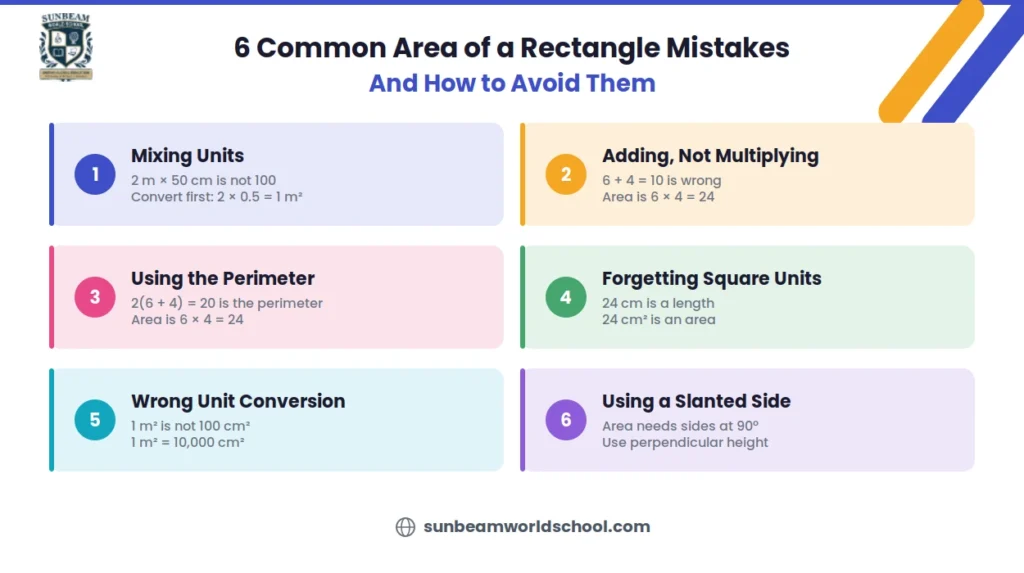
Six area mistakes students make, and how to avoid each one
The 6 most common mistakes are mixing units, adding instead of multiplying, confusing area with perimeter, forgetting square units, converting square units incorrectly, and using a slanted side instead of the height. Each is easy to avoid once you know to look for it, and writing units and working clearly is also one of the simplest ways to write a maths paper in board exams without losing easy marks.
| Mistake | Wrong | Right | How to avoid it |
|---|---|---|---|
| Mixing units | 2 m × 50 cm = 100 | 2 m × 0.5 m = 1 m² | Convert sides to one unit before multiplying |
| Adding instead of multiplying | 6 + 4 = 10 | 6 × 4 = 24 | Area grows fast; it should usually be bigger than the sides |
| Using the perimeter formula | 2(6 + 4) = 20 | 6 × 4 = 24 | Ask: am I covering or going around? |
| Forgetting square units | 24 cm | 24 cm² | Two lengths multiplied always give a squared unit |
| Wrong square-unit conversion | 1 m² = 100 cm² | 1 m² = 10,000 cm² | Square the length conversion factor |
| Using a slanted side | Parallelogram: base × slant side | base × perpendicular height | Area needs sides at right angles |
Solved Examples: Area of a Rectangle
These 12 solved examples cover every type of rectangle area problem, from basic multiplication to diagonals, fractions, algebra, L-shapes and surface area. Each one shows what to notice first, the working, and a check.
Example 1: Area of the Rectangle Below With Sides 8 and 15
The area is 120 square units, because length × width = 15 × 8 = 120.
What to notice: Both sides are given in the same (unnamed) unit, so you can multiply straight away.
- A = l × w
- A = 15 × 8
- A = 120 square units
Check: Round to 15 × 10 = 150; the answer should be a little less, and 120 is.
Example 2: Area of a Rectangle 7.5 cm Long and 4 cm Wide
The area is 30 cm², because 7.5 × 4 = 30.
What to notice: One side is a decimal, so multiply as normal and keep the decimal point in place.
- A = 7.5 cm × 4 cm
- 7.5 × 4 = (7 × 4) + (0.5 × 4) = 28 + 2
- A = 30 cm²
Example 3: Area of a Rectangle 3 ft Long and 18 in Wide
The area is 4.5 sq ft (or 648 sq in), because 18 in equals 1.5 ft and 3 × 1.5 = 4.5.
What to notice: The units are different, so convert before multiplying.
- Convert: 18 in ÷ 12 = 1.5 ft
- A = 3 ft × 1.5 ft = 4.5 sq ft
- Alternative: 3 ft = 36 in, so A = 36 × 18 = 648 sq in
- Check: 648 ÷ 144 = 4.5 sq ft ✓
Example 4: Width of a Rectangle With Area 96 m² and Length 12 m
The width is 8 m, because width = area ÷ length and 96 ÷ 12 = 8.
What to notice: You know the area and one side, so rearrange the formula.
- A = l × w, so w = A ÷ l
- w = 96 ÷ 12
- w = 8 m
- Check: 12 × 8 = 96 ✓
Example 5: Area of a Rectangle With Perimeter 30 cm and Length 9 cm
The area is 54 cm², because the width works out to 6 cm and 9 × 6 = 54.
What to notice: You cannot find area from perimeter directly; find the missing side first.
- P = 2(l + w), so 30 = 2(9 + w)
- Divide by 2: 15 = 9 + w
- w = 6 cm
- A = 9 × 6 = 54 cm²
Example 6: Dimensions When Length Is 3 Times Width and Area Is 48 cm²
The rectangle is 12 cm by 4 cm, because 3w × w = 48 gives w = 4.
What to notice: Write both sides in terms of one unknown.
- Let width = w, so length = 3w
- 3w × w = 48, so 3w² = 48
- w² = 16, so w = 4 cm
- Length = 3 × 4 = 12 cm, width = 4 cm
- Check: 12 × 4 = 48 ✓
Example 7: Area of a Rectangle With Diagonal 13 cm and Length 12 cm
The area is 60 cm², because Pythagoras gives a width of 5 cm and 12 × 5 = 60.
What to notice: The diagonal forms a right triangle with the length and width.
- w² = d² − l² = 13² − 12² = 169 − 144 = 25
- w = √25 = 5 cm
- A = 12 × 5 = 60 cm²
Example 8: Area of a Rectangle ¾ m Long and ⅔ m Wide
The area is ½ m², because ¾ × ⅔ = 6/12 = ½.
What to notice: Multiply numerators, multiply denominators, then simplify.
- A = ¾ × ⅔ = (3 × 2) ÷ (4 × 3) = 6/12
- A = ½ m²
- Shortcut: Cancel the 3s before multiplying: ¾ × ⅔ = 2/4 = ½
Example 9: Value of x for Sides x and x + 3 With Area 40
The value of x is 5, because x(x + 3) = 40 factorises to (x + 8)(x − 5) = 0 and a length cannot be negative.
What to notice: Setting the area expression equal to the area creates a quadratic equation.
- x(x + 3) = 40
- x² + 3x − 40 = 0
- (x + 8)(x − 5) = 0
- x = −8 (rejected, length cannot be negative) or x = 5
- Check: sides 5 and 8, and 5 × 8 = 40 ✓
Example 10: Area of an L-Shaped Room 10 ft by 8 ft Missing a 4 ft by 3 ft Corner
The area is 68 sq ft, because the full rectangle is 80 sq ft and the missing corner is 12 sq ft.
What to notice: Composite shapes can be solved by adding parts or subtracting the missing part.
- Full rectangle: 10 × 8 = 80 sq ft
- Missing corner: 4 × 3 = 12 sq ft
- A = 80 − 12 = 68 sq ft
- Check with the split method: 10 × 5 + 6 × 3 = 50 + 18 = 68 ✓
Example 11: Area of a 2 m Path Around a 20 m by 15 m Garden
The path covers 156 m², because the outer rectangle is 456 m² and the garden is 300 m².
What to notice: The path adds 2 m on each side, so each dimension grows by 4 m.
- Outer rectangle: (20 + 4) × (15 + 4) = 24 × 19 = 456 m²
- Garden: 20 × 15 = 300 m²
- Path = 456 − 300 = 156 m²
Example 12: Surface Area of a Box 5 cm × 3 cm × 2 cm
The surface area is 62 cm², because the three pairs of faces measure 30, 20 and 12 cm².
What to notice: A box has 6 rectangular faces in 3 matching pairs.
- SA = 2(lw + lh + wh)
- SA = 2(5 × 3 + 5 × 2 + 3 × 2) = 2(15 + 10 + 6) = 2 × 31
- SA = 62 cm²
Which Grade Learns the Area of a Rectangle?
Students first learn the area of a rectangle in Grade 3 and build on it through Grade 6, following the US Common Core math standards. Each grade adds a new layer: counting squares, then formulas, then fractions, then 3D surface area.
| Grade | Standard | What students learn |
|---|---|---|
| 3 | 3.MD.C.7 | Find area by tiling, connect area to multiplication, use the area model, find areas of L-shaped figures |
| 4 | 4.MD.A.3 | Apply the area and perimeter formulas, find a missing side length |
| 5 | 5.NF.B.4 | Find the area of rectangles with fraction side lengths |
| 6 | 6.G.A.4 | Find the surface area of boxes using nets |
Practice Questions With Full Solutions
Try these 8 questions on your own first, then compare your working with the solutions below.
- Find the area of a rectangle 12 cm by 5 cm.
- A rectangle has an area of 84 in² and a width of 7 in. Find its length.
- A rectangle has a perimeter of 40 ft and a width of 8 ft. Find its area.
- Find the diagonal of a rectangle 12 m by 9 m.
- Find the area of a rectangle 1½ ft by ⅔ ft.
- Find the area of a rectangle 2.5 m by 80 cm, in m².
- Find the surface area of a box 4 cm × 3 cm × 2 cm.
- A rectangle's sides double from 5 × 3. What is the new area, and how many times bigger is it?
Solutions
The answers are 60 cm², 12 in, 96 sq ft, 15 m, 1 sq ft, 2 m², 52 cm² and 60 square units; full working for each is below.
- 60 cm². A = 12 × 5 = 60.
- 12 in. l = A ÷ w = 84 ÷ 7 = 12.
- 96 sq ft. l + w = 40 ÷ 2 = 20, so l = 20 − 8 = 12 ft. A = 12 × 8 = 96.
- 15 m. d = √(12² + 9²) = √(144 + 81) = √225 = 15.
- 1 sq ft. 1½ = 3/2, so A = 3/2 × 2/3 = 6/6 = 1.
- 2 m². 80 cm = 0.8 m, so A = 2.5 × 0.8 = 2.
- 52 cm². SA = 2(4 × 3 + 4 × 2 + 3 × 2) = 2(12 + 8 + 6) = 2 × 26 = 52.
- 60 square units, 4 times bigger. Original area = 15. New sides 10 × 6 = 60. 60 ÷ 15 = 4, matching the k² rule (2² = 4).
Area of a Rectangle Formula Cheat Sheet
This table collects every rectangle formula from this guide in one place, so you can revise or look one up quickly.
| To find | Formula | Example |
|---|---|---|
| Area | A = l × w | 15 × 8 = 120 |
| Length | l = A ÷ w | 96 ÷ 8 = 12 |
| Width | w = A ÷ l | 96 ÷ 12 = 8 |
| Perimeter | P = 2(l + w) | 2(10 + 6) = 32 |
| Diagonal | d = √(l² + w²) | √(64 + 36) = 10 |
| Missing side from diagonal | w = √(d² − l²) | √(169 − 144) = 5 |
| Area of a square | A = s² | 5² = 25 |
| Surface area of a box | SA = 2(lw + lh + wh) | 2(15 + 10 + 6) = 62 |
| Surface area of an open box | SA = lw + 2lh + 2wh | 15 + 20 + 12 = 47 |
| Volume of a box | V = l × w × h | 5 × 3 × 2 = 30 |
| Area after scaling by k | New A = k² × old A | 2² × 6 = 24 |
Conclusion
Now that you know the area of a rectangle is length × width, put it into practice: check your units, calculate the area, and always write the answer in square units. Use the same approach to tackle missing sides, fractions, L-shaped figures, and surface-area problems with confidence.
Ready to build on this skill? Explore the area of a square and practice more geometry concepts with Sunbeam World School, where students learn through clear explanations, guided practice, and real-world applications.

Frequently Asked Questions
Is the area of a rectangle length times width?
-Yes, the area of a rectangle is always length times width, written as A = l × w. Multiplying the two sides counts every unit square inside the shape, so a rectangle 6 cm long and 4 cm wide has an area of 24 cm².
What is the formula for the area of a rectangle?
+How do you find the area of a rectangle step by step?
+How do you find the length of a rectangle if you know the area?
+What is the surface area of a rectangle?
+How do you find the area of a rectangle with a diagonal?
+Why is area measured in square units?
+Can two rectangles with the same area have different perimeters?
+What happens to the area if you double the length and width?
+Is a square a rectangle?
+How do you find the dimensions of a rectangle?
+How do you find the width of a rectangle?
+How do you find the area of a rectangle with fractions?
+How do you find the area of a rectangle with perimeter?
+What is the area of a rectangle in square feet?
+
In this article
Share this post:


Press and Blogs
Stay updated with our press releases, educational blogs, and more.

Quick Summary Animal sounds are the noises animals make to communicate, warn of danger and...
Quick Summary An algebra equation is a maths statement that sets two expressions equal using...

Quick Summary Sympathy means feeling sorry for someone from your own point of view. Empathy...