
 Education
Algebra Equations: Types, Formulas, Steps to Solve and Examples
Quick Summary An algebra equation is a maths statement that sets two expressions equal using an equals sign (=), with at least one unknown value such as x. You solve it by isolating the variable, using inverse operations and doing the same thing to both sides, so 4x + 10 = 30 becomes 4x = 20 and then x = 5.
Algebra equations are the starting point for almost every maths topic students meet after middle school, from linear graphs in Class 8 to quadratics in Class 10 and entrance exams like JEE. The easiest way to picture one is a balance scale, where both pans must weigh the same, so whatever you add to or remove from one side you must also do to the other. Getting comfortable with them means knowing their parts and types, the steps to solve them, the formulas worth memorising and the mistakes to avoid, and then practising until each step feels natural.
Free Download: Get our Algebra Formula Cheat Sheet and Equations Worksheet (PDF) with answers for quick revision.
What Is Algebra, in Simple Words?
Algebra is the branch of maths that uses letters such as x and y to stand for unknown numbers, so you can write rules and find missing values instead of guessing them. For example, if 4 pencils cost ₹40 and you want the price of one, algebra writes this as 4x = 40 and tells you each pencil costs ₹10. Arithmetic works only with known numbers, while algebra lets you describe patterns, compare options and solve problems where one piece of information is missing.
What Is an Algebra Equation?
An algebra equation is a mathematical statement in which two expressions are set equal with an equals sign, and at least one of them contains a variable whose value is unknown. A simple example is 2x + 3 = 11, where the left side and the right side must have exactly the same value. Mathematicians often write any algebraic equation in the general form P(x) = 0, where P(x) is a polynomial, which is why equations are grouped by the highest power of the variable.
The equals sign means "is the same as", not "the answer comes next", and this small idea clears up a lot of confusion for beginners.
What Does It Mean to Solve an Equation Algebraically?
Solving an equation algebraically means finding the value of the variable that makes both sides equal by using logical steps such as inverse operations, rather than guessing numbers or reading a graph. In 2x + 3 = 11 the solution is x = 4, because 2(4) + 3 gives 11. An algebraic solution shows each step, so it works for fractions and negatives that would be hard to guess, and examiners give marks for the working as well as the final answer.
What Are the Parts of an Algebra Equation?
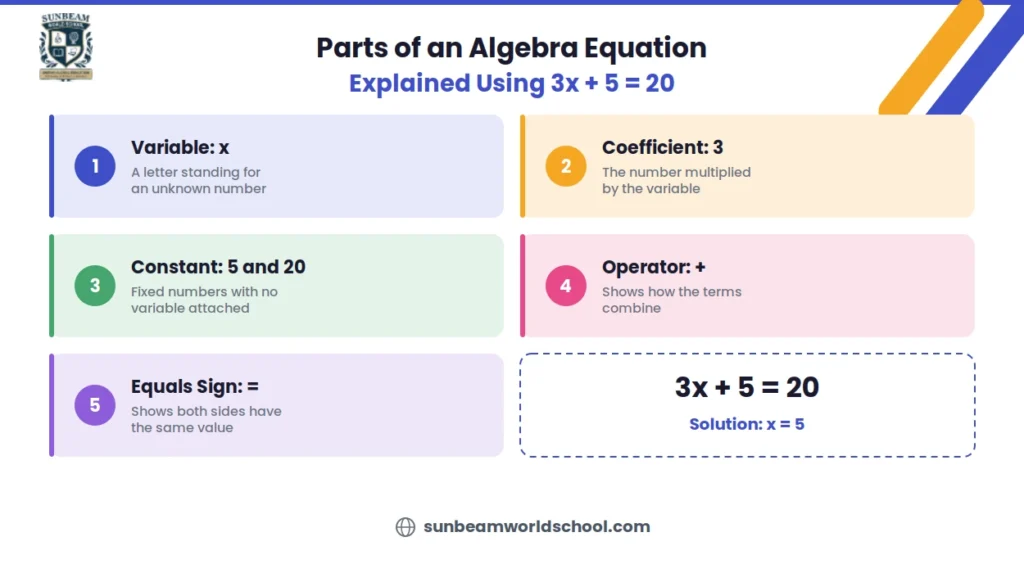
Every algebra equation is built from five parts,
An algebra equation has five main parts: variables, constants, coefficients, operators and the equals sign, and each one plays a fixed role. Looking at 3x + 5 = 20 makes these parts easy to spot.
| Part | What it means | Example in 3x + 5 = 20 |
|---|---|---|
| Variable | A letter standing for an unknown number | x |
| Coefficient | The number multiplied by a variable | 3 |
| Constant | A fixed number with no variable | 5 and 20 |
| Operator | A symbol showing an operation | + |
| Equals sign | Shows both sides have the same value | = |
Variables
Variables are letters such as x, y or z that hold the place of a number you do not know yet. Any letter can be used, although x and y are the most common, and an equation can have one variable or several. The goal of solving is always to find what number the variable stands for.
Constants
Constants are plain numbers such as 5, −3 or 20 that keep the same value throughout the equation. They usually sit on their own, without a letter attached, and they are often the first terms you move when you start solving.
Coefficients
Coefficients are the numbers written directly in front of a variable, so in 3x the coefficient is 3, which means x is counted three times. When no number appears, as in x + 2, the coefficient is 1, and dividing by the coefficient is usually the final step in solving a linear equation.
Terms, Operators and the Equals Sign
Terms are the separate pieces of each side, such as 3x and 5, and operators like +, −, × and ÷ show how those terms combine. The equals sign divides the equation into a left side and a right side, and it is the one part that must never be moved or changed while solving.
What Is the Difference Between an Algebraic Expression and an Equation?
An algebraic expression is a maths phrase without an equals sign, such as 3x + 5, while an algebra equation joins two expressions with an equals sign, such as 3x + 5 = 17. You can simplify or evaluate an expression, but you can only solve an equation, because only an equation gives you a condition to meet.
| Feature | Algebraic expression | Algebra equation |
|---|---|---|
| Equals sign | No | Yes |
| Example | 3x + 5 | 3x + 5 = 17 |
| What you do with it | Simplify or evaluate | Solve |
| Has a solution? | No, it has a value for each x | Yes, x = 4 here |
| Like in English | A phrase | A complete sentence |
What Are the Types of Algebra Equations?
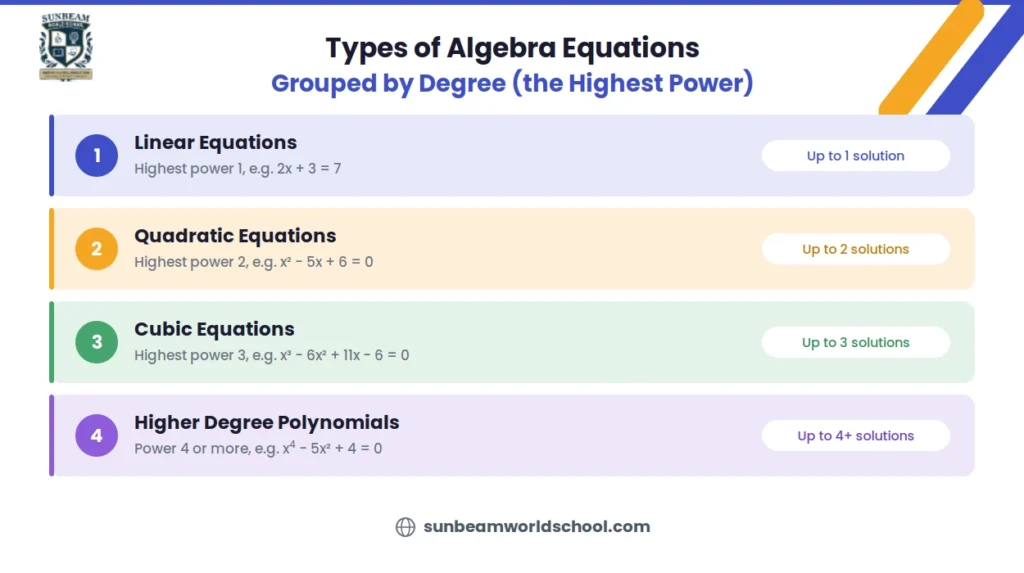
Types of algebra equations by degree
Algebra equations are mainly grouped by their degree, the highest power of the variable, into linear, quadratic, cubic and higher polynomial equations, plus rational and radical equations. The degree also tells you the maximum number of solutions an equation can have, which makes it a quick way to know what to expect before you solve.
| Type | Degree | General form | Example | Max solutions | Graph shape |
|---|---|---|---|---|---|
| Linear | 1 | ax + b = 0 | 2x + 3 = 7 | 1 | Straight line |
| Quadratic | 2 | ax² + bx + c = 0 | x² − 5x + 6 = 0 | 2 | Parabola (U shape) |
| Cubic | 3 | ax³ + bx² + cx + d = 0 | x³ − 6x² + 11x − 6 = 0 | 3 | S shaped curve |
| Quartic | 4 | ax⁴ + bx³ + cx² + dx + e = 0 | x⁴ − 5x² + 4 = 0 | 4 | W or M shape |
| Rational | Varies | P(x) / Q(x) = 0 | (x + 1) / (x − 2) = 3 | Varies | Curves with gaps |
| Radical | Varies | Variable under a root | √(x + 3) = 5 | Varies | Half curves |
Linear Equations
Linear equations are equations where the variable has a highest power of 1, so they always form a straight line on a graph and have one solution. An example is 2x + 3 = 7, which gives x = 2. Linear equations in two variables, such as y = 2x + 1, are often written in slope intercept form, y = mx + c, where m is the slope and c is where the line crosses the y axis.
Quadratic Equations
Quadratic equations are equations where the highest power of the variable is 2, written in the standard form ax² + bx + c = 0, where a is not zero. They form a U shaped curve called a parabola and can have two, one or no real solutions, so x² − 5x + 6 = 0 has the two solutions x = 2 and x = 3. Even finding the side of a square from its area is a quadratic, since s² = 64 gives s = 8, taking only the positive root because a length cannot be negative, which is why the area of a square and quadratic equations are so closely linked.
Cubic Equations
Cubic equations are equations where the highest power of the variable is 3, written as ax³ + bx² + cx + d = 0, and they can have up to three solutions. For example, x³ − 6x² + 11x − 6 = 0 has the solutions 1, 2 and 3, and its graph forms an S shaped curve.
Higher Degree Polynomial Equations
Polynomial equations of degree 4 or more, called quartic and quintic equations, have the highest power of 4, 5 or above and can have as many solutions as their degree. For example, x⁴ − 5x² + 4 = 0 has four solutions, x = 1, −1, 2 and −2. Students usually meet these only in senior classes or advanced algebra courses.
Rational and Radical Equations
Rational equations contain a variable in the denominator of a fraction, while radical equations contain a variable under a square root or other root. For example, √(x + 3) = 5 becomes x + 3 = 25 after squaring both sides, so x = 22. Trigonometric equations such as sin x = 0.5 are not algebraic equations, because sine and cosine are not built from addition, subtraction, multiplication, division and roots alone, so they belong to a separate group called transcendental equations.
How Are Equations Classified by Their Solutions?
Equations are classified by their solutions into three groups: conditional equations with a specific solution, identities that are true for every value, and contradictions that have no solution. Knowing which kind you have stops you from searching for an answer that does not exist.
Conditional Equations
Conditional equations are true only for particular values of the variable, so 2x + 1 = 7 is true only when x = 3. Most equations students solve in school are conditional equations, since the whole task is to find that specific value.
Identities
Identities are equations that stay true whatever value you put in, such as 2(x + 3) = 2x + 6. When you simplify an identity, both sides become exactly the same, and this is why algebra formulas like (a + b)² = a² + 2ab + b² are called algebraic identities.
Contradictions
Contradictions are equations that are never true for any value, such as x + 5 = x + 2. When you subtract x from both sides you get 5 = 2, which is false, so the equation has no solution and the right answer is simply "no solution".
How Do You Solve Algebra Equations Step by Step?
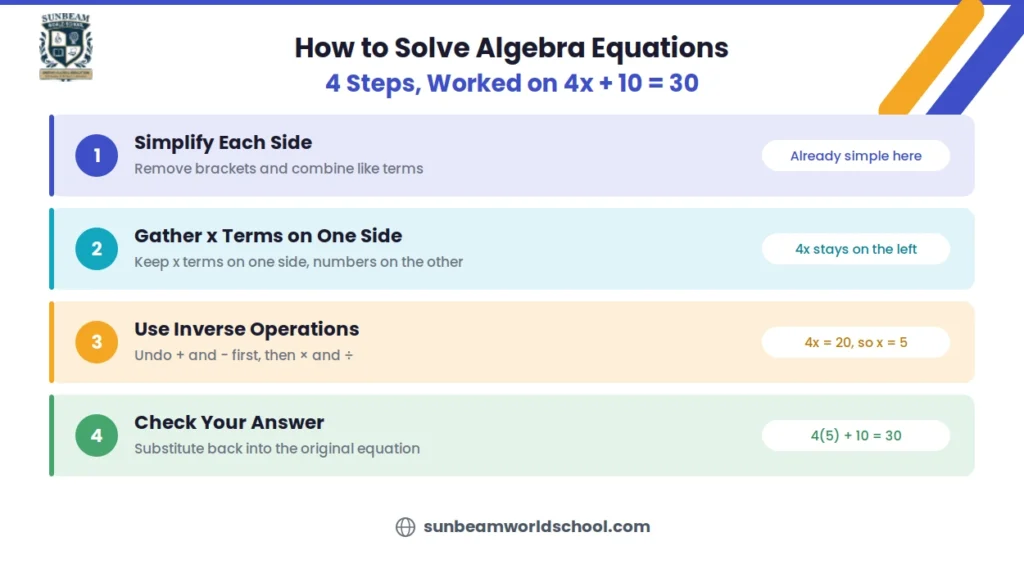
Simplify, gather x terms, use inverse operations and check,
You solve an algebra equation in four steps: simplify each side, move variable terms to one side, use inverse operations to isolate the variable, and check the answer by substituting it back. Every step must be done equally to both sides, so the equation stays balanced.
- Simplify each side. Remove brackets using the distributive property and combine like terms, so 3(x + 2) + x becomes 4x + 6.
- Gather variable terms on one side. Add or subtract terms so all the x terms sit on one side and the plain numbers sit on the other.
- Use inverse operations to isolate the variable. Undo addition with subtraction and multiplication with division, working in reverse BODMAS order, so you undo + and − before × and ÷.
- Check your answer. Substitute the value back into the original equation and confirm both sides are equal.
Worked example: 4x + 10 = 30
- Subtract 10 from both sides: 4x = 20
- Divide both sides by 4: x = 5
- Check: 4(5) + 10 = 30, which is correct
Solving One-Step Equations
One-step equations are solved with one inverse operation, because only one thing has been done to the variable. For x + 8 = 15, subtract 8 from both sides to get x = 7, and for x ÷ 4 = 6, multiply both sides by 4 to get x = 24. Similarly, 5x = 35 needs one division by 5, giving x = 7.
Solving Two-Step Equations
Two-step equations are solved by first undoing addition or subtraction and then undoing multiplication or division. Take 9x + 7 = −7: subtract 7 from both sides to get 9x = −14, then divide by 9 to get x = −14/9, or about −1.56. Checking it, 9(−14/9) + 7 = −14 + 7 = −7, so the answer is correct.
Solving Equations With Variables on Both Sides
Equations with variables on both sides are solved by moving all the x terms to one side before isolating x. For 5x + 3 = 2x + 18, subtract 2x from both sides to get 3x + 3 = 18, subtract 3 to get 3x = 15, and divide by 3 to get x = 5. If the equation has brackets, as in 3(x + 2) = 2x + 10, expand first to get 3x + 6 = 2x + 10, which gives x = 4.
Solving Quadratic Equations
Quadratic equations are solved by one of three methods: factorisation, the quadratic formula or completing the square, and each gives up to two answers.
- Factorisation: x² − 5x + 6 = 0 becomes (x − 2)(x − 3) = 0, so x = 2 or x = 3.
- Quadratic formula: For ax² + bx + c = 0, x = (−b ± √(b² − 4ac)) / 2a. For 2x² + 3x − 2 = 0, b² − 4ac = 9 + 16 = 25, so x = (−3 ± 5) / 4, which gives x = 1/2 or x = −2.
- Completing the square: x² + 6x + 5 = 0 becomes (x + 3)² = 4, so x + 3 = ±2, giving x = −1 or x = −5.
Solving Simultaneous Equations With x and y
Two equations with x and y, called simultaneous equations, are solved by elimination or substitution, which turns them into a single equation with one variable. With elimination, adding x + y = 10 and x − y = 4 removes y and gives 2x = 14, so x = 7 and y = 3. With substitution, if y = 2x and x + y = 12, replacing y gives 3x = 12, so x = 4 and y = 8.
Quick Tricks for Solving Equations
Two quick tricks speed up solving: clear fractions first, and cross multiply when two fractions are equal.
- Clear fractions first. Multiply every term by the LCM of the denominators, so x/2 + x/3 = 10 becomes 3x + 2x = 60, giving x = 12.
- Cross multiply. When one fraction equals another, as in (x + 1)/3 = (x − 1)/2, multiply across to get 2x + 2 = 3x − 3, so x = 5.
How Can You Check if Your Answer Is Correct?
You check an algebra equation by substituting your answer into the original equation and confirming that the left side equals the right side. If 5x + 3 = 2x + 18 gives x = 5, then the left side is 5(5) + 3 = 28 and the right side is 2(5) + 18 = 28, so the answer is right. Always substitute into the original equation, not a later line, since a mistake in an early step would otherwise go unnoticed, and this 30 second habit catches sign errors before they cost marks in an exam.
What Are the 5 Basic Rules of Algebra?
The 5 basic rules of algebra are the commutative, associative, distributive, identity and inverse properties, and together they explain why every solving step is allowed.
| Rule | What it says | Example |
|---|---|---|
| Commutative | Order does not change a sum or product | a + b = b + a, ab = ba |
| Associative | Grouping does not change a sum or product | (a + b) + c = a + (b + c) |
| Distributive | Multiplication spreads over addition | a(b + c) = ab + ac |
| Identity | Adding 0 or multiplying by 1 changes nothing | a + 0 = a, a × 1 = a |
| Inverse | Opposites cancel to 0 or 1 | a + (−a) = 0, a × (1/a) = 1 |
The inverse property is the one used most while solving, because subtracting 10 to cancel a +10, or dividing by 4 to cancel a ×4, is simply applying an inverse.
What Are the Most Important Algebra Formulas?
The most important algebra formulas are the standard identities for squares and cubes, the difference of squares and the quadratic formula, since they appear in almost every chapter from Class 8 onwards. The cube identities in the table, such as (a + b)³, become much easier to remember once you see how each term of the a plus b whole cube formula is derived.
| Formula name | Formula |
|---|---|
| Square of a sum | (a + b)² = a² + 2ab + b² |
| Square of a difference | (a − b)² = a² − 2ab + b² |
| Difference of squares | a² − b² = (a + b)(a − b) |
| Cube of a sum | (a + b)³ = a³ + 3a²b + 3ab² + b³ |
| Cube of a difference | (a − b)³ = a³ − 3a²b + 3ab² − b³ |
| Sum of cubes | a³ + b³ = (a + b)(a² − ab + b²) |
| Difference of cubes | a³ − b³ = (a − b)(a² + ab + b²) |
| Square of three terms | (a + b + c)² = a² + b² + c² + 2ab + 2bc + 2ca |
| Product of two binomials | (x + a)(x + b) = x² + (a + b)x + ab |
| Quadratic formula | x = (−b ± √(b² − 4ac)) / 2a |
What Are Some Examples of Algebra Equations With Answers?
The 10 examples below show algebra equations with answers, moving from simple one-step equations to quadratic and simultaneous equations.
| No. | Equation | Type | Working | Answer |
|---|---|---|---|---|
| 1 | x + 9 = 17 | One step | Subtract 9 | x = 8 |
| 2 | 7x = 56 | One step | Divide by 7 | x = 8 |
| 3 | x ÷ 5 = 9 | One step | Multiply by 5 | x = 45 |
| 4 | 2x − 5 = 11 | Two step | Add 5, divide by 2 | x = 8 |
| 5 | 6x + 4 = 2x + 20 | Both sides | 4x = 16 | x = 4 |
| 6 | 4(x − 3) = 20 | Brackets | x − 3 = 5 | x = 8 |
| 7 | (x + 4) ÷ 3 = 5 | Fraction | x + 4 = 15 | x = 11 |
| 8 | x² − 9 = 0 | Quadratic | x² = 9 | x = 3 or −3 |
| 9 | x² + x − 12 = 0 | Quadratic | (x + 4)(x − 3) = 0 | x = 3 or −4 |
| 10 | 2x + y = 11, x − y = 1 | Simultaneous | Add: 3x = 12 | x = 4, y = 3 |
How Do You Turn a Word Problem Into an Algebra Equation?
You turn a word problem into an algebra equation by choosing a letter for the unknown, translating key words into symbols and writing the sentence as an equation. Most students find solving easy and translating hard, so learning the key words below removes most of the difficulty.
| Words in the problem | Symbol |
|---|---|
| sum, more than, increased by, total | + |
| difference, less than, decreased by | − |
| product, times, twice, of | × |
| quotient, per, shared equally, divided by | ÷ |
| is, equals, gives, will be | = |
Example 1: A number increased by 12 is 30. Let the number be x, so x + 12 = 30 and x = 18.
Example 2: Riya has twice as many pencils as Aman, and together they have 24. Let Aman have x, so x + 2x = 24, giving 3x = 24, so Aman has 8 and Riya has 16.
Example 3: A triangle has an area of 30 cm² and a base of 10 cm. Using ½ × base × height = area gives ½ × 10 × h = 30, so 5h = 30 and the height is 6 cm, which is how most missing-height questions on the area of a triangle are solved.
How Are Algebra Equations Used in Real Life?
Algebra equations are used in real life to find unknown amounts in shopping, travel, phone plans, cooking and saving money, often without people realising they are doing algebra.
- Shopping on a budget: If 3 notebooks and a ₹40 pen cost ₹220, then 3x + 40 = 220, so each notebook costs ₹60.
- Travel time: Distance = speed × time, so a 180 km trip at 60 km/h gives 180 = 60t, which means t = 3 hours.
- Comparing phone plans: Plan A costs ₹100 plus ₹2 per minute and Plan B costs ₹160 plus ₹1 per minute, so 100 + 2m = 160 + m shows both cost the same at 60 minutes.
- Scaling a recipe: If 300 g of flour serves 4, then 300/4 = f/10 gives 750 g for 10 people.
- Measuring a room or plot: If a rectangular room has an area of 48 m² and a length of 8 m, then 8b = 48 gives a breadth of 6 m, and the same working finds a missing side with the area of a rectangle or a missing base with the parallelogram area formula, where base × height = area.
- Saving pocket money: Saving ₹150 a week to reach ₹1,200 gives 150w = 1,200, so it takes 8 weeks.
Fun fact: Can you write "I love you" as an equation? Yes. Solve 9x − 7i > 3(3x − 7u) and you get i < 3u, which reads like "i <3 u", a popular maths joke among students.
What Mistakes Do Students Make When Solving Equations?
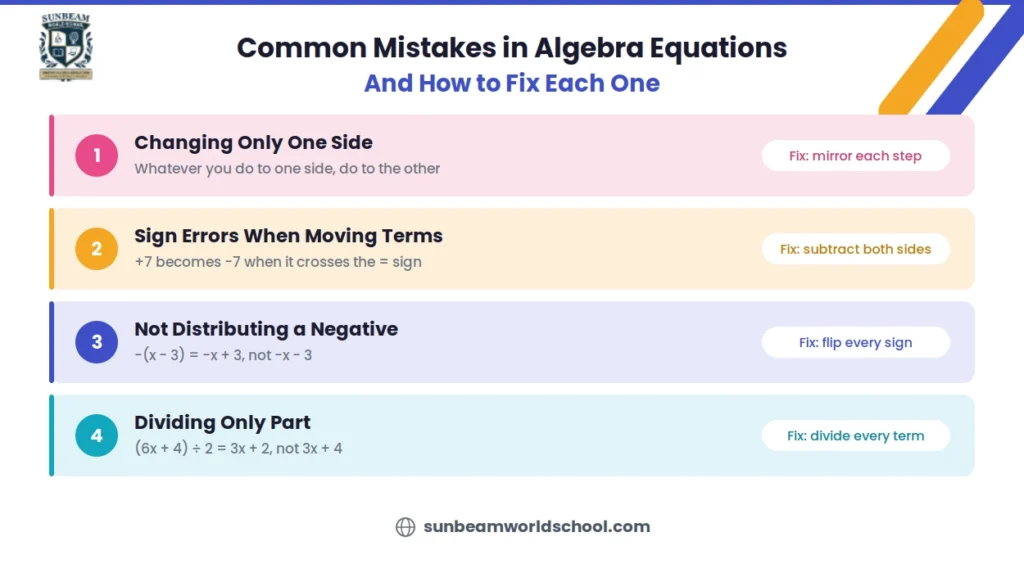
Four common mistakes in solving equations
The most common mistakes in solving algebra equations are changing only one side, making sign errors, distributing a negative incorrectly and dividing only part of an expression, and the check by substitution described above catches most of them.
Changing Only One Side of the Equation
Changing only one side breaks the balance, so the answer comes out wrong even if every other step is correct. If you subtract 5 on the left, you must subtract 5 on the right as well, and writing the operation on both sides in your working helps you remember.
Making Sign Errors When Moving Terms
Sign errors happen when a term changes sides without changing its sign, which is the single most frequent mistake in exams. When +7 moves across the equals sign it becomes −7, because you are really subtracting 7 from both sides.
Forgetting to Distribute a Negative Sign
Forgetting to distribute a negative means only the first term inside the bracket gets the minus sign. The correct expansion of −(x − 3) is −x + 3, not −x − 3, so slow down whenever a minus sign sits in front of a bracket.
Dividing Only Part of an Expression
Dividing only part of an expression leaves some terms undivided, so (6x + 4) ÷ 2 must become 3x + 2, not 3x + 4. Every term on that side has to be divided by the same number.
What Practice Questions Can You Try on Algebra Equations?
The 15 practice questions below cover every type of equation in this post, arranged in three levels so students can start easy, build confidence and finish with challenge questions. Solve each one on paper first, then compare your working with the answers that follow.
Practice Exercise
Level 1: Basic
- x + 15 = 40
- x − 8 = 19
- 9x = 72
- x ÷ 6 = 7
- 3x + 2 = 17
Level 2: Intermediate 6. 5x − 7 = 3x + 9 7. 2(x + 5) = 24 8. x/3 + 4 = 10 9. 7 − 2x = 1 10. (2x − 1) ÷ 5 = 3
Level 3: Challenge 11. x² − 7x + 10 = 0 12. x² = 49 13. x + y = 15 and x − y = 5 14. 3x + 2y = 16 and x + 2y = 8 15. The sum of two consecutive numbers is 45. Find the numbers.
Answers With Working
Level 1: Basic
- Subtract 15 from both sides: x = 40 − 15, so x = 25.
- Add 8 to both sides: x = 19 + 8, so x = 27.
- Divide both sides by 9: x = 72 ÷ 9, so x = 8.
- Multiply both sides by 6: x = 7 × 6, so x = 42.
- Subtract 2 to get 3x = 15, then divide by 3, so x = 5.
Level 2: Intermediate 6. Subtract 3x to get 2x − 7 = 9, add 7 to get 2x = 16, so x = 8. 7. Expand to get 2x + 10 = 24, subtract 10 to get 2x = 14, so x = 7. 8. Subtract 4 to get x/3 = 6, multiply by 3, so x = 18. 9. Subtract 7 to get −2x = −6, divide by −2, so x = 3. 10. Multiply by 5 to get 2x − 1 = 15, add 1 to get 2x = 16, so x = 8.
Level 3: Challenge 11. Factorise to (x − 2)(x − 5) = 0, so x = 2 or x = 5. 12. Take the square root of both sides, so x = 7 or x = −7. 13. Add the equations to get 2x = 20, so x = 10, then 10 + y = 15 gives x = 10, y = 5. 14. Subtract the second equation from the first to get 2x = 8, so x = 4, then 4 + 2y = 8 gives x = 4, y = 2. 15. Let the numbers be x and x + 1, so 2x + 1 = 45, giving 2x = 44 and x = 22, so the numbers are 22 and 23.
When Do Students Learn Algebra Equations in School?
Students in CBSE schools usually meet simple algebra equations around Class 6 and 7, linear equations in one variable in Class 8, and pairs of linear equations and quadratic equations in Class 10. In the UK, simple equations are a typical Year 7 topic, while US students cover them in Algebra 1, usually in Grade 8 or 9. Since Class 10 board papers test these chapters through multi-step questions, clear working matters as much as the answer, and it is a big part of knowing how to write the maths paper in the board exam for full marks.
What Is the Difference Between Algebra 1 and Algebra 2 Equations?
Algebra 1 equations focus on linear equations, inequalities, systems of two equations and an introduction to quadratics, while Algebra 2 equations cover quadratics in depth along with polynomial, rational, radical, exponential and logarithmic equations. In Indian terms, Algebra 1 roughly matches Class 8 to 10 maths and Algebra 2 overlaps with Class 11 and 12, which also forms the base for entrance exams and is why many students preparing for them ask whether NCERT is enough for JEE Mains.
How Can Students Learn Algebra Equations on Their Own?
Students can learn algebra equations on their own by mastering one equation type at a time, practising 10 to 15 questions daily and checking every answer by substitution. Self-study works best with a clear order: one-step equations, then two-step equations, then variables on both sides, then brackets and fractions, and finally word problems and quadratics.
Writing every step, even when it feels obvious, builds the habit that prevents careless errors later. Short daily sessions also beat long weekend cramming, since knowing how to study effectively is more about regular practice than long hours, and keeping a "mistake notebook" of wrong answers shows which step keeps going wrong. If the same type of question stays confusing after a week of practice, that is the moment to ask a teacher, since one short explanation often saves hours of struggling alone.
How Can Parents Explain Algebra Equations to a Child?
Parents can explain algebra equations to a child by using a balance scale, a "mystery box" story and everyday puzzles, so the idea of an unknown feels familiar before symbols appear. For example, hide 4 sweets in a box, put 3 more beside it and ask how many are in the box if there are 7 altogether, then write it as x + 3 = 7.
A real or drawn balance scale shows why both sides must change together, which is the core rule of algebra. Everyday questions, such as "how many more days until we save ₹500?", show children that algebra solves real problems, and praising effort rather than speed helps, since letting children make mistakes without fear is one of the simplest ways to foster confidence and self esteem in kids.
Conclusion
Algebra equations become simple once you remember one rule, whatever you do to one side you do to the other, so start today by solving the five basic practice questions above, checking each answer by substitution, and moving to the next level only when all five are right.
Students who want guided support can learn maths with live teachers at Sunbeam World School, an online school offering a CBSE aligned curriculum and the NIOS pathway, where every student moves at their own pace through personalized learning.

Frequently Asked Questions
What is an algebra equation in simple words?
-An algebra equation in simple words is a maths sentence saying two things are equal, where one number is hidden behind a letter like x. For example, x + 3 = 8 means some number plus 3 equals 8, so the hidden number is 5.
What are the 4 steps to solving an algebra equation?
+What are the 3 main types of algebraic equations?
+How do you solve 9x + 7 = −7?
+What is the difference between an equation and an expression?
+What is an example of an algebraic equation?
+Is a trigonometric equation an algebraic equation?
+What are the 5 basic rules of algebra?
+What is the formula for a quadratic equation?
+How do you turn a word problem into an algebra equation?
+Why do we need algebra in real life?
+What is an algebraic expression?
+How can I learn algebra equations on my own?
+
In this article
Share this post:


Press and Blogs
Stay updated with our press releases, educational blogs, and more.

Quick Summary Animal sounds are the noises animals make to communicate, warn of danger and...

Quick Summary Essential Repeat (ER) in CBSE means a student has not met the passing...

Quick Summary The area of rectangle equals its length multiplied by its width (A =...