Admissions Open for Academic Year 2026–27 · Limited Seats Available · Nursery to Grade 12 · IND +91 97112 56925 · UAE +971 58 592 4773 · World's First  AI-Powered  Online School · 100K+ Students across 135+ Countries · Admissions Open for Academic Year 2026–27 · Limited Seats Available · Nursery to Grade 12 · IND +91 97112 56925 · UAE +971 58 592 4773 · World's First  AI-Powered  Online School · 100K+ Students across 135+ Countries ·
Sunbeam World School
SW
Sunbeam World School
International Online School
Uniting Global EducationAsia's Largest Online School
Online Early Years School | British EYFS Curriculum for Ages 3-6
Admissions Open · 2026-27

Online Early Years School Following the British EYFS Curriculum

Sunbeam World School delivers the Early Years Foundation Stage (EYFS) curriculum online for children aged 3 to 6. Live play-based classes across all 7 areas of learning, qualified early years educators, small 2:20 groups, and a clear pathway into Cambridge Primary.

Live Play-Based Classes Ages 3 to 6 British EYFS Curriculum Small 2:20 Batches 7 Areas of Learning Qualified Early Years Educators
4.8 Google (2,400+ reviews) 100K+ students 135+ countries
3-6
Ages served
7
EYFS learning areas
2:20
Teacher to child ratio
100K+
Students globally
135+
Countries
54
Years legacy
4.8★
Google (2,400+ reviews)
At a Glance

British EYFS Early Years Programme at a Glance

AgesChildren aged 3 to 6 (Nursery, LKG / Reception, UKG / Year 1 readiness)
CurriculumBritish Early Years Foundation Stage (EYFS) statutory framework
Learning areasAll 7 EYFS areas: 3 prime areas and 4 specific areas of learning and development
ApproachPlay-based, child-initiated and adult-directed learning following the characteristics of effective learning
Class formatShort live classes with qualified early years educators, plus recordings on our LMS
Class size2:20 teacher to child ratio, with an assistant teacher in every session
AssessmentObservation-based continuous assessment aligned to the Early Learning Goals (ELGs) and EYFS Profile
Annual feeVisit the fee structure page for current tuition and instalment details
Progresses toCambridge Primary School
AdmissionsOpen year round. Check the eligibility criteria or start the admission process
What Is EYFS

What Is the Early Years Foundation Stage (EYFS) Curriculum?

EYFS stands for Early Years Foundation Stage. It is the British statutory framework that sets the standards for the learning, development and care of children from birth to age 5.

The Early Years Foundation Stage (EYFS) is the British government framework used in every nursery, preschool, childminder setting and reception class across England. It covers children from birth to five years old and is organised around 7 areas of learning and development, split into 3 prime areas and 4 specific areas. The framework is built on four guiding principles: every child is a unique child, children learn through positive relationships, children develop best in enabling environments, and children learn and develop in different ways and at different rates. At Sunbeam World School, our online early years school delivers this same EYFS framework through live play-based classes, qualified early years educators, and a structured path from Nursery through to Cambridge Primary.

7 Areas of Learning

The 7 Areas of Learning and Development in the EYFS Curriculum

The EYFS curriculum is structured around 3 prime areas that build the foundation, and 4 specific areas that deepen and apply those skills. All 7 are taught at Sunbeam World School.

The 3 Prime Areas

Prime Area 1
Foundation of all learning

Communication and Language

Children learn to listen attentively, understand spoken language, and express themselves clearly. This area underpins all 7 areas of learning. Our educators use storytelling, songs, rhymes and conversation to build vocabulary, confidence and attention in every live session.

Prime Area 2
Movement and coordination

Physical Development

Children develop fine motor skills (pencil grip, cutting, threading) and gross motor skills (running, balancing, climbing) alongside healthy habits. Online sessions pair with offline movement activities so physical development is built into every day.

Prime Area 3
Confidence and relationships

Personal, Social and Emotional Development

Children develop a positive sense of themselves and others, form friendships, learn to manage feelings, and understand appropriate behaviour. This is the area most parents underestimate and the one that determines how well a child settles into formal school.

The 4 Specific Areas

Specific Area 1
Reading and writing

Literacy

Phonics, letter recognition, early reading and early writing. Children learn through systematic synthetic phonics, picture books, rhymes and mark-making, building the foundation for fluent reading by the end of Reception.

Specific Area 2
Numbers, shapes and patterns

Mathematics

Counting, number recognition, addition and subtraction, shapes, patterns and measurement. Number sense is built through play, games and hands-on sorting rather than worksheets and drills.

Specific Area 3
People, places and nature

Understanding the World

Children explore the physical world, communities, cultures, seasons and basic technology. In a classroom with students from 135+ countries, cultural awareness happens naturally rather than as a scheduled topic.

Specific Area 4
Art, music and imagination

Expressive Arts and Design

Art, music, dance, movement, dramatic play and making things. Children explore materials, share ideas, perform songs and create freely. This area builds confidence in self-expression and creative thinking.

Section: AS SEEN IN

Sunbeam World School in the News - Featured Online School

Real stories, real recognition - from national television to world records.

GUINNESS WORLD RECORDS
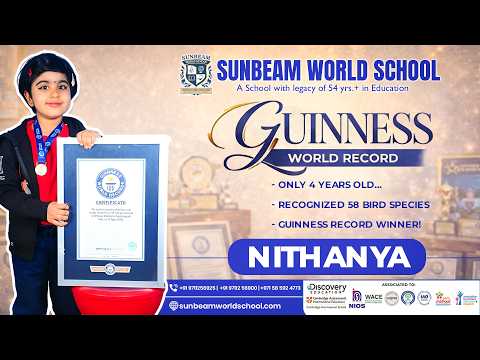
4-Year-Old Record Holder Nithanya - Our Student - Sunbeam World School video thumbnail
4-Year-Old Record Holder Nithanya - Our Student
Check Nithanya Video →
JIOHOTSTAR - FUTURE SCHOOLS
Sunbeam World School Featured on India's Biggest Streaming Platform - Sunbeam World School video thumbnail
Sunbeam World School Featured on India's Biggest Streaming Platform
Jio Hotstar Streaming Platform Video →
Dr. Alisha Madhok Walia
What Every Parent Must Know! - Sunbeam World School video thumbnail
What Every Parent Must Know!
Parent Must Know - Video From Founder →
CEO, Sunbeam World School
Dr. Alisha Madhok Walia, CEO of Sunbeam World School - Sunbeam World School video thumbnail
Dr. Alisha Madhok Walia, CEO of Sunbeam World School
A Message from our Founder & CEO →
CEO, Sunbeam World School
Building Confident & Curious Children | Sunbeam World School - Sunbeam World School video thumbnail
Building Confident & Curious Children | Sunbeam World School
Building Confident Video from CEO
CEO, Sunbeam World School
Dr. Alisha Madhok Walia, CEO - Sunbeam World School - Sunbeam World School video thumbnail
Dr. Alisha Madhok Walia, CEO - Sunbeam World School
A Message from our Founder & CEO →
CEO, Sunbeam World School
AI-Powered Learning for Global Success - Sunbeam World School video thumbnail
AI-Powered Learning for Global Success
Watch the Story →
Young Achiever
Young Talent from Sunbeam World School - Sunbeam World School video thumbnail
Young Talent from Sunbeam World School
Watch the Story →
Yoga Star!
7 Year Old → Yoga Star!💫 You Won’t Believe Her Story - Sunbeam World School video thumbnail
7 Year Old → Yoga Star!💫 You Won’t Believe Her Story
Watch the Story →
Future-Ready Education
Future-Ready Education Starts Here - Sunbeam World School video thumbnail
Future-Ready Education Starts Here
Watch the Story →
How It Works

How Play-Based Learning Works in Our Online EYFS School

The EYFS framework treats play as the primary vehicle for learning. Here is how we deliver that online.

Short Live Sessions, Not School Days

Sessions are kept deliberately short and highly interactive, matched to a 3 to 6 year old's attention span. Educators use stories, songs, games and visuals. Screen time stays balanced because every live session is paired with offline activity.

Child-Initiated and Adult-Directed Activities

Learning follows the EYFS model: a mix of child-initiated exploration and adult-directed teaching. Children choose, explore and create, while educators observe, guide and extend learning through purposeful interaction.

Two Adults in Every Session

A class teacher plus an assistant at a 2:20 ratio. At this age a child who is not spoken to simply stops participating. The second adult ensures every child is seen, spoken to and supported.

Observation-Based Assessment

There are no formal exams. Teachers assess through continuous observation against the 17 Early Learning Goals (ELGs) and share termly progress reports with parents, tracking development across all 7 areas of learning.

Home Learning Partnership

Parents are partners, not teachers. You receive weekly updates, activity ideas, observation notes and guidance on how to extend learning at home through play, reading and conversation rather than worksheets.

Foundation Principles

The 4 EYFS Guiding Principles and the 5 British Values

Every EYFS setting, including ours, is built on four guiding principles and promotes five fundamental British values. Here is how they shape daily life at Sunbeam World School.

The 4 Guiding Principles of EYFS

Every child is a unique child. Children are constantly learning and can be resilient, capable, confident and self-assured. Our educators observe each child individually and plan around their strengths and interests.
Children learn through positive relationships. Strong bonds with adults and other children create the security a child needs to explore and take risks. Our small 2:20 groups ensure every child has a relationship with their teacher.
Children develop best in enabling environments. The environment responds to individual needs and builds partnerships between educators and parents. Our LMS, activity packs and weekly parent guidance create this environment online.
Children learn and develop in different ways and at different rates. The EYFS framework covers all children, including those with special educational needs and disabilities. Our special educators work alongside class teachers where a child needs additional support.

The 5 British Values in EYFS

Democracy. Children make choices, vote on activities, take turns deciding and learn that their voice matters in the group.
Rule of law. Children follow classroom rules and routines, understand boundaries and learn that rules keep everyone safe.
Individual liberty. Children are free to explore, make decisions, express preferences and develop confidence in their own abilities.
Mutual respect. Turn-taking, listening, sharing, valuing what others say and treating every person with kindness.
Tolerance of those with different faiths and beliefs. In a global classroom with students from 135+ countries, cultural awareness and respect for difference are not a scheduled lesson but a lived daily experience.
Grade Levels

Online Nursery, LKG and UKG in the British EYFS Curriculum

Three stages covering ages 3 to 6, each leading into the next with the same teachers, platform and routine.

Age 3-4
Foundation Stage 1

Nursery (Pre-K)

A nurturing start focusing on the 3 prime areas: communication and language, physical development, and personal, social and emotional development. Play-based sessions with songs, stories and hands-on craft.

Age 4-5
Foundation Stage 2 (Reception)

Lower Kindergarten (LKG)

The balance shifts to cover all 7 areas of learning. Systematic phonics begins, early numeracy deepens, and children build the literacy and social skills assessed through the Early Learning Goals at the end of this stage.

Age 5-6
Year 1 Readiness

Upper Kindergarten (UKG)

Preparing children for the transition into formal primary school. Reading, writing and number fluency develop to the level expected at the start of Cambridge Primary, and independent learning habits take root.

What Comes Next

From EYFS to Cambridge Primary: School Readiness Built In

The EYFS is not a holding pattern before real school. It decides how well a child copes when structured learning begins: whether they can sit with a task, ask for help, work beside other children, hold a pencil properly and follow a two-step instruction.

By the end of the EYFS at Sunbeam World School, children meet the Early Learning Goals across all 7 areas and are assessed through the EYFS Profile. They move into Cambridge Primary with the same teachers, the same platform and the same routine, so nothing has to be relearned.

Families who later change direction are not locked in. Records transfer to our American, Australian and CBSE-aligned pathways, or to a school outside Sunbeam World School.

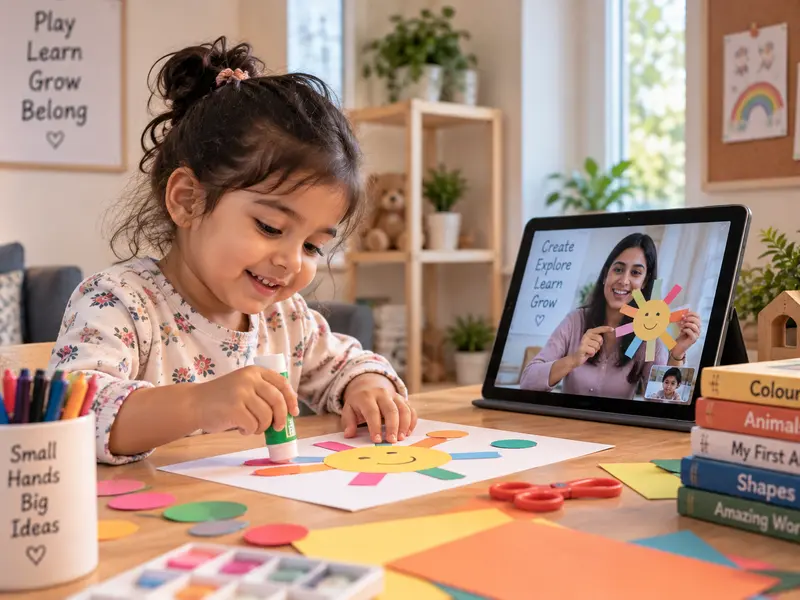
A young child in a live online EYFS class at home, engaged in a play-based learning activity while a teacher leads the session on screen
Who We Serve

Who Our Online EYFS Early Years School Is For

NRI and Expat Families

Families living abroad who want a British early years education their child can carry to the next country, following the same EYFS framework used in schools across England.

Parents Choosing British Over CBSE

Families who prefer the EYFS play-based approach over a textbook-first nursery. The British early years curriculum builds school readiness through exploration, not rote learning.

Homeschooling Families

Parents who want a structured EYFS curriculum delivered by qualified educators at home, without having to plan lessons or source resources themselves.

Frequently Relocating Families

Service families, diplomatic postings and parents on transferable jobs, where a stable school that follows an internationally recognised curriculum is worth more than a local one.

Working Parents

Three daily batches mean the live session fits around your working day. You are never expected to teach the lessons yourself.

Families Comparing Curricula

Undecided between British EYFS, American, Australian and CBSE? Start here and switch later without losing progress.

Early Years Activities

Engaging Early Years Activities That Build All 7 EYFS Learning Areas

Every activity is mapped to the EYFS areas of learning and development. All are included in the annual fee.

Storytelling & Read-Aloud Phonics & Rhymes Early Writing & Mark-Making Counting & Number Games Shapes, Sorting & Patterns Art, Craft & Drawing Music, Dance & Movement Dramatic & Pretend Play Show & Tell Nature & Seasons Yoga for Kids Puppetry & Role Play

Children needing extra support work with our special educators. Regional and foreign language exposure is available from the earliest stage.

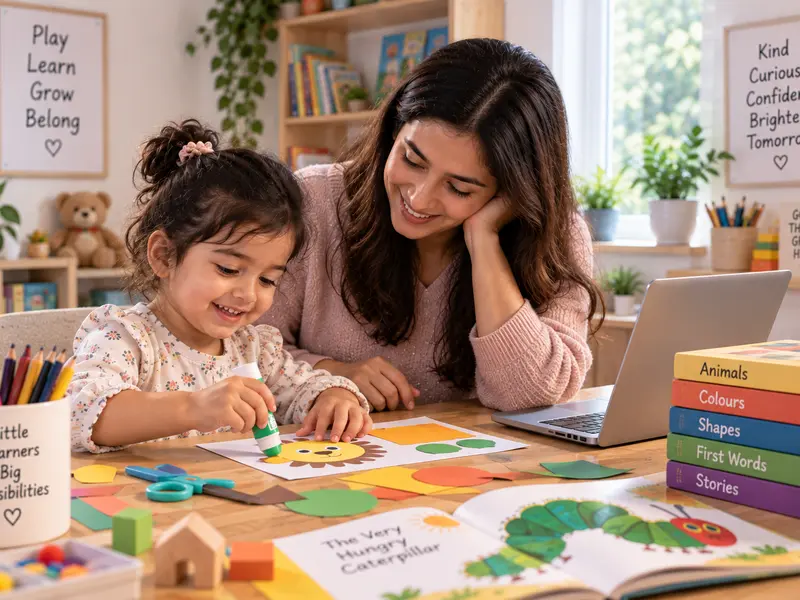
A parent sitting with their young child at home during an EYFS early years activity
Fees

EYFS Early Years Tuition, All Inclusive

The annual early years fee covers every live session, all digital learning material and activity packs, assessment, progress reporting and co-curricular activities. There is no separate technology charge and nothing extra to buy. Visit the fee structure page for current tuition, instalment options and available discounts.

  • All-inclusive annual fee covering every live session, all learning material, LMS access, assessment and reporting
  • Flexible instalments: the annual fee is payable in three instalments across the academic year, with No-Cost EMI available
  • Discounts available: sibling discount, one-time-payment discount, and refer-and-earn savings
Online EYFS Early Years, Explained

Everything Parents Ask Before Choosing an Online Early Years School

In-depth, point-by-point answers on the EYFS framework, 7 areas of learning, assessment, British values, fees, class format and school readiness. Tap any topic to expand.

EYFS stands for Early Years Foundation Stage. It is the British statutory framework published by the Department for Education that sets the standards every early years provider in England must meet for the learning, development and care of children from birth to age 5. The framework has been mandatory since 2008, and the current version (updated September 2026) applies to all nurseries, preschools, childminders and reception classes. International schools that follow the British curriculum, including Sunbeam World School, use the same EYFS framework to deliver early childhood education online to families in 135+ countries.

Key facts at a glance

  • Full form: Early Years Foundation Stage. Often written as EYFS. The framework is sometimes called the EYFS statutory framework or the EYFS curriculum.
  • Age range: birth to 5 years old, covering nursery (Foundation Stage 1) and reception (Foundation Stage 2). At Sunbeam World School, the programme extends to UKG (age 5-6) for Year 1 readiness.
  • Structure: 7 areas of learning and development, split into 3 prime areas and 4 specific areas. Assessment is through the 17 Early Learning Goals and the EYFS Profile at the end of Reception.
  • 4 guiding principles: every child is a unique child; children learn through positive relationships; children develop best in enabling environments; children learn and develop in different ways and at different rates.
  • International recognition: the same framework used by British international schools in Dubai, Singapore, Hong Kong, Bucharest and worldwide. Sunbeam World School holds Cambridge Assessment and IAO accreditation, so our EYFS programme transfers to any school following the British curriculum.

The EYFS curriculum is built around 7 areas of learning and development. These are not 7 separate subjects taught in isolation. They are interconnected areas that overlap naturally during play, activity and conversation. A single baking activity, for example, can cover literacy (reading the recipe), mathematics (measuring ingredients), communication and language (discussing the process), physical development (stirring and pouring), and understanding the world (where food comes from). The 7 areas are split into 3 prime areas that build the foundation, and 4 specific areas that deepen and apply those skills.

The 3 prime areas

  • Communication and language: listening, understanding, and speaking. Children develop vocabulary, attention and confidence through stories, songs, rhymes and conversation. This area underpins all 7 areas of learning and is the single best predictor of later academic success.
  • Physical development: fine motor skills (pencil grip, cutting, threading, doing up buttons) and gross motor skills (running, jumping, balancing, climbing). Online sessions pair with offline movement activities, craft packs and outdoor play guidance.
  • Personal, social and emotional development: forming friendships, managing feelings, building confidence, taking turns, following rules and developing a positive sense of self and others. This area determines how well a child settles into formal school.

The 4 specific areas

  • Literacy: systematic synthetic phonics, letter recognition, early reading and early writing. By the end of Reception, children read simple sentences, write recognisable words and understand what they have read.
  • Mathematics: counting to 20, number recognition, addition and subtraction, shapes, patterns, measurement and basic problem-solving. Number sense is built through play, sorting and games rather than worksheets.
  • Understanding the world: people and communities, the natural world, seasons, cultures, places and technology. In a global classroom with children from 135+ countries, this area comes alive naturally.
  • Expressive arts and design: art, craft, music, dance, movement, dramatic play, role-play and design. Children explore materials, share ideas, perform and create freely, building confidence in self-expression.

This is the most common question Indian and NRI parents ask, and there is no single right answer. The right choice depends on the family's goals, where the child will study next, and what style of learning the parent values at age 3 to 6. Both are legitimate, accredited pathways. Sunbeam World School offers both, and families can switch between them without losing progress.

How they compare

  • Teaching approach: CBSE-aligned nursery introduces structured academic content early, with textbooks, worksheets and a teacher-directed model. British EYFS prioritises play-based, child-initiated learning where children explore, discover and build skills through activity rather than instruction.
  • Assessment: CBSE uses periodic tests, marks and report cards from early on. EYFS uses continuous observation-based assessment against the 17 Early Learning Goals, with no formal exams. The EYFS Profile at the end of Reception summarises readiness for Year 1.
  • Curriculum structure: CBSE follows NCERT-mapped subjects (Hindi, English, Maths, EVS). EYFS organises learning around 7 interconnected areas of development, covering academic, physical, social, emotional and creative growth together.
  • International portability: EYFS is recognised by British schools worldwide, making it ideal for families who relocate frequently. CBSE is recognised primarily in India and some Middle Eastern countries. Both pathways at Sunbeam World School are accredited.
  • Where each leads: EYFS leads into Cambridge Primary and eventually IGCSE. CBSE leads into the CBSE primary pathway and eventually CBSE Board exams. Families at Sunbeam World School can switch between pathways at any stage.

There are no formal exams in the EYFS. Assessment is observation-based and continuous, meaning educators watch children during play and activities, note what they can do, and plan what comes next. This is fundamentally different from a test-and-marks model. The EYFS uses two formal checkpoints and one ongoing process.

How EYFS assessment works

  • Ongoing observation: teachers observe children during daily activities and record what they see across all 7 areas of learning. These observations build a picture of each child's development, not a snapshot from a single test day.
  • Progress check at age 2: a short summary of development in the 3 prime areas, shared with parents. This identifies any early support needs before they become gaps.
  • 17 Early Learning Goals (ELGs): at the end of Reception, each child is assessed against 17 specific goals across the 7 areas. Teachers judge whether the child is meeting the expected level or is still emerging. These are not pass/fail tests; they describe developmental readiness.
  • The EYFS Profile: the end-of-Reception summary that brings together all 17 ELG assessments plus a commentary on the 3 characteristics of effective learning (playing and exploring, active learning, creating and thinking critically). This profile is shared with parents and passed to the Year 1 teacher.
  • What parents receive at Sunbeam World School: termly progress reports across all 7 areas, weekly observation notes, activity guidance for home learning, and a full EYFS Profile at the end of LKG (Reception). The focus is always on what the child can do and what comes next.

The EYFS framework requires every setting to promote the 5 fundamental British values and to assess children against the 3 characteristics of effective learning. These are not optional add-ons; they shape how every session is planned and how every child's progress is understood.

The 5 British values in EYFS

  • Democracy: children make choices, vote on group activities, and learn that their voice and preferences matter.
  • Rule of law: children follow classroom rules and routines, understand boundaries, and learn that rules exist to keep everyone safe and respected.
  • Individual liberty: children are free to explore, make decisions, express preferences, and develop confidence in their own abilities without fear of judgement.
  • Mutual respect: turn-taking, listening, sharing, valuing what others say, and treating every person with kindness regardless of background.
  • Tolerance of those with different faiths and beliefs: in a global classroom with students from 135+ countries, children experience cultural diversity as a daily reality rather than a scheduled topic. This is one of the strongest advantages of an international online school.

The 3 characteristics of effective learning

  • Playing and exploring (engagement): children investigate, experience things, and have a go. They are willing to try new activities and show curiosity about the world around them.
  • Active learning (motivation): children concentrate, keep trying when things are difficult, and enjoy what they achieve. They are not passive recipients of instruction.
  • Creating and thinking critically (thinking): children have their own ideas, make links between ideas, and develop strategies for doing things. This is where independent thinking begins.

The term "online nursery" covers a wide range of models. Some are fully self-paced video libraries with no live teacher at all; others, like Sunbeam World School, run a live, teacher-led classroom where recorded lessons exist only as a backup for revision, not as the main way a child learns. Understanding which model a school actually uses is the single most important thing to check before enrolling, because it changes everything else, from how much attention a child gets to how the fee is structured.

How Sunbeam World School's online EYFS programme works

  • Live interactive classes: every session is led by a qualified early years educator in real time. Children interact, respond, sing, draw and participate, not watch a recording.
  • 2:20 teacher to child ratio: a class teacher plus an assistant educator in every session. At age 3 to 6, a child who is not spoken to individually stops participating, so the second adult matters more than class technology.
  • Balanced screen time: live sessions are kept short and age-appropriate. Every session is paired with an offline hands-on activity: cutting, drawing, sorting, building, outdoor play. Screen time is managed by design, not by telling parents to set a timer.
  • 3 daily batches: morning, afternoon and evening sessions covering roughly six time zones, so a family in India, UAE, UK, Singapore or Australia can choose the slot that fits their day.
  • Recordings on the LMS: every session is recorded and posted the same day on our learning management system with notes and activity sheets. Recordings are a revision tool, not the primary teaching method.
  • Parents are partners, not teachers: educators plan and deliver every session. Parents supervise, join in where they want to, and receive weekly updates, observation notes and activity guidance as part of the EYFS home learning partnership. No parent is expected to deliver a lesson.

The honest answer is that online nursery is not a like-for-like replacement for a high-quality physical nursery. It is a different model with its own advantages and trade-offs, and for many families it is the better option. The question is not which is "better" in the abstract but which is better for your child and your situation right now.

Where online EYFS is stronger

  • Global access: families living abroad, in remote areas, or in countries where a British EYFS school does not exist locally can access the same framework and qualified educators.
  • Consistency for relocating families: the same teachers, platform and routine travel with the child. No more starting over at a new nursery in a new city every year.
  • Smaller class sizes: 2:20 at Sunbeam World School, compared to the 1:8 or 1:13 ratios common in physical nurseries. Every child is seen and spoken to individually.
  • Flexibility: three daily batches, no commute, no uniform, and recordings available for days when a child is unwell or the family is travelling.
  • Parent involvement: the EYFS home learning partnership works naturally when the parent is present. Parents see exactly what their child is learning and how.

Where offline nursery is stronger

  • Physical peer interaction: running, climbing, sharing a sandpit, negotiating over a toy in real time. Online programmes supplement this with group activities, show-and-tell and parent-guided social tasks, but it is not identical.
  • Full-day care: if a family needs childcare for a full working day, a physical nursery provides that. Online sessions are shorter and require a supervising adult at home.

Who online EYFS suits best

  • NRI and expat families who want a British early years start their child can carry internationally
  • Families relocating frequently (service, diplomatic, corporate postings)
  • Homeschooling families who want a structured EYFS curriculum delivered by qualified educators
  • Children who learn differently or need the support of special educators
  • Parents who prefer the British EYFS approach over a local nursery following a different curriculum

The annual fee covers the complete EYFS programme with no hidden charges. There is no separate technology fee, no additional charge for activity packs, and no extra cost for assessment or reporting. Everything a child needs to complete the year is included.

What is included

  • All live classes across all 7 EYFS areas of learning, with qualified early years educators
  • All digital learning material, activity packs, worksheets and creative resources
  • Full LMS access with recorded lessons, notes and parent dashboard
  • Assessment and reporting: termly progress reports, weekly observation notes, and the EYFS Profile at end of Reception
  • Co-curricular sessions: music, art, yoga, storytelling, show-and-tell and all enrichment activities

Payment and discounts

  • Three instalments: the annual fee is split across three payments through the academic year, with No-Cost EMI available
  • Discounts: sibling discount, one-time-payment discount, and refer-and-earn savings are available
  • Visit the fee structure page for current tuition amounts, instalment breakdowns and available discounts

Play-based learning in the EYFS does not mean children play randomly and hope they learn something. It means educators design the environment, the materials and the interactions so that specific learning outcomes emerge naturally through play, exploration and conversation. A child sorting coloured blocks is learning mathematics. A child retelling a story with puppets is building literacy and communication and language. The educator's role is to observe, extend and document, not to lecture.

What a typical day looks like

  • Morning circle and warm-up: a short live session with songs, greetings, calendar talk and a shared story. This builds communication and language and personal, social and emotional development.
  • Focused learning session: an adult-directed activity targeting a specific EYFS area, such as phonics (literacy), number work (mathematics), or a science exploration (understanding the world). Kept short, interactive and visual.
  • Offline activity time: after each live session, children move to a hands-on task away from the screen: cutting, gluing, drawing, building, sorting, cooking, gardening, or outdoor play. This is where fine motor skills and gross motor skills develop.
  • Creative or co-curricular session: music, art, yoga, dramatic play, show-and-tell or a cultural activity covering expressive arts and design.

How outdoor learning works in an online setting

  • The EYFS places significant emphasis on outdoor learning and free-flow access. In an online school, this is delivered through guided outdoor activity packs: nature walks, leaf collections, mud play, gardening, water experiments and movement games that parents facilitate at home or in a local park. Weekly guidance includes specific outdoor tasks mapped to the EYFS areas of learning.

One of the biggest worries parents have about online nursery is whether a 3-year-old will actually engage with a screen and a teacher they have never met. At Sunbeam World School, settling in is a structured process. The EYFS framework requires every child to be assigned a key person, and that requirement is taken seriously in our online setting.

How settling in works online

  • Pre-enrolment call: a one-to-one video call between the class teacher and the parent (with the child present) before classes begin. The teacher learns the child's name, interests and any concerns.
  • Gradual introduction: the first week uses shorter sessions and familiar songs. Parents sit with the child on screen for the first few sessions and gradually step back.
  • No traditional separation anxiety: the child is at home with a parent nearby. Screen shyness settles quickly because the child sees the same teacher and the same small group every day.

The EYFS key person system

  • What it means: every child must have a named key person who is their primary caregiver and the main point of contact for parents. At Sunbeam World School, the class teacher is the key person for every child in their 2:20 group.
  • What the key person does: tracks development, writes observation notes, plans next steps, communicates with the parent weekly, and ensures the child feels known and valued.

Personal care and independence

  • No prerequisites: children do not need to be fully potty trained, independent at mealtimes, or able to dress themselves before starting. These are skills the EYFS actively teaches. Parents handle physical care at home while educators build independence through the curriculum.
  • Potty training and accidents: because the child is at home, parents manage toileting directly. The educator supports by weaving independence and self-care language into sessions and by not interrupting a child who needs to leave the screen briefly.

In physical EYFS nurseries, many schools use digital learning journals such as Tapestry or Seesaw to share photos and observations with parents. At Sunbeam World School, the equivalent is built into the parent dashboard on our LMS, where parents see recorded sessions, observation notes, activity completions and progress summaries in one place.

How development is tracked

  • Ongoing observation: the key person observes each child during live sessions and records notes against the 7 EYFS areas. These are descriptions of what the child said, did and understood, not test scores.
  • Progress check at age 2: for children entering at age 2-3, a mandatory short summary of development in the 3 prime areas, shared with parents and health visitors where relevant.
  • 17 Early Learning Goals: at end of Reception (LKG), each child is assessed against 17 goals across all 7 areas. The EYFS Profile summarises readiness for Year 1.

How often parents hear from us

  • Daily: parents see every live session in real time and access recordings on the LMS the same day
  • Weekly: observation notes, activity guidance, and focus areas for home learning
  • Termly: a full progress report covering all 7 areas with next-step recommendations
  • On request: parent-teacher calls can be scheduled at any time

The transition from play-based EYFS to the more structured National Curriculum in Year 1 (or Cambridge Primary at Sunbeam World School) is the biggest concern parents of five-year-olds raise. School readiness is not an add-on taught in the last term; it is the outcome the entire EYFS framework builds toward across all 7 areas of learning.

What school readiness means in the EYFS

  • Academic readiness: by end of Reception, children meeting the Early Learning Goals can read simple sentences using phonics, write recognisable words, count reliably to 20, add and subtract with small numbers, and talk about the world with confidence.
  • Social and emotional readiness: children can work cooperatively, take turns, follow instructions, manage feelings, and form positive relationships. These determine whether a child thrives or struggles in a formal classroom.
  • Physical readiness: proper pencil grip, using scissors, sitting for sustained periods, and managing basic self-care with increasing independence.
  • Learning-to-learn readiness: the 3 characteristics of effective learning describe a child who can concentrate, keep trying, have their own ideas and make connections. This is what Year 1 teachers value most.

How Sunbeam World School handles the transition

  • Same teachers, same platform: children moving into Cambridge Primary stay on the same LMS with familiar teachers and routines. No new building, no new faces, no settling-in anxiety.
  • EYFS Profile handover: the detailed profile with all 17 ELG assessments is passed to the Year 1 teacher, who knows exactly where each child is.
  • Gradual increase in structure: UKG sessions are slightly longer and more structured than Nursery, so children experience a gentle increase in formality rather than a sudden jump on day one of Year 1.
  • Pathway flexibility: families who decide to switch to the American, Australian or CBSE pathway after EYFS can do so. Records transfer across all pathways at Sunbeam World School.
planet

Frequently Asked Questions

What is EYFS and what does EYFS stand for?

-

EYFS stands for Early Years Foundation Stage. It is the British statutory framework that sets the standards for the learning, development and care of children from birth to age 5. The EYFS curriculum is organised around 7 areas of learning and development and is followed by every nursery, preschool, childminder and reception class in England.

What are the 7 areas of learning in the EYFS?

+

What is the British curriculum for the early years?

+

What are the 5 British values in EYFS?

+

Which is better, CBSE or British curriculum for early years?

+

What age group is eligible for the online early years school?

+

How are online EYFS classes conducted for nursery and kindergarten?

+

How does the British EYFS curriculum prepare my child for primary school?

+

What are the characteristics of effective learning in the EYFS?

+

Is the EYFS curriculum recognised internationally?

+

Do parents need to teach the lessons?

+

How is my child assessed in the EYFS?

+

Is online nursery as good as offline nursery?

+

Can my child join mid-year?

+

How much does the EYFS early years programme cost?

+

Give Your Child a British Early Years Education from Anywhere in the World

Live play-based classes following the EYFS curriculum, qualified early years educators, small 2:20 groups, and a clear pathway into Cambridge Primary. Book a free demo class and watch a session before you decide.

4.8 Google rating · British EYFS Curriculum · Cambridge Accredited · Teaching since 1972
Book A Free Demo
WhatsApp
Admission counselor
Kajal Online