

 Exam
Exam
Parallelogram Area Formula: Base x Height, Diagonals & Vectors Explained
Quick Summary The area of a parallelogram is calculated by multiplying its base by its perpendicular height, giving the formula A = b x h. When the height is not known, you can use the trigonometric method A = ab sin(x) with two adjacent sides and the included angle, or the diagonal method A = ½ x d1 x d2 x sin(y) when both diagonals and their intersection angle are given.
The parallelogram is one of the most common shapes students encounter in geometry, from Class 8 mensuration chapters all the way through to vector algebra in Class 12 and competitive exams like JEE. Understanding its area formula is not just about memorising a single equation. It is about knowing which formula to use depending on what information a problem gives you, and then applying that formula step by step without skipping anything.
In this guide, we will walk through every method for finding the area of a parallelogram in detail. So, if you are preparing for board exams and want structured strategies for maths papers, this is a good place to strengthen your geometry foundation.
What Is a Parallelogram?
A parallelogram is a four-sided flat shape (a quadrilateral) whose opposite sides are both equal in length and parallel to each other. Think of it as a rectangle that has been pushed to one side so that the angles are no longer 90 degrees, though rectangles themselves are also a special type of parallelogram.
Key Properties of a Parallelogram
Every parallelogram shares a consistent set of properties that come up repeatedly in geometry problems. Opposite sides are equal and parallel, which means if one side measures 8 cm, the side directly across from it also measures 8 cm. Opposite angles are equal as well, so if one corner is 60 degrees, the corner diagonally opposite is also 60 degrees. Adjacent angles are supplementary, meaning they always add up to 180 degrees. The diagonals of a parallelogram bisect each other, which means they cut each other exactly in half at their point of intersection. These properties are what make the area formulas below work the way they do.
Special Types: Rhombus, Rectangle, and Square
A parallelogram becomes a more specific shape when extra conditions are met. A rectangle is a parallelogram where all four angles are 90 degrees. A rhombus is a parallelogram where all four sides are equal in length. A square satisfies both conditions simultaneously, making it a rectangle, a rhombus, and a parallelogram all at once. This is why the area formula for a parallelogram (A = b x h) works perfectly for rectangles and squares too, since the perpendicular height in those shapes is simply the length of the adjacent side.
What Is the Area of a Parallelogram?
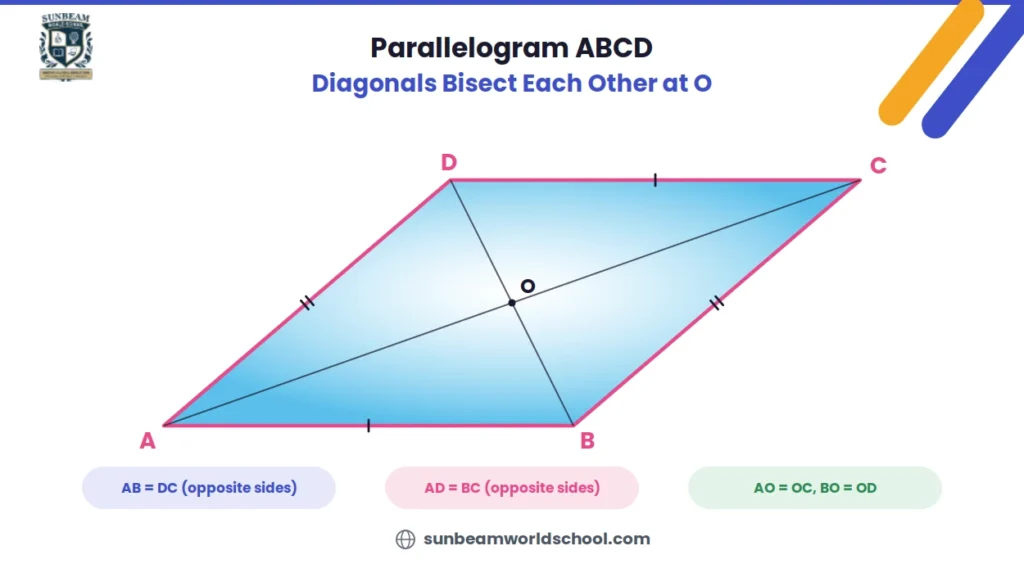
Parallelogram ABCD with diagonals bisecting each other at point O.
The area of a parallelogram is the total region enclosed within its four sides, measured in square units such as cm², m², or mm². It tells you how much flat surface the shape covers.
Derivation: Why Base x Height Works
The simplest way to understand why the area formula works is to picture cutting a right triangle from one end of the parallelogram and sliding it to the other end. Here is how that reasoning unfolds step by step:
Step 1. Start with any parallelogram. Label the bottom side as the base (b). The shape leans to one side, so it is not a rectangle yet.
Step 2. Draw a perpendicular line from the top-left corner straight down to the base. This creates a right triangle on the left side of the shape. The length of that perpendicular line is the height (h).
Step 3. Cut that right triangle away from the left side of the parallelogram.
Step 4. Slide the triangle across to the right side and attach it there. The slanted right edge of the original parallelogram and the hypotenuse of the triangle fit together perfectly.
Step 5. The shape you now have is a perfect rectangle with width b and height h.
Step 6. Since the area of a rectangle is length multiplied by width, and you have not added or removed any area by rearranging the pieces, the area of the original parallelogram must also be b x h.
This visual reasoning is what makes the formula A = b x h intuitive rather than something you need to memorise blindly.
Simple Explanation Of Parallelogram for Beginners
If the derivation above still feels abstract, try this real-world version. Imagine you have a cardboard box that is leaning to one side on a table. The bottom edge of the box is the base. Now imagine pushing the box upright so it stands straight, like a rectangle. The amount of table space the box covers does not change just because you straightened it, and you can measure that space by multiplying the bottom edge by how tall the box stands when it is perfectly upright. That upright measurement is the perpendicular height.
The leaning side of the box (the slant) is longer than the upright height, which is exactly why you must use the perpendicular height in the formula and not the slant side. Another way to think about it: if you printed a parallelogram on a sheet of paper and cut it out, the area is the amount of paper you are left holding. No matter how you tilt the cut-out, the paper does not grow or shrink, and the formula A = b x h tells you exactly how much paper that is.
How Do You Find the Area of a Parallelogram Using Base and Height?
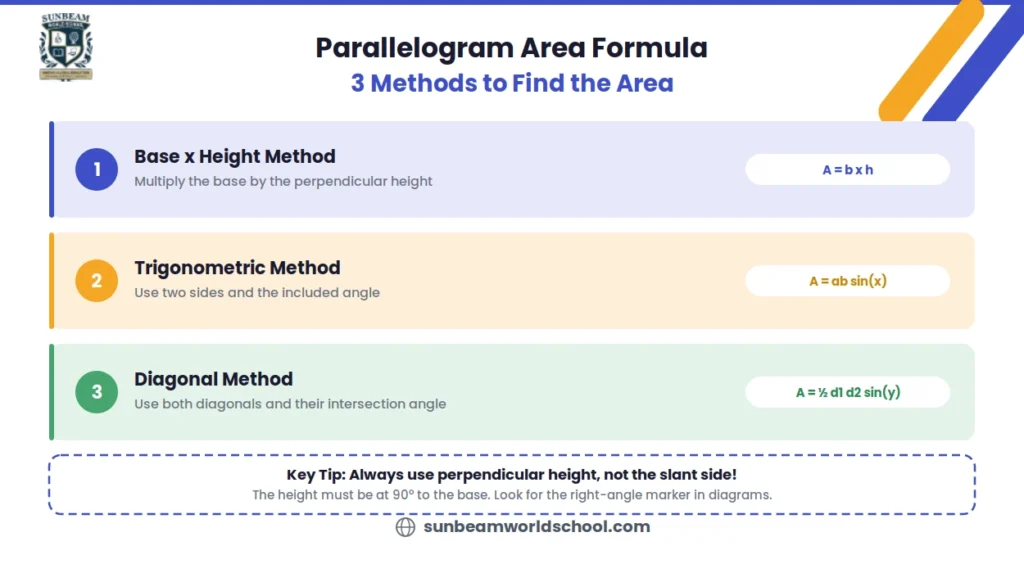
Three parallelogram area formulas at a glance: base x height, trigonometry with sides and angle, and diagonal method.
You multiply the base by the perpendicular height. This is the most widely used formula and the one that appears in almost every school textbook from Class 6 onward.
The Standard Formula: A = b x h
The formula is written as:
A = b x h
Here, b is the length of any one side you choose as the base, and h is the perpendicular distance from that base to the opposite side. The result is always expressed in square units. For instance, if the base is 12 cm and the height is 7 cm, the area is 12 x 7 = 84 cm².
Perpendicular Height vs Slant Height
This is the single most common mistake students make when calculating the area of a parallelogram. The height in the formula is not the length of the slanted side. It is the vertical distance measured at a right angle (90 degrees) from the base to the opposite side. If a parallelogram has a base of 10 cm and a slant side of 6 cm, you cannot simply multiply 10 x 6 to get the area. You need the perpendicular height, which will always be shorter than or equal to the slant side. In exam diagrams, the perpendicular height is usually shown as a dashed line with a small square symbol at the base to indicate the right angle. Always look for that marker before picking your value for h.
Step-by-Step Calculation Process
Here is the exact process to follow every time you use this formula:
Step 1. Identify the base. Look at the diagram or the given information and pick one side as the base. Any side can serve as the base, but exam questions usually label the bottom side. Write down the value with its unit (for example, b = 15 m).
Step 2. Identify the perpendicular height. Find the measurement that runs at 90 degrees from the base to the opposite side. In a diagram, it is the dashed line with the right-angle square. Do not use the slant side. Write down the value (for example, h = 9 m).
Step 3. Check that both measurements use the same unit. If the base is in metres and the height is in centimetres, convert one of them so they match. For instance, 50 cm becomes 0.5 m, or 2 m becomes 200 cm.
Step 4. Multiply base by height. Perform the multiplication: A = 15 x 9 = 135.
Step 5. Attach the correct square unit. Since both measurements were in metres, the area is 135 m². If they had been in centimetres, it would be cm². Never leave the answer without a square unit.
Parallelogram Area Formula for Class 8, 9, and 10
The base x height formula is introduced at different depths depending on which class you are in, and knowing where it fits in your syllabus helps you focus your revision. In the CBSE and most state boards, the area of a parallelogram first appears in Class 8 under the Mensuration chapter (NCERT Chapter 11), where students learn A = b x h alongside the areas of other quadrilaterals like trapeziums and rhombuses. In Class 9, the concept returns in Chapter 9 (Areas of Parallelograms and Triangles) with a more rigorous, proof-based treatment.
Students learn to prove that parallelograms on the same base and between the same parallels have equal area, a theorem that CBSE board exams test regularly. By Class 10, the formula itself is assumed knowledge and appears inside coordinate geometry and trigonometry problems rather than as a standalone topic. For ICSE students, the same progression holds, though the chapter numbers differ. If you are revising for a specific class, focus on the type of question your syllabus emphasises: Class 8 tests direct formula application, Class 9 tests theorem-based proofs and comparisons, and Class 10 tests the formula inside larger multi-step problems.
How Do You Calculate the Area of a Parallelogram Without Height?
When the perpendicular height is not given, you can use the lengths of two adjacent sides and the angle between them to calculate the area using trigonometry. This method is especially useful in problems where only side lengths and angles appear, which is common in Class 11 trigonometry and competitive exams where the height is deliberately left out.
The Trigonometric Formula: A = ab sin(x)
The formula is:
A = ab sin(x)
In this formula, a and b are the lengths of any two adjacent sides (not opposite sides), and x is the angle between those two sides (called the included angle). Since sin(90°) = 1, this formula simplifies to A = ab when the parallelogram is a rectangle, which is a nice confirmation that all these formulas are consistent with each other.
Step-by-Step Calculation Process
Step 1. Identify the two adjacent sides. These are two sides that share a common vertex (corner). In a parallelogram ABCD, side AB and side BC are adjacent. Write down their lengths (for example, a = 14 cm and b = 10 cm).
Step 2. Identify the included angle. This is the angle formed at the vertex where the two adjacent sides meet. It is not the angle at the opposite corner. Write it down (for example, x = 30°).
Step 3. Find the sine of the angle. Look up or recall the sine value. Common values: sin(30°) = 0.5, sin(45°) = 0.7071, sin(60°) = 0.866, sin(90°) = 1. For other angles, use a calculator or trigonometric table.
Step 4. Multiply: side a x side b x sin(angle). Perform the calculation in order: 14 x 10 = 140, then 140 x 0.5 = 70.
Step 5. Write the answer with square units. A = 70 cm².
Worked Example Using Two Sides and an Angle
Problem: A parallelogram has adjacent sides of 14 cm and 10 cm, and the included angle between them is 30 degrees. Find the area.
Step 1. a = 14 cm, b = 10 cm (adjacent sides).
Step 2. Included angle x = 30°.
Step 3. sin(30°) = 0.5.
Step 4. A = 14 x 10 x 0.5 = 140 x 0.5 = 70.
Step 5. Area = 70 cm².
Verification check: If the angle were 90° instead, sin(90°) = 1, and the area would be 14 x 10 x 1 = 140 cm², which matches what you would get from base times height for a rectangle. This confirms the formula is working correctly.
How Do You Find the Area of a Parallelogram Using Diagonals?
When both diagonals and the angle at their intersection are known, you can find the area without needing the base, height, or side lengths at all. This formula is particularly useful for rhombus problems, since the diagonals of a rhombus intersect at right angles.
The Diagonal Formula: A = ½ x d1 x d2 x sin(y)
The formula is:
A = ½ x d1 x d2 x sin(y)
Here, d1 and d2 are the lengths of the two diagonals, and y is the angle at which the diagonals intersect. When the diagonals meet at 90 degrees (as in a rhombus), sin(90°) = 1, so the formula simplifies to A = ½ x d1 x d2. This simplified version is actually the standard area formula for a rhombus that most students learn separately, but it is really just a special case of this more general parallelogram formula.
Step-by-Step Calculation Process
Step 1. Write down the lengths of both diagonals. For example, d1 = 16 cm and d2 = 12 cm.
Step 2. Find the angle at the intersection point. The two diagonals cross each other, forming four angles. You need the angle at that intersection. Note that opposite angles at the intersection are equal, and the diagonals of a parallelogram create two pairs of vertically opposite angles. Use either one of the acute or obtuse angles, since sin(y) and sin(180° - y) give the same result. Write it down (for example, y = 60°).
Step 3. Find the sine of the intersection angle. sin(60°) = 0.866 (approximately).
Step 4. Multiply the three values together. d1 x d2 x sin(y) = 16 x 12 x 0.866. First compute 16 x 12 = 192. Then 192 x 0.866 = 166.27.
Step 5. Multiply by ½ (or divide by 2). A = ½ x 166.27 = 83.14.
Step 6. Write the answer with square units. Area ≈ 83.14 cm².
Worked Example with Given Diagonals
Problem: The diagonals of a parallelogram measure 16 cm and 12 cm, and they intersect at an angle of 60 degrees. Find the area.
Step 1. d1 = 16 cm, d2 = 12 cm.
Step 2. Intersection angle y = 60°.
Step 3. sin(60°) = 0.866.
Step 4. 16 x 12 = 192. Then 192 x 0.866 = 166.27.
Step 5. ½ x 166.27 = 83.14.
Step 6. Area ≈ 83.14 cm².
Quick comparison: If those same diagonals intersected at 90° instead, sin(90°) = 1, and the calculation becomes ½ x 16 x 12 x 1 = 96 cm². The area is larger when the diagonals are perpendicular, which makes geometric sense because the shape is "spread out" more fully.
Area of a Rhombus Using the Parallelogram Formula
A rhombus is a special parallelogram where all four sides are equal and, crucially, the diagonals always intersect at exactly 90 degrees. This means the general diagonal formula A = ½ x d1 x d2 x sin(y) simplifies automatically, because sin(90°) = 1. The result is the well-known rhombus area formula:
A = ½ x d1 x d2
You do not need to memorise this as a separate formula. It is simply what happens when you plug 90° into the parallelogram's diagonal formula. For example, if a rhombus has diagonals of 10 cm and 14 cm, the area is ½ x 10 x 14 = 70 cm². This connection is worth remembering because exam questions sometimes describe a shape as a "parallelogram with equal sides" or give you perpendicular diagonals without explicitly calling it a rhombus, and recognising that you can use A = ½ x d1 x d2 saves time.
How Is the Area of a Parallelogram Calculated in Vector Form?
In coordinate geometry and vector algebra (typically Class 12 and JEE-level problems), the sides or diagonals of a parallelogram are given as vectors rather than simple measurements. The area is then found using the cross product, which is a clean and powerful method once you are comfortable with determinants. This method is especially relevant for students working through NCERT-based preparation for JEE and other competitive exams, where vector problems appear frequently.
Cross Product Method: A = |a x b|
When two adjacent sides of a parallelogram are represented as vectors a and b, the area equals the magnitude of their cross product:
A = |a x b|
Step-by-Step Calculation Using the Cross Product
Step 1. Write down the two vectors. Identify the two adjacent side vectors from the problem. For example, a = 2i + 3j + k and b = i - j + 2k.
Step 2. Set up the 3x3 determinant. Arrange the unit vectors and components in three rows:
Row 1: i, j, k (unit vectors) Row 2: 2, 3, 1 (components of vector a) Row 3: 1, -1, 2 (components of vector b)
Step 3. Expand along the first row using cofactors. This means calculating three 2x2 determinants:
For the i component: take the 2x2 matrix formed by removing the i-column. That gives you (3)(2) - (1)(-1) = 6 - (-1) = 6 + 1 = 7.
For the j component: take the 2x2 matrix formed by removing the j-column, and flip the sign. That gives you -[(2)(2) - (1)(1)] = -[4 - 1] = -3.
For the k component: take the 2x2 matrix formed by removing the k-column. That gives you (2)(-1) - (3)(1) = -2 - 3 = -5.
Step 4. Write the resulting cross product vector. a x b = 7i - 3j - 5k.
Step 5. Calculate the magnitude. |a x b| = √(7² + (-3)² + (-5)²) = √(49 + 9 + 25) = √83.
Step 6. Simplify. √83 ≈ 9.11.
Step 7. Write the answer. Area = √83 ≈ 9.11 square units.
Diagonal Vectors: A = ½ |d1 x d2|
If the diagonals (rather than the sides) are given as vectors, the area formula becomes:
A = ½ |d1 x d2|
The factor of ½ appears because the diagonals span the full parallelogram twice over when you take their cross product. The steps for computing the cross product are identical to those above. The only difference is that you halve the final magnitude. This is a common format in 12th-standard board exam questions and entrance tests.
Step-by-Step Calculation Using Diagonal Vectors
Step 1. Write down the two diagonal vectors. For example, d1 = 3i + 2j - k and d2 = i - 4j + 3k.
Step 2. Set up the determinant:
Row 1: i, j, k Row 2: 3, 2, -1 Row 3: 1, -4, 3
Step 3. Expand along the first row:
i-component: (2)(3) - (-1)(-4) = 6 - 4 = 2. j-component: -[(3)(3) - (-1)(1)] = -[9 - (-1)] = -[9 + 1] = -10. k-component: (3)(-4) - (2)(1) = -12 - 2 = -14.
Step 4. Cross product: d1 x d2 = 2i - 10j - 14k.
Step 5. Magnitude: |d1 x d2| = √(4 + 100 + 196) = √300 = 10√3.
Step 6. Apply the ½ factor: A = ½ x 10√3 = 5√3.
Step 7. Area = 5√3 ≈ 8.66 square units.
What Are All the Parallelogram Area Formulas at a Glance?
Here is a summary table that brings every method together in one place, making it easy to pick the right formula based on what information a problem gives you.
| Method | Formula | When to Use |
|---|---|---|
| Base and Height | A = b x h | The perpendicular height is given or can be found |
| Trigonometry (Sides and Angle) | A = ab sin(x) | Two adjacent sides and the included angle are known |
| Diagonals | A = ½ x d1 x d2 x sin(y) | Both diagonals and their intersection angle are known |
| Vectors (Adjacent Sides) | A = |a x b| | Sides are given as vectors in coordinate geometry |
| Vectors (Diagonals) | A = ½ |d1 x d2| | Diagonals are given as vectors |
Building a strong command over these formulas is part of developing the kind of mathematical fluency that supports effective studying across subjects.
What Are Common Mistakes Students Make When Finding the Area Of Parallelogram?
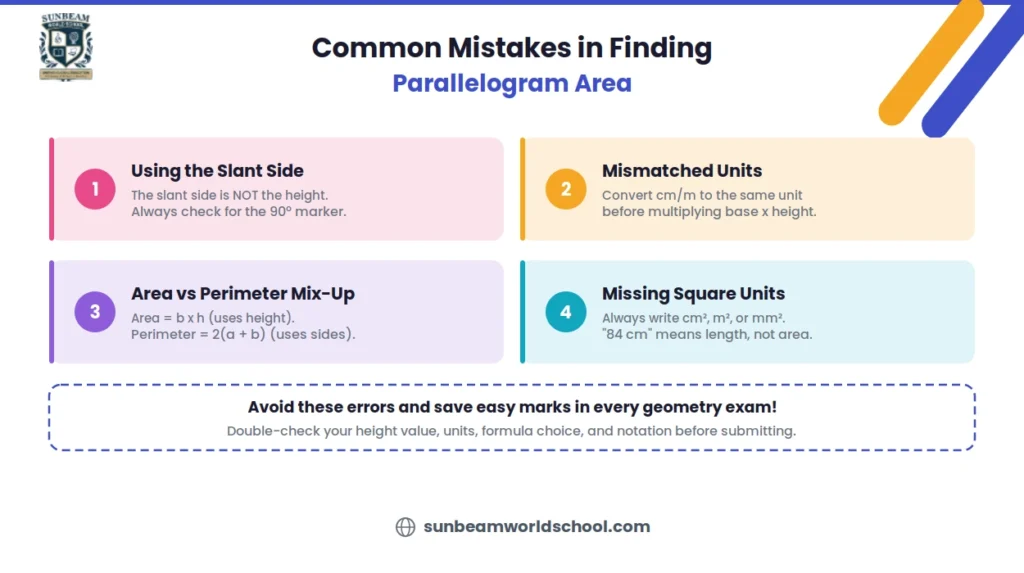
Four common mistakes to avoid when finding the area of a parallelogram.
Even students who know the formula well can lose marks by falling into a few predictable traps. Being aware of these mistakes before an exam is the easiest way to avoid them.
Using the Slant Side Instead of the Perpendicular Height
This is by far the most frequent error. The slant side of a parallelogram looks like it could be the height, especially in a quickly drawn diagram. Always check for the right-angle marker (the small square) at the base of the height line. If there is no right angle, the measurement is the slant side, not the height, and using it will give you an incorrect, inflated answer.
Forgetting to Convert Units Before Multiplying
When the base and height are given in different units, such as the base in centimetres and the height in metres, you must convert them to the same unit before multiplying. A base of 2 m and a height of 50 cm does not give an area of 100. You need to convert 50 cm to 0.5 m first, making the area 2 x 0.5 = 1 m². This kind of unit awareness is a foundational mathematical skill that helps across all topics, from basic ordering of numbers to complex mensuration.
Mixing Up Area and Perimeter Formulas
The perimeter of a parallelogram is 2(a + b), where a and b are the lengths of adjacent sides. The area is b x h. Students occasionally use 2(a + b) when the question asks for area, or multiply two sides together (a x b) as though it were a rectangle. A quick sanity check is to remember that area always involves the height, while perimeter involves only side lengths.
Leaving Out Square Units in the Final Answer
Area is always measured in square units. Writing "84 cm" instead of "84 cm²" is a careless but costly mistake in exams, as it technically means a length rather than an area. Make it a habit to write the square unit immediately after calculating the numerical answer.
The "Two Sides Only" Misconception
No, you cannot find the area with just two side lengths, and this is a misconception that catches many students. If you are given only the two side lengths of a parallelogram (say 12 cm and 8 cm) and nothing else, you cannot determine the area. Unlike a rectangle, where the sides meet at 90 degrees and the area is simply length times width, a parallelogram can be "squashed" to any angle while keeping the same side lengths.
A parallelogram with sides 12 cm and 8 cm could have an area anywhere from nearly 0 (if the shape is almost completely flattened) to 96 cm² (if the angle is 90°, making it a rectangle). To calculate the area, you always need one additional piece of information: either the perpendicular height, the included angle between the sides (so you can use A = ab sin(x)), or the diagonals and their intersection angle. If a question gives you only two sides and asks for the area, look carefully for a height or angle hidden in the diagram or in earlier parts of the problem.
Perimeter of a Parallelogram (Do Not Confuse with Area)
Since students frequently mix up the area and perimeter formulas, it is worth stating the perimeter formula clearly in one place. The perimeter of a parallelogram is the total length around its boundary:
P = 2(a + b)
Here, a and b are the lengths of any two adjacent sides. For example, if a parallelogram has sides of 14 cm and 9 cm, the perimeter is 2(14 + 9) = 2 x 23 = 46 cm. Notice that the perimeter uses only the side lengths and has nothing to do with the height. The area, by contrast, always involves the perpendicular height (or an angle, or diagonals). A quick way to remember: perimeter counts the fence around the shape, area counts the ground inside it.
Solved Examples on Area of a Parallelogram
Working through a range of problems is the most reliable way to move from understanding the formula to being able to apply it confidently under exam conditions. Each example below is solved step by step so you can follow the exact process.
Example 1: Finding Area from Base and Height
Problem: A parallelogram has a base of 18 cm and a perpendicular height of 11 cm. Find its area.
Step 1. Identify the values: b = 18 cm, h = 11 cm.
Step 2. Check: both values are in centimetres, so no conversion is needed.
Step 3. Apply the formula: A = b x h = 18 x 11.
Step 4. Calculate: 18 x 11 = 198.
Step 5. Attach the unit: Area = 198 cm².
Example 2: Finding the Base When Area Is Given
Problem: The area of a parallelogram is 120 m² and its perpendicular height is 8 m. Find the base.
Step 1. Write down what you know: A = 120 m², h = 8 m, b = ?
Step 2. Rearrange the formula A = b x h to solve for b: b = A / h.
Step 3. Substitute: b = 120 / 8.
Step 4. Calculate: 120 ÷ 8 = 15.
Step 5. Attach the unit: Base = 15 m.
Example 3: Finding the Height When Area Is Given
Problem: A parallelogram has an area of 264 cm² and a base of 22 cm. What is the perpendicular height?
Step 1. Write down what you know: A = 264 cm², b = 22 cm, h = ?
Step 2. Rearrange the formula: h = A / b.
Step 3. Substitute: h = 264 / 22.
Step 4. Calculate: 264 ÷ 22 = 12.
Step 5. Attach the unit: Height = 12 cm.
Example 4: Area Using Trigonometry (Without Height)
Problem: A parallelogram has two adjacent sides measuring 20 cm and 13 cm, with the included angle being 45 degrees. Find the area.
Step 1. Identify the adjacent sides: a = 20 cm, b = 13 cm.
Step 2. Identify the included angle: x = 45°.
Step 3. Find the sine: sin(45°) = 0.7071.
Step 4. Multiply the sides: 20 x 13 = 260.
Step 5. Multiply by the sine value: 260 x 0.7071 = 183.85.
Step 6. Area ≈ 183.85 cm².
Example 5: Area Using Diagonals
Problem: The diagonals of a parallelogram are 24 cm and 18 cm, and they intersect at an angle of 90 degrees. Find the area.
Step 1. Write down the diagonals: d1 = 24 cm, d2 = 18 cm.
Step 2. Intersection angle: y = 90°.
Step 3. Find the sine: sin(90°) = 1.
Step 4. Multiply the diagonals: 24 x 18 = 432.
Step 5. Multiply by sin(y): 432 x 1 = 432.
Step 6. Multiply by ½: ½ x 432 = 216.
Step 7. Area = 216 cm².
Note: Since the diagonals intersect at 90 degrees, this parallelogram is specifically a rhombus.
Example 6: Area with Unit Conversion
Problem: A parallelogram has a base of 1.5 m and a perpendicular height of 80 cm. Find the area in m².
Step 1. Identify the values: b = 1.5 m, h = 80 cm.
Step 2. The units do not match. Convert the height to metres: 80 cm = 80 / 100 = 0.8 m.
Step 3. Now both are in metres: b = 1.5 m, h = 0.8 m.
Step 4. Apply the formula: A = 1.5 x 0.8 = 1.2.
Step 5. Area = 1.2 m².
Example 7: Compound Area Problem
Problem: A figure is made up of a rectangle with length 20 cm and width 10 cm, with a parallelogram attached to one of its longer sides. The parallelogram has a base of 20 cm and a perpendicular height of 6 cm. Find the total area of the figure.
Step 1. Calculate the area of the rectangle: A₁ = length x width = 20 x 10 = 200 cm².
Step 2. Calculate the area of the parallelogram: A₂ = b x h = 20 x 6 = 120 cm².
Step 3. Add both areas together: Total = 200 + 120 = 320.
Step 4. Total area = 320 cm².
Example 8: Algebraic Expression for Base
Problem: The area of a parallelogram is (4x² + 12x) cm² and the height is 4x cm. Express the base in simplified form.
Step 1. Write the formula rearranged for base: b = A / h.
Step 2. Substitute: b = (4x² + 12x) / 4x.
Step 3. Factor the numerator: 4x² + 12x = 4x(x + 3).
Step 4. Divide: 4x(x + 3) / 4x = (x + 3).
Step 5. Base = (x + 3) cm.
Students who enjoy working with algebraic identities and formula expansions will find this type of problem a natural extension of those skills.
Example 9: Vector Cross Product
Problem: The adjacent sides of a parallelogram are given as vectors a = 4i + 2j - 3k and b = 2i - 5j + k. Find the area.
Step 1. Set up the determinant:
Row 1: i, j, k Row 2: 4, 2, -3 Row 3: 2, -5, 1
Step 2. Calculate the i-component: (2)(1) - (-3)(-5) = 2 - 15 = -13.
Step 3. Calculate the j-component (with sign flip): -[(4)(1) - (-3)(2)] = -[4 - (-6)] = -[4 + 6] = -10.
Step 4. Calculate the k-component: (4)(-5) - (2)(2) = -20 - 4 = -24.
Step 5. Cross product: a x b = -13i - 10j - 24k.
Step 6. Magnitude: |a x b| = √(169 + 100 + 576) = √845.
Step 7. Simplify: √845 = √(169 x 5) = 13√5 ≈ 29.07.
Step 8. Area = 13√5 ≈ 29.07 square units.
Practice Questions
Test your understanding with these problems. Try solving them on your own before scrolling down to the answers.
- A parallelogram has a base of 25 cm and a height of 14 cm. What is its area?
- The area of a parallelogram is 270 m². If its base is 18 m, find the perpendicular height.
- Two adjacent sides of a parallelogram are 16 cm and 10 cm, and the angle between them is 60 degrees. Calculate the area.
- The diagonals of a parallelogram are 30 cm and 20 cm. They intersect at an angle of 45 degrees. Find the area.
- The adjacent sides of a parallelogram are given as vectors a = 3i + 2j - k and b = i - 4j + 3k. Find the area.
- A parallelogram has an area of 450 cm² and a perpendicular height of 18 cm. Find the length of the base.
- Two adjacent sides of a parallelogram are 25 m and 12 m, and the included angle is 30°. Find the area.
- The base of a parallelogram is 3.5 m and the height is 120 cm. Find the area in m².
Answers to Practice Questions
Answer 1. Formula: A = b x h. A = 25 x 14 = 350 cm².
Answer 2. Rearrange the formula: h = A / b. h = 270 / 18 = 15 m.
Answer 3. Formula: A = ab sin(x). A = 16 x 10 x sin(60°) = 160 x 0.866 = 138.56 cm² (approx.).
Answer 4. Formula: A = ½ x d1 x d2 x sin(y). A = ½ x 30 x 20 x sin(45°) = ½ x 600 x 0.7071 = ½ x 424.26 = 212.13 cm² (approx.).
Answer 5. Cross product: a x b using the determinant:
Row 1: i, j, k Row 2: 3, 2, -1 Row 3: 1, -4, 3
i-component: (2)(3) - (-1)(-4) = 6 - 4 = 2. j-component: -[(3)(3) - (-1)(1)] = -[9 + 1] = -10. k-component: (3)(-4) - (2)(1) = -12 - 2 = -14.
a x b = 2i - 10j - 14k. |a x b| = √(4 + 100 + 196) = √300 = 10√3 ≈ 17.32 square units.
Answer 6. Rearrange the formula: b = A / h. b = 450 / 18 = 25 cm.
Answer 7. Formula: A = ab sin(x). A = 25 x 12 x sin(30°) = 300 x 0.5 = 150 m².
Answer 8. First, convert to the same unit: 120 cm = 1.2 m. A = b x h = 3.5 x 1.2 = 4.2 m².
How Do Parallelogram Area Formulas Compare with Other Shapes?
Students often encounter parallelogram area questions alongside problems on rectangles, triangles, trapeziums, and rhombuses, especially in mensuration chapters and mixed-topic exams. The table below puts all the key formulas side by side so you can see how they relate to each other and avoid mixing them up.
| Shape | Area Formula | Key Variables |
|---|---|---|
| Parallelogram | A = b x h | b = base, h = perpendicular height |
| Rectangle | A = l x w | l = length, w = width (all angles are 90°) |
| Triangle | A = ½ x b x h | b = base, h = perpendicular height |
| Trapezium (Trapezoid) | A = ½ x (a + b) x h | a and b = parallel sides, h = perpendicular height |
| Rhombus | A = ½ x d1 x d2 | d1 and d2 = diagonals (they meet at 90°) |
| Circle | A = π x r² | r = radius |
A few patterns worth noting from this table. The triangle formula is exactly half of the parallelogram formula, which makes sense because a diagonal cuts any parallelogram into two equal triangles. The rectangle formula is identical to the parallelogram formula, since a rectangle is simply a parallelogram with 90-degree angles.
The rhombus formula is a special case of the parallelogram's diagonal formula with sin(90°) = 1. Seeing these connections means you are not memorising six separate formulas in isolation. You are learning one family of related ideas, and each formula is a variation of the same underlying principle: area equals some version of base times height.
Conclusion
Here is a quick self-check before you close this page. Can you write down all three parallelogram area formulas from memory right now? Base times height, the trig version with sine, and the diagonal version with the ½ factor? If yes, you are in solid shape. If one of them felt fuzzy, scroll back to that section and work through the steps one more time. Geometry rewards repetition, and the difference between "I've seen it" and "I can do it under exam pressure" is usually just two or three extra practice problems.
At Sunbeam World School, we build every maths concept this way: formula first, reasoning behind it, step-by-step method, then enough worked examples that the concept sticks. If you want the same clarity across every subject your child is studying, book a free demo class and see how our teachers make even the trickiest topics feel straightforward.

Frequently Asked Questions
What is the formula for the area of a parallelogram?
-The area of a parallelogram is calculated using the formula A = b x h, where b is the length of the base and h is the perpendicular height measured at a right angle from the base to the opposite side. The result is always in square units.
How do you find the area of a parallelogram without knowing the height?
+Can you calculate the area of a parallelogram using its diagonals?
+What is the difference between the perpendicular height and the slant height of a parallelogram?
+What units are used to express the area of a parallelogram?
+Is the area formula for a parallelogram the same as for a rectangle?
+Can you find the area of a parallelogram with only two sides and no height or angle?
+What is the parallelogram area formula in Class 9 NCERT?
+
In this article
Share this post:


Press and Blogs
Stay updated with our press releases, educational blogs, and more.

Quick Summary The area of rectangle equals its length multiplied by its width (A =...

Quick Summary Student success motivational quotes are short, memorable lines that can help students stay...

Quick Summary The area of a square is A = s² (side × side). A...