
 Education
What’s the Difference Between Empathy and Sympathy?
Quick Summary Sympathy means feeling sorry for someone from your own point of view. Empathy means understanding and sharing their feelings from their point of view. Sympathy says "I feel for you," while empathy says "I feel with you," so empathy usually leaves a person feeling understood rather than pitied.
Empathy shares a person's feelings from their side, while sympathy looks at their pain from your own. Both show care, but they make people feel very different.
Imagine a child who comes home upset because nobody sat with them at lunch. One parent says, "Oh no, I'm so sorry, you'll make new friends." Another parent sits down and says, "That sounds really lonely. Tell me what happened." Both parents care, but the first reply is sympathy and the second is empathy.
Children notice this difference quickly. Learning to respond with empathy is a big part of raising kind children, and it sits at the heart of instilling moral values in kids. So what is the difference between empathy and sympathy, and why does the empathy versus sympathy question matter so much at home? Let's start with the key differences, then see how they play out in real conversations.
What Are the Key Differences Between Empathy and Sympathy?
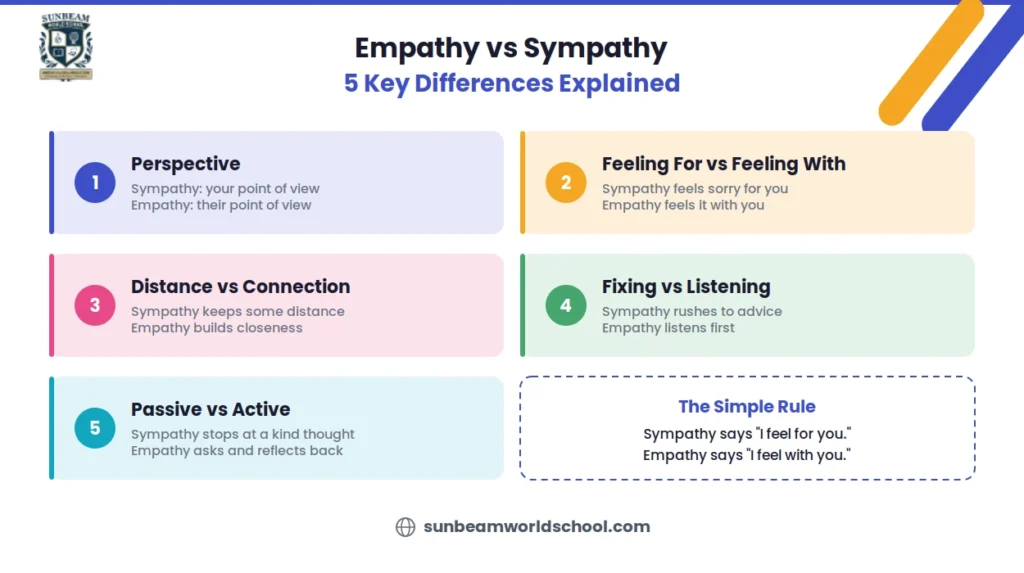
Empathy vs sympathy 5 key differences
The key difference between sympathy and empathy is perspective. Sympathy sees someone's pain from the outside and feels sorry for them. Empathy steps inside their experience and feels it with them.
Sympathy keeps a small, safe distance from the other person. Empathy closes that distance by imagining how the situation feels to them. Sympathy and empathy both come from a good place, which is why people mix them up so often. The table below puts them side by side.
| Sympathy | Empathy | |
|---|---|---|
| Meaning | Feeling sorrow or concern for someone | Understanding and sharing what someone feels |
| Perspective | Your own point of view | The other person's point of view |
| Emotional position | Feeling for someone | Feeling with someone |
| Distance | Keeps some distance | Builds closeness |
| Typical response | Reassurance, advice, "at least..." | Listening, naming feelings, "that sounds hard" |
| How the person feels | Sometimes pitied or rushed | Understood and less alone |
| Example | "I'm sorry that happened to you." | "That sounds painful. I'm here, tell me more." |
So how does empathy differ from sympathy day to day? It shows up in five clear ways.
Perspective. Sympathy judges a situation through your own eyes, so it often sounds like "I would hate that." Empathy asks how it feels to the person living it.
Feeling for vs feeling with. Sympathy feels sorry for someone and stays beside their pain. Empathy shares a version of the feeling and sits inside it with them.
Distance vs connection. Sympathy can be offered without getting close, which is why it suits condolence cards. Empathy asks you to slow down and engage, which is why it deepens relationships.
Fixing vs listening. Sympathetic replies often rush toward a solution or a silver lining. Empathetic replies stay with the feeling first and offer help only when the person is ready.
Passive concern vs active engagement. Sympathy can stop at a kind thought. Empathy takes action, such as asking questions and reflecting back what you heard.
To see why these differences matter, it helps to look closely at what each word really means.
What Do Empathy and Sympathy Actually Mean?
Empathy means understanding and sharing another person's feelings from their point of view. Sympathy means feeling concern or sorrow for someone from your own point of view. In other words, the sympathy vs empathy meaning comes down to where you stand.
If you had to define empathy vs sympathy in one line, empathy is feeling with someone and sympathy is feeling for them. This simple sympathy vs empathy definition matches how psychologists and dictionaries describe the two words.
Empathy Meaning and Definition
Empathy is putting yourself in someone's shoes and letting them know you get it. The word is surprisingly young. Psychologist Edward Titchener brought it into English in 1909 to translate the German word Einfühlung, which means "feeling into."
Nursing researcher Theresa Wiseman later broke empathy into four attributes in her 1996 study:
- Seeing the world as others see it
- Staying non-judgmental
- Understanding the other person's feelings
- Communicating that understanding
Three Types of Empathy
Psychologist Paul Ekman and author Daniel Goleman describe three types of empathy. Each one adds a layer to the last.
Cognitive empathy is understanding what someone thinks or feels, without necessarily feeling it yourself. A teacher who senses a quiet student is confused is using cognitive empathy.
Emotional empathy is feeling a version of someone's emotion yourself, like tearing up when a friend cries. It builds strong bonds, but too much of it can leave a person drained.
Compassionate empathy combines understanding and feeling with action. A parent who notices their child's worry, feels it with them and then helps them plan a next step is showing the fullest form of empathy.
Sympathy Meaning and Whether Sympathy Is Bad
To define sympathy simply, it is sorrow or concern for someone else's hardship. Most dictionaries give a similar sympathy definition, describing care for a person in trouble. The word comes from the Greek sympatheia, made of syn (with) and pathos (feeling), and has been used in English since the 1500s.
Sympathy is not bad. It is often the right response for condolences, acquaintances or situations you cannot relate to. People on forums like Reddit sometimes argue that sympathy keeps others at arm's length, but it only becomes unhelpful when it replaces listening. Saying "at least it wasn't worse" skips over feelings, while a sincere sympathy card to a grieving colleague is kind and fitting.
The meanings become much clearer once you hear them in everyday conversation.
What Does Empathy vs Sympathy Sound Like in Real Life?
Sympathy usually sounds like reassurance or a silver lining, while empathy sounds like listening and naming feelings. Learning how to show empathy vs sympathy mostly comes down to the words you choose, since the same kind intention can come out either way.
Why "I'm Sorry" Is Usually Sympathy
Saying "I'm sorry" on its own is usually sympathy. It expresses sorrow, but it does not show that you understand how the person feels. It becomes empathy when you add words about their feelings.
"I'm sorry you didn't get picked for the team" is sympathy. "I'm sorry you didn't get picked. You practised so hard, so that must feel really disappointing" is empathy. The second version notices the effort and the feeling, not just the event.
Sympathy Phrases and Empathy Phrases to Use Instead
Small changes in wording can turn a sympathetic reply into an empathetic one. Swapping even one or two of these phrases makes conversations feel more supportive.
| Sympathy phrase | Empathy phrase to use instead |
|---|---|
| "I'm so sorry for you." | "I'm so sorry. How are you feeling about it?" |
| "At least you still have..." | "That sounds really hard." |
| "Don't worry, it'll be fine." | "It makes sense that you're worried." |
| "I know exactly how you feel." | "I can't fully know how this feels, but I'm here." |
| "Look on the bright side." | "Do you want to talk about it, or just have company?" |
| "You poor thing." | "That must have been so frustrating." |
| "Everything happens for a reason." | "I'm really glad you told me." |
| "Try not to think about it." | "What's been the hardest part?" |
Five Sympathy vs Empathy Examples From Everyday Life
These empathy examples and sympathy examples show how the two responses differ in five common moments.
A friend loses a family member. Sympathy says "They're in a better place now," which can close the conversation. Empathy says "I know how close you were to her. How are you holding up?"
A child fails an exam. Sympathy says "Never mind, there's always next time," which can brush the feeling aside. Empathy says "You worked so hard, so I can see why you're upset," and it pairs well with the practical steps in how to handle failure in exams.
A classmate is left out at lunch. Sympathy thinks "poor thing" and carries on eating. Empathy remembers how being left out felt and says "Do you want to sit with us?"
A parent or colleague has a stressful day. Sympathy says "You should just relax tonight," offering advice too soon. Empathy says "That sounds exhausting. What happened?" and simply listens.
Someone's pet dies. Sympathy says "At least you can get another one." Empathy says "He was part of your family for years. You must miss him so much."
Notice that the empathetic replies are not longer or more polished. They simply stay with the person's feelings.
When to Use Empathy vs Sympathy
Use empathy with people you are close to, such as family, friends and students, because they need to feel understood. Use sympathy for formal moments, such as a condolence card to a distant colleague or a note to a neighbour.
Choosing empathy or sympathy is not about one being right and the other wrong. Knowing how to sympathize with someone kindly still matters, especially when you do not know them well. The same pattern of "with" and "for" shows up in the words themselves, which often confuse people.
What Is the Difference Between Empathetic and Sympathetic?
An empathetic person understands and shares someone's feelings from their point of view. A sympathetic person feels sorry for someone without necessarily sharing their experience.
Empathetic vs Sympathetic in Everyday Sentences
The empathetic vs sympathetic difference mirrors the nouns. For example, "Riya was empathetic when her friend failed, because she remembered her own failure and listened." By contrast, "The neighbours were sympathetic and sent a card."
So what does it mean to be empathetic? It means you listen closely, notice feelings and respond from the other person's side. In any sympathetic vs empathetic comparison, also remember that "sympathetic" has two extra meanings. It can mean agreeing with an idea, as in "the principal was sympathetic to the request," and in biology it names the sympathetic nervous system.
Empathize vs Sympathize and When to Use Each Verb
Use "empathize" when you understand someone's feelings because you can imagine or have lived them. Use "sympathize" when you feel sorry for someone without fully sharing the feeling.
The sympathize vs empathize choice depends on how close you are to the experience. A student might say "I can empathize with your exam nerves, I felt the same last year." In Indian and British English, the spellings sympathise and empathise are equally correct.
Empathic vs Empathetic, Two Spellings With One Meaning
The empathic vs empathetic question has a simple answer: both words mean the same thing. "Empathic" is the older form used in psychology, while "empathetic" is more common in everyday speech.
Empathy and sympathy also have close neighbours, such as compassion and pity, that are easy to mix up.
How Are Empathy, Sympathy, Compassion, Pity and Apathy Different?
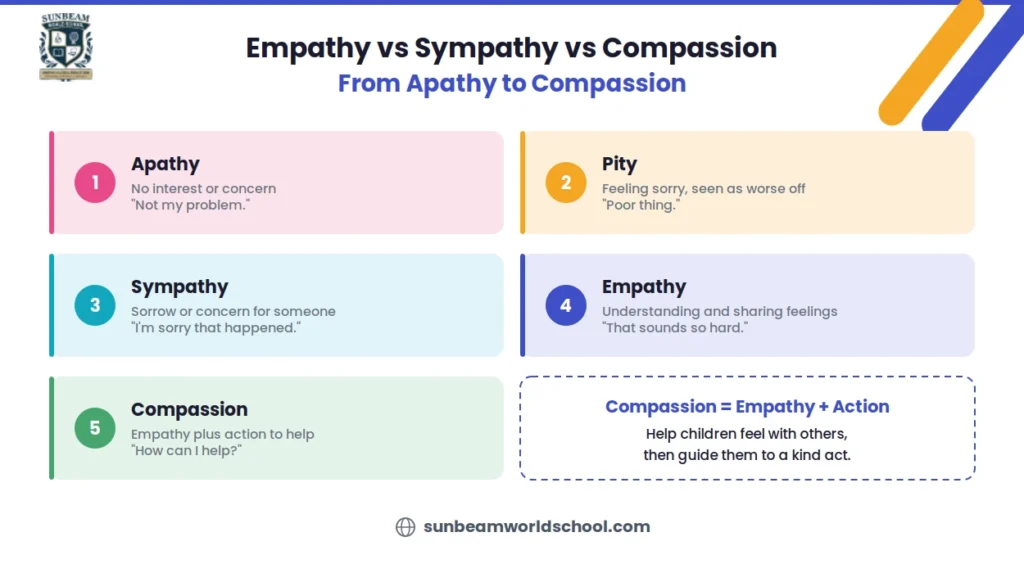
Empathy vs sympathy vs compassion vs pity
Apathy, pity, sympathy, empathy and compassion sit on one spectrum of caring. It moves from not caring at all, to feeling sorry, to feeling with someone and finally to helping them. Comparing empathy vs sympathy vs compassion vs pity on one scale makes each word easier to use.
| Word | What it means | Example |
|---|---|---|
| Apathy | No interest or concern | "Not my problem." |
| Pity | Feeling sorry for someone seen as worse off | "Poor thing." |
| Sympathy | Feeling sorrow or concern for someone | "I'm sorry that happened." |
| Empathy | Understanding and sharing their feelings | "That sounds so hard, I'm with you." |
| Compassion | Empathy plus the wish and action to help | "That sounds hard. How can I help?" |
Compassion vs Empathy and Why Compassion Goes Further
The main difference between empathy and compassion is action. Empathy feels with someone, while compassion adds a wish to help. That is why the sympathy vs empathy vs compassion question usually comes down to what you do next.
Neuroscientists Tania Singer and Olga Klimecki studied empathy vs compassion in a 2014 paper in Current Biology. They found that constantly sharing others' pain can turn into "empathic distress," which leads to burnout. Compassion training, however, was linked with more positive feelings and brain networks tied to care.
So in the empathetic vs compassionate debate, compassion is often the healthier long-term goal. The lesson for parents is simple: help children feel with others, then guide them toward a kind action.
Pity vs Sympathy and Why Pity Feels Distancing
In a pity vs sympathy comparison, pity carries a sense that the other person is worse off than you. It quietly places the helper above the person being helped. Sympathy vs pity is a small shift in words, but it explains why "you poor thing" can sting, even when meant kindly.
Empathy vs Apathy and the Opposite of Empathy
In the empathy vs apathy comparison, apathy is generally seen as the opposite of empathy. It means a lack of interest or concern for what others feel, making it the most common empathy antonym. An empath vs apathy comparison shows the two extremes clearly, since an empath feels others' emotions intensely while apathy feels almost nothing. In children, apathy can be a sign of tiredness or low mood rather than unkindness.
Before teaching children where they sit on this spectrum, it is worth checking where you sit yourself.
Are You More Empathetic or Sympathetic?
You are likely more empathetic if you listen before advising, ask how someone feels and avoid saying "at least." You likely lean sympathetic if you tend to offer quick reassurance or advice. Most people use both, so the goal is simply to notice your default.
A Quick Self Check
Answer yes or no to these eight statements:
- When a friend shares a problem, I ask questions before giving advice.
- I rarely start comforting sentences with "at least."
- I can picture how a situation feels to someone, even if I would react differently.
- I can sit with someone's sadness without trying to fix it right away.
- I notice changes in tone, posture or facial expression.
- I reflect feelings back, for example "you sound frustrated."
- I avoid saying "I know exactly how you feel" unless it is truly true.
- After someone confides in me, they often say they feel lighter.
Six or more yes answers means you naturally lean toward empathy. Three or fewer means you may lean toward sympathy. Every "no" is simply a habit you can start practising, and two well-known experts offer a helpful place to begin.
Brené Brown on Empathy vs Sympathy
Brené Brown sums up the difference in one well-known line: "empathy fuels connection, sympathy drives disconnection." The Brené Brown empathy vs sympathy idea comes from a popular 2013 RSA animated short, which builds on Theresa Wiseman's four attributes of empathy.
In the Brené Brown empathy video, empathy climbs down into a dark hole to sit with someone. Sympathy stays at the top and calls down a quick bit of comfort. Brown also notes that empathetic replies rarely begin with "at least," because that phrase looks for a silver lining in someone's pain.
Some therapists on Reddit feel her framing is unfair to sympathy, and they have a point. The balanced reading is that Brown criticises sympathy that minimises feelings, not sympathy itself.
The 7 Elements of Empathy From Dr. Helen Riess
Dr. Helen Riess, a Harvard Medical School psychiatrist, turned empathy into seven practical habits. Her E.M.P.A.T.H.Y. model comes from her work training doctors and appears in her book The Empathy Effect.
- Eye contact: A warm gaze shows you are paying attention, not checking your phone.
- Muscles of facial expression: A gentle, concerned face signals that you are with the person.
- Posture: Sitting at eye level and leaning in, especially with children, makes you approachable.
- Affect: Naming the emotion you notice, such as "you look worried," helps people feel seen.
- Tone of voice: A calm, soft tone often matters more than the exact words.
- Hearing the whole person: Listen for the feelings behind the words without interrupting or judging.
- Your response: Notice your own reaction so you can respond calmly instead of on impulse.
These habits matter more than ever, because research suggests empathy is becoming harder to find.
Why Does Empathy Matter So Much Today?
Empathy matters today because research shows it is declining, even as it remains essential for trust, learning and wellbeing. Homes, classrooms and clinics all work better when people feel understood.
Why Empathy Is Becoming Rarer
A University of Michigan meta-analysis led by Sara Konrath studied 72 studies and nearly 14,000 American college students. It found that students scored about 40% lower in empathy than students 20 to 30 years earlier. The sharpest drop happened after the year 2000.
Researchers have discussed possible reasons, such as more time online and a growing focus on personal success. Harvard's Making Caring Common project found a similar pattern. In a survey of over 10,000 middle and high school students, students were three times more likely to agree than disagree that their parents cared more about grades than about kindness.
Children learn what adults celebrate. When kindness is praised as often as marks, empathy has room to grow.
Why a High IQ Does Not Guarantee Empathy
A high IQ does not automatically make a person more empathetic. Intelligence and empathy are separate abilities. Emotional intelligence, which covers noticing and managing emotions, is much more closely linked to empathy. The good news is that empathy grows with practice, whatever a child's test scores.
How Counsellors, Nurses and Teachers Use Empathy
Many caring professions treat empathy as a core skill. Psychologist Carl Rogers named "empathic understanding" as a core condition of therapy in 1957. Theresa Wiseman's four attributes came from nursing research, where empathy helps patients feel safe enough to share symptoms.
In teaching, empathy means understanding why a student is struggling before correcting them. This matters just as much in virtual classrooms, and it is a common concern for parents asking whether their child will make friends in online school. A supportive, empathetic setting is also why many families explore whether online school is better for mental health.
Professionals learn empathy through training, and children learn it the same way, one small moment at a time at home.
How Can Parents Teach Children Empathy Instead of Sympathy?
Parents teach empathy by naming feelings, asking perspective-taking questions, modelling good listening and using stories and role play. Knowing how to teach empathy vs sympathy starts with daily practice, since small moments matter more than any lecture about kindness.
Name Feelings Out Loud So Children Learn the Words
Naming feelings gives children the words to recognise emotions. Simple comments like "you look frustrated with that puzzle" teach that feelings have names. A child who can name a feeling is much better at noticing it in a friend.
Swap "Say Sorry" for Perspective-Taking Questions
A quick "say sorry" often skips the most important step, which is thinking about the other person. After a playground conflict, ask "How do you think he felt?" and "What could you do to help?" This turns a forced apology into real understanding.
Model Empathetic Listening at Home
Children learn empathy mostly by watching how adults treat them. Put your phone away, get down to their eye level and reflect back what they said. Feeling truly heard also builds their sense of worth, one of the key ways to foster confidence and self esteem in kids.
Use Stories and Role Play to Practise Perspective Taking
Stories and role play let children step into someone else's shoes safely. Pause during a bedtime story to ask "Why do you think the character did that?" You can also act out a scene where one toy feels left out.
Conclusion
Sympathy says, “I’m sorry you’re going through this,” while empathy helps a child feel understood, supported, and less alone. Teaching empathy to children is an important part of social-emotional learning (SEL) because it helps them recognise emotions, build healthy relationships, communicate with confidence, and respond thoughtfully to others.
At Sunbeam World School, empathy is practised every day through our focus on social emotional learning in the curriculum.
Parents can start today by asking their child, “How do you think they felt?” when discussing a story, conflict, or everyday situation. Small conversations like these can help children develop emotional intelligence, empathy, compassion, and stronger social skills over time.
The goal is not just to teach children what empathy means, but to give them opportunities to practice it every day.

Frequently Asked Questions
Are empathy and sympathy the same thing?
-No, empathy and sympathy are not the same thing, although both show care for someone in pain. Sympathy means feeling sorry for a person from your own point of view. Empathy means understanding and sharing their feelings from their point of view.
What does empathy mean?
+What does sympathy mean?
+What is sympathy, and is sympathy bad?
+What does empathetic mean?
+Is saying "I'm sorry" sympathy or empathy?
+Is empathy better than sympathy?
+Is sympathy an emotion?
+What is it called when you feel bad for someone?
+What is the opposite of empathy?
+What is compassionate empathy?
+Can you have empathy without sympathy?
+How do you remember the difference between empathy and sympathy?
+What is empathy vs sympathy in simple words?
+Can empathy be taught to children?
+
In this article
Share this post:


Press and Blogs
Stay updated with our press releases, educational blogs, and more.

Quick Summary Animal sounds are the noises animals make to communicate, warn of danger and...

Quick Summary An algebra equation is a maths statement that sets two expressions equal using...

Quick Summary Essential Repeat (ER) in CBSE means a student has not met the passing...