
 CBSE
CBSE
What Is Essential Repeat in CBSE?
Quick Summary Essential Repeat (ER) in CBSE means a student has not met the passing criteria and must reappear for the board exams in the next academic year. CBSE introduced the term in 2020 to replace the word "Fail", and it applies in Class 12 when a student fails in two or more of five main subjects, or three or more when a sixth subject is taken, and in Class 10 when a student fails in, or misses, three or more subjects. ER students cannot take the compartment exam in the same year, but they can reappear as regular or private candidates, with passed practical marks generally carried forward.
Essential Repeat in CBSE is the term students see on their marksheet when they have not cleared enough subjects to pass the board exam, and it means they need to appear again in the next main exam session. Seeing "ER" or "RT" on a result page can feel frightening for both students and parents, especially when nobody explains what these short forms mean or what to do next. The good news is that ER comes with a clear path forward, and many students who receive it pass comfortably the following year. This guide answers what is Essential Repeat in CBSE, explains its meaning for Class 10, 11 and 12, the marksheet codes that appear with it, how it differs from a CBSE compartment exam, how to fill the form, when the exam happens and how to prepare.
Key Facts About Essential Repeat in CBSE
| Question | Short answer |
|---|---|
| What does ER stand for? | Essential Repeat, CBSE's term for "Fail" since 2020 |
| Is ER pass or fail? | Fail, the student has not yet passed the board exam |
| Class 12 trigger | Failing in two or more of five main subjects, or three or more with a sixth subject |
| Class 10 trigger | Failing in, or being absent for, three or more subjects |
| Can an ER student give compartment? | No, ER students reappear in the next main exam |
| Which subjects must be retaken? | All main subjects in theory, while passed practical marks are generally carried forward |
| How to apply | Through a school as a regular student, or through CBSE's private candidate form |
| When is the exam? | With the next year's main board exams, usually from February |
What Is Essential Repeat (ER) in CBSE?
Essential Repeat (ER) in CBSE means a student has not met the passing criteria and must reappear for the board exams in the next academic year. It is a result status rather than a separate exam, and making sense of it starts with understanding how CBSE decides who has passed.
CBSE started using "Essential Repeat" in place of the word "Fail" in 2020, because the board felt that "Fail" printed on a marksheet was deeply demotivating for teenagers. The change in wording does not change the outcome, since an ER student has still not passed Class 10 or Class 12, but it presents the result as a step to repeat rather than a final verdict.
The meaning of Essential Repeat in CBSE result 2026 has not changed, so students with ER this year reappear in the 2027 main board exam, just as students who received Essential Repeat in CBSE Class 12 2025 results reappeared in 2026. The only new element is the Class 10 two board exam system, which the next section explains.
How Does CBSE Decide Who Gets Essential Repeat?
CBSE decides Essential Repeat in three steps: it checks the 33% pass mark in each subject, marks any failed part with a code, and then counts the failed subjects. That final count is what separates a compartment from ER, and the limit is different for each class.
Step 1: CBSE Checks the 33% Pass Mark in Every Subject
CBSE requires a minimum of 33% in every subject, and subjects with practicals need 33% separately in the theory part and in the practical part. This is why a student can score a reasonable total and still not clear a subject, since a very low theory score pulls them below the line even when practical marks are strong. In practice, the theory minimum works out to about 27 marks in an 80 mark paper and about 23 marks in a 70 mark paper, and the full split is explained in passing marks out of 80 in CBSE.
Step 2: CBSE Marks Failed Parts With Codes Like RT and RP
On a CBSE marksheet, RT means Repeat in Theory, RP means Repeat in Practical, COMP means compartment and ER means Essential Repeat. RT and RP sit next to the individual subjects that fell short, while COMP or ER appears in the result column once CBSE has counted those subjects, so whenever you see ER in CBSE result pages, DigiLocker or the printed ER in marksheet column, the subject codes beside it show exactly where marks were lost.
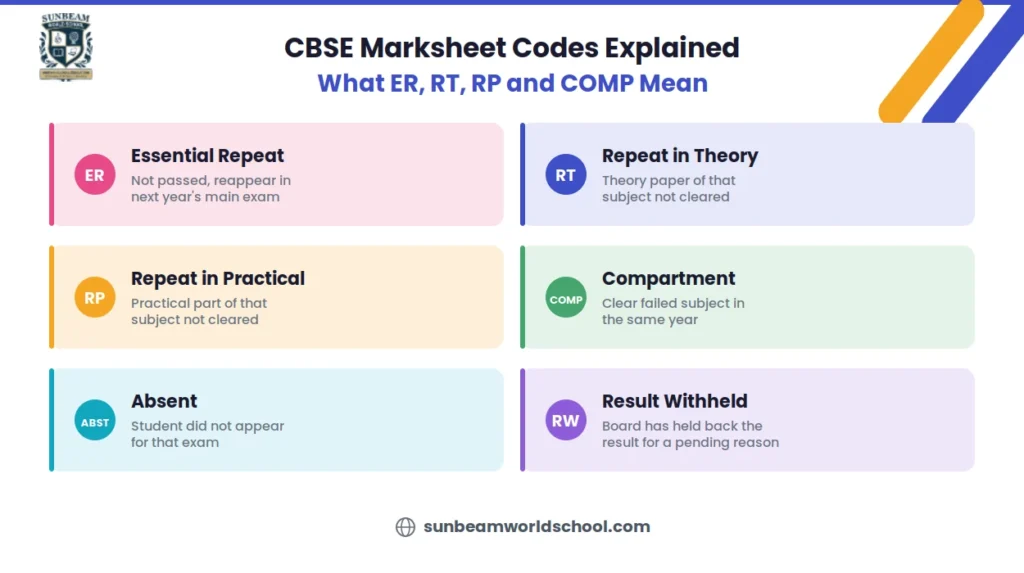
What ER, RT, RP and other codes mean on a CBSE marksheet.
| Code | Full form | What it means |
|---|---|---|
| RT | Repeat in Theory | The student did not clear the theory paper of that subject |
| RP | Repeat in Practical | The student did not clear the practical part of that subject |
| COMP | Compartment | The student can clear the failed subject in a supplementary or second exam |
| ER / ESSENTIAL REPEAT | Essential Repeat | The student has not passed and must reappear in the next main exam |
| ABST | Absent | The student did not appear for that exam |
| RW | Result Withheld | The board has held back the result for a pending reason |
RT arrived in 2020 alongside ER, replacing the older code FT, which stood for Fail in Theory.
Step 3: CBSE Counts the Failed Subjects to Decide ER or Compartment
Essential Repeat needs two or more failed subjects in Class 12 and three or more in Class 10, while Class 9 and Class 11 decide it at school level.
Essential Repeat meaning in CBSE Class 12. One failed subject means compartment, but failing two or more of the five main subjects leads to ER. So if you fail in 2 of your 5 main subjects, you reappear in next February's main exam rather than the summer supplementary exam. An additional sixth subject can replace a failed elective, which is why a student with six subjects reaches ER only after three failures. For the same reason, Essential Repeat in CBSE Class 12 in one subject is rare, and it usually comes from missed papers, incomplete internal assessment or failed compartment attempts.
Essential Repeat meaning in CBSE Class 10. Essential Repeat in CBSE Class 10 applies when a student fails in, or misses, three or more subjects in the compulsory February and March exam. Under the two board exam system that began in 2026, students who fail only one or two subjects are placed in compartment and can clear them in the optional May exam, which also works as an improvement exam, but ER students cannot sit the May exam at all, as the guide to CBSE's two board exam system and improvement rules explains.
Essential Repeat meaning in CBSE Class 11 and Class 9. Essential Repeat in CBSE Class 11 is a school decision, because Class 9 and Class 11 exams are set and marked by the school rather than the board. It usually means repeating the class, so parents should speak to the school early, since many schools offer a re-test or remedial support first.
Once you know which side of the line a result falls on, the next question is how ER and compartment differ in practice.
How Is Essential Repeat CBSE Different From a Compartment Exam?
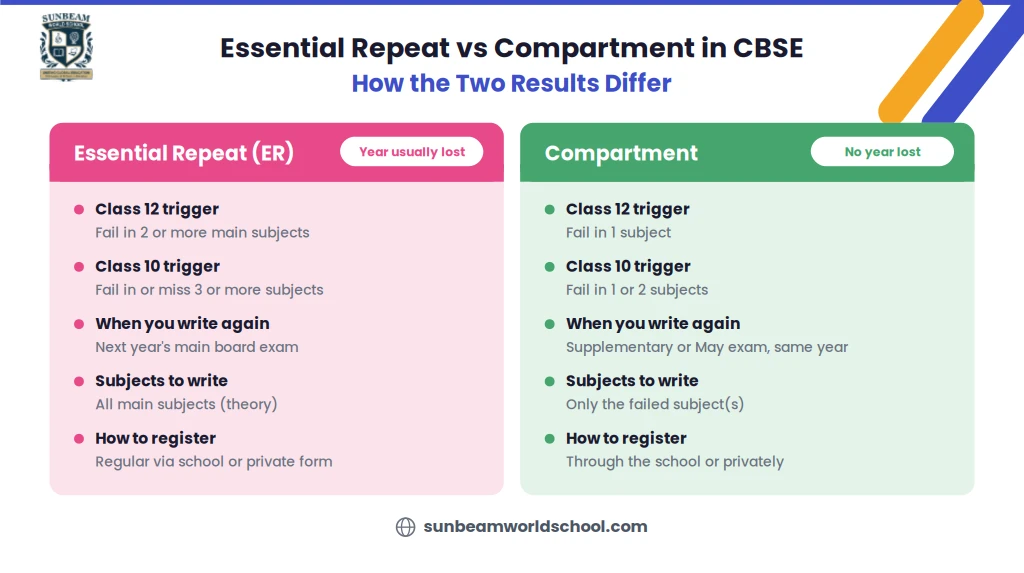
Essential Repeat vs compartment: what each result means for the year ahead.
Essential Repeat means reappearing in all main subjects next year, while a compartment exam clears only the failed subject or subjects in the same year without losing time. With the triggers already covered above, the Essential Repeat vs compartment comparison below focuses on what each result means for the year ahead.
| Essential Repeat (ER) | Compartment | |
|---|---|---|
| When you write again | Next year's main board exam | Supplementary or second exam in the same year |
| Subjects to write | All main subjects in theory | Only the failed subject or subjects |
| Compartment exam allowed? | No | Yes, that is the compartment exam |
| Impact on academic year | Usually one year is lost | No year lost if the student clears it |
| How to register | As a regular student through a school or as a private candidate | Through the school or as a private candidate |
The biggest practical difference is time, since a compartment student can often join college or Class 11 on schedule, while an ER student plans for a year of preparation. That extra year is often where confusion creeps in, which is why several myths about ER keep circulating.
What Are the Common Myths About Essential Repeat?
The four most common Essential Repeat myths are that ER students retake only failed subjects, ER means E1 or E2 grades, 30 out of 100 passes, and ER is permanent. Many of these ideas spread through forums and question-and-answer sites, so it helps to check each one against CBSE's actual rules.
Myth 1: "With ER, You Only Reappear in the Subjects You Failed"
ER students reappear in the theory papers of all main subjects, not only the failed ones, because retaking only failed subjects is how a compartment works. Confirming the subject list during registration avoids an unpleasant surprise close to the exam.
Myth 2: "ER Means You Got an E1 or E2 Grade"
CBSE no longer uses E1 or E2 grades, because Class 10 and Class 12 now follow a nine point scale from A1 to E, where E marks an uncleared subject. The older E1 and E2 grades belonged to the earlier CCE system in Class 10, and since grades A1 to D2 are given only to students who pass, the RT, RP and ER codes tell you far more about what went wrong.
Myth 3: "30 Marks Out of 100 Is a Pass"
Thirty marks out of 100 is below CBSE's 33% minimum, so it is not a pass. The confusion comes from split papers, where 30 out of an 80 mark theory paper does clear the theory minimum, so always check the maximum marks for the part you are looking at.
Myth 4: "ER Means You Can Never Pass Class 12 With CBSE"
Essential Repeat is a temporary status, not a permanent one, and students can clear it in the next main exam and receive a normal pass certificate. Many students who repeat with a clear plan end up with better marks than a rushed first attempt would have given them, which raises the real question every ER family faces next.
Is Repeating 12th a Good Option After Essential Repeat?
Repeating 12th is a good option for most ER students, because a full year of focused preparation usually leads to a clean pass and better marks than a hurried attempt. Colleges and employers look at the final pass certificate and marks, and a one year gap with a strong result is rarely a problem in admissions.
Choosing to repeat 12th only helps if the year is used differently, though, and the route a student picks shapes what that year looks like. Families should talk it through with a teacher or counsellor, weighing the student's age, confidence and long-term goals against the options below.
What Options Do ER Students Have?
ER students have three main options: reappear as regular CBSE students, register as private candidates, or move to an open schooling board such as NIOS. There is no single right choice, so the decision should depend on the student's learning style and future plans.
Reappear as a Regular or Private CBSE Candidate
Staying within CBSE keeps the student on the same syllabus they already know, which makes revision easier and keeps the certificate from the same board. Regular students get daily classes, teacher guidance and practical support throughout the year, while private candidates study on their own or with outside help and only appear for the board exams. JEE, NEET or CUET aspirants often prefer this route, because the repeat year can strengthen board and entrance preparation together.
Consider Open Schooling Through NIOS
The National Institute of Open Schooling (NIOS) is a recognised national board that offers flexible exam schedules and lets learners choose subjects that suit them. NIOS also offers Transfer of Credit (TOC), which allows a student who did not clear a board exam to carry over marks from a limited number of passed subjects, as explained in what TOC in NIOS means. NIOS certificates are accepted for higher education and government jobs, which makes it a practical route for students who want to finish without waiting for the next CBSE cycle.
Use NIOS On-Demand Exams to Avoid Waiting a Full Year
NIOS On-Demand Examinations (ODE) let enrolled learners take Secondary and Senior Secondary exams when they feel ready, instead of waiting for a fixed board exam date. Each candidate gets a computer-generated question paper at an NIOS regional centre, results are declared every month, and a student can attempt a subject again until they are satisfied. Combining Transfer of Credit for passed subjects with On-Demand Exams for the rest can shorten the gap considerably, although students should confirm current eligibility and fees with NIOS first.
Choose an Online School That Offers Structure and Flexibility
An online school can give ER students the daily structure of classes and teacher support while letting them learn at a pace that suits their weak subjects. This works especially well for students who lost confidence in a traditional classroom, since smaller online batches make it easier to ask questions and get individual attention. At Sunbeam World School, students preparing for board exams can follow a CBSE aligned curriculum or the NIOS pathway with live teachers and personalised support.
What Do Essential Repeat Students Need to Do?
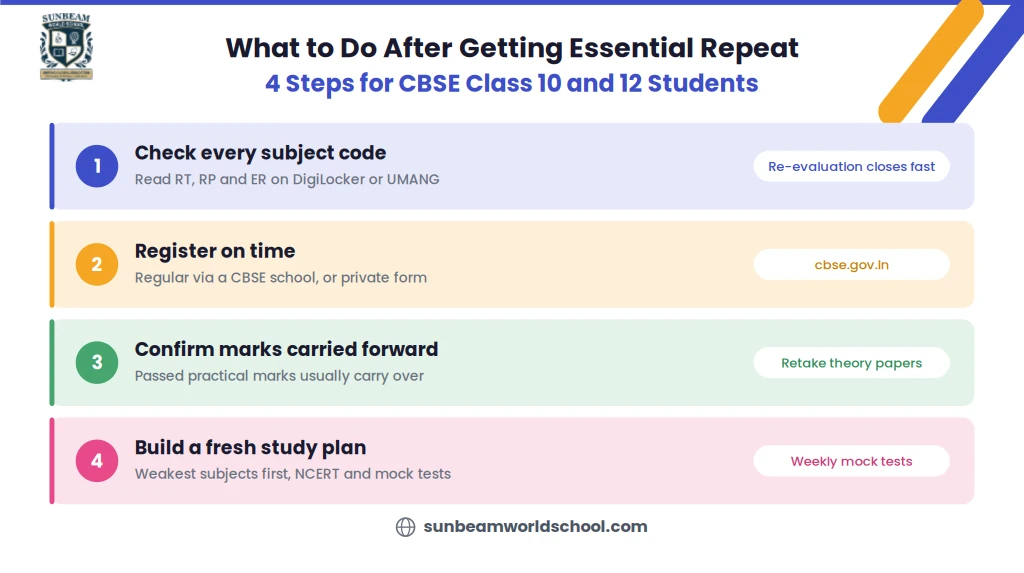
4 steps for students who received Essential Repeat in CBSE.
Essential Repeat students need to reappear for all their main subjects in the next annual board exam, registering as a regular candidate through a school or as a private candidate. For anyone asking about Essential Repeat in CBSE Class 12, what to do next comes down to four steps taken in the right order, because starting study before registration is the most common mistake.
- Check the marksheet and every subject code. Download the official marksheet from the CBSE results website, DigiLocker or UMANG and read the RT, RP and ER codes against each subject. If a paper seems unfairly marked, apply for CBSE's verification or re-evaluation right away, since these windows close soon after results.
- Register on time as a regular or private candidate. A student who misses registration cannot sit the next exam at all, so enrol through a CBSE school or apply through the private candidate form as soon as CBSE announces the dates, using the steps in the next section.
- Confirm which marks carry forward. CBSE generally carries forward practical and internal assessment marks that a student has already passed, so most ER students reappear only in theory papers, but this depends on the subject, so confirm it with the school or the official notice.
- Build a fresh study plan. Repeating the same routine rarely changes the result, so the new plan should start with the weakest subjects, using the preparation methods covered later in this guide.
What Are the Requirements for Essential Repeat Students in CBSE Class 12?
Essential Repeat students in CBSE Class 12 must register on time, retake the theory papers of all main subjects and score at least 33% in each. Where a subject has both parts, theory and practical are counted separately. Students should also keep their previous marksheet, admit card and roll number safe, because registration asks for these details.
What Is the Essential Repeat Form and How Do You Apply?
There is no separate Essential Repeat form, so ER students apply through a CBSE school as regular students or through CBSE's private candidate form on cbse.gov.in. Anyone searching for a CBSE Class 12 Essential Repeat form or an Essential Repeat form 2026 will land on this same private candidate form, which also covers compartment students and those who want to improve their marks, and for the 2027 exams it is expected to open around September 2026.
How to Apply for Essential Repeat in CBSE Class 12 as a Private Candidate
ER students apply as private candidates in five steps on cbse.gov.in, so keep the previous year's marksheet and roll number ready before starting.
- Visit cbse.gov.in and open the private candidate registration link for the coming exam year.
- Choose your category, which for ER students is the Essential Repeat or failure category, and enter the previous year's roll number and details.
- Select your exam centre city and confirm your subjects, which are normally the same subjects you took last year.
- Upload a recent photograph and signature, then pay the exam fee online.
- Download and save the confirmation page, then keep checking the CBSE website for your admit card closer to the exam.
Deadlines and fees change every year and late fees apply after the main window closes, so it is safest to follow the latest CBSE circular rather than dates copied from older articles.
Can an ER Student Repeat Through the Same or a Different School?
An ER student can repeat Class 12 as a regular student through their old school or a new CBSE school, if the school agrees to enrol them. The school must also submit the student's name to the board before CBSE's registration deadline, while students who prefer to study independently can skip school enrolment and apply as private candidates instead.
How Can Students Prepare to Clear the Exam Next Time?
Students clear the exam next time by diagnosing what went wrong, rebuilding weak foundations and practising under real exam conditions, rather than simply studying longer hours. The mindset side matters just as much, and these strategies for handling exam failure help students turn a setback into a plan.
Find Out What Actually Went Wrong
Students should first identify why each weak subject failed, whether because of concept gaps, poor time management, exam anxiety or incomplete syllabus coverage. Each of these needs a different fix, since a concept gap needs teaching while a time problem needs timed practice. A short conversation with a teacher who can review the student's previous answer patterns can save weeks of unfocused revision.
Rebuild Basics Using NCERT Before Moving to Harder Material
NCERT textbooks are the most reliable way to rebuild weak subjects, because CBSE board papers are based directly on NCERT chapters, in-text questions and exercises. Students often jump to guidebooks and question banks too early, but without clear basics those resources only add confusion. Once a chapter feels comfortable in NCERT, the student can move on to sample papers and previous years' questions for that chapter.
Practise With Sample Papers and Timed Mock Tests
Regular timed practice with CBSE sample papers and previous years' papers teaches a student how the board frames questions and how to pace themselves across a three hour paper. A good rhythm is one full mock test every week in the last three months, followed by a careful review of every mistake. Presentation also matters, and simple habits such as clear headings, underlined key points and neat diagrams can add valuable marks in subjects like science and social science.
Build a Realistic Weekly Study Plan
A weekly plan that gives more time to weak subjects, but does not ignore stronger ones, keeps a student moving steadily without burning out. Short daily sessions tend to work better than long, irregular study bursts, since they build memory and confidence at the same time. Adding one fixed rest day each week also matters, because a repeat year needs energy for several months of steady work, and that is where support at home makes a real difference.
How Can Parents Support a Child With an ER Result?
Parents support a child with an ER result best by staying calm, separating the result from the child's worth, and helping them plan the next practical step together. The way adults react in the first few days often shapes how a student approaches the entire repeat year.
Respond With Calm Instead of Criticism
Parents should respond to an ER result with calm acknowledgment, not blame or comparison, because a child's first reaction from home shapes how they recover. A simple message like "This is hard, and we will work it out together" gives a child the security they need. Practical ideas for this stage are covered in what to do after failing a board exam, which walks families through the first steps after a disappointing result.
Watch for Signs of Stress and Low Mood
Board exam results can trigger real anxiety, sadness or withdrawal, so parents should watch for changes in sleep, appetite, mood or social contact in the weeks after results. Keeping conversations open and routines steady helps, and if a child seems persistently low, speaking to a school counsellor or mental health professional is a sensible step. A student who feels emotionally supported is far more likely to return to study with focus.
Help Plan the Year Without Taking Over
Parents can help by sitting with their child to choose a board, register on time and set up a study timetable, while still letting the student own the plan. Checking in once a week on progress works better than daily questioning, which can feel like pressure. Celebrating small milestones, such as finishing a difficult chapter or improving a mock test score, keeps motivation alive through a long year.
Conclusion
An Essential Repeat result is a pause, not a full stop, and the students who bounce back fastest act early: check every subject code this week, register the moment CBSE opens the form, and start a study plan built around your weakest subjects.
Sunbeam World School supports ER students with live online classes on a CBSE-aligned curriculum or the NIOS pathway, giving personalized attention to the subjects that need it most. To choose the right route for your child, book a free counselling session with the Sunbeam World School admissions team.

Frequently Asked Questions
What is Essential Repeat (ER) in CBSE?
-Essential Repeat (ER) in CBSE is the result status given to a student who has not passed the board exam and cannot clear it through a compartment exam. The student must reappear in the next year's main board exam to receive a pass certificate.
Does Essential Repeat mean pass or fail in CBSE?
+What does RT mean in the CBSE result?
+What is the difference between compartment and Essential Repeat in CBSE?
+Can Essential Repeat students give the compartment exam?
+What is the Essential Repeat meaning in CBSE Class 10?
+Is there a separate Essential Repeat form for CBSE Class 12?
+When is the Essential Repeat exam date for CBSE Class 12?
+Do Essential Repeat students give practical exams again?
+Is 23 out of 70 pass or fail in CBSE?
+Is 30 marks pass or fail in CBSE Class 12?
+I got Essential Repeat in my CBSE Class 12 result. What should I do?
+What if I fail in 3 subjects in CBSE Class 12?
+Can you repeat Class 12 in CBSE after passing?
+What is a pass certificate in CBSE?
+Can an Essential Repeat student switch to NIOS?
+
In this article
Share this post:


Press and Blogs
Stay updated with our press releases, educational blogs, and more.

Quick Summary Animal sounds are the noises animals make to communicate, warn of danger and...
Quick Summary An algebra equation is a maths statement that sets two expressions equal using...

Quick Summary Sympathy means feeling sorry for someone from your own point of view. Empathy...