
Share this post:


What Are Adjectives? Definition, Types, Examples and List
Quick Summary An adjective is a word that describes or modifies a noun or pronoun by telling us its quality, size, colour, number, origin or another feature, as in a red car or three books. Adjectives usually sit before a noun or after a linking verb such as is or seems, and many change form to compare things, like tall, taller, tallest.
Adjectives are describing words that give more information about a noun or pronoun. In a quiet room, the word quiet tells us what the room is like, and in three quiet rooms, three adds how many rooms there are.
So what's an adjective, exactly? Most children first meet adjectives as "describing words," and that is a good place to start. Adjectives are also one of the quickest ways to turn simple English sentences for kids into richer ones, since I saw a dog becomes far more interesting as I saw a tiny, muddy dog. A word's job can change from sentence to sentence, though, so fast is an adjective in a fast car but an adverb in the car moves fast. This guide covers the definition, the types of adjectives, an A to Z adjectives list, 50 example sentences, comparison rules, adjective order and the mistakes students make most often.
What Are Adjectives?
Adjectives are words that modify a noun or pronoun by giving information about its quality, quantity, size, color, age, origin, or identity. If you need to define adjective in one line for an exam, this standard definition of adjective works well, and dictionaries shorten the word to adj. in their entries. The word is pronounced AJ-ik-tiv, and what is meant by adjective is the same across all adjectives in the English language: a word that adds detail to a noun or pronoun. A simple way to spot one is to ask, "Which noun or pronoun is this word telling me more about?"
| Example | What the adjective does |
|---|---|
| a bright room | bright describes the room |
| an old photograph | old tells the age of the photograph |
| three students | three gives the number of students |
| an Indian restaurant | Indian shows origin or association |
| a difficult question | difficult describes the question |
| The question is difficult. | difficult describes the subject after a linking verb |
Asking what a word modifies is more reliable than looking for words that "sound descriptive," because the same word can play different roles in different sentences.
What Does an Adjective Do in a Sentence?
An adjective makes a noun more specific by narrowing down which one, what kind or how many. Compare I bought a car with I bought a small electric car, where car names the object while small and electric tell the listener exactly which kind of car the speaker means.
| Function | Examples | What it adds |
|---|---|---|
| Quality | a beautiful garden, a difficult exam | A characteristic |
| Physical property | a large box, a red dress | Size or colour |
| Material | a wooden table | What it is made of |
| Quantity or number | many questions, three books | Amount or number |
| Identification | this book, Indian cuisine | Which one or what kind |
| Comparison | a taller building, the tallest building | Degree of a quality |
This is why "an adjective is a describing word" works well for beginners, but older students benefit from seeing that adjectives also count, identify and compare.
How Can You Identify an Adjective in a Sentence?
You can identify an adjective by checking whether the word gives information about a noun or pronoun, rather than by its spelling or by whether it appears on a list. The function of the word in that particular sentence is what decides its part of speech.
| Sentence | Word | Function |
|---|---|---|
| She bought a blue dress. | blue | Adjective, modifies dress |
| The dress looks blue. | blue | Adjective, describes dress after a linking verb |
| a fast car | fast | Adjective, modifies car |
| The bird flies fast. | fast | Adverb, modifies flies |
A Simple Three-Step Test for Spotting Adjectives
The quickest test is to ask three questions in order: what the word modifies, where it sits and what meaning it adds. If the answer to the first question is a noun or pronoun, you are almost certainly looking at an adjective.
| Step | Question | Why it helps |
|---|---|---|
| 1 | What does the word modify? | A link to a noun or pronoun is the strongest clue. |
| 2 | Where does it appear? | Before a noun or after a linking verb are the usual adjective positions. |
| 3 | What meaning does it add? | The same word can do different jobs in different sentences. |
Where Do Adjectives Appear in a Sentence?
Adjectives usually appear in two places, either directly before a noun (a quiet street) or after a linking verb such as is, seems, looks or becomes (the street is quiet). A few adjectives can also follow the noun, as in something special or the people involved.
Attributive Adjectives
An attributive adjective sits directly before the noun it describes, and it is the most common position in English. You can stack several attributive adjectives before one noun, as long as they follow the usual order explained later in this guide.
| Example | Adjective | Noun |
|---|---|---|
| a quiet street | quiet | street |
| an expensive watch | expensive | watch |
| a young athlete | young | athlete |
| a beautiful old wooden house | beautiful, old, wooden | house |
Predicative Adjectives
A predicative adjective comes after a linking verb and describes the subject of the sentence. Linking verbs connect the subject to a description instead of showing an action, so in the soup smells delicious, delicious describes the soup and not the act of smelling.
| Sentence | Linking verb | Adjective | Describes |
|---|---|---|---|
| The child is happy. | is | happy | child |
| The soup smells delicious. | smells | delicious | soup |
| The sky became dark. | became | dark | sky |
| The students seemed tired. | seemed | tired | students |
This is why the rule "adjectives come before nouns" is only half the story, since predicative adjectives follow the verb while still describing the subject.
What Are the Different Types of Adjectives?
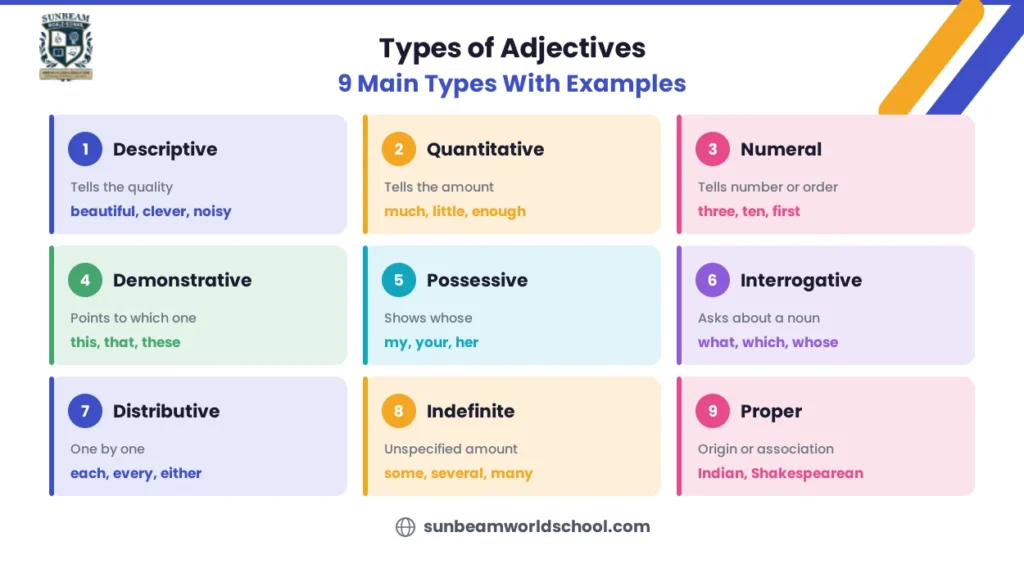
Types of Adjectives
The main types of adjectives are descriptive, quantitative, numeral, demonstrative, possessive, interrogative, distributive, indefinite and proper adjectives, along with the articles a, an and the, while comparative and superlative forms cover degree. Most school grammar books in India still teach these traditional labels, so they are worth knowing even though modern grammar groups some of them differently.
| Type | What it tells us | Common examples | Example sentence |
|---|---|---|---|
| Descriptive | Quality | beautiful, clever, noisy | She lives in a beautiful house. |
| Quantitative | Amount | much, little, enough | There is little water left. |
| Numeral | Number or order | three, ten, first | Three students answered correctly. |
| Demonstrative | Which one | this, that, these, those | Those shoes belong to me. |
| Possessive | Whose | my, your, his, her | Her phone is on the table. |
| Interrogative | Asks about a noun | what, which, whose | Which book are you reading? |
| Distributive | Members one by one | each, every, either, neither | Each student received a certificate. |
| Indefinite | Unspecified amount | some, several, many | Several people attended. |
| Proper | Origin or association | Indian, American, Shakespearean | We studied Indian history. |
| Comparative | Compares two | taller, better, more useful | This road is shorter. |
| Superlative | Highest or lowest degree | tallest, best, most useful | She is the tallest student. |
These groups can overlap, because most types sort adjectives by meaning while comparative and superlative sort them by degree. Each type is explained below with examples.
Descriptive Adjectives
Descriptive adjectives (also called qualitative adjectives) describe a quality of a noun, such as its appearance, size, shape, colour, personality, condition or temperature. They are the largest group of adjectives and the ones children learn first, often starting with basic shapes and colours names in English for kids.
| Category | Examples | Sentence |
|---|---|---|
| Appearance | beautiful, attractive | She wore a beautiful dress. |
| Size | large, tiny | They live in a large house. |
| Shape | round, narrow | We walked through a narrow street. |
| Colour | red, blue | He bought a blue jacket. |
| Personality | friendly, patient | She is a patient teacher. |
| Condition | broken, clean | The room was clean. |
| Temperature | cold, hot | The water feels cold. |
Quantitative and Numeral Adjectives
Quantitative adjectives show an amount (much, little, enough), while numeral adjectives show an exact number or position (three, first, tenth). Quantitative adjectives usually go with uncountable nouns like water or time, and numeral adjectives go with countable nouns like students or books.
| Type | Example | Meaning |
|---|---|---|
| Quantitative | much time | An amount |
| Quantitative | little water | A small amount |
| Numeral (cardinal) | three students | An exact number |
| Numeral (ordinal) | first position | An order or rank |
Demonstrative Adjectives
Demonstrative adjectives are this, that, these and those when they come before a noun to point to a specific person or thing. This and these refer to things that are near, while that and those refer to things that are farther away, and the singular or plural form must match the noun.
| Word | Example | Use |
|---|---|---|
| this | this book | Singular, near |
| that | that house | Singular, far |
| these | these shoes | Plural, near |
| those | those photographs | Plural, far |
Possessive Adjectives
Possessive adjectives are my, your, his, her, its, our and their, and they come before a noun to show ownership or connection. They differ from possessive pronouns such as mine or yours, which stand alone without a noun (this book is mine).
| Word | Example | Meaning |
|---|---|---|
| my | my notebook | Belongs to the speaker |
| your | your phone | Belongs to the listener |
| his | his jacket | Belongs to a male person |
| her | her bag | Belongs to a female person |
| its | its tail | Belongs to an animal or thing |
| our | our house | Belongs to a group including the speaker |
| their | their car | Belongs to other people |
Interrogative Adjectives
Interrogative adjectives are which, what and whose when they come directly before a noun in a question. If the word stands alone, as in Which do you want?, it is working as a pronoun instead.
| Word | Example | Purpose |
|---|---|---|
| which | Which book are you reading? | Picks one from a set |
| what | What colour is the car? | Asks for information |
| whose | Whose bag is this? | Asks about ownership |
Distributive Adjectives
Distributive adjectives are each, every, either and neither, and they refer to members of a group individually rather than all together. Because they point to one member at a time, they are followed by a singular noun and a singular verb, as in every student is present.
| Word | Example | Meaning |
|---|---|---|
| each | Each student received a certificate. | Every member, considered separately |
| every | Every student must attend. | All members, one by one |
| either | Either option will work. | One of two |
| neither | Neither answer is correct. | Not one and not the other of two |
Indefinite Adjectives
Indefinite adjectives such as some, many, few, several, any and enough describe a noun without giving an exact number or amount. They are useful when the exact figure is unknown or does not matter.
| Word | Example | Information given |
|---|---|---|
| some | some people | An unspecified amount |
| many | many questions | A large, unspecified number |
| few | few opportunities | A small number |
| several | several options | More than a few |
| enough | enough time | A sufficient amount |
Articles (A, An, The)
Articles are a, an and the, and traditional grammar treats them as a special kind of adjective because they come before a noun and limit it. A and an are indefinite articles that point to any one thing (a book, an apple), while the is the definite article that points to a specific thing (the book on the table).
| Article | Type | Example |
|---|---|---|
| a | Indefinite, before a consonant sound | a pencil, a uniform |
| an | Indefinite, before a vowel sound | an egg, an hour |
| the | Definite | the sun, the book you lent me |
Proper Adjectives
Proper adjectives are formed from proper nouns, such as Indian from India or Shakespearean from Shakespeare, and they always start with a capital letter. They usually show nationality, origin, culture or a link to a famous person or period.
| Proper noun | Proper adjective | Example |
|---|---|---|
| India | Indian | Indian cuisine |
| America | American | American history |
| Shakespeare | Shakespearean | Shakespearean drama |
| Victoria | Victorian | Victorian architecture |
What Is a List of Common Adjectives From A to Z?
The A-Z list below gives common adjectives beginning with every letter of the alphabet, chosen so that children can use them in everyday writing and speech. If you are looking for adjectives that begin with a particular letter, such as A, E, I or W, jump straight to that row. Letter A has extra words because it is one of the most searched groups, and letter X includes short meanings since those adjectives are less familiar.
| Letter | Common adjectives |
|---|---|
| A | able, active, adorable, adventurous, afraid, alert, amazing, ambitious, angry, anxious, artistic, attractive, awful, awkward |
| B | beautiful, big, bitter, bold, brave, bright, brilliant, busy |
| C | calm, careful, cheerful, clean, clever, cold, curious, cute |
| D | dangerous, dark, deep, delicious, different, difficult, dirty, dull |
| E | eager, early, easy, elegant, empty, energetic, enormous, excited |
| F | fair, famous, fancy, fast, fierce, fresh, friendly, funny |
| G | generous, gentle, giant, glad, gloomy, good, graceful, grumpy |
| H | happy, hard, healthy, heavy, helpful, honest, huge, humble |
| I | icy, ideal, impatient, important, innocent, intelligent, interesting, itchy |
| J | jealous, jolly, joyful, juicy, jumpy, junior |
| K | keen, kind, knotty, knowledgeable, kooky |
| L | large, lazy, light, little, lively, lonely, loud, lucky |
| M | magnificent, messy, mighty, mild, modern, modest, muddy, mysterious |
| N | narrow, nasty, naughty, neat, nervous, new, nice, noisy |
| O | obedient, odd, old, open, orange, ordinary, outstanding |
| P | patient, peaceful, perfect, polite, poor, powerful, pretty, proud |
| Q | quaint, qualified, quarrelsome, quick, quiet, quirky |
| R | rapid, rare, ready, rich, rough, round, rude, rusty |
| S | sad, safe, shiny, short, shy, silly, smart, strong |
| T | tall, tasty, tender, thick, thin, tiny, tired, tough |
| U | ugly, unique, unusual, upset, urgent, useful |
| V | vacant, vague, valuable, vast, victorious, vivid |
| W | warm, weak, wealthy, weird, wet, wide, wise, witty |
| X | xenial (friendly to guests), xeric (very dry), xanthic (yellowish), xyloid (like wood), xenophobic (afraid of foreigners) |
| Y | yearly, yellow, young, youthful, yummy |
| Z | zany, zealous, zesty, zigzag, zippy |
X is the trickiest letter for adjectives, and most everyday X words are nouns rather than describing words, which is easy to see in this collection of words that start with X. Remember that a word on any list only counts as an adjective when it describes a noun in the sentence, so light is an adjective in a light bag but a noun in switch on the light.
Describing Words That Start With Ac, Ad, Al, Aq and Th
Describing words that start with two-letter combinations such as ac, ad, al, aq and th are useful for word games, spelling practice and alliteration in poems. The table groups common adjectives by these starting letters.
| Starts with | Adjectives |
|---|---|
| Ac | accurate, acceptable, accidental, acidic, active, actual |
| Ad | adaptable, adequate, admirable, adorable, adult, adventurous |
| Al | alarming, alert, alive, alone, alternative, alluring |
| Aq | aquatic, aquamarine, aquiline |
| Th | thankful, thick, thin, thirsty, thorough, thoughtful, thrilling |
Where Can You Find Adjectives That Start With Each Letter From A to Z?
You can find a full adjectives list for every letter of the alphabet in the letter-by-letter guides below, each with a longer word list and example sentences. Pick a letter to see a much longer list of adjectives that start with it than the short sample shown above.
Which Adjectives Can You Use to Describe a Person?
Adjectives that describe a person fall into four useful groups, which are positive personality traits, negative personality traits, appearance and feelings. Choosing from the right group helps a child write a more accurate character sketch, report or "describe yourself" answer.
| Group | Example adjectives | Example sentence |
|---|---|---|
| Positive personality | kind, honest, brave, generous, patient, cheerful, confident, polite | My grandmother is generous and patient. |
| Negative personality | rude, lazy, selfish, jealous, careless, stubborn, bossy | The bossy captain ignored his team. |
| Appearance | tall, short, slim, strong, curly-haired, well-dressed | Her tall, curly-haired brother waved at us. |
| Feelings | happy, nervous, excited, lonely, proud, worried, calm | Riya felt proud after her speech. |
Personality adjectives usually describe who someone is over time, while feeling adjectives describe how they are at a particular moment, so Arjun is cheerful says something different from Arjun is happy today.
What Are 50 Examples of Adjectives in Sentences?
The 50 sample sentences using adjectives below show each adjective in action, grouped by the kind of information it adds. Seeing sentences containing adjectives, rather than words in a list, helps students remember both the word and the way it is used in a sentence.
| # | Adjective | Sentence | What it shows |
|---|---|---|---|
| 1 | patient | She is a patient teacher. | Personality |
| 2 | generous | He is a generous neighbour. | Personality |
| 3 | young | The young athlete won. | Age |
| 4 | friendly | We met a friendly guide. | Personality |
| 5 | curious | The child is curious. | Character |
| 6 | wooden | I bought a wooden table. | Material |
| 7 | heavy | She carried a heavy suitcase. | Weight |
| 8 | ancient | He found an ancient coin. | Age |
| 9 | large | The phone has a large screen. | Size |
| 10 | blue | She wore a blue jacket. | Colour |
| 11 | quiet | They live in a quiet neighbourhood. | Condition |
| 12 | beautiful | We visited a beautiful village. | Appearance |
| 13 | narrow | The city has narrow streets. | Shape |
| 14 | modern | They stayed in a modern hotel. | Age or style |
| 15 | vast | The museum has a vast collection. | Size |
| 16 | excited | I was excited about the trip. | Emotion |
| 17 | nervous | She felt nervous before the exam. | Emotion |
| 18 | tired | He looked tired after work. | Condition |
| 19 | delighted | The children were delighted. | Emotion |
| 20 | silent | Everyone became silent. | Condition |
| 21 | several | Several students volunteered. | Quantity |
| 22 | many | We have many options. | Quantity |
| 23 | little | There is little time left. | Quantity |
| 24 | three | She bought three notebooks. | Number |
| 25 | few | Few people understood. | Quantity |
| 26 | wider | This road is wider than the old one. | Comparative |
| 27 | lighter | My new bag is lighter. | Comparative |
| 28 | largest | This is the largest room. | Superlative |
| 29 | more careful | She is more careful than her brother. | Comparative |
| 30 | most interesting | That was the most interesting lecture. | Superlative |
| 31 | this | This book belongs to me. | Demonstrative |
| 32 | those | Those flowers need water. | Demonstrative |
| 33 | my | My brother lives abroad. | Possessive |
| 34 | their | Their house is near the park. | Possessive |
| 35 | which | Which route should we take? | Interrogative |
| 36 | Italian | We ordered Italian food. | Proper |
| 37 | Indian | She enjoys Indian classical music. | Proper |
| 38 | American | He studies American history. | Proper |
| 39 | Shakespearean | They watched a Shakespearean play. | Proper |
| 40 | Victorian | We learned about Victorian architecture. | Proper |
| 41 | cold | The water feels cold. | Predicative |
| 42 | delicious | The cake smells delicious. | Predicative |
| 43 | happy | The children seem happy. | Predicative |
| 44 | orange | The sky became orange. | Predicative |
| 45 | correct | The answer sounds correct. | Predicative |
| 46 | well-known | She is a well-known author. | Compound |
| 47 | two-bedroom | They rented a two-bedroom flat. | Compound |
| 48 | boring | It was a boring lecture. | Participial (-ing) |
| 49 | bored | The students were bored. | Participial (-ed) |
| 50 | broken | We saw a broken window. | Participial |
What Are the Degrees of Comparison of Adjectives?
Adjectives have three degrees of comparison, which are positive (tall), comparative (taller) and superlative (tallest). The positive degree simply describes, the comparative compares two things and the superlative picks out the highest or lowest in a group of three or more.
| Degree | Job | Example | Sentence |
|---|---|---|---|
| Positive | Describes without comparing | tall | Ravi is tall. |
| Comparative | Compares two things | taller | Ravi is taller than Amit. |
| Superlative | Highest or lowest in a group | tallest | Ravi is the tallest student in the class. |
How Do You Form Comparative Adjectives?
You form most comparative adjectives by adding -er to short adjectives (tall to taller) or by putting more before longer adjectives (more beautiful). A comparative shows a difference between two people, things or situations, and it is often followed by than, although than can be left out when the comparison is already clear.
Rules for Adding -er and -est to Short Adjectives
One-syllable adjectives usually take -er and -est, with small spelling changes depending on how the word ends. The table groups the four main spelling patterns together so they are easy to compare.
| Spelling pattern | Positive | Comparative | Superlative | Example |
|---|---|---|---|---|
| Most one-syllable words, add -er/-est | tall, cold | taller, colder | tallest, coldest | Today is colder than yesterday. |
| Ends in -e, add -r/-st | large, safe, wide | larger, safer, wider | largest, safest, widest | This is the safest route. |
| Ends in consonant + y, change y to i | happy, easy, busy | happier, easier, busier | happiest, easiest, busiest | Friday is our busiest day. |
| Short vowel + one consonant, double it | big, hot, thin | bigger, hotter, thinner | biggest, hottest, thinnest | July is the hottest month. |
When Should You Use "More" Instead of -er?
Use more and most with adjectives of three or more syllables, such as beautiful, expensive and interesting, and with many two-syllable adjectives such as careful, useful and polite. Some two-syllable adjectives take -er instead (happy, narrow, simple), so syllable count is a helpful guide rather than a fixed rule.
| Positive | Comparative | Superlative | Example |
|---|---|---|---|
| beautiful | more beautiful | most beautiful | This garden is more beautiful. |
| expensive | more expensive | most expensive | This is the most expensive option. |
| interesting | more interesting | most interesting | The second book is more interesting. |
| careful | more careful | most careful | Be more careful next time. |
Which Comparative Adjectives Are Irregular?
The most common irregular comparatives are good, better, best and bad, worse, worst, which change completely instead of adding -er or more. Students simply need to memorise this small set, since no spelling rule produces them.
| Positive | Comparative | Superlative | Example |
|---|---|---|---|
| good | better | best | This solution is better. |
| bad | worse | worst | The weather is worse today. |
| little | less | least | We have less time. |
| much / many | more | most | She has more experience. |
| far | farther / further | farthest / furthest | The second village is farther away. |
Is "Funner" a Real Word or Should You Say "More Fun"?
More fun is the standard and safest choice in school writing, while funner appears in casual speech but is still marked as informal in most dictionaries. A few adjectives have more than one accepted comparative form, which shows that grammar rules describe strong patterns rather than a machine that produces every form.
What Is a Double Comparative and Why Is It Wrong?
A double comparative uses both more and -er together, as in more easier, which is incorrect because the -er ending already shows comparison. The same mistake happens with irregular forms, since better is already comparative and does not need more.
| Incorrect | Correct | Reason |
|---|---|---|
| more easier | easier | -er already marks comparison. |
| more happier | happier | -er already marks comparison. |
| more better | better | Better is already comparative. |
How Can You Show How Big a Difference Is?
You can show the size of a difference by placing words like much, far, slightly or a little before a comparative adjective. For example, much better signals a big gap, while slightly better signals a small one.
| Modifier | Example | What it signals |
|---|---|---|
| much | much better | A big difference |
| far | far better | A clear, big difference |
| considerably | considerably better | A large difference |
| slightly | slightly better | A small difference |
| a little | a little better | A small difference |
Comparatives also appear in patterns that do not use than at all. The weather is getting colder compares today with an earlier time, and the more you practise, the better you become links two changes together.
How Do Superlative Adjectives Work?
A superlative adjective shows the highest or lowest degree of a quality within a group of three or more, and it is formed with -est (tallest) or most (most beautiful). Short adjectives usually take -est, longer adjectives usually take most, and irregular adjectives such as good become best.
| Positive | Superlative | Example |
|---|---|---|
| tall | tallest | She is the tallest student. |
| small | smallest | This is the smallest room. |
| beautiful | most beautiful | It is the most beautiful garden. |
| good | best | This is the best option. |
Why Do Superlatives Usually Take "The"?
Superlatives usually take the because they point to one particular member at the top or bottom of a group, as in the tallest student or the best option. Superlatives can occasionally appear without the, especially after a possessive (my best friend), but the plus a superlative is the standard pattern.
What Is the Difference Between Comparative and Superlative Adjectives?
A comparative adjective compares two things (taller than), while a superlative adjective places one thing at the extreme of a whole group (the tallest). The table sets the two side by side.
| Feature | Comparative | Superlative |
|---|---|---|
| Purpose | Shows a difference | Shows the highest or lowest degree |
| Typical comparison | Two things | One thing within a group |
| Example | taller | tallest |
| Common structure | taller than | the tallest |
| Irregular example | better | best |
What Are Gradable and Non-Gradable Adjectives?
Gradable adjectives describe qualities that can exist in different amounts, such as cold, happy or expensive, so they work with very, more and most. Non-gradable adjectives describe a category or an all-or-nothing state, such as wooden, dead or unique, so they are not normally made stronger or compared.
| Adjective | Different degrees | Comparative / superlative | Type |
|---|---|---|---|
| cold | slightly cold, very cold, extremely cold | colder, coldest | Gradable |
| expensive | fairly expensive, very expensive | more expensive, most expensive | Gradable |
| happy | slightly happy, very happy | happier, happiest | Gradable |
| difficult | fairly difficult, very difficult | more difficult, most difficult | Gradable |
| wooden | Not normally scaled | Not normally compared | Non-gradable |
This explains why very cold sounds natural while very wooden sounds odd in its literal sense, although writers sometimes bend these rules for effect, as in a very unique idea in casual speech.
What Is the Correct Order of Adjectives in English?
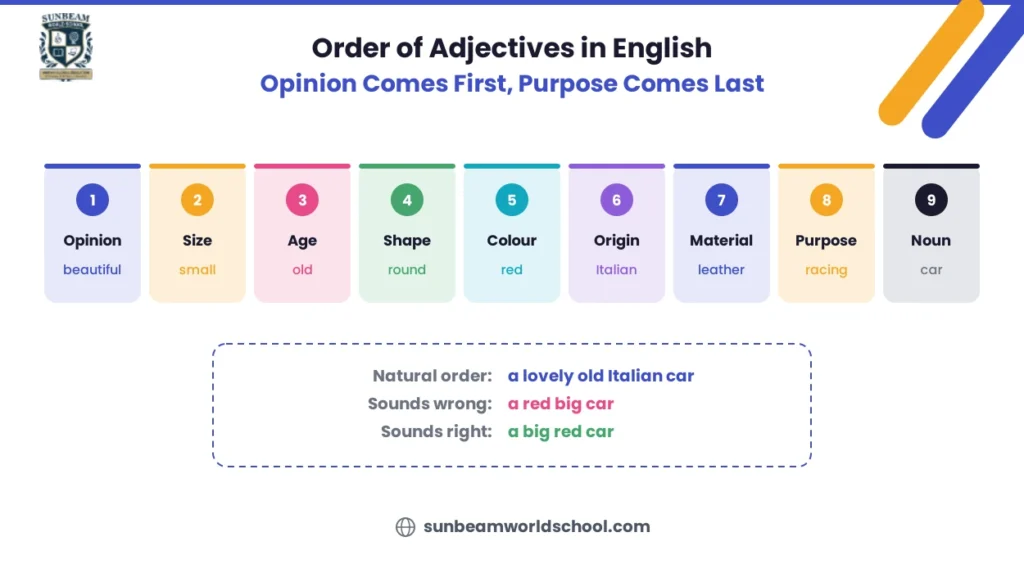
Order of Adjectives
The usual order of adjectives in English is opinion, size, age, shape, colour, origin, material and purpose, followed by the noun. That is why a big red car sounds natural while a red big car sounds wrong to native speakers, even though most of them could not explain the rule.
| Order | Category | Example |
|---|---|---|
| 1 | Opinion | beautiful |
| 2 | Size | small |
| 3 | Age | old |
| 4 | Shape | round |
| 5 | Colour | red |
| 6 | Origin | Italian |
| 7 | Material | leather |
| 8 | Purpose or type | racing |
| 9 | Noun | car |
In practice, sentences rarely use more than two or three adjectives at once, so a lovely old Italian car is far more common than a full string of eight. Opinion words sit farthest from the noun because they are personal judgements, while material and purpose words sit closest because they are almost part of the thing's name.
When Does Adjective Order Change?
Adjective order changes when a word before the noun forms a compound noun with it, because the compound behaves like a single noun. In a black coffee cup, coffee cup is one unit and black describes the whole cup, while in a racing car the word racing names the type of car.
| Phrase | How to read it |
|---|---|
| a black coffee cup | A coffee cup that is black |
| a racing car | A car built for racing |
| a big school bus | A school bus that is big |
When Do You Put a Comma Between Adjectives?
Put a comma between two adjectives only when they are coordinate adjectives, which means each one describes the noun independently. A quick test is to insert and between them or swap their order, and if both still sound natural, use a comma.
| Test | Coordinate | Non-coordinate |
|---|---|---|
| Example | a long, cold winter | an old silver locket |
| "And" test | a long and cold winter (natural) | an old and silver locket (unnatural) |
| Swap test | a cold, long winter (works) | a silver old locket (unnatural) |
| Comma? | Yes | No |
These tests are helpful clues rather than strict laws, and the real question is whether the adjectives work separately or whether one forms a close unit with the noun.
When Do Compound Adjectives Need a Hyphen?
Compound adjectives need a hyphen when they come before the noun, as in a well-known author, but usually not when they come after it, as in the author is well known. The hyphen shows the reader that the words work together as one description.
| Compound adjective | Noun | Example |
|---|---|---|
| well-known | author | She is a well-known author. |
| high-speed | train | We travelled by high-speed train. |
| two-bedroom | flat | They rented a two-bedroom flat. |
| five-year-old | child | A five-year-old child won the prize. |
| Before the noun | After the noun |
|---|---|
| a well-known writer | The writer is well known. |
| a five-year-old child | The child is five years old. |
What Is the Difference Between an Adjective and an Adverb?
An adjective modifies a noun or pronoun, while an adverb modifies a verb, an adjective, another adverb or a whole clause. In she is a careful driver, careful describes the driver, but in she drives carefully, carefully describes how she drives.
| Sentence | Word | What it modifies | Part of speech |
|---|---|---|---|
| She is a careful driver. | careful | driver | Adjective |
| She drives carefully. | carefully | drives | Adverb |
| He is a fast runner. | fast | runner | Adjective |
| He runs fast. | fast | runs | Adverb |
| She feels bad. | bad | she | Adjective |
| She performed badly. | badly | performed | Adverb |
Not every adverb ends in -ly, and words like fast, hard, early and late can be either adjectives or adverbs depending on the sentence. Checking what the word modifies is always more reliable than checking its ending.
Why Is "I Feel Bad" Correct and Not "I Feel Badly"?
"I feel bad" is correct because feel works as a linking verb here, so it is followed by an adjective that describes the subject I. "I feel badly" would describe the action of feeling, as if your sense of touch were poor, which is not what people usually mean.
| Sentence | What the word describes | Meaning |
|---|---|---|
| I feel bad. | I | I am in a bad state or mood. |
| I played badly. | played | My performance was poor. |
| The soup smells bad. | the soup | The soup has an unpleasant smell. |
| He smelled the soup carefully. | smelled | He did the action carefully. |
Are My, This and Each Adjectives or Determiners?
Words like my, this, each and which are called adjectives in traditional school grammar but determiners in modern grammar, and both labels describe the same words. Students should use the term their textbook or exam expects, while knowing that the other label exists.
| Word | Traditional school grammar | Modern grammar | Example |
|---|---|---|---|
| this | Demonstrative adjective | Determiner | this book |
| my | Possessive adjective | Possessive determiner | my book |
| each | Distributive adjective | Determiner | each student |
| which | Interrogative adjective | Determiner | which book |
Modern grammar separates them because they behave differently from true describing adjectives, since you can say a very beautiful book but never a very this book. This is also why grammar websites sometimes seem to disagree about how many types of adjectives there are.
What Is the Difference Between -ing and -ed Adjectives?
Adjectives ending in -ing describe the thing that causes a feeling, while adjectives ending in -ed describe the person who experiences it. So the movie was boring means the movie caused boredom, and I was bored means I felt that boredom.
| -ing adjective | Usually means | -ed adjective | Usually means |
|---|---|---|---|
| boring | Causes boredom | bored | Feels boredom |
| interesting | Causes interest | interested | Feels interest |
| exciting | Causes excitement | excited | Feels excitement |
| confusing | Causes confusion | confused | Feels confusion |
| tiring | Causes tiredness | tired | Feels tired |
| frightening | Causes fear | frightened | Feels fear |
Mixing these up is one of the most common mistakes students make, because I am boring actually means "I make other people bored," which is rarely what the speaker intends.
Is a Participial Adjective the Same as a Participle?
A participial adjective uses the same form as a participle, but it works as an adjective only when it describes a noun. In the children are playing, playing is part of the verb, while in the playing children, playing describes the children.
| Sentence | Role of the word |
|---|---|
| The children are playing. | playing is part of the verb phrase. |
| the playing children | playing describes children. |
| The window was broken by the ball. | broken is part of a passive verb. |
| a broken window | broken describes window. |
Can a Noun Work as an Adjective?
Yes, a noun can work like an adjective when it sits before another noun and describes it, as in school bus, coffee cup or stone wall. The word stays a noun, though, and is simply acting as a modifier, which is the main difference between a noun used this way and a true adjective such as wooden.
| Phrase | Modifier | Noun | What the modifier is |
|---|---|---|---|
| school bus | school | bus | Noun used as a modifier |
| coffee cup | coffee | cup | Noun used as a modifier |
| stone wall | stone | wall | Noun used as a modifier |
| wooden table | wooden | table | True adjective |
This kind of adjectival use is very common in English, and a group of words that does an adjective's job, such as full of water in a bucket full of water, is called an adjectival phrase. One easy check is that true adjectives can usually take very or a comparative form, so a very old bus works but a very school bus does not, which confirms that school is still a noun.
How Are Adjectives Formed From Other Words?
Many adjectives are formed by adding a suffix such as -ful, -less, -ous, -ive, -al, -ic, -y, -ish or -able to a noun or verb. Knowing these endings helps students recognise unfamiliar adjectives and build new ones from words they already know.
| Suffix | Base word | Adjective | Example |
|---|---|---|---|
| -ful | care | careful | She is careful with her work. |
| -less | care | careless | That was a careless mistake. |
| -ous | danger | dangerous | It is a dangerous road. |
| -ive | effect | effective | This is an effective method. |
| -al | nature | natural | We prefer natural materials. |
| -ic | history | historic | The fort is a historic site. |
| -y | cloud | cloudy | It is a cloudy day. |
| -ish | child | childish | That was childish behaviour. |
| -able | comfort | comfortable | The chair is comfortable. |
The process also works in reverse, turning an adjective to noun form with endings like -ness, -ity and -y, so happy becomes happiness, kind becomes kindness, able becomes ability and brave becomes bravery. Suffixes are patterns rather than formulas, so they cannot be added to every word, and -ly is a special case because it usually makes adverbs (quickly) but sometimes makes adjectives (friendly, lovely).
What Are the Most Common Adjective Mistakes?
The most common adjective mistakes are using an adjective where an adverb is needed, doubling comparatives or superlatives, mixing up -ed and -ing forms, adding unnecessary commas and putting adjectives in the wrong order. Each mistake has a clear reason, which makes it easier to fix than to memorise.
| Mistake | Incorrect | Correct | Why |
|---|---|---|---|
| Adjective instead of adverb | She sings beautiful. | She sings beautifully. | The word describes sings. |
| Double comparative | more easier | easier | -er already marks comparison. |
| Double superlative | most fastest | fastest | -est already marks the superlative. |
| Wrong -ed or -ing | I am boring. | I am bored. | The speaker feels boredom. |
| Unneeded comma | an old, silver necklace | an old silver necklace | Silver necklace is a close unit. |
| Wrong order | a wooden beautiful table | a beautiful wooden table | Opinion comes before material. |
| Capital letter missing | indian food | Indian food | Proper adjectives take a capital. |
How Can You Use Adjectives Effectively in Writing?
You use adjectives effectively by choosing one precise adjective instead of a vague one, and by cutting any adjective that does not change what the reader understands. A peaceful day tells the reader far more than a good day, while piling three or four adjectives onto every noun usually makes writing slower and weaker.
| Vague | More precise options | What changes |
|---|---|---|
| a good day | a productive day, a peaceful day, a difficult day | The exact quality becomes clear. |
| a nice place | a quiet place, a historic place, a lively place | The reader can picture it. |
| a big problem | a serious problem, a costly problem, a complex problem | The kind of problem is named. |
A strong noun or verb often does more work than an adjective, so the puppy can replace the small young dog. Learning to make these choices is a big part of how teachers improve a child's writing skills, especially in descriptive essays and stories.
How Can Parents Help Children Learn Adjectives at Home?
Parents can help children learn adjectives through short, playful daily habits such as describing objects together, playing adjective games and asking for "one more describing word" during conversations. Small, regular practice works better than long grammar drills because children learn words fastest when they use them.
Play "Describe It" with everyday objects. Pick any object at home, such as an apple, and take turns adding an adjective like red, round, shiny or crunchy. The game builds vocabulary quickly and teaches children that one noun can be described in many different ways.
Use the five senses as prompts. Ask how something looks, sounds, smells, tastes and feels, which naturally produces adjectives like loud, sweet, soft and bitter. This also helps children write fuller descriptions in their school compositions.
Turn comparisons into a game. Line up three toys or fruits and ask which one is bigger, heavier or the smallest. Hands-on comparisons like these are a simple form of activity based learning, and they make degrees of comparison stick far better than a rules table.
Upgrade tired adjectives together. When your child writes good or nice, ask for a more exact word, such as thrilling or cosy. Over time, children start reaching for precise adjectives on their own.
Can You Spot the Adjective? Practice Questions With Answers
These practice questions test three skills, which are identifying adjectives, choosing between adjectives and adverbs, and fixing comparative errors. Try each one before checking the answer column.
Level 1: Find the Adjective
Each sentence below contains one adjective, and the answer column shows which noun it describes.
| Sentence | Answer | What it modifies |
|---|---|---|
| The blue car is outside. | blue | car |
| She bought an expensive dress. | expensive | dress |
| The children looked tired. | tired | children |
| We visited a beautiful village. | beautiful | village |
| He carried a heavy box. | heavy | box |
Level 2: Adjective or Adverb?
Choose the correct word in each sentence by asking whether it describes a noun or an action.
| Question | Answer | Reason |
|---|---|---|
| She is a careful / carefully driver. | careful | Describes driver. |
| She drives careful / carefully. | carefully | Describes drives. |
| He looks angry / angrily. | angry | Describes the subject after a linking verb. |
| He answered the question angry / angrily. | angrily | Describes answered. |
Level 3: Correct the Comparative
Each phrase below has a comparison error, and the answer column shows the corrected form.
| Incorrect | Correct | Reason |
|---|---|---|
| more easier | easier | -er already marks the comparative. |
| narrow than | narrower than | A comparative is needed before than. |
| more happier | happier | -er already marks the comparative. |
| most fastest | fastest | -est already marks the superlative. |
Conclusion
An adjective is best understood not as a word on a list but as a word doing a job, which is giving information about a noun or pronoun. Children build that understanding fastest with steady, hands-on practice, which is the idea behind personalised learning for students at Sunbeam World School.

Frequently Asked Questions
What is an adjective in simple words?
-An adjective, in simple words, is a describing word that tells us more about a noun or pronoun. It can show quality, size, colour, number or origin. In a red car, red is the adjective because it tells us what the car looks like.
How do you define adjective with examples?
+What are describing words called?
+What are 10 examples of adjectives?
+What are the main types of adjectives?
+What are some adjectives that start with A?
+What adjectives can describe a person?
+How do you identify an adjective in a sentence?
+What is the difference between an adjective and an adverb?
+Can adjectives modify adverbs?
+Can an adjective describe another adjective?
+What is a comparative adjective?
+What is a superlative adjective?
+What is the correct order of adjectives?
+What is the difference between bored and boring?
+