
 Digital Learning
Animal Sounds: 100+ Animals and Their Sounds List (A to Z)
Quick Summary Animal sounds are the noises animals make to communicate, warn of danger and call their young. In English, they are written as onomatopoeia, words like woof, moo and quack that imitate the real sound, and each one has a matching verb, so dogs bark, cats meow, cows moo, lions roar and snakes hiss.
Animal sounds are often among the first words toddlers learn. Fun sounds like “moo” and “woof” are easy to copy, helping children build listening skills, vocabulary, and early speech. They also pair naturally with learning animal names in English for kids.
This guide covers 100 animal sounds from A to Z, including farm, pet, wild, sea and baby animals, bird calls, insect sounds, sound words, related verbs and fun ways for kids to learn them.
What Are Animal Sounds Called in English?
Animal sounds in English are called onomatopoeia, so the names for animal sounds, such as moo, oink, buzz and hiss, are words that copy the sound they describe. Each piece of animal onomatopoeia can be used in three ways: as a sound word ("The cow said moo"), as a verb ("The cow moos") and as a noun ("We heard a loud moo").
Many animals also have a proper verb that is different from the sound word. A dog says "woof", but the verb is "bark", while a horse says "neigh" and the verb can be "neigh" or "whinny". The cry of an animal is also called its call, and learning both forms helps children describe animals in full sentences, which is why English lessons usually teach the sound word and the verb together.
What Are the 20 Most Common Animal Sounds?
The 20 most common animal sounds are the ones children hear in songs, stories and daily life, such as a dog's woof, a cat's meow, a cow's moo and a duck's quack. These 20 animal sounds show what sounds animals make most often, and the table below shows each animal with its sound word, its verb and an example sentence.
| Animal | Sound Word | Verb | Example Sentence |
|---|---|---|---|
| Dog | Woof, arf | Bark | The dog barked when the bell rang. |
| Cat | Meow, purr | Meow, purr | The cat purred on my lap. |
| Cow | Moo | Moo, low | The cows mooed in the field. |
| Duck | Quack | Quack | The ducks quacked by the pond. |
| Sheep | Baa | Bleat | The lamb bleated for its mother. |
| Goat | Baa, maa | Bleat | The goat bleated at the gate. |
| Horse | Neigh | Neigh, whinny | The horse neighed before the race. |
| Pig | Oink | Grunt, squeal | The pigs grunted in the mud. |
| Rooster | Cock-a-doodle-doo | Crow | The rooster crowed at sunrise. |
| Hen | Cluck | Cluck, cackle | The hen clucked over her chicks. |
| Lion | Roar | Roar | The lion roared across the plains. |
| Tiger | Roar | Roar, growl | The tiger growled in the grass. |
| Wolf | Awoo | Howl | The wolf howled at the moon. |
| Donkey | Hee-haw | Bray | The donkey brayed loudly. |
| Elephant | Toot | Trumpet | The elephant trumpeted to its herd. |
| Monkey | Ooh-ooh-aah-aah | Chatter, screech | The monkeys chattered in the trees. |
| Snake | Hiss | Hiss | The snake hissed and slid away. |
| Bee | Buzz | Buzz, hum | The bees buzzed around the flowers. |
| Frog | Ribbit, croak | Croak | The frogs croaked after the rain. |
| Owl | Hoot, twit-twoo | Hoot | An owl hooted in the dark. |
What Are 100 Animals and Their Sounds From A to Z?
The animal sounds list A to Z below covers more than 100 animals in alphabetical order within six groups, farm, pet, wild, bird, water and insect, so you can find any animal quickly. Each table gives the animal, the sound word and the verb used to describe it.
Farm and Barn Animal Sounds
Farm animal sounds and farmyard animal noises are the most familiar ones for young children, since barn animals like cows, pigs, sheep and hens appear in almost every early picture book and nursery rhyme.
| Animal | Sound Word | Verb |
|---|---|---|
| Alpaca | Hmm | Hum |
| Buffalo | Moo | Bellow, low |
| Camel | Grumble | Grunt, groan |
| Cattle (cow, bull) | Moo | Moo, low, bellow |
| Chicken (hen) | Cluck | Cluck, cackle |
| Donkey | Hee-haw | Bray |
| Duck | Quack | Quack |
| Goat | Baa, maa | Bleat |
| Goose | Honk | Honk, hiss |
| Horse | Neigh | Neigh, whinny, snort |
| Llama | Hmm | Hum |
| Mule | Hee-haw | Bray |
| Ox | Moo | Low, bellow |
| Pig | Oink | Grunt, squeal |
| Rooster | Cock-a-doodle-doo | Crow |
| Sheep | Baa | Bleat |
| Turkey | Gobble | Gobble |
| Yak | Grunt | Grunt |
Pet Animal Sounds
Pet animal sounds are the ones families hear every day at home, and many pets, like cats and guinea pigs, use different sounds to show they are happy, hungry or scared.
| Animal | Sound Word | Verb |
|---|---|---|
| Budgie | Tweet | Chirp, warble |
| Cat | Meow, purr | Meow, purr, hiss |
| Dog | Woof, arf | Bark, howl, growl, whine |
| Ferret | Dook | Dook, chatter |
| Guinea pig | Wheek | Squeak, squeal |
| Hamster | Squeak | Squeak |
| Mouse | Squeak | Squeak |
| Parrot | Squawk | Squawk, talk |
| Rabbit | Thump | Thump, squeal |
| Rat | Squeak | Squeak |
Wild Animal Sounds
Wild animal sounds range from the deep roar of a lion to the soft hum of a giraffe, and these jungle, safari and zoo animal sounds, sometimes called wildlife animal sounds, help animals call their group, defend territory and warn others across long distances. These sounds pair well with learning wild animal names, so children can match each animal to its call.
| Animal | Sound Word | Verb |
|---|---|---|
| Bat | Squeak | Squeak, screech |
| Bear | Grr | Growl, roar |
| Cheetah | Chirp | Chirp, purr |
| Chimpanzee | Ooh-ooh | Pant-hoot, scream |
| Coyote | Yip | Howl, yip |
| Deer | Bleat | Bleat, bell, bark |
| Dingo | Awoo | Howl |
| Elephant | Toot | Trumpet, rumble |
| Elk | Bugle | Bugle |
| Fox | Yip | Bark, scream, yelp |
| Giraffe | Hmm | Hum, snort |
| Gorilla | Hoo-hoo | Grunt, hoot |
| Hedgehog | Snuffle | Snuffle, huff |
| Hippopotamus | Honk | Grunt, honk |
| Hyena | Whoop | Whoop, giggle |
| Jackal | Awoo | Howl |
| Kangaroo | Chuck | Grunt, cough |
| Koala | Grunt | Bellow |
| Leopard | Rasp | Rasp, growl |
| Lion | Roar | Roar |
| Mink | Chuckle | Chuckle, hiss |
| Monkey | Ooh-ooh-aah-aah | Chatter, screech |
| Moose | Grunt | Bellow, grunt |
| Okapi | Chuff | Chuff |
| Panda | Baa | Bleat, honk |
| Raccoon | Chitter | Chitter, purr |
| Reindeer (caribou) | Grunt | Grunt |
| Rhinoceros | Snort | Snort, bellow |
| Squirrel | Chatter | Chatter, squeak |
| Tiger | Roar | Roar, growl, chuff |
| Wolf | Awoo | Howl |
| Zebra | Bark | Bark, bray |
Bird Sounds
Bird sounds are usually described as songs or bird calls, where songs are longer tunes birds sing to attract mates or claim territory, while calls are short sounds used to warn or keep in touch.
| Animal | Sound Word | Verb |
|---|---|---|
| Cockatoo | Squawk | Screech |
| Crow | Caw | Caw |
| Cuckoo | Cuckoo | Call |
| Dove | Coo | Coo |
| Eagle | Screech | Screech, cry |
| Flamingo | Honk | Honk, grunt |
| Hawk | Screech | Screech |
| Nightingale | Tweet | Sing, warble |
| Owl | Hoot, twit-twoo | Hoot, screech |
| Peacock | May-awe | Scream |
| Pigeon | Coo | Coo |
| Quail | Bob-white | Whistle, call |
| Raven | Croak | Croak, caw |
| Robin | Tweet | Chirp, sing |
| Seagull | Squawk | Squawk, cry |
| Sparrow | Chirp, tweet | Chirp |
| Swan | Honk | Trumpet, hiss |
| Woodpecker | Rat-a-tat | Drum, peck |
Sea and Water Animal Sounds
Sea animal sounds, also called underwater animal sounds, travel much further than sounds in air, which is why whales and dolphins rely on clicks, whistles and songs to find food and stay in touch underwater.
| Animal | Sound Word | Verb |
|---|---|---|
| Alligator | Grr | Bellow, hiss |
| Crocodile | Grr | Bellow, hiss |
| Dolphin | Click | Click, whistle |
| Fish | Grunt | Grunt, drum |
| Frog | Ribbit, croak | Croak |
| Otter | Squeak | Squeak, chirp |
| Penguin | Hee-haw | Bray, trumpet |
| Pistol shrimp | Snap | Snap |
| Seahorse | Click | Click |
| Seal | Arf | Bark |
| Sea lion | Arf | Bark, roar |
| Toad | Croak | Croak, trill |
| Walrus | Bellow | Bellow, whistle |
| Whale | Click | Sing, click |
Insect and Reptile Sounds
Insect and reptile sounds are usually made with body parts rather than voices, since bees buzz with their fast wings, crickets rub their wings together and rattlesnakes shake their tails. Together with frogs and birds, insects make most of the rainforest animal sounds you hear at dusk.
| Animal | Sound Word | Verb |
|---|---|---|
| Bee | Buzz | Buzz, hum |
| Cicada | Zzz | Buzz, drone |
| Cricket | Chirp | Chirp |
| Fly | Buzz | Buzz |
| Gecko | Tokay | Chirp, click |
| Grasshopper | Chirp | Chirp |
| Mosquito | Zzz | Whine, buzz |
| Rattlesnake | Rattle | Rattle, hiss |
| Snake | Hiss | Hiss |
How Are Animal Sounds Written in Words?
Animal sounds in words are written by spelling out how they sound to our ears, so a dog's bark becomes "woof", a pig's grunt becomes "oink" and a frog's call becomes "ribbit". These animal sounds written out appear in books and comics, and the same animal sounds typed out appear in text messages.
| Animal | Written in Words | Also Written As |
|---|---|---|
| Dog | Woof | Arf, ruff, bow-wow |
| Cat | Meow | Miaow, purr |
| Cow | Moo | Mooo |
| Pig | Oink | Oink oink |
| Sheep | Baa | Baaa |
| Goat | Maa | Baa, meh |
| Horse | Neigh | Nay |
| Donkey | Hee-haw | Eeyore |
| Rooster | Cock-a-doodle-doo | Kukdu-koo (Hindi) |
| Duck | Quack | Quack quack |
| Frog | Ribbit | Croak |
| Monkey | Ooh-ooh-aah-aah | Eek eek |
| Bird | Tweet | Chirp, cheep |
| Snake | Hiss | Sss |
| Bee | Buzz | Bzz |
| Owl | Hoot | Twit-twoo |
| Peacock | May-awe | Ee-ow |
Spellings can vary because people hear sounds differently, so you will see both "baa" and "maa" for a goat, and "woof" and "arf" for a dog. For dog noises in text or a monkey noise in text, "woof" and "ooh-ooh-aah-aah" are the most widely understood, just as "oink" is the standard way to write pig sounds in words, "baa" is a sheep sound in words, "may-awe" is how peacock sounds in words are usually spelled and "moo" is the usual cow sound word. Animal sounds written this way are a figure of speech, much like the comparisons in these metaphor examples, because the word stands in for something we hear rather than see.
Which Animals Roar, Bark, Hiss, Howl or Bray?
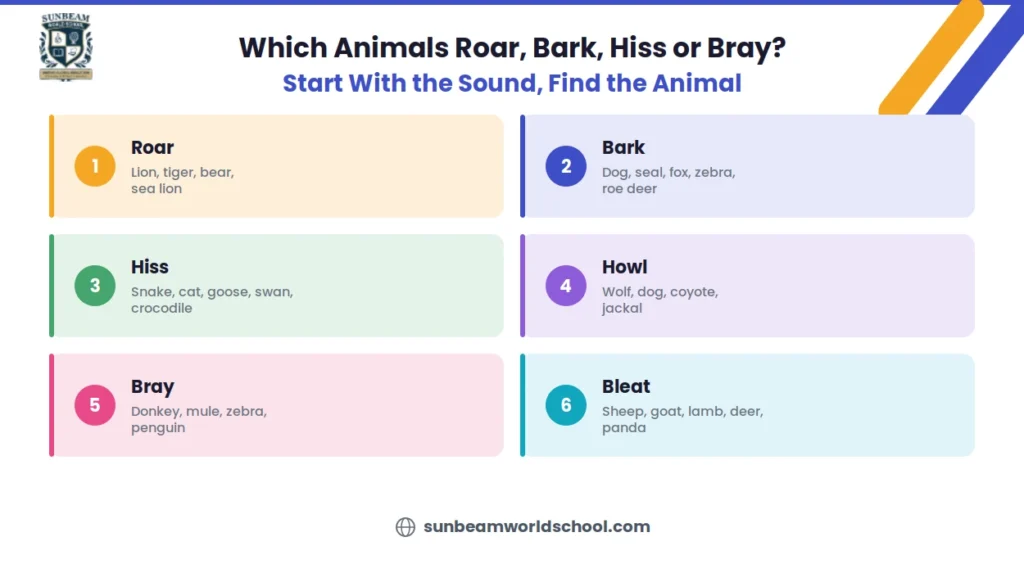
Start with the sound and find the animals that make it.
Animals that roar include lions and tigers, animals that bark include dogs and seals, animals that hiss include snakes and geese, animals that howl include wolves, and the best-known animal that brays is the donkey. The table below works in reverse, so you can start with a sound and find the animals that make it.
| Sound Verb | Animals That Make It |
|---|---|
| Roar | Lion, tiger, bear, sea lion |
| Bark | Dog, seal, fox, zebra, roe deer |
| Hiss | Snake, cat, goose, swan, crocodile |
| Howl | Wolf, dog, coyote, jackal |
| Bray | Donkey, mule, zebra, penguin |
| Bleat | Sheep, goat, lamb, deer, panda |
| Growl | Bear, dog, tiger, leopard |
| Grunt | Pig, yak, gorilla, camel, moose |
| Squeak | Mouse, hamster, guinea pig, bat |
| Screech | Owl, monkey, eagle, cockatoo |
| Chirp | Bird, cricket, cheetah, gecko |
| Hum | Giraffe, llama, alpaca, bee |
| Croak | Frog, toad, raven |
| Snort | Horse, rhinoceros, pig |
| Trumpet | Elephant, swan |
In the same way, animals that growl include bears and leopards, animals that squeak include mice and guinea pigs, animals that screech include owls and monkeys, and animals that scream include foxes, peacocks and some goats.
What Sounds Do Baby Animals Make?
Baby animals make softer, higher sounds than adults, and these infant animal sounds are usually calls to their mothers when they are hungry, cold or lost, so a puppy yips, a kitten mews and a chick peeps.
| Baby Animal | Parent | Sound Word | Verb |
|---|---|---|---|
| Puppy | Dog | Yip | Yip, whimper |
| Kitten | Cat | Mew | Mew |
| Lamb | Sheep | Baa | Bleat |
| Kid | Goat | Maa | Bleat |
| Calf | Cow | Moo | Bawl, moo |
| Chick | Hen | Peep, cheep | Peep |
| Duckling | Duck | Peep | Peep |
| Piglet | Pig | Wee | Squeal |
| Foal | Horse | Neigh | Whinny |
| Cub | Lion, bear | Mew | Mew, cry |
Why Do Animals Make Sounds?
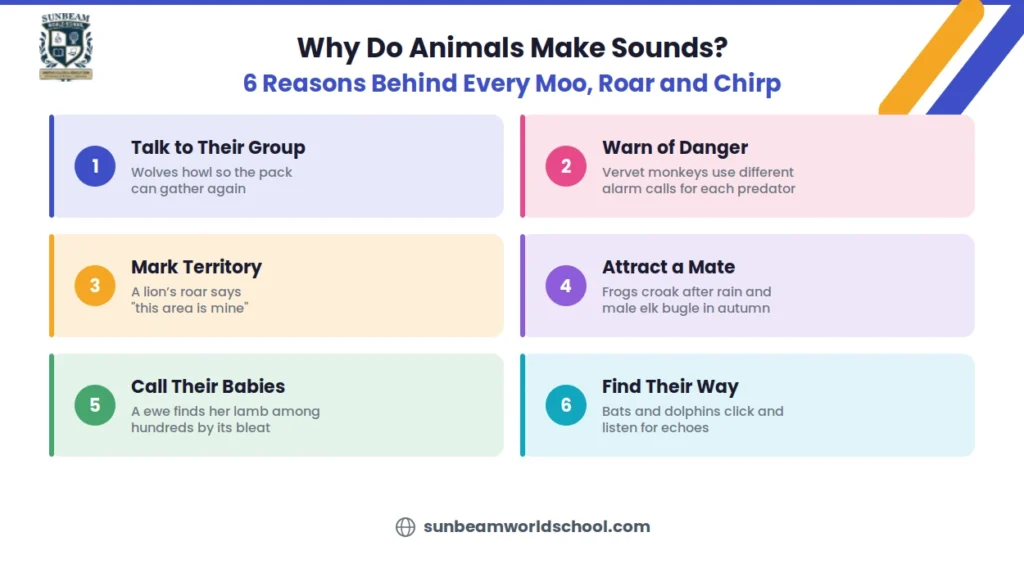
Animals make sounds to communicate, warn, and mark territory
Animals make sounds to communicate with their group, warn of danger, mark territory, attract a mate and find their babies, so the sounds animals make always carry a message, and some animals also use sound to find their way.
To Communicate With Their Group
Animals use sounds to keep in touch with their herd, pack or flock, especially when they cannot see each other. Elephants rumble to herd members far away, and wolves howl so the pack can gather again after hunting.
To Warn of Danger
Animal warning sounds tell others that a predator is close, so the group can hide or run. Vervet monkeys are well known for this, since researchers found they use different alarm calls for leopards, eagles and snakes, and each call makes the group react in a different way.
To Mark Territory
Many animals use loud sounds to tell rivals that an area is already taken. A lion's roar and a bird's morning song both work like a "this is mine" sign, which saves animals from fighting.
To Attract a Mate
Mating calls help animals find partners, which is why frogs croak loudly after rain and male elk bugle in autumn. Birds often sing their best and longest songs during the breeding season for the same reason.
To Call Their Babies
Mothers and babies recognise each other's voices, even in a crowd. A ewe can find her lamb among hundreds of sheep by its bleat, and penguin parents find their chicks in huge colonies by their calls.
To Find Their Way With Echolocation
Bats and dolphins find their way using echolocation, which means they make clicks or squeaks and listen for the echoes. The returning echo tells them where food and obstacles are, even in complete darkness or murky water.
Why Does Every Animal Sound Different?
Every animal sounds different because of how its body makes sound, and scientists divide animal sounds into two types of sounds: vocalizations made with a voice and non-vocal sounds made with other body parts. Mammals use vocal cords in the throat, and bigger animals usually have longer vocal cords, which give deeper sounds like a lion's roar, while small animals make high squeaks. Birds use a special voice organ called a syrinx, which lets some sing two notes at once, and many insects make sound without a voice at all, by rubbing body parts together or beating their wings very fast.
What Are the Weirdest, Scariest, Funniest and Cutest Animal Sounds?
The weirdest animal sounds and scary animal sounds include the red fox's scream and the peacock's human-like cry, while goats screaming and donkeys braying are among the funniest animal sounds, and otter squeaks and kitten mews are the cutest. These strange animal noises surprise people because the sound does not match how the animal looks, so the weird animal sounds below are grouped into scary, funny, surprising and cute, to help you find the funny sounds from animals or the spooky ones quickly.
Scary Animal Sounds
Scary animal sounds are often heard at night, which makes them even more startling.
- Red fox: Foxes, especially females in the mating season, give a high, piercing scream that sounds like a person in trouble.
- Peacock: A peacock's loud "may-awe" call can sound like a human shouting for help.
- Barred owl: Its call sounds like "who cooks for you", and pairs sometimes break into wild cackling duets.
- Coyote: A group of coyotes yipping and howling together can sound like many more animals than there really are.
- Koala: Male koalas make a deep, rumbling bellow that sounds far too big for such a small, cuddly animal.
Funny Animal Sounds
Funny animal noises make people laugh because they sound almost human or completely unexpected.
- Goat: Some goats let out a scream that sounds exactly like a person yelling.
- Donkey: The loud, wheezy "hee-haw" bray is one of the funniest sounds on a farm.
- Turkey: A turkey's quick "gobble gobble" sounds like a bubbling laugh.
- Camel: Camels grumble and groan loudly, as if they are complaining.
Surprising Animal Sounds
Surprising animal sounds are weird animal noises from animals that sound nothing like they look.
- Cheetah: Cheetahs cannot roar, and instead they chirp like birds.
- Elk: Male elk make a high, whistling "bugle" that sounds more like a squeaky trumpet than a big deer.
- Giraffe: Giraffes were long thought to be silent, but a 2015 study found that they hum at night.
- Rock hyrax: This small, furry animal sings long songs, and males change their songs to impress females.
- Roe deer: Roe deer bark like dogs when they sense danger.
- Screaming piha: This plain grey Amazon bird has one of the loudest calls in the rainforest.
Cute Animal Sounds
Cute animal sounds are usually small, high and soft, which is why they make people smile.
- Otter: Otters squeak and chirp to their family.
- Ferret: Happy ferrets make a soft clucking sound that owners call "dooking".
- Desert rain frog: This tiny frog lets out a squeaky cry that sounds like a toy.
- Kitten: A kitten's tiny "mew" is a call for its mother.
- Baby goat: Young goats make high "maa" calls that sound like a crying baby.
- Penguin chick: Chicks whistle and peep so their parents can find them.
What Is the Loudest Animal in the World?
The sperm whale is the loudest and noisiest animal in the world, since its clicks can reach about 230 decibels underwater, while the howler monkey is often called the loudest land animal. Sound is measured differently in water and air, so underwater numbers cannot be compared directly with sounds on land, but these loud animal sounds are all extreme for each animal's size, so the answer to what is the noisiest animal depends on whether you mean water or land.
| Animal | Where | How Loud |
|---|---|---|
| Sperm whale | Ocean | About 230 dB (underwater) |
| Pistol shrimp | Ocean | About 210 dB (underwater), from snapping its claw |
| Greater bulldog bat | Air | Up to about 140 dB echolocation calls |
| Lion | Land | About 114 dB, often said to be heard up to 8 km away |
| Howler monkey | Land | Howls often said to carry up to about 5 km through the forest |
Which Animal Sounds Are the Most Relaxing?
The most relaxing animal sounds are gentle, steady sounds like a cat's purr, birdsong at dawn, crickets at night, frogs after rain and whale songs. Many people use these sounds to fall asleep or calm down, because their rhythm feels steady and safe.
- Cat purr: A slow, low purr is one of the most comforting sounds for pet owners.
- Birdsong: Morning bird choruses are a favourite for relaxing and waking up gently.
- Musical wren: This Amazon bird sings a flute-like song that sounds like a tune played on an instrument.
- Coquí frog: In Puerto Rico, the coquí's "ko-KEE" call is a famous night-time lullaby.
- Whale song: Humpback whale songs are long, slow and often used in sleep recordings.
What Animals Make Noise at Night?
Owls, crickets, frogs, foxes, jackals, bats and nightjars are the animals that make noise at night most often, and these nighttime animal sounds are common because the animals are nocturnal and do most of their hunting or calling after dark.
- Owls hoot and screech while hunting.
- Crickets chirp, and they chirp faster on warmer nights.
- Frogs and toads croak loudly, especially after rain.
- Foxes bark and scream, mostly in winter.
- Jackals howl in groups, a common night sound in Indian villages.
- Bats squeak, though most of their calls are too high for humans to hear.
- Nightjars make a long, churring call that sounds like a small engine.
How Can You Identify an Animal by Its Sound?
You can identify animal sounds, whether you are asking "what sound is this?" or "what animal is making this sound?", by noting the time of day, the place, the pitch and how often the sound repeats, then matching it with a sound guide or app. A loud call at night near trees is often an owl, while a steady chirp in grass is usually a cricket.
- Notice the time: Night sounds usually come from owls, frogs, crickets, foxes or bats.
- Notice the place: Sounds near water often come from frogs, toads or water birds.
- Listen to the pitch: Deep sounds usually come from big animals, while high sounds come from small ones.
- Count the pattern: Many birds repeat the same short pattern, which makes them easier to recognise.
- Use a free app: An animal sound identifier app such as Merlin Bird ID or BirdNET can answer "what animal makes this sound?" for birds from a short recording.
How Do Animal Sounds Differ in Other Languages?
Animal sounds in different languages change because each language spells sounds using its own letters and sound patterns, so an English "woof" becomes "bhau bhau" in Hindi and "wan wan" in Japanese. The animals sound the same everywhere, but people hear and write them differently.
| Animal | English | Hindi | Spanish | French | Japanese |
|---|---|---|---|---|---|
| Dog | Woof | Bhau bhau (भौं भौं) | Guau | Ouaf | Wan wan |
| Cat | Meow | Myaun (म्याऊँ) | Miau | Miaou | Nyaa |
| Rooster | Cock-a-doodle-doo | Kukdu-koo (कुकड़ुकू) | Quiquiriquí | Cocorico | Kokekokko |
| Duck | Quack | Kain kain (कैं कैं) | Cuac | Coin-coin | Gaa gaa |
Comparing animal sounds in Spanish, French animal sounds and Japanese animal sounds with English and Hindi is a fun way for children to notice how languages differ, and it can be a good starting point when learning the Hindi alphabet, since many sound words use simple letters, and comparing animal sounds in other languages builds curiosity about both.
Do Animal Sounds Count as Words?
Animal sounds as words count in English, because words like moo, quack and hiss are found in dictionaries and work as nouns, verbs and interjections. They belong to a group of words called onomatopoeia, which also includes sounds like bang, splash and tick-tock.
For example, "moo" is an interjection in "Moo, said the cow", a verb in "The cows moo every morning" and a noun in "I heard a moo". This is why animal sounds are useful in early English lessons, since one word teaches children three ways to build a sentence.
Do Animals Have Their Own Language?
Animals do not have a language like humans, but many of them communicate using sounds that carry clear meanings. Vervet monkeys use separate alarm calls for different predators, and dolphins use signature whistles that work a little like names. However, animals do not combine sounds into new sentences with grammar the way people do, so scientists usually call this animal communication rather than language.
What Sound Did Dinosaurs Make?
Dinosaurs probably did not roar like they do in films, and a 2016 study suggested that some may have made closed-mouth booming or cooing sounds, similar to how doves and ostriches call today. Since sounds do not leave fossils, scientists study the closest living relatives of dinosaurs, which are birds and crocodiles, to make their best guess. The famous movie roars were created by mixing the sounds of animals like elephants, lions and alligators.
How Can Kids Learn Animal Sounds?
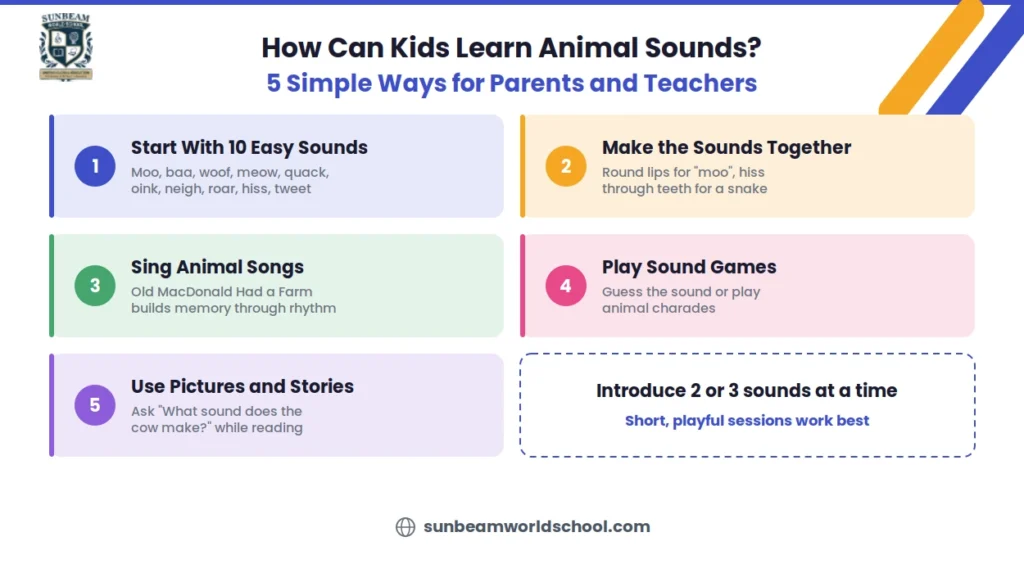
Start small, make the sounds together and keep sessions short and playful.
Kids learn animal sounds best, and animal noises for kids stick fastest, by starting with a few easy sounds, singing songs, playing sound games, looking at picture cards and hearing real animals. Short, playful sessions work better than long lessons, since young children learn sounds by copying and repeating them.
Start With the 10 Easiest Animal Sounds
The 10 easiest animal sounds for infants and toddlers are moo, baa, woof, meow, quack, oink, neigh, roar, hiss and tweet, because they use simple mouth shapes and are easy to copy. Introduce two or three at a time, point to the animal and make the sound together until your child can say it alone.
How to Make Animal Sounds With Your Voice
Learning how to make animal sounds with your voice is easier when you copy the shape of the sound. Round your lips for "moo", say "baa" with a shaky voice for a sheep, hiss through your teeth for a snake, and lower your voice for a lion's roar. Exaggerated sounds and funny faces keep children interested and help them practise speech sounds at the same time.
Sing Animal Sound Songs
An animal sounds song like the traditional "Old MacDonald Had a Farm" help children remember sounds through rhythm and repetition. Swapping in new animals each time keeps the song fresh, and rhymes help memory too, as you can see with these rhyming words for kids.
Play Animal Sound Games
An animal sounds game turns practice into play. Try "guess the sound", where one person makes a sound and others name the animal, or "animal charades", where children act and sound like an animal for others to guess.
Use Picture Cards and Stories
Picture cards and storybooks connect each sound to an image, which helps children remember both. Pause while reading short stories for kids in English to ask, "What sound does the cow make?"
Listen to Real Animals
Visiting a farm, zoo or park lets children hear how animals really sound, which is often different from the sounds in books. Even listening to birds and dogs on a walk can become a simple sound-spotting game.
Animal Sounds Quiz for Kids
The animal sounds quiz below has 10 simple questions to test what children have learned. Read each question aloud, let your child answer, then check the answers below.
- Which animal says "moo"?
- What sound does a duck make?
- Which animal neighs?
- What is the verb for a dog's sound?
- Which animal says "hee-haw"?
- What sound does a snake make?
- Which bird hoots at night?
- What sound does an elephant make?
- Which animal says "cock-a-doodle-doo"?
- What sound does a baby chick make?
Answers: 1. Cow 2. Quack 3. Horse 4. Bark 5. Donkey 6. Hiss 7. Owl 8. Trumpet 9. Rooster 10. Peep or cheep
Conclusion
Learning animal sounds is a simple and playful way to build your child’s English vocabulary, listening skills and early speech. Start with five familiar animals, repeat their sounds together, and gradually introduce new animal names and sounds through songs, stories and pictures. At Sunbeam World School, children develop language skills through engaging, personalised learning experiences designed around their pace and interests.

Frequently Asked Questions
What are the noises animals make called?
-The noises animals make are called animal sounds or animal calls, and in English the words for them are called onomatopoeia. Words like moo, woof and quack imitate the real sound, while verbs like bark, bray and bleat describe the action of making it.
What does a giraffe say?
+What sound do goats make?
+Do goats and sheep make the same sound?
+What sound does a bear make?
+What noise does a llama make?
+What sound does a yak make?
+What sound does a reindeer make?
+What noise does a pig make?
+What does a donkey say?
+How do you write a frog sound in text?
+Do fish and seahorses make sounds?
+What animal makes a clicking noise?
+How many animal sounds are there?
+
In this article
Share this post:


Press and Blogs
Stay updated with our press releases, educational blogs, and more.

Quick Summary An algebra equation is a maths statement that sets two expressions equal using...

Quick Summary Essential Repeat (ER) in CBSE means a student has not met the passing...
Quick Summary The area of rectangle equals its length multiplied by its width (A =...