

 Education
Area of a Triangle
Quick Summary The area of a triangle equals half the product of its base and height: A = ½ x b x h. This formula works for every triangle as long as you know the base and the perpendicular height. When the height is not given, use Heron's formula (for three sides), the SAS formula ½absinC (for two sides and the included angle), or the coordinate geometry formula (for three vertices). The area is always measured in square units such as cm², m², or in².
The area of a triangle is one of the most fundamental concepts in geometry, and it appears in almost every maths exam from Class 6 through Class 12 and beyond. Whether you are solving a straightforward base-and-height problem or working through a coordinate geometry question in a board exam, understanding how to calculate the area of triangle problems correctly is essential.
This guide covers the basic formula, specific formulas for right-angled, equilateral, isosceles, and scalene triangles, Heron's formula, the SAS trigonometric method, and the coordinate geometry approach, all with worked examples and practice questions.
What Is a Triangle?
A triangle is a closed, two-dimensional shape with three straight sides, three angles, and three vertices (corners). It is the simplest polygon in geometry and one of the most important shapes in mathematics. The sum of all three interior angles of any triangle is always 180 degrees, regardless of its size or shape. Triangles appear everywhere in the real world, from roof trusses and bridge structures to pizza slices and road signs, making them one of the first shapes children learn to identify.
The key properties of a triangle include: it has exactly three sides and three angles, the sum of any two sides is always greater than the third side (known as the triangle inequality), and the exterior angle of a triangle equals the sum of the two opposite interior angles. Understanding these basic properties is essential before learning how to calculate area of triangle problems in exams.
Types of Triangles
Triangles are classified into different types based on their sides and their angles. Based on sides, there are three types: an equilateral triangle has all three sides equal, an isosceles triangle has two sides equal, and a scalene triangle has all three sides of different lengths. Based on angles, there are also three types: an acute triangle has all angles less than 90 degrees, a right triangle has one angle exactly equal to 90 degrees, and an obtuse triangle has one angle greater than 90 degrees.
| Based on Sides | Based on Angles |
|---|---|
| Equilateral (all sides equal) | Acute (all angles < 90°) |
| Isosceles (two sides equal) | Right (one angle = 90°) |
| Scalene (all sides different) | Obtuse (one angle > 90°) |
Each type of triangle has its own area formula, and all of them are covered in the sections below.
What Is the Formula for the Area of a Triangle?
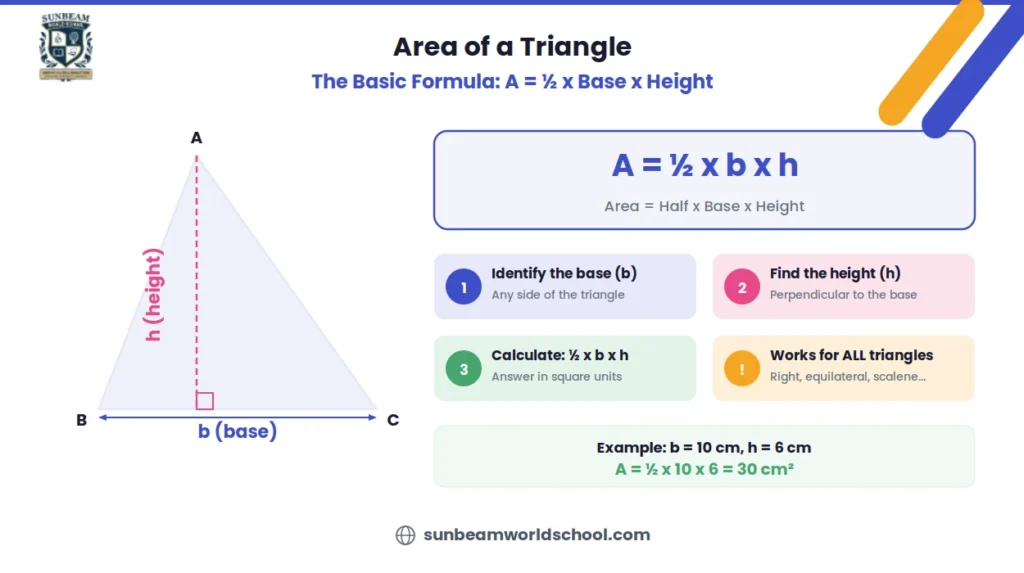
The basic area of a triangle formula: A = ½ x base x height,
The standard formula for the area of a triangle is A = ½ x base x height, often written as A = ½bh. This formula exists because a triangle is exactly half of a parallelogram with the same base and height. In this formula, the base (b) is any one side of the triangle, and the height (h) is the perpendicular distance from that base to the opposite vertex. This is sometimes called the "half base times height" formula, and it works for every type of triangle: right-angled, equilateral, isosceles, scalene, acute, or obtuse.
To use this formula, follow three simple steps. First, identify the base of your triangle. Second, find the perpendicular height measured from the base to the opposite corner. Third, multiply the base by the height and divide the result by 2.
Example: If a triangle has a base of 10 cm and a height of 6 cm:
A = ½ x 10 x 6 = ½ x 60 = 30 cm²
The equation for area of a triangle can also be rearranged to find a missing dimension. If you know the area and the height, you can find the base using b = (2 x A) / h. If you know the area and the base, you can find the height using h = (2 x A) / b. These rearranged versions are especially useful in exam questions where the area is given and you need to work backwards.
| Formula | Use When |
|---|---|
| A = ½ x b x h | Base and height are known |
| b = (2 x A) / h | Area and height are known, find base |
| h = (2 x A) / b | Area and base are known, find height |
How to Find the Area of a Right Triangle?
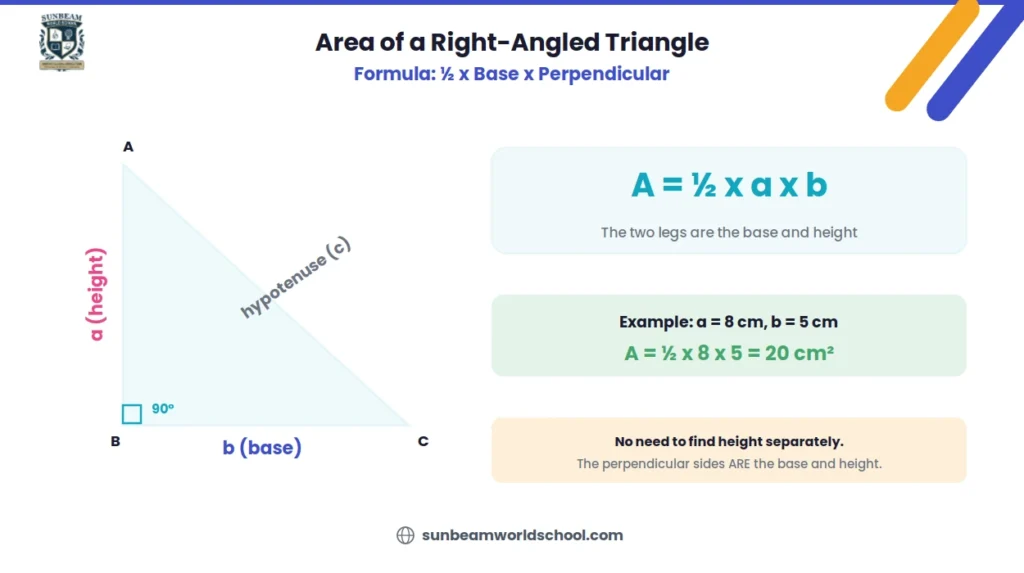
Area of a right-angled triangle: A = ½ x a x b,
The area of a right-angled triangle is calculated using the same ½bh formula, but with one useful shortcut: the two sides that form the right angle (the two legs) are always the base and the height. You do not need to calculate a separate perpendicular height because the legs are already perpendicular to each other.
Formula: A = ½ x base x perpendicular side
Example: A right-angled triangle has legs of 8 cm and 5 cm.
A = ½ x 8 x 5 = ½ x 40 = 20 cm²
If you are given the hypotenuse instead of both legs, you will need to use the Pythagorean theorem (a² + b² = c²) first to find the missing leg, and then apply the area formula.
How to Find the Area of an Equilateral Triangle?
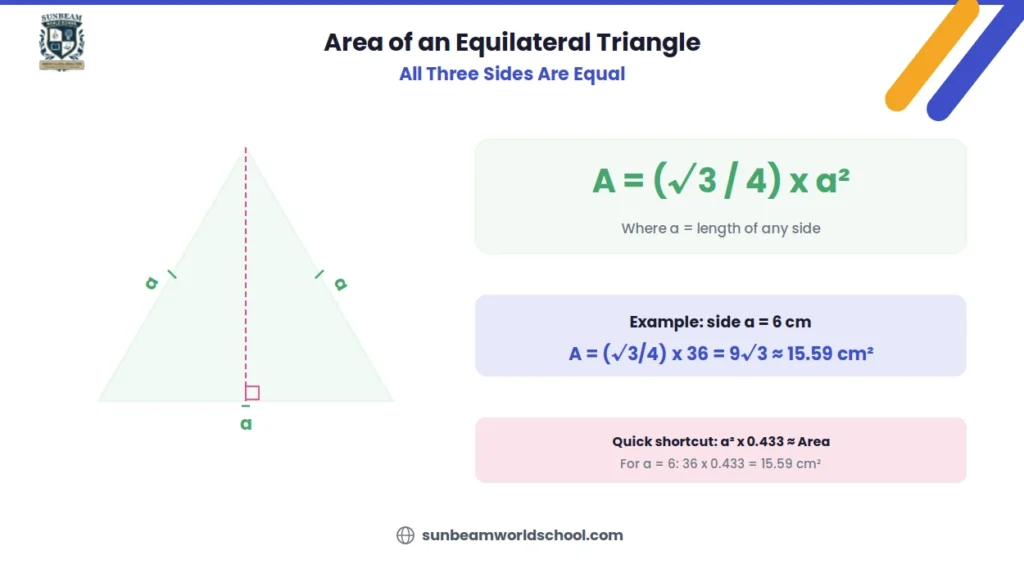
Area of an equilateral triangle: A = (√3/4) x a², where a is the length of any side.
The area of an equilateral triangle, where all three sides are equal in length, is calculated using the formula A = (√3/4) x a², where "a" is the length of any side. This formula is derived from the standard ½bh formula by calculating the height of an equilateral triangle using the Pythagorean theorem.
Formula: A = (√3/4) x a²
Example: Find the area of an equilateral triangle with side 6 cm.
A = (√3/4) x 6² = (√3/4) x 36 = 9√3 ≈ 15.59 cm²
A quick approximation shortcut: since √3/4 ≈ 0.433, you can multiply the side squared by 0.433 to get a fast estimate. For a side of 6 cm, that gives 36 x 0.433 = 15.59 cm², which matches the exact answer.
Example from PAA: What is the area of a triangle where every side is 5 units?
A = (√3/4) x 5² = (√3/4) x 25 = 25√3/4 ≈ 10.83 square units
How to Find the Area of an Isosceles Triangle?
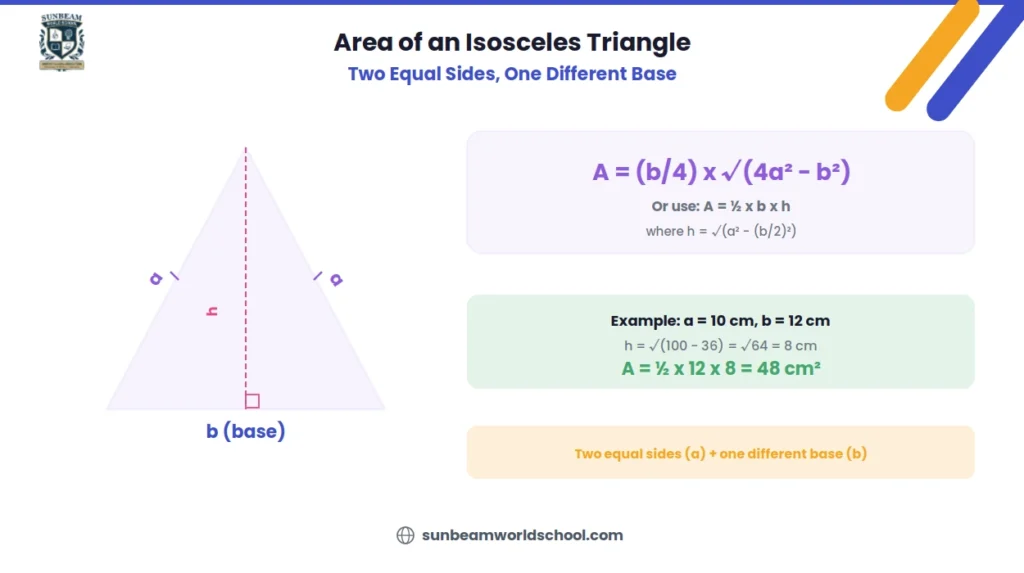
Area of an isosceles triangle: A = (b/4) x √(4a² - b²), or use A = ½ x b x h
The area of an isosceles triangle, where two sides are equal, can be calculated using the formula A = (b/4) x √(4a² - b²), where "a" is the length of one of the equal sides and "b" is the length of the base (the unequal side). This formula is derived by first finding the height using the Pythagorean theorem.
Formula: A = (b/4) x √(4a² - b²)
Alternatively, if you know the base and can calculate the height, you can simply use A = ½ x b x h, where the height h = √(a² - (b/2)²).
Example: An isosceles triangle has equal sides of 10 cm each and a base of 12 cm.
Step 1: Find the height: h = √(10² - 6²) = √(100 - 36) = √64 = 8 cm
Step 2: Find the area: A = ½ x 12 x 8 = 48 cm²
How to Find the Area of a Scalene Triangle?
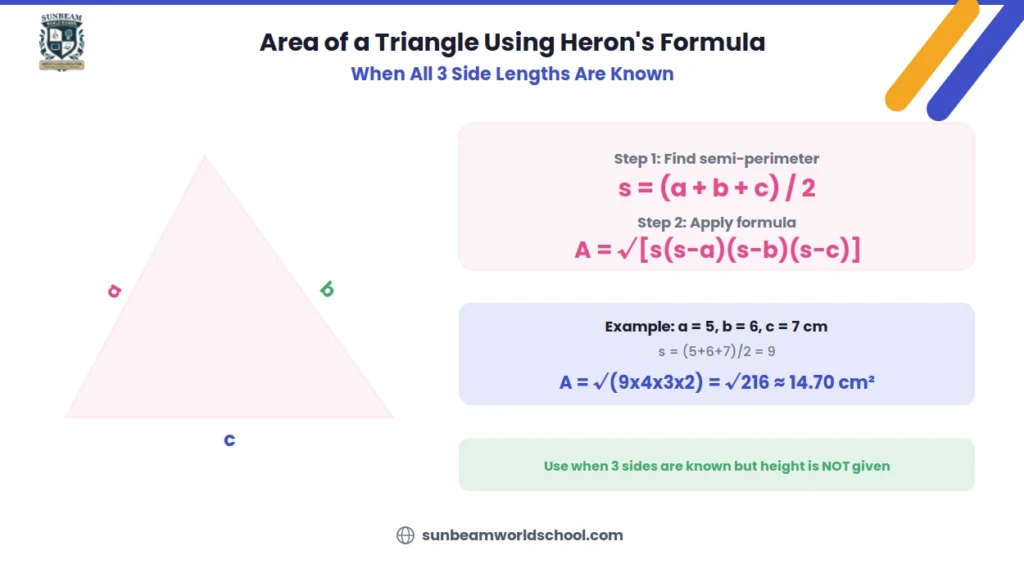
Heron's formula: A = √[s(s-a)(s-b)(s-c)]
The area of a scalene triangle, where all three sides have different lengths, is most easily calculated using Heron's formula since you typically cannot identify the height directly from the given measurements. If the height is provided, you can still use the standard A = ½bh formula, but in most exam questions involving scalene triangles, only the three side lengths are given.
Example: A scalene triangle has sides of 7 cm, 8 cm, and 9 cm. Using Heron's formula (explained in the next section):
s = (7 + 8 + 9) / 2 = 12
A = √(12 x 5 x 4 x 3) = √720 ≈ 26.83 cm²
How to Find the Area of a Triangle With 3 Sides?
Heron's formula lets you find the area of any triangle when you know the lengths of all three sides but do not know the height. This is one of the most important formulas for exam preparation because many problems give only the side lengths and expect you to calculate the area without measuring or constructing a perpendicular.
Step 1: Find the semi-perimeter: s = (a + b + c) / 2. The "s" in Heron's formula stands for semi-perimeter, which is simply half of the total perimeter of the triangle.
Step 2: Apply Heron's formula: A = √[s(s - a)(s - b)(s - c)]
Example: A triangle has sides a = 5 cm, b = 6 cm, and c = 7 cm.
s = (5 + 6 + 7) / 2 = 9
A = √[9 x (9-5) x (9-6) x (9-7)] = √[9 x 4 x 3 x 2] = √216 ≈ 14.70 cm²
Heron's formula works for every type of triangle: equilateral, isosceles, and scalene. It is especially useful when you cannot determine the height from the given information, which is why it appears so frequently in CBSE, ICSE, and competitive exam questions.
How to Calculate the Area of a Triangle Without Height?
When the height of a triangle is not given, you have three alternative methods to find the area depending on what information is available.
Method 1: Heron's formula (three sides known) If you know all three sides, use s = (a + b + c) / 2 and then A = √[s(s - a)(s - b)(s - c)]. This is the most common method for finding area without height.
Method 2: SAS formula (two sides and the included angle known) If you know two sides and the angle between them, use A = ½ x a x b x sinC, where a and b are the two known sides and C is the included angle.
Method 3: Coordinate formula (three vertices known) If you know the coordinates of all three vertices, use the coordinate geometry formula explained in the next section.
The key takeaway is that the height is not always required to calculate the area of a triangle. Depending on the information given in the question, one of these three methods will always work.
How to Find the Area of a Triangle Using Coordinates?
The area of a triangle in coordinate geometry is calculated using the formula A = ½ |x₁(y₂ - y₃) + x₂(y₃ - y₁) + x₃(y₁ - y₂)|, where (x₁, y₁), (x₂, y₂), and (x₃, y₃) are the coordinates of the three vertices.
Formula: A = ½ |x₁(y₂ - y₃) + x₂(y₃ - y₁) + x₃(y₁ - y₂)|
Example: Find the area of a triangle whose vertices are A(1, 2), B(4, 6), and C(7, 2).
A = ½ |1(6 - 2) + 4(2 - 2) + 7(2 - 6)|
A = ½ |1(4) + 4(0) + 7(-4)|
A = ½ |4 + 0 - 28|
A = ½ |-24| = ½ x 24 = 12 square units
This formula is derived from the concept of the determinant of a matrix and is widely used in coordinate geometry problems in Class 10 and Class 12 maths examinations. If the result of the formula is zero, it means the three points are collinear (they lie on a single straight line and do not form a triangle).
What Is ½absinC and How Is It Used?
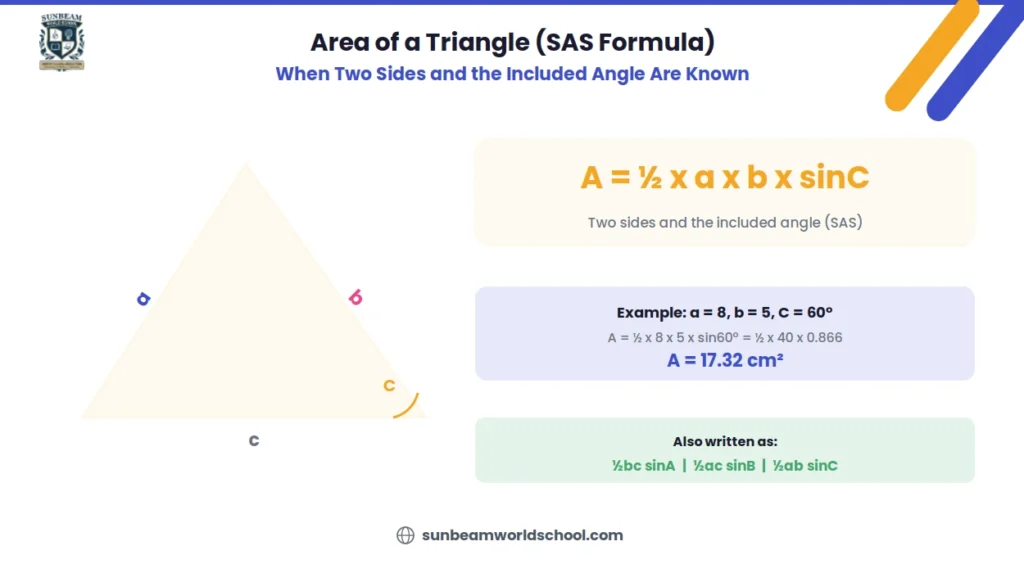
SAS formula: A = ½ x a x b x sinC
The area of a triangle when two sides and the included angle are known is calculated using the SAS (Side-Angle-Side) formula: A = ½ x a x b x sinC. In this formula, "a" and "b" are the two known sides, and C is the angle between them.
Formulas (depending on which angle is known):
A = ½ x b x c x sinA
A = ½ x a x c x sinB
A = ½ x a x b x sinC
Example: Two sides of a triangle are 8 cm and 5 cm, and the included angle is 60°.
A = ½ x 8 x 5 x sin60° = ½ x 40 x (√3/2) = ½ x 40 x 0.866 = 17.32 cm²
The ½absinC formula is used whenever you have two sides and the angle between them. It is particularly useful in trigonometry problems and appears regularly in Class 11 and Class 12 maths papers.
What Is the Difference Between Area and Perimeter of a Triangle?
The area and perimeter of a triangle are two different measurements that students sometimes confuse. The area measures the space inside the triangle (in square units), while the perimeter measures the total length of the boundary (in linear units). The formula of perimeter of triangle is simply the sum of all three sides: P = a + b + c.
| Measurement | Formula | Unit | What It Measures |
|---|---|---|---|
| Area | A = ½ x b x h | cm², m², in² | Space enclosed inside |
| Perimeter | P = a + b + c | cm, m, in | Total boundary length |
How to find the perimeter of a triangle: Add the lengths of all three sides together. For example, if a triangle has sides of 5 cm, 7 cm, and 9 cm, the perimeter is 5 + 7 + 9 = 21 cm.
How to calculate the perimeter of a triangle when one side is missing: If the triangle is right-angled, use the Pythagorean theorem to find the missing side first. If two sides and an angle are known, use the cosine rule: c² = a² + b² - 2ab cosC.
Example: A triangle has sides 5 cm, 12 cm, and 13 cm, with a height of 4.62 cm to the base of 13 cm.
Perimeter = 5 + 12 + 13 = 30 cm
Area = ½ x 13 x 4.62 = 30.03 cm²
Notice that in this example the perimeter and the area happen to be numerically close (30 and 30.03), but they represent completely different things: 30 cm of boundary length versus 30.03 cm² of enclosed space. Understanding this distinction is important for solving word problems correctly and is a common point of confusion in foundation-level maths.
All Triangle Area Formulas at a Glance
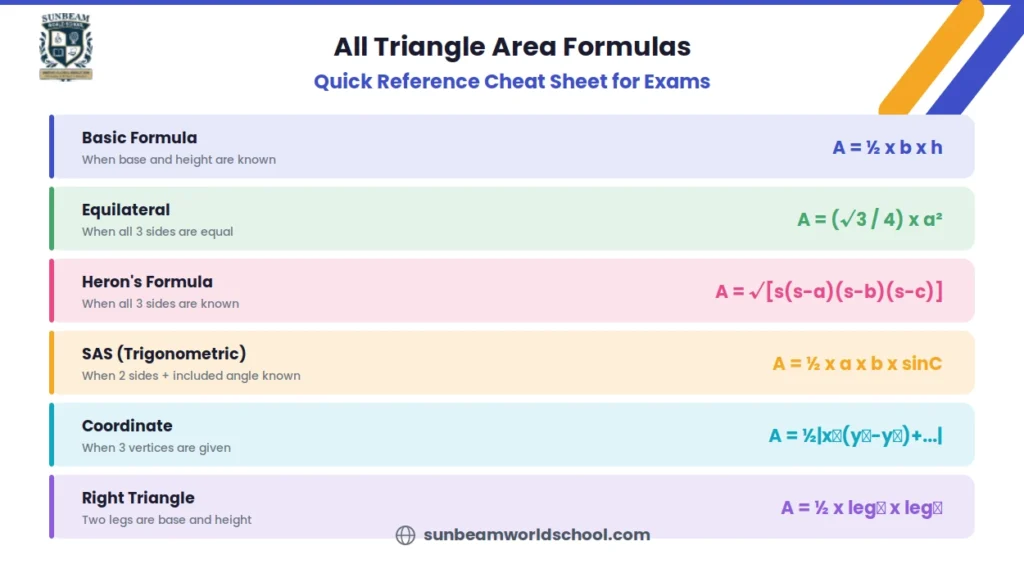
All six triangle area formulas in one cheat sheet: ½bh, √3/4 x a², Heron's, ½absinC, coordinate, and right triangle.
Every formula for finding the area of a triangle covered in this guide is summarised in the table below. Bookmark this section for quick revision before exams.
| Formula | When to Use | Variables |
|---|---|---|
| A = ½ x b x h | Base and height are known | b = base, h = height |
| A = (√3/4) x a² | Equilateral triangle (side known) | a = side |
| A = (b/4)√(4a² - b²) | Isosceles triangle (sides known) | a = equal side, b = base |
| A = √[s(s-a)(s-b)(s-c)] | Three sides known (Heron's) | s = semi-perimeter |
| A = ½ x a x b x sinC | Two sides and included angle (SAS) | a, b = sides, C = angle |
| A = ½|x₁(y₂-y₃)+x₂(y₃-y₁)+x₃(y₁-y₂)| | Three vertices known (coordinate) | (x₁,y₁), (x₂,y₂), (x₃,y₃) |
Remembering which formula to use depends entirely on what information the question gives you. If you have the base and height, use ½bh. If you have three sides but no height, use Heron's formula. If you have two sides and the angle between them, use ½absinC. If you have coordinates, use the coordinate formula. Practising problems with each formula builds the habit of identifying the right approach quickly, which is exactly what examiners test for. For more on building effective study habits around formula-heavy subjects, check our dedicated guide.
Solved Examples on Area of a Triangle
Example 1: Find the area of a triangle with base 14 cm and height 9 cm.
A = ½ x 14 x 9 = ½ x 126 = 63 cm²
Example 2: An equilateral triangle has a side of 8 cm. Find its area.
A = (√3/4) x 8² = (√3/4) x 64 = 16√3 ≈ 27.71 cm²
Example 3: Find the area of a triangle with sides 10 cm, 12 cm, and 14 cm using Heron's formula.
s = (10 + 12 + 14) / 2 = 18
A = √[18 x 8 x 6 x 4] = √3456 ≈ 58.79 cm²
Example 4: Two sides of a triangle are 7 cm and 10 cm, and the included angle is 45°. Find the area.
A = ½ x 7 x 10 x sin45° = ½ x 70 x 0.707 = 24.75 cm²
Example 5: Find the area of a triangle with vertices P(2, 3), Q(5, 7), and R(8, 1).
A = ½ |2(7 - 1) + 5(1 - 3) + 8(3 - 7)|
A = ½ |12 + (-10) + (-32)| = ½ |-30| = 15 square units
Practice Questions on Area of a Triangle (With Answers)
Test your understanding with these 15 questions. Try solving each one on your own before checking the answer. Consistent practice with different formula types is one of the habits that separates top 1% students from the rest.
Q1. A triangle has a base of 16 cm and a height of 7 cm. Find its area.
Answer: A = ½ x 16 x 7 = 56 cm²
Q2. A triangle has a base of 9.5 cm and a height of 4 cm. Find its area.
Answer: A = ½ x 9.5 x 4 = 19 cm²
Q3. The area of a triangle is 42 cm² and its height is 12 cm. Find the base.
Answer: b = (2 x 42) / 12 = 84 / 12 = 7 cm
Q4. The area of a triangle is 60 cm² and its base is 15 cm. Find the height.
Answer: h = (2 x 60) / 15 = 120 / 15 = 8 cm
Q5. A right-angled triangle has legs of 6 cm and 10 cm. Find its area.
Answer: A = ½ x 6 x 10 = 30 cm²
Q6. Find the area of an equilateral triangle with side 12 cm.
Answer: A = (√3/4) x 12² = (√3/4) x 144 = 36√3 ≈ 62.35 cm²
Q7. The area of an equilateral triangle is 25√3 cm². Find the length of each side.
Answer: 25√3 = (√3/4) x a², so a² = 100, therefore a = 10 cm
Q8. An isosceles triangle has two equal sides of 13 cm and a base of 10 cm. Find its area.
Answer: h = √(13² - 5²) = √(169 - 25) = √144 = 12 cm. Area = ½ x 10 x 12 = 60 cm²
Q9. A triangle has sides of 8 cm, 11 cm, and 13 cm. Find its area using Heron's formula.
Answer: s = (8 + 11 + 13) / 2 = 16. A = √(16 x 8 x 5 x 3) = √1920 ≈ 43.82 cm²
Q10. A triangular park has sides of 40 m, 30 m, and 50 m. Find the area of the park.
Answer: s = (40 + 30 + 50) / 2 = 60. A = √(60 x 20 x 30 x 10) = √360000 = 600 m²
Q11. Two sides of a triangle are 9 cm and 12 cm and the included angle is 30°. Find the area.
Answer: A = ½ x 9 x 12 x sin30° = ½ x 108 x 0.5 = 27 cm²
Q12. Find the area of a triangle with vertices A(0, 0), B(6, 0), and C(3, 4).
Answer: A = ½ |0(0 - 4) + 6(4 - 0) + 3(0 - 0)| = ½ |0 + 24 + 0| = 12 square units
Q13. A triangle has sides 5 cm, 5 cm, and 6 cm. Find its area without using the height directly.
Answer: s = (5 + 5 + 6) / 2 = 8. A = √(8 x 3 x 3 x 2) = √144 = 12 cm²
Q14. In a triangle, two sides are 10 cm and 14 cm, and the included angle is 90°. Find the area.
Answer: A = ½ x 10 x 14 x sin90° = ½ x 140 x 1 = 70 cm²
Q15. A triangular garden has a base of 25 m and an area of 200 m². A fence needs to be built along the height. How tall is the fence?
Answer: h = (2 x 200) / 25 = 400 / 25 = 16 m
Conclusion
Understanding the area of a triangle across all its formula variations is one of the most valuable skills in school mathematics, and regular practice with each method builds the speed and confidence needed for exams. At Sunbeam World School, mathematical concepts like these are taught through step-by-step problem-solving, visual explanations, and personalised practice that help every student build a strong foundation from the ground up.

Frequently Asked Questions
What is the formula for the area of a triangle?
-The most commonly used formula for the area of a triangle is A = ½ x base x height. You multiply the base of the triangle by its perpendicular height and then divide the result by two. The answer is always in square units.
What is the area of triangle ABC?
+What is ½absinC used for?
+How do you calculate the area of a triangle without knowing the height?
+What is the area of a right-angle triangle?
+How to find the area of an equilateral triangle?
+What is the area of a triangle where every side is 5 units?
+What is the area of Δ (delta)?
+How do you find the missing dimension of a triangle?
+How to find the base of a triangle?
+How do you find the area of a triangle using coordinates?
+Can the area of a triangle be negative?
+
In this article
Share this post:


Press and Blogs
Stay updated with our press releases, educational blogs, and more.

Quick Summary Animal sounds are the noises animals make to communicate, warn of danger and...

Quick Summary An algebra equation is a maths statement that sets two expressions equal using...

Quick Summary Essential Repeat (ER) in CBSE means a student has not met the passing...