
 Kids Learning
(a + b)³ & (a − b)³ Formula: Whole Cube Identities & Examples
| Quick Answer:
The (a + b)³ formula, or a plus b whole cube formula, is (a + b)³ = a³ + 3a²b + 3ab² + b³, compactly a³ + b³ + 3ab(a + b). The related a minus b whole cube formula is (a − b)³ = a³ − 3a²b + 3ab² − b³, compactly a³ − b³ − 3ab(a − b). Both expand the cube of a two-term expression, with signs alternating in the second. |
The (a + b)³ formula, known as the a plus b whole cube formula, is one of the most important algebraic identities you'll ever use. It states that (a + b)³ = a³ + 3a²b + 3ab² + b³, and it shows up everywhere: expanding brackets, simplifying expressions, and even cubing numbers in your head.
This guide covers both the (a + b)³ formula and the a minus b whole cube formula (a − b)³ in full, along with a clean step-by-step proof, solved examples, and every closely related cube identity — (a + b + c)³ and the sum and difference of cubes (a³ + b³ and a³ − b³) — all explained simply in one place.
What Is the (a + b)³ Formula?
The (a + b)³ formula gives the expanded form of the cube of a binomial (a + b). In words, “a plus b, whole cubed” means you multiply the binomial by itself three times: (a + b) × (a + b) × (a + b). Carrying out that multiplication produces four terms:
| (a + b)3 = a3 + 3a2b + 3ab2 + b3
A Plus B Whole Cube Formula |
There is also a compact (factored) form of the same identity that is extremely handy for mental maths and for connecting the cube to the sum of cubes:
| (a + b)3 = a3 + b3 + 3ab(a + b)
Compact form of a b cube formula |
Notice the structure of the full expansion: the powers of a decrease from 3 to 0 while the powers of b increase from 0 to 3, and the middle coefficients are both 3. This “1 – 3 – 3 – 1” coefficient pattern comes straight from the third row of Pascal’s triangle, which is why the same pattern appears in every binomial cube.
Proof / Derivation of the (a + b)³ Formula
If you go for Major subjects in class 11, such as Maths, you do not need to memorize the a plus b whole cube formula blindly — it can be derived in three short steps by writing the cube as a square times the binomial.
- Write the cube as a product of a square and the binomial:
(a + b)³ = (a + b)² × (a + b)
- Replace the square with the known identity (a + b)² = a² + 2ab + b²:
(a + b)³ = (a² + 2ab + b²)(a + b)
- Multiply each term by (a + b) and collect like terms:
a²·a + a²·b + 2ab·a + 2ab·b + b²·a + b²·b
= a³ + a²b + 2a²b + 2ab² + ab² + b³
= a³ + 3a²b + 3ab² + b³
Grouping the two middle terms gives the compact form: a³ + 3a²b + 3ab² + b³ = a³ + b³ + 3ab(a + b). This proof works for any numbers or expressions you substitute for a and b, which is what makes it an identity rather than just an equation.
The (a − b)³ Formula (A Minus B Whole Cube / a-b Whole Cube)
The a minus b whole cube identity follows the same pattern as (a + b)³, except the terms containing an odd power of b become negative. You can get it directly by replacing b with −b in the a b whole cube formula.
| (a − b)3 = a3 − 3a2b + 3ab2 − b3
A Minus B Whole Cube Formula |
Its compact form is (a − b)³ = a³ − b³ − 3ab(a − b). Notice that the signs alternate: positive, negative, positive, negative.
The (a + b + c)³ Formula (A B C Whole Cube)
Cubing a trinomial — the a b c whole cube — looks intimidating but has a neat factored form:
| (a + b + c)3 = a3 + b3 + c3 + 3(a + b)(b + c)(c + a)
A Plus B Plus C Whole Cube Formula |
Written out fully, the expansion is:
| a3 + b3 + c3 + 3a2b + 3a2c + 3b2a + 3b2c + 3c2a + 3c2b + 6abc |
| Related identity ("a cube plus b cube plus c cube ka sutra"): a³ + b³ + c³ − 3abc = (a + b + c)(a² + b² + c² − ab − bc − ca). A useful special case: if a + b + c = 0, then a³ + b³ + c³ = 3abc. |
Sum and Difference of Cubes: a³ + b³ and a³ − b³
The a plus b whole cube formula not only improves academic performance but also strengthens the analytical thinking skills needed for future success in science, technology, engineering, and mathematics (STEM) fields.
Students often confuse the whole-cube expansions above with the sum-of-cubes and difference-of-cubes factoring formulas. These are different identities — one expands a cube, the other factorises a sum or difference of two cubes.
| a3 + b3 = (a + b)(a2 − ab + b2)
Sum of cubes — a³ + b³ formula a3 − b3 = (a − b)(a2 + ab + b2) Difference of cubes — a³ − b³ formula |
These two are tied directly to the a plus b whole cube formula through the relationship a³ + b³ = (a + b)³ − 3ab(a + b) and a³ − b³ = (a − b)³ + 3ab(a − b). A handy way to remember the quadratic factor: square the first, change the sign of the product, square the last (the “SOAP” pattern — Same, Opposite, Always Positive).
Cube of a Binomial (Binomial Cubed Formula)
The (a + b)³ and (a − b)³ identities are specific cases of the general cube of a binomial. For any binomial (x + y), the binomial cubed formula is the same 1–3–3–1 pattern:
| (x + y)3 = x3 + 3x2y + 3xy2 + y3
Cube of binomial formula |
This is also the general cubed formula you apply whenever a single bracketed term is raised to the power 3 — for example the x cube formula (x + a)³ or any expression of the form (term₁ + term₂)³.
All Cube Formulas in One Table
This quick-reference table collects every cube identity covered on this page, so you can revise the full cubing formula set at a glance.
| Cube Identity | Formula |
| (a + b)³ | a³ + 3a²b + 3ab² + b³ = a³ + b³ + 3ab(a + b) |
| (a − b)³ | a³ − 3a²b + 3ab² − b³ = a³ − b³ − 3ab(a − b) |
| (a + b + c)³ | a³ + b³ + c³ + 3(a + b)(b + c)(c + a) |
| a³ + b³ | (a + b)(a² − ab + b²) |
| a³ − b³ | (a − b)(a² + ab + b²) |
| a³ + b³ + c³ − 3abc | (a + b + c)(a² + b² + c² − ab − bc − ca) |
Solved Examples Using the (a + b)³ Formula
The fastest way to master the a b whole cube formula is to apply it. Work through these, then try covering the answer and solving them yourself.
Example 1 — Expand (x + 2)³
Use (a + b)³ with a = x, b = 2: x³ + 3(x²)(2) + 3(x)(2²) + 2³ = x³ + 6x² + 12x + 8
Answer: (x + 2)³ = x³ + 6x² + 12x + 8
Example 2 — Expand (2x + 3y)³
Use (a + b)³ with a = 2x, b = 3y: (2x)³ + 3(2x)²(3y) + 3(2x)(3y)² + (3y)³ = 8x³ + 3(4x²)(3y) + 3(2x)(9y²) + 27y³ = 8x³ + 36x²y + 54xy² + 27y³
Answer: 8x³ + 36x²y + 54xy² + 27y³
Example 3 — Find 11³ mentally using (10 + 1)³
Use (a + b)³ with a = 10, b = 1: 10³ + 3(10²)(1) + 3(10)(1²) + 1³ = 1000 + 300 + 30 + 1 = 1331
Answer: 11³ = 1331
Example 4 — Expand (3x − 2)³
Use (a − b)³ with a = 3x, b = 2: (3x)³ − 3(3x)²(2) + 3(3x)(2²) − 2³ = 27x³ − 54x² + 36x − 8
Answer: 27x³ − 54x² + 36x − 8
Example 5 — If a + b = 5 and ab = 6, find a³ + b³
Use a³ + b³ = (a + b)³ − 3ab(a + b): = 5³ − 3(6)(5) = 125 − 90 = 35
Answer: a³ + b³ = 35
How the Cube Formula Links to the Volume of a Cube
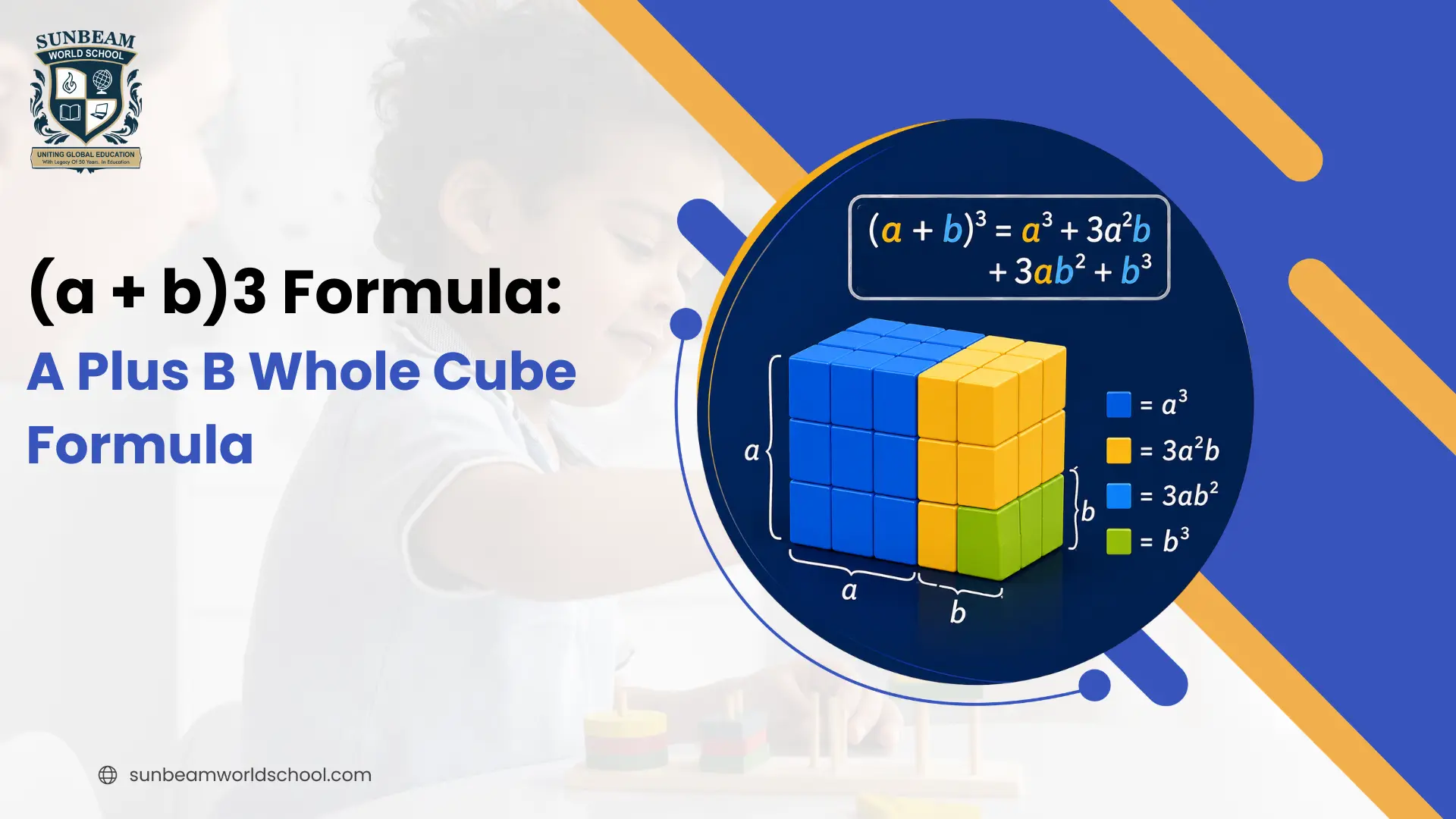
The word “cube” connects algebra to geometry. The volume of a cube with side length s is V = s³. If that side is itself a sum — say a side of length (a + b) — then the volume is (a + b)³, and the four terms of the expansion correspond to the eight smaller boxes that fit inside the large cube: one a³ cube, one b³ cube, three slabs of size a²b, and three slabs of size ab². This geometric picture is exactly why the a plus b whole cube formula has its 1–3–3–1 structure, and it is a great way to visualise the identity rather than memorise it.
Common Mistakes to Avoid
- Writing (a + b)³ = a³ + b³. This is the single most common error. You must include both middle terms, 3a²b and 3ab².
- Mixing up the sign pattern in (a − b)³. Remember the signs alternate + − + −, so the b³ term is negative.
- Confusing whole cubes with sums of cubes. (a + b)³ expands a cube; a³ + b³ factorises into (a + b)(a² − ab + b²). They are not interchangeable.
- Dropping the coefficient when a or b has its own coefficient. In (2x + 3y)³, you must cube and square the full terms 2x and 3y, not just x and y.
Conclusion
Master the a b whole cube formula and the related cube identities, and a huge portion of algebra suddenly becomes faster and more intuitive, from expanding binomials to mental-maths shortcuts and exam-level factorization.
The key is to practice: work through the examples, recognize the 1–3–3–1 pattern, and never confuse a whole cube like (a + b)³ with a sum of cubes like a³ + b³.
For clearer, exam-focused maths explainers like this one, explore the learning resources from Sunbeam World School, where strong fundamentals are built one formula at a time.

Frequently Asked Questions
What is the formula for (a + b)³?
-The (a + b)³ formula, or a plus b whole cube formula, is (a + b)³ = a³ + 3a²b + 3ab² + b³. It can also be written compactly as a³ + b³ + 3ab(a + b).
What is the (a − b)³ formula?
+What is the difference between (a + b)³ and a³ + b³?
+What is the formula of a³ + b³ and a³ − b³?
+What is the (a + b + c)³ formula?
+What is "a cube plus b cube plus c cube ka sutra"?
+Is (a + b)³ equal to a³ + b³?
+How do you derive the (a + b)³ formula?
+
In this article
Share this post:


Press and Blogs
Stay updated with our press releases, educational blogs, and more.

Quick Summary Animal sounds are the noises animals make to communicate, warn of danger and...

Quick Summary The area of rectangle equals its length multiplied by its width (A =...

Quick Summary Sympathy means feeling sorry for someone from your own point of view. Empathy...