
 Education
What Is Activity-Based Learning (ABL)? Benefits, Examples & Importance
Quick Summary Activity-Based Learning (ABL) is a teaching approach in which children learn concepts through hands-on activities, group work, and real-life problem-solving instead of listening passively to lectures. It builds stronger retention, sharper critical thinking, and greater confidence because students experience ideas rather than just memorising them. Schools use it across every age group, from sorting blocks in preschool to running full projects in senior classes.
What Is Activity-Based Learning (ABL)?
Activity-Based Learning is a student-centered method of teaching where children acquire knowledge by doing rather than by sitting and listening. Instead of a teacher simply explaining a concept from the front of the room, students measure, build, role-play, experiment, or solve a real problem, and the concept sinks in through that experience.
This shift matters because a child who has actually balanced a seesaw to understand levers, or grown a bean plant to see photosynthesis in action, holds onto that knowledge far longer than one who has only read about it. The teacher's role changes too, moving from the sole source of information to a guide who designs activities, asks questions, and steps back so the child can explore. This same logic sits at the heart of what educators now call an activity-based curriculum, where hands-on tasks replace passive absorption as the primary way students learn.
Why Is Activity-Based Learning Important for Students?
The importance of Activity-Based Learning comes down to how it matches the way children's brains are actually wired to learn, through touching, seeing, moving, and experimenting, rather than through repetition alone. When a lesson engages several senses at once instead of just hearing, the brain builds stronger, more durable connections around that concept, which is a fundamentally different process from memorising something because a teacher said it aloud.
This is also why Activity-Based Learning has shifted from being an occasional classroom add-on to a core expectation in modern schools. Curiosity-driven, hands-on lessons keep children invested in ways that lecture-only teaching rarely manages, and that steady investment shows up later as better classroom participation, fewer behavioral issues, and a real interest in how something works rather than just what needs to be written down for an exam. Understood this way, the importance of ABL is less about any single skill it builds and more about the different, deeper kind of learning it makes possible in the first place.
What Are the Key Benefits of Activity-Based Learning?
The benefits of Activity-Based Learning extend well beyond a single subject or exam, shaping how a child thinks, works with others, and approaches new challenges for years afterward.
| Benefit | What It Looks Like in Practice |
|---|---|
| Stronger understanding and retention | Concepts learned through touch and movement are remembered longer than concepts only heard in a lecture |
| Critical thinking and problem-solving | Real, open-ended tasks force students to test ideas, fail, and adjust, building genuine reasoning skills |
| Boosted engagement and motivation | Students stay focused because they are working toward something they built or discovered themselves |
| Stronger social and collaborative skills | Group tasks require negotiation, listening, and shared responsibility that solo seatwork cannot teach |
| Greater confidence and independence | Every completed activity gives a child proof they can figure things out on their own |
Stronger Understanding and Retention
Concepts learned through direct experience are remembered far longer than those learned through listening alone. The brain encodes physical and sensory experiences more durably than spoken explanations. A student who has built a small bridge from ice-cream sticks to understand load and balance carries that mental picture into every future physics lesson on structures. This is closely tied to why schools increasingly use memory-building activities and games alongside traditional teaching, since active engagement strengthens recall in a way that passive review rarely matches.
Critical Thinking and Problem-Solving Skills
When a child is handed a real task rather than a worked example, they have to ask questions, test ideas, fail, adjust, and try again. And that repeated cycle is exactly what builds critical thinking. A group asked to design a water filter from household materials has to weigh trade-offs, argue for their approach, and revise it when it does not work the first time. These are the same foundational life skills that help a student make sound decisions well beyond the classroom, from managing time to evaluating conflicting information.
Boosted Engagement and Motivation
Students who are actively involved in a lesson rarely watch the clock, because they are working toward something they built or discovered themselves rather than absorbing information handed to them. This sense of ownership turns a classroom into a place children look forward to rather than one they endure, and self-motivated learners tend to put in more effort without needing constant prompting from a teacher.
Stronger Social and Collaborative Skills
Most activity-based tasks are done in groups, which means children have to negotiate roles, listen to differing opinions, and combine their strengths to reach a shared outcome. Over time, this builds communication, patience, and leadership in a way that individual seatwork simply cannot, since a child cannot finish a group project by working around their teammates.
Greater Confidence and Independence
Every activity a child completes on their own terms, even a small one, gives them proof that they can figure things out, and that proof adds up into real self-belief. Because ABL lets students work at their own pace and in their own way, it also reduces the fear of getting an answer wrong in front of the class, which in turn makes children more willing to take risks and ask questions.
What Are Some Real Activity-Based Learning Examples?
Activity-Based Learning looks different depending on a child's age, but the underlying idea, learning by doing, stays the same at every stage.
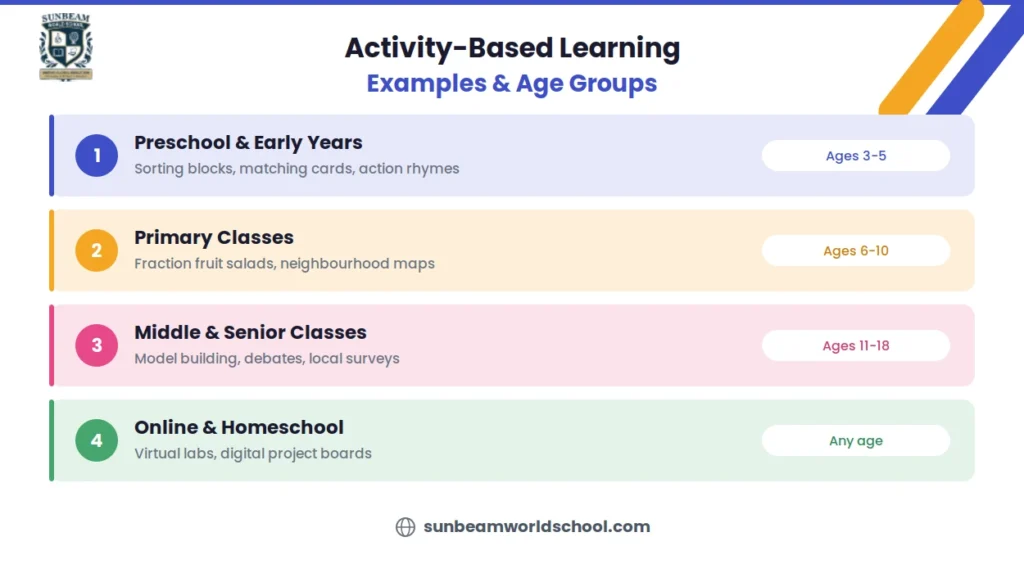
Real Activity-Based Learning examples for every age group
| Age Group | Example Activities |
|---|---|
| Preschool and early years | Sorting coloured blocks, matching animal flashcards, finger painting, singing rhymes with actions |
| Primary classes | Measuring ingredients for a fruit salad to learn fractions, drawing a neighbourhood map, acting out a moral story, using toy currency for maths |
| Middle and senior classes | Building a working model of a simple machine, running a local survey, debating current affairs, producing a short documentary |
| Online and homeschooling students | Virtual science simulations, collaborative digital project boards, guided kitchen experiments, family quiz nights |
Examples for Preschool and Early Years
At this stage, almost all learning happens through play: sorting coloured blocks by size, matching animal flashcards, singing rhymes with actions, or finger painting to explore colour mixing. These simple, sensory-rich activities build language, motor skills, and early number sense long before a child is ready for a worksheet, which is one reason early childhood education programmes lean so heavily on play-based methods.
Examples for Primary Classes
Primary students enjoy activities such as measuring ingredients to make a fruit salad while learning fractions, drawing a map of their neighbourhood for a geography lesson, or acting out a short skit to understand a moral story. Using beads, toy currency, or measuring cups instead of only numbers on a page turns abstract maths into something a child can physically hold and manipulate.
Examples for Middle and Senior Classes
Older students take on more complex, project-based work: building a working model of a simple machine, running a survey on water usage in their neighbourhood, debating a current affairs topic, or producing a short documentary on local history. These tasks combine research, presentation, and teamwork skills that a textbook chapter alone cannot teach.
Examples for Online and Homeschooling Students
Activity-Based Learning is not limited to a physical classroom. In an online or homeschool setting, it can take the form of virtual science simulations, collaborative digital boards where students build a project together in real time, guided kitchen experiments for chemistry basics, or family quiz nights that turn revision into a game. What matters is that the child is doing something with the concept, not simply watching a screen deliver it.
How Is Activity-Based Learning Different From Traditional Learning?
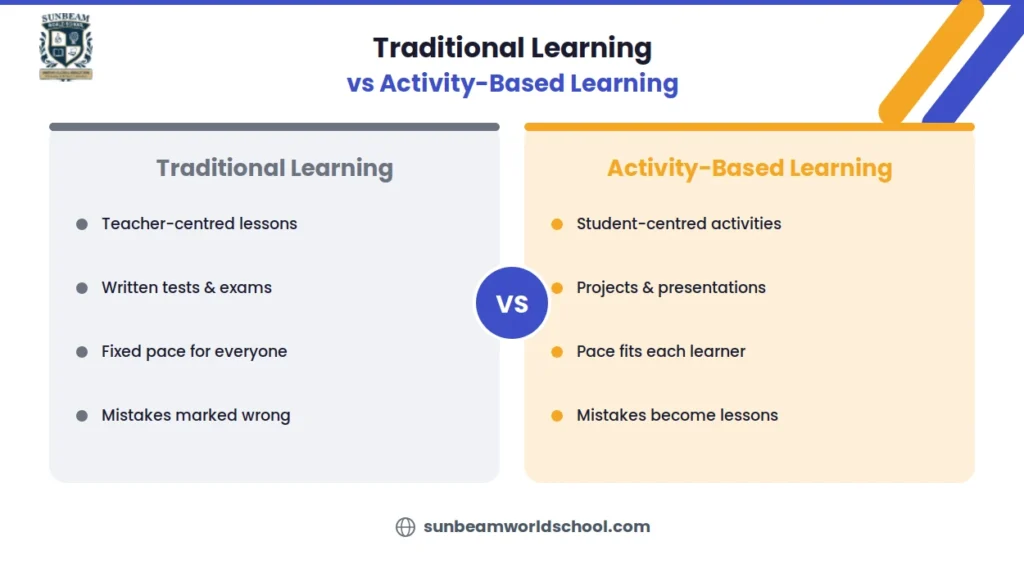
Traditional Learning vs Activity-Based Learning, side by side
Traditional learning is teacher-centered, with the teacher delivering information through lectures while students mostly listen, take notes, and are assessed through written exams. Activity-Based Learning flips this arrangement, the student does the work, the teacher steps into the role of facilitator.
| Aspect | Traditional Learning | Activity-Based Learning |
|---|---|---|
| Teaching approach | Teacher-centred, teacher delivers content | Student-centred, teacher facilitates |
| Student role | Listens and takes notes | Actively participates and explores |
| Assessment method | Written tests and exams | Projects, presentations, and observation |
| Focus | Academic results | Hands-on understanding and skills |
| Classroom environment | Structured, fixed seating | Flexible, activity-based spaces |
| Learning style | Lecture-based | Group-based, experiential |
| Pace of learning | Fixed, set by the syllabus timetable | Flexible, adjusted to how quickly a child grasps a concept |
| Role of mistakes | Often penalised on a test | Treated as part of the process, corrected through trial and revision |
The difference in teaching approach changes what actually happens in the room during a lesson. In a traditional classroom, the teacher plans the explanation, delivers it, and checks understanding through questions or a worksheet, so the student's main job is to absorb and retain what was said. In an activity-based classroom, the teacher instead plans a task, sets up the materials or problem, and then moves between groups asking guiding questions, so most of the actual thinking happens with the students rather than in front of them.
Assessment looks different for the same reason. A written exam is efficient to grade and compares every student against the same fixed set of questions, which is why it remains useful for checking factual recall and exam readiness. Project and presentation-based assessment in ABL takes longer to evaluate fairly, but it captures things a written test cannot, such as how a student reasons through an unfamiliar problem, how they respond when a first attempt fails, or how well they explain their thinking to a group.
The two approaches also treat mistakes very differently, and this has a real effect on how confident a child feels in class. Traditional assessment tends to penalise a wrong answer immediately, on a test, in front of a mark. Activity-Based Learning treats a failed first attempt at building a model or solving a problem as expected and useful, something to be revised rather than simply marked down, which is part of why students in activity-based settings are often more willing to attempt hard problems without fear of getting it wrong the first time.
Neither approach fully replaces the other in most schools today, since strong academic foundations from direct instruction still pair well with the deeper understanding that comes from hands-on practice.
What Are the Challenges of Activity-Based Learning?
Activity-Based Learning is not without friction, and schools that adopt it need to plan around a few real, practical difficulties rather than assume hands-on lessons run themselves.
| Challenge | What It Means in Practice |
|---|---|
| Assessment difficulties | Grading a project or presentation fairly takes more judgement than marking a written test against a fixed answer key |
| Classroom management | Multiple groups working on different tasks at once need active, constant guidance rather than a single lecture delivered to everyone |
| Time and planning demands | Designing a good activity, gathering materials, and observing every student's progress takes considerably longer than preparing a lecture |
| Resource and training needs | Teachers need specific facilitation skills, and schools need space, materials, and sometimes technology that traditional teaching does not require |
Assessment Difficulties
Grading a project, a group presentation, or a hands-on task fairly is genuinely harder than marking a written test against a fixed answer key, because a teacher has to judge reasoning, effort, and collaboration rather than simply checking whether an answer matches. Two students can reach the same correct outcome through very different levels of understanding, and a rubric has to be detailed enough to tell the difference. This is why schools that do ABL well invest time upfront in clear, consistent scoring criteria rather than judging each project on instinct alone.
Classroom Management
When several groups are working on different parts of a task at the same time, the room naturally gets louder and less predictable than it would during a single lecture delivered to everyone at once. A teacher has to move between groups, catch problems early, and keep every student meaningfully involved rather than letting one or two children in a group do all the work. Without a clear structure and firm time limits on each stage of the activity, this kind of session can drift into disorganised chaos rather than productive exploration.
Time and Planning Demands
Designing a good activity takes considerably longer than writing a lecture, since a teacher has to think through materials, likely mistakes, group sizes, and what a fair outcome even looks like before the lesson begins. Observing every student's progress during the activity, rather than just reviewing a stack of test papers afterward, also adds to the time a teacher spends on each topic. Over a full term, this workload adds up, which is one reason some schools use ABL for select topics rather than every single lesson.
Resource and Training Needs
Activity-Based Learning often needs materials, space, or technology that a lecture simply does not require, whether that is craft supplies for a primary class or a digital collaboration tool for an online lesson. Just as importantly, teachers need training in facilitation, in how to ask a guiding question instead of giving the answer, and in how to manage a room where the teacher is not the only source of information. Schools that skip this training tend to end up with activities that look busy but do not actually deepen understanding.
None of these challenges are reasons to avoid Activity-Based Learning altogether, but they do explain why some schools that claim to use it in their marketing do not actually practise it well in the classroom. The difference usually comes down to whether teachers have been properly trained in facilitation, whether lessons are planned with enough lead time, and whether the school has invested in the materials and space that hands-on learning genuinely needs.
How Does Activity-Based Learning Align With NEP 2020?
India's National Education Policy 2020 explicitly pushes schools away from rote memorisation and toward experiential, competency-based learning, which places Activity-Based Learning at the centre of how the policy expects children to be taught. The NCF 2023 built on this by asking schools to design lessons around what a child can actually do with a concept, not just what they can repeat on paper, a shift that is reshaping how curriculum design in Indian schools approaches every subject from science to language. For parents, this means a school that genuinely practises ABL is not simply following a trend; it is aligned with where Indian education policy is deliberately headed.
How Does Sunbeam World School Conduct Activity-Based Learning?
Being an online school does not stop Sunbeam World School from making Activity-Based Learning central to how classes run, it simply changes what the activity looks like.
The Engage-Explore-Explain-Elaborate-Evaluate Model
Lessons follow a step-by-step model, Engage, Explore, Explain, Elaborate, and Evaluate, that is built around students trying, questioning, and applying a concept rather than only hearing it explained once and moving on. A topic is first introduced through a question or a hook that gets students curious, then students explore it hands-on before the teacher formally explains the concept, and finally students elaborate on it through a task and are evaluated on how well they can apply it, not just recall it.
Project-Based and Collaborative Digital Activities
In practice, this shows up as project-based tasks, collaborative digital exercises, and live sessions where students work through a problem together instead of watching a one-way explanation, with lessons deliberately tied back to real, personal experiences so a concept has somewhere to attach itself. Breakout rooms and shared digital boards let a class split into small groups for an activity, then come back together to present what they found, mirroring the group dynamic of a physical classroom project without needing the same room.
AI-Integrated LMS and Personalised Pacing
An AI-integrated LMS supports this by personalising the pace and difficulty of activities for each learner, so a hands-on task can adjust to a child who needs more practice or one who is ready to move faster, something a single physical classroom activity often cannot do for every student at once. Recorded sessions and a parent dashboard also mean a child can revisit an activity or explanation as many times as needed, which keeps the learning-by-doing approach intact even for a concept that did not click the first time around.
This full learning approach is what lets an online, globally distributed school still deliver the kind of active, experiential learning that used to require a traditional classroom.
How Can Parents Support Activity-Based Learning at Home?
Parents can extend Activity-Based Learning well beyond school hours through simple, everyday actions rather than expensive kits or elaborate setups. Cooking together teaches measurement and basic chemistry, gardening introduces plant biology firsthand, and a board game after dinner can quietly build strategic thinking. Encouraging a child's questions instead of only checking their marks, and celebrating the effort behind an activity rather than just the result, does more for long-term learning than most people expect. Families exploring flexible, activity-rich home learning often find that this everyday, hands-on approach fits naturally alongside a structured academic curriculum.
Conclusion
Activity-Based Learning helps children learn by doing, exploring, and applying concepts rather than simply memorising them. At Sunbeam World School, engaging projects, collaborative activities, live classes, and AI-powered learning make education more interactive and personalised, even in an online setting. The result is a learning experience that builds understanding, confidence, curiosity, and real-world skills.

Frequently Asked Questions
What is Activity-Based Learning (ABL) in simple terms?
-Activity-Based Learning (ABL) is a teaching method where children learn concepts by doing hands-on activities like experiments, role-play, and group projects, instead of only listening to lectures. This approach makes understanding deeper and knowledge easier to remember over time.
What are the main benefits of Activity-Based Learning for students?
+What are some good examples of Activity-Based Learning?
+How is Activity-Based Learning different from traditional classroom teaching?
+Which age group benefits most from Activity-Based Learning?
+Can Activity-Based Learning work in an online or homeschooling setup?
+
In this article
Share this post:


Press and Blogs
Stay updated with our press releases, educational blogs, and more.

Quick Summary There are 25 prime numbers from 1 to 100: 2, 3, 5, 7,...

Quick Summary Roman numerals 1 to 1000, also called Roman numbers, use seven letters: I...

Quick Summary Animal sounds are the noises animals make to communicate, warn of danger and...