 Education
Roman Numerals 1 to 1000: Chart and Rules
Quick Summary Roman numerals 1 to 1000, also called Roman numbers, use seven letters: I (1), V (5), X (10), L (50), C (100), D (500) and M (1000), and numbers 1 to 100 need only the first five. You add a letter when it comes after a bigger one, as in VI = 6, and subtract it when it comes before a bigger one, as in IV = 4, so 50 is L, 99 is XCIX, 500 is D and 1000 is M.
Children meet Roman numerals every day on clock faces, book chapters and class names like Class VIII, and once they know five letters and one simple rule, every number up to 100 follows the same pattern. Below you will find the full chart, the rules, the mistakes to avoid, a list up to 1000 and a short practice set with answers.
What Are Roman Numerals?
Roman numerals are a number system from ancient Rome that uses seven letters, I, V, X, L, C, D and M, instead of digits to write numbers. Each letter has a fixed value, and letters are added or subtracted depending on their order, so XI is 11 while IX is 9. Roman numerals are also called Roman numbers, and they are still used today for clocks, chapters, names like Henry VIII and events like the Olympics.
What Is the Roman Numbers 1 to 100 Chart?
The Roman numbers 1 to 100 chart shows every number from 1 to 100 beside its Roman numeral, starting at I and ending at C. This Roman numerals chart covers Roman counting from one to hundred, so read each column from top to bottom to find any number.
| Number | Roman | Number | Roman | Number | Roman | Number | Roman |
|---|---|---|---|---|---|---|---|
| 1 | I | 26 | XXVI | 51 | LI | 76 | LXXVI |
| 2 | II | 27 | XXVII | 52 | LII | 77 | LXXVII |
| 3 | III | 28 | XXVIII | 53 | LIII | 78 | LXXVIII |
| 4 | IV | 29 | XXIX | 54 | LIV | 79 | LXXIX |
| 5 | V | 30 | XXX | 55 | LV | 80 | LXXX |
| 6 | VI | 31 | XXXI | 56 | LVI | 81 | LXXXI |
| 7 | VII | 32 | XXXII | 57 | LVII | 82 | LXXXII |
| 8 | VIII | 33 | XXXIII | 58 | LVIII | 83 | LXXXIII |
| 9 | IX | 34 | XXXIV | 59 | LIX | 84 | LXXXIV |
| 10 | X | 35 | XXXV | 60 | LX | 85 | LXXXV |
| 11 | XI | 36 | XXXVI | 61 | LXI | 86 | LXXXVI |
| 12 | XII | 37 | XXXVII | 62 | LXII | 87 | LXXXVII |
| 13 | XIII | 38 | XXXVIII | 63 | LXIII | 88 | LXXXVIII |
| 14 | XIV | 39 | XXXIX | 64 | LXIV | 89 | LXXXIX |
| 15 | XV | 40 | XL | 65 | LXV | 90 | XC |
| 16 | XVI | 41 | XLI | 66 | LXVI | 91 | XCI |
| 17 | XVII | 42 | XLII | 67 | LXVII | 92 | XCII |
| 18 | XVIII | 43 | XLIII | 68 | LXVIII | 93 | XCIII |
| 19 | XIX | 44 | XLIV | 69 | LXIX | 94 | XCIV |
| 20 | XX | 45 | XLV | 70 | LXX | 95 | XCV |
| 21 | XXI | 46 | XLVI | 71 | LXXI | 96 | XCVI |
| 22 | XXII | 47 | XLVII | 72 | LXXII | 97 | XCVII |
| 23 | XXIII | 48 | XLVIII | 73 | LXXIII | 98 | XCVIII |
| 24 | XXIV | 49 | XLIX | 74 | LXXIV | 99 | XCIX |
| 25 | XXV | 50 | L | 75 | LXXV | 100 | C |
[Image: Roman numerals 1 to 100 chart. Alt text: "Roman numbers 1 to 100 chart"]
Roman Numbers Converter [Embed converter widget here: type a number to get its Roman numeral, or type a Roman numeral to get the number.]
What Are the Roman Letters and Their Values?
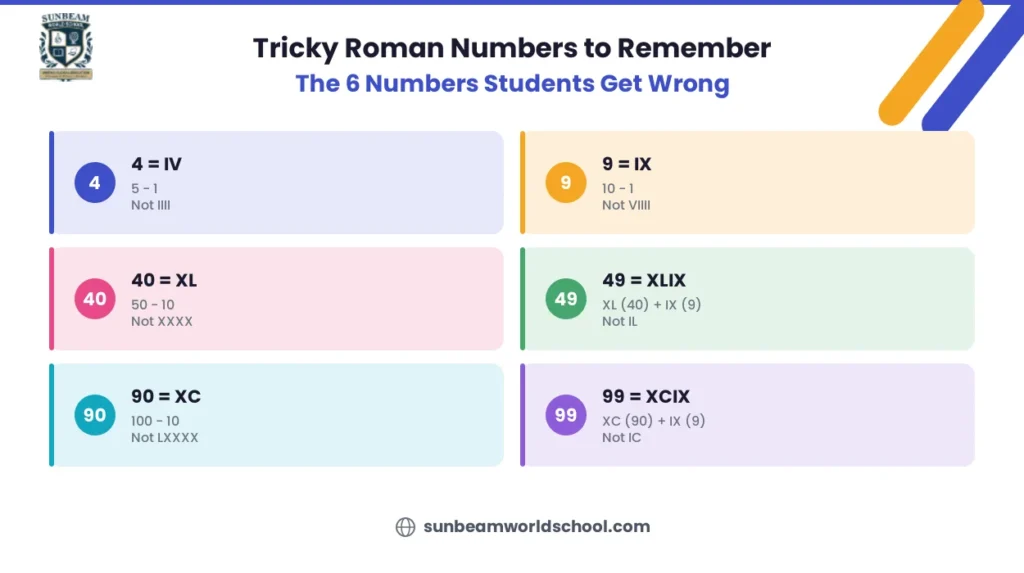
The six Roman numerals students get wrong most often.
The Roman letters are I, V, X, L, C, D and M, seven symbols with fixed values from which every Roman number is built. Only the first five are needed for numbers up to 100, while D and M appear in larger numbers.
| Letter | I | V | X | L | C | D | M |
|---|---|---|---|---|---|---|---|
| Value | 1 | 5 | 10 | 50 | 100 | 500 | 1000 |
How Do You Write Roman Numbers?

Three simple rules and one trick to write any Roman numeral.
You write Roman numbers with three rules: add, subtract, and never repeat a letter more than three times. Each rule is explained below with examples.
The Add Rule
A smaller or equal letter placed after a bigger one is added to it, so VI is 5 + 1 = 6. In the same way XII is 10 + 2 = 12 and LXX is 50 + 20 = 70, and most Roman numbers are written like this.
The Subtract Rule
A smaller letter placed before a bigger one is subtracted from it, so IV is 5 − 1 = 4 and XC is 100 − 10 = 90. Only six pairs work like this: IV (4), IX (9), XL (40), XC (90), CD (400) and CM (900).
The Repeat Rule
I, X, C and M can repeat up to three times, which is why 3 is III and 30 is XXX, but 4 has to be IV. V, L and D never repeat, and Roman numerals have no symbol for zero.
The Tens and Ones Trick
Any number up to 99 is written by splitting it into tens and ones, writing each part in Roman numerals and joining them. For example, 68 is 60 + 8, which gives LX + VIII = LXVIII, and this table holds every piece you will need.
| Ones | 1 | 2 | 3 | 4 | 5 | 6 | 7 | 8 | 9 |
|---|---|---|---|---|---|---|---|---|---|
| Roman | I | II | III | IV | V | VI | VII | VIII | IX |
| Tens | 10 | 20 | 30 | 40 | 50 | 60 | 70 | 80 | 90 |
| Roman | X | XX | XXX | XL | L | LX | LXX | LXXX | XC |
How Do You Read Roman Numerals?
You read Roman numerals from left to right, adding each value, and subtracting any letter that sits just before a bigger one. Spotting the subtraction pairs first, such as IX or XL, makes it quick.
| Roman numeral | Working | Number |
|---|---|---|
| XIV | X + IV = 10 + 4 | 14 |
| XXXIX | XXX + IX = 30 + 9 | 39 |
| XLV | XL + V = 40 + 5 | 45 |
| LXXVII | L + XX + VII = 50 + 20 + 7 | 77 |
| XCIX | XC + IX = 90 + 9 | 99 |
What Mistakes Do Students Make with Roman Numbers?
Students most often repeat a letter four times, subtract from a letter that is too big, or swap the order of a pair, which changes the number completely. These six numbers cause the most trouble.
| Number | Wrong | Correct | Why |
|---|---|---|---|
| 4 | IIII | IV | I cannot repeat four times |
| 9 | VIIII | IX | I cannot repeat four times |
| 40 | XXXX | XL | X cannot repeat four times |
| 49 | IL | XLIX | I can only be subtracted from V and X |
| 90 | LXXXX | XC | X cannot repeat four times |
| 99 | IC | XCIX | I can only be subtracted from V and X |
Order matters too, because XL is 40 while LX is 60, so always check whether the smaller letter comes before or after the bigger one.
What Are Roman Numbers 1 to 1000?
Roman numerals 1 to 1000 run from I to M, with D (500) halfway, and each number after 100 is a hundreds part plus a number from 1 to 99. For example, 245 is CC (200) + XLV (45), which gives CCXLV.
| Hundreds | 100 | 200 | 300 | 400 | 500 | 600 | 700 | 800 | 900 | 1000 |
|---|---|---|---|---|---|---|---|---|---|---|
| Roman | C | CC | CCC | CD | D | DC | DCC | DCCC | CM | M |
The full list from 101 to 1000 is below, with one table for each hundred.
Roman Numerals 101 to 200
Roman numerals 101 to 199 all start with C (100), so 101 is CI and 200 is CC.
| Number | Roman | Number | Roman | Number | Roman | Number | Roman |
|---|---|---|---|---|---|---|---|
| 101 | CI | 126 | CXXVI | 151 | CLI | 176 | CLXXVI |
| 102 | CII | 127 | CXXVII | 152 | CLII | 177 | CLXXVII |
| 103 | CIII | 128 | CXXVIII | 153 | CLIII | 178 | CLXXVIII |
| 104 | CIV | 129 | CXXIX | 154 | CLIV | 179 | CLXXIX |
| 105 | CV | 130 | CXXX | 155 | CLV | 180 | CLXXX |
| 106 | CVI | 131 | CXXXI | 156 | CLVI | 181 | CLXXXI |
| 107 | CVII | 132 | CXXXII | 157 | CLVII | 182 | CLXXXII |
| 108 | CVIII | 133 | CXXXIII | 158 | CLVIII | 183 | CLXXXIII |
| 109 | CIX | 134 | CXXXIV | 159 | CLIX | 184 | CLXXXIV |
| 110 | CX | 135 | CXXXV | 160 | CLX | 185 | CLXXXV |
| 111 | CXI | 136 | CXXXVI | 161 | CLXI | 186 | CLXXXVI |
| 112 | CXII | 137 | CXXXVII | 162 | CLXII | 187 | CLXXXVII |
| 113 | CXIII | 138 | CXXXVIII | 163 | CLXIII | 188 | CLXXXVIII |
| 114 | CXIV | 139 | CXXXIX | 164 | CLXIV | 189 | CLXXXIX |
| 115 | CXV | 140 | CXL | 165 | CLXV | 190 | CXC |
| 116 | CXVI | 141 | CXLI | 166 | CLXVI | 191 | CXCI |
| 117 | CXVII | 142 | CXLII | 167 | CLXVII | 192 | CXCII |
| 118 | CXVIII | 143 | CXLIII | 168 | CLXVIII | 193 | CXCIII |
| 119 | CXIX | 144 | CXLIV | 169 | CLXIX | 194 | CXCIV |
| 120 | CXX | 145 | CXLV | 170 | CLXX | 195 | CXCV |
| 121 | CXXI | 146 | CXLVI | 171 | CLXXI | 196 | CXCVI |
| 122 | CXXII | 147 | CXLVII | 172 | CLXXII | 197 | CXCVII |
| 123 | CXXIII | 148 | CXLVIII | 173 | CLXXIII | 198 | CXCVIII |
| 124 | CXXIV | 149 | CXLIX | 174 | CLXXIV | 199 | CXCIX |
| 125 | CXXV | 150 | CL | 175 | CLXXV | 200 | CC |
Roman Numerals 201 to 300
Roman numerals 201 to 299 all start with CC (200), so 201 is CCI and 300 is CCC.
| Number | Roman | Number | Roman | Number | Roman | Number | Roman |
|---|---|---|---|---|---|---|---|
| 201 | CCI | 226 | CCXXVI | 251 | CCLI | 276 | CCLXXVI |
| 202 | CCII | 227 | CCXXVII | 252 | CCLII | 277 | CCLXXVII |
| 203 | CCIII | 228 | CCXXVIII | 253 | CCLIII | 278 | CCLXXVIII |
| 204 | CCIV | 229 | CCXXIX | 254 | CCLIV | 279 | CCLXXIX |
| 205 | CCV | 230 | CCXXX | 255 | CCLV | 280 | CCLXXX |
| 206 | CCVI | 231 | CCXXXI | 256 | CCLVI | 281 | CCLXXXI |
| 207 | CCVII | 232 | CCXXXII | 257 | CCLVII | 282 | CCLXXXII |
| 208 | CCVIII | 233 | CCXXXIII | 258 | CCLVIII | 283 | CCLXXXIII |
| 209 | CCIX | 234 | CCXXXIV | 259 | CCLIX | 284 | CCLXXXIV |
| 210 | CCX | 235 | CCXXXV | 260 | CCLX | 285 | CCLXXXV |
| 211 | CCXI | 236 | CCXXXVI | 261 | CCLXI | 286 | CCLXXXVI |
| 212 | CCXII | 237 | CCXXXVII | 262 | CCLXII | 287 | CCLXXXVII |
| 213 | CCXIII | 238 | CCXXXVIII | 263 | CCLXIII | 288 | CCLXXXVIII |
| 214 | CCXIV | 239 | CCXXXIX | 264 | CCLXIV | 289 | CCLXXXIX |
| 215 | CCXV | 240 | CCXL | 265 | CCLXV | 290 | CCXC |
| 216 | CCXVI | 241 | CCXLI | 266 | CCLXVI | 291 | CCXCI |
| 217 | CCXVII | 242 | CCXLII | 267 | CCLXVII | 292 | CCXCII |
| 218 | CCXVIII | 243 | CCXLIII | 268 | CCLXVIII | 293 | CCXCIII |
| 219 | CCXIX | 244 | CCXLIV | 269 | CCLXIX | 294 | CCXCIV |
| 220 | CCXX | 245 | CCXLV | 270 | CCLXX | 295 | CCXCV |
| 221 | CCXXI | 246 | CCXLVI | 271 | CCLXXI | 296 | CCXCVI |
| 222 | CCXXII | 247 | CCXLVII | 272 | CCLXXII | 297 | CCXCVII |
| 223 | CCXXIII | 248 | CCXLVIII | 273 | CCLXXIII | 298 | CCXCVIII |
| 224 | CCXXIV | 249 | CCXLIX | 274 | CCLXXIV | 299 | CCXCIX |
| 225 | CCXXV | 250 | CCL | 275 | CCLXXV | 300 | CCC |
Roman Numerals 301 to 400
Roman numerals 301 to 399 all start with CCC (300), so 301 is CCCI and 400 is CD.
| Number | Roman | Number | Roman | Number | Roman | Number | Roman |
|---|---|---|---|---|---|---|---|
| 301 | CCCI | 326 | CCCXXVI | 351 | CCCLI | 376 | CCCLXXVI |
| 302 | CCCII | 327 | CCCXXVII | 352 | CCCLII | 377 | CCCLXXVII |
| 303 | CCCIII | 328 | CCCXXVIII | 353 | CCCLIII | 378 | CCCLXXVIII |
| 304 | CCCIV | 329 | CCCXXIX | 354 | CCCLIV | 379 | CCCLXXIX |
| 305 | CCCV | 330 | CCCXXX | 355 | CCCLV | 380 | CCCLXXX |
| 306 | CCCVI | 331 | CCCXXXI | 356 | CCCLVI | 381 | CCCLXXXI |
| 307 | CCCVII | 332 | CCCXXXII | 357 | CCCLVII | 382 | CCCLXXXII |
| 308 | CCCVIII | 333 | CCCXXXIII | 358 | CCCLVIII | 383 | CCCLXXXIII |
| 309 | CCCIX | 334 | CCCXXXIV | 359 | CCCLIX | 384 | CCCLXXXIV |
| 310 | CCCX | 335 | CCCXXXV | 360 | CCCLX | 385 | CCCLXXXV |
| 311 | CCCXI | 336 | CCCXXXVI | 361 | CCCLXI | 386 | CCCLXXXVI |
| 312 | CCCXII | 337 | CCCXXXVII | 362 | CCCLXII | 387 | CCCLXXXVII |
| 313 | CCCXIII | 338 | CCCXXXVIII | 363 | CCCLXIII | 388 | CCCLXXXVIII |
| 314 | CCCXIV | 339 | CCCXXXIX | 364 | CCCLXIV | 389 | CCCLXXXIX |
| 315 | CCCXV | 340 | CCCXL | 365 | CCCLXV | 390 | CCCXC |
| 316 | CCCXVI | 341 | CCCXLI | 366 | CCCLXVI | 391 | CCCXCI |
| 317 | CCCXVII | 342 | CCCXLII | 367 | CCCLXVII | 392 | CCCXCII |
| 318 | CCCXVIII | 343 | CCCXLIII | 368 | CCCLXVIII | 393 | CCCXCIII |
| 319 | CCCXIX | 344 | CCCXLIV | 369 | CCCLXIX | 394 | CCCXCIV |
| 320 | CCCXX | 345 | CCCXLV | 370 | CCCLXX | 395 | CCCXCV |
| 321 | CCCXXI | 346 | CCCXLVI | 371 | CCCLXXI | 396 | CCCXCVI |
| 322 | CCCXXII | 347 | CCCXLVII | 372 | CCCLXXII | 397 | CCCXCVII |
| 323 | CCCXXIII | 348 | CCCXLVIII | 373 | CCCLXXIII | 398 | CCCXCVIII |
| 324 | CCCXXIV | 349 | CCCXLIX | 374 | CCCLXXIV | 399 | CCCXCIX |
| 325 | CCCXXV | 350 | CCCL | 375 | CCCLXXV | 400 | CD |
Roman Numerals 401 to 500
Roman numerals 401 to 499 all start with CD (400), so 401 is CDI and 500 is D.
| Number | Roman | Number | Roman | Number | Roman | Number | Roman |
|---|---|---|---|---|---|---|---|
| 401 | CDI | 426 | CDXXVI | 451 | CDLI | 476 | CDLXXVI |
| 402 | CDII | 427 | CDXXVII | 452 | CDLII | 477 | CDLXXVII |
| 403 | CDIII | 428 | CDXXVIII | 453 | CDLIII | 478 | CDLXXVIII |
| 404 | CDIV | 429 | CDXXIX | 454 | CDLIV | 479 | CDLXXIX |
| 405 | CDV | 430 | CDXXX | 455 | CDLV | 480 | CDLXXX |
| 406 | CDVI | 431 | CDXXXI | 456 | CDLVI | 481 | CDLXXXI |
| 407 | CDVII | 432 | CDXXXII | 457 | CDLVII | 482 | CDLXXXII |
| 408 | CDVIII | 433 | CDXXXIII | 458 | CDLVIII | 483 | CDLXXXIII |
| 409 | CDIX | 434 | CDXXXIV | 459 | CDLIX | 484 | CDLXXXIV |
| 410 | CDX | 435 | CDXXXV | 460 | CDLX | 485 | CDLXXXV |
| 411 | CDXI | 436 | CDXXXVI | 461 | CDLXI | 486 | CDLXXXVI |
| 412 | CDXII | 437 | CDXXXVII | 462 | CDLXII | 487 | CDLXXXVII |
| 413 | CDXIII | 438 | CDXXXVIII | 463 | CDLXIII | 488 | CDLXXXVIII |
| 414 | CDXIV | 439 | CDXXXIX | 464 | CDLXIV | 489 | CDLXXXIX |
| 415 | CDXV | 440 | CDXL | 465 | CDLXV | 490 | CDXC |
| 416 | CDXVI | 441 | CDXLI | 466 | CDLXVI | 491 | CDXCI |
| 417 | CDXVII | 442 | CDXLII | 467 | CDLXVII | 492 | CDXCII |
| 418 | CDXVIII | 443 | CDXLIII | 468 | CDLXVIII | 493 | CDXCIII |
| 419 | CDXIX | 444 | CDXLIV | 469 | CDLXIX | 494 | CDXCIV |
| 420 | CDXX | 445 | CDXLV | 470 | CDLXX | 495 | CDXCV |
| 421 | CDXXI | 446 | CDXLVI | 471 | CDLXXI | 496 | CDXCVI |
| 422 | CDXXII | 447 | CDXLVII | 472 | CDLXXII | 497 | CDXCVII |
| 423 | CDXXIII | 448 | CDXLVIII | 473 | CDLXXIII | 498 | CDXCVIII |
| 424 | CDXXIV | 449 | CDXLIX | 474 | CDLXXIV | 499 | CDXCIX |
| 425 | CDXXV | 450 | CDL | 475 | CDLXXV | 500 | D |
Roman Numerals 501 to 600
Roman numerals 501 to 599 all start with D (500), so 501 is DI and 600 is DC.
| Number | Roman | Number | Roman | Number | Roman | Number | Roman |
|---|---|---|---|---|---|---|---|
| 501 | DI | 526 | DXXVI | 551 | DLI | 576 | DLXXVI |
| 502 | DII | 527 | DXXVII | 552 | DLII | 577 | DLXXVII |
| 503 | DIII | 528 | DXXVIII | 553 | DLIII | 578 | DLXXVIII |
| 504 | DIV | 529 | DXXIX | 554 | DLIV | 579 | DLXXIX |
| 505 | DV | 530 | DXXX | 555 | DLV | 580 | DLXXX |
| 506 | DVI | 531 | DXXXI | 556 | DLVI | 581 | DLXXXI |
| 507 | DVII | 532 | DXXXII | 557 | DLVII | 582 | DLXXXII |
| 508 | DVIII | 533 | DXXXIII | 558 | DLVIII | 583 | DLXXXIII |
| 509 | DIX | 534 | DXXXIV | 559 | DLIX | 584 | DLXXXIV |
| 510 | DX | 535 | DXXXV | 560 | DLX | 585 | DLXXXV |
| 511 | DXI | 536 | DXXXVI | 561 | DLXI | 586 | DLXXXVI |
| 512 | DXII | 537 | DXXXVII | 562 | DLXII | 587 | DLXXXVII |
| 513 | DXIII | 538 | DXXXVIII | 563 | DLXIII | 588 | DLXXXVIII |
| 514 | DXIV | 539 | DXXXIX | 564 | DLXIV | 589 | DLXXXIX |
| 515 | DXV | 540 | DXL | 565 | DLXV | 590 | DXC |
| 516 | DXVI | 541 | DXLI | 566 | DLXVI | 591 | DXCI |
| 517 | DXVII | 542 | DXLII | 567 | DLXVII | 592 | DXCII |
| 518 | DXVIII | 543 | DXLIII | 568 | DLXVIII | 593 | DXCIII |
| 519 | DXIX | 544 | DXLIV | 569 | DLXIX | 594 | DXCIV |
| 520 | DXX | 545 | DXLV | 570 | DLXX | 595 | DXCV |
| 521 | DXXI | 546 | DXLVI | 571 | DLXXI | 596 | DXCVI |
| 522 | DXXII | 547 | DXLVII | 572 | DLXXII | 597 | DXCVII |
| 523 | DXXIII | 548 | DXLVIII | 573 | DLXXIII | 598 | DXCVIII |
| 524 | DXXIV | 549 | DXLIX | 574 | DLXXIV | 599 | DXCIX |
| 525 | DXXV | 550 | DL | 575 | DLXXV | 600 | DC |
Roman Numerals 601 to 700
Roman numerals 601 to 699 all start with DC (600), so 601 is DCI and 700 is DCC.
| Number | Roman | Number | Roman | Number | Roman | Number | Roman |
|---|---|---|---|---|---|---|---|
| 601 | DCI | 626 | DCXXVI | 651 | DCLI | 676 | DCLXXVI |
| 602 | DCII | 627 | DCXXVII | 652 | DCLII | 677 | DCLXXVII |
| 603 | DCIII | 628 | DCXXVIII | 653 | DCLIII | 678 | DCLXXVIII |
| 604 | DCIV | 629 | DCXXIX | 654 | DCLIV | 679 | DCLXXIX |
| 605 | DCV | 630 | DCXXX | 655 | DCLV | 680 | DCLXXX |
| 606 | DCVI | 631 | DCXXXI | 656 | DCLVI | 681 | DCLXXXI |
| 607 | DCVII | 632 | DCXXXII | 657 | DCLVII | 682 | DCLXXXII |
| 608 | DCVIII | 633 | DCXXXIII | 658 | DCLVIII | 683 | DCLXXXIII |
| 609 | DCIX | 634 | DCXXXIV | 659 | DCLIX | 684 | DCLXXXIV |
| 610 | DCX | 635 | DCXXXV | 660 | DCLX | 685 | DCLXXXV |
| 611 | DCXI | 636 | DCXXXVI | 661 | DCLXI | 686 | DCLXXXVI |
| 612 | DCXII | 637 | DCXXXVII | 662 | DCLXII | 687 | DCLXXXVII |
| 613 | DCXIII | 638 | DCXXXVIII | 663 | DCLXIII | 688 | DCLXXXVIII |
| 614 | DCXIV | 639 | DCXXXIX | 664 | DCLXIV | 689 | DCLXXXIX |
| 615 | DCXV | 640 | DCXL | 665 | DCLXV | 690 | DCXC |
| 616 | DCXVI | 641 | DCXLI | 666 | DCLXVI | 691 | DCXCI |
| 617 | DCXVII | 642 | DCXLII | 667 | DCLXVII | 692 | DCXCII |
| 618 | DCXVIII | 643 | DCXLIII | 668 | DCLXVIII | 693 | DCXCIII |
| 619 | DCXIX | 644 | DCXLIV | 669 | DCLXIX | 694 | DCXCIV |
| 620 | DCXX | 645 | DCXLV | 670 | DCLXX | 695 | DCXCV |
| 621 | DCXXI | 646 | DCXLVI | 671 | DCLXXI | 696 | DCXCVI |
| 622 | DCXXII | 647 | DCXLVII | 672 | DCLXXII | 697 | DCXCVII |
| 623 | DCXXIII | 648 | DCXLVIII | 673 | DCLXXIII | 698 | DCXCVIII |
| 624 | DCXXIV | 649 | DCXLIX | 674 | DCLXXIV | 699 | DCXCIX |
| 625 | DCXXV | 650 | DCL | 675 | DCLXXV | 700 | DCC |
Roman Numerals 701 to 800
Roman numerals 701 to 799 all start with DCC (700), so 701 is DCCI and 800 is DCCC.
| Number | Roman | Number | Roman | Number | Roman | Number | Roman |
|---|---|---|---|---|---|---|---|
| 701 | DCCI | 726 | DCCXXVI | 751 | DCCLI | 776 | DCCLXXVI |
| 702 | DCCII | 727 | DCCXXVII | 752 | DCCLII | 777 | DCCLXXVII |
| 703 | DCCIII | 728 | DCCXXVIII | 753 | DCCLIII | 778 | DCCLXXVIII |
| 704 | DCCIV | 729 | DCCXXIX | 754 | DCCLIV | 779 | DCCLXXIX |
| 705 | DCCV | 730 | DCCXXX | 755 | DCCLV | 780 | DCCLXXX |
| 706 | DCCVI | 731 | DCCXXXI | 756 | DCCLVI | 781 | DCCLXXXI |
| 707 | DCCVII | 732 | DCCXXXII | 757 | DCCLVII | 782 | DCCLXXXII |
| 708 | DCCVIII | 733 | DCCXXXIII | 758 | DCCLVIII | 783 | DCCLXXXIII |
| 709 | DCCIX | 734 | DCCXXXIV | 759 | DCCLIX | 784 | DCCLXXXIV |
| 710 | DCCX | 735 | DCCXXXV | 760 | DCCLX | 785 | DCCLXXXV |
| 711 | DCCXI | 736 | DCCXXXVI | 761 | DCCLXI | 786 | DCCLXXXVI |
| 712 | DCCXII | 737 | DCCXXXVII | 762 | DCCLXII | 787 | DCCLXXXVII |
| 713 | DCCXIII | 738 | DCCXXXVIII | 763 | DCCLXIII | 788 | DCCLXXXVIII |
| 714 | DCCXIV | 739 | DCCXXXIX | 764 | DCCLXIV | 789 | DCCLXXXIX |
| 715 | DCCXV | 740 | DCCXL | 765 | DCCLXV | 790 | DCCXC |
| 716 | DCCXVI | 741 | DCCXLI | 766 | DCCLXVI | 791 | DCCXCI |
| 717 | DCCXVII | 742 | DCCXLII | 767 | DCCLXVII | 792 | DCCXCII |
| 718 | DCCXVIII | 743 | DCCXLIII | 768 | DCCLXVIII | 793 | DCCXCIII |
| 719 | DCCXIX | 744 | DCCXLIV | 769 | DCCLXIX | 794 | DCCXCIV |
| 720 | DCCXX | 745 | DCCXLV | 770 | DCCLXX | 795 | DCCXCV |
| 721 | DCCXXI | 746 | DCCXLVI | 771 | DCCLXXI | 796 | DCCXCVI |
| 722 | DCCXXII | 747 | DCCXLVII | 772 | DCCLXXII | 797 | DCCXCVII |
| 723 | DCCXXIII | 748 | DCCXLVIII | 773 | DCCLXXIII | 798 | DCCXCVIII |
| 724 | DCCXXIV | 749 | DCCXLIX | 774 | DCCLXXIV | 799 | DCCXCIX |
| 725 | DCCXXV | 750 | DCCL | 775 | DCCLXXV | 800 | DCCC |
Roman Numerals 801 to 900
Roman numerals 801 to 899 all start with DCCC (800), so 801 is DCCCI and 900 is CM.
| Number | Roman | Number | Roman | Number | Roman | Number | Roman |
|---|---|---|---|---|---|---|---|
| 801 | DCCCI | 826 | DCCCXXVI | 851 | DCCCLI | 876 | DCCCLXXVI |
| 802 | DCCCII | 827 | DCCCXXVII | 852 | DCCCLII | 877 | DCCCLXXVII |
| 803 | DCCCIII | 828 | DCCCXXVIII | 853 | DCCCLIII | 878 | DCCCLXXVIII |
| 804 | DCCCIV | 829 | DCCCXXIX | 854 | DCCCLIV | 879 | DCCCLXXIX |
| 805 | DCCCV | 830 | DCCCXXX | 855 | DCCCLV | 880 | DCCCLXXX |
| 806 | DCCCVI | 831 | DCCCXXXI | 856 | DCCCLVI | 881 | DCCCLXXXI |
| 807 | DCCCVII | 832 | DCCCXXXII | 857 | DCCCLVII | 882 | DCCCLXXXII |
| 808 | DCCCVIII | 833 | DCCCXXXIII | 858 | DCCCLVIII | 883 | DCCCLXXXIII |
| 809 | DCCCIX | 834 | DCCCXXXIV | 859 | DCCCLIX | 884 | DCCCLXXXIV |
| 810 | DCCCX | 835 | DCCCXXXV | 860 | DCCCLX | 885 | DCCCLXXXV |
| 811 | DCCCXI | 836 | DCCCXXXVI | 861 | DCCCLXI | 886 | DCCCLXXXVI |
| 812 | DCCCXII | 837 | DCCCXXXVII | 862 | DCCCLXII | 887 | DCCCLXXXVII |
| 813 | DCCCXIII | 838 | DCCCXXXVIII | 863 | DCCCLXIII | 888 | DCCCLXXXVIII |
| 814 | DCCCXIV | 839 | DCCCXXXIX | 864 | DCCCLXIV | 889 | DCCCLXXXIX |
| 815 | DCCCXV | 840 | DCCCXL | 865 | DCCCLXV | 890 | DCCCXC |
| 816 | DCCCXVI | 841 | DCCCXLI | 866 | DCCCLXVI | 891 | DCCCXCI |
| 817 | DCCCXVII | 842 | DCCCXLII | 867 | DCCCLXVII | 892 | DCCCXCII |
| 818 | DCCCXVIII | 843 | DCCCXLIII | 868 | DCCCLXVIII | 893 | DCCCXCIII |
| 819 | DCCCXIX | 844 | DCCCXLIV | 869 | DCCCLXIX | 894 | DCCCXCIV |
| 820 | DCCCXX | 845 | DCCCXLV | 870 | DCCCLXX | 895 | DCCCXCV |
| 821 | DCCCXXI | 846 | DCCCXLVI | 871 | DCCCLXXI | 896 | DCCCXCVI |
| 822 | DCCCXXII | 847 | DCCCXLVII | 872 | DCCCLXXII | 897 | DCCCXCVII |
| 823 | DCCCXXIII | 848 | DCCCXLVIII | 873 | DCCCLXXIII | 898 | DCCCXCVIII |
| 824 | DCCCXXIV | 849 | DCCCXLIX | 874 | DCCCLXXIV | 899 | DCCCXCIX |
| 825 | DCCCXXV | 850 | DCCCL | 875 | DCCCLXXV | 900 | CM |
Roman Numerals 901 to 1000
Roman numerals 901 to 999 all start with CM (900), so 901 is CMI, 999 is CMXCIX and 1000 is M.
| Number | Roman | Number | Roman | Number | Roman | Number | Roman |
|---|---|---|---|---|---|---|---|
| 901 | CMI | 926 | CMXXVI | 951 | CMLI | 976 | CMLXXVI |
| 902 | CMII | 927 | CMXXVII | 952 | CMLII | 977 | CMLXXVII |
| 903 | CMIII | 928 | CMXXVIII | 953 | CMLIII | 978 | CMLXXVIII |
| 904 | CMIV | 929 | CMXXIX | 954 | CMLIV | 979 | CMLXXIX |
| 905 | CMV | 930 | CMXXX | 955 | CMLV | 980 | CMLXXX |
| 906 | CMVI | 931 | CMXXXI | 956 | CMLVI | 981 | CMLXXXI |
| 907 | CMVII | 932 | CMXXXII | 957 | CMLVII | 982 | CMLXXXII |
| 908 | CMVIII | 933 | CMXXXIII | 958 | CMLVIII | 983 | CMLXXXIII |
| 909 | CMIX | 934 | CMXXXIV | 959 | CMLIX | 984 | CMLXXXIV |
| 910 | CMX | 935 | CMXXXV | 960 | CMLX | 985 | CMLXXXV |
| 911 | CMXI | 936 | CMXXXVI | 961 | CMLXI | 986 | CMLXXXVI |
| 912 | CMXII | 937 | CMXXXVII | 962 | CMLXII | 987 | CMLXXXVII |
| 913 | CMXIII | 938 | CMXXXVIII | 963 | CMLXIII | 988 | CMLXXXVIII |
| 914 | CMXIV | 939 | CMXXXIX | 964 | CMLXIV | 989 | CMLXXXIX |
| 915 | CMXV | 940 | CMXL | 965 | CMLXV | 990 | CMXC |
| 916 | CMXVI | 941 | CMXLI | 966 | CMLXVI | 991 | CMXCI |
| 917 | CMXVII | 942 | CMXLII | 967 | CMLXVII | 992 | CMXCII |
| 918 | CMXVIII | 943 | CMXLIII | 968 | CMLXVIII | 993 | CMXCIII |
| 919 | CMXIX | 944 | CMXLIV | 969 | CMLXIX | 994 | CMXCIV |
| 920 | CMXX | 945 | CMXLV | 970 | CMLXX | 995 | CMXCV |
| 921 | CMXXI | 946 | CMXLVI | 971 | CMLXXI | 996 | CMXCVI |
| 922 | CMXXII | 947 | CMXLVII | 972 | CMLXXII | 997 | CMXCVII |
| 923 | CMXXIII | 948 | CMXLVIII | 973 | CMLXXIII | 998 | CMXCVIII |
| 924 | CMXXIV | 949 | CMXLIX | 974 | CMLXXIV | 999 | CMXCIX |
| 925 | CMXXV | 950 | CML | 975 | CMLXXV | 1000 | M |
How Can Kids Learn Roman Numbers Quickly?
Kids learn Roman numbers fastest by mastering 1 to 10 first, then the tens, and practising for about ten minutes a day with clocks and simple games. Learning just these 18 pieces is enough to write every number up to 99.
A Roman numeral clock gives free daily practice for 1 to 12, while matching cards, where children pair number cards with numeral cards, turn revision into a game. Short, regular sessions work far better than one long one, which is true of how to study effectively in any subject, and praising effort over speed keeps a hesitant child motivated. Children who find numbers hard, including those with dyscalculia, do best with one new letter at a time and a printed chart to check against, rather than guessing, since steady success builds the confidence and self esteem they need to keep going.
What Are Some Roman Numbers Practice Questions?
Good Roman numbers practice questions test writing, reading, comparing and calculating with numerals, and the 20 below move from 6 easy to 7 challenge-level questions with worked answers. Try each level on paper before checking.
Level 1: Easy
Level 1 questions test the add and subtract rules on single numbers up to 500.
- Write 9 in Roman numerals.
- Write 14 in Roman numerals.
- Write 40 in Roman numerals.
- Write 500 in Roman numerals.
- What number is XIX?
- What number is XC?
Level 2: Medium
Level 2 questions test the trickiest numerals, such as 99 and 444, along with ordering and comparing.
- Write 99 in Roman numerals.
- Write 444 in Roman numerals.
- What number is XLV?
- What number is CDXLIV?
- Arrange in increasing order: XXV, XIII, XIV, X.
- Which is the odd one out: X, XXIX, C, II?
- Which is bigger, XLIX or LI?
Level 3: Challenge
Level 3 questions test calculations, real-life years and error spotting, which need both writing and reading skills together.
- Find XLV + XXIX and write the answer in Roman numerals.
- Find XC − XXXIV and write the answer in Roman numerals.
- Find XII × IV and write the answer in Roman numerals.
- A building plaque reads MCMXCIX. In which year was it built?
- Write the year 2026 in Roman numerals.
- Riya wrote 45 as VL. What is wrong, and what is the correct numeral?
- Which number below 100 has the longest Roman numeral, and how many letters does it use?
Answers
Each answer below shows the working step by step, so you can see exactly where a mistake happened.
Level 1: Easy
- 9 = 10 − 1, so IX
- 14 = 10 + 4 = X + IV, so XIV
- 40 = 50 − 10, so XL
- 500 is D
- XIX = X + IX = 10 + 9, so 19
- XC = 100 − 10, so 90
Level 2: Medium 7. 99 = 90 + 9 = XC + IX, so XCIX (not IC) 8. 444 = 400 + 40 + 4 = CD + XL + IV, so CDXLIV 9. XLV = XL + V = 40 + 5, so 45 10. CDXLIV = CD + XL + IV = 400 + 40 + 4, so 444 11. X is 10, XIII is 13, XIV is 14 and XXV is 25, so the order is X, XIII, XIV, XXV 12. X is 10, XXIX is 29, C is 100 and II is 2, and 29 is the only odd number, so the answer is XXIX 13. XLIX is 49 and LI is 51, so LI is bigger, even though XLIX has more letters
Level 3: Challenge 14. XLV + XXIX = 45 + 29 = 74 = LXX + IV, so LXXIV 15. XC − XXXIV = 90 − 34 = 56 = L + VI, so LVI 16. XII × IV = 12 × 4 = 48 = XL + VIII, so XLVIII 17. MCMXCIX = M + CM + XC + IX = 1000 + 900 + 90 + 9, so it was built in 1999 18. 2026 = 2000 + 20 + 6 = MM + XX + VI, so MMXXVI 19. V can never be used for subtraction, so VL is wrong. 45 = 40 + 5 = XL + V, so the correct numeral is XLV 20. 88, written as LXXXVIII, uses 8 letters, the longest of any number below 100
Conclusion
Roman numbers 1 to 100 are easy to learn because they use only five letters, I (1), V (5), X (10), L (50) and C (100), and two simple rules: add a letter that comes after a bigger one, and subtract a letter that comes before a bigger one.
Here is a simple plan to master them in one week:
- Day 1 to 2: Learn Roman numbers 1 to 10 by heart.
- Day 3 to 4: Learn the tens: X, XX, XXX, XL, L, LX, LXX, LXXX, XC and C.
- Day 5: Join tens and ones to write any number, like 68 = LX + VIII.
- Day 6: Learn the tricky ones: 4, 9, 40, 49, 90 and 99.
- Day 7: Solve the 20 practice questions above and check your answers with the chart.
Practise for ten minutes a day, read Roman numerals on clocks and book chapters, and you will soon be ready for Roman numerals 1 to 1000 too. If your child needs extra help with maths, Sunbeam World School offers live classes at their own pace through personalized learning.

Frequently Asked Questions
What are the Roman numbers 1 to 10?
-The Roman numbers 1 to 10 are I, II, III, IV, V, VI, VII, VIII, IX and X, written with just three letters: I (1), V (5) and X (10). Numbers 1 to 3 repeat I, while 4 is IV because I placed before V means 5 minus 1. Numbers 6 to 8 add I's after V, so VII is 5 + 2, and 9 is IX because I before X means 10 minus 1. These ten numerals are the building blocks of every larger Roman number, since 11 to 99 simply reuse them after a tens part, so learning them first makes the whole chart much easier.
What are the Roman numbers 1 to 20?
+How do you write Roman numbers 1 to 50?
+What is 50 in Roman numerals?
+Is 99 written as IC in Roman numerals?
+What does IX mean in Roman numerals?
+What is 1000 in Roman numerals?
+How are Roman numbers 1 to 10000 written?
+Is there a zero in Roman numerals?
+Why do clocks use IIII instead of IV?
+Is it "Roman numerals" or "Roman numbers"?
+What is the logic behind Roman numerals?
+What is the easiest way for adults to learn Roman numerals?
+How do you remember Roman numerals 1 to 12?
+Why should students learn Roman numerals?
+What are lowercase Roman numerals like i, ii, iii and iv?
+Can Roman numerals show fractions?
+How do you write a date in Roman numerals?
+What is Roman ginti 1 se 100 tak?
+How do you type Roman numerals in MS Word?
+
In this article
Share this post:


Press and Blogs
Stay updated with our press releases, educational blogs, and more.

Quick Summary There are 25 prime numbers from 1 to 100: 2, 3, 5, 7,...

Quick Summary Animal sounds are the noises animals make to communicate, warn of danger and...

Quick Summary An algebra equation is a maths statement that sets two expressions equal using...