
 Kids Learning
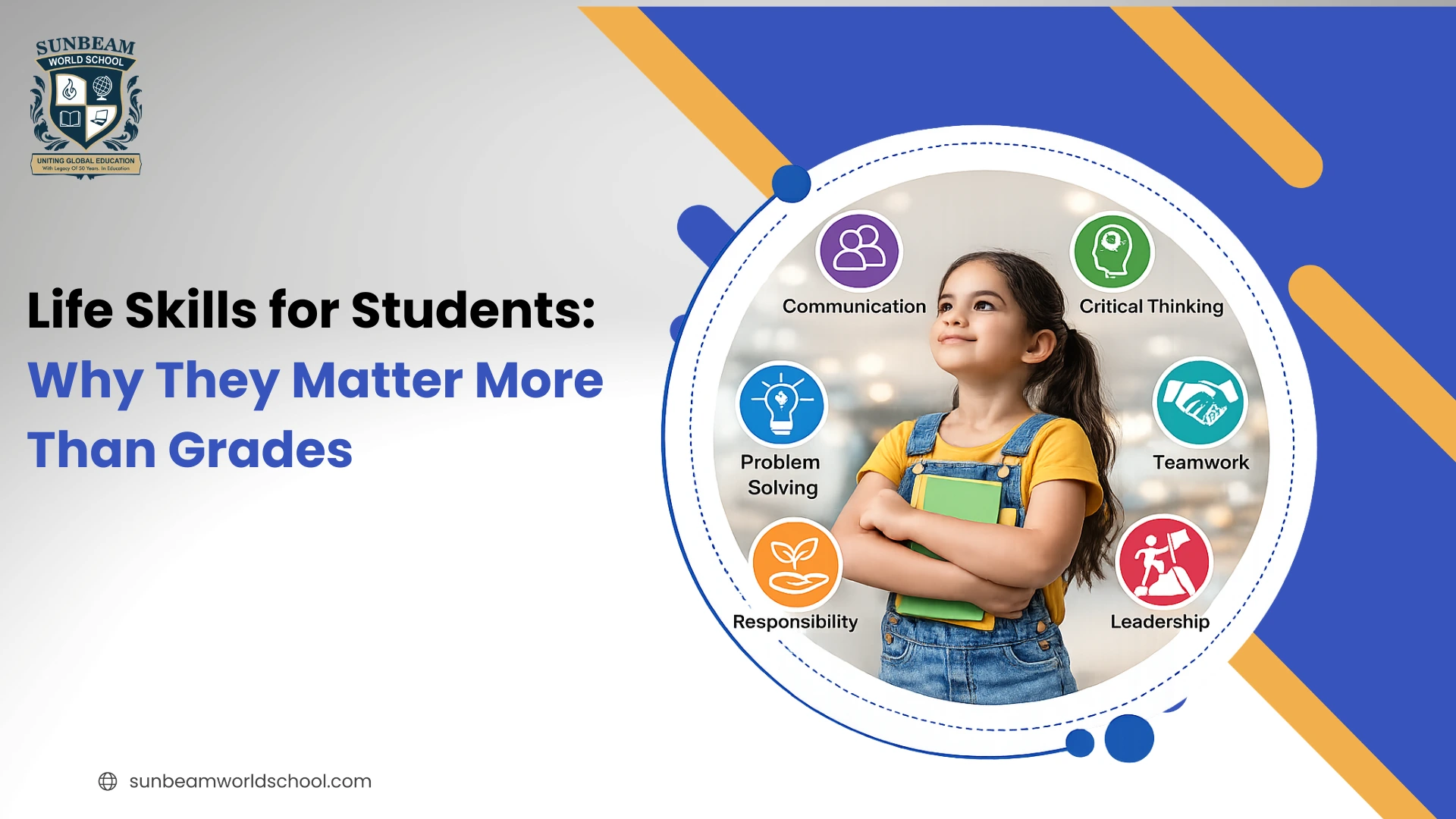
Life Skills for Students: Why They Matter More Than Grades
| Life skills are practical, social, and emotional abilities that help students manage everyday challenges with confidence. Defined by the WHO as "abilities for adaptive and positive behavior," they include critical thinking, communication, emotional intelligence, decision-making, resilience, and empathy.
The importance of life skills lies in preparing students for real-world success — not just examinations. Unlike academic knowledge, life skills are transferable across every area of life: career, relationships, and personal well-being. Schools these days integrate life skills into daily learning, recognizing that a child who can think clearly, communicate well, and bounce back from failure is truly educated. |
When was the last time your child used the quadratic formula in real life?
Now think about the last time they had to manage a disagreement with a friend, handle pressure before an exam, or figure out how to plan their week. These situations happen every single day, and they require a set of abilities that no textbook can fully teach.
These are life skills, and they may be the most important thing your child learns during their school years.
This blog explores what life skills are, which ones every student needs, how schools can nurture them, and why parents and educators at schools are making them a cornerstone of modern education.
What Are Life Skills?
Life skills are the practical, social, and emotional abilities that help a person navigate everyday challenges confidently and effectively. The term covers a wide range, from knowing how to communicate clearly, to managing your emotions under pressure, to making thoughtful decisions when the stakes are high.
The World Health Organization (WHO) identified six foundational categories of life skills that remain deeply relevant today:
- Communication and interpersonal skills — the ability to express ideas clearly and listen actively
- Decision-making and problem-solving — thinking through options and acting on them wisely
- Creative and critical thinking — approaching challenges from new angles and evaluating information carefully
- Self-awareness and empathy — understanding your own feelings and genuinely considering others'
- Assertiveness and self-control — standing up for yourself calmly, without aggression
- Resilience and coping — bouncing back from setbacks and learning from failure
As the world has evolved, so has this list. Today's students also need digital literacy, financial awareness, adaptability, and what educators call the 4 Cs: Critical thinking, Creativity, Collaboration, and Communication.
What is Life Skill?A life skill is any practical, social, or emotional ability that helps a person manage real-world situations with confidence and good judgment. The life skills definition most widely accepted comes from the World Health Organization (WHO): |
In simpler terms: A life skill is any practical, social, or emotional ability that helps a person manage real-world situations with confidence and good judgment.
The term covers a wide spectrum, from knowing how to communicate clearly and manage your emotions under pressure, to making thoughtful decisions, solving problems creatively, and bouncing back from failure.
When we describe life skills, they generally fall into three broad categories:
| Category | What It Covers |
| Thinking Skills | Critical thinking, decision-making, problem-solving, creative thinking |
| Social Skills | Communication, teamwork, empathy, interpersonal relationships |
| Emotional Skills | Self-awareness, resilience, self-control, emotional regulation |
These three dimensions work together. A student who thinks clearly but lacks empathy will struggle in relationships. One who is socially gifted but emotionally fragile will buckle under pressure. True life skill development addresses all three.
Importance of Life Skills For Students
Life skills help students build confidence, communication, problem-solving, and decision-making abilities, preparing them to succeed both in school and in everyday life.
1. Academic Success Alone Is Not Enough
India produces millions of graduates every year. Yet employers consistently report that fresh candidates, regardless of their marks, struggle with communication, teamwork, and problem-solving on the job. Life skills bridge the gap between a degree and actual capability.
A student who learns to manage time, set goals, and handle stress will perform better academically and professionally. These are not soft extras — they are the foundation of real-world achievement.
2. They Build Emotional Resilience
School can be stressful. Peer pressure, exam anxiety, social conflict, and self-doubt are very real experiences for children and teenagers. Students who develop self-awareness and emotional regulation can process these challenges rather than be overwhelmed by them.
Teaching a child to name their emotions, manage frustration, and seek help when needed is one of the most protective things a school or parent can do.
3. They Prepare Students for Real-Life Situations
Think of a typical day as an adult: you manage time in the morning, handle a difficult conversation at work, make financial choices over lunch, and support a family member in the evening. Every one of those moments draws on a life skill.
The earlier children begin developing these abilities, the more naturally they become a part of how they move through the world.
4. They Foster Healthy Relationships
Social and interpersonal skills are the engine of every healthy relationship — with friends, teachers, parents, and eventually colleagues. Students who practise active listening, empathy, and constructive conflict resolution build stronger bonds and experience greater social well-being throughout their lives.
The Most Important Life Skills Every Student Should Develop
According to the World Economic Forum, skills like critical thinking, resilience, and emotional intelligence are among the most important future workforce skills.
Critical Thinking and Problem-Solving
The ability to look at a problem, question assumptions, gather information, and arrive at a reasoned solution is invaluable — in school, in career, and in citizenship. Students who think critically are less likely to accept misinformation and more likely to find creative solutions.
How to nurture it: Encourage students to ask "why" and "what if" — not just "what." Project-based learning, debates, and open-ended discussions are especially effective.
Communication Skills
Knowing what you want to say is only half the battle. The other half is saying it clearly — in writing, in speech, and through body language. Students who communicate well build confidence in the classroom and credibility in the wider world.
How to nurture it: Public speaking opportunities, collaborative projects, journaling, drama, and group activities all develop communication in different ways.
Emotional Intelligence (EQ)
Research consistently shows that emotional intelligence — the ability to understand and manage your own emotions while recognising others' — is a stronger predictor of life success than IQ alone. It shapes how students handle failure, support peers, and navigate conflict.
How to nurture it: Regular check-ins on how students are feeling, mindfulness practices, and creating space for honest conversations about emotions in the classroom.
Decision-Making and Creative Thinking
Every day, students face choices — some trivial, some significant. Teaching them a framework for decision-making (pause, consider options, anticipate consequences, act) builds the judgment they will need throughout life. Creative thinking enables them to see beyond the obvious and find unexpected solutions.
How to nurture it: Scenario-based learning, design thinking projects, and encouraging experimentation without fear of failure.
Self-Awareness and Empathy
Self-awareness — knowing your strengths, weaknesses, triggers, and values — is the starting point for personal growth. Empathy — the ability to genuinely understand another person's experience — is the foundation of compassion and leadership.
Together, they form the core of emotional intelligence and healthy relationships.
How to nurture it: Reflective journaling, community service, storytelling, and cross-cultural interactions.
Resilience and Adaptability
Failure is not the opposite of success — it is a part of the path. Students who develop resilience treat setbacks as information, not identity. In a world changing faster than ever, adaptability — the willingness to unlearn and relearn — is equally essential.
How to nurture it: Praise effort over outcome, create a safe space for mistakes, and model resilience as educators and parents.
Financial and Digital Literacy
These are the two great practical life skills of the 21st century. Understanding how money works — saving, budgeting, the cost of borrowing — gives students agency over their futures. Digital literacy — navigating the internet safely, evaluating information, managing screen time — is now as essential as reading.
How to nurture it: Introduce basic financial concepts age-appropriately, and incorporate media literacy into everyday learning.
Life Skills Definition and Examples
Understanding a definition is one thing. Seeing it in action is another. Here are life skills definition and examples across all three categories, brought to life through everyday student situations:
Thinking Skills
Critical Thinking Definition: The ability to analyse information, question assumptions, and reach well-reasoned conclusions. Example: A student reads two conflicting articles about climate change and evaluates which one uses stronger evidence — rather than believing the first thing they read.
Decision-Making Definition: Choosing wisely between options by considering consequences. Example: A student weighs whether to join an extra activity or rest before exams — and makes a choice based on their priorities and energy levels.
Problem-Solving Definition: Identifying a challenge and working through it systematically. Example: A student whose group project is falling apart steps in to reassign tasks and reset the timeline rather than panicking.
Social Skills
Communication Definition: Expressing ideas clearly in speech and writing, and listening actively. Example: A student who respectfully disagrees with a teacher's point — using evidence, not emotion — demonstrates strong communication skill.
Teamwork and Collaboration Definition: Working effectively with others toward a shared goal. Example: During a school science fair, a student supports a struggling teammate rather than doing everything alone to "win."
Empathy Definition: Understanding and sharing the feelings of another person. Example: A student notices a classmate sitting alone and checks in — not because they were told to, but because they genuinely felt concern.
Emotional Skills
Self-Awareness Definition: Knowing your own strengths, weaknesses, emotions, and values. Example: A student recognises that they get anxious before presentations and prepares extra — rather than avoiding the task.
Resilience Definition: Recovering from setbacks and continuing forward with renewed effort. Example: After failing a test, a student analyses what went wrong, seeks help, and improves — instead of giving up.
Self-Control Definition: Managing impulses and emotions in challenging situations. Example: A student feels frustrated during a game but chooses not to react aggressively — taking a breath instead.
These life skills definition and examples make clear that these are not vague ideals. They are observable, teachable, and measurable behaviours — and they can be developed at any age.
How Schools Can Integrate Life Skills into Education
Life skills are most effective when they are woven into the fabric of school life — not treated as a standalone subject or a once-a-year workshop.
Curriculum Integration: Teachers can embed life skills into existing subjects. A history debate builds communication and critical thinking. A science experiment builds problem-solving and resilience. A group project builds collaboration and empathy.
Real-Life Scenarios: Simulations, role plays, and service-learning projects connect what students learn to how the world actually works.
The Role of Educators: A teacher who models emotional intelligence, demonstrates resilience, and creates a psychologically safe classroom is teaching life skills even without saying the words.
Parental Partnership: The home environment is just as important as school. Parents who listen actively, allow age-appropriate decision-making, and talk openly about emotions reinforce every skill the school works to build.
The Long-Term Benefits of Life Skills Education
The returns on life skills education compound over time.
For careers: Employers in every sector consistently rank communication, teamwork, problem-solving, and adaptability among the top traits they look for — often above technical qualifications. A student with strong life skills will stand out in interviews, thrive in teams, and grow into leadership roles.
For personal independence: A young adult who can manage their time, finances, and emotions is not just employable — they are capable of building a life with intention and confidence.
For society: When students develop empathy, civic awareness, and ethical thinking, they grow into citizens who contribute positively — to their communities, their country, and the world. Life skills education, at its best, is also character education.
How to Describe Life Skills: A Framework for Parents and EducatorsIf someone asked you to describe life skills in one sentence, this works well: "Life skills are the abilities that help you handle what life actually throws at you — not just what appears on an exam." For a slightly fuller picture, you can describe life skills using this simple framework: ● Think clearly — so you make good decisions even under pressure ● Communicate well — so you can express yourself and understand others ● Manage your emotions — so feelings guide you rather than control you ● Build strong relationships — so you thrive in every environment ● Bounce back from failure — so setbacks make you stronger, not smaller When you understand life skills this way to parents, it becomes immediately clear why they belong at the heart of education — not as a replacement for academics, but as the bedrock that makes academic effort worthwhile. |
Life Skills at Sunbeam World School
At Sunbeam World School, we understand that the world our students will graduate into will demand far more than textbook knowledge. Our approach to education is built on the conviction that every child deserves to be prepared — academically, emotionally, socially, and practically — for the full range of what life will bring.
From collaborative project work and debate programmes to mindfulness initiatives and community engagement, life skills are not an add-on at Sunbeam. They are embedded in how we teach, how we interact with students, and how we partner with families.
We invite parents to explore how our curriculum prepares students for life — not just examinations.
Learn more about our approach to holistic education
Enquire about admissions at Sunbeam World School
Conclusion
Academic excellence will always matter, but grades alone cannot prepare children for the complexities of real life. The ability to communicate effectively, think critically, manage emotions, adapt to challenges, and build meaningful relationships shapes how students grow into confident and capable individuals.
That is why life skills education is no longer optional — it is essential.
At Sunbeam World School, we believe true education goes beyond textbooks and examinations. Through collaborative learning, leadership opportunities, emotional development, and real-world experiences, we help students build the confidence and practical abilities they need to thrive in every stage of life.
Because success is not only about scoring well in school — it is about being prepared for the world beyond it.

Frequently Asked Questions
What is life skill in simple words?
-A life skill is any ability that helps a person handle real-life situations effectively — such as communicating clearly, managing emotions, solving problems, or making good decisions.
What are the most important life skills for school students?
+At what age should children start learning life skills?
+How are life skills different from academic skills?
+How can parents support life skills development at home?
+Why do schools need to teach life skills?
+
In this article
Share this post:


Press and Blogs
Stay updated with our press releases, educational blogs, and more.

Quick Summary Animal sounds are the noises animals make to communicate, warn of danger and...
Quick Summary The area of rectangle equals its length multiplied by its width (A =...
Quick Summary Sympathy means feeling sorry for someone from your own point of view. Empathy...