

 Kids Learning
How to Improve Your Child’s Writing Skills
Quick Summary
You can improve your child's writing skills by making writing a regular part of everyday life and keeping practice enjoyable. Reading together, using creative prompts, playing writing games, writing for real purposes, and giving positive feedback can gradually build vocabulary, confidence, clarity, and creativity.
Writing is a skill children develop through regular practice, reading, conversation, and opportunities to express their own ideas. It does not have to begin with long essays or formal assignments. A short journal entry, a story about a picture, or even a shopping list can give a child useful writing practice.
Parents can make this process easier by focusing on progress rather than perfection. When children have interesting things to write about and feel that their ideas matter, they are more likely to practise willingly and become more confident writers.
Why Are Writing Skills Important for Children?
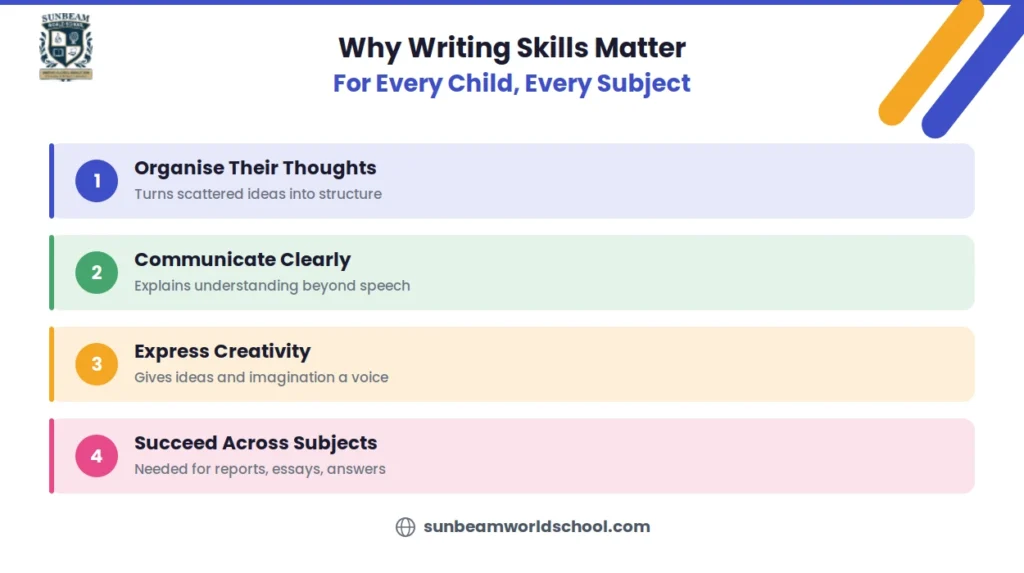
Writing does more than fill a page. It helps children think clearly and communicate with confidence.
Writing skills are important for children because they help them organise thoughts, communicate ideas clearly, express creativity, and succeed across different school subjects. Strong writing also gives students a practical way to explain what they understand instead of relying only on spoken answers.
Writing is closely connected with reading and language development. As children read stories, articles, poems, and other age-appropriate material, they encounter new vocabulary, sentence patterns, ideas, and ways of expressing themselves. Regular writing then gives them an opportunity to use those language skills actively.
Writing is also an important part of broader skill development, as children learn to organise ideas, communicate clearly, solve problems, and express themselves with confidence.
Writing also becomes increasingly important as children move through school. They may need to write answers, summaries, reports, stories, projects, emails, and essays. Building the habit early can make these tasks feel more manageable and less intimidating.
For younger learners, parents can also support language development with practical resources such as our guide to simple English sentences for kids, which can help children practise everyday language in context.
How Can You Improve Your Child's Writing Skills?
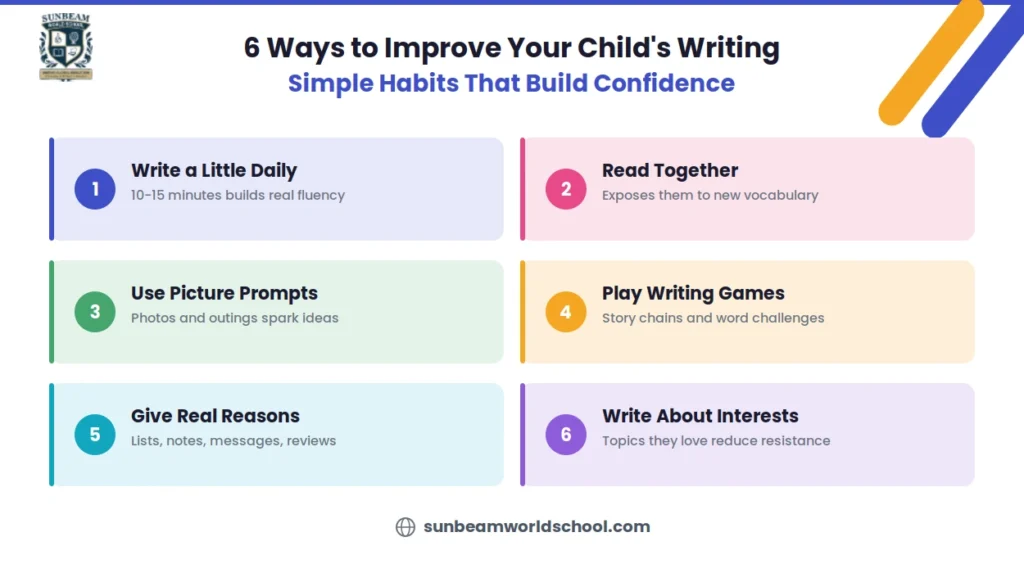
Six simple, everyday habits that help children build writing confidence without added pressure.
You can improve your child's writing skills by giving them frequent, meaningful opportunities to write and by making those opportunities enjoyable rather than treating every activity like homework. The goal is to help children practise putting ideas into words while gradually improving vocabulary, sentence structure, organisation, spelling, and clarity.
The following seven activities can be adapted to different ages and interests, so parents can choose what feels natural for their child.
1. Encourage Your Child to Write a Little Every Day
Daily writing practice helps children become more comfortable with expressing ideas and gradually builds writing fluency. The activity does not need to take more than 10 to 15 minutes, especially for younger children.
Ask your child to write about something they did that day, describe a favourite object, keep a short diary, or make a list of things they want to do. Older children can write reflections, short stories, opinions, or responses to something they have read.
The important part is consistency. A child who writes a little several times a week gets more useful practice than a child who is asked to complete a long writing assignment only occasionally.
2. Make Reading a Regular Part of the Day
Reading regularly improves writing by exposing children to vocabulary, sentence structures, storytelling techniques, and different ways of presenting ideas. Children do not need to study every sentence they read, because simply seeing well-formed language repeatedly can influence how they write.
Read together when possible and talk about what your child notices in a story. Ask questions such as, "Why do you think the character did that?" or "What do you think will happen next?" These conversations can help children organise ideas before they put them on paper.
You can also combine reading with language practice using resources such as rhyming words for kids, which can support vocabulary development and give younger writers more words to experiment with.
3. Turn Pictures and Everyday Experiences Into Writing Prompts
Pictures and everyday experiences make useful writing prompts because children already have something concrete to describe, imagine, or explain. A simple photograph, family outing, drawing, toy, or interesting object can become the starting point for a paragraph or story.
Show your child a picture and ask them to describe what they see, what the people might be thinking, or what could happen next. For older children, ask them to create a complete story with a beginning, middle, and ending.
You can also use real experiences. After a trip to the park, museum, or another place, ask your child to write three things they noticed and one thing they enjoyed. This turns ordinary experiences into natural writing practice.
4. Use Fun Writing Games and Creative Challenges
Writing games make practice feel less like an assignment and can encourage children who are reluctant to write. Games also give children a reason to experiment with words, sentences, characters, and ideas without worrying too much about getting everything perfect.
Try a story-building game where each person adds one sentence, or give your child three unrelated words and ask them to create a short story using all three. Another option is a "what happens next?" challenge, where you provide the opening sentence and let your child decide how the story develops.
For younger children, word games, rhyming challenges, and simple sentence-building activities can make writing practice more playful. For older students, persuasive challenges, character creation, and short storytelling competitions can add variety.
5. Give Your Child Real Reasons to Write
Children often become more interested in writing when they can see why the writing is useful. Instead of limiting writing to schoolwork, involve your child in everyday tasks that naturally require words.
Ask them to write a shopping list, thank-you note, birthday message, recipe, short review, instructions for a game, or note to a family member. Older children can write emails, personal reflections, book reviews, or short explanations of something they know well.
Real-world writing also teaches children that writing changes depending on the purpose and audience. A message to a friend will sound different from a school report, and learning that difference helps children become more flexible communicators.
6. Teach Revision and Proofreading Without Making It Stressful
Revision and proofreading help children turn a first draft into clearer and more accurate writing. Instead of correcting every mistake yourself, encourage your child to read their work again and look for one or two specific things.
For younger children, you might ask them to check whether every sentence starts with a capital letter and ends with the correct punctuation. Older children can look for repeated words, unclear sentences, missing details, spelling errors, and places where an idea could be explained more clearly.
Keep the process positive. If every writing activity ends with a long list of corrections, children may begin to associate writing with failure. Instead, point out what works well first, then choose a small number of improvements to work on together.
For focused spelling and writing practice, parents can also use dictation words in English, adapting the difficulty to the child's class level.
7. Let Your Child Write About What They Love
Children are more likely to write when the subject connects with their interests. A child who loves animals might write about a favourite species, while a sports fan could describe a match, create a player profile, or write a fictional sports story.
Ask your child what they would like to write about before assigning a topic whenever possible. Giving them some choice can make writing feel more personal and reduce the resistance that often comes with compulsory topics.
As their confidence grows, gradually introduce different types of writing. A child who starts with stories about their favourite game can later move into descriptions, opinions, explanations, persuasive writing, and school assignments.
How Can Parents Encourage Children to Write Without Pressure?
Parents can encourage children to write without pressure by focusing on ideas, effort, and progress before correcting every spelling or grammar mistake. A supportive response helps children see writing as a skill they can develop rather than a test they might fail.
Start by showing genuine interest in what your child has written. Ask what they meant by an interesting sentence, why they chose a particular character, or what they would like to add to the story. These questions show that their ideas have value.
It is also useful to model writing at home. Let children see you making a list, writing a message, planning something, or editing your own work. When writing is presented as a normal part of everyday life, children are more likely to see it as useful rather than as another school task.
For ideas that support broader confidence and communication development, you can explore how to introduce yourself in class, which shows how students can practise expressing themselves clearly and confidently.
How Does Online School Support Better Writing Skills?
Online school can support writing skills through regular assignments, teacher feedback, digital communication, project work, and opportunities for students to express ideas in different formats. A well-structured online learning environment can make writing part of everyday academic communication rather than an occasional activity.
Students may write answers during lessons, complete projects, respond to questions, prepare presentations, or submit written assignments for feedback. These activities give them repeated opportunities to organise information and communicate clearly.
At Sunbeam World School, the online learning approach includes interactive classes and activities that encourage students to participate, communicate, collaborate, and express their ideas. The school's curriculum also places emphasis on reading, writing, spelling, and language skills, giving students opportunities to build these foundations alongside other academic abilities.
Parents who want to understand how structured online learning differs from parent-led homeschooling can also read our guide to homeschooling versus online school.
What If My Child Does Not Like Writing?
If your child does not like writing, start with short activities connected to their interests instead of immediately asking them to write long paragraphs. Resistance can decrease when children have more choice, the topic feels meaningful, and mistakes are treated as part of learning.
Begin with drawing and labelling, captions for pictures, short messages, lists, or one-paragraph stories. You can then gradually increase the amount of writing as your child's confidence grows.
If handwriting itself is frustrating, consider whether typing, dictation, or another writing method could help the child focus on expressing ideas. The aim is to build communication and writing ability while avoiding unnecessary frustration.
What Are Some Quick Writing Activities Parents Can Try at Home?
Some quick writing activities parents can try at home include three-word stories, postcards from an imaginary trip, picture-based writing, a simple family newsletter, and rewriting the ending of a favourite story. These activities take only a few minutes, need no special materials, and turn writing into something playful rather than another task on a to-do list.
These five ideas work well because they build directly on the strategies covered earlier, using prompts, games, and real-world writing, but in a format simple enough to try the same evening. Pick one or two to start with rather than attempting all five at once, and let your child's interest guide how often you repeat them.
Three-Word Story
Give your child three unrelated words, for example dragon, umbrella, and kitchen, and ask them to write a short story that uses all three. The randomness of the words is what makes this activity fun, since children often come up with surprising and imaginative connections they would never think to write about otherwise. This works well for children who feel stuck when given an open-ended topic, because the three words provide just enough structure to get started without limiting their creativity.
Postcard From Anywhere
Ask your child to imagine they are on a trip, real or completely made up, and to write a short postcard describing what they see, what they did, and how they feel about the place. This activity naturally introduces descriptive writing and sensory detail, since a good postcard needs to make the reader feel like they are there too. It also works well for children who enjoy travel, geography, or imaginative play, since they can set their postcard anywhere from a nearby city to an invented planet.
Picture Detective
Show your child a photograph or a drawing, either one they already have or one from a book or magazine, and ask them to write three sentences describing what is happening in it. Then ask for one more sentence guessing what might happen next. This activity builds observation skills alongside writing, since children need to look closely at details before they can describe them, and the prediction sentence encourages basic narrative thinking about cause and effect.
Family Newsletter
Once a week, ask your child to write two or three sentences about something that happened at home, at school, or with friends, and collect these into a simple ongoing "family newsletter." This could be as basic as a page in a notebook or a shared document, and other family members can contribute too. The regularity of this activity is what makes it valuable, since it builds a writing habit gently over time, and children often enjoy seeing their own words become part of something the whole family keeps adding to.
Alternate Ending
After reading a short story together, whether from a book, a class assignment, or a story you have told them, ask your child to rewrite the ending in their own way. This activity works particularly well because it removes the pressure of starting from a blank page, since the setup and characters already exist, and children only need to focus on imagining what happens next. It is also a useful way to check how well a child has understood a story, since a thoughtful alternate ending usually reflects a clear grasp of the plot and characters.
How Can Sunbeam World School Help Children Build Communication and Writing Skills?
Sunbeam World School supports communication and language development through structured online learning, interactive classes, and activities that give students opportunities to express their ideas. Writing is part of a wider set of communication skills that students can develop alongside reading, speaking, listening, and collaboration.
The school's online environment can also give students opportunities to participate in discussions, presentations, storytelling, projects, and other activities that require them to organise and communicate ideas. These experiences can complement regular writing practice and help students become more confident communicators.
Sunbeam World school's learning approach also recognises that children learn at different paces. With teacher guidance and a structured learning environment, students can receive support as they develop academic skills and greater independence in their learning.
Conclusion
Strong writing skills grow through regular practice, reading, creativity, and encouragement, not through memorising rules alone. Give your child meaningful reasons to write, make practice enjoyable, and allow their confidence to grow one piece of writing at a time.
For more guidance on helping children become independent and confident learners, explore the value of independent learning.

Frequently Asked Questions
How can I improve my child's writing skills at home?
-You can improve your child's writing skills at home by encouraging short daily writing, reading together, using creative prompts, playing word and writing games, and giving positive feedback. Let your child write about interests and everyday experiences so practice feels useful rather than forced.
What are some fun writing activities for kids?
+How does reading help improve a child's writing?
+How often should children practise writing?
+How can I help my child improve spelling and grammar?
+What should I do if my child refuses to write?
+
In this article
Share this post:


Press and Blogs
Stay updated with our press releases, educational blogs, and more.

Quick Summary There are 25 prime numbers from 1 to 100: 2, 3, 5, 7,...

Quick Summary Roman numerals 1 to 1000, also called Roman numbers, use seven letters: I...

Quick Summary Animal sounds are the noises animals make to communicate, warn of danger and...