
 Kids Learning
200+ Rhyming Words for Kids: Meaning, Examples, Activities & Easy Learning Guide
List of Common Rhyming Words by SoundRhyming words are words that sound the same at the end. The easiest way to learn them is by grouping words with the same sound pattern. Here are some common rhyming word groups:
These word groups help children quickly understand how sounds work in English. |
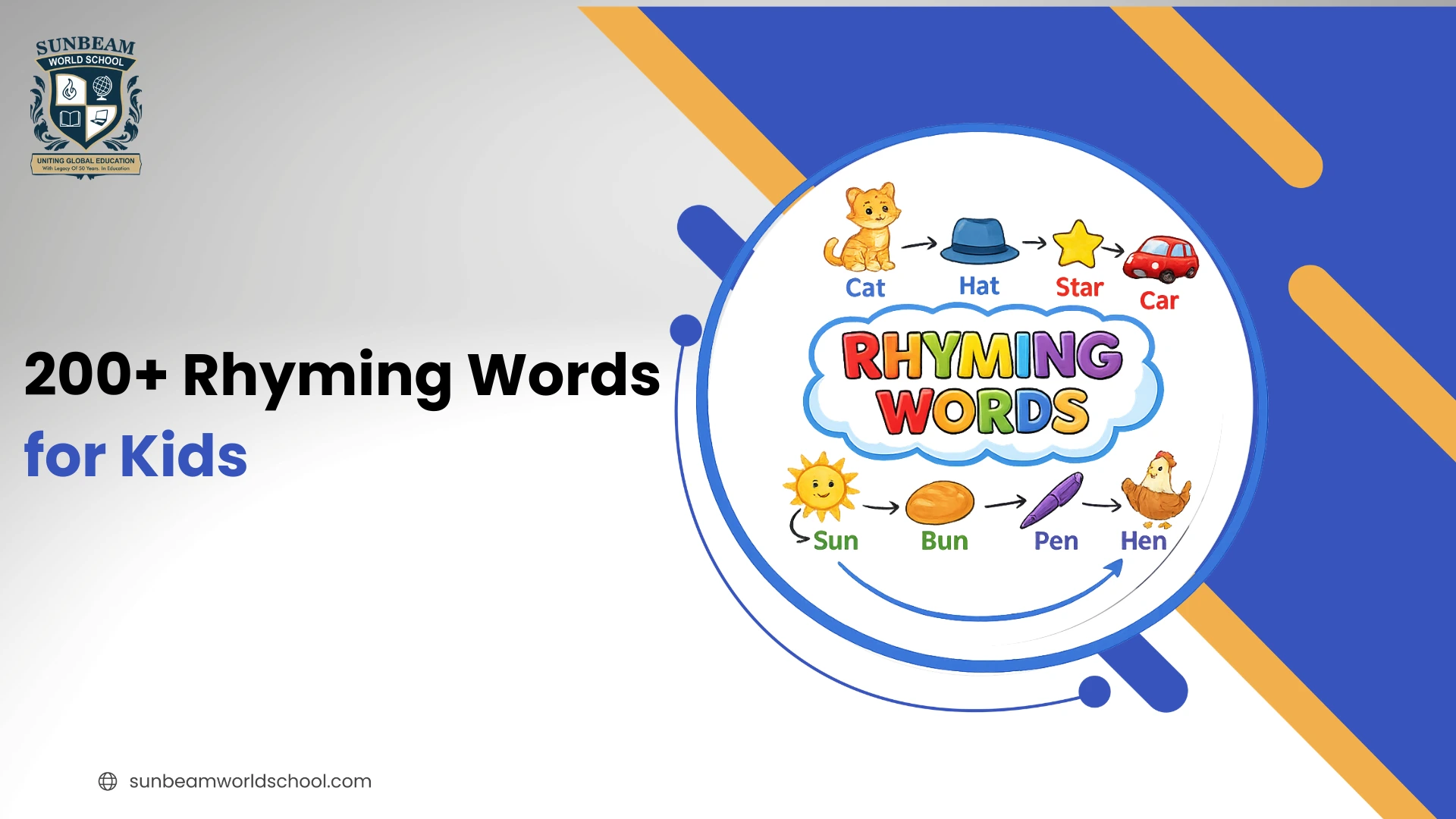
Rhyming words make learning language fun, engaging, and easier for children to understand. From songs and storybooks to everyday conversations, rhymes help kids recognize sound patterns and build strong reading and spelling skills.
In this guide, you’ll find 200+ rhyming words, simple examples, word families, and fun activities designed to help children learn quickly and with confidence.
What Are Rhyming Words?
Rhyming words are words that sound the same at the end, even if they are spelled differently. For example, blue and shoe rhyme because they share the same ending sound.
In simple terms, rhyming is based on sound patterns, not spelling. Words like cat–hat and rain–train rhyme because their ending sounds match. In language learning, this is called phonetic similarity, when the sound from the last stressed vowel to the end of the word is the same.
Rhyming is a natural part of how children learn language. It appears in:
- Nursery rhymes
- Songs
- Storybooks
- Everyday conversations
Because of this, children start recognizing rhymes even before they learn to read.
| Quick Definition
Rhyming words = two or more words whose ending sounds match. Example: day/play / stay/way. The spelling can differ; only the sound must match. |
Why Do Rhyming Words Matter for Children?
Many parents think of rhyming as a charming extra — a fun part of reading time, nothing more. But research in early childhood literacy tells a very different story. A child's ability to recognize rhyme is one of the strongest early predictors of how well they'll learn to read and spell.
Here's why rhyming has such a deep impact:
1. It Builds Phonemic Awareness
Phonemic awareness is the ability to hear and manipulate individual sounds in spoken words. It's the bedrock of reading. When a child recognizes that "cat," "bat," and "mat" all share the "-at" ending, they're not just noticing a pattern — they're actively analyzing sound structure. This is exactly the skill they'll need to decode written words later.
2. It Supercharges Memory
Rhyming makes language stick. There's a reason poems, prayers, and multiplication tables have been set to rhyme for centuries — the human brain encodes rhythmic, patterned information far more efficiently than random strings of words. When children practice rhymes, they're also training their memory muscles.
3. It Grows Vocabulary Organically
When a child learns that "light," "night," "right," "tight," and "sight" all rhyme, they're not just learning five separate words; they're learning a whole family of words built around a shared sound pattern. This word-family approach is one of the fastest ways to expand a young learner's vocabulary.
4. It Makes Reading More Enjoyable
Books that rhyme are simply more fun to read. The predictability of the pattern invites children to guess what comes next, which builds engagement and confidence. A child who confidently fills in "...so I wore my favorite hat" is experiencing the joy of being a reader — long before they can decode every word on the page.
5. It Supports Spelling
Recognizing that "bake," "cake," "lake," and "make" all follow the same spelling pattern (-ake) helps children spell by analogy. Instead of memorizing every word individually, they learn a pattern and apply it across an entire family of words. This is far more efficient than rote memorization.
Types of Rhymes Every Child Should Know
Not all rhymes are identical. As children grow, they encounter different kinds of rhyme in books, songs, and poetry. Understanding these types helps both teachers and parents explain why some words "almost rhyme" but not quite.
Perfect Rhyme
The ending sounds match exactly.
cat / hat, blue / shoe, night / light
Near Rhyme
Also called a "slant rhyme." Sounds are similar but not identical.
time / line, love / move
Eye Rhyme
Words look like they rhyme but sound different.
love / prove, have / gave
End Rhyme
Rhyme at the end of a line — the most common type in children's poetry.
Internal Rhyme
Rhyme within a single line of poetry.
"I drove myself over the grove"
Family Rhymes
Groups of words sharing one sound pattern.
-at: cat, bat, hat, mat, rat, sat
For children in early primary years, the focus should be on perfect rhymes and word families. Near rhymes and internal rhymes can be introduced gradually as children become more confident readers and writers.
200+ Examples of Rhyming Words For Kids
Below is a curated rhyming words list organized by ending sound. These are the most commonly used patterns in children's literature, phonics programs, and early English curricula. Each group is a "word family"; teach one, and your child gets several for the price of one.
Short Vowel Families
| Pattern | Rhyming Words | Sample Sentence |
| -at | cat, bat, hat, mat, rat, sat, fat, pat, flat, that | The cat sat on the mat. |
| -an | can, fan, man, pan, ran, van, tan, plan, scan, than | The man ran to his van. |
| -in | bin, fin, pin, tin, win, chin, grin, spin, thin, twin | She will win and grin. |
| -og | dog, fog, hog, log, frog, bog, clog, blog, smog | The dog sat on the log. |
| -ug | bug, hug, mug, rug, tug, plug, shrug, snug, drug, slug | The bug sat snug on the rug. |
| -en | hen, men, pen, ten, den, when, then, wren, yen | Ten hens are in the den. |
Long Vowel & Vowel Sound Families
| Pattern | Rhyming Words | Sample Sentence |
| -ay | day, play, stay, way, bay, clay, gray, hay, lay, may, pay, ray, say, tray, sway, stray, pray, display | We play outside every day. |
| -ake | bake, cake, fake, lake, make, rake, sake, take, wake, snake, brake, shake, flake, stake | Let's bake a cake by the lake. |
| -ite / -ight | bite, kite, night, light, right, sight, tight, fight, bright, flight, might, slight, knight, write | Fly the kite in the bright light. |
| -eel / -eal | feel, heel, kneel, meal, peel, real, seal, steel, wheel, deal, heal, squeal, appeal | I can feel the wheel is real. |
| -eep | deep, keep, sleep, sheep, creep, steep, sweep, weep, jeep, leap, cheap, heap, reap | The sheep fall asleep in the deep. |
| -ow (long) | blow, flow, glow, grow, know, show, slow, snow, throw, crow, below, rainbow | Watch the snow glow. |
| -oo / -ue | blue, clue, glue, true, dew, flew, new, grew, stew, shoe, through, you, zoo, moon, soon | The blue shoe flew through the zoo. |
Digraph & Blend Families
| Pattern | Rhyming Words | Sample Sentence |
| -all | ball, call, fall, hall, mall, tall, wall, small, stall, crawl, haul | The tall ball rolled down the hall. |
| -ound | bound, found, ground, hound, mound, round, sound, wound, around, profound | A round sound was found underground. |
| -ing | bring, king, ring, sing, spring, sting, swing, thing, wing, cling, fling, sling, string | The king can sing and ring the bell. |
| -ank | bank, drank, frank, rank, sank, tank, thank, blank, clank, prank, spank | He drank water from the tank. |
| -ump | bump, dump, hump, jump, lump, pump, rump, stump, trump, clump, grump, plump, slump | Jump over the big stump. |
| -ark | bark, dark, hark, lark, mark, park, shark, spark, stark, embark, remark | The shark swam in the dark park. |
| Teacher Tip:
Start with just one word family per week. Children learn more deeply from mastering one family thoroughly than from being exposed to ten families superficially. The -at family alone gives a beginner reader ten decodable words instantly. |
Words That Rhyme With Day
"Day" is one of the most versatile words in the English language when it comes to rhyming. It belongs to the -ay word family, which is among the richest and most useful sound patterns for young learners. Whether you're writing a poem, teaching phonics, or helping a child complete a rhyming worksheet, this deep-dive list — sorted by word length — will be your go-to reference.
| "The -ay family is a gift to early readers — simple sounds, dozens of words, and endless opportunities to play." |
Three-Letter Words That Rhyme with Day
Three-letter rhymes are the perfect starting point for very young learners. They're short, easy to pronounce, and most of them are high-frequency words that children encounter every day in reading and conversation.
| Word | Meaning | Example Sentence |
| bay | A sheltered area of water | The boat rested in the bay. |
| gay | Bright and cheerful; lively | The colours were gay and bright. |
| hay | Dried grass used as animal feed | The horses ate the hay. |
| jay | A type of colourful bird | A blue jay sat on the fence. |
| lay | To put something down gently | Lay the book on the table. |
| may | To be allowed; also a month | You may go outside now. |
| nay | An old-fashioned word for "no" | He said nay to the idea. |
| pay | To give money in exchange | I will pay for the ticket. |
| ray | A beam of light or energy | A ray of sun hit the floor. |
| say | To speak or express in words | What did she say? |
| way | A route, method, or manner | Which way do we go? |
| yay | An exclamation of joy | Yay, we won the match! |
| Classroom Activity Idea
Write each three-letter -ay word on a card. Ask children to sort them into two piles: "things I can see" (bay, hay, ray) and "action/describing words" (lay, pay, say, way). This doubles as a grammar activity. |
Four-Letter Words That Rhyme with Day
Four-letter rhymes with "day" introduce blends and consonant clusters, making them ideal for children who have mastered simple three-letter words and are ready to level up their phonics skills.
| Word | Meaning | Example Sentence |
| clay | Soft, mouldable earth material used in pottery | She shaped a pot from the clay. |
| flay | To strip or criticise harshly | The wind seemed to flay the leaves. |
| fray | To unravel at the edges; a conflict | The rope began to fray at the end. |
| gray | A colour between black and white | The sky turned gray before the storm. |
| play | To engage in fun activities | Children love to play all day. |
| pray | To speak to God; to hope earnestly | They pray together every morning. |
| slay | To defeat or kill; (informal) to impress greatly | The hero will slay the dragon. |
| stay | To remain in a place | Please stay and play with us. |
| sway | To move gently from side to side | The trees sway in the breeze. |
| tray | A flat container for carrying things | She carried the cups on a tray. |
| okay | Acceptable; all right | Is it okay if I go now? |
Longer Words That Rhyme with Day
As children grow into more fluent readers and writers, they encounter multi-syllable words that carry the same -ay ending sound. These longer rhymes are especially useful for older students working on poetry, creative writing, and expanding their vocabulary beyond simple word families.
| Word | Syllables | Meaning & Example |
| away | 2 | To a distance. "The bird flew away." |
| betray | 2 | To be disloyal to someone. "He would never betray a friend." |
| birthday | 2 | The anniversary of one's birth. "Happy birthday today!" |
| decay | 2 | To rot or break down slowly. "Leaves decay in autumn." |
| delay | 2 | To make something happen later. "There was a delay in the train." |
| display | 2 | To show or exhibit. "The school will display the artwork." |
| halfway | 2 | At the middle point. "We are halfway there!" |
| hooray | 2 | An exclamation of joy. "Hooray, the holidays are here!" |
| okay | 2 | Satisfactory; fine. "Everything is going to be okay." |
| portray | 2 | To represent or describe. "The painting portrays a sunset." |
| relay | 2 | A race in teams; to pass on a message. "They won the relay race." |
| repay | 2 | To pay back. "I will repay you one day." |
| subway | 2 | An underground railway. "We took the subway to school." |
| today | 2 | On this current day. "Let's finish this today." |
| birthday | 2 | Annual celebration of birth. "Her birthday is in May." |
| faraway | 3 | Distant in space or time. "She dreamed of a faraway land." |
| holiday | 3 | A period of time for rest or travel. "The holiday is just a day away." |
| runaway | 3 | Escaping from control. "The runaway horse galloped away." |
| yesterday | 3 | The day before today. "Yesterday was a sunny day." |
| Writing Prompt for Older Kids
Challenge students to write a four-line poem using at least three words from the longer rhymes list — for example: "today," "holiday," and "away." This builds both vocabulary and creative writing skills in one activity. |
How to Teach Rhyming Words to Children
Teaching rhyming words or vegetable names to kids is less about drilling lists and more about tuning a child's ear to language. The sequence matters: hear first, then speak, then read, then write. Skipping straight to the written word often leaves children confused about why it works.
Step 1: Listen First
Read rhyming books aloud. Pause before the rhyming word and let your child predict it. This "close the book and guess" approach is enormously powerful. Picture books by authors like Dr. Seuss, Julia Donaldson (The Gruffalo), and A.A. Milne are ideal for this.
Step 2: Sort by Sound, Not by Spelling
Use picture cards rather than word cards with very young children. Show pictures of a "bee," a "tree," and a "key" and ask, "Do these sound the same at the end?" This removes the spelling barrier entirely and trains pure phonemic awareness.
Step 3: Make It Physical
Clap for each syllable. Jump when you hear a rhyme. Use a "rhyme bin" — a small box where you physically drop word cards if they rhyme with today's target word. Young children learn through movement; keep their bodies involved in the learning.
Step 4: Move to Word Families on Paper
Once a child can hear rhymes reliably, introduce written word families. Write "-at" on a card. Show how changing the first letter creates "cat → bat → hat → mat." This bridges the gap between phonemic awareness and phonics — from sound to spelling.
Step 5: Create Original Rhymes
Invite children to make up silly rhymes of their own. "The fat cat sat on a hat with a bat" doesn't have to make sense, it just has to rhyme. Nonsense rhymes are not only acceptable, but they're also excellent practice. They prove the child understands the sound principle, not just the memorized examples.
5 Fun Rhyming Activities for Home & Classroom
The best activities for rhyming are simple, require almost no materials, and feel like games, not work. We also have games and activities to make learning Animal names in English easy for Kids. Here are five that work beautifully for ages 3 to 8.
-
The Rhyme Jar
Write one word on a slip of paper and drop it in a jar. Each day, pull one out and see how many rhymes the family can think of together before breakfast. Keep a score chart on the fridge.
-
Odd One Out
Say three words aloud: "cat, bat, sun." Which one doesn't rhyme? Start with obvious ones and gradually make them trickier. This builds focused listening and discrimination skills.
-
Finish My Rhyme
Start a two-line rhyming sentence and leave the last word blank. "I saw a dog sitting on a ___." Children love guessing and competing to find the funniest answer.
-
Rhyme Hunt Walk
On your next walk, pick a word — say "tree." Challenge your child to spot things that rhyme with it (bee, knee, free). Bring vocabulary learning outdoors and into real life.
-
Build a Rhyme Book
Give your child a small notebook as their personal rhyme book. Each week, they add a new word family with drawings. By the end of the school year, they have a vocabulary book they made themselves.
Common Mistakes Parents Make When Teaching Rhyming Words
Even well-meaning parents and teachers sometimes approach rhyming in ways that unintentionally slow a child's progress. Here are the most common pitfalls — and what to do instead.
Mistake 1: Focusing Only on Written Lists
Handing a child a printed list of rhyming words to memorize skips the most important step: hearing. Rhyming is fundamentally an auditory skill. Written practice should come after the child can reliably identify rhymes by ear.
Mistake 2: Correcting Nonsense Rhymes
If a child says "zat" rhymes with "cat," celebrate it — even if "zat" isn't a real word. They've understood the principle. Correcting this actually discourages the risk-taking that language learning requires. Real words and nonsense words both teach the same sound patterns.
Mistake 3: Rushing to Harder Words
Some parents worry their child is "too good" at simple rhymes and rush ahead to multi-syllable or slant rhymes too early. Depth beats speed. A child who can generate 15 family words with confidence has a stronger foundation than one who has been briefly exposed to 10 different families.
Mistake 4: Treating It as Separate from Reading
Rhyming practice should be woven directly into daily reading aloud. When you pause at a rhyming word in a book and look at your child expectantly, you're connecting the joy of story with the mechanics of sound. That connection is the whole point.
Conclusion
Rhyming words may seem simple on the surface, but they play a powerful role in shaping a child’s reading journey. From building phonemic awareness to improving memory and vocabulary, rhymes create a strong foundation for lifelong learning.
The key is to keep it natural, playful, and consistent. Whether it’s through stories, games, or everyday conversations, children learn best when they enjoy the process.
At Sunbeam World School, we believe that early language development should be engaging, interactive, and rooted in real understanding. By combining structured phonics with creative learning methods, we help children build strong literacy skills with confidence and joy.
Because when learning feels like play, growth happens effortlessly.

Frequently Asked Questions
What are 10 rhyming words?
-10 rhyming words are: cat–hat, dog–log, sun–fun, bat–rat, pen–hen. These words share the same ending sounds, making them easy examples for beginners learning phonics and sound patterns.
What are 50 rhyming words?
+What are rhyme words?
+What are rhyming words for kids?
+What are rhyming words with “you”?
+What age should children start learning rhyming words?
+Do rhyming words need to be spelled the same way?
+What are the easiest rhyming words families for beginners?
+My child recognizes rhyming words, but has difficulty to produce them, is it normal?
+How is rhyming connected to reading ability?
+What are some good rhyming books for young children?
+
In this article
Share this post:


Press and Blogs
Stay updated with our press releases, educational blogs, and more.

Quick Summary Animal sounds are the noises animals make to communicate, warn of danger and...
Quick Summary The area of rectangle equals its length multiplied by its width (A =...
Quick Summary Sympathy means feeling sorry for someone from your own point of view. Empathy...