
 Online School
Homeschool vs Online School: Which Is Better For Your Child
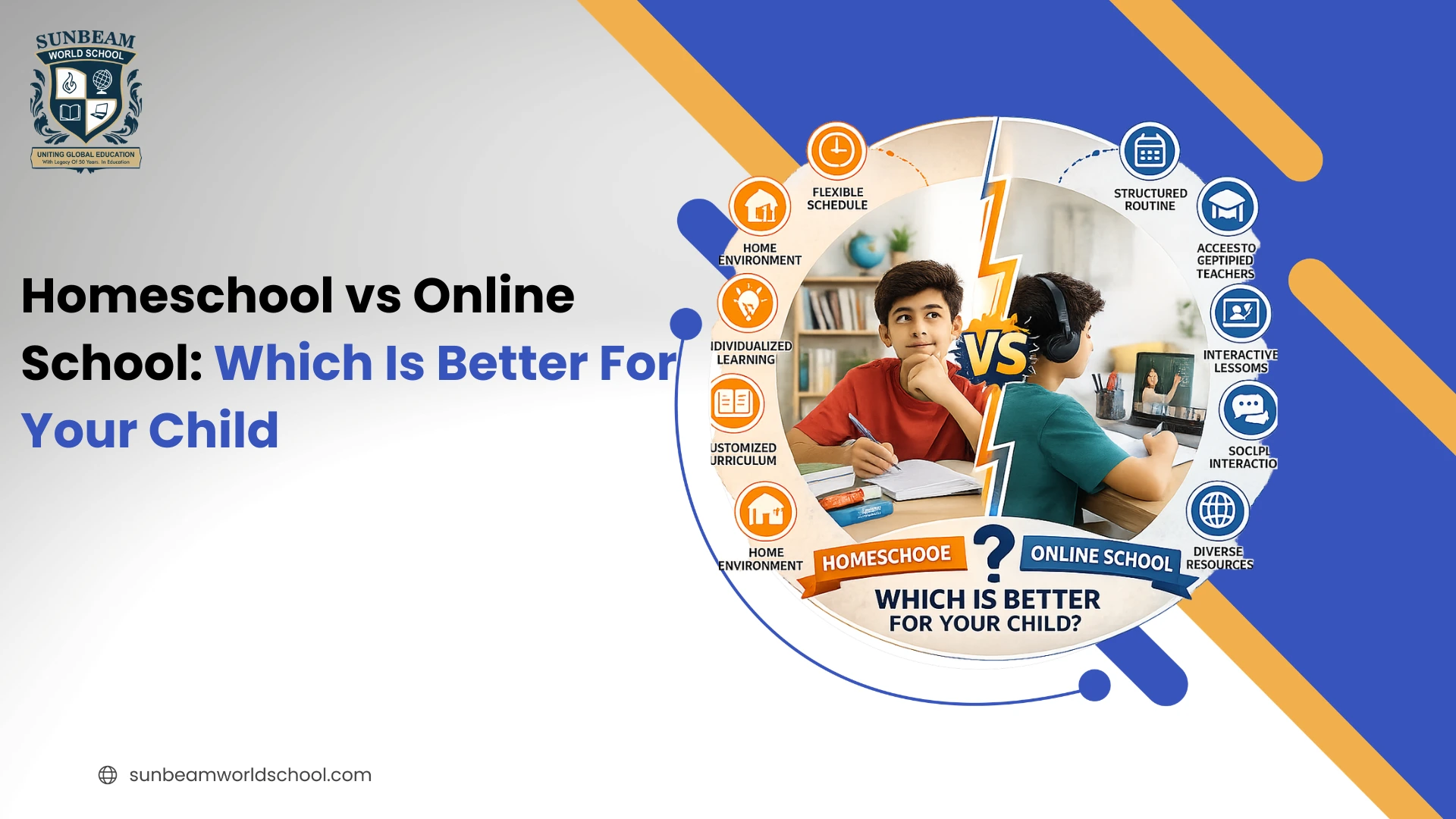
| Homeschooling and online schooling are often confused because both allow children to study from home, but they differ significantly in structure, teaching responsibility, certification, and academic support.
In homeschooling, parents act as the primary educators and manage curriculum, assessments, and scheduling. Online schools provide certified teachers, structured classes, recognized curricula, regular assessments, and board-recognized certifications. For Indian families, online schooling often offers a clearer pathway to higher education because students receive recognized academic credentials without needing to register separately for board examinations. Homeschooling provides greater flexibility and control but requires substantial parental involvement and planning. When choosing between online school vs homeschooling, parents should consider factors such as available teaching time, academic goals, certification requirements, social interaction opportunities, and long-term educational plans. For most families seeking flexibility without sacrificing academic structure, online schooling provides a balanced solution that combines home-based learning with professional educational support. |
When a parent first starts exploring non-traditional education, one question almost always comes up: "Is homeschooling and online school the same thing?"
The short answer is no, but it's easy to mix them up. Both take place at home. Both give your child freedom from a traditional classroom. But after that, they diverge quite significantly. One places the entire teaching burden on you. The other gives your child a real school experience, just delivered through a screen.
This guide walks you through every important difference, so you can decide between online school vs homeschooling, what's actually right for your family.
| What you'll learn: What homeschooling and online school actually mean, how they compare across 6 key factors, the real pros and cons of each, and a simple decision framework to help you choose. |
What Is Homeschooling?
Homeschooling is when a parent or guardian takes on the full responsibility of educating their child at home. There's no school — online or offline — involved. You are the teacher, the curriculum designer, the scheduler, and the examiner.
Some families love this level of control. Others find it overwhelming. The key word is full responsibility. If your child needs to learn algebra, you need to teach it — or find and pay for a tutor. If your child needs a science experiment, you design it. If they need structured feedback on an essay, that falls to you.
In India, homeschooling has no formal legal framework. Parents typically enroll children as "private candidates" to appear for CBSE or NIOS board exams once they're of age.
| Important for Indian parents: Homeschooling in India, does not automatically lead to a recognized school certificate. For board certifications, you'll need to register separately as a private exam candidate. This requires extra planning. |
What Is an Online School?
An online school is a real school, just delivered over the internet. Students attend live or recorded classes taught by certified, trained teachers. There are classmates, assessments, report cards, and a structured academic calendar. The difference from a brick-and-mortar school is simply the medium.
Accredited online schools like Sunbeam World School follow a recognized curriculum (such as CBSE), employ qualified educators, and award board-recognized certificates. Your child gets the structure and credibility of a formal education, with the flexibility to learn from home.
| Think of it this way: Online school = traditional school moved to a virtual classroom. Homeschool = parents running the school themselves at home. |
Homeschool vs Online School: The 6 Key Differences
Here's a clear side-by-side comparison between homeschooling and online school, across the factors that matter most to parents.
| Factor | Homeschooling | Online School (e.g., Sunbeam World School) |
| Who teaches? | Parent or privately hired tutor | Certified, qualified teachers |
| Curriculum | Parent-designed or purchased; no standard framework | Board-recognized curriculum (CBSE, Cambridge, etc.) |
| Structure | Fully flexible; can lack consistency without planning | Structured timetable with regular classes and accountability |
| Certification | Requires separate registration for board examinations | Directly leads to recognized board certification |
| Socialization | Limited; social opportunities must be arranged separately | Peer interaction through live classes, clubs, and activities |
| Parental Effort | Very high; parents manage teaching, planning, and assessment | Moderate; parents supervise while teachers handle instruction |
| Cost | Lower if parent teaches; higher with private tutors and resources | School fees apply; often more affordable than many traditional schools |
| Technology Required | Minimal; depends on the family's learning approach | Computer/tablet and stable internet connection required |
| Assessment & Progress Tracking | Parent-managed; may vary in quality and consistency | Regular tests, assignments, report cards, and teacher feedback |
| College & University Recognition | Depends on examination route and certification obtained | Widely recognized board credentials accepted by colleges and universities |
| Extracurricular Activities | Must be sourced independently | Integrated activities, competitions, workshops, and student clubs |
| Learning Support | Depends on parent expertise or hired tutors | Access to subject specialists, counselors, and academic support teams |
Homeschooling: Honest Pros & Cons
Homeschooling works beautifully for certain families — and is genuinely difficult for others. Here's what you need to know before committing.
Advantages
- Complete control over curriculum content and pace
- Deep religious or cultural integration possible
- Works well for children with specific medical needs
- Lowest cost if the parent teaches directly
- No fixed daily schedule, total time flexibility
Disadvantages
- The parent must be available full-time to teach
- No peer interaction unless actively arranged
- Quality depends entirely on parents' knowledge
- No recognized certificate without board exam registration
- Difficult to teach advanced subjects (Science, Maths)
Who is Homeschooling actually right for?
Homeschooling makes sense when a parent is a qualified educator themselves, when a child has a medical condition that prevents any institutional engagement, or when the family has very specific philosophical or religious reasons for keeping education entirely in-house.
For most families, especially working parents, the commitment is simply not feasible without significant compromise on either the quality of education or the parents' professional life.
Online School: Honest Pros & Cons
Online schooling has grown dramatically, and for good reason. But it's not without its own considerations.
Advantages
- Taught by certified, subject-specialist teachers
- Leads to board-recognized certificates (CBSE, ICSE)
- Flexible scheduling within a clear structure
- Peer interaction, clubs, group projects
- Parents can work — no full-time teaching required
Considerations
- Requires a stable internet connection
- Screen time increases compared to homeschool
- Less physical activity than a campus school
- Self-discipline still matters for the student
| Sunbeam World School advantage: Our online school combines CBSE-aligned academics with interactive live sessions, dedicated mentors, extracurricular activities, and a strong parent communication system — so you're never out of the loop, but never overwhelmed either. |
What About Socialization?
This is the concern parents raise most. "My child will miss out on friendships." It's valid — and it's something that differs sharply between homeschooling and online schooling.
With homeschooling, social interaction has to be deliberately arranged by parents — playdates, co-ops, sports clubs, community groups. It takes ongoing effort, and children from homeschooled environments sometimes find it harder to adapt to group dynamics later.
With a well-run online school, socialization is built into the structure. Live group classes, collaborative projects, inter-school competitions, clubs, and virtual events give children regular, meaningful interaction with peers. It's not identical to a physical school, but it's far from isolation.
Which Is Right for Your Child?
There's no universal answer — and anyone who tells you otherwise is selling something. Here's a simple framework to guide your thinking:
Consider Homeschooling If…
- You are a trained teacher with time to commit fully
- Your child has a medical condition limiting screen exposure
- Religious or philosophical values require total curriculum control
- Your child is extraordinarily self-directed and advanced
Consider Online School If…
- Online school works better when:
- Both parents work or cannot teach full-time
- You want a recognized certificate and structured academics
- Your child needs qualified teachers across all subjects
- Peer interaction and structured activities matter to you
| A parent's honest reflection: "We tried homeschooling for a year. I'm not a trained teacher, and managing my job while trying to teach Maths was burning us both out. Online school gave my daughter actual teachers, real classmates, and gave me my sanity back." — Parent testimonial, Sunbeam World School |
Homeschool vs Online School in India
The India context adds some important nuances that global articles often miss.
Legal recognition
India does not have a formal homeschooling law. Homeschooled children need to appear as private candidates for Class 10 and 12 board exams (CBSE/NIOS). This requires separate registration, documentation, and exam preparation. Accredited online schools eliminate this complexity entirely — students receive their board certificates through the school.
College admissions
For college admissions in India, a board-issued mark sheet is typically required. Students from recognized online schools have clear pathways. Homeschooled students may face additional scrutiny and paperwork during admissions to Indian universities.
Competitive exam preparation
If your child aims for JEE, NEET, or CUET, a structured online school with subject-specialist teachers provides far better preparation than a self-designed homeschool curriculum.
Final Thoughts
Both homeschooling and online schooling are valid responses to the same question: how do we give our child a better education than the default?
Homeschooling is meaningful for families who have the time, teaching competency, and motivation to own every aspect of their child's education. It's a full lifestyle commitment, and for the right families, it's deeply rewarding.
Online school is the better choice for most families — especially in India — where board-recognized certification, subject-specialist teachers, peer learning, and parental peace of mind all matter. It offers the flexibility of learning from home without placing the entire teaching burden on parents.
At Sunbeam World School, we've built our online school program with exactly this in mind: real academic rigor, caring teachers, a strong student community, and a curriculum that prepares children for board exams and beyond.
If you're weighing your options, we'd love to help you find the right fit for your child. Speak with our admissions counselors no pressure, just honest guidance.

Frequently Asked Questions
Is online school the same as homeschooling?
-No. Online school is run by an accredited institution with certified teachers, a recognized curriculum, and structured assessments. Homeschooling means parents take full responsibility for teaching their child, with no institution involved. Both happen at home, but they are fundamentally different in how education is delivered and certified.
Which is better for academic outcomes- homeschool or online school?
+Can a homeschooled student get a CBSE certificate in India?
+How much does online school cost as compared to homeschooling?
+Will my child miss out on socializing in an online school?
+Is homeschooling legal in India?
+
In this article
Share this post:


Press and Blogs
Stay updated with our press releases, educational blogs, and more.

Quick Summary An algebra equation is a maths statement that sets two expressions equal using...

Quick Summary The area of rectangle equals its length multiplied by its width (A =...
Quick Summary Sympathy means feeling sorry for someone from your own point of view. Empathy...