
 Accredited Online School
The Importance of Skill Development in School Education: A Complete Guide for Parents
Quick Answer Skill development in school education means teaching students practical abilities like critical thinking, communication, and problem solving, not just academic facts. It matters because marks alone do not prepare students for real jobs or real life. Schools that focus on skills alongside academics help students become more confident, adaptable, and ready for the future.
For generations, a child's report card was the main way parents and schools judged how well a student was doing, with high marks signaling success and low marks raising concern. But the world students are growing up in today asks for more than exam scores. Employers want problem solvers, colleges look for independent thinkers, and everyday life demands skills that no textbook fully teaches, like communication, adaptability, and the confidence to figure things out on your own.
This is where skill development in school education comes in. It does not replace academics, it makes academics useful. In this guide, we will look at what skill development means, why it matters more than ever, what skills students need most, and how parents can support it, whether their child is in a regular school or a more flexible path like homeschooling.
What Is Skill Development in Education?
Skill development is the process of building practical abilities that help students use what they learn in real situations, rather than simply remembering it for a test.
It generally falls into two broad categories. Technical skills include things like coding, using digital tools, or working with data, while soft skills cover communication, critical thinking, teamwork, and problem solving. Together, these are the abilities that shape how a student handles real situations, not just how they perform on exam papers.
This distinction matters because traditional schooling has mostly been built around one pattern: read the chapter, remember the facts, and write them down in an exam. Skill development changes that approach by asking a different question. Instead of "what do you know," it asks "what can you do with what you know." That shift, from treating knowledge as the end goal to treating it as a tool, is really the idea behind skill based education.
Why Do Skills Matter More Than Marks?
Skills matter more than marks because they prepare students for real challenges, while marks mostly measure how well a student can remember information for a test.
Marks have always been easy to measure, since a number on a report card is simple to compare and rank across students. But being easy to measure does not make something accurate, and a high score does not always show whether a student can think clearly, explain an idea well, or work through a problem they have never seen before.
This gap tends to become obvious once students finish school and step into workplaces that rarely ask for exam transcripts. Instead, they ask what a person can actually do, how they handle unfamiliar situations, and how well they work with others, which is often a hard transition for a student who has memorized formulas but never really practiced applying them.
Skill based learning helps close this gap early by giving students regular chances to make decisions, discuss ideas, and solve real problems alongside their usual subjects. This does not mean marks stop mattering, since they still reflect effort and understanding. But when skills are built alongside marks, students leave school with both knowledge and the ability to actually use it.
What Key Skills Does Every Student Need?
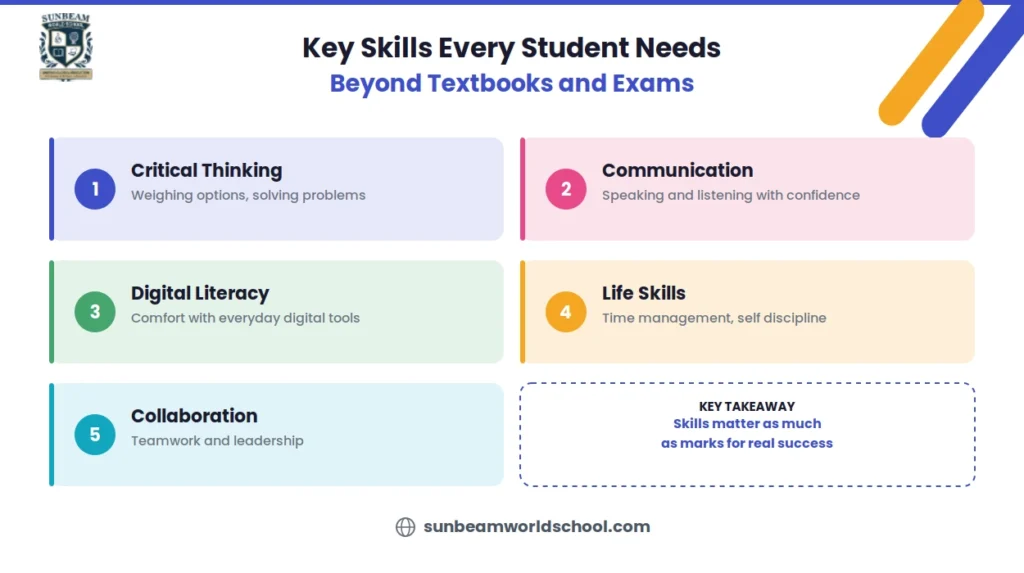
Key skills every student needs to succeed beyond textbooks and exams.
Every student benefits from a mix of thinking skills, communication skills, digital skills, and life skills, and each one plays a different role in preparing them for the world beyond school.
Critical Thinking and Decision Making
Critical thinking helps students look at a problem from different angles before settling on a solution, which is really the skill behind good decision making. Students who practice this regularly get better at asking useful questions, weighing their options, and resisting the urge to jump to conclusions, and this habit shows up just as often in everyday choices as it does in tricky exam questions.
Communication Skills
Being able to explain an idea clearly, whether in writing or out loud, is one of the most useful skills a student can build over time. Activities like debates, presentations, and group discussions give students practice speaking with confidence and listening actively, and this kind of communication makes it far easier for them to work well with teachers, classmates, and eventually colleagues.
Digital Literacy and Technical Proficiency
Most jobs today require some level of comfort with technology, so digital literacy has become a practical necessity rather than a bonus skill. This means students should be able to use digital tools confidently, know how to find reliable information online, and adapt to new software or platforms as they come up, even if they never learn to code. In short, they should not feel lost the moment they are handed a new tool.
Life Skills and Self Discipline
Life skills cover things school subjects rarely teach directly, such as managing time, staying organized, handling setbacks, and working independently, and these tend to carry over into adulthood far more directly than most academic content. Self discipline matters especially in flexible learning environments, where a student is largely setting and following their own pace. Our detailed guide on life skills for students covers this in more depth.
Collaboration and Leadership
Working well in a team, and occasionally leading one, is a skill students usually build through group projects, sports, or other shared activities. Learning how to plan with others, keep a team motivated, and work through disagreements prepares students for almost every environment they will enter later, from college group work to their first job.
Why Shift From Traditional Methods of Learning Is Important?
Shifting from traditional learning methods is important because the old model, where every student learns the same thing at the same pace, does not fit how differently students actually learn.
Traditional classrooms are usually built around a single pace for the whole group, which overlooks the fact that some students need more time on a topic while others move faster and end up bored waiting for the rest of the class, and over time this mismatch can lead to real disengagement. There is also a heavy focus on memorization in most traditional settings, where students learn to reproduce answers for an exam rather than practice thinking a problem through, which limits creativity and makes it harder for them to apply what they have learned once they step outside the classroom.
On top of this, traditional schooling comes with practical limits, since students need to be in a specific place at a specific time, which can be difficult for families dealing with relocation, health issues, or other commitments, and it is often expensive once transport, materials, and other costs are added up.
None of this means traditional education has no value, since it has worked for generations and still offers structure and social interaction that many students genuinely benefit from. But moving toward more flexible, skill focused methods addresses gaps that traditional classrooms were never really designed to solve, like personalized pacing and real world application. You can read more about this shift in the power of personalized learning for students.
What Are the Benefits of Skill Based Learning?
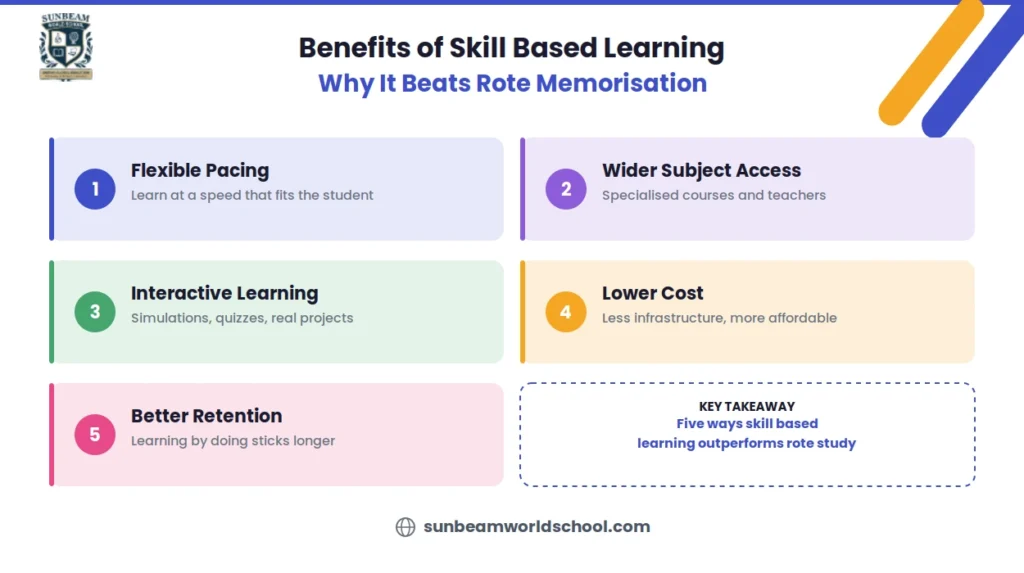
Explore five key benefits of skill-based learning beyond traditional memorisation.
Skill based learning offers more flexibility, more personalization, and better preparation for real life compared to traditional methods, and these advantages tend to build on each other rather than working in isolation. A student who learns at their own pace is also more likely to stay engaged, and a student who stays engaged tends to retain more of what they learn. Here is a closer look at what this looks like in practice.
Learning at a Pace That Actually Fits the Student
One of the biggest advantages of skill based learning is that it does not force every student through the same material at the same speed. A student who grasps a concept quickly can move ahead instead of sitting through repetition they do not need, while a student who needs more time on a particular topic can take it without feeling rushed or falling behind the rest of the class. This kind of pacing reduces the frustration and boredom that often build up in a rigid, one size fits all classroom, and it gives students a much healthier relationship with learning itself.
Access to a Wider Range of Subjects and Specialists
Skill based programs are rarely limited to whatever subjects and teachers happen to be available locally. Because much of this learning can happen through online platforms, project based modules, or specialized electives, students often get access to courses and instructors they would never encounter in a conventional school, whether that is a coding specialist, a public speaking coach, or an expert in a niche subject. This widens what a student can explore well beyond the standard syllabus, and it often helps them discover interests or strengths they did not know they had.
More Engaging, Hands-On Ways of Learning
Rather than relying purely on lectures and textbooks, skill based learning leans heavily on simulations, quizzes, real world projects, and other interactive formats that ask students to actually do something with what they are learning. This kind of active involvement tends to hold a student's attention far better than passive listening, and it gives them a way to check their own understanding as they go, instead of only finding out how well they have learned something when a final exam or report card arrives.
A More Affordable Path to Quality Education
Many skill based programs, particularly those delivered online, require far less investment in physical infrastructure like classrooms, transport, and printed materials, and these savings are often passed on to families in the form of lower fees. This makes it possible for students in smaller towns or with tighter budgets to access the same quality of instruction and resources that were once limited to expensive private institutions, without compromising on what they actually learn.
Deeper, Longer Lasting Understanding
When students learn by applying a concept rather than simply memorizing it for a test, that knowledge tends to stick with them far longer. Skill-based learning is built around this idea, using hands-on practice and real-world application to help students form a genuine understanding rather than a temporary one that fades soon after the exam is over. This is ultimately what makes skill-based learning valuable well beyond the school years, since the abilities it builds keep showing up in college, careers, and everyday decision-making long after specific facts have been forgotten.
How Does NEP 2020 Promote Skill Based Education?
India's National Education Policy 2020 promotes skill based education by pushing schools to prepare students for a job market that is changing quickly because of automation, artificial intelligence, and new technology.
NEP 2020 recognizes that many routine jobs are already being taken over by machines and software, and to prepare students for that shift, it encourages a curriculum that goes beyond textbook knowledge and builds practical, transferable skills. This includes a stronger focus on vocational exposure, project based learning, and flexibility in subject choices, so that students are ready for a job market that looks quite different from the one their parents entered. If you want to understand how these policy changes affect board structures, our post on whether the 10th board has been removed under the new education policy covers this in detail.
How Does Online School Support Skill Development?
Online school supports skill development by giving students personalized learning opportunities, flexible schedules, and access to interactive lessons that go beyond traditional textbook-based learning.
In an online school environment, students can learn at a pace that suits their individual needs while receiving guidance from teachers through live classes, discussions, projects, and digital learning activities. This flexibility gives students more opportunities to practice skills such as communication, critical thinking, problem solving, digital literacy, and time management. Project-based assignments and interactive activities also encourage students to apply what they learn instead of simply memorizing information for exams.
At Sunbeam World School, online learning combines structured academics with practical skill development, helping students build independence, confidence, and digital skills alongside their regular curriculum. The flexible learning environment allows students to develop skills that can support them in higher education, future careers, and everyday life.
How Can Parents Support Skill Development at Home?
Parents can support skill development at home by giving children real responsibilities, encouraging them to solve problems on their own, and making room for activities outside the standard curriculum.
Give them real responsibilities. Simple tasks like managing a small budget, planning a family outing, or organizing their own study schedule build decision making and life skills naturally, without feeling like a lesson.
Let them struggle a little. It can be tempting to step in and solve a problem for a child right away, but asking guiding questions and letting them work through it themselves builds the kind of critical thinking that classroom learning alone often cannot.
Encourage communication. Small habits, like asking your child to explain what they learned that day in their own words, or having regular conversations about their opinions on things, build communication skills gradually over time.
Support their interests outside class. Whether it is coding, art, sports, or public speaking, activities outside the standard syllabus often teach skills that stick far longer than exam preparation does.
Help them build routines that stick. Skill development also depends on good time management habits at home. Our guide on how to manage time and schedules while homeschooling has practical tips parents can start using right away.
Conclusion
Marks show what a student remembers, but skills show what they can do with it. Building both, whether in a traditional classroom or a flexible setup like homeschooling, is what truly prepares a child for life after school. If you want to explore ways to build this kind of confidence and independence early on, our post on fostering confidence and self esteem in kids is a good place to start.
At Sunbeam World School, students get the flexibility to learn at a pace that works for them while developing skills through interactive lessons, projects, and real-world activities. The approach combines structured academics with opportunities to build communication, critical thinking, digital literacy, and independent learning skills.
With personalized learning support and a flexible online environment, we help students develop the confidence to apply what they learn beyond the classroom. This makes learning more meaningful while preparing students for higher education, future careers, and everyday life.

Frequently Asked Questions
Why is skill development important in school education?
-Skill development is important in school education because it prepares students to apply what they learn in real situations, not just recall it for exams. It builds critical thinking, communication, and problem solving abilities that matter throughout life, well beyond the classroom.
What are the key skills students need today?
+Why is shifting from traditional learning methods important?
+How does homeschooling support skill development?
+
In this article
Share this post:


Press and Blogs
Stay updated with our press releases, educational blogs, and more.

Quick Summary An algebra equation is a maths statement that sets two expressions equal using...

Quick Summary The area of rectangle equals its length multiplied by its width (A =...
Quick Summary Sympathy means feeling sorry for someone from your own point of view. Empathy...