
 Exam
Exam
Is the 10th Board Removed in the New Education Policy?
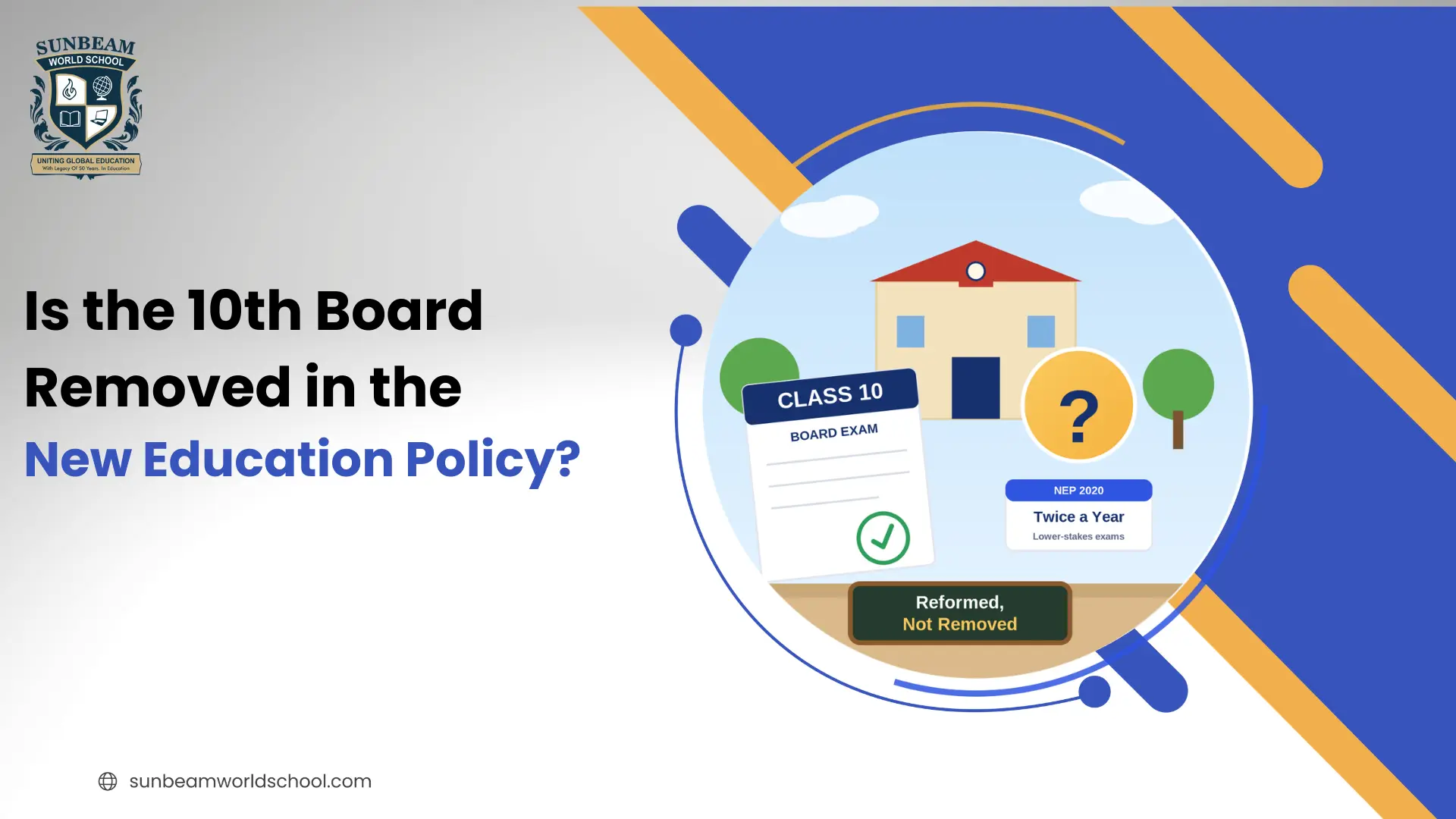
Is the 10th board removed in the New Education Policy?No, the Class 10 board exam has NOT been removed under NEP 2020. However, it has been significantly reformed. Starting from the 2025-26 academic year, CBSE now conducts two board examinations per year for Class 10 students. The first is mandatory (Feb-March); the second is an optional improvement exam (May-June). The format has also shifted toward competency-based questions instead of rote memorization. |
Every year, as exam season approaches, a wave of rumors sweeps through school corridors, WhatsApp groups, and coaching centers: "Has the 10th board been canceled? Did NEP 2020 abolish it?" Parents panic. Students hope. The internet offers contradictory answers.
This article cuts through the confusion with verified, up-to-date facts. We explain exactly what NEP 2020 says about Class 10 board exams, what CBSE has actually changed, how the new dual examination system works, and what it means for students appearing in 2026 and beyond.
| Myth
NEP 2020 Removed the 10th Board This is false. No official government notification or NEP document says the Class 10 board exam will be abolished. Fact NEP 2020 Reformed the 10th Board Board exams continue, but are now more flexible, competency-based, and offered twice a year, not once. |
What Is NEP 2020?
The National Education Policy (NEP) 2020 is India's most sweeping education reform since 1986. Approved by the Union Cabinet in July 2020, it restructures the entire schooling system, from curriculum design and assessment to teacher training and higher education.
At its core, NEP 2020 aims to move Indian education away from memorization and high-stakes testing toward genuine understanding, critical thinking, and skill development.
Key structural changes include replacing the old 10+2 schooling model with a 5+3+3+4 framework: Foundational (ages 3–8), Preparatory (8–11), Middle (11–14), and Secondary (14–18). It also promotes mother-tongue instruction until Grade 5, eliminates rigid Science/Commerce/Arts stream divisions, and introduces vocational education from Grade 6 onwards.
Is the 10th Board Exam Abolished Under NEP 2020?
Not at all, NEP 2020 does not eliminate Class 10 board examinations. The policy specifically states that board exams at Classes 10 and 12 will be retained, but reformed to test conceptual understanding rather than the ability to memorize and reproduce textbook answers.
The confusion around this question arises partly because NEP 2020 strongly critiques the existing exam-heavy culture in Indian education, and partly because the policy recommends making board exams "easier" and "less stressful." Some readers misinterpreted this as a signal that the exams would be scrapped entirely.
They won't be. What is changing is how those exams are designed, when they are held, and how results are recorded.
What Has Actually Changed Under NEP: Key Reforms
| Area | Before NEP 2020 | Under NEP 2020 |
| No. of Exams/Year | One board exam per year | Two board exams per year (mandatory + optional) |
| Question Type | Primarily descriptive, rote-based | Mix of MCQs, analytical, and descriptive questions |
| Report Card | Marks/percentages only | Holistic — includes strengths, values, co-curriculars |
| Subject Streams | Fixed Science / Commerce / Arts | Flexible — students choose across disciplines |
| Internal Assessment | Conducted once per year | Conducted once per year (no change) |
| Evaluation Focus | Memory and reproduction | Competency, application, critical thinking |
The CBSE Dual Board Examination System
The most concrete and immediate change students need to understand is the CBSE Dual Board Examination. On June 25, 2025, CBSE issued an official notification formalizing this system for Class 10, effective from the academic year 2026-27.
Exam 1: Mandatory
- Main Board Examination
- February 17 – March 10, 2026
- All Class 10 students must appear
- Full syllabus covered
- Results announced in April 2026
- Determines pass/fail status
Exam 2: Optional
- Improvement Examination
- May 15 – June 1, 2026
- Optional for students who passed Exam 1
- Improve score in up to 3 subjects
| Important: Which Score Is Used?
For students who appear in both exams, the better score from either attempt is used in the final result. There is no penalty for appearing in the second exam. However, no third attempt is available within the same academic year. |
Expected Benefits Of Dual Board Exams for Students
The CBSE dual exam model is expected to benefit students in several ways:
- Better academic confidence
- Reduced fear of failure
- Improved performance opportunities
- Greater flexibility in score improvement
- Stronger focus on understanding concepts
- Healthier student mental well-being
Students preparing for competitive exams may also benefit because they can improve Board scores without losing an academic year.
Challenges Schools May Face In Dual Board Eams
While the reform offers major benefits, schools may also face implementation challenges such as:
- Increased exam administration workload
- Scheduling and logistics management
- Additional evaluation responsibilities
- Teacher training for competency-based assessments
- Infrastructure readiness
CBSE is expected to gradually streamline these processes as the system expands nationwide.
Eligibility Rules for the Second (Improvement) Exam
Not all students are automatically eligible for the May improvement exam. Here's what students and parents need to know:
Who CAN Appear
Students who passed all subjects in Exam 1
Students with compartment results (failed in 1-2 subjects)
Sports quota students who missed Exam 1 due to events
Who CANNOT Appear
Students who failed 3 or more subjects in Exam 1
Students seeking a third attempt in the same year
Students with incomplete internal assessments
| Essential Repeat Rule
If a student fails three or more subjects in Exam 1, they are marked "Essential Repeat" and must wait until the next academic year. The May exam is not available to them. |
Changes to the Exam Pattern and Question Format
Beyond the dual exam structure, the format of questions in the Class 10 board exam has also changed under NEP 2020. The new question papers contain a deliberate mix of three types:
1. Objective Questions (MCQs)
These test recall and factual accuracy quickly. Under NEP, they form a higher portion of paper than before, especially in subjects like Science and Mathematics.
2. Analytical / Application-Based Questions
These require students to apply concepts to real-world situations. The shift away from purely descriptive answers is perhaps the most significant pedagogical change in the new pattern.
3. Descriptive / Long-Answer Questions
These remain part of the paper but now reward clarity of thought and structured reasoning over the ability to reproduce long textbook paragraphs verbatim.
The New Holistic Report Card
NEP 2020 envisions replacing the traditional marks-and-percentage report card with a far richer document. The holistic report card will include academic performance, co-curricular participation, values and ethics, self-assessment, and peer assessment components.
This shift has not yet been fully implemented across all schools, but CBSE schools have been progressively integrating holistic reporting in internal assessments.
What About State Boards?
CBSE and ICSE have both moved to implement dual board exams from 2026. State boards are at varying stages of adoption:
| State Board | Status (as of May 2026) |
| Maharashtra (SSC) | Evaluating dual exam feasibility |
| Tamil Nadu (SSLC) | Studying NEP implementation roadmap |
| Karnataka SSLC | Internal consultations ongoing |
| Punjab Board | Assessing infrastructure readiness |
| Jharkhand Board | Planning phase |
If you are under a state board, check with your board's official website for the latest implementation status. The NEP framework is a national recommendation; individual boards set their own timelines.
Does the Dual Exam System Reduce Pressure or Double It?
This is the debate playing out among educators and parents. Proponents argue that giving students two chances to prove themselves reduces the catastrophic consequences of a single bad day, encourages learning over cramming, and is more equitable for students from disadvantaged backgrounds.
Critics point out that conducting two full-scale board exams per year places additional logistical burden on schools, increases costs, and may inadvertently create pressure to perform well in both attempts rather than only one.
What is clear is that the intent of the change, reducing the high-stakes nature of a single annual board exam, is aligned with international best practices. Countries like the UK (GCSEs), the US (SAT retakes), and Singapore already offer students multiple assessment windows.
Key Takeaways for Students and Parents
|
Conclusion
The Class 10 board examination is not disappearing under NEP 2020; it is evolving into a more flexible, student-friendly, and concept-focused system. The introduction of dual board exams, competency-based evaluation, and holistic assessment reflects a broader shift in Indian education toward deeper learning rather than memorization.
For students, this means more opportunities to improve performance, less dependence on a single high-pressure exam, and a stronger focus on practical understanding and critical thinking. At the same time, consistent preparation, internal assessments, and conceptual clarity remain more important than ever.
At Sunbeam World School, students are guided through these changing academic frameworks with structured learning support, future-ready teaching methods, and personalized academic mentoring designed to help them confidently adapt to the evolving CBSE and NEP education landscape.

Frequently Asked Questions
Is The 10th Board Exam Removed Under NEP 2020?
-No, NEP 2020 has not removed the Class 10 board exam. The exams continue but are now reformed, with a dual exam system, competency-based questions, and a more holistic grading model.
What is the CBSE dual board exam system for Class 10?
+When did the CBSE dual exam system actually start?
+What happens if a student fails 3 or more subjects in Exam 1?
+Will state boards also follow the NEP 2020 dual exam system?
+How has the question paper pattern changed under NEP 2020?
+Can a student appear in the second exam even if they scored well in the first?
+Is NEP 2020 fully implemented in schools yet?
+
In this article
Share this post:


Press and Blogs
Stay updated with our press releases, educational blogs, and more.

Quick Summary Roman numerals 1 to 1000, also called Roman numbers, use seven letters: I...

Quick Summary The area of rectangle equals its length multiplied by its width (A =...

Quick Summary Student success motivational quotes are short, memorable lines that can help students stay...