
 Online School
Uses of Computer in Daily Life: 20 Examples for Students, Home and Work
Quick Answer
Computers are used in daily life for education, communication, banking and payments, shopping, entertainment, work, healthcare, and government services, covering most of the tasks people rely on a screen for every day. Beyond these core eight, computers also support scientific research, manufacturing, agriculture, travel booking, and household management, making them central to both personal routines and larger systems like hospitals, banks, and schools.
A computer used to mean something you sat down at, in an office or a lab. Now it's just as often a laptop open on a kitchen table, a school-issued Chromebook, or the browser tab someone flips to between classes. Over 1.03 billion people in India are online today, up from barely half the population five years ago, and that shift shows up in how ordinary days are actually structured, not just in how offices run.
The rest of this guide breaks that answer down into a full list of 20 examples of computer usage in everyday life.
What Is a Computer?
A computer is an electronic device that receives, processes, stores, and displays information to help people complete different tasks. It can be used to create documents, browse the internet, attend online classes, communicate with others, manage data, make payments, watch videos, play games, and much more. Modern computers include desktops, laptops, and other connected devices, and they have become an important part of everyday life. For students, computers are especially useful for learning, research, completing assignments, developing digital skills, and accessing educational resources online.
20 Uses of Computers in Our Daily Life
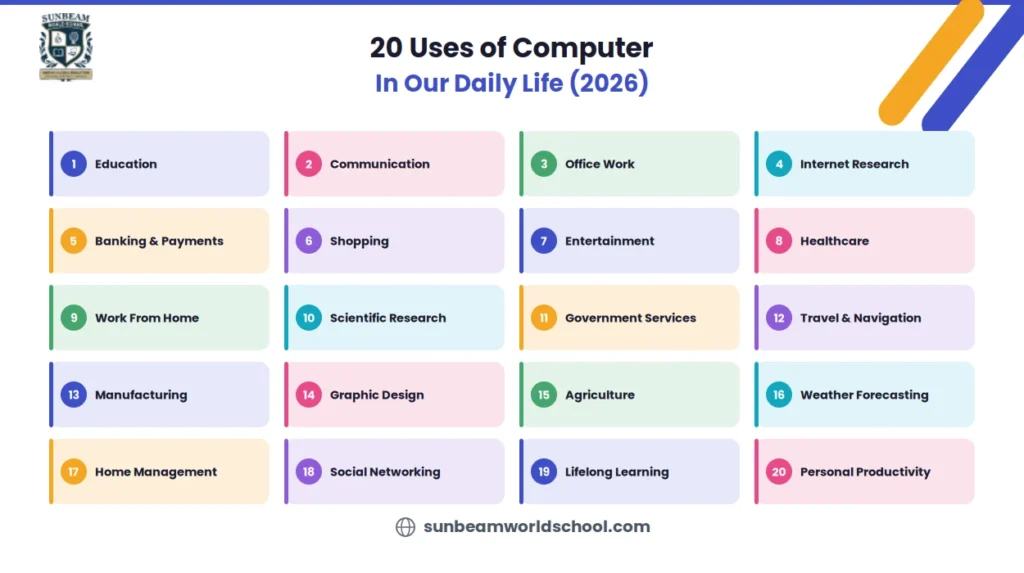
From classrooms to government portals, here's how the 20 uses of a computer in daily life break down into six broad categories.
Computers show up in plenty of other corners of daily life, from scientific research to disaster forecasting to the design work behind the products people use. Here's the complete list of 20, with what each one actually looks like in practice.
1. Education and Online Learning
School has stopped being a place you go and started being something you also log into. Students use computers for live and recorded classes, research through digital libraries, assignment writing, and increasingly, early coding practice built directly into the curriculum rather than treated as an optional elective. Building strong computer literacy early on makes all of this easier to pick up.
2. Communication
A call that once meant a landline and a long-distance charge now takes a tap. Email handles formal exchanges, while Zoom, Teams, and Google Meet carry meetings and webinars, and apps like WhatsApp Web keep everyday conversations going in the background of a workday.
3. Office Work and Business Productivity
Spreadsheets, invoices, payroll, and client presentations all run through a computer before they reach anyone else. Small businesses use tools like Tally or Zoho for accounting, and comfort with these basics has quietly become a baseline job requirement rather than a specialised one.
4. Internet Research and Information Access
Search engines, digital journals, and reference sites make a computer the fastest route to almost any fact. A full keyboard and larger screen still make it the better tool for comparing sources, reading longer material, or fact-checking against something credible rather than the first result that appears. It's part of why the internet has become so central to how students learn, not just how they look things up.
5. Banking, Payments, and Finance
This is where the shift is most measurable. UPI processed 23.2 billion transactions worth ₹29.90 lakh crore in a single month in 2026, and it now handles roughly 85% of India's digital payment volume through apps like PhonePe and Google Pay. Behind the scenes, the same computer systems run fraud detection, loan processing, and institutional risk reporting at a scale no manual system could match.
6. Shopping and E-commerce
Amazon and Flipkart replaced the trip to the store for a large share of everyday purchases, with price comparisons, reviews, and live delivery tracking built in. The same shift let small sellers open a storefront without ever renting physical space.
7. Entertainment
Streaming, gaming, and music make up the single most time-consuming category of computer use for most people. Netflix and Spotify have mostly replaced physical media, and gaming, whether solo or online with friends, has grown into one of the largest entertainment industries anywhere.
8. Healthcare
Hospitals run on electronic health records to keep patient histories accurate and accessible, and diagnostic machines like CT and MRI scanners are computer-operated by design. Telemedicine has extended this further, letting doctors consult patients in areas without a nearby clinic.
9. Work From Home
Remote work exists because file sharing, video calls, and task tracking can now happen from anywhere with an internet connection. Google Drive keeps documents synced, Trello and Asana keep deadlines visible, and the flexibility has particularly helped parents and students balancing multiple responsibilities at once.
10. Scientific Research
Calculations that once took years of manual work now run in minutes. Researchers use computers to model climate patterns, simulate chemical reactions, and share findings with collaborators on the other side of the world almost instantly, which is a large part of why scientific progress has accelerated so fast in recent decades.
11. Government and Digital Services
Applying for an ID, filing taxes, or checking a public record no longer requires standing in a line. Portals like DigiLocker store and verify official documents digitally, and e-governance systems have made government processes more trackable and, in most cases, faster.
12. Travel and Navigation
Booking a train ticket on IRCTC, checking live traffic before a drive, or tracking a delivery in real time are all things a computer or connected device handles quietly and constantly. Airlines and railways also rely on the same kind of systems to manage scheduling across entire networks.
13. Manufacturing and Automation
Factories increasingly run on computer-controlled machinery for production and quality checks, work that used to depend heavily on manual labour. Computer-aided design lets manufacturers test a product digitally long before building a physical version, cutting both cost and error.
14. Graphic Design and Multimedia
What once needed a darkroom or an editing suite now fits on a laptop. Designers, photographers, and video editors use computers for everything from logo work to full video production, which has made creative careers far more accessible to people working independently.
15. Agriculture
Precision farming tools now help farmers decide when to plant, irrigate, or harvest based on soil and market data rather than guesswork alone. It's one of the clearest signs of how far computer use has spread beyond offices and classrooms into physical, hands-on work.
16. Weather Forecasting and Disaster Management
Meteorological computer models process satellite and sensor data to predict storms, floods, and heatwaves days in advance, giving governments and communities time to prepare. This same computing power supports early-warning systems that have measurably reduced disaster casualties in recent years.
17. Home and Household Management
Budgeting apps, grocery planning, and smart home devices have turned household organisation into something far less paper-dependent than it used to be. For a lot of families, this kind of digital planning has simply become how things get run.
18. Social Networking
India had close to 500 million active social media users by late 2025, using platforms to stay in touch, follow news, and in a growing number of cases, run a small business or a cause entirely through social reach.
19. Lifelong Learning and Skill Development
Coursera, edX, and YouTube have made structured learning available well outside a formal classroom, letting anyone pick up a new skill or certification on their own schedule. Career growth is far less tied to physical access to an institution than it used to be.
20. Personal Productivity and Organization
Calendars, reminders, and document tools help people manage both work and personal responsibilities in one place. It's the least visible use on this list, but probably the one most people rely on without thinking about it, and it usually comes down to a handful of basic computer skills rather than anything specialised.
What Are the Top 5 Uses of a Computer in Daily Life?
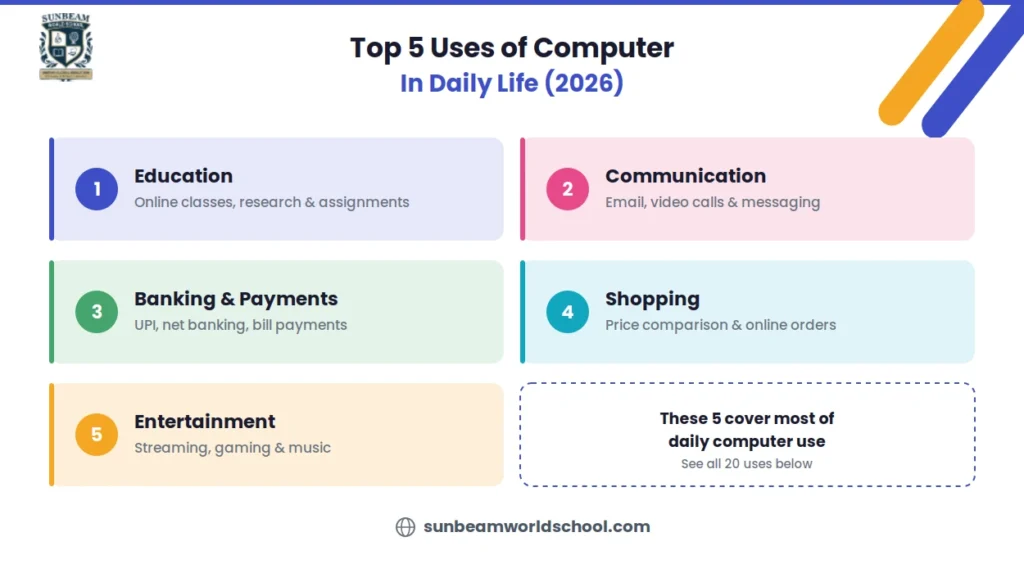
The five uses of a computer that account for most of daily screen time, education, communication, banking and payments, shopping, and entertainment.
The top five uses of a computer in daily life are education, communication, banking and digital payments, online shopping, and entertainment. These five account for the vast majority of the time most people spend on a computer or smartphone each day.
Banking is a good example of how fast this has scaled. UPI alone processed 23.2 billion transactions worth ₹29.90 lakh crore in a single month in 2026, a volume that simply didn't exist a decade ago, and one that now runs through phones and computers as casually as a phone call.
What Are The Uses of Computers in Daily Life for Students
Students are the group most likely to spend an entire academic life around computers, since the 15 to 34 age bracket makes up the largest share of India's internet users. Beyond assignments and research, computers now support coding practice, group project collaboration, and computer-based competitive exams, which is why digital literacy matters so much for kids today, closer to a foundational skill than an elective one. It's also why schools that build this into everyday learning, rather than treating it as a once-a-week computer lab session, tend to give students a real head start.
Which is better in daily life: Computers vs. Smartphones
Smartphones have taken over the quick tasks: messaging, UPI payments, scrolling. Computers still hold the ground for anything that needs a full keyboard, a larger screen, or heavier software, which covers most schoolwork, coding, spreadsheets, and design, and it's also where most AI tools built for education are designed to be used. With roughly 850 million smartphone users in India still relying on a computer for serious academic or professional work, the two devices function less like rivals and more like a division of labor.
Conclusion
What started as a tool for offices and research labs is now part of how people learn, earn, and stay connected day to day. The scale of that shift in India alone, over a billion people online and tens of billions of digital transactions every month, makes clear this isn't a passing trend. For students in particular, growing up fluent with computers is becoming as basic a skill as reading, which is why schools that treat digital literacy as part of their everyday curriculum, the way Sunbeam World School does, tend to prepare students better for whatever comes after school.

Frequently Asked Questions
What are the main uses of computers in daily life?
-The main uses of computers in daily life are education, communication, banking, shopping, entertainment, work, and healthcare. Computers help people learn, connect, manage money, and stay organised, covering almost every part of a typical day for students, professionals, and families alike.
What are the top 5 uses of a computer?
+What are 10 uses of a computer in our daily life?
+How are computers used in education?
+How do computers help in banking and shopping?
+What are the uses of computers at home?
+Why are computers important for students?
+What are the advantages of using a computer daily?
+Do computers still matter now that most people use smartphones?
+
In this article
Share this post:


Press and Blogs
Stay updated with our press releases, educational blogs, and more.

Quick Summary Animal sounds are the noises animals make to communicate, warn of danger and...

Quick Summary An algebra equation is a maths statement that sets two expressions equal using...

Quick Summary The area of rectangle equals its length multiplied by its width (A =...