

 CBSE
CBSE
What Is APAAR ID? Full Meaning, Identity Value & Registration Guide
Quick Answer
APAAR ID (Automated Permanent Academic Account Registry) is a 12-digit lifelong academic ID issued to students across India under the "One Nation, One Student ID" initiative of NEP 2020. It is linked to Aadhaar, DigiLocker, and the Academic Bank of Credits, and it stores a student's marksheets, certificates, and achievements in one verified digital record that stays the same from school through postgraduate studies. It is generated using a student's PEN and UDISE+ records, and it differs from state-level identifiers like PEN and EMIS, which only track a student within one state's system.
You may have come across the term APAAR ID on a school form, a college admission portal, or in a conversation about India's new education policies, and wondered what it actually means. Or maybe you already have one and just want to understand what it does and why it matters.
Either way, this guide covers everything you need to know: what APAAR ID means, what "identity value" refers to, how it differs from PEN and EMIS numbers, why it matters, who is eligible, and exactly how to register, check, and download one.
What Is APAAR ID?
APAAR stands for Automated Permanent Academic Account Registry. It is a 12-digit unique ID issued to students across India under the government's "One Nation, One Student ID" initiative, a flagship component of the National Education Policy (NEP) 2020.
Think of it as a digital academic identity that stays with a student for life, from pre-primary school all the way through postgraduate and doctoral studies. Unlike a roll number or admission ID, which changes every time a student switches schools or colleges, the APAAR ID remains constant no matter how many institutions, states, or education boards a student passes through.
Why APAAR ID Was Introduced
Before APAAR ID, a student's academic history was scattered across physical marksheets, certificates, and institution-specific records that were easy to lose, damage, or duplicate. APAAR ID was introduced to solve this by creating one verified digital record per student, cutting down on fraud, paperwork, and the administrative delays that came with manually verifying documents at every admission or exam.
Key Features of APAAR ID
- It functions as a secure digital record that stores marksheets, certificates, degrees, and extracurricular achievements such as sports records, NCC certificates, or Olympiad participation.
- It is linked to DigiLocker and the Academic Bank of Credits (ABC), making it easy to verify and share academic information instantly instead of chasing down physical copies.
- It reduces paperwork, prevents loss of physical documents, and cuts down on duplicate or fraudulent records, a problem that has historically plagued large-scale admissions and recruitment processes in India.
- It is built on the same underlying database infrastructure as UDISE+ (Unified District Information System for Education Plus), which means the ID is only as reliable as the accuracy of a student's school records, so name and date-of-birth mismatches are a common early hurdle.
Practically speaking, the shift APAAR ID represents is a move away from India's fragmented, state-by-state, institution-by-institution student tracking toward a single national academic footprint that follows a learner for decades.
What Is the Identity Value in APAAR ID?
The identity value is essentially the verification detail tied to your APAAR ID, typically drawn from your Aadhaar-based demographic information (such as your name, date of birth, and gender) that is cross-checked when your APAAR ID is generated. It is what confirms that the person holding the ID is who they claim to be, rather than a duplicate or fabricated entry.
Where to Find Your Identity Value
Your identity value is generated automatically during the APAAR ID creation process, when your details are verified against Aadhaar or school records maintained in UDISE+. It is not something you apply for or create separately from your APAAR ID. Once your APAAR ID is issued and appears in your DigiLocker "Issued Documents" section, the associated identity details are stored alongside it and can be viewed within the same digital record.
Why the Identity Value Matters for Verification
The identity value is what gives the APAAR ID its credibility. Because it is tied to a verified identity source rather than self-reported information, institutions, exam boards, and credit systems can trust that the academic record attached to the ID genuinely belongs to that student. This is what makes APAAR ID far harder to forge or duplicate than older systems based on roll numbers or admission slips, which relied on manual, institution-level checks that were easy to falsify.
In short: the APAAR ID is the number, and the identity value is the verification layer underneath it that makes that number trustworthy enough for national-level use in exams, credit transfers, and admissions.
APAAR ID vs PEN vs EMIS: What's the Difference?
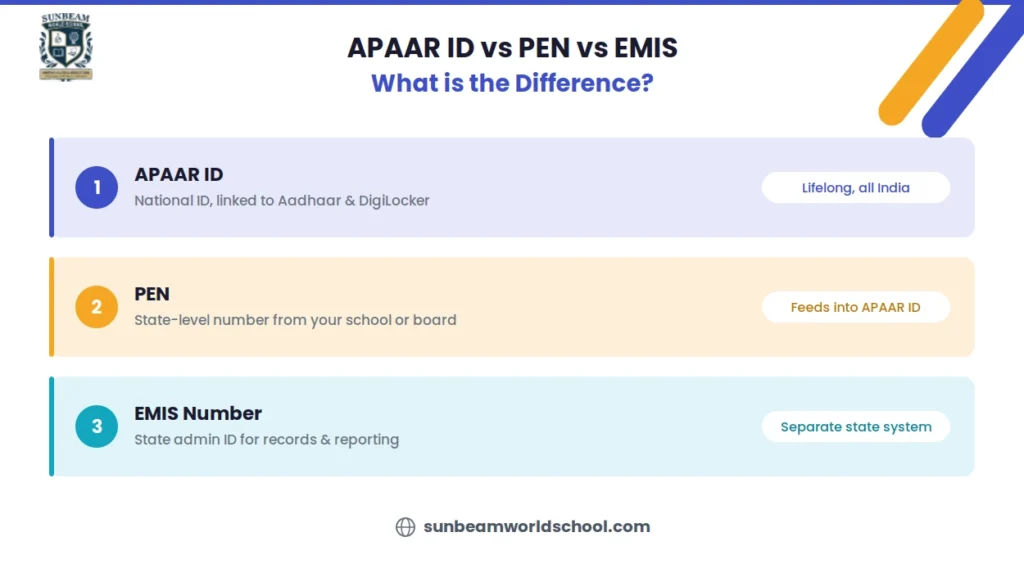
Understanding the Difference APAAR ID vs PEN vs EMIS
Students and parents often encounter three different identifiers in India's education system: APAAR ID, PEN, and EMIS number. They sound similar and are sometimes used interchangeably, but they operate at different levels and serve different purposes.
| Feature | APAAR ID | PEN (Permanent Education Number) | EMIS Number |
|---|---|---|---|
| Full form | Automated Permanent Academic Account Registry | Permanent Education Number | Educational Management Information System number |
| Level | National | State level | State level |
| Format | 12-digit number, linked to Aadhaar | Typically 11 to 14 digits, format varies by state | Varies by state, some states use shorter formats such as 6 to 10 digits |
| Purpose | Lifelong national academic identity, linked to DigiLocker and the Academic Bank of Credits | Tracks a student within a specific state's school or board system | Feeds student data into a state's administrative and reporting database |
| Issued by | Central government, through the APAAR portal and UDISE+ | State school or education board | State education department or district-level EMIS system |
| Scope | Works across states, institutions, and levels of education, from school through PhD | Mostly limited to school-level records within one state | Used for administrative reporting, attendance tracking, subsidy disbursal, and processes like state counselling for engineering or medical admissions |
| Relationship to APAAR | N/A | Required as a prerequisite. A student's PEN must exist and their UDISE+ name must match Aadhaar before an APAAR ID can be generated | Generally a separate state-run system that does not feed directly into APAAR ID generation the way PEN does |
What Is a PEN Number?
PEN, or Permanent Education Number, is assigned by a student's school or state education board and is primarily used to track a student's academic journey within that state's system, appearing on documents like attendance registers, transfer certificates, and admission registers. It is a prerequisite for APAAR ID: without a valid PEN and matching UDISE+ records, APAAR ID generation typically fails or gets stuck in verification. If you are still trying to locate your child's PEN, our detailed guide on what a PEN number is and how to find it walks through the full process.
What Is an EMIS Number?
EMIS, or Educational Management Information System, is broader than PEN. It refers to the entire state-level data infrastructure used to collect and manage information on students, teachers, schools, attendance, and government subsidies. The "EMIS number" some states issue, such as the number used during Tamil Nadu's TNEA engineering counselling process, is just one output of this larger system. EMIS numbers are not standardized nationally and vary significantly in format and use from state to state. For a full walkthrough on locating or generating this number, including what to do if you do not have a transfer certificate on hand, see our guide on EMIS numbers for CBSE students.
How APAAR ID, PEN, and EMIS Connect
The relationship is essentially hierarchical. State-level systems like EMIS and PEN generate and hold student data locally. Once verified against UDISE+ and Aadhaar, that data becomes the foundation on which a student's APAAR ID is built. APAAR ID then becomes the single national identity that consolidates and travels with the student regardless of which state or institution they are in.
If you are asked for a PEN or EMIS number during a state-specific process, and separately asked for an APAAR ID during a national one, you are not filling out redundant paperwork. You are interacting with two different layers of the same system.
Why Is APAAR ID Important for Students?
The core purpose of APAAR ID is to reduce paperwork and eliminate the risk of lost or duplicated academic records. Here is how it plays out across the different stages of a student's academic life.
For Board Exams (CBSE and State Boards)
CBSE and several state education boards have started linking APAAR ID to student records for board exams, with circulars mandating its inclusion in candidate lists. This means students need to submit less documentation during exam registration, and identity verification becomes faster and less prone to manual error.
For Entrance Exams (JEE, NEET, and Others)
National entrance exams are gradually adopting it too. It is not mandatory everywhere yet, but bodies conducting exams like JEE Main and NEET have added APAAR ID fields to reduce impersonation and speed up identity checks, an issue that has caused real problems in high-stakes exams in the past.
For Credit Transfer via the Academic Bank of Credits
APAAR ID plays a direct role in the Academic Bank of Credits system, allowing students to accumulate and transfer academic credits across institutions and study modes, including online, distance, and hybrid programs, in line with NEP 2020's multiple entry and exit framework.
For National Education Planning
APAAR ID also supports better education planning at scale. When student data is consistent and centralized, state and central education departments can track dropout rates, migration between institutions, and learning outcomes with far more accuracy than fragmented paper records ever allowed.
Key Benefits of APAAR ID for Students and Parents
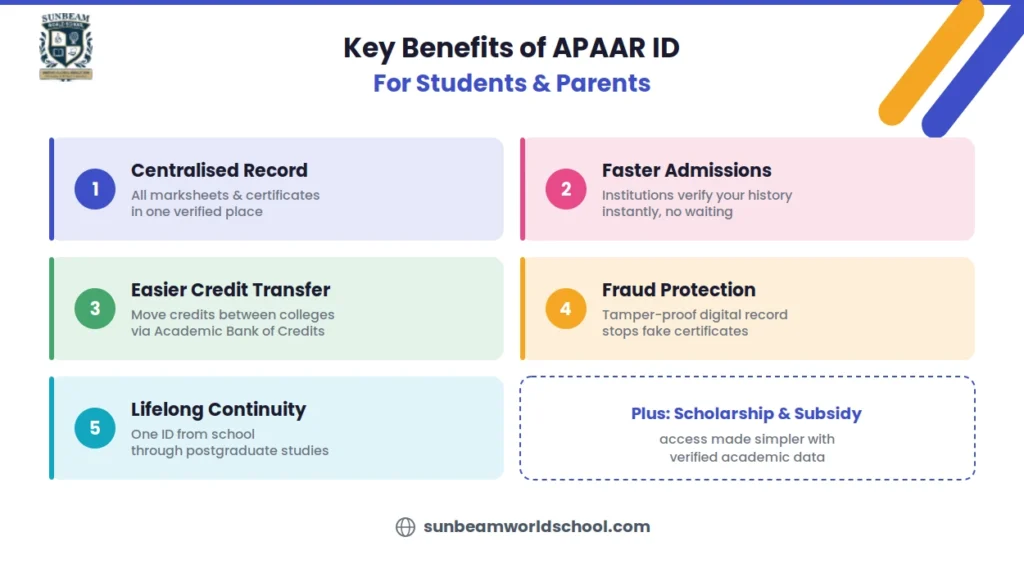
Benefits of APAAR ID
Beyond policy compliance, APAAR ID offers practical, everyday advantages:
- One centralized record: Marksheets, certificates, and achievements are stored in a single verified digital format instead of scattered physical files that can be lost, damaged, or misplaced during a move or transfer.
- Faster admissions: Institutions can access your verified academic history instantly, reducing back and forth during enrollment and cutting down the weeks some admissions processes used to take for document verification alone.
- Seamless credit transfer: Since APAAR ID is linked to the Academic Bank of Credits, credits earned at one institution, or through one mode of study, can move with you to another, supporting NEP 2020's vision of flexible, modular degrees.
- Stronger fraud protection: A tamper-proof digital record makes it much harder for fake certificates or degrees to pass verification, an issue that has affected recruitment and admissions processes for years.
- Lifelong continuity: The same ID follows you from school through postgraduate studies, so you are not rebuilding your academic record every time you change institutions, states, or modes of study.
- Simplified scholarship and subsidy access: Because the ID consolidates verified academic data, it can also streamline eligibility checks for government scholarships and education-linked benefits that require proof of enrollment or academic standing.
Is APAAR ID Mandatory for Students in India?
APAAR ID is not universally mandatory across every school, board, and exam body in India, but adoption is expanding quickly. CBSE and several state boards have already begun requiring it for board exam registration, and national entrance exam bodies like NTA have introduced APAAR ID fields for JEE Main and NEET. Individual schools may also make it a requirement for admission or record-keeping, even if it is not yet a nationwide legal mandate. Given how quickly adoption is spreading, it is worth generating your APAAR ID early rather than waiting until an institution requires it.
Who Is Eligible for APAAR ID?
Any student enrolled in a recognized school, college, or university in India is eligible for an APAAR ID, regardless of age or grade level, from pre-primary through postgraduate and doctoral studies. Eligibility itself is straightforward, but the process differs slightly depending on whether the student is a minor.
Eligibility Criteria for School and College Students
There is no minimum age, board, or grade requirement to be eligible for an APAAR ID. The only real prerequisite is that the student's academic records exist in UDISE+ (for school students) or are recognized by an accredited institution (for higher education students), and that those records can be matched against Aadhaar.
Parental Consent Requirements for Minors
Since most school-going students are minors, schools are required to obtain parental or guardian consent before generating the ID. This usually happens through a consent form circulated at the start of the academic year or during admission, and schools are expected to keep a record of that consent on file. Once consent is given, the school verifies the student's demographic details against UDISE+ and, where applicable, Aadhaar, and generates the APAAR ID, which is then linked to the student's DigiLocker account for safekeeping.
The Most Common Reason APAAR ID Generation Fails
If a student's name in school records does not exactly match their name on Aadhaar, this is the single most common reason APAAR ID generation fails. It is worth checking both records in advance rather than waiting for an error to surface during registration.
This is also worth keeping in mind if your child ever needs to move between schools and carry forward their transfer certificate and marksheets, since a correctly linked APAAR ID makes that record transfer far smoother.
How to Register for APAAR ID
There are two common registration routes, depending on whether you are a school student or already in higher education.
Through Your School (for School Students)
For school-going students, the process is mostly handled internally:
- The school collects and verifies demographic details against UDISE+ records.
- Parental or guardian consent is obtained for minors, usually via a signed form.
- The school generates the APAAR ID through the official APAAR portal.
- The ID is linked to the student's DigiLocker account for access and download.
Through DigiLocker (for College and University Students)
If you are in college or a university program, you can generate your APAAR ID directly:
- Visit the DigiLocker website or open the app, then log in or create an account using your mobile number.
- Enter your Aadhaar number for identity verification.
- Navigate to "Academic Bank of Credits" within DigiLocker and select the APAAR ID option.
- Fill in the required details: full name, date of birth, gender, PEN or identification information, year of admission, and institution name.
- Authorize DigiLocker to share your data with ABC. Once approved, your APAAR ID will appear under your "Issued Documents" section.
The entire process typically takes only a few minutes once your Aadhaar and academic records are aligned. If generation fails, the most common causes are a name mismatch between Aadhaar and school records, or a missing PEN, both of which need to be resolved with your school or institution before you can try again.
How to Check, Download, or Login to Your APAAR ID
Once your APAAR ID has been generated, you do not need to apply for it again or track it separately. It lives inside your DigiLocker account alongside your other verified documents.
How to Download Your APAAR Card from DigiLocker
- Log in to the DigiLocker website or app using your registered mobile number.
- Go to the "Issued Documents" section.
- Locate your APAAR ID card, which will appear once your school or institution has completed generation.
- Download or share it directly from DigiLocker whenever an institution requests it.
How to Check Your APAAR ID Status
If your APAAR ID has not yet appeared in DigiLocker, the most reliable way to check its status is to contact your school or institution directly, since they can confirm whether generation is complete, still pending verification, or stuck due to a data mismatch. Trying to track status independently outside of your school is generally not possible, since students and parents cannot generate or query APAAR ID status without institutional involvement.
APAAR ID vs Academic Bank of Credits (ABC): Key Differences
APAAR ID and the Academic Bank of Credits are closely connected, which often leads to confusion between the two. Here is a clear breakdown:
| Feature | APAAR ID | Academic Bank of Credits (ABC) |
|---|---|---|
| What it is | A unique, lifelong identity number for a student | A digital repository that stores and manages academic credits |
| Purpose | Creates a single verified academic identity | Enables credit accumulation and transfer between institutions |
| Scope | Covers marksheets, certificates, and achievements | Covers credits earned through courses and programs |
| How it's used | To verify a student's academic history | To redeem or transfer credits toward a degree |
| Built on | NAD (National Academic Depository) infrastructure and UDISE+ verified data | Requires an active APAAR ID to be linked before credits can be accumulated |
Put simply: APAAR ID is the identity that unlocks the system, while ABC is the mechanism that manages the credits linked to that identity. You cannot meaningfully use the ABC system without an APAAR ID in place, since the credit ledger is tied directly to that identity number.
Common Questions About APAAR ID
Is APAAR ID Compulsory to Fill?
APAAR ID is not yet compulsory for every student in India, but adoption is expanding fast enough that most students will need one soon regardless. CBSE and several state boards already require it for board exam registration, and national entrance exam bodies like NTA have added APAAR ID fields for JEE Main and NEET. Individual schools can also make it mandatory for admission or record-keeping on their own, even where no nationwide law requires it. Given how quickly this is spreading, it's worth generating one early rather than waiting until an institution demands it.
Who Gives APAAR ID to Students?
A student's school or college generates the APAAR ID, not the student or parent directly. For school-going students, the school verifies demographic details against UDISE+ records, obtains parental consent for minors, and creates the ID through the official APAAR portal. College and university students can generate their own APAAR ID directly through DigiLocker, without going through an institution, once their Aadhaar and academic details are verified.
Is APAAR ID the Same as DigiLocker?
No, APAAR ID and DigiLocker are different things that work together, not the same system. APAAR ID is the 12-digit academic identity number itself, the unique lifelong ID tied to a student's records. DigiLocker is the government platform where that ID, along with the documents linked to it, is stored, verified, and made shareable. You need DigiLocker to access and download your APAAR ID card, but the ID and the platform are two separate parts of the system.
Are Aadhaar and APAAR ID the Same?
No, Aadhaar and APAAR ID are separate identity numbers that serve different purposes. Aadhaar is a general-purpose identity number issued to all Indian residents for a wide range of government and financial services. APAAR ID is a distinct, education-specific identity issued only to students, and it uses Aadhaar-based demographic details purely to verify who a student is during the APAAR ID creation process, not as a substitute for Aadhaar itself.
What Is an APAAR ID Card?
An APAAR ID card is the downloadable digital document that displays a student's 12-digit APAAR ID along with their basic verified details, such as name, date of birth, and issuing institution. It is generated automatically once a student's APAAR ID has been created and appears in the "Issued Documents" section of their DigiLocker account. Students and parents can download or share this card directly from DigiLocker whenever a school, college, or exam body requests proof of the APAAR ID.
Conclusion
APAAR ID is quickly becoming a core part of how academic records are managed in India, from school report cards to postgraduate degrees. It is not just another government ID: it is designed to make verification faster, records more secure, and moving between institutions significantly easier.
At Sunbeam World School, we make sure every enrolled student's academic records, from admission through board exams, are properly documented and ready to support a smooth APAAR ID linkage. Whether your child is just starting their schooling journey or transitioning from a regular school to an online one, having accurate, verified records in place from day one saves real hassle later, whether that is at admission time, exam registration, or when applying for higher education.
If you are exploring what an accredited, CBSE-aligned online school looks like day to day, our guide on what an online school actually is is a good place to start.

Frequently Asked Questions
What is APAAR ID, and why is it important for students?
-APAAR ID is a 12-digit lifelong academic identity number issued to students under NEP 2020, and it is important because it centralizes academic records, speeds up verification, and reduces paperwork across admissions, board exams, and entrance exams nationwide.
What is the full form of APAAR ID?
+How does APAAR ID work for students?
+Who is eligible to get an APAAR ID?
+Is APAAR ID mandatory for all students in India?
+What documents are required to create an APAAR ID?
+What are the benefits of having an APAAR ID?
+How is APAAR ID different from a PEN or EMIS number?
+Can students update or correct their APAAR ID details?
+How will APAAR ID benefit students in the future?
+
In this article
Share this post:


Press and Blogs
Stay updated with our press releases, educational blogs, and more.

Quick Summary Animal sounds are the noises animals make to communicate, warn of danger and...

Quick Summary An algebra equation is a maths statement that sets two expressions equal using...

Quick Summary Essential Repeat (ER) in CBSE means a student has not met the passing...