
 Online School
How Do I Move My Child from a Regular School to an Online School?
Yes, you can move your child from a regular school to an online school, at any grade and at any point in the year. You need a Transfer Certificate from the current school, report cards, standard identity documents, and admission to a school registered with a recognized board. No approval from the current school or from any education authority is required.
Three things decide how smoothly the move goes: which class your child is in, whether the new school is registered with a recognized board such as NIOS or BOSSE, and how early you request the TC. Nothing else in the process is complicated.
This guide answers the questions parents ask us during that decision: whether the current school can refuse, which documents are needed, which classes are safe to switch in, what happens to the CBSE syllabus and board registration, how admission works, what it costs, and how to move back to a regular school if you change your mind.
Why Do Parents Move a Child from a Regular School to an Online School?
Parents move a child from a regular school to an online school for reasons that are practical rather than ideological. Seven come up in almost every admissions conversation we have, and our guide to the signs it is time to switch to an online school covers how they usually show up at home first.
Reason 1: A Parent's Job Moves to Another City or Country
A parent's job moves, and the child's schooling pays for it. Every June and July our admissions team takes the same calls: a bank transfer to Singapore, a posting to Dubai, a corporate move to another Indian city, and a family with a few weeks to find a school before the flight.
Those parents choose an online school for one reason. The child's education stops depending on the family's address. They continue on the CBSE aligned pathway, attend the same classes with the same teachers from the new country, and keep Indian board certification through NIOS or BOSSE, so the next posting costs the child nothing academically. NRI families who move back to India later use the same continuity in reverse. We wrote a full guide for parents in transferable jobs on exactly this.
For families expecting another move in a few years, that is the whole argument. The school stops being a thing you leave behind.
Reason 2: The Daily Commute Is Eating the Childhood
The daily commute eats hours that belong to the child. In metros a school run of sixty to ninety minutes each way costs two to three hours a day, which is exactly where sport, music, reading and sleep used to live. Removing the commute is the only education reform a family can make on its own, in one week, at no cost.
Reason 3: The Class Does Not Fit the Child's Pace
The class does not fit the child's pace, and a room of forty cannot solve it. A child who is ahead is bored into carelessness, and a child who needs one more explanation is quietly left behind. Personalised pacing is the reason parents cite most often when they call us, and it is the one thing a conventional timetable is structurally unable to give.
Reason 4: Sport or Performance Training Needs Daytime Hours
Sport and performance training need daytime hours that no conventional school can release. Young athletes train when the ground is free, and young musicians and dancers rehearse when their teachers are available. Online school moves the timetable around the training instead of asking a twelve year old to choose between the two, which we cover in detail for student athletes.
Reason 5: There Is No Good School Within Reach
There is no good school within reach for a large number of Indian families, and the old answers were expensive: relocate the household, or send the child to a boarding school. An online school brings nationally recruited teachers and five curriculum choices to the town the family already lives in, and it is how online schooling reaches children in places good schools do not.
Reason 6: The Child Is Struggling or Unhappy at School
A child who is struggling or unhappy at school is a real reason to move, and it needs saying plainly. Bullying, anxiety, illness and a run of failing marks all bring families to us, and none of them reflects badly on the child or the parent. A school can be wrong for a child without anyone being at fault. We have written separately about online school for students with special needs, for chronically ill children, and for students who dropped out.
Reason 7: The Fees Stop Making Sense
The fees stop making sense once a family counts everything. Transport, uniforms, canteen, activity levies and development charges sit on top of the advertised tuition, and many parents find a full online school fee lands below what they already pay. The comparison worth running is total cost against total cost, not tuition against tuition, and our cost comparison of online and traditional school runs it line by line.
One step belongs before all seven. Talk to your child first. A move made with a ten year old rather than to them settles faster, because the child arrives at the first class expecting it instead of enduring it.
Do I Need Permission from My Child's Current School to Switch?
You do not need permission from your child's current school to switch. Choosing a school is a parent's decision, and the current school's role is administrative: it issues the Transfer Certificate that records the class studied and conduct, and hands over the marksheets. It does not approve or refuse your choice of the next school.
Two things do have to be settled before the TC is issued: pending fees and school property such as library books or ID cards. Clear both, then apply in writing to the principal, since a formal written withdrawal closes the attendance record cleanly and prevents a fee dispute or an unauthorised absence appearing later. The document follows once both are done.
Most schools issue a TC in about two to seven working days, and most state rules expect it within roughly seven to fifteen days of a written application (TeacherGyan, August 2024; EdPayU, 10 April 2026).
Can a School Refuse to Give the TC or Hold My Child Back?
A school cannot refuse the TC for a child in Classes 1 to 8, including for unpaid fees, under the Right to Education Act 2009, and refusing one can invite action from the State Commission for Protection of Child Rights (EdPayU, 10 April 2026). For Classes 9 to 12, a school may record pending dues but is still expected to issue the document within a reasonable time once formalities are complete.
If a school delays anyway, three steps usually resolve it: put the request in writing with a date, ask for the reason in writing, and escalate to the district education officer if nothing moves. Keep copies of everything. In practice, a written request that mentions the RTE provision tends to be enough.
Check every detail on the TC before you accept it, since a spelling or date error resurfaces years later at a board exam or a university admission (CitizenNest, 27 May 2026). Keep the original safe and a scanned copy handy.
What Documents Do I Need to Enrol My Child in an Online School?
You need the same documents any school admission requires, and a recognized online school will list them upfront rather than improvising later.
- Transfer Certificate, also called the School Leaving Certificate, from the current school. The two names describe the same document (India Docs Portal, May 2026).
- Report cards or marksheets for the last completed year, which the new school uses to confirm grade placement.
- Birth certificate, plus Aadhaar and any APAAR ID, since school and board records are keyed to them.
- Passport size photographs and parent identity proof. Families outside India are usually asked for the child's passport and visa pages instead of a domestic address proof.
- For a Class 10 or 12 entry, previous board registration details, because the new board registration has to be planned around them.
Sunbeam World School publishes its eligibility criteria and a full document checklist so families gather everything once. If a document is stuck with the previous school, tell the admissions team at the start rather than at the end. Provisional processes exist precisely for this.
Which Class Is the Right One to Switch In?
The right class to switch in is any grade from 1 to 8, or the start of Class 9 or Class 11. Those are the points where no board cycle is running, so nothing has to be unpicked. The table below is the whole timing question in one view.
|
Your child's class |
Can you switch? |
What to watch |
|
Nursery to Grade 8 |
Any time in the year |
Nothing structural. A short placement assessment helps the school pitch the level correctly |
|
Start of Class 9 |
Yes, and it is a clean entry point |
Board registration for Class 10 is planned fresh on the new pathway |
|
Middle of Class 9 |
Yes |
Confirm how the new board's registration timeline works before you move |
|
Class 10 |
Only inside the board registration window |
NIOS and BOSSE run registration cycles with cut off dates. Miss the window and the exam sitting moves |
|
Start of Class 11 |
Yes, the cleanest senior entry |
The Class 10 certificate from any recognized board carries the child in |
|
Middle of Class 12 |
Rarely advisable |
Registration and practicals are already in motion. Plan the move for after the boards |
The mid session question has its own answer, including what happens to the year already underway, in our guide to switching to an online school mid year.
Will My Child Lose a Year by Moving to an Online School?
Your child will not lose a year by moving to an online school, provided the switch is timed outside a running board cycle and the new school places them by assessment rather than by guesswork. Grades 1 to 8 carry over on the previous report card. Class 9 and Class 11 entries start fresh cycles by design.
The one situation that costs time is a Class 10 or Class 12 move made after the new board's registration window has closed, which can push the exam sitting to the next cycle. That is a calendar problem, not an online school problem, and it is avoided by checking the registration dates on nios.ac.in before you commit to a date. Our guide to NIOS admission dates and deadlines tracks the current cycle.
What Happens to My Child's Board Registration and Syllabus?
Your child's board registration does not travel with them, because registration belongs to the board rather than the school. A child leaving a CBSE school for an online school on the CBSE aligned pathway continues with NCERT textbooks and CBSE pattern teaching, then registers for board examinations with NIOS or BOSSE, national boards under the Ministry of Education. Our guide to online school validity in India explains why those certificates carry the same standing.
Families with a different destination in mind pick a different pathway at this point, since the switch is the natural moment to choose: Cambridge for the UK, the American curriculum for the US, or WACE for Australia, which the Association of Indian Universities recognised as Class 12 equivalent in 2023.
Our comparison of CBSE, IGCSE and the American curriculum sets the choice out side by side. The syllabus continuity your child needs is real, but so is the chance to stop drifting down a path nobody chose.
How Does Online School Admission Actually Work?
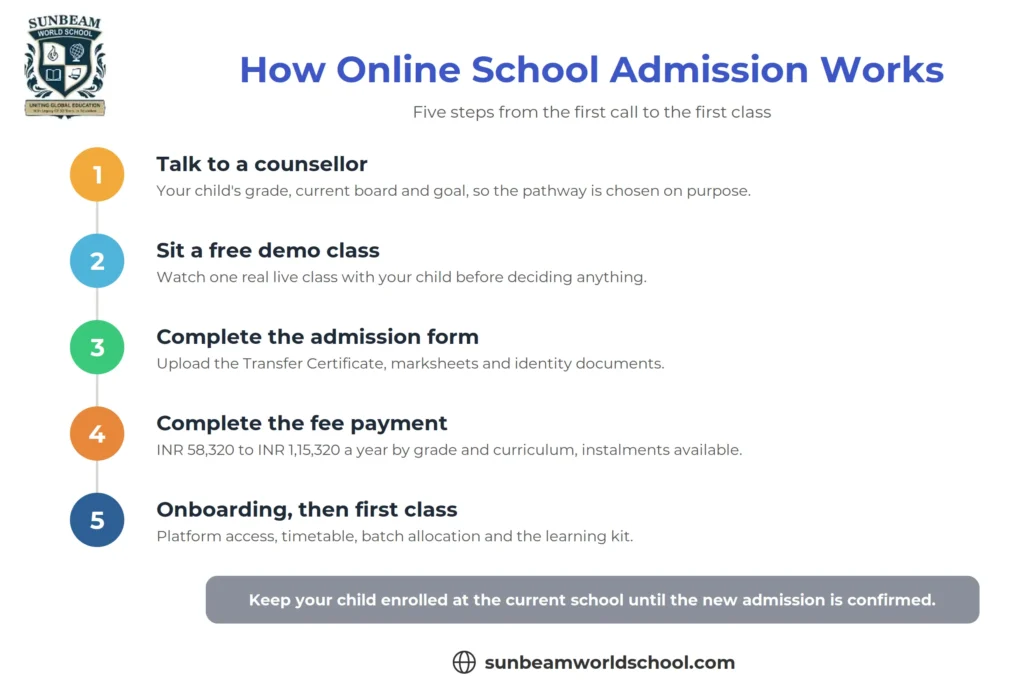
How online school admission works with a simple five-step process, from the initial consultation to your child's first online class.
Online school admission works in five steps, and at Sunbeam World School admissions run through the year for Nursery to Grade 12 rather than in a single annual window. Our step by step enrolment guide walks through each stage.
- Talk to a counsellor about your child's grade, current board and goal, so the pathway is chosen on purpose.
- Sit a free demo class with your child before deciding anything. Watching one live class answers more questions than any brochure.
- Complete the admission form and upload the documents listed above.
- Complete the fee payment. The published range is INR 58,320 to INR 1,15,320 a year depending on grade and curriculum, with instalment options, on the fee structure page. Board registration and examination fees are charged separately by the boards.
- Onboarding: platform access, timetable, batch allocation and the learning kit [CONFIRM: dispatch time in days], then the first class.
Do this in the right order and one habit saves the most grief: keep your child enrolled at the current school until the new admission is confirmed. Withdraw only when the seat is secure.
What Does My Family Need at Home Before the First Class?
Your family needs three practical things at home, and none of them is expensive. Any recent laptop or tablet with a working camera, a stable internet connection of roughly 10 Mbps, and a quiet corner with a table where the child sits for class. A dedicated study space matters more than any gadget on the list. The full specification is on our essential requirements page.
The fourth requirement is the one families underestimate: an adult presence for younger children in the early weeks. Not a teacher, and not supervision of every lesson, just someone nearby while the routine settles. Older students usually need the opposite, a room where nobody interrupts.
Plan the offline half of the week at the same time. Families who sign the child up for neighbourhood sport, a hobby class or a local club in the first month rarely raise socialisation as a problem later, because the reclaimed commute hours go somewhere deliberate. Online school runs its own clubs and extracurricular activities alongside them.
How Long Does It Take a Child to Settle In?
Children usually settle into online school within a few weeks, and the pattern is consistent enough that schools plan for it. The work is not harder; the structure is unfamiliar.
What shortens the adjustment is a study routine that looks like school: the same start time each day, a fixed place to sit, uniform hours for study and breaks, and an evening that is genuinely free. Our study tips for students in a virtual school are worth reading with your child in week one.
Tell the new school what did not work at the old one. A child who was lost in a class of forty, or bullied, or bored, needs the teachers to know that on day one rather than in the first parent meeting. Every good online school asks this question at admission [CONFIRM: describe Sunbeam's onboarding or orientation step if one exists].
What If It Does Not Work Out and We Want to Go Back?
If it does not work out, you can go back. A recognized online school issues the same Transfer Certificate and marksheets that conventional schools admit against, and a Class 10 certificate from NIOS or BOSSE opens Class 11 at a CBSE, ICSE or state board school. The move back is documentation, not permission, and our full guide to returning to a regular school after online school walks through it.
This matters more than it looks, because it changes the size of the decision. You are not choosing a school for the next ten years. You are choosing the right school for the years in front of you, with the door open behind you. Families who understand that choose on the child's actual needs instead of on the fear of being trapped, which is the only way this decision is ever made well.
What Should You Ask an Online School Before You Move Your Child?
Ask an online school five questions before you move your child, and ask them in writing. The answers tell you more about the next five years than any tour of the platform.
- Which board will my child be registered with, and what is the registration code? Verify it on the board's own listing rather than on the school's website, and read what accreditation actually means before you weigh any logo.
- What are the live class hours for my child's grade, and how many children are in the batch?
- What is the all in annual cost, including board registration and examination fees?
- Can I see a sample Transfer Certificate, and how many working days does it take to issue?
- What exactly will my child hold at the end of Class 10 and Class 12, and who signs it?
Sunbeam World School publishes its accreditations and board pathways for the same reason we tell families to ask these questions of every school, including us: the answers should be identical whether you are joining or leaving.

Frequently Asked Questions
Does CBSE allow online school?
-CBSE allows its curriculum to be taught online, but it affiliates physical schools rather than online only schools, so an online school teaches the CBSE aligned syllabus and certifies students through NIOS or BOSSE, national boards under the same Ministry of Education. Your child studies NCERT textbooks with CBSE pattern assessment and receives a board certificate that universities, JEE, NEET and employers treat on par with a CBSE certificate.
What is the best age to start online school?
+Can I switch my child to an online school with failing grades?
+Will my child's marks and school records transfer?
+Can I move my child from a regular school to an online school?
+Do I need a No Objection Certificate to join an online school?
+Will my child lose an academic year if we switch to online school?
+What happens to my child's CBSE syllabus if we move to an online school?
+How long does online school admission take?
+Can we go back to a regular school if online school does not suit my child?
+How do I withdraw my child from public school for online school?
+
In this article
Share this post:


Press and Blogs
Stay updated with our press releases, educational blogs, and more.

Quick Summary An algebra equation is a maths statement that sets two expressions equal using...
Quick Summary The area of rectangle equals its length multiplied by its width (A =...
Quick Summary Sympathy means feeling sorry for someone from your own point of view. Empathy...