
 Digital Learning
Will My Child Make Friends in Online School? An Honest Guide for Parents
Will my child make friends in online school? It is one of the most common questions parents ask us during admissions, and a fair one once the playground and the shared classroom are no longer part of the day.
The short answer is yes: children make real friends in online school. What changes is how those friendships form. They grow through small classes, clubs, group projects, and shared hobbies rather than who sits nearby, which takes a little more intention. This guide covers how friendships form online, how to prevent isolation, whether online school affects social skills, and the practical steps you can take at home to help.
Do children really make friends in online school?
Yes, children in online school make genuine, lasting friendships, and many say their friendships feel closer because they are chosen around shared interests rather than seating charts or catchment areas. A child who loves coding, chess, football, or drama meets others who love the same thing, often from many different countries, and those bonds tend to be deep because they start from something real.
The honest trade is that online school has fewer casual, accidental encounters- the quick playground chat or the walk home- so friendships are built more deliberately. That is not a weakness so much as a difference, and it is why a good school designs social contact into the week rather than leaving it to chance. You can see the rhythm of a socially active online day in a day in the life of an online school student.
How children make friends in online school
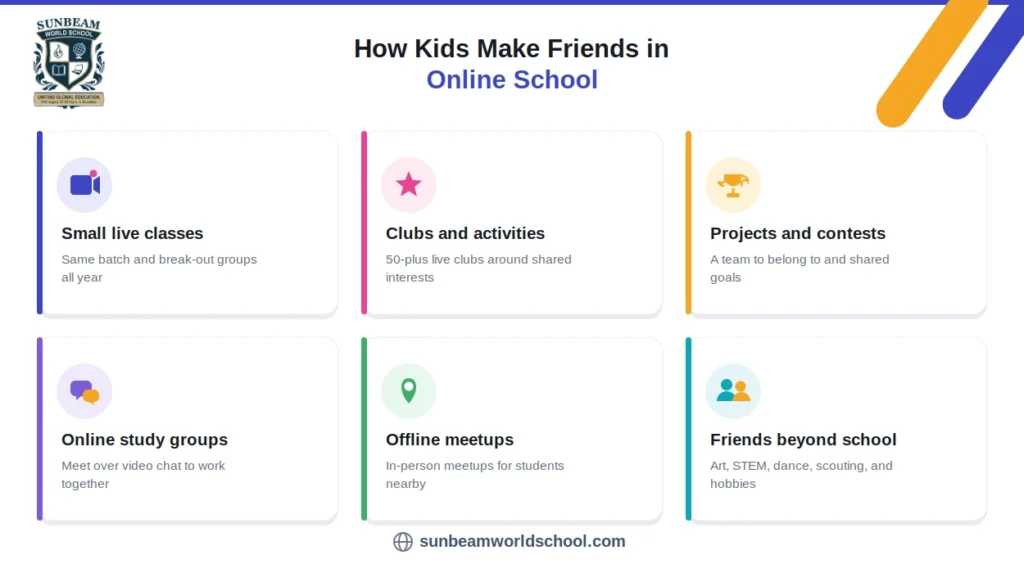
How kids make friends in online school through live classes, clubs, study groups, collaborative projects, offline meetups, and shared interests.
Friendships online grow through repeated, structured contact around shared interests. Here are the five channels that do most of the work.
Small live classes and break-out groups
Online classes are smaller than a typical physical room, often fifteen to twenty students, and they keep the same batch together across the year. Break-out groups pair the same handful of children again and again for discussion and tasks, which is exactly how familiarity turns into friendship. Seeing the same faces daily, on camera, talking and laughing, builds real bonds.
Clubs, activities, and cultural events
This is where most online friendships are made. Live co-curricular clubs in coding, robotics, chess, art, music, dance, debate, and public speaking bring together children who share a passion, and cultural nights and festival celebrations give them a stage and a reason to dress up and perform together. Sunbeam World School runs more than fifty such live activities, described on the school life page.
Group projects and competitions
Working toward something shared accelerates friendship. Group projects, inter-house contests, quizzes, and inter-school competitions give children a common goal, a team to belong to, and the small shared victories and setbacks that turn classmates into friends.
Online study groups and peer collaboration
Beyond timetabled lessons, children can set up their own online study groups, meeting over video chat to work through homework or revise together. Working on shared assignments gives them a relaxed, low-pressure setting to talk, help each other, and turn a classmate into a friend, which is one of the simplest ways to deepen a friendship.
City-wise offline meetups
Good online schools organise in-person meetups, picnics, and activity days for students who live in the same city or region, usually once or twice a year. These give online friendships a face-to-face anchor and often turn online classmates into weekend friends.
Friendships outside school, including beyond sport
Because online school frees up two to three hours a day, children have real time for in-person friendships, and not only through sport. Art and STEM classes at a local centre, library clubs, dance and music schools, coding or robotics workshops, scouting, drama groups, and neighbourhood volunteering all put your child among peers who share an interest. If your child is not sporty, these are where many local friendships will come from. Online school does not replace local friendships; it leaves room for them, as families discover when they move from a regular school to an online school.
Online School Gives Friends From All Over The World
Here is the part parents rarely expect: online school gives a child a genuinely global circle of friends. In a physical classroom, friendships are limited to whoever lives within a short bus ride. Online, a child shares live classes and clubs with peers from many countries, so a quiet reader in one city can become close friends with a fellow book-lover on another continent.
A global peer group from day one
Because an online school draws students from around the world, your child's classmates and club-mates span dozens of countries. Friendships form across borders around a shared love of coding, art, chess, or debate, and time zones become a detail to plan around rather than a barrier.
Real cross-cultural friendships
Learning alongside children in other countries means picking up their festivals, foods, languages, and points of view firsthand, from friends who live them. That builds empathy, curiosity, and a worldview a single-city classroom cannot offer, and it is one of the quiet advantages of an online education.
Connections that outlast school
International friendships made through school clubs and projects often carry on long after graduation, giving your child a global network for university, travel, and work. What starts as a group chat about a shared hobby can become a friendship that spans continents for years.
Is online school lonely or isolating?
Online school can feel lonely, but only when socialization is left to chance. A child who logs in for class and logs off again, with no clubs, no activities, and no in-person outlets, will feel isolated, just as a child would in a physical school with no friends. The difference is that online, this is preventable by design rather than luck.
The way to keep online school from being isolating is simple and worth doing from day one:
- Build activity into the week. Enrol in at least one or two live clubs so there is regular contact beyond academic class.
- Keep an in-person anchor. A local sport, class, or neighbourhood group gives face-to-face friendship alongside the online circle.
- Watch for withdrawal. If a normally chatty child goes quiet, stops joining activities, or avoids camera-on sessions, treat it as a signal and talk to their teacher early.
A well-run school makes this easier by scheduling social contact into the timetable rather than hoping it happens. If you are weighing the wider question of connection and community, the honest comparison in is online school better than in-person looks at social life on both sides.
Does online school affect social skills?
No, online school does not harm social skills when there is regular live interaction, and it can actively build some. Speaking on camera, presenting to a group, collaborating in break-out rooms, and working with peers from around the world develop confidence, clear communication, and cross-cultural ease, skills that matter enormously in modern universities and workplaces.
What online school offers less of is unstructured, in-the-moment social practice, the improvised playground negotiation. That gap is easy to close with regular in-person contact through sport, hobbies, and meetups, so children get both the digital communication skills and the face-to-face ones. Balancing screen time with off-screen social time is part of this, and the realistic picture is in the guide on how much screen time online school really involves.
How to help your child make friends in online school
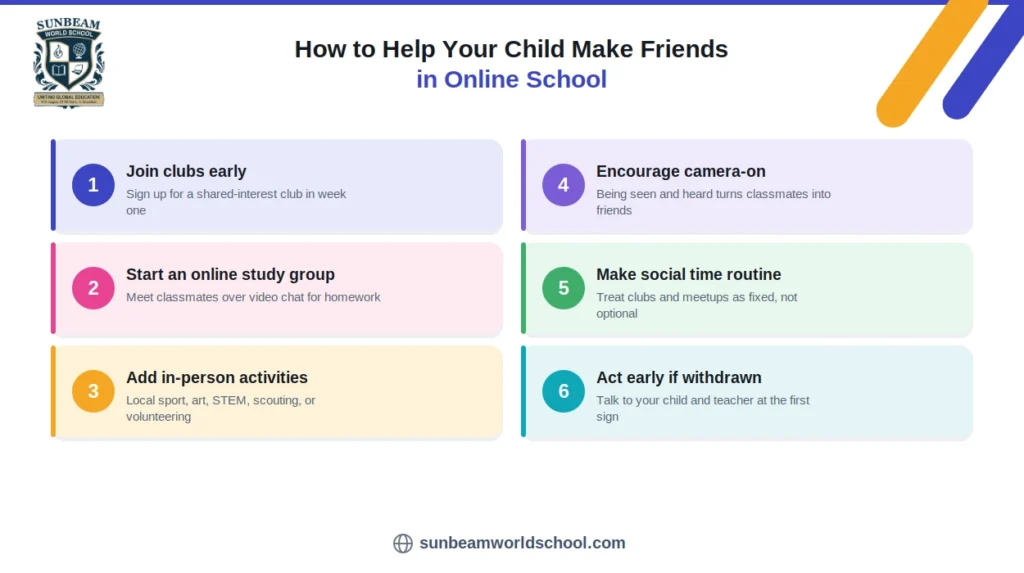
Six simple ways parents can help their child build friendships in online school.
Your involvement in the first few weeks makes a big difference. These steps consistently help children build a social circle quickly.
- Join extracurriculars early. Do not wait for your child to feel settled first. Signing up for one or two live clubs in week one gives them an instant group who share an interest.
- Set up an online study group. Encourage your child to meet a few classmates over video chat to do homework or revise together. Shared work in a relaxed setting is a natural, low-pressure way to bond.
- Supplement with in-person activities. A weekly face-to-face activity keeps offline friendship in the mix, and it does not have to be sport. A local sports team, scouting, an art or STEM class, dance, or neighbourhood volunteering all work.
- Arrange a meetup. If a few classmates live nearby, suggest a get-together. Parents organising one afternoon can spark friendships that carry back into class.
- Encourage camera-on participation. Being visible and speaking up, even a little, is how online classmates become friends. Gently encourage it rather than allowing a term of silent, camera-off attendance.
- Build social time into the routine. Treat clubs and meetups as fixed parts of the week, not optional extras, so contact stays regular.
- Act early if they withdraw. If your child seems lonely, talk to them and their teacher quickly. A small nudge in week three is far easier than a fix in month three.
What about shy or introverted children?
Online school often suits shy and introverted children better than a large physical campus. Smaller live classes are less overwhelming, the chat box offers a lower-pressure way to join in, and there is time to think before speaking. Many quiet children who felt lost in a crowded room find their voice in a group of fifteen.
Very extroverted children, who draw energy from constant social buzz, need more planned in-person outlets to feel fully satisfied, so for them the local sport club or meetup calendar matters more. Either way, the model can work; it just needs to be matched to the child, which is the theme of who online school is best for.
How Sunbeam World School builds friendships and community
Sunbeam World School treats community as something to build, not assume. As a global online school with students in 135 countries, it designs connection into the week rather than leaving it to chance. Here is how.
Fifty-plus live clubs and activities
More than fifty live co-curricular clubs, in coding, robotics, chess, art, music, dance, debate, and public speaking, group children by shared interest across borders. This is where most friendships begin, because a child meets others who love exactly what they love. Regional and foreign language classes add another way to bond over a shared language or culture.
Cultural nights, festivals, and house competitions
Regular cultural nights, festival celebrations, and house-based and inter-school competitions give children a stage, a team to belong to, and shared goals. Preparing and performing together, or competing for a house, is one of the fastest ways classmates become friends.
Regional offline meetups
Sunbeam World School organizes in-person meetups and activity days for students who live in the same city or region, usually once or twice a year. These give online friendships a face-to-face anchor and often turn online classmates into weekend friends.
Small batches and consistent break-out groups
Live classes are small and keep the same batch together across the year, and break-out groups pair the same handful of peers again and again. That daily familiarity, seeing and speaking with the same faces, is the quiet engine behind lasting friendships.
A safe, supervised community
All of this happens in a moderated, teacher-led environment with monitored group spaces, so children socialise in a protected setting. For younger learners especially, this is far safer than open, unmoderated internet groups.
The result is a social life that looks different from a physical campus but runs just as deep. Parents describe it in their own words on the reviews page, and the easiest way to see it is to book a free demo class and watch a live session in action.

Frequently Asked Questions
Will my child make friends in online school?
-Yes, children make real, lasting friendships in online school through small live classes, break-out groups, clubs, competitions, and offline meetups. Because friendships form around shared interests rather than seating, many children find them closer than they expected. It takes a little more intention than a physical school, but the social circle is genuine.
Is online school lonely?
+How do online school students socialize?
+Does online school affect social skills?
+Is online school bad for shy or introverted children?
+How can I help my child make friends in online school?
+Are online friendships real, or just a poor substitute for in-person ones?
+Is there regular social interaction in online school?
+Can my child make friends from other countries in online school?
+
In this article
Share this post:


Press and Blogs
Stay updated with our press releases, educational blogs, and more.

Quick Summary Animal sounds are the noises animals make to communicate, warn of danger and...

Quick Summary An algebra equation is a maths statement that sets two expressions equal using...
Quick Summary The area of rectangle equals its length multiplied by its width (A =...