
 CBSE
Area of a Circle: Formula, How to Find and Examples
Quick Summary The area of a circle is equal to πr², where r is the radius and π is about 3.14 or 22/7, so a circle with a 7 cm radius has an area of 154 cm². If you know the diameter, use πd²/4, and always write the answer in square units such as cm² or m².
The area of a circle tells you how much flat space a round shape covers, whether it is a pizza, a roti, a circular garden or a running track. Like the area of a square, it needs just one measurement, the radius, and one simple formula. This guide explains the area of circle formula, how to find and calculate the area of a circle from the radius, diameter or circumference, how the formula is derived and proved, and how to find the area of sectors, semicircles and rings, followed by solved examples and practice questions with answers.
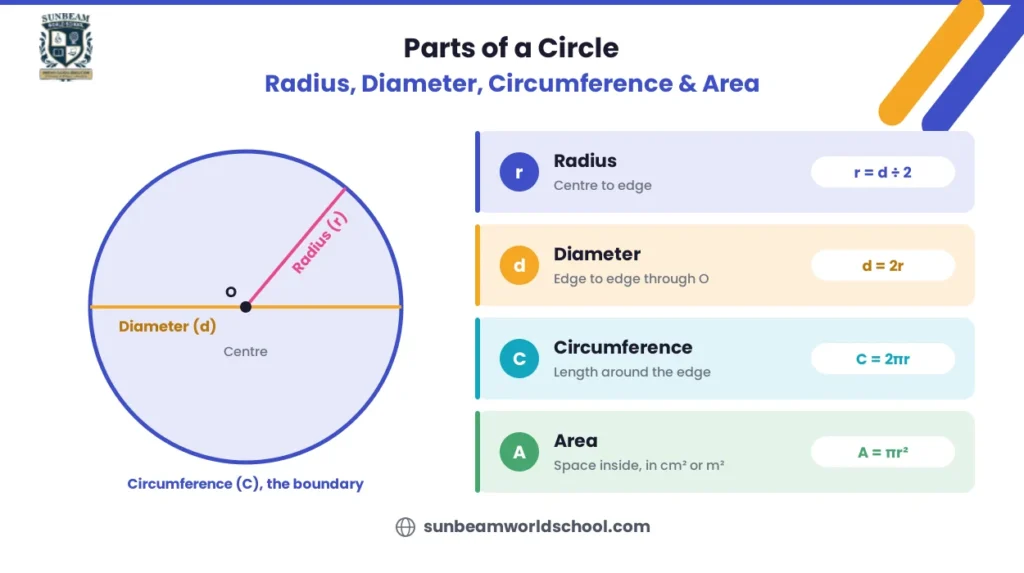
The radius, diameter and circumference of a circle
What Is the Area of a Circle?
The area of a circle is the total space enclosed inside its boundary, calculated as πr² and measured in square units like cm², m² or square inches. Simply put, it answers the question "how much surface does this circle cover?"
If you place a circular plate on a table, the area of the circle is the part of the table the plate hides. To define area of a circle in one line, it is the number of unit squares that fit inside it. This is why the area of a circle definition always mentions the region inside the boundary, while the length of the boundary itself is a different measurement called the circumference. Since area counts square units, the area of circle is always written in square units. The area of circle unit follows the radius, so a radius in centimetres gives square centimetres and a radius in metres gives square metres, which is why the area of a circle units in any answer must match the radius.
What Are the Radius, Diameter and Circumference?
The radius, diameter and circumference are the three measurements of a circle, and the radius is the one used in the area formula. Knowing how they connect lets you find the area from any one of them.
| Part | What it means | Formula |
|---|---|---|
| Centre | The fixed point in the middle of the circle | Usually marked O |
| Radius (r) | Distance from the centre to the edge | r = d ÷ 2 |
| Diameter (d) | Distance across the circle through the centre, the longest chord | d = 2r |
| Circumference (C) | Length of the boundary, also called the perimeter or length of the circle | C = 2πr or πd |
| Pi (π) | Circumference divided by diameter, the same for every circle | π ≈ 3.14 or 22/7 |
What Is the Formula for the Area of a Circle?
Rearranging circle slices into a near rectangle shows why the area of a circle is πr × r = πr².
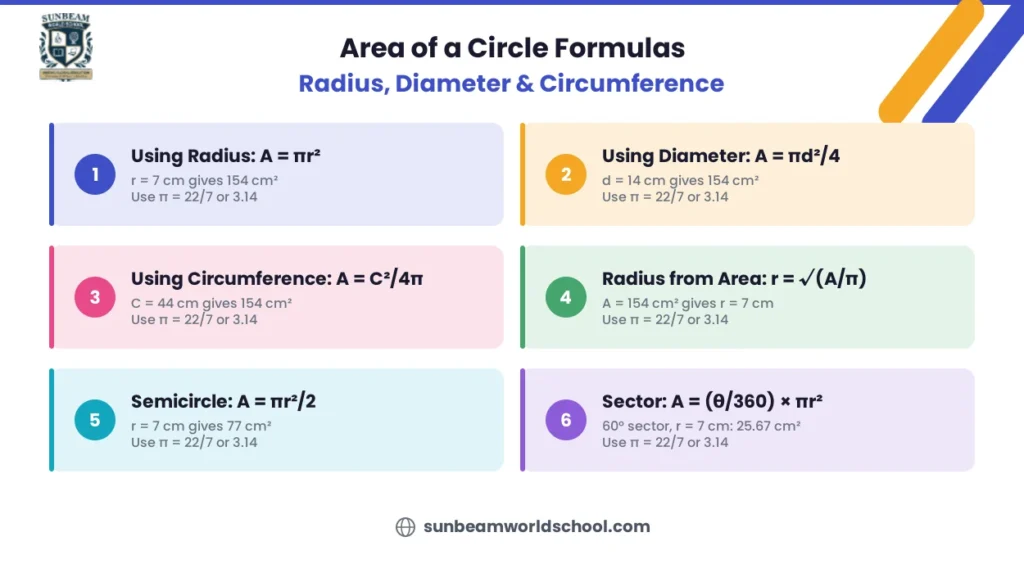
The formula for the area of a circle is A = πr², where A is the area, r is the radius and π is about 3.14159. This single area of circle formula, sometimes called the round area formula, can be rewritten to work with the diameter, the circumference or even to find the radius backwards.
| You know | Formula to use |
|---|---|
| Radius (r) | A = πr² |
| Diameter (d) | A = πd²/4 |
| Circumference (C) | A = C²/4π |
| Area, need radius | r = √(A/π) |
| Area, need diameter | d = 2√(A/π) |
| Area, need circumference | C = 2√(πA) |
| Circumference and radius | A = ½ × C × r |
[Image: area-of-a-circle-formulas.png, formula cheat sheet. Alt text: "Area of a circle formulas using radius, diameter and circumference"]
Area of a Circle Formula Using Radius (πr² Formula)
The πr² formula says the area of a circle equals pi multiplied by the radius multiplied by itself, so A = π × r × r. This is the main formula to calculate area of a circle, and the one most textbooks call the area of the circle formula.
Read aloud as "pi r squared", the pi r2 formula works like this: square the radius first, then multiply by π. For a radius of 10 cm, 10² = 100, and 100 × 3.14 = 314 cm². Some students search for an "area of radius formula", but a radius is a length, so what they need is this formula for the area of a circle with a given radius, which is sometimes called the radius to area formula.
Area of a Circle Using Diameter
The area of a circle using diameter is A = π(d/2)², which simplifies to A = πd²/4, often written as pi by 4 d square or (π/4) × d². So the area of a circle of diameter d is πd²/4, which saves you from halving the diameter first.
This area of a circle diameter formula comes from swapping r for d/2 in πr², since (d/2)² = d²/4. Engineers use it all the time because diameters are easier to measure than radii, for example, using the area of circle in terms of diameter for a 14 cm plate gives 22/7 × 196 ÷ 4 = 154 cm². You can also halve the diameter and use πr², and both routes give the same answer, which makes the area of a circle given diameter easy to check.
Area of a Circle with Circumference
The area of a circle with circumference C is A = C²/4π, so you can find the area without ever measuring the radius. For a circumference of 44 cm, A = 44² ÷ (4 × 22/7) = 1936 × 7 ÷ 88 = 154 cm².
This works because C = 2πr gives r = C/2π, and putting that radius into πr² simplifies to C²/4π. It is the quickest route when a question gives the length of a circular fence, a wheel's rim or a running track instead of its radius.
Radius of a Circle from Area
The radius of a circle from area is r = √(A/π), so you divide the area by π and then take the square root. A circle of area 154 cm² has a radius of √(154 ÷ 22/7) = √49 = 7 cm.
Because the radius and area of circle are linked by r = √(A/π), this radius of a circle formula with area also answers "surface area to radius" and "area to diameter" questions, since doubling the radius gives the diameter, d = 2√(A/π). For example, a circle with an area of 10 square units has a radius of √(10/π), which is about 1.784 units.
How to Find Area of Circle?
You find the area of circle by getting the radius first, then squaring it and multiplying by π. If you are given the diameter or circumference, convert it to the radius, or use the matching formula directly, as shown below for the area of circle with radius, the area of circle with diameter and the area of circle with circumference.
How to Find Area of Circle Using Radius
To find the area of circle using radius, square the radius and multiply by π, so a 5 cm radius gives 5² × 3.14 = 25 × 3.14 = 78.5 cm². This is the most direct method because the radius already fits straight into A = πr².
How to Find Area of Circle Using Diameter
To find the area of circle using diameter, halve the diameter to get the radius and then use πr², or use πd²/4 directly. A circle with a 28 cm diameter has a radius of 14 cm, so its area is 22/7 × 14 × 14 = 616 cm².
How to Find Area with Circumference
To find area with circumference, divide the circumference by 2π to get the radius, then use πr², or apply A = C²/4π in one step. A circumference of 88 cm gives r = 88 ÷ (2 × 22/7) = 14 cm, so the area is 616 cm².
How to Calculate Area of a Circle?
How to calculate the area of a circle comes down to four steps: find the radius, square it, multiply by π and add square units. Following the same order every time prevents most exam mistakes.
- Find the radius. If you have the diameter, divide it by 2, and if you have the circumference, divide it by 2π.
- Square the radius. Multiply the radius by itself, so 7 becomes 7 × 7 = 49.
- Multiply by π. Use 22/7 or 3.14, whichever the question asks for, so 49 × 22/7 = 154.
- Write square units. The final answer is 154 cm², not 154 cm.
For how to measure the area of a circle in real life, such as a table top, measure straight across the middle with a ruler or tape to get the diameter, halve it, and then follow these same four steps.
Should You Use π = 22/7 or 3.14?
You should use π = 22/7 when the radius or diameter is a multiple of 7, and π = 3.14 for decimals or other numbers, unless the question tells you which to use. Both are close approximations, since the real value of π is 3.14159…, while 22/7 is 3.142857… and 3.14 is slightly smaller.
CBSE and NCERT questions often pick radii like 7, 14, 21 or 3.5 so that the 7 in 22/7 cancels and the answer comes out as a whole number. An area of a circle calculator uses the full value of π, so its answer may differ slightly from a textbook answer using 22/7 or 3.14. With a calculator, use the π button for the most accurate answer, and if a question says "leave your answer in terms of π", simply write it as 36π cm² for a 6 cm radius without multiplying it out.
How to Derive Area of Circle?
You derive the area of circle formula by cutting the circle into thin pieces and rearranging them into a shape whose area you already know, such as a rectangle or a triangle. Both methods lead to the same result, A = πr², and each one is a genuine area of circle proof rather than a memory trick.
[Image: derivation-of-area-of-circle.png, circle cut into slices and rearranged into a near rectangle. Alt text: "Derivation of area of circle using rectangle method"]
Derivation Using Rectangles
The derivation of area of circle using rectangles shows that a circle cut into many thin slices rearranges into a near rectangle πr long and r wide. Multiplying length by width gives πr × r = πr².
Cut a circle into 16 equal slices, like a pizza, and lay them in a row with the points facing up and down alternately. The shape looks like a wavy parallelogram, and as the slices get thinner it turns into a rectangle. Its height is the radius, r, and its length is half the circumference, since half the crust is on the top and half on the bottom, which is ½ × 2πr = πr.
Derivation Using Triangles
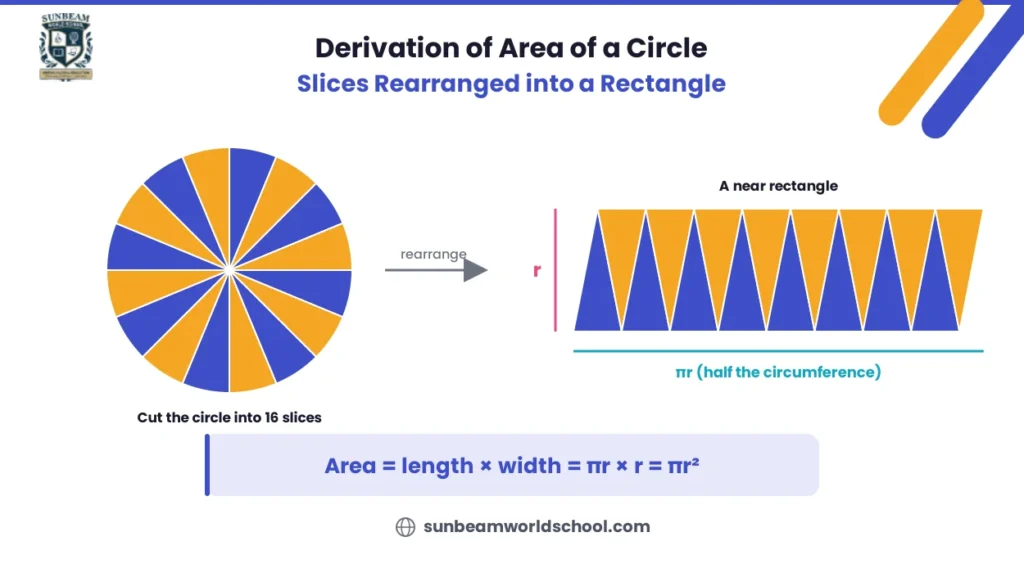
Rearranging circle slices into a near rectangle shows why the area of a circle is πr × r = πr².
The derivation using triangles unrolls the circle into thin rings that stack into a triangle with a base of 2πr and a height of r. Its area is ½ × 2πr × r = πr².
Imagine the circle is made of many thin concentric rings, like an onion slice. Cut each ring and straighten it, then stack them from the longest, the outer edge of length 2πr, to the shortest at the centre. The stack forms a triangle, and using the area of a triangle formula, ½ × base × height, gives exactly πr².
Archimedes Proof of Area of Circle
Archimedes proved, around 250 BC, that the area of a circle equals the area of a right triangle whose two shorter sides are the radius and the circumference, so A = ½ × C × r. Since C = 2πr, this gives ½ × 2πr × r = πr².
This answers a question many students ask online, whether A = r × (½ × circumference) only approximates the area of a circle. It does not approximate it, it is exactly the area, written in a different form. Archimedes reached this by fitting polygons with more and more sides inside and outside the circle, and with 96-sided polygons he also showed that π lies between 223/71 and 22/7, the same 22/7 students still use today.
Proof of Area of Circle Using Integration
The proof of area of circle using integration adds up thin rings from the centre to the edge, so A = ∫₀ʳ 2πx dx = πr². Each ring at a distance x from the centre has a length of 2πx and a tiny width dx, so its area is about 2πx dx.
Adding every ring from x = 0 to x = r gives 2π × r²/2 = πr², which is why the area of circle using integration, also called the area of circle by integration, matches the slicing methods above. Another route uses the circle's equation x² + y² = r², where the area is 4 × ∫₀ʳ √(r² − x²) dx, and this also works out to πr². Students meet this second method in Class 12 in the chapter on applications of integrals.
What Is the Difference Between Area and Perimeter of Circle?
The area of a circle measures the space inside it using πr² in square units, while the perimeter, called the circumference, measures the boundary length using 2πr in plain units. Area covers the surface, while perimeter goes around the edge.
| Feature | Area of circle | Perimeter (circumference) of circle |
|---|---|---|
| What it measures | Space inside the circle | Length of the boundary |
| Formula with radius | πr² | 2πr |
| Formula with diameter | πd²/4 | πd |
| Units | Square units (cm², m²) | Length units (cm, m) |
| Example, r = 7 cm | 154 cm² | 44 cm |
| Real-life use | Grass for a round lawn | Fencing around the lawn |
The area and circumference of circle formula pair is easy to mix up, so remember that "squared" goes with area because area is measured in square units. To find the circumference and area of the circle together, work out the radius once and use it in both formulas.
What Is 2πr?
2πr is the formula for the circumference of a circle, the distance around its edge, and not its area. For a radius of 7 cm, 2πr = 2 × 22/7 × 7 = 44 cm, while the area, πr², is 154 cm².
The formula comes from the definition of π itself, since π is the circumference divided by the diameter, so C = πd = π × 2r = 2πr. A quick way to tell 2πr and πr² apart is that 2πr has no square, so its answer is a length in cm or m.
Is There an Area of Circumference of Circle Formula?
There is no area of circumference, because the circumference is a curved line with length but no width. When people search for the area of circumference of circle formula, they usually need either the area of a circle from its circumference, A = C²/4π, or the circumference formula itself, C = 2πr.
What Is the Area of a Sector of a Circle?
Sector and segment of the circle
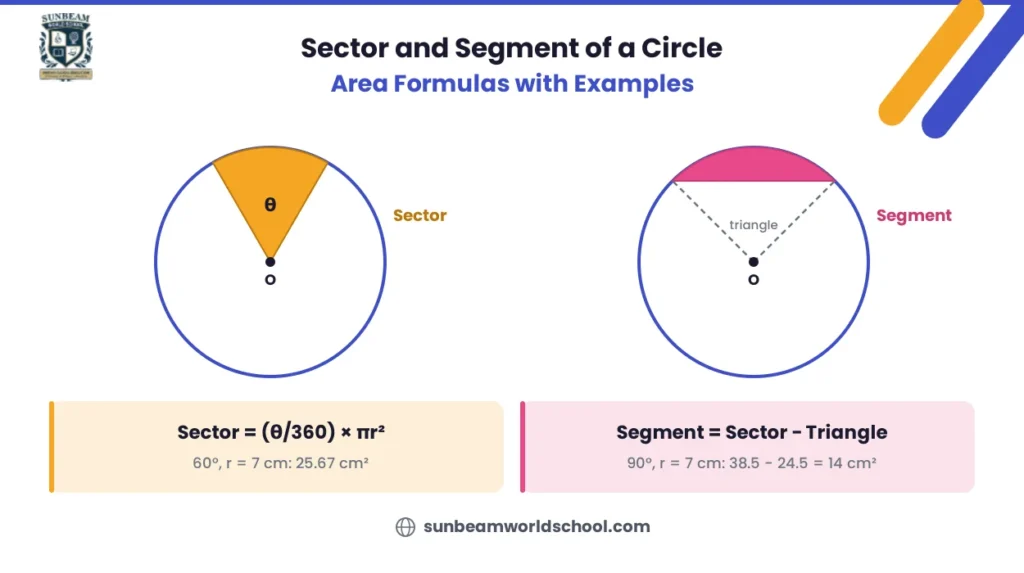
The area of a sector of a circle is (θ/360) × πr², where θ is the angle at the centre in degrees. A sector is a slice of the circle, like a slice of pizza, so its area is that fraction of the whole circle.
For example, a sector with a 60° angle in a circle of radius 7 cm is 60/360, or one sixth, of 154 cm², which is about 25.67 cm². Students sometimes search for the "area of arc of circle", but an arc is a curved line with a length and no area, so what they usually need is the area of the sector that the arc closes off, while the arc length is (θ/360) × 2πr.
Area of a Segment of a Circle
The area of a segment of a circle is the area of the sector minus the area of the triangle formed by the two radii and the chord. For a 90° sector of radius 7 cm, the sector is 38.5 cm² and the triangle is ½ × 7 × 7 = 24.5 cm², so the segment is 14 cm².
[Image: area-of-sector-and-segment.png, circle showing a shaded sector and a shaded segment. Alt text: "Area of circle sector and segment"]
How to Find the Area of Part of a Circle?
You find the area of part of a circle by working out what fraction of the full circle it is and multiplying that fraction by πr². A semicircle is one half, a quarter circle is one quarter and a sector depends on its angle.
| Part of a circle | Fraction of the circle | Formula | Example, r = 7 cm |
|---|---|---|---|
| Semicircle | 1/2 | πr²/2 | 77 cm² |
| Quarter circle | 1/4 | πr²/4 | 38.5 cm² |
| Sector | θ/360 | (θ/360) × πr² | 60° gives 25.67 cm² |
| Ring (annulus) | Outer minus inner | π(R² − r²) | R = 14, r = 7 gives 462 cm² |
Area of a Semicircle
The area of a semicircle is πr²/2, which is exactly half the area of the full circle. For a 14 cm diameter, the radius is 7 cm, so the area of semicircle is 154 ÷ 2 = 77 cm².
Area of Quarter Circle
The area of quarter circle is πr²/4, which is one quarter of the full circle's area. A quarter circle of radius 10 cm has an area of 3.14 × 100 ÷ 4 = 78.5 cm², and this shape often appears in questions about a goat tied at the corner of a square field.
Area of Ring Formula
The area of ring formula is π(R² − r²), where R is the outer radius and r is the inner radius. It works for a ring, the area of concentric circle pairs, the area of circular pathway around a park and a hollow circle such as a washer.
The idea is simple: find the area of the big circle and subtract the area of the small circle in the middle. For a pipe or washer, this hollow circle area formula gives the cross-sectional area of the ring, and for an athletics track it gives the area of the running surface.
What Is the Surface Area of a Circle?
The surface area of a circle is simply its area, πr², because a circle is a flat, two-dimensional shape with only one surface. There is no separate surface area of a circle formula, so a circle of radius 7 cm has a surface area of 154 cm².
Since a circle has no thickness, terms like total surface area and curved surface area do not really apply to it. When students search "what is the surface area of a circle", they usually mean either the flat area of a circular disc or the surface of a 3D solid like a cylinder or sphere, which have their own formulas.
What Is the TSA and CSA of Circle?
A circle has no separate TSA (total surface area) or CSA (curved surface area), because those terms describe 3D solids. The answer to any "TSA of circle formula", "total surface area of circle", "CSA of circle formula" or "curved surface area of circle" question is just πr², or you need the formula for the 3D shape you are working with.
| Shape | Curved surface area (CSA) | Total surface area (TSA) |
|---|---|---|
| Circle (flat) | Not applicable | Area = πr² |
| Cylinder | 2πrh | 2πr(r + h) |
| Cone | πrl | πr(l + r) |
| Sphere | 4πr² | 4πr² |
| Hemisphere | 2πr² | 3πr² |
Notice that the flat circle, πr², appears inside every TSA formula above, because each solid has a circular base or face.
Area of Circular Disc
The area of circular disc is πr², the same as the area of a circle, so the area of disc of radius r is πr² and the disc area formula, also called the area of disc formula, needs only the radius. A coin, a CD or a circular plate are all discs, and the area of circular plate with a 21 cm diameter is 22/7 × 10.5 × 10.5 = 346.5 cm².
The same formula gives the cross sectional area of a circle, which is the flat face you see when you cut a wire, rod or pipe straight across. A wire with a 2 mm diameter has a cross section area of circle equal to 3.14 × 1² = 3.14 mm², and the cross sectional area of circle formula πd²/4 is used to size electric cables and water pipes.
Is It Possible to Know the Exact Area of a Circle?
Yes, the exact area of a circle is πr², and writing the answer in terms of π, such as 49π cm², gives it with no rounding at all. Only the decimal answer is approximate, because π is an irrational number whose digits never end or repeat.
A circle of radius 7 cm has an area of exactly 49π cm², which is about 153.94 cm² with π = 3.14159 and 154 cm² with π = 22/7. The small gap comes from the value of π you choose, not from the formula, which is why questions tell you which value to use and why "leave your answer in terms of π" is the most accurate option.
How to Find the Area of a Circle Without Pi?
You can estimate the area of a circle without pi by drawing it on squared paper and counting the squares inside, or by using 3 × r², which comes out about 4.5% too small. Both give a close estimate, but not the exact area.
To count squares, draw the circle on 1 cm grid paper, count every full square inside it, count each part square that is more than half inside as one, and ignore the rest. A circle with a 5 cm radius gives a count close to 78, near its true area of 78.54 cm², while 3 × 5² = 75 cm² is a rougher but quicker estimate.
Area of Circle and Square: Which Is Bigger?
A square is always bigger than a circle drawn inside it, because a circle covers only π/4, or about 78.5%, of a square whose side equals the circle's diameter. A square of side 14 cm has an area of 196 cm², while the circle inside it has an area of 154 cm².
The area of square circle comparison works because the square's area is d² while the circle's area is πd²/4, and π/4 is about 0.785. The same idea gives the area of circle in rectangle questions, where the largest circle that fits has a diameter equal to the shorter side. For a 10 cm by 6 cm rectangle, the largest circle has a 6 cm diameter and an area of 28.26 cm², while the area of the rectangle is 60 cm². An area of inscribed circle question works the same way, since the circle inscribed in a square has a radius of half the side.
Area of a Circle Examples
The area of a circle examples below cover the radius, diameter and circumference, plus real-life word problems, with full working for each.
Find the Area of a Circle of Diameter 8.4 m
The area of a circle of diameter 8.4 m is 55.44 m². The radius is 8.4 ÷ 2 = 4.2 m, so A = 22/7 × 4.2 × 4.2 = 22/7 × 17.64 = 55.44 m².
This is a popular NCERT-style question because 4.2 is a multiple of 7 (0.6 × 7), so the 7 in 22/7 cancels neatly: 22 × 0.6 × 4.2 = 55.44.
Area of a Circle with a Radius of 5
The area of a circle with a radius of 5 cm is 78.5 cm² using π = 3.14. The working is 5 × 5 = 25, then 25 × 3.14 = 78.5 cm², or about 78.54 cm² using π = 3.14159, and exactly 25π cm² in terms of π, the standard 5 radius circle area answer.
Area of a Circle with Radius 7 cm
The area of a circle with radius 7 cm is 154 cm². Using π = 22/7, A = 22/7 × 7 × 7 = 22 × 7 = 154 cm², which is the most common example in Indian textbooks.
Area of 12 Inch Circle
The area of a 12 inch circle is about 113.1 square inches, because a 12 inch diameter gives a 6 inch radius and 3.14159 × 6² ≈ 113.1 in². This is why a 12 inch pizza (113 in²) gives you more food than two 8 inch pizzas (about 50.3 in² each, or 100.5 in² together).
Find the Circumference and Area of the Circle
For a circle of radius 14 cm, the circumference is 88 cm and the area is 616 cm². The circumference is 2 × 22/7 × 14 = 88 cm, and the area is 22/7 × 14 × 14 = 616 cm².
Area of a Circle Word Problems
Area of a circle word problems ask you to find the radius from the story, calculate πr², and then use the area to answer a cost or comparison question.
Problem 1: Grass for a circular lawn. A circular lawn has a radius of 21 m, and turf costs ₹10 per m². The area is 22/7 × 21 × 21 = 1386 m², so the turf costs 1386 × 10 = ₹13,860.
Problem 2: Path around a circular park. A 7 m wide path runs around a circular park of radius 14 m. The outer radius is 14 + 7 = 21 m, so the path's area is 22/7 × (21² − 14²) = 22/7 × 245 = 770 m².
Problem 3: Polishing a round table. A round table top has a diameter of 1.4 m, and polishing costs ₹50 per m². The radius is 0.7 m, so the area is 22/7 × 0.7 × 0.7 = 1.54 m², and the cost is ₹77.
Problem 4: Finding the radius. A circular garden has an area of 616 m². Then r² = 616 ÷ 22/7 = 196, so the radius is 14 m.
What Mistakes Do Students Make When Finding the Area of a Circle?
The most common mistakes are putting the diameter into πr², mixing up the area and circumference formulas, forgetting square units and squaring π along with r. Each one is easy to fix once you know to look for it.
| Mistake | Wrong working (d = 14 cm) | Correct working |
|---|---|---|
| Using the diameter as the radius | 22/7 × 14 × 14 = 616 cm² | 22/7 × 7 × 7 = 154 cm² |
| Using 2πr for area | 2 × 22/7 × 7 = 44 | 44 is the circumference, area is 154 cm² |
| Forgetting square units | 154 cm | 154 cm² |
| Squaring π as well | (π × 7)² ≈ 484 | π × 7² = 154 cm² |
| Rounding π too early in long problems | Using 3 for π | Use 3.14, 22/7 or the π button |
Using the Diameter in Place of the Radius
Using the diameter in place of the radius makes the answer four times too big, because doubling a length and then squaring it multiplies the area by 4. Always check whether a question gives the radius or diameter, and underline it before you start.
Mixing Up Area and Circumference
Mixing up the area and circumference formulas happens because both use π and r, but area has r squared and circumference has 2 r. A quick check is the units: if your answer should be in cm², you need the formula with the square.
In Which Class Do Students Learn Area of a Circle?
Students in CBSE schools usually first learn the area of a circle in middle school, around Class 7 or 8, and study it in depth in Class 10 in the chapter Areas Related to Circles, which covers sectors, segments and combined shapes. In the US the formula is part of Grade 7 maths, and in the UK it is taught in Key Stage 3.
The Class 10 chapter often combines circles with squares, triangles and rectangles in one figure, so knowing all the area formulas well matters as much as the circle formula itself. Board papers give marks for each step, so writing the formula, the substitution and the units clearly is a big part of knowing how to write the maths paper in the board exam.
What Practice Questions Can You Try on the Area of a Circle?
The 12 practice questions below cover every formula in this guide, from simple radius questions to rings and word problems. Use π = 22/7 unless the question says 3.14.
Practice Exercise
- Find the area of a circle with a radius of 14 cm.
- Find the area of a circle with a diameter of 10 cm (use π = 3.14).
- Find the area of a circle with a radius of 3.5 m.
- Find the area of a circle in terms of π if the radius is 6 cm.
- The area of a circle is 616 cm². Find its radius.
- The circumference of a circle is 88 cm. Find its area.
- The area of a circle is 314 cm² (use π = 3.14). Find its diameter.
- Find the area of a semicircle with a diameter of 28 cm.
- Find the area of a quarter circle with a radius of 10 cm (use π = 3.14).
- Find the area of a 90° sector of a circle with a radius of 14 cm.
- Find the area of a ring with an outer radius of 10 cm and an inner radius of 6 cm (use π = 3.14).
- A circular table top has a diameter of 1.4 m. Find the cost of polishing it at ₹50 per m².
Answers With Working
- 22/7 × 14 × 14 = 616 cm²
- r = 5, so 3.14 × 25 = 78.5 cm²
- 22/7 × 3.5 × 3.5 = 38.5 m²
- π × 6² = 36π cm²
- r² = 616 ÷ 22/7 = 196, so r = 14 cm
- r = 88 ÷ (2 × 22/7) = 14, so area = 616 cm²
- r² = 314 ÷ 3.14 = 100, so r = 10 and d = 20 cm
- r = 14, so 616 ÷ 2 = 308 cm²
- 3.14 × 100 ÷ 4 = 78.5 cm²
- 90/360 × 616 = 154 cm²
- 3.14 × (100 − 36) = 3.14 × 64 = 200.96 cm²
- r = 0.7, area = 1.54 m², so cost = 1.54 × 50 = ₹77
Conclusion
The area of a circle always comes back to one formula, A = πr², so find the radius first, square it, multiply by π and write square units. Students who want a teacher to walk them through formulas like this at their own pace can learn maths live at Sunbeam World School through personalized learning.

Frequently Asked Questions
What is the formula for the area of a circle?
-The formula for the area of a circle is A = πr², where r is the radius and π is about 3.14 or 22/7. If you know the diameter instead, use A = πd²/4, and always write the answer in square units such as cm².
How do you find the area of a circle using diameter?
+How do you calculate the area of a circle from circumference?
+How do you find the radius of a circle from area?
+What is the area of a circle with radius 7 cm?
+Can the area and circumference of a circle be equal?
+Does a circle have a total surface area?
+What unit is the area of a circle measured in?
+What is the area of a sector of a circle?
+What is 2πr?
+Is the area of a circle exact or an approximation?
+What is the area of a circle formula in Hindi (वृत्त के क्षेत्रफल का सूत्र)?
+Why is the area of a circle πr²?
+
In this article
Share this post:


Press and Blogs
Stay updated with our press releases, educational blogs, and more.

Quick Summary Common words that start with V include very, visit, voice, value, vase, van,...

Quick Summary Roman numerals 1 to 1000, also called Roman numbers, use seven letters: I...

Quick Summary Animal sounds are the noises animals make to communicate, warn of danger and...