

 Online School
A Day in the Life of an Online School Student
A day in the life of an online school is shaped by three positives: flexibility, deep focused learning, and self-directed time management. There is no commute hassle, live classes run one to five hours a day depending on grade, and the rest of the day belongs to meals at home, sport, family, hobbies and eight to ten hours of sleep. Nursery is under an hour on screen. High school averages four to five hours of live instruction plus two to three of independent work.
The Sunbeam World School master timetable below shows exactly what each hour looks like across nursery, primary, middle and high school.
What does a typical day for an online school student look like?
A typical online school day is built around three blocks: live classes with a teacher (one to five hours), independent work through the school portal (one to three hours), and the rest of the day for meals at home, sport, family, friends and rest. The proportions shift with the child's grade, and the whole day is anchored to a published timetable rather than to informal study.
The single biggest change from a physical school day is what happens around the classroom, not inside it. The learner keeps the class teacher, the fixed batch, the attendance record and the school-issue report card. What the family gains back is the one to two hours a physical school loses to commute and unstructured campus time. That reclaimed time becomes a longer breakfast, a real workout, a serious sport or music practice in the afternoon, and a family dinner in the evening.
Three positive themes run through every well-run online school day, and each is engineered into the schedule rather than left to chance:
- Flexibility. No morning commute, a later start, multiple batch options for global learners, and the freedom to complete independent work at the learner's own pace within the day.
- Deep focused learning. Live classes are compressed into a shorter window and independent work is time-blocked in 45 to 90-minute sessions. Instruction runs deeper, not longer.
- Self-directed time management. The learner runs their own diary from Grade 6 onward, supported by teacher check-ins, a school portal and a weekly review with a parent. It is one of the strongest transferable skills the online school day builds.
What do online high school students actually do all day?
Online high school students spend about four to five hours in live classes, two to three hours on independent work, two to three hours on sport or extracurriculars, and the rest of the day on meals, family and sleep. Total screen time sits at six to seven hours, similar to a physical-school teenager who uses a laptop for homework.
Live classes for Grades 9 to 12 sit between 08:00 and 12:30 in most batches. Lunch is at home. Afternoons cover independent work, past-paper practice, essay drafts, lab write-ups and sport. Grade 11 and 12 learners spend the early evening on university-application work: personal statement, portfolio, entrance-test prep. Evenings are for family and a wind-down for sleep.
What does the online school day look like at Sunbeam World School?
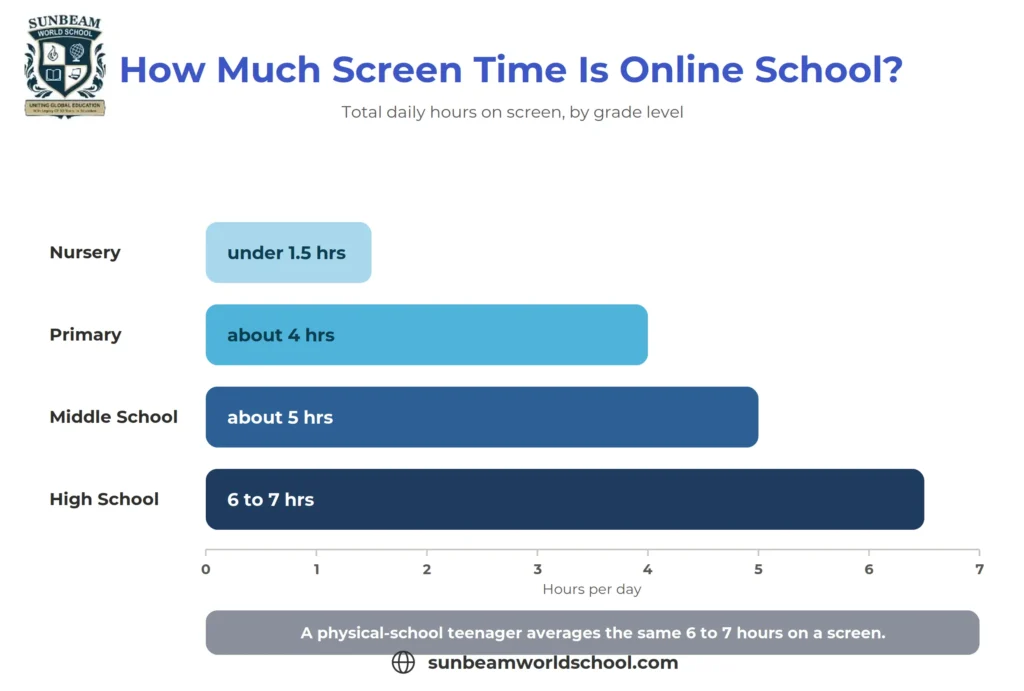
how daily screen time in a full-time online school varies by grade level, from Nursery to High School
At Sunbeam World School, live instruction runs one hour a day for nursery, three hours for primary, four hours for middle school, and four to five hours for high school. The rest of the day is timetabled off-screen. The master schedule below shows the full day in one grid.
Sunbeam World School daily timetable
|
Time |
Nursery / Early Years |
Primary |
Middle School |
High School |
|
06:30 - 07:30 |
Sleep |
Wake, breakfast |
Wake, breakfast |
Wake, workout, breakfast |
|
07:30 - 08:30 |
Wake, breakfast |
Review schedule, free reading |
Review schedule, free reading |
Independent study: hardest subject first |
|
08:30 - 10:15 |
Free play at home |
Live class 1 & 2 (English, Maths) with break |
Live class 1 & 2 with break |
Live class 1 & 2 (core subjects) with break |
|
09:00 - 10:00 |
Live class: songs, phonics, story, guided drawing |
Live class with break |
Live class with break | Live class with break |
|
10:15 - 12:30 |
Snack, play, teacher-set play tasks with parent |
Live class 3, then independent worksheet |
Live class 3 & 4 |
Live class 3 & 4 (electives) |
|
12:30 - 13:30 |
Lunch, walk or garden time |
Lunch with family, screen-free |
Lunch, screen-free hour |
Lunch, full screen-off hour |
|
13:30 - 15:00 |
Afternoon nap |
Live class 4 (art, music, PE) plus revision |
Independent work: assignments, past papers, teacher one-on-one |
Independent work: past papers, essay drafts, lab write-ups |
|
15:00 - 17:00 |
Outdoor play, park, neighbourhood friends |
Extracurricular: sport, art, music, coding, in-person play |
Extracurricular: sport, chess, robotics, music, drama |
Extracurricular: sport training, music, debate, volunteering |
|
17:00 - 19:00 |
Snack, story, bath, quiet play |
Free time, hobby, family walk |
Second study block or hobby project |
University-application work (Grade 11-12), reading |
|
19:00 - 20:30 |
Dinner, bedtime story, lights out 20:00 |
Dinner, reading, lights out 20:30 |
Family time, dinner |
Family time, dinner |
|
20:30 - 22:15 |
Sleep |
Sleep |
Reading, downtime, sleep 21:00 |
Review notes, wind-down, sleep 22:15 |
|
Live-class total |
1 hour |
3 hours |
4 hours |
4 to 5 hours |
|
Total screen time |
<90 min |
~4 hours |
~5 hours |
6 to 7 hours |
|
Sleep secured |
12+ hours |
9 to 10 hours |
9 hours |
8 to 9 hours |
The schedule is delivered on the Sunbeam World School portal (see the learning management system) with live classes, recorded playback, teacher one-on-ones, assignment tracking and parent reporting in one place. Programme-specific pages give the full curriculum for the nursery, primary, middle school and high school pathways. Global learners choose a batch that matches their local morning on the school timings page; annual term dates sit on the academic year page.
What is it actually like being an online school student?
The experience is calmer mornings, longer sleep, more sport, home meals, and a smaller local friend group with a larger long-distance one. It rewards learners who own their diary and asks parents to supervise the schedule rather than the classroom.
Patterns that come up repeatedly across accredited online school learners:
- "I sleep more." No commute plus a later start returns eight to ten hours of nightly sleep to most learners.
- "I have time for the thing I love." Serious sport, music, dance, coding and business projects fit into the freed-up afternoon.
- "My friends are in different places." Local friends come from sport clubs and neighbourhood groups. Online-cohort friendships are long-distance and often deeper because they form around shared interests.
- "I had to learn discipline early." From Grade 6, the learner runs their own diary. Uncomfortable at first, a competitive advantage by Grade 11.
- "I actually eat proper meals." Lunch at the family table replaces a rushed lunchbox.
Real learner voices are on the Sunbeam World School reviews page, and the deeper narrative of student life sits on the school life page.
What do online school students do in their free time?
Online school students are usually involved in a structured sport, music, dance, coding, personal projects, reading, family time, and in-person friends. Recreational screen time is usually kept short. The compressed school day frees up the 15:00 to 19:00 window that physical-school students lose to commute and after-school study.
In rough order of prevalence: three to five afternoons of structured sport per week, twice-weekly music or dance, a personal project or coding hobby (Grade 6 and up), tutoring younger siblings or community volunteering (Grade 9 and up), and free outdoor play (Grade 1 to 5). Gaming and social media happen in short evening windows, not the mid-afternoon block.
How much screen time do online school students really get in a day?
The screen time students in online school get in a day is, Nursery: under 90 minutes. Primary: about four hours. Middle school: about five. High school: six to seven, similar to a physical-school teenager who uses a laptop for homework and communication.
The number that surprises parents is that a well-run online school day is not longer on screen than a physical school day for most secondary learners. What differs is that the online school child's screen time is mostly educational (live instruction, past papers, research) while a physical-school child's laptop hours are usually recreational because school hours already consumed the day. Breaks, movement, off-screen reading, art, sport and outdoor time are timetabled into the day, not treated as residual. The full model is described on the Sunbeam World School learning approach page.
When in the day do online school students make friends and socialize?
Two windows in the day of an online school carry socialization. Inside the online classroom, live-class break-out groups and moderated forums between 08:30 and 12:30. Outside it, the freed-up 15:00 to 19:00 window when the online school student reaches sport, music and neighbourhood groups while physical-school peers are still commuting home.
This is where the flexibility of the online day directly shapes friendships. Break-out groups pair the same learners repeatedly across the school year, so classroom friendships form even without a shared corridor. The mid-afternoon window belongs to the local sport ground, dance class, coding club and family friends. Many online school cohorts also organise city-wise offline meetups once or twice a year. The friendship count is similar to physical school; the geography and the timing are different.
How do online school students manage focus and time through the day?
Through five habits mapped to specific time blocks in the day: a dedicated workspace, a printed plan written the night before, 45 to 90-minute time-blocked deep-work sessions, website and app blocks during class hours (08:00-15:00), and a 20-minute Sunday weekly review. Discipline is built by the environment, not willpower.
Focus and time management are the two skills that separate learners who thrive in an online school from those who drift, and both are well-documented in learner communities on Reddit's r/getdisciplined and r/GetStudying. What actually works, mapped to the master timetable above:
- 07:30-08:30 - Dedicated workspace ready. Same desk, same chair, no bed. The brain associates the space with school and switches into focus mode faster. A printed schedule sits next to the laptop; paper avoids the phone-notification drift.
- 08:00-15:00 - App and site blocks live. An ordinary browser extension or router setting removes gaming and social media from reach during school hours. This is the single highest-impact discipline habit for a high school online learner.
- 08:30-12:30 - Live-class blocks. Live sessions carry their own structure. Focus is enforced by the teacher and the class, not by the individual learner.
- 13:30-15:00 - Deep-work time-blocks. Independent work is broken into 45 to 90-minute blocks, each with a single named task. Short break between blocks. This is the exact "deep work" pattern the AI Overview quotes from r/simpleliving.
- Sunday, 20 minutes - Weekly review. Done with a parent for Grades 6 to 10, solo for Grades 11 and 12. Assignment deadlines are noted, the top three priorities are chosen, and the coming week is planned. Learners who skip the Sunday review start the following week behind.
Time management is a skill an online school demands one to two years earlier than a physical school. The learners who own their diary by Grade 11 tend to arrive at university with the exact skills the first term expects.
How do teachers give feedback and support inside the online school day?
Feedback is built into two points in the day: live-class questions during 08:30 to 12:30, and teacher one-on-one support hours in the 13:30 to 15:00 window. Written feedback on assignments arrives through the school portal within 48 hours, and monthly parent-teacher meetings replace the physical school-gate exchange.
Live classes at Sunbeam World School are small enough for the teacher to see every learner and address individual questions in real time. Independent work is submitted through the school portal, marked by the teacher and returned with comments the learner can act on before the next class. Parents receive a weekly performance summary and a monthly review meeting, which sits alongside the daily activity trail in the learning management system.
What are the honest challenges of a day in an online school, and how are they handled?
The three real challenges of a student in an online school are home distractions, sustaining focus without a peer group in the same room, and eye strain from screen exposure. Each is handled by a specific fix inside the daily schedule rather than by willpower.
- Home distractions (siblings, deliveries, the fridge): a dedicated workspace closed off from the living area, agreed with the family, keeps the learner's block undisturbed.
- Sustaining focus without in-room peers: live-class break-out groups reproduce the peer effect, and virtual co-study sessions with a classmate on a video call replace the shared-library feeling for Grade 10 and up.
- Eye strain: the 20-20-20 rule sits inside every timetabled break, and off-screen assignments (reading, hands-on projects, art) are scheduled at least once per day.
- Loss of motivation on a bad week: the Sunday weekly review is the recovery point, not an add-on. The point of the review is to reset, not to admire the plan.
Is being an online school student stressful for mental health?
A well-structured online school is less stressful than a physical school for most learners because of longer sleep, no commute, home meals, and a better fit for individual pace. Poorly structured online school (no schedule, no supervision, no in-person friends) can be more stressful, and the difference is entirely in how the day is set up.
Documented benefits of an online school include reduced social-comparison stress, no bullying at the school gate, protected sleep, and the flexibility to see a counselor or therapist during the day if needed. Documented risks involve isolation if the family does not build in-person social contact, drift if there is no daily schedule, and eye strain if breaks are skipped. For learners managing chronic illness, athletes on national circuits, and families that relocate frequently, the online model is often the difference between finishing school on time and having to drop out, as covered in the piece on how online school helps chronically ill children thrive and in the article on how online school benefits student athletes.
What does a weekend look like for an online school student?
Weekends are school-free unless the learner has voluntarily scheduled catch-up work. Saturday is usually a longer sport session or a family activity. Sunday is protected family time plus a 20-minute schedule review for the coming week.
Two habits consistently make the following week calmer. A meal plan agreed on Sunday reduces weekday negotiation and improves nutrition. A 20-minute Sunday review of the coming week front-loads assignment deadlines and prevents the classic Friday-evening backlog. Learners who skip the Sunday review are much more likely to enter the following week with an unread assignment.
The most useful next step for a family considering the switch is to see the schedule in action at the child's grade level.(If you've decided already, here's how the move from a regular school works, TC included) Sunbeam World School offers a free trial class where parents and learners can sit in on a real live session, meet the teacher, and see how the day is structured before enrolment. Families can book a free demo class, review the accredited pathways on the learning approach page, and read what current families say on the online school reviews page.

Frequently Asked Questions
What do online school students do all day?
-Online school students attend live classes with a teacher, complete independent work on the school portal, take timetabled off-screen breaks, eat home meals with family, do a structured afternoon extracurricular such as sport or music, spend evenings at home, and sleep between eight and ten hours a night. Live-class time runs one hour for nursery, three hours for primary, four hours for middle school, and four to five hours for high school. Independent work adds another one to three hours through the day. Two-thirds or more of the day at every age is spent off the screen, and every hour is anchored to a published timetable rather than to informal study.
How many hours a day does an online school student study?
+What time does the online school day start?
+How much sleep does an online school student get?
+Do online school students have friends?
+How do online school students stay disciplined and focused through the day?
+Do online school students take holidays like a regular school?
+
In this article
Share this post:


Press and Blogs
Stay updated with our press releases, educational blogs, and more.

Quick Summary An algebra equation is a maths statement that sets two expressions equal using...

Quick Summary The area of rectangle equals its length multiplied by its width (A =...

Quick Summary Sympathy means feeling sorry for someone from your own point of view. Empathy...