
Quick Summary A CBSE Class 9 English paper carries 80 theory marks and 20 marks of internal assessment. For 2026-27 the prescribed book is Kaveri, and the 80 marks split into Reading Skills 20, Writing Skills and Grammar 30, and Language through Literature 30. English is now offered at two language levels, R1 and R2, which share the same textbook and the same section marks but differ in the question types.
CBSE Class 9 English sample papers are the practice papers students write before the half yearly and annual exams, and the section marks changed this year in a way that quietly breaks older papers. Kaveri replaced Beehive and Moments as a single merged textbook, and the literature section is no longer the biggest block on the paper. Writing and Grammar now carries equal weight with Literature, which should change how a student divides revision time. This page sets out the current section marks, what R1 and R2 mean, the writing tasks you can expect, and how to practise a paper that rewards skill over memory.
CBSE Class 9 English 2026-27 at a Glance
| Item | Detail |
|---|---|
| Prescribed book | Kaveri, a single merged textbook |
| Theory paper | 80 marks |
| Internal assessment | 20 marks |
| Reading Skills | 20 marks |
| Writing Skills and Grammar | 30 marks |
| Language through Literature | 30 marks |
| Language levels | R1 and R2 |
CBSE Class 9 English Sample Paper 2026-27 PDF Download
Download the Sunbeam World School Class 9 English sample paper below. It is a full 80-mark paper following the 2026-27 split of Reading Skills 20, Writing Skills and Grammar 30 and Language through Literature 30, and it comes with a complete marking scheme. The file is free and needs no sign-up.
| Paper | What is inside | Download |
|---|---|---|
| Class 9 English Sample Paper 2026-27, Set 1 | 80 marks, 3 hours, reading, writing, grammar and literature, with marking scheme | Download PDF |
Print it and write it by hand in one timed sitting, because the writing section is as much a test of speed and format as of ideas. Mark the objective parts from the scheme, then compare your writing answers against the value points listed for each task.
Sample papers for the other subjects are linked from our CBSE Class 9 sample papers hub.
What Is the Section-Wise Marks Distribution for Class 9 English?
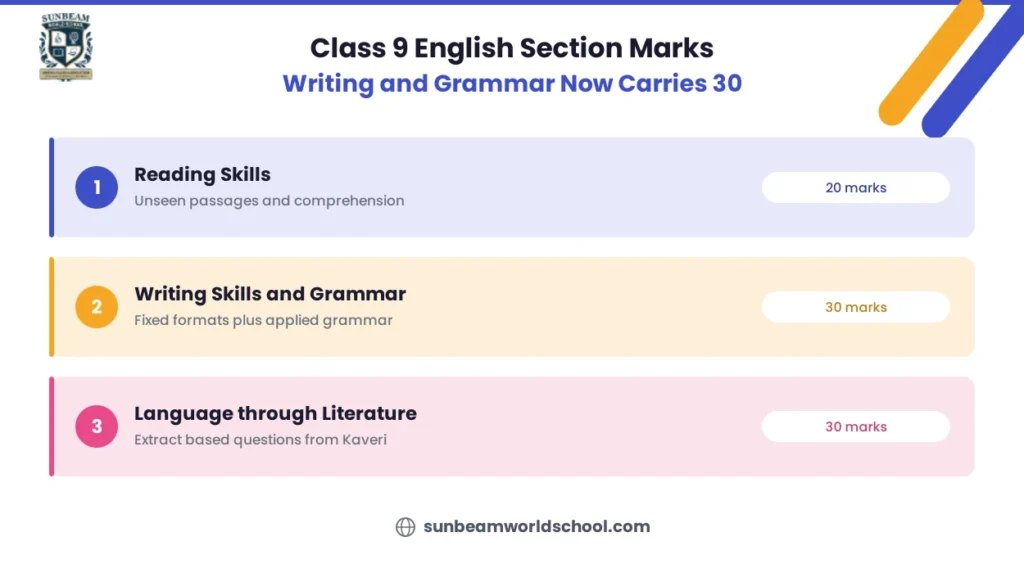
The Class 9 English theory paper divides its 80 marks into three sections: Reading Skills 20, Writing Skills and Grammar 30, and Language through Literature 30. Both language levels, R1 and R2, follow this same split.
| Section | Area | Marks |
|---|---|---|
| A | Reading Skills | 20 |
| B | Writing Skills and Grammar | 30 |
| C | Language through Literature | 30 |
| Total | 80 |
This is the change most likely to catch a student out. Under the previous pattern, Literature carried 40 marks and Writing with Grammar carried 20, so a student used to the old paper will over-prepare the textbook and under-prepare writing and grammar by ten marks each way. If a practice paper gives Literature 40 marks, it was written for the earlier syllabus.
The practical consequence is that Writing and Grammar is now joint-largest on the paper, and it is the section that improves fastest with practice because it tests skill rather than content. A student who spends a fortnight on letter formats, essay structure and grammar exercises can move those 30 marks considerably, which is rarely true of the literature section in the same time.
What Are R1 and R2 in Class 9 English?
R1 and R2 are the two language levels at which English is offered from 2026-27, under CBSE's three-language framework. Both use the same prescribed textbook, Kaveri, and both carry the same 20, 30 and 30 section marks, so the difference is in the question types rather than the syllabus or the weightage.
The variation shows up inside the sections. In Reading, R1 typically sets a descriptive or discursive passage alongside a case-based one, while R2 sets a factual or literary passage with a different marks split between the two. In Writing, the longer essay task differs in both type and length, with R1 asking for a descriptive or narrative essay of around 200 to 250 words and R2 for a shorter narrative piece. Students should check with their school which level they have been entered for before choosing practice papers, because a paper written for the other level will set unfamiliar tasks even though the marks look identical.
What Does the Class 9 English Writing Section Ask For?
The Writing portion of Section B carries 20 of that section's 30 marks, with grammar taking the remaining 10, and it sets several short formats plus one longer piece. The formats recur year after year, which makes them the most predictable marks on the whole paper.
Expect a notice or invitation, a letter to the editor or formal email, a factual description or magazine article, and a longer essay. Each has a fixed structure and word limit, and marks go to a student who follows the format exactly, even when the content is ordinary. The mistake students make is planning these mentally instead of writing them out, because word limits and handwriting speed only become real on paper. Our collection of essay topics for students is a practical place to start, and the suggestions in improving a child's writing skills help with the longer piece.
What Grammar Topics Come in the Class 9 English Paper?
Grammar carries roughly 10 marks within Section B, tested through applied questions rather than definitions, so a student is asked to use a structure correctly rather than name it. The topics are the standard secondary set, and they are among the most reliably scoring questions on the paper.
Tenses, voice, reported speech, determiners, modals, subject-verb agreement and sentence transformation all appear regularly. Because these are rule-based, short daily practice works far better than one long session, and mistakes repeat in predictable places. Our guides to active and passive voice and direct and indirect speech cover the two transformations that cost students the most marks, and prepositions in, on and at deals with the errors that slip through even in otherwise strong writing.
How Should Students Prepare the Literature Section from Kaveri?
Language through Literature carries 30 marks and draws on Kaveri, which merges what used to be two separate readers into one book of prose and poetry. Questions are extract based and constructed response, so students are asked to interpret a passage from a text they have studied rather than reproduce a summary.
Because the book is new this session, there is a real risk in using old practice papers here: they will set questions on Beehive and Moments passages that are no longer prescribed. Preparing a text properly means knowing the sequence of events, the characters, the central idea and a few quotable lines, rather than memorising a prepared answer. Extract-based questions reward a student who can locate the moment in the text and say what it shows, which is a different skill from recall.
Poetry needs separate attention. Students tend to read poems once and move on, then lose marks on questions about imagery, tone or the poet's intent, which are standard in this section.
What Is the Internal Assessment in Class 9 English?
Internal assessment in English carries 20 marks, awarded through the year across pen and paper tests, multiple assessment, portfolio and a listening and speaking component. In languages, that fourth component is the distinguishing one, and it is split between listening and speaking skills.
This makes classroom participation genuinely count rather than being a soft extra. A student who avoids reading aloud, skips oral tasks or stays quiet in discussion is giving away marks that are much harder to recover in the written paper. Keeping the portfolio in order and turning up for the periodic tests covers most of the rest.
How Should a Class 9 Student Practise English Sample Papers?
A Class 9 student should write at least three full English papers before the annual exam, under timed conditions and by hand, because English is the subject where writing speed most directly limits the score. The reading and writing sections together carry 50 of the 80 marks and both are tests of skill, which means they improve with repetition in a way that literature revision does not.
Write the full piece, never the outline
Students routinely plan a letter or essay mentally and move on, then find in the exam that they cannot produce 250 words in the time available. Writing the whole thing out, to the word limit, in the time you would have on the day, is the only practice that transfers. The same applies to reading comprehension, where skimming the passage and reading the questions is not the same as doing it under a clock.
Keep the formats on one page
Notice, invitation, formal letter, email and article each have a fixed layout, and marks are awarded for the layout itself. Writing all of them onto a single revision sheet, then checking your practice answers against it, catches the small omissions that cost marks, such as a missing subject line or a misplaced date.
Read the Kaveri texts more than once
Extract-based questions can come from anywhere in the prescribed texts, so a student who has read each piece twice is in a far better position than one who has read a summary. The second reading is where the details that answer interpretation questions become visible.
Where Can I Get the Official Class 9 English Syllabus?
The official CBSE Class 9 English curriculum for 2026-27, with the section-wise marks and the R1 and R2 question patterns, is published on CBSE's Curriculum 2026-27 page under Secondary Curriculum Part-I. It is the most authoritative guide to the paper pattern, since schools build the English paper from this design.
The chapter-wise Kaveri PDFs are free on the NCERT portal, and they are worth opening to confirm which prose and poetry pieces are prescribed this year before relying on any practice paper. The full set of official Class 9 material is listed in our guide to CBSE Class 9 sample papers.
Conclusion
Writing and Grammar is the section that moves a Class 9 English score, and it is the one most students under-prepare because the old paper weighted literature more heavily. Write the full pieces by hand, to the word limit, under a clock, and those 30 marks come within reach. For live English classes and regular written feedback through Class 9, book a free demo session with the Sunbeam World School team.