

 Online Learning
Is Online School better Than In-Person? An Honest Guide
If you are weighing online school against the traditional classroom, you have probably noticed the internet is split down the middle. Some people are convinced online is the future; others insist nothing beats a real classroom. So let us cut through it.
The honest answer is that neither is better for every child. Online school wins on flexibility, cost, and letting a child learn at their own pace. In-person school wins on everyday socialising, hands-on facilities, and built-in structure. Which one is “better” comes down to your child's age, personality, and how your family's days actually run. Below is a straight, no-spin comparison, with a proper look at the pros and cons, whether online school is worth it, and whether it is genuinely good for kids.
Online school vs in-person school at a glance
Before the detail, here is the core of the comparison in one view. You will also see this framed as online learning vs offline learning, which is the same question in different words. Note the last two rows: an accredited online school and a physical school award the same recognised board certificate, so this is a question of fit, not academic value.
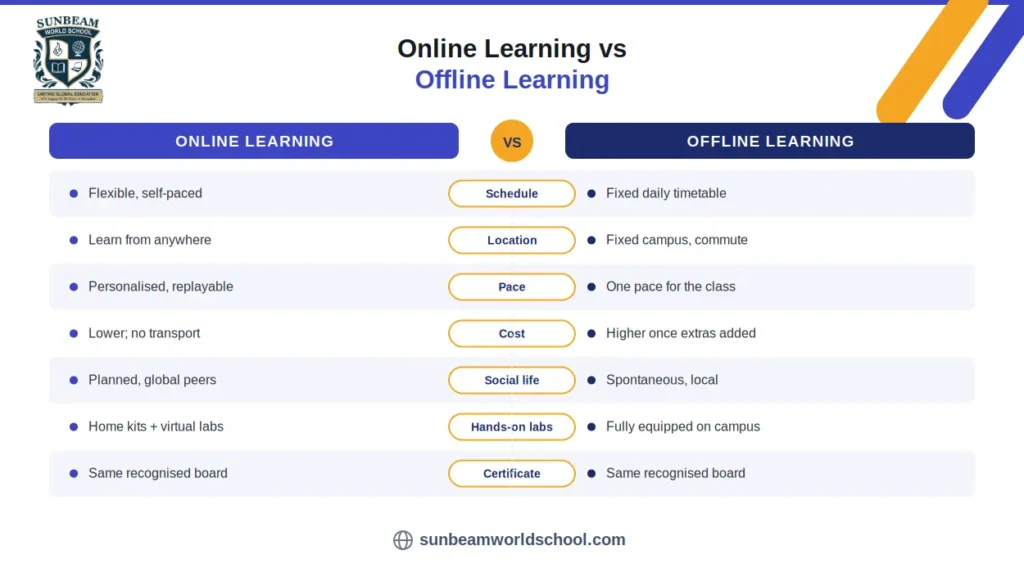
Online Learning vs. Offline Learning: A comparison of flexibility, classroom experience, costs, and recognized certifications.
|
Aspect |
Online school |
In-person school |
|
Schedule |
Flexible; live classes plus self-paced work |
One fixed timetable for everyone |
|
Location |
Learn from anywhere, no commute |
Fixed campus with a daily commute |
|
Pace |
Personalised; replay any lesson |
One pace for the whole class |
|
Socialising |
Built in, but planned (clubs, meetups) |
Constant and spontaneous |
|
Hands-on labs |
Home kits plus virtual and 3D labs |
Fully equipped on campus |
|
Cost |
Often lower; no transport or uniform |
Higher once extras are counted |
|
Certificate |
Same recognised board certificate |
Same recognised board certificate |
|
Best for |
Self-motivated learners, athletes, movers |
Very young children, those needing structure |
In one line: online school suits self-motivated learners, athletes and performers, frequent movers, and children who find a large classroom overwhelming; in-person school suits very young children, learners who rely on external structure, and students in fields that need heavy hands-on lab work.
Pros of online school
Here is what online learning genuinely does well, and why so many families now choose it over offline, in-person schooling.
Flexibility and self-paced learning
This is the reason most families arrive at online school. A physical class moves at one speed for everyone; online learning lets your child move at theirs. Live classes are compressed into a shorter block of roughly one to five hours depending on grade, and a synchronous and asynchronous model means a child attends real-time sessions and then works through recorded lessons whenever they focus best. A quick learner races ahead on easy topics; a child who needs longer replays a lesson until it clicks. That control lowers stress and protects the confidence a one-pace-for-all room can quietly wear down.
More time without the commute
Cutting the daily commute hands back two to three hours a day, and that time changes the shape of a child's life. Most online learners sleep eight to ten hours a night simply because there is no early bus to catch, and the afternoon opens up for serious sport, music, or a project that a full campus day never allowed. You can see how the reclaimed hours are actually spent, hour by hour, in a day in the life of an online school student.
Learning that fits your child's style
No two children learn the same way, yet a physical classroom usually runs on one teaching style. Online school makes room for personalised learning: visual learners lean on videos and diagrams, auditory learners on recorded explanations, and hands-on learners on interactive tasks. Small live classes of roughly fifteen to twenty students, plus one-on-one teacher hours, mean a child gets attention shaped around them rather than the middle of a forty-student room, which is where individualised learning approaches start to pay off.
A calmer, safer environment
For some children, the hardest part of school is not the work; it is the room. Constant noise, side conversations, and the pressure to fit in can drain focus before a lesson even starts. Learning from a familiar, safe space removes much of that, along with the sharper edges of peer pressure and bullying that make some school days stressful. Children who find crowded classrooms overwhelming often do their best work at home.
Lower overall cost
Online school is usually a cost-efficient, budget-friendly choice once you count the full picture. Fees are often lower than an equivalent international school, and the family stops paying for transport, uniforms, canteen, and, in some cases, a hostel. Study resources arrive as PDFs and e-books through the portal, so there is no full stack of physical textbooks to buy. Current rates sit on the fee structure page.
Wider course and curriculum choice
A single local school can only offer so much. A good online school offers several pathways from one portal, including Indian, British, American, and Australian curricula, plus electives like coding and additional languages. That means a child in a smaller town can study a Cambridge or American programme that simply does not exist nearby, which is one of the clearest examples of the equal learning opportunities the model creates.
Stronger independence and digital skills
From around Grade 6, an online learner runs their own diary, tracks deadlines, and stays on task without a bell. It feels demanding at first and becomes a genuine advantage later, because self-discipline and time management are exactly what universities and remote-first careers reward. Instant feedback from auto-graded quizzes and a familiar school portal add digital fluency on top.
Cons of online school
No model is perfect, and an honest comparison says so plainly. Here is where online school genuinely struggles, and what a well-run school does to soften it.
Demands real self-discipline
This is the biggest honest drawback. Without a bell or a teacher standing over the room, the same laptop that runs the lesson also runs games and social media, so distraction and procrastination are real risks. The fix is environment rather than willpower: a dedicated workspace, app and site blocks during class hours, and a short weekly review with a parent. Children who rely on external structure to stay on task find this the hardest part of the switch, usually for the first two to four weeks.
Socializing takes more effort
A physical campus provides constant, unplanned social contact; online school does not, so friendships have to be built on purpose. Good schools engineer this through break-out groups that keep the same peers together, clubs and competitions across countries, and city-wise offline meetups, while local friendships come from sport and neighbourhood groups in the freed-up afternoon. The social shape changes and the depth does not have to suffer, but it will not happen by accident. There is more on how this works on the school life page.
Limited hands-on lab work
A chemistry bench is a chemistry bench, and a physical lab or workshop cannot be copied pixel for pixel. Good online schools bridge the gap with a home-delivered learning kit, virtual and simulated 3D labs, and project-based coursework, which covers most of the curriculum well. Even so, students heading into fields that lean heavily on practical, in-person collaboration may prefer a traditional classroom for those years.
Screen time and reliance on technology
Online school means more time on a screen and a hard dependence on a reliable device and internet connection. Daily screen time ranges from under an hour for nursery to about six to seven hours for high school, similar to a physical-school teenager who uses a laptop for homework. A well-designed programme keeps this age-appropriate, runs on lower bandwidth than video-first platforms, and posts recorded classes so a connectivity dip does not cost a lesson; the realistic numbers by grade are in the guide on how much screen time online school really involves. A family without stable internet or a quiet study space will still find the model a struggle.
Not built for the very young
Under-fives usually need the constant, hands-on, in-person environment a campus provides. Online learning can play a light role at this age, but only when a parent or carer is present for the short daily session. A good nursery or early-years programme keeps live time to about an hour and fills the rest of the day with off-screen play; it never pretends to replace adult supervision.
Where in-person school still wins
To keep this fair, here is what a physical school does better, and where it remains the stronger choice.
Built-in structure and accountability
A physical school provides structure by default: a fixed timetable, a supervised room, and a teacher who keeps everyone on task. For a child who genuinely cannot settle without that scaffolding, a campus does the work an online learner has to do for themselves.
Everyday, spontaneous socializing
Corridors, playgrounds, and shared lunch tables create constant, unplanned friendships that no schedule can fully reproduce. For a very social child who is energised by that daily contact, in-person school has a real edge.
Fully hands-on facilities
Labs, workshops, sports grounds, and art rooms are there to be used every day. Students in practical, equipment-heavy fields get exposure on a physical campus that home kits and virtual labs can only partly match.
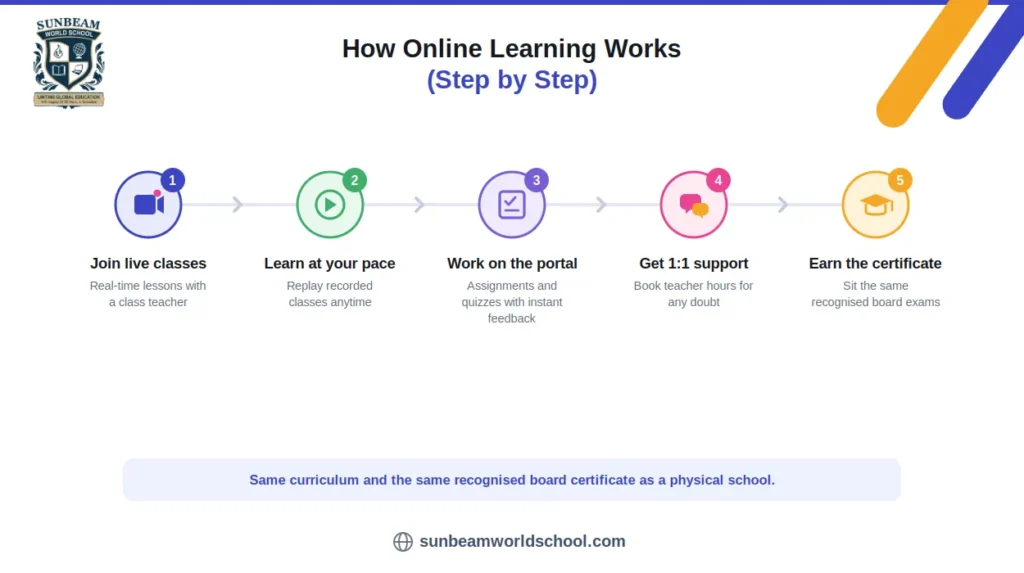
How a well-run online school closes the gap
How a well-run online school closes the gap
Most of the drawbacks above are design problems, not facts of online learning, and a strong programme is built to solve them. Sunbeam World School is a useful reference point for what “well-run” looks like in practice: a fully online school serving over 100,000 students across 135 countries, from Nursery to Grade 12.
- On discipline and structure, live teacher-led classes on a fixed timetable, a school portal that tracks attendance and work, and weekly teacher check-ins replace the bell with a real routine.
- On socialising, break-out groups, 50-plus live co-curricular activities, cultural nights, and city-wise offline meetups keep friendships real, as shown on the school life page.
- On hands-on learning, a home-delivered learning kit for science, art, and craft complements virtual and simulated labs.
- On recognition, accreditations including IAO, Cambridge, Cognia, NIOS, BOSSE, and WACE mean the certificate is valid for higher education; the full list is on the affiliations and accreditation page.
- On personalization, Indian, British, American, and Australian pathways run from one portal, with a healthy student-teacher ratio and one-on-one support hours.
The surest way to judge fit is to watch a real class before deciding, so families can book a free demo, read verified parent reviews, or start an application when ready.
Is online school easier?
Online school is not easier; it is different. The academic difficulty is identical because the syllabus, rigour, and board assessments are the same. What changes is where the effort goes, so it helps to be specific about both sides.
What is genuinely easier online
- Replaying a lesson as many times as you need, instead of catching it once.
- Learning at your own pace, moving fast on easy topics and slowing on hard ones.
- No commute fatigue, which leaves more energy for study and everything else.
- Asking for help through one-on-one teacher hours, rather than waiting for the next period.
What is genuinely harder online
- Sitting down on time without a bell, and starting work under your own steam.
- Resisting the phone, games, and social media on the same device.
- Building friendships, which takes intention rather than proximity.
- Fully hands-on subjects that a home kit can only partly replicate.
The verdict: difficulty is redistributed, not reduced. Learners who lean on external structure find online harder at first; those who already own their schedule find it easier, and most adjust within two to four weeks.
Are online classes as effective as in-person?
Yes, accredited online classes are as effective as in-person learning when qualified teachers deliver live instruction and the child keeps a routine. Students sit the very same board examinations, and outcome data from accredited online schools shows university acceptance and competitive-exam results on par with physical peers. The recognition and validity detail sits in Is Online School Valid in India?.
Effectiveness is not automatic, though. It rises and falls with a few specific factors, which are also the things worth checking before you enrol:
- Live instruction, real teachers in real time rather than a pre-recorded video library.
- Accreditation, a recognised board behind the certificate, verifiable on the board's own directory.
- A healthy student-teacher ratio, small enough live classes for genuine individual attention.
- Feedback and routine, fast marking, a school portal, and a daily schedule the family actually keeps.
Where effectiveness falls away is with unaccredited, self-paced-only platforms that have no live teaching and no community. Those are not full-time online schools, and they are the source of most “online does not work” complaints.
Are online schools worth it?
Online schools are worth it when three conditions hold, and not worth it when they do not. Judge any school against these before you commit.
Worth it when
- The school is accredited by a recognised board, so the certificate carries into university and jobs.
- Qualified teachers deliver live instruction with recorded playback and one-on-one support.
- The family can provide a quiet workspace, reliable internet, and light daily supervision.
Not worth it when
- The provider is unaccredited or self-paced only, with no live teaching or community.
- There is no way to verify the board, the teachers, or the outcomes.
- The home cannot offer a stable study setup, which undercuts the whole model.
When the first list is true, the return is strong: the same recognised certificate, two to three reclaimed hours a day, and often lower total fees than an equivalent in-person school.
Is online school good for kids?
Online school is good for kids when it is age-appropriate, well-structured, and paired with real off-screen and in-person social time. It suits self-motivated learners, athletes, performers, frequent movers, and children who find large classrooms overwhelming. It is less suited to very young children who need constant hands-on supervision, or to children with no routine and no adult available to help set one. Because the answer genuinely shifts with age, it is worth splitting.
Younger children (nursery and primary)
For the youngest learners, screen time is deliberately short, often under an hour a day for nursery, and the day is mostly hands-on and off-screen. Online school is good for young children when a parent or carer supports the brief daily session, and less so as a stand-alone arrangement, because children this age still need close adult supervision. The nursery and early-years model is built around that reality.
Middle and high school
Older children often gain the most: a personalized pace, replayable lessons, one-on-one teacher time, and room for serious sport, music, or coding in the afternoon. From around Grade 6 they also build the self-management that pays off at university, as the post on how online school benefits student athletes shows in practice.
How to choose between online and in-person
There is no universal winner, so the decision comes down to reading your own child and your own week honestly. Work through the five questions below, then check your answer against the signs that point each way. In most families the picture becomes clear once all five are on the table.
Five questions to ask first
- Age and independence. How old is your child, and how well do they already manage their own time? Younger, less independent children usually need the structure of a physical room, while a self-managing child from around Grade 6 often flourishes with the freedom online school gives.
- Interests and commitments. Is there a serious sport, instrument, performance schedule, or project that a full campus day keeps squeezing out? If a real commitment needs protected afternoon hours, that is a strong pull toward online.
- Home routine and supervision. Can you offer a quiet workspace, a reliable device and internet, and light daily supervision? Online school rewards a settled home setup and struggles without one, so be honest about what your day can support.
- Budget and total cost. Compare like with like. Set the full annual cost of the current school, including transport, uniform, and canteen, against the online fee, and factor in a one-off device or internet upgrade if you need it.
- Recognition and accreditation. Whatever you choose, the certificate has to be recognised. Verify a school's board accreditation on the board's own directory before anything else, and read real parent reviews to sense-check the day-to-day experience.
Signs online school is the right fit
- Your child is self-motivated, or is ready to build that habit with support.
- A sport, art, or other commitment needs real time back in the day.
- The family moves, travels, or lives abroad, and needs continuity.
- Your child finds large, noisy classrooms draining or anxiety-inducing.
- You want a curriculum, Indian or international, that no local school offers.
Signs in-person school is the better fit
- Your child is very young and needs constant hands-on supervision.
- They struggle to start work without a bell and an adult in the room.
- They are energised by constant, in-person social contact.
- They are heading, in the near term, into a lab or equipment-heavy field.
- Home cannot yet offer a quiet space and a reliable connection.
Try before you decide
The single best test is a real class, not a brochure. Sitting in on a live session shows you the teaching, the class size, and how your child responds to the format, which settles most doubts faster than any comparison list. Families can book a free demo class to see the day in action before committing.
Why Sunbeam World School is the best online school for your child
If online school is the right direction, the next question is which one. Sunbeam World School is consistently rated among the best online schools for Indian and global families, and the reasons are all verifiable on its own directories and public review platforms rather than in marketing claims.
- Seven-plus international accreditations. Recognised by IAO, Cambridge, Cognia, NIOS, BOSSE, and SCSA for WACE, so the certificate is valid for university and jobs; the full list is on the affiliations and accreditation page.
- Five curriculum pathways in one school. CBSE-aligned Indian curriculum with NIOS or BOSSE, Cambridge IGCSE and A Level, an American diploma via Cognia, and WACE, with the freedom to change pathway without a full re-admission.
- Genuinely personalised teaching. Live teacher-led classes with recorded playback, one-on-one support hours booked by the learner, and a healthy student-teacher ratio that protects individual attention.
- Hands-on and inclusive by design. A home-delivered learning kit for science, art, and craft, virtual and simulated labs, trained special educators, and regional and foreign language electives.
- Proven scale and trust. More than 100,000 students across 135 countries, a 4.8 Google rating from 2,400-plus verified parent reviews, and a 50-year physical-schooling legacy behind the group; family voices are on the reviews page.
- Transparent and supported. Clear 2026-27 fees with no hidden extras, free counselling before and after the decision, and a simple 3-step admission.
The best way to see why families choose it is to watch a real class, so you can book a free demo or explore the learning approach before you decide.

Frequently Asked Questions
Is online school better than in-person school?
-Neither is universally better; the right choice depends on the child's learning style, schedule, and self-discipline. Online school is better for flexibility, cost, and self-paced learning, which suits self-motivated learners, athletes, and frequent movers. In-person school is better for spontaneous socialising, fully hands-on labs, and the built-in structure that very young children and learners who struggle with time management rely on. Because both, when accredited, lead to the same recognised certificate, the decision comes down to your child's needs and how your family's week actually runs.
Is online school easier than in-person school?
+Are online classes as effective as in-person learning?
+Is online school good for kids?
+Can my child switch back to a regular school later?
+
In this article
Share this post:


Press and Blogs
Stay updated with our press releases, educational blogs, and more.

Quick Summary An algebra equation is a maths statement that sets two expressions equal using...
Quick Summary The area of rectangle equals its length multiplied by its width (A =...
Quick Summary Sympathy means feeling sorry for someone from your own point of view. Empathy...