
 Kids Learning
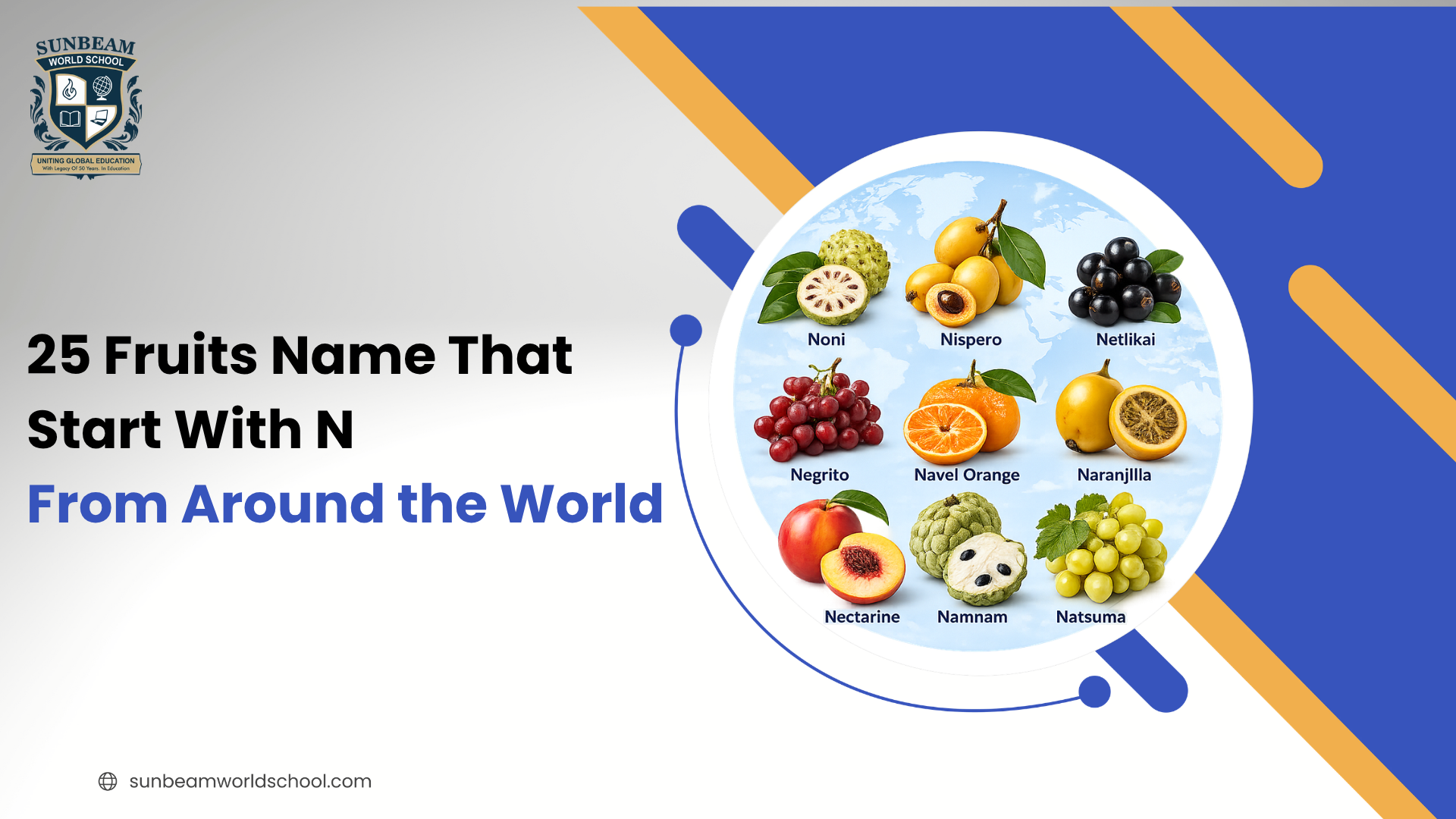
25 Fruits Name That Start With N From Around the World
| Fruit names start with N include both common favorites and rare tropical varieties found worldwide. Popular fruit name include nectarine, navel orange, nashi pear, and nungu, while exotic fruits like naranjilla, noni, and naartjie are known for their unique flavors and cultural significance. These fruits in N vary widely in taste, from sweet and juicy to tart, floral, or even pungent, and are used in juices, desserts, jams, traditional medicine, and savory dishes. Exploring fruits that start with N is a fun way to learn about global agriculture, nutrition, and culinary traditions. |
Ever wondered how many fruit that start with “N”? Beyond nectarines and navel oranges lies a world of unusual, delicious, and fascinating fruits from different cultures and climates. Explore 25 n letter fruit name, learn where they come from, how they taste, and the best ways to enjoy them.
Get ready for a flavorful journey around the world with fruit name starting n!
25 Popular Fruits That Start with N
Nature has gifted us with a fascinating variety of fruits, and many of them begin with the letter "N." From everyday favourites to rare tropical gems, these fruits are enjoyed across cultures and continents. Whether you're expanding your vocabulary, teaching young learners, or simply curious about exotic produce, this visual guide offers a delightful exploration of fruits that start with "N."
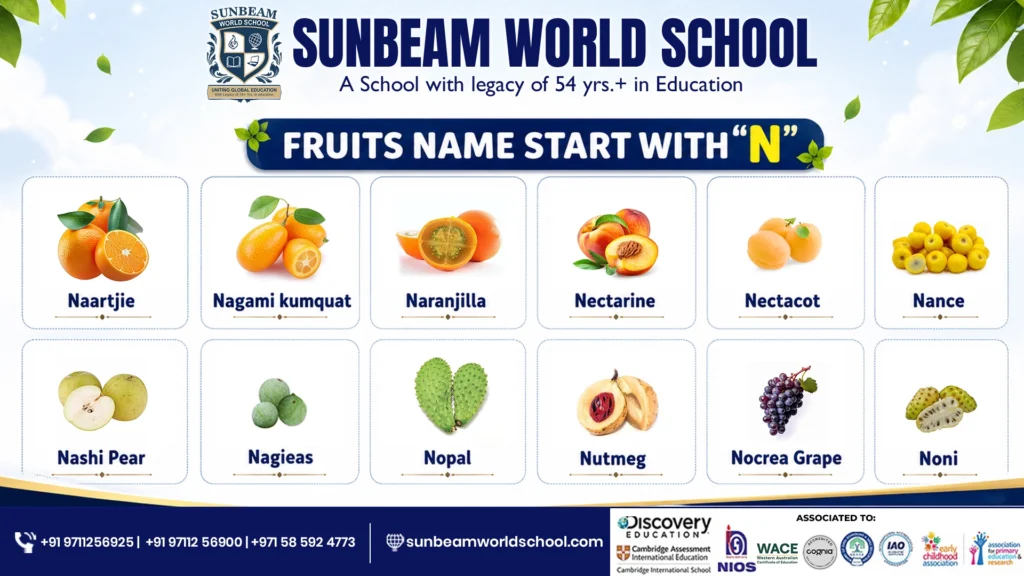
An educational visual chart displaying popular fruits whose names start with the letter "N,-curated by Sunbeam World School.
- Naartjie
Also known as: South African Mandarin, Cape Tangerine
If you've ever peeled a mandarin and felt like the universe was rewarding you, you'd love a naartjie. This easy-peel citrus is the everyday fruit of South Africa — sold on street corners, tucked into school lunchboxes, and eaten in the car on road trips. The name comes from Tamil, and the fruit itself originates from East Asia before making South Africa its culinary home.
Naartjies taste gentler and less acidic than most tangerines, with a floral sweetness that makes them incredibly moreish. Their loose, almost papery skin practically falls off, and segments separate with zero effort. Beyond eating fresh, the zest is a fantastic addition to cakes, glazes, and even spiced chutneys. The essential oils in the peel also have documented antimicrobial and anti-inflammatory properties — a bonus for something that already tastes this good.
- Nagami Kumquat
Also known as: Oval Kumquat
The nagami kumquat is a tiny paradox: the skin is sweet and the flesh is tart — the exact opposite of every other citrus fruit you know. You eat them whole, skin and all, and that first bite is always a surprise. Native to China but now grown widely in Florida, California, and across Asia, the nagami is the kumquat variety you'll find in most grocery stores.
They're wonderful eaten out of hand as a snack, but they also make exceptional marmalades, candied garnishes, and cocktail muddlings. Their high pectin content means they set into jam without any added thickener. Nutritionally, they deliver a solid hit of fiber and vitamin C in a package smaller than a golf ball.
- Nam Dok Mai Mango
Also known as: Water of the Flower Mango
If mangoes had a royalty tier, Nam Dok Mai would be on the throne. This Thai variety is considered among the finest mangoes in the world — elongated, golden-yellow, with buttery flesh that's almost fiber-free and intensely aromatic. The name translates to "water of the flower," and eating one feels exactly like that: fragrant, honey-sweet, and dripping with juice.
In Thailand and Australia (where it's now widely cultivated), Nam Dok Mai is the go-to mango for eating fresh, blended into smoothies, or paired with sticky rice in the classic Thai dessert. Its lack of fibrous strands makes it ideal for slicing cleanly. It's rich in vitamins C and K, plus folate and beta-carotene.
- Nance Fruit
Also known as: Nanche, Muruci, Golden Spoon
Nance is a fascinating little fruit — cherry-sized, golden-yellow, and grown on the Byrsonima crassifolia tree across Central America and the Caribbean. Its flavor is one of the more unusual on this list: sweet on the surface but with an underlying funkiness that some describe as a cross between banana, pear, and mild cheese. It sounds odd; it tastes addictive.
In Costa Rica and Mexico, nance is eaten raw, frozen in sugar syrup (a roadside classic), turned into raspado de nance (shaved ice), blended into a fermented drink called chicha, or baked into pastries. The skin is edible but easily slips off. It's an excellent source of vitamin C and fiber, and the oil from the seeds has traditional medicinal uses.
- Naranjilla (Lulo)
Also known as: Little Orange, Lulo (Colombia)
Despite its name meaning "little orange," naranjilla isn't related to citrus at all — its closest relative is the tomato. Found predominantly in Colombia and Ecuador, this small round fruit has a bright green-orange skin covered in fine hairs, and the inside is divided into segments filled with tart, intensely flavored green pulp. The taste is famously hard to describe: most people say it's like pineapple crossed with lemon, with a hint of rhubarb.
In Colombia, jugo de lulo — simply blended with water and sugar — is practically the national cold drink. The pulp works brilliantly in sorbets, ice creams, and cocktails. Its high acidity also makes it a natural tenderizer in marinades. Nutritionally, it's stacked: vitamins A, C, B6, K, folate, iron, calcium, and magnesium. This kind of global food exploration is at the heart of a well-rounded curriculum in education that connects science, geography, and culture.
- Nashi Pear
Also known as: Asian Pear, Apple Pear, Sand Pear
The nashi pear is the best of both worlds: it has the round shape and satisfying crunch of an apple, but the delicate sweetness and juiciness of a pear. Originating in East Asia, it's now grown widely in Japan, Korea, China, Australia, and New Zealand. The skin ranges from golden-russet to pale green depending on variety, and the white flesh is crisp, granular, and exceptionally juicy.
Unlike Western pears, nashi holds its texture when cooked, making it great for poaching or grilling alongside savory dishes. In Korean cuisine, grated nashi is used as a meat tenderizer in bulgogi marinades — its natural enzymes break down proteins beautifully. It also makes exceptional fresh juice that's lighter and less sweet than apple juice. High in vitamins C and K, plus fiber.
- Natal Plum
Also known as: Num-num, Amatungulu (Carissa macrocarpa)
Despite the name, Natal plum isn't a plum at all — it's native to the coastal forests of South Africa and belongs to a completely different plant family. The small, glossy red fruit has a deep crimson flesh with a flavor that sits somewhere between cranberry and plum: tart, slightly astringent, but with a lovely sweetness when fully ripe. The plant itself is thorny and often used as a hedge in South African gardens.
Raw Natal plums are edible but slightly latex-y unless fully ripe. They truly shine when cooked: transformed into vivid jams, chutneys, and sauces that pair beautifully with game meats and cheese boards. The flavor responds well to warming spices like cinnamon and ginger. A good source of vitamins C and D, plus calcium.
- Navel Orange
Also known as: Washington Navel, Cara Cara (pink variety)
One of the most familiar fruits in the world, the navel orange is distinguished by the small secondary fruit that forms at the blossom end — creating that belly-button-like "navel." Originally from Brazil, where a spontaneous mutation produced this seedless variety in the early 1800s, it was later brought to California, where the whole U.S. navel orange industry was born from just two trees.
Navel oranges are prized for being seedless, easy to peel, and reliably sweet-tangy without being overpowering. They're the gold standard for fresh eating and freshly squeezed juice. The Cara Cara variety, a type of navel orange, has striking pink flesh with berry-like undertones. All navel oranges are excellent sources of vitamin C, folate, and potassium.
- Nectacot
Also known as: Nectarine-Apricot Hybrid
The nectarine is a modern stone fruit that starts with n, a hybrid — the result of careful cross-breeding between a nectarine and an apricot. It inherits the smooth, fuzz-free skin of the nectarine and the tangy, slightly floral sweetness of an apricot. The flesh is typically golden-orange and juicy, with a flavor that's more complex than either parent fruit alone.
Nectacots are versatile in the kitchen: delicious eaten fresh, lovely sliced onto cheese boards, and excellent baked into crisps and tarts where their balanced sweetness shines without becoming cloying. Because they hold their structure when cooked, they're preferred over apricots for preserves that benefit from visible fruit pieces. High in vitamin C and beta-carotene.
- Nectarine
Also known as: Smooth Peach (it's a genetic peach variant)
The most famous fruit on this entire list. The nectarine is technically a peach — a natural genetic mutation that produces smooth skin instead of the characteristic fuzz. They originated in China over 2,000 years ago and were introduced to Europe by the 17th century. Today they're grown across the world wherever warm summers and mild winters allow.
Nectarines are juicy, sweet, and aromatic with a slight tang near the skin. They're extraordinarily versatile: eaten fresh in fruit salads and yogurt bowls, grilled with honey for a summer dessert, baked into cobblers and galettes, or preserved as jam. Their firm flesh holds up beautifully when cooked. They're rich in beta-carotene, folate, potassium, and vitamins A and C.
- Neem Fruit
Also known as: Indian Lilac Fruit (Azadirachta indica)
You probably know neem as the basis of Ayurvedic medicine, pest repellants, and skincare products. But few people realize the tree produces a small olive-shaped fruit. Native to the Indian subcontinent, neem fruit has a strong sulfuric, intensely bitter flavor that makes it largely inedible raw. However, it plays a significant role in traditional medicine across South and Southeast Asia.
The seeds yield neem oil, widely used in organic pest control and cosmetics. In parts of India, young neem leaves and flowers are cooked with other ingredients to create bitter dishes believed to have detoxifying properties — especially consumed at the start of spring festivals. Compounds in neem fruit are studied for antiviral, antibacterial, and anti-inflammatory effects.
- Nepalese Hog Plum (Lapsi)
Also known as: Lapsi, Choerospondias axillaris
Lapsi is a national flavor in Nepal — intensely sour, chewy when dried, and addictive in a way that only the most extreme flavors manage to be. The fruit grows on subtropical trees in Nepal and Bhutan and has a greenish-yellow hue when ripe. Eaten raw, its sourness is almost aggressive; but that acidity is exactly what makes it valuable in cooking.
Lapsi is most famously turned into a spiced, dried candy that's a beloved street snack across Nepal. It's also made into pickles and chutneys, where its tartness balances rich or spicy flavors beautifully. Cooked into soups and vegetable dishes, it functions as a souring agent much like tamarind. Exceptionally high in vitamin C.
- Nere Fruit (African Locust Bean)
Also known as: Locust Bean Pulp, Parkia biglobosa
The nere tree is a cornerstone of West African food culture, but most of the fame goes to its seeds, which are fermented to produce dawadawa — a pungent, deeply savory condiment used like miso or soy sauce. Less celebrated but equally interesting is the sweet pulp surrounding those seeds inside the pods.
The pod pulp is sugary, mildly tangy, and edible fresh. It's also dried and eaten as a snack or dissolved in water to make a lightly sweet drink. The pulp is high in carbohydrates and dietary fiber, making it an important energy food in rural communities. The entire tree — pods, seeds, bark, and leaves — has been used for centuries in traditional medicine and cuisine.
- Newtown Pippin Apple
Also known as: Albemarle Pippin, Virginia Pippin
America's oldest cultivated apple variety, the Newtown Pippin was first discovered in the early 1700s in what is now Queens, New York. It was a favorite of both George Washington and Thomas Jefferson, and was reportedly the apple Benjamin Franklin sent to Europe to impress the aristocracy. Its crisp, tart-sweet flavor with a complex, almost wine-like depth is unlike any modern apple.
Newtown Pippins are late-season apples, harvested in October and November, and they actually improve after a few months of cold storage. They're primarily used today for hard cider production, where their tannins and complex flavor shine. They also bake beautifully in pies and hold their shape well. A good source of fiber and vitamin C.
- Nocera Grape
Also known as: Nocera di Sicilia
One of Sicily's oldest native grape varieties, the Nocera grape is a deep purple-black berry that has been cultivated on the island for centuries. It's rarely found outside Italy, but its history stretches back to ancient Greek colonization of the island. The grape produces wines with bold tannins, good acidity, and deep color — qualities that once made it a popular blending grape throughout southern Italy.
As a table grape, Nocera has a rich, slightly rustic sweetness with hints of dried berries. It's experiencing a minor revival as small Sicilian producers rediscover heirloom varieties for their terroir-driven character. The grapes are also used in traditional grape musts and syrups.
- Nonda Plum
Also known as: Parinari nonda
One of the more unusual fruits on this list, the nonda plum is native to northern Australia and Papua New Guinea, where it grows in tropical woodlands and open forests. The small orange-brown fruit has a dry, starchy flesh with a flavor that many describe as reminiscent of baked potato or dry bread — an unusual savory quality that made it a survival food for Aboriginal Australians and early European explorers.
Despite its strange flavor profile by modern fruit standards, the nonda plum is high in carbohydrates and was historically crucial as a calorie-dense food source. It's not widely commercialized, but foragers and bush food enthusiasts prize it as part of the Australian Indigenous food tradition.
- Noni Fruit
Also known as: Indian Mulberry, Cheese Fruit, Morinda citrifolia
Noni is not a fruit you eat on a whim. It smells powerfully of stinky cheese — a pungent, barnyard aroma that's immediately off-putting if you're not expecting it. Native to Southeast Asia and the Pacific islands, where it's been used in traditional medicine for over 2,000 years, noni is almost never eaten fresh by choice. What is Noni fruit if u ask? It's pressed into juice, fermented, or processed into supplements.
Despite its challenging smell, noni juice has a massive global wellness market because of its antioxidant content — specifically iridoids and scopoletin — that early research suggests may have anti-inflammatory properties. In traditional Polynesian and Hawaiian medicine, almost every part of the noni fruit in India is used to treat various ailments. When mixed with sweeter fruits like pineapple or mango, the flavor becomes tolerable and even interesting.
- Nopal Fruit
Also known as: Cactus Fruit name, Tuna (in Mexico), Sabra
The prickly pear is the fruit of the nopal cactus — and yes, it absolutely deserves a place on this list. The oval, spined fruit grows on the paddles of Opuntia cacti found across Mexico, the American Southwest, the Mediterranean, and North Africa. The flesh inside ranges from vivid magenta to golden-yellow, and the flavor is subtly sweet with a mild earthiness — like a cross between watermelon and bubblegum, but lighter.
Prickly pear is used across Mexican and Mediterranean cuisines in syrups, agua fresca, jams, cocktails (the margarita variation is stunning), and even as a natural food dye. It's also eaten fresh, chilled, or frozen as granita. A word of warning: the tiny hair-like spines called glochids will irritate your skin — always handle them with gloves or tongs. Rich in vitamin C, magnesium, and betalain antioxidants.
Learning about such exotic produce is a great example of how STEM and STEAM education can connect science with culture and real-world exploration.
- Nungu (Ice Apple)
Also known as: Toddy Palm Fruit, Taal Fruit, Taati Munjalu
Nungu is a summer treasure in coastal India and Sri Lanka. It grows on the palmyra palm tree — one of the tallest palms in Asia — and the fruit itself has a thick, hard black shell that hides three or four jelly-like translucent segments inside. These segments look almost like peeled lychees and have a beautifully subtle sweetness with a hint of floral nectar and coconut.
Eating nungu is a tactile, cooling experience — the jelly is cool, slippery, and hydrating, which is why it's such a beloved summer food in Tamil Nadu and Andhra Pradesh. It's eaten straight from the shell, blended into milkshakes and desserts, or mixed with coconut milk and palm sugar. In hot climates, it functions as a natural electrolyte-replenishing snack. It's also believed to aid digestion and cool body heat in Ayurvedic tradition.
- Nutmeg Fruit
Also known as: Myristica fragrans Fruit
The nutmeg spice we grind over eggnog and pasta is actually just one tiny part of a much larger fruit. The nutmeg tree produces a fleshy, apricot-sized fruit that splits open when ripe to reveal: first a vibrant red lacy covering (mace, another spice), then a hard shell, and inside that — the nutmeg seed. Most of the world throws the outer fruit away, but in Grenada (the "Spice Isle") and Indonesia, it's a culinary ingredient in its own right.
In Grenada, nutmeg fruit pulp is turned into a sweet, warming jam that's become a local specialty. In the Banda Islands of Indonesia, it's candied or made into a syrup for drinks. The pulp has a mild, subtly aromatic flavor that's nothing like the intense spice of the seed. It's a reminder that so many spices come wrapped in an entirely separate food we've never thought to eat.
- Nyii (Umnyi)
Also known as: Umnyi, Wild Plum of East Africa
Nyii or Umnyi is a small, sweet berry found in southern and eastern Africa, particularly in the coastal forests of Tanzania, Mozambique, and South Africa's KwaZulu-Natal region. The ovoid berries ripen to a deep purplish-black and have a honey-sweet flavor that's reminiscent of dried dates. Traditionally they are harvested wild and eaten fresh, or sun-dried to intensify the sweetness.
Dried nyii berries are used much like raisins — stirred into porridge, added to fermented beverages, or cooked into sweet compotes. Fresh berries are sometimes mixed into yogurt or eaten as a cooling dessert. They play an important nutritional role in regions where they grow, providing natural sugars, fiber, and antioxidants during seasons when other fruits are scarce.
- Nageia Nagi
Also known as: Asian Bayberry, Nagi Tree Fruit
The Nageia nagi is an evergreen conifer native to China, Japan, and Taiwan. Unlike most trees on this list, it belongs to the family Podocarpaceae rather than a traditional fruit tree family. The tree produces small, round, deep blue-purple fruits about the size of a large pea. The edible pulp is thin, slightly waxy, and mildly sweet with a resinous quality.
The fruit has very limited culinary use — it's occasionally eaten fresh where the trees grow wild, and the seeds can be pressed for an oil used in cooking in parts of Japan and China. The tree itself is more valued as an ornamental and for its durable wood. Still, as a botanical curiosity and a genuine fruit starting with N, it earns its place here.
- Nectaplum
Also known as: Nectarine-Plum Hybrid
The nectaplum is a hybrid stone fruit name that combines traits of the nectarine and plum. The result is a fruit with smooth, fuzz-free skin (from the nectarine parent) and a deep red-purple color (from the plum). The flesh is juicy, with a more complex flavor than either parent — sweet but with a deeper, more jammy, slightly tannic note that plums bring to the party.
Nectaplums are excellent for fresh eating and also perform beautifully when roasted — they caramelize quickly and develop a rich, concentrated flavor. They're lovely in galettes, sliced into cheese plates alongside sharp aged cheddar, or cooked down with vanilla into a simple compote. Because they hold their shape when cooked, they're preferred over softer plums for rustic tarts and baked goods.
- Nectacotum
Also known as: Triple Hybrid (Nectarine + Apricot + Plum)
The nectacotum is the most complex hybrid on this list — a three-way cross between a nectarine, apricot, and plum. The result is a reddish-pink to deep violet fruit with a rich, multi-layered sweetness that has hints of all three parents: the juicy fragrance of nectarine, the honeyed tartness of apricot, and the jammy depth of plum. It's one of the more adventurous achievements in modern stone fruit breeding.
Nectacotums are excellent eaten fresh, where the complexity of flavor is most apparent. They're also outstanding in jams and preserves, where that layered sweetness concentrates beautifully. Sliced into salads with arugula and goat cheese, or baked into a rustic tart, they make a statement. High in vitamin C and antioxidants from the combination of parent fruits.
Fruit Name Start With N
Here is a complete list of N fruit name. Looking for more fruit names? Explore our complete A–Z fruit list featuring fruits from every letter of the alphabet.
| # | Fruit | Origin | Flavor | Best Use |
| 1 | Naartjie | South Africa | Sweet, floral | Fresh, juice |
| 2 | Nagami Kumquat | China / USA | Tart flesh, sweet skin | Marmalade |
| 3 | Nam Dok Mai Mango | Thailand | Buttery, aromatic | Fresh / desserts |
| 4 | Nance Fruit | Central America | Sweet-funky | Frozen treats |
| 5 | Naranjilla | Colombia | Pineapple-lemon | Juice |
| 6 | Nashi Pear | East Asia | Crisp, lightly sweet | Fresh / marinades |
| 7 | Natal Plum | South Africa | Cranberry-tart | Jam, chutney |
| 8 | Navel Orange | Brazil / USA | Classic sweet-tangy | Fresh / juice |
| 9 | Nectacot | Hybrid | Tangy-floral | Tarts, jam |
| 10 | Nectarine | China | Sweet, juicy | Fresh / baked |
| 11 | Neem Fruit | India | Very bitter | Medicinal |
| 12 | Nepalese Hog Plum | Nepal | Very sour | Candy, pickle |
| 13 | Nere Fruit | West Africa | Sweet pulp | Snack, drinks |
| 14 | Newtown Pippin Apple | USA (1700s) | Tart, complex | Cider, baking |
| 15 | Nocera Grape | Sicily, Italy | Rich, tannic | Wine |
| 16 | Nonda Plum | Australia | Starchy, potato-like | Bush food |
| 17 | Noni Fruit | Pacific Islands | Very pungent | Juice / supplement |
| 18 | Nopal / Prickly Pear | Mexico | Mildly sweet | Syrup, cocktails |
| 19 | Northern Spy Apple | USA (1800s) | Tart, firm | Apple pie |
| 20 | Nungu | South India | Subtle, floral-sweet | Fresh / milkshake |
| 21 | Nutmeg Fruit | Indonesia | Mild, aromatic | Jam, candy |
| 22 | Nyii | East Africa | Honey-sweet | Dried, porridge |
| 23 | Nageia Nagi | Japan / China | Mild, resinous | Fresh / oil |
| 24 | Nectaplum | Hybrid | Jammy-sweet | Roasted, tarts |
| 25 | Nectacotum | Triple hybrid | Complex, layered | Fresh, jam |
Conclusion
From tropical classics like nectarines and navel oranges to lesser-known gems like nyii, nonda plum, and nectacotum, fruit from N showcase the incredible diversity of nature. Each n letter fruit name carries unique flavours, cultural significance, and nutritional benefits that make exploring them both fun and educational. If this list sparked your curiosity, be sure to also check out our full guide to fruit names in English for kids.
At Sunbeam World School, learning goes beyond textbooks. The benefits of online education shine brightest when students can explore the world through subjects they genuinely enjoy — like food, nature, and global culture. Exploring fruits from around the world is a wonderful way for students to connect science, geography, and healthy living, perfectly aligned with a modern education that celebrates curiosity and global awareness.

Frequently Asked Questions
What are some fruits that start with N?
-Fruits that start with N include nectarine, navel orange, nashi pear, naartjie, noni, naranjilla, nagami kumquat, nungu, and natal plum. These fruits come from different regions worldwide and are known for their unique flavors, textures, and culinary uses.
Which is the most popular fruit starting with N?
+Is a nectarine a peach?
+What is a naartjie fruit?
+What does naranjilla taste like?
+Which fruits starting with N are healthiest?
+Which fruits starting with N are found in India?
+
In this article
Share this post:


Press and Blogs
Stay updated with our press releases, educational blogs, and more.

Quick Summary Animal sounds are the noises animals make to communicate, warn of danger and...

Quick Summary The area of rectangle equals its length multiplied by its width (A =...

Quick Summary Sympathy means feeling sorry for someone from your own point of view. Empathy...