
 Education
States and Capitals of India: A Complete List for Students
Quick answer:
India has 28 states and 8 union territories in 2026, making 36 capitals in total. This total number of states and union territories has not changed since 2019, when Jammu and Kashmir was reorganised into two union territories. The most recent change came in April 2026, when Parliament confirmed Amaravati as Andhra Pradesh’s sole and permanent capital. Any list of states and capitals that still shows a “three capitals” plan for Andhra Pradesh is out of date.
Understanding the states and capitals of India is one of the first real steps into Indian geography, and it is a core topic for school students, quiz preparation, and competitive exams. India works less like a single country and more like a federation of nations: each of the 28 states has its own dominant language, cuisine, and identity, all held together under one constitution.
This complete guide gives you the full, updated list of all 28 states of India and their capitals for 2026, the 8 union territories and their capitals, the official languages of each state, a map of India with states and capitals, the recent changes most other lists have missed, memory tricks that actually work, and a quick quiz to test yourself. Whether you are searching for how many states are there in India, the total number of states in India, or a simple list of Indian states and their capitals with names, everything is covered below and kept current for 2026.
How many states and union territories are there in India in 2026?
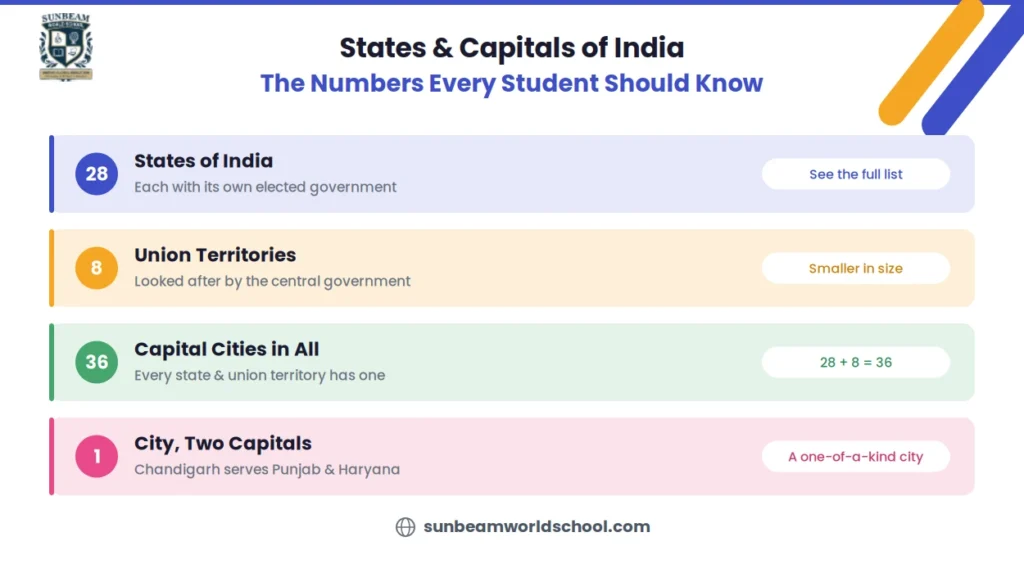
India has 28 states and 8 union territories in 2026, which together have 36 capitals. So if you are asking how many states are there in India, the answer is 28, and the total number of states and union territories combined is 36. Each of the 28 states has its own elected government led by a Chief Minister and its own state legislature with real law-making powers. The 8 union territories are administered directly by the central government through a Lieutenant Governor or an Administrator appointed by the President. When people ask “how many states in India including Telangana,” the answer is still 28, because Telangana is already counted as one of those 28 states; it became the 29th state in 2014, before the 2019 change brought the count back down.
This is the current and correct count, and it has been stable since 2019. That year, the former state of Jammu and Kashmir was reorganised into two union territories, Jammu and Kashmir and Ladakh, which reduced the number of states in India from 29 to 28 and raised the number of union territories to 8. So whether a question is phrased as the total states in India, the number of states in India, or the no of states in India, the figure is the same: 28 states, 8 union territories, and 36 capitals in total for 2026.
Is it 28 or 29 states in India? Why do some lists still show 29
Key facts about the states and capitals of India
India’s internal map has been redrawn many times, which is exactly why so many lists disagree. The modern shape began in 1956, when the States Reorganisation Commission redrew India’s boundaries largely along linguistic lines, on the idea that people who share a language govern themselves more effectively together. Since then, the count has changed several times, and the 29-states figure comes from one specific five-year window.
Here is what actually happened, step by step:
- 2000: Three new states, Chhattisgarh, Jharkhand, and Uttarakhand, were carved out of Madhya Pradesh, Bihar, and Uttar Pradesh.
- 2014: Telangana split from Andhra Pradesh and became India’s 29th state. From 2014 to 2019, India genuinely had 29 states.
- 2019: The state of Jammu and Kashmir was reorganised into two union territories, Jammu and Kashmir and Ladakh. That removed one state and brought the total back to 28.
So any list showing 29 states of India is showing the pre-2019 map. The correct figure today is 28 states and 8 union territories. This 28-versus-29 confusion is one of the most common traps in general knowledge and competitive exams, so it is worth remembering the reason behind the number, not just the number itself.
List of all 28 states of India and their capitals
Here is the full list of all 28 states of India and their capitals, numbered 1 to 28 and updated for 2026. The states are arranged alphabetically, which is the format used in most official documents and competitive exams, and this is the same order you will see in a “state and capital name 1 to 28” list. Alongside each state’s capital, the table below gives its region and its main official language, so it works as a single reference for the states of India, their capital cities, and their state names together.
|
# |
State |
Capital |
Region |
Main Language |
|
1 |
Andhra Pradesh |
Amaravati |
South |
Telugu |
|
2 |
Arunachal Pradesh |
Itanagar |
Northeast |
English |
|
3 |
Assam |
Dispur |
Northeast |
Assamese |
|
4 |
Bihar |
Patna |
East |
Hindi |
|
5 |
Chhattisgarh |
Raipur |
Central |
Hindi |
|
6 |
Goa |
Panaji |
West |
Konkani |
|
7 |
Gujarat |
Gandhinagar |
West |
Gujarati |
|
8 |
Haryana |
Chandigarh |
North |
Hindi |
|
9 |
Himachal Pradesh |
Shimla |
North |
Hindi |
|
10 |
Jharkhand |
Ranchi |
East |
Hindi |
|
11 |
Karnataka |
Bengaluru |
South |
Kannada |
|
12 |
Kerala |
Thiruvananthapuram |
South |
Malayalam |
|
13 |
Madhya Pradesh |
Bhopal |
Central |
Hindi |
|
14 |
Maharashtra |
Mumbai |
West |
Marathi |
|
15 |
Manipur |
Imphal |
Northeast |
Meitei (Manipuri) |
|
16 |
Meghalaya |
Shillong |
Northeast |
English |
|
17 |
Mizoram |
Aizawl |
Northeast |
Mizo |
|
18 |
Nagaland |
Kohima |
Northeast |
English |
|
19 |
Odisha |
Bhubaneswar |
East |
Odia |
|
20 |
Punjab |
Chandigarh |
North |
Punjabi |
|
21 |
Rajasthan |
Jaipur |
Northwest |
Hindi |
|
22 |
Sikkim |
Gangtok |
Northeast |
Nepali |
|
23 |
Tamil Nadu |
Chennai |
South |
Tamil |
|
24 |
Telangana |
Hyderabad |
South |
Telugu |
|
25 |
Tripura |
Agartala |
Northeast |
Bengali |
|
26 |
Uttar Pradesh |
Lucknow |
North |
Hindi |
|
27 |
Uttarakhand |
Dehradun |
North |
Hindi |
|
28 |
West Bengal |
Kolkata |
East |
Bengali |
One point that often appears as a trick question: Chandigarh is the capital of both Punjab and Haryana, yet it is itself a union territory, so it belongs to neither state fully. It appears in the states table above only as their shared capital, and again in the union territories table below in its own right.
The 8 union territories of India and their capitals
India has 8 union territories in 2026, each administered directly by the central government rather than by its own elected state government. A union territory is different from a state: it does not have a full state government of its own by default. That said, three of the eight, Delhi, Puducherry, and Jammu and Kashmir, do have their own elected legislature, which gives them a partial mix of both systems.
|
# |
Union Territory |
Capital |
Own Legislature? |
|
1 |
Andaman and Nicobar Islands |
Sri Vijaya Puram (formerly Port Blair) |
No |
|
2 |
Chandigarh |
Chandigarh |
No |
|
3 |
Dadra and Nagar Haveli and Daman and Diu |
Daman |
No |
|
4 |
Delhi (NCT) |
New Delhi |
Yes |
|
5 |
Jammu and Kashmir |
Srinagar (summer) / Jammu (winter) |
Yes |
|
6 |
Ladakh |
Leh |
No |
|
7 |
Lakshadweep |
Kavaratti |
No |
|
8 |
Puducherry |
Puducherry |
Yes |
Two details in this table catch people out. New Delhi, the capital of India, sits inside the union territory of Delhi rather than being a state capital. And the capital of the Andaman and Nicobar Islands, Port Blair, was renamed Sri Vijaya Puram in 2024, a change many lists and textbooks still have not updated.
What is the difference between a state and a union territory?
A state has its own elected government led by a Chief Minister, while a union territory is administered directly by the central government through a Lieutenant Governor or an Administrator. The people of a state vote their state government into power, and that government holds wide law-making powers. A union territory’s administrator is appointed by the President, and the central government holds much more direct control. The exceptions are Delhi, Puducherry, and Jammu and Kashmir, which have their own elected legislatures.
|
Point |
State |
Union Territory |
|
Who runs it |
Its own elected government |
The central government |
|
Main leader |
Chief Minister |
Lieutenant Governor / Administrator |
|
How it is chosen |
People vote for it |
Appointed by the President |
|
Example |
Maharashtra, Kerala |
Ladakh, Chandigarh |
|
How many |
28 |
8 |
States and union territories with more than one capital
Three states and union territories in India officially use more than one capital: Jammu and Kashmir, Himachal Pradesh, and Maharashtra. Almost every guide mentions the first of these, but far fewer mention that it is not the only one, which makes this a reliable quiz and exam question.
|
State / UT |
Capitals |
Why it has two |
|
Jammu and Kashmir |
Srinagar (summer), Jammu (winter) |
Heavy winter snow makes Srinagar hard to govern from, so the administration shifts to Jammu each winter and back to Srinagar in summer. |
|
Himachal Pradesh |
Shimla (summer), Dharamshala (winter) |
Dharamshala was declared the winter capital in January 2017 to make governance easier from the lower Kangra valley. |
|
Maharashtra |
Mumbai (main), Nagpur (second capital) |
Under the 1953 Nagpur Pact, Nagpur hosts the state legislature’s winter session each year. |
What changed on India’s map in 2026
Two updates make many older states-and-capitals lists wrong today, and getting them right is what separates a current 2026 list from a stale one. One change is from 2026 and the other from 2024, but both are still missing from a surprising amount of study material.
- Amaravati is now Andhra Pradesh’s sole and permanent capital. Parliament passed the Andhra Pradesh Reorganisation (Amendment) Act, 2026, which was notified on 6 April 2026 with retrospective effect from 2 June 2024. It gives Amaravati statutory status as the state’s only capital and formally ends the earlier “three capitals” proposal (Amaravati, Visakhapatnam, and Kurnool).
- Port Blair has been renamed Sri Vijaya Puram. The capital of the Andaman and Nicobar Islands was officially renamed by a gazette notification dated 14 September 2024. Many textbooks and lists still show “Port Blair.”
These are the only two changes since the 2019 reorganisation of Jammu and Kashmir, which means the overall count of 28 states, 8 union territories, and 36 capitals is unchanged. What changed is a capital’s legal status and a capital’s name, not the number of states in India.
Which state capital is not the largest city?
In five Indian states, the capital is not the largest city. In most states the capital is also the biggest city, such as Maharashtra (Mumbai), Karnataka (Bengaluru), and Tamil Nadu (Chennai). But five states are exceptions, and these are the ones that appear in quizzes and exams.
|
State |
Capital |
State’s Largest City |
|
Andhra Pradesh |
Amaravati |
Visakhapatnam |
|
Gujarat |
Gandhinagar |
Ahmedabad |
|
Haryana |
Chandigarh |
Faridabad |
|
Madhya Pradesh |
Bhopal |
Indore |
|
Assam |
Dispur |
Guwahati (Dispur sits inside the Guwahati area) |
A common exam question is “which state’s capital is not its largest city, Indore or Bhopal?” The answer is that Bhopal is the capital of Madhya Pradesh, while Indore is the larger city.
Largest, smallest, and record-holding states of India
Rajasthan is India’s largest state by area and Goa its smallest, while Uttar Pradesh is the most populous state and Sikkim the least. India’s states and union territories span a huge range in both area and population, so the key records are collected below.
|
Record |
State / UT |
Detail |
|
Largest state by area |
Rajasthan |
About 342,239 sq km, larger than several European countries, yet mostly desert and semi-arid land |
|
Smallest state by area |
Goa |
About 3,702 sq km, though not the smallest administrative unit, as some union territories are smaller |
|
Most populous state |
Uttar Pradesh |
Over 240 million people (2026 estimate), more than most countries on Earth |
|
Least populous state |
Sikkim |
Around 700,000 people |
|
Largest union territory |
Ladakh |
About 59,146 sq km |
|
Smallest union territory |
Lakshadweep |
About 32 sq km |
|
Newest state |
Telangana |
Formed on 2 June 2014, separated from Andhra Pradesh |
One point worth remembering for exams: Goa is the smallest state, but not the smallest administrative unit in India. Some union territories, such as Lakshadweep, are smaller still.
Official languages of Indian states
Each Indian state uses a dominant regional language for official work, and the Eighth Schedule of the Constitution recognises 22 scheduled languages. The main language for every one of the 28 states is listed in the master table above. What often trips people up is that six states officially recognise more than one language.
|
State |
Official Languages |
Why more than one |
|
Sikkim |
Nepali, Bhutia, Lepcha, Hindi, and others |
Reflects a mix of ethnic communities |
|
Nagaland |
English |
Many tribal languages, so English serves as the common administrative language |
|
Meghalaya |
English, Khasi, Garo |
Reflects the two largest tribal communities alongside English |
|
Jharkhand |
Hindi, plus Santali, Bengali, Urdu and others |
Recognises several tribal and regional languages |
|
Telangana |
Telugu, Urdu |
A large Urdu-speaking population, concentrated around Hyderabad |
|
Uttarakhand |
Hindi, Sanskrit |
The only state to give Sanskrit official status, added in 2010 |
Two facts stand out. Uttarakhand is the only Indian state that recognises Sanskrit as an official language. And Andhra Pradesh and Telangana both use Telugu, a reminder that Telangana was carved out of Andhra Pradesh.
How to remember all states and capitals of India easily
The fastest way to memorise all 36 state and capital pairs is to break them into small regional groups and practise a little each day, rather than trying to learn the whole list at once. These five methods work well together.
1. Learn by direction. Split India into North, South, East, West, Central, and Northeast, and study one region a day. The Northeast’s “Seven Sisters” are best learned as a single group.
2. Match the first letter. Some pairs share a sound: Andhra Pradesh and Amaravati, Gujarat and Gandhinagar, Maharashtra and Mumbai. Learn these first for quick early progress.
3. Build a hook for tricky pairs. For Gujarat and Gandhinagar, remember the capital is named after Gandhi, who was born in Gujarat. For Kerala, remember Thiruvananthapuram as “the long one.”
4. Draw a blank map. Print a blank outline map of India and fill in the states and capitals from memory. This map method uses spatial memory, which is far stronger than reading a list.
This blank-map exercise is a simple form of activity-based learning: placing names on a map uses spatial memory, which is far stronger than reading a list, and it directly answers the common search for an India map with states and capitals.
5. Quiz each other. One person names a state, the other answers with the capital, then swap. Ten minutes a day beats one long cram session.
The Seven Sisters trick: the seven northeastern states are Assam, Arunachal Pradesh, Manipur, Meghalaya, Mizoram, Nagaland, and Tripura. A simple device is “A Arranged My Many Notes Today.” Sikkim is sometimes added as the eighth, the “Brother” state.
Why states and capitals of India matter for competitive exams
Questions on Indian states and capitals appear in the General Knowledge and General Awareness sections of nearly every major Indian competitive exam, from UPSC and SSC CGL and CHSL to Railways, Bank PO, NDA, and state government exams. Common formats include “which is the capital of [state]?”, “how many states and union territories are there in India?”, “which states share [city] as a capital?”, and “which states were formed after 2000?”
Three points cause the most repeat mistakes. First, Chandigarh is a union territory that also serves as the shared capital of Punjab and Haryana. Second, the three dual-capital states (Jammu and Kashmir, Himachal Pradesh, and Maharashtra) each use different cities for different seasons or sessions. Third, Amaravati is now the capital of Andhra Pradesh, while Hyderabad belongs solely to Telangana.
For school students, this topic first appears in Class 5 Social Science and is built on through the middle grades, with NCERT Geography textbooks as the standard reference for children on the CBSE board. Sunbeam World School's online programmes, aligned to the Indian curriculum, teach exactly this kind of concept-first Social Science, so that students understand how states and capitals were formed rather than only memorising the list.
Quick quiz: test yourself on states and capitals
Try these on your own first, then check the answers below.
Part 1: State capitals
1. What is the capital of Maharashtra?
2. What is the capital of Kerala?
3. What is the capital of Rajasthan?
4. What is the capital of Gujarat?
5. What is the capital of Tamil Nadu?
6. What is the capital of West Bengal?
7. What is the capital of Uttar Pradesh?
8. What is the capital of Telangana?
9. What is the capital of Assam?
10. What is the capital of Andhra Pradesh?
Part 2: Union territories
11. What is the capital of India?
12. What is the capital of Ladakh?
13. What are the two capitals of Jammu and Kashmir?
14. What is the capital of Lakshadweep?
15. What is the new name of Port Blair?
Part 3: Bonus round
16. Is it 28 or 29 states in India today?
17. How many states and union territories are there in India in total?
18. Besides Jammu and Kashmir, name one state with a summer and winter capital.
19. Which state’s capital is not its largest city, Indore or Bhopal?
20. Which two states share Telugu as an official language?
Answers: 1. Mumbai 2. Thiruvananthapuram 3. Jaipur 4. Gandhinagar 5. Chennai 6. Kolkata 7. Lucknow 8. Hyderabad 9. Dispur 10. Amaravati 11. New Delhi 12. Leh 13. Srinagar and Jammu 14. Kavaratti 15. Sri Vijaya Puram 16. 28 states 17. 28 states and 8 union territories (36 in total) 18. Himachal Pradesh (Shimla and Dharamshala) or Maharashtra (Mumbai and Nagpur) 19. Bhopal is the capital; Indore is the larger city 20. Andhra Pradesh and Telangana.
Conclusion
India in 2026 has 28 states, 8 union territories, and 36 capitals, along with a set of exceptions and recent changes that most lists miss: the 28-versus-29 confusion, the three dual-capital states, the renaming of Port Blair to Sri Vijaya Puram, and the 2026 confirmation of Amaravati as the capital of Andhra Pradesh. Learn the list in small regional groups, use a map of India to fix the states and capitals in your memory, practise a little each day, and revisit the quiz whenever you need a refresher. This is the kind of clear, concept-first learning we care about at Sunbeam World School, an online school for children from nursery to grade 12.
Frequently Asked Questions
How many states and union territories are there in India in 2026?
-India has 28 states and 8 union territories in 2026, which together have 36 capitals. The 28 states each run their own elected government led by a Chief Minister, while the 8 union territories are governed mainly by the central government. This total number of states and union territories has been stable since 2019, when the former state of Jammu and Kashmir was reorganised into two separate union territories, Jammu and Kashmir and Ladakh.
What is the total number of states in India?
+Is it 28 or 29 states in India?
+What are the names of the 28 states of India and their capitals?
+What is the capital of Andhra Pradesh now?
+Which is the capital of India?
+Which is the newest state of India?
+How many capitals does India have in total?
+Does India have 29 states?
+
In this article
Share this post:


Press and Blogs
Stay updated with our press releases, educational blogs, and more.
Quick Summary Animal sounds are the noises animals make to communicate, warn of danger and...
Quick Summary An algebra equation is a maths statement that sets two expressions equal using...

Quick Summary Essential Repeat (ER) in CBSE means a student has not met the passing...