
 Kids Learning
List Of 200+ Animals Name in English for Kids
| Common animal names in English include a wide variety of species across different categories. These range from wild animals like lions, tigers, elephants, giraffes, and bears to farm animals such as cows, horses, pigs, and sheep.
Children are also familiar with pet animals like dogs, cats, rabbits, and hamsters, which are commonly found in homes. Animals can also be grouped based on where they live — for example, aquatic animals like whales, dolphins, and sharks live in water, while birds such as owls, parrots, and penguins are known for their feathers and ability to fly (with some exceptions). Understanding these common animal names helps children build vocabulary, recognize categories, and develop a basic understanding of the natural world. |
Animals fascinate every child, from pets at home to wild creatures in jungles and oceans. Learning animal names in English helps kids build vocabulary, improve pronunciation, and develop early science skills.
This guide features 200+ animal names in English from A to Z, along with categories, fun facts, quizzes, and activities, making learning simple, engaging, and perfect for kids.
Why Learn Animal Names in English?
Learning animal names is one of the first and most exciting vocabulary milestones for children. Here's why it matters more than you think:
Vocabulary Growth
Kids naturally love animals, making it easy to build English word banks quickly.
Phonics Practice
Animal names like "elephant," "giraffe," and "rhinoceros" introduce complex sounds.
Science Readiness
Knowing categories (mammal, reptile) builds a foundation for biology.
Cognitive Skills
Sorting and classifying animals develops critical thinking.
Creative Writing
Animal vocabulary enriches stories, essays, and descriptions.
Real-World Connection
Helps kids engage with nature, zoos, and wildlife documentaries.
10 Farm Animals Name in English for Kids
Farm animals are the first animals most children learn about. They are friendly, familiar, and easy to remember!
| Animal | Sound | Baby Name | Fun Fact |
|---|---|---|---|
| Cow | Moo | Calf | Gives us milk, butter, and cheese |
| Horse | Neigh | Foal | Can sleep standing up |
| Pig | Oink | Piglet | Has a very powerful sense of smell |
| Sheep | Baa | Lamb | Its fluffy coat is called wool |
| Goat | Meh | Kid | One of the first animals humans tamed |
| Hen | Cluck | Chick | Lays eggs every single day |
| Dog | Bark | Puppy | Has been friends with humans for 15,000 years |
| Cat | Meow | Kitten | Can hear sounds humans cannot |
| Donkey | Hee-Haw | Foal | Stronger than a horse of the same size |
| Duck | Quack | Duckling | Waterproof feathers keep them dry |
10 Pet Animals Name in English for Kids
Pets are animals that live with us at home. They need love, food, and care every day!
| Pet Animal | Sound | Baby Name | Why Kids Love Them |
|---|---|---|---|
| Dog | Bark / Woof | Puppy | Loyal, playful, and loves cuddles |
| Cat | Meow | Kitten | Soft, independent, and loves to purr |
| Rabbit | Squeak | Kitten / Kit | Fluffy, gentle, and fun to hold |
| Fish | — | Fry | Calming to watch, easy to care for |
| Hamster | Squeak | Pup | Runs on wheels and stores food in cheeks |
| Parrot | Squawk | Chick | Can mimic words and sing songs |
| Turtle | — | Hatchling | Slow, peaceful, and very long-lived |
| Guinea Pig | Wheek | Pup | Very friendly and loves being held |
| Goldfish | — | Fry | Can recognise their owner's face |
| Budgie | Chirp | Chick | Small, colourful, and loves to talk |
200+ A–Z Animals Name List In English
Here is the complete alphabetical list of animals name in English, your go-to reference for every letter of the alphabet.
| Aardvark (Mammal) | Albatross (Bird) | Alligator (Reptile) | Alpaca (Mammal) | Anaconda (Reptile) | Anteater (Mammal) |
| Antelope (Mammal) | Ape (Mammal) | Armadillo (Mammal) | Axolotl (Amphibian) | Baboon (Mammal) | Bat (Mammal) |
| Bear (Mammal) | Beaver (Mammal) | Bee (Insect) | Buffalo (Mammal) | Bull (Mammal) | Butterfly (Insect) |
| Bison (Mammal) | Blue Jay (Bird) | Camel (Mammal) | Catfish (Fish) | Chameleon (Reptile) | Cheetah (Mammal) |
| Chimpanzee (Mammal) | Clownfish (Fish) | Cobra (Reptile) | Crab (Crustacean) | Crane (Bird) | Crocodile (Reptile) |
| Crow (Bird) | Deer (Mammal) | Dingo (Mammal) | Dolphin (Mammal) | Donkey (Mammal) | Dragonfly (Insect) |
| Duck (Bird) | Duck-billed Platypus (Mammal) | Eagle (Bird) | Eel (Fish) | Elephant (Mammal) | Elk (Mammal) |
| Emperor Penguin (Bird) | Emu (Bird) | Falcon (Bird) | Ferret (Mammal) | Flamingo (Bird) | Fly (Insect) |
| Fox (Mammal) | Frog (Amphibian) | Gazelle (Mammal) | Gecko (Reptile) | Giant Panda (Mammal) | Giraffe (Mammal) |
| Goat (Mammal) | Gorilla (Mammal) | Grasshopper (Insect) | Hamster (Mammal) | Hawk (Bird) | Hedgehog (Mammal) |
| Heron (Bird) | Hippopotamus (Mammal) | Horse (Mammal) | Hummingbird (Bird) | Hyena (Mammal) | Iguana (Reptile) |
| Impala (Mammal) | Jaguar (Mammal) | Jellyfish (Sea creature) | Kangaroo (Mammal) | Kite (Bird) | Kiwi (Bird) |
| Koala (Mammal) | Komodo Dragon (Reptile) | Ladybug (Insect) | Leopard (Mammal) | Lion (Mammal) | Llama (Mammal) |
| Lobster (Crustacean) | Macaw (Bird) | Manta Ray (Fish) | Moose (Mammal) | Monkey (Mammal) | Mosquito (Insect) |
| Mouse (Mammal) | Narwhal (Mammal) | Newt (Amphibian) | Nightingale (Bird) | Octopus (Cephalopod) | Orangutan (Mammal) |
| Ostrich (Bird) | Otter (Mammal) | Owl (Bird) | Ox (Mammal) | Panther (Mammal) | Parrot (Bird) |
| Peacock (Bird) | Penguin (Bird) | Polar Bear (Mammal) | Python (Reptile) | Quail (Bird) | Quokka (Mammal) |
| Rabbit (Mammal) | Raccoon (Mammal) | Ram (Mammal) | Raven (Bird) | Rhinoceros (Mammal) | Robin (Bird) |
| Salamander (Amphibian) | Salmon (Fish) | Scorpion (Arachnid) | Sea Horse (Fish) | Sea Turtle (Reptile) | Seal (Mammal) |
| Shark (Fish) | Sloth (Mammal) | Snow Leopard (Mammal) | Sparrow (Bird) | Spider (Arachnid) | Squirrel (Mammal) |
| Swan (Bird) | Tiger (Mammal) | Toad (Amphibian) | Tortoise (Reptile) | Toucan (Bird) | Tree Frog (Amphibian) |
| Tuna (Fish) | Turkey (Bird) | Turtle (Reptile) | Urial (Mammal) | Vampire Bat (Mammal) | Vulture (Bird) |
| Walrus (Mammal) | Warthog (Mammal) | Whale (Mammal) | Wolf (Mammal) | Woodpecker (Bird) | Wombat (Mammal) |
| X-ray Tetra (Fish) | Xenops (Bird) | Yak (Mammal) | Yellow Warbler (Bird) | Zebra (Mammal) | Zebrafish (Fish) |
Understanding The 5 Main Categories of Animals
Scientists group animals into categories based on shared features. Here are the 5 main groups you need to know:
| Category | Approx. Number of Animals |
| Mammals | 45+ animals |
| Birds | 40+ animals |
| Reptiles | 25+ animals |
| Amphibians | 15+ animals |
| Fish | 30+ animals |
| Insects | 20+ animals |
Did You Know?
Scientists have identified over 8.7 million animal species on Earth — but only about 1.2 million have been formally named and described so far!
List of Mammal Names
Mammals are warm-blooded animals that breathe air, have hair or fur, give birth to live young (mostly), and feed their babies milk. They are the most intelligent group of animals on Earth.
| Animal Name | Where Found | Quick Fact |
| Lion | Africa | Called the "King of the Jungle," lives in groups called prides |
| Elephant | Africa, Asia | Largest land animal; uses its trunk for smelling, breathing, and grabbing |
| Tiger | Asia | Largest wild cat; each tiger has a unique stripe pattern |
| Bear | Worldwide | Can hibernate for up to 7 months; excellent swimmers |
| Fox | Worldwide | Highly adaptable; known for cleverness in folklore and nature |
| Wolf | North America, Eurasia | Lives in family packs; communicates with howls |
| Giraffe | Africa | Tallest animal on Earth — neck alone can be 6 feet long |
| Zebra | Africa | No two zebras have identical stripe patterns |
| Cheetah | Africa | Fastest land animal — reaches speeds up to 120 km/h |
| Dolphin | Oceans worldwide | Highly intelligent; communicates using clicks and whistles |
| Whale | All oceans | Blue whale is the largest animal ever known to exist |
| Rhinoceros | Africa, Asia | Their horn is made of keratin — same material as human fingernails |
| Hippopotamus | Africa | Despite their bulk, hippos can run at 30 km/h |
| Kangaroo | Australia | Babies (joeys) live in their mother's pouch for 6 months |
| Giant Panda | China | Eats up to 38 kg of bamboo every single day |
| Koala | Australia | Sleeps up to 22 hours a day to digest tough eucalyptus leaves |
| Hedgehog | Europe, Asia, Africa | Has about 5,000 spines on its back — made of hollow keratin |
| Squirrel | Worldwide | Has a great memory — can remember thousands of nut hiding spots |
| Rabbit | Worldwide | Teeth never stop growing — they wear them down by chewing |
| Otter | Rivers, coasts | Holds hands while sleeping so it doesn't drift away from its partner |
List of Bird Names
Birds are the only animals with feathers. They are warm-blooded, lay eggs, and most can fly. With over 10,000 known species, birds are one of the most diverse groups of animals on Earth.
| Bird Name | Habitat | Interesting Fact |
| Eagle | Mountains, forests | Can spot prey from 3 km away — vision 8x stronger than humans |
| Duck | Lakes, rivers | Waterproof feathers — oil glands keep water from soaking through |
| Peacock | South Asia | Male's tail feathers can grow up to 1.8 metres long |
| Flamingo | Tropical regions | Pink colour comes from the algae and shrimp they eat |
| Owl | Worldwide | Can rotate its head up to 270 degrees; hunts mostly at night |
| Penguin | Antarctic, Sub-Antarctic | Cannot fly but are exceptional swimmers — speed up to 36 km/h |
| Parrot | Tropical regions | Some species can mimic human speech and live 80+ years |
| Sparrow | Worldwide | One of the most widespread birds; found on every continent except Antarctica |
| Swan | Lakes, rivers | Mates for life; pairs often seen swimming together gracefully |
| Ostrich | African savannas | Largest and heaviest bird; fastest running bird at 70 km/h |
| Woodpecker | Forests worldwide | Pecks wood up to 20 times per second to find insects |
| Falcon | Worldwide | Peregrine falcon is the fastest animal on Earth at 389 km/h in a dive |
| Robin | Europe, North America | Males are famous for their bright orange-red breast |
| Toucan | South American rainforests | Enormous colorful bill helps it reach fruit and regulate body temperature |
| Crane | Wetlands, grasslands | Famous for elaborate courtship dances; some species migrate 10,000+ km |
List of Reptile Names
Reptiles are cold-blooded animals covered in scales. They breathe air, and most lay eggs. Unlike mammals, they can't produce their own body heat — they rely on the sun to warm up.
| Reptile Name | Habitat | Key Feature |
| Crocodile | Tropical rivers, lakes | One of the oldest creatures on Earth — unchanged for 200 million years |
| Alligator | USA, China | Unlike crocodiles, their lower teeth are hidden when mouth is closed |
| Tortoise | Land (worldwide) | Can live for over 150 years; the oldest on record was 190 years old |
| Sea Turtle | Oceans worldwide | Navigates thousands of miles using Earth's magnetic field |
| Python | Asia, Africa, Australia | World's longest snake; the reticulated python can reach over 7 metres |
| Cobra | Africa, Asia | Can raise up to a third of its body off the ground; hood spreads as warning |
| Chameleon | Africa, Madagascar | Changes colour for communication and temperature regulation |
| Gecko | Warm climates worldwide | Can walk upside down using millions of microscopic foot hairs |
| Komodo Dragon | Indonesian islands | World's largest lizard; saliva contains bacteria that weakens prey |
| Iguana | Central & South America | Can fall from 15 metres and walk away completely unhurt |
List of Amphibian Names
Amphibians are fascinating animals that live two lives, starting in water (as larvae) and moving to land as adults. Their skin is moist and smooth, and most need water to reproduce.
| Amphibian Name | Habitat | Interesting Fact |
| Frog | Worldwide (near water) | Can jump up to 20 times their own body length in a single leap |
| Salamander | Moist habitats worldwide | Can regrow lost limbs, tails, eyes, and even parts of their heart |
| Toad | Worldwide | Dry, bumpy skin (not warts!) and shorter legs than frogs |
| Axolotl | Mexico (nearly extinct in wild) | The "Peter Pan" of amphibians — never fully metamorphoses |
| Tree Frog | Tropical forests | Sticky toe pads allow climbing smooth vertical surfaces and even glass |
| Poison Dart Frog | South American rainforests | Tiny but deadly — their skin toxins can kill 10 adult humans |
| Newt | Temperate regions | Some species can produce enough toxin to kill a human if swallowed |
| Caecilian | Tropical regions | Legless and worm-like; mostly blind and live underground |
List of Fish Names
Fish are cold-blooded aquatic animals that breathe through gills and usually have scales. There are over 33,000 known species — more than all other vertebrate groups combined!
| Fish Name | Water Type | Interesting Fact |
| Shark | Salt water | Has been on Earth for over 450 million years — older than dinosaurs |
| Clownfish | Salt water | Can change sex — all clownfish are born male, dominant ones become female |
| Angelfish | Fresh & salt water | Recognizes their owners' faces and can spit water to get attention |
| Salmon | Both (migrates) | Returns to the exact river where it was born to lay its own eggs |
| Puffer Fish | Salt water | Inflates to 3x its size when threatened; contains deadly tetrodotoxin |
| Goldfish | Fresh water | Memory is much better than believed — can remember things for months |
| Swordfish | Salt water | Can heat its eyes and brain to see better while hunting in cold water |
| Catfish | Fresh water | Has up to 100,000 taste buds all over its body — like tasting with its skin |
| Seahorse | Salt water | The only animal where the male carries and gives birth to babies |
| Manta Ray | Salt water | The largest ray species, with a wingspan reaching up to 7 metres |
Insects & Bugs Names
Insects are the most numerous animals on Earth, for every human, there are approximately 1.4 billion insects! They have 3 body parts, 6 legs, and most have wings at some life stage.
| Insect Name | Role in Nature | Amazing Fact |
| Bee | Pollinator | A single bee visits 2,000 flowers a day to make just 1 teaspoon of honey |
| Butterfly | Pollinator | Tastes with its feet — has taste sensors on its legs |
| Caterpillar | Food chain | Completely dissolves inside a chrysalis before becoming a butterfly |
| Ladybug | Natural pesticide | One ladybug can eat up to 5,000 aphids in its lifetime |
| Grasshopper | Food chain | Hears through organs on its abdomen, not its head |
| Beetle | Decomposer | 400,000 known species — about 1 in 4 animal species is a beetle |
| Dragonfly | Natural mosquito control | Catches 95% of its prey — highest hunting success rate among predators |
| Ant | Ecosystem engineer | Can carry 50x their body weight; colonies can have 700,000 workers |
What Are Baby Animals Called?
Did you know that almost every animal has a special name for its babies? Here are the most important ones every child should know:
| Animal | Baby Name | Fun Detail |
|---|---|---|
| Cat | Kitten | Born with eyes closed; opens them at 10 days |
| Dog | Puppy | Cannot hear or see at birth |
| Cow | Calf | Can stand and walk within hours of birth |
| Horse | Foal | Can run within 2 hours of being born |
| Lion | Cub | Blind at birth; stays with mother for 2 years |
| Tiger | Cub | Has the same stripe pattern from birth |
| Bear | Cub | Born the size of a squirrel! |
| Kangaroo | Joey | Born the size of a jellybean; grows in the pouch |
| Deer | Fawn | White spots help it hide in forests |
| Duck | Duckling | Can swim on the day it hatches |
| Sheep | Lamb | Recognises its mother by her voice |
| Pig | Piglet | Born in groups called litters |
| Rabbit | Kitten / Kit | Born without fur; grows it within a week |
| Frog | Tadpole | Lives in water before becoming a land frog |
| Butterfly | Caterpillar | Transforms completely inside a chrysalis |
| Swan | Cygnet | Born grey-brown; turns white over months |
| Eagle | Eaglet | Stays in the nest for up to 3 months |
| Whale | Calf | Drinks its mother's milk underwater! |
| Elephant | Calf | Weighs 90–120 kg at birth |
| Penguin | Chick | Kept warm under a parent's feet on ice |
| Goat | Kid | Can jump and play within hours of birth |
| Chicken | Chick | Pecks its way out of the egg using a special tooth |
| Fish | Fry | Hatches from tiny eggs in water |
| Fox | Cub / Kit | Born blind and deaf in underground dens |
| Monkey | Infant | Clings to its mother's belly for the first months |
80 Common Animals Name In English
Learning animal names in English is one of the most exciting first steps for young learners. Animals spark natural curiosity in children — making them the perfect subject for building vocabulary, improving memory, and developing a love for the natural world. Whether they roam wild jungles, live on farms, or share our homes as pets, every animal has a name worth knowing. Take a look at some of the most common animals kids learn first:
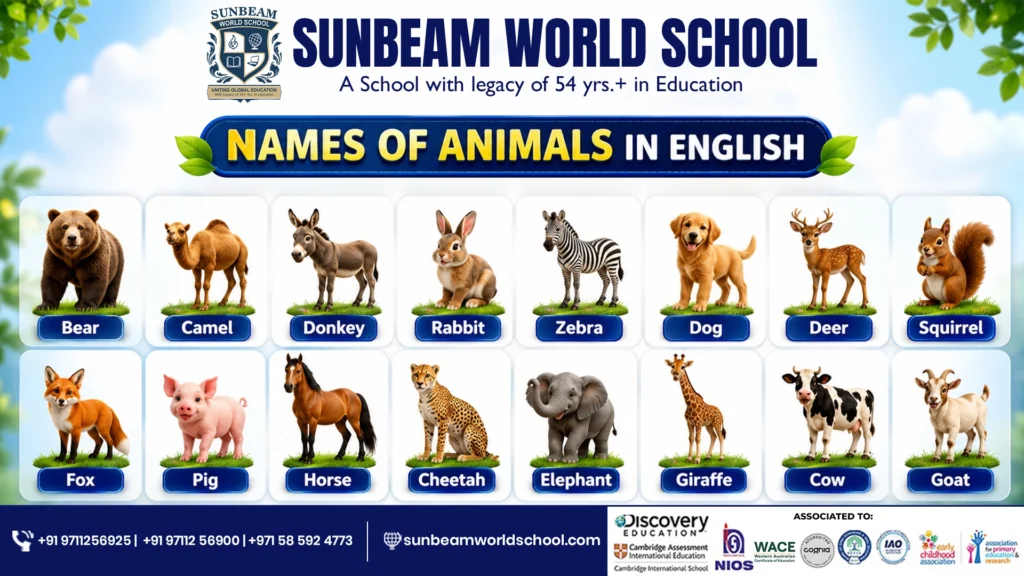
common animal names in English with pictures — a visual learning guide for kids covering wild, domestic, and farm animals.
1. Lion
Category: Mammal
The lion is a large, powerful wild cat. Males are known for their magnificent mane. Lions live in groups called prides, and females do most of the hunting. They communicate with roars that can be heard 8 km away.
2. Elephant
Category: Mammal
The elephant is the world's largest land animal. African elephants can weigh up to 7,000 kg. They are extremely intelligent, show emotions, and can even recognize themselves in a mirror — a skill shared by very few animals.
3. Tiger
Category: Mammal
Tigers are the largest of all wild cats. Unlike lions, tigers are solitary hunters who rely on their iconic orange-and-black striped coats to stalk prey. Every tiger's stripe pattern is as unique as a human fingerprint.
4. Giraffe
Category: Mammal
The giraffe is the tallest animal on Earth, reaching heights of up to 5.5 metres. Despite their long necks, they have the same number of neck bones as humans — just 7, but much larger. They use their long tongue to strip leaves from trees.
5. Blue Whale
Category: Mammal
The blue whale is the largest animal ever known to have lived on Earth. It can grow up to 30 metres long and weigh 200,000 kg. Its heart alone is the size of a small car, and its call can be heard from 1,600 km away underwater.
6. Eagle
Category: Bird
Eagles are apex predators of the sky. Their eyesight is up to 8 times stronger than a human's, allowing them to spot a rabbit from 3 km away. They are symbols of freedom and strength in many cultures worldwide.
7. Crocodile
Category: Reptile
Crocodiles are living fossils — virtually unchanged for over 200 million years. They have the strongest bite force of any animal on Earth. Despite being fearsome predators, crocodile mothers are surprisingly gentle with their hatchlings.
8. Butterfly
Category: Insect
Butterflies undergo complete metamorphosis: egg → caterpillar → chrysalis → adult. Their wings are actually transparent — the colors we see come from tiny scales that reflect light. They taste food with their feet!
9. Frog
Category: Amphibian
Frogs are amphibians that start life in water as tadpoles and transform into land animals. They breathe through both their lungs and their skin. There are over 7,000 known species of frogs, ranging from tiny ones to those the size of a dinner plate.
10. Shark
Category: Fish
Sharks have existed for 450 million years — longer than trees! They have multiple rows of teeth that continuously grow and replace themselves. Their skin feels like sandpaper and is actually made of tiny tooth-like structures called dermal denticles.
11. Penguin
Category: Bird
Penguins are birds that cannot fly, but they are master swimmers. Emperor penguins can dive to 500 metres and hold their breath for 20 minutes. The male emperor penguin keeps a single egg warm on his feet through the brutal Antarctic winter.
12. Chameleon
Category: Reptile
Chameleons are famous for changing color, but this is actually communication and temperature regulation — not camouflage. Their eyes can move independently, giving them a full 360° view. Their sticky tongue can extend twice the length of their body in 0.07 seconds.
13. Bear
Category: Mammal
Bears are large, powerful mammals found across North America, Europe, and Asia. They can hibernate for up to 7 months, surviving entirely on stored fat. Despite their bulk, bears are excellent swimmers and fast runners — reaching 55 km/h.
14. Wolf
Category: Mammal
Wolves are highly social animals that live in family packs with a clear hierarchy. They communicate through howls, which can travel 10 km. Wolves are the ancestors of all domestic dogs, first tamed by humans over 15,000 years ago.
15. Fox
Category: Mammal
Foxes are the most widespread wild members of the dog family. The red fox has adapted to live in cities, forests, and deserts alike. They use Earth's magnetic field to hunt — the only known land mammal with this ability.
16. Zebra
Category: Mammal
Zebras are African wild horses instantly recognised by their black-and-white stripes. No two zebras have identical patterns. Their stripes may confuse predators by making it hard to single out one animal from a running herd.
17. Cheetah
Category: Mammal
The cheetah is the fastest land animal on Earth, reaching 120 km/h in short bursts. Unlike other big cats, cheetahs cannot roar — they purr instead. They rely entirely on speed, not strength, to catch prey like gazelles.
18. Dolphin
Category: Mammal
Dolphins are highly intelligent marine mammals. They communicate through a complex system of clicks, whistles, and squeaks. Each dolphin has a unique "signature whistle" — like a name — that others use to call them.
19. Rhinoceros
Category: Mammal
Rhinoceroses are the second-largest land animals. Their horn is made of keratin — the same material as human fingernails. Despite their size, rhinos can charge at 50 km/h. All five species are threatened with extinction.
20. Hippopotamus
Category: Mammal
Hippos spend up to 16 hours a day in water to protect their sensitive skin from the sun. Despite their huge size, they can run at 30 km/h on land. They are considered one of the most dangerous animals in Africa.
21. Kangaroo
Category: Mammal
Kangaroos are the world's largest marsupials, found only in Australia. Babies (called joeys) are born the size of a jellybean and crawl into their mother's pouch to develop for 6 months. Kangaroos cannot walk backwards.
22. Giant Panda
Category: Mammal
Giant pandas eat up to 38 kg of bamboo every day. Despite being bears, they have a special wrist bone that acts like a thumb, helping them grip bamboo stalks. They are a global symbol of wildlife conservation.
23. Koala
Category: Mammal
Koalas are marsupials native to Australia. They sleep up to 22 hours a day because digesting tough eucalyptus leaves uses enormous energy. Koala fingerprints are nearly identical to human fingerprints under a microscope.
24. Hedgehog
Category: Mammal
Hedgehogs have about 5,000 hollow keratin spines on their back. When threatened, they curl into a tight ball. They are lactose intolerant — despite the popular image, feeding them milk is actually harmful to their health.
25. Otter
Category: Mammal
Sea otters hold hands while sleeping so they don't drift apart — groups are called "rafts." They have the densest fur of any animal (about 1 million hairs per square inch) and use their belly as a table to crack open shellfish with stones.
26. Rabbit
Category: Mammal
Rabbits' teeth never stop growing — they must chew constantly to wear them down. They can see almost 360° around them without moving their head. Baby rabbits are called kittens or kits, and a group of rabbits is called a colony.
27. Squirrel
Category: Mammal
Squirrels have an exceptional spatial memory, allowing them to find thousands of buried nuts months later. They deliberately bury fake caches when other animals are watching to protect their real food stores — a sign of sophisticated thinking.
28. Monkey
Category: Mammal
There are over 260 known monkey species. Monkeys are highly social and live in groups called troops. Many use tools — capuchin monkeys use stones to crack nuts. They communicate through facial expressions, sounds, and body language.
29. Gorilla
Category: Mammal
Gorillas are the largest primates and share 98.3% of their DNA with humans. They live in family groups led by a dominant silverback male. Gorillas can learn sign language and have been known to express emotions like grief and laughter.
30. Orangutan
Category: Mammal
Orangutans are the only great apes native to Asia. They are exceptionally intelligent, using tools and building elaborate nests from branches every night. Their name comes from Malay words meaning "person of the forest."
31. Camel
Category: Mammal
Camels store fat (not water) in their humps for energy during long desert treks. They can drink 200 litres of water in 15 minutes and survive weeks without drinking. Their thick eyelashes and closeable nostrils protect against sandstorms.
32. Horse
Category: Mammal
Horses have been companions to humans for over 5,000 years. They can sleep both standing up and lying down. Horses have nearly 360° vision but have blind spots directly in front of and behind them. They communicate primarily through body language.
33. Cow
Category: Mammal
Cows are highly social animals that form close friendships and become stressed when separated from companions. They have an excellent memory and can recognise up to 100 other cows by their faces. A dairy cow produces about 25 litres of milk per day.
34. Pig
Category: Mammal
Pigs are among the most intelligent domestic animals — smarter than dogs in many cognitive tests. They cannot sweat (hence rolling in mud to stay cool) and have an extraordinary sense of smell, 2,000 times stronger than a human's.
35. Sheep
Category: Mammal
Sheep can recognise and remember up to 50 individual sheep faces for over 2 years. They experience a range of emotions and have been shown to feel optimism or pessimism. A flock of sheep will follow a leader — a behaviour farmers use for herding.
36. Goat
Category: Mammal
Goats are curious, playful, and highly adaptable. They were one of the first animals to be domesticated — about 10,000 years ago. Goats have rectangular pupils that give them a field of vision of 320–340 degrees, helping them spot predators easily.
37. Deer
Category: Mammal
Deer are the only animals with antlers, which grow and shed every year. Only males grow antlers in most species. They use antlers to compete for mates. Baby deer (fawns) are born with white spots that act as camouflage in dappled forest light.
38. Moose
Category: Mammal
Moose are the largest members of the deer family. A male's antlers can span up to 1.8 metres across. Despite their enormous size, moose are excellent swimmers and can dive up to 5.5 metres underwater to eat aquatic plants.
39. Seal
Category: Mammal
Seals are marine mammals perfectly adapted for cold water. They can slow their heart rate from 100 to 10 beats per minute when diving, conserving oxygen. On land they are clumsy, but underwater they are graceful and can dive to 500 metres.
40. Walrus
Category: Mammal
Walruses use their iconic tusks to haul themselves out of the water, establish social rank, and break breathing holes in ice. They can slow their heartbeat to survive freezing Arctic waters. A walrus can sleep in the ocean, inflating throat pouches to float.
41. Peacock
Category: Bird
The peacock (male peafowl) fans its spectacular tail feathers — which can reach 1.8 metres — to attract females. The "eyes" on the feathers are not for seeing but for show. Females (peahens) prefer males with the most elaborate displays.
42. Duck
Category: Bird
Ducks have waterproof feathers thanks to oil from a preen gland. Their feet have no nerves or blood vessels that feel cold, so they can stand on ice comfortably. Ducklings imprint on the first moving thing they see after hatching — usually their mother.
43. Swan
Category: Bird
Swans are among the largest flying birds and are famous for mating for life. A group of swans is called a bevy or wedge. Cygnets (baby swans) are born grey-brown and gradually turn white. Swans can be aggressive when defending their nests.
44. Owl
Category: Bird
Owls are silent, nocturnal hunters. Their asymmetrical ears allow them to pinpoint prey by sound alone in total darkness. Owls cannot move their eyes in their sockets — instead they rotate their entire head up to 270 degrees.
45. Parrot
Category: Bird
Parrots are among the most intelligent birds, capable of mimicking speech and solving complex puzzles. African grey parrots can learn a vocabulary of over 1,000 words and understand their meaning. Some parrots live for over 80 years.
46. Flamingo
Category: Bird
Flamingos get their pink colour from the carotenoid pigments in the algae and shrimp they eat. Without this diet, they turn white. They stand on one leg to conserve body heat. A group of flamingos is called a flamboyance.
47. Woodpecker
Category: Bird
Woodpeckers peck wood up to 20 times per second to find insects and create nest holes. Their skull has special shock-absorbing bone to prevent brain damage. Their incredibly long tongue wraps around their skull when not in use.
48. Ostrich
Category: Bird
The ostrich is the world's largest and heaviest bird, standing up to 2.7 metres tall. It cannot fly but can run at 70 km/h — the fastest running bird on Earth. Ostriches have the largest eyes of any land animal, bigger than their brain.
49. Hummingbird
Category: Bird
Hummingbirds are the only birds that can fly backwards, forwards, and hover in place. Their wings beat 50–80 times per second. To fuel this extreme lifestyle, they visit up to 2,000 flowers per day and eat twice their body weight in nectar.
50. Crow
Category: Bird
Crows are considered among the most intelligent animals on the planet. They use tools, solve multi-step puzzles, recognise human faces, hold grudges, and even leave gifts for people who feed them. They have been observed teaching their young.
51. Tortoise
Category: Reptile
Tortoises are land reptiles famous for their extreme longevity — some live over 150 years. They carry their shell for life; it is fused to their spine and ribs and cannot be removed. The Galapagos giant tortoise can weigh over 400 kg.
52. Sea Turtle
Category: Reptile
Sea turtles navigate thousands of miles across open ocean using Earth's magnetic field as a compass. They return to the exact beach where they were born to lay their own eggs — sometimes after 30 years at sea. They can live for over 100 years.
53. Python
Category: Reptile
Pythons are non-venomous constrictors — they squeeze prey until it cannot breathe. The reticulated python is the world's longest snake, reaching over 7 metres. After eating a large meal, a python may not need to eat again for months.
54. Cobra
Category: Reptile
Cobras are venomous snakes famous for spreading a "hood" of flattened neck ribs as a warning display. The king cobra is the world's longest venomous snake (up to 5.5 metres). Spitting cobras can accurately spit venom at eyes from 2.5 metres away.
55. Gecko
Category: Reptile
Geckos can walk upside down on smooth ceilings thanks to millions of microscopic hair-like structures on their feet that create adhesive forces. Most geckos cannot blink — they lick their eyes to keep them clean and moist.
56. Komodo Dragon
Category: Reptile
The Komodo dragon is the world's largest lizard, growing up to 3 metres long. It has a forked tongue that "tastes" the air to detect prey up to 9 km away. Female Komodo dragons can reproduce without a male.
57. Alligator
Category: Reptile
Alligators are found only in the USA and China. Unlike crocodiles, their lower teeth are hidden when their mouth is closed. They are surprisingly caring parents — mothers guard their nests and carry hatchlings to water in their mouths.
58. Iguana
Category: Reptile
Iguanas are large herbivorous lizards from Central and South America. They can fall from 15 metres and walk away unharmed. They have a "third eye" on top of their head that detects light and predators.
59. Salamander
Category: Amphibian
Salamanders can regrow lost limbs, tails, eyes, and even parts of their heart or brain. The axolotl, a type of salamander, never fully metamorphoses and keeps its juvenile features for life.
60. Tree Frog
Category: Amphibian
Tree frogs have sticky toe pads that allow them to climb smooth surfaces. Some species have transparent skin, letting you see internal organs.
61. Clownfish
Category: Fish
Clownfish live in sea anemones and are protected from stings by a special coating. All clownfish are born male — some change into females later.
62. Salmon
Category: Fish
Salmon migrate from rivers to the ocean and back again. They return to the exact place they were born using smell and Earth's magnetic field.
63. Puffer Fish
Category: Fish
Puffer fish inflate when threatened and contain a powerful toxin. Despite this, they are eaten as a delicacy in Japan.
64. Goldfish
Category: Fish
Goldfish have strong memories and can learn tricks. They can live for over 20 years in proper conditions.
65. Catfish
Category: Fish
Catfish have whisker-like barbels and can taste with their entire body. Some can even move on land.
66. Seahorse
Category: Fish
In seahorses, the male carries and gives birth to babies. They swim upright and use their tails to hold onto plants.
67. Manta Ray
Category: Fish
Manta rays are huge, with wingspans up to 7 metres. They feed on plankton and can swim gracefully through oceans.
68. Bee
Category: Insect
Bees are important pollinators. They communicate through dances and help produce a large portion of the food we eat.
69. Ladybug
Category: Insect
Ladybugs eat harmful insects like aphids. Their bright colour warns predators to stay away.
70. Ant
Category: Insect
Ants are strong and social. They live in colonies and can carry objects many times their own weight.
71. Dragonfly
Category: Insect
Dragonflies are excellent hunters with nearly perfect accuracy. They have large eyes and can see in almost every direction.
72. Beetle
Category: Insect
Beetles are the largest group of animals, with hundreds of thousands of species found all over the world.
73. Earthworm
Category: Invertebrate
Earthworms help keep soil healthy by improving air and nutrient flow. They are very important for farming and gardening.
74. Spider
Category: Arachnid
Spiders have 8 legs and produce silk stronger than steel. Most are harmless to humans.
75. Scorpion
Category: Arachnid
Scorpions have a venomous sting and glow under ultraviolet light. Mothers carry their babies on their backs.
76. Octopus
Category: Cephalopod
Octopuses are highly intelligent. They can change colour and shape to hide and have multiple hearts.
77. Lobster
Category: Crustacean
Lobsters grow by shedding their shells. They have powerful claws used for catching and breaking food.
78. Crab
Category: Crustacean
Crabs usually walk sideways and use their claws for defense and communication.
79. Jellyfish
Category: Sea Creature
Jellyfish have no brain or bones but have existed for millions of years. Some species can regenerate and live very long lives.
80. Platypus
Category: Mammal
The platypus is a unique egg-laying mammal with a duck-like bill. It can detect electric signals from prey underwater.
Animals Name in Hindi and English for Kids
| English Name | Hindi Name | Pronunciation |
|---|---|---|
| Lion | सिंह / शेर | Singh / Sher |
| Tiger | बाघ | Baagh |
| Elephant | हाथी | Haathi |
| Horse | घोड़ा | Ghoda |
| Cow | गाय | Gaay |
| Dog | कुत्ता | Kutta |
| Cat | बिल्ली | Billi |
| Monkey | बंदर | Bandar |
| Bear | भालू | Bhaalu |
| Deer | हिरण | Hiran |
| Crow | कौआ | Kauwa |
| Parrot | तोता | Tota |
| Peacock | मोर | Mor |
| Snake | सांप | Saanp |
| Rabbit | खरगोश | Khargosh |
| Fish | मछली | Machhli |
| Frog | मेंढक | Mendhak |
| Butterfly | तितली | Titli |
| Giraffe | जिराफ | Jiraaf |
| Zebra | ज़ेबरा | Zebra |
Games & Activities for Learning Animal Names
Learning is most effective when it's fun! Here are proven activities that help children (and adults!) remember animal names quickly.
Activity 1: Animal Alphabet Challenge
Go through each letter of the alphabet and challenge your child to name an animal for every letter. Time them each round and celebrate improvement. Example: A = Ant, B = Bear, C = Cheetah... Tip: make it a family race!
Activity 2: Act Like the Animal
One player acts out an animal using only movements and sounds — no words. Others guess the animal name. This builds vocabulary, body awareness, and is endlessly entertaining for ages 3–10.
Activity 3: Animal Name Spelling Bee
Call out an animal name and have kids spell it aloud or write it. Start simple (Cat, Dog, Bear) and progress to harder names (Rhinoceros, Hippopotamus, Axolotl). Great for spelling and vocabulary together.
Activity 4: Sort the Animals
Write 20 animal names on cards. Ask children to sort them into: Mammals / Birds / Reptiles / Fish / Amphibians. This is excellent for developing classification skills — a key science concept in early education.
Activity 5: Animal Fact Book
Have kids pick their favourite 5 animals, draw each one, write the name, and add one interesting fact. Creating their own mini-encyclopedia dramatically improves retention compared to passive reading.
Activity 6: Where in the World?
Use a world map and stickers or pins. Name an animal and ask kids to mark where it lives. Lion → Africa. Kangaroo → Australia. Snow Leopard → Himalayas. This connects animal names to world geography naturally.
Animal Quiz
Section 1: Multiple Choice
- Which animal is the fastest land animal?
a) Lion
b) Tiger
c) Cheetah
d) Zebra - Which animal can change its color for communication and temperature?
a) Gecko
b) Chameleon
c) Iguana
d) Snake - Which animal is known as the largest animal on Earth?
a) Elephant
b) Blue Whale
c) Giraffe
d) Whale Shark - Which bird can fly backwards?
a) Eagle
b) Parrot
c) Hummingbird
d) Crow - Which animal gives birth to babies carried by the male?
a) Seahorse
b) Dolphin
c) Shark
d) Frog - Which reptile is the longest snake in the world?
a) Cobra
b) Python
c) Viper
d) Anaconda - Which insect helps in pollination and makes honey?
a) Ant
b) Beetle
c) Bee
d) Butterfly - Which animal has tusks and lives in cold Arctic regions?
a) Seal
b) Walrus
c) Polar Bear
d) Whale
Section 2: True or False
- Penguins can fly long distances.
- Frogs can breathe through their skin.
- Goldfish only have a 3-second memory.
- Spiders are insects.
- Elephants can recognize themselves in a mirror.
- Kangaroos can walk backwards.
Section 3: Fill in the Blanks
- A group of wolves is called a ________.
- The ________ is the largest bird in the world.
- ________ are known for eating bamboo.
- ________ have whisker-like barbels and can taste with their body.
- A baby kangaroo is called a ________.
- ________ are animals that can regrow lost body parts like limbs.
Answer Key
Multiple Choice:
- c) Cheetah
- b) Chameleon
- b) Blue Whale
- c) Hummingbird
- a) Seahorse
- b) Python
- c) Bee
- b) Walrus
True/False:
- False
- True
- False
- False
- True
- False
Fill in the Blanks:
- Pack
- Ostrich
- Giant Panda
- Catfish
- Joey
- Salamanders
Conclusion
Learning animal names is much more than memorizing words, it’s about understanding the world around us, developing curiosity, and building a strong foundation for science and language skills. When children learn through fun facts, quizzes, and activities, they retain knowledge faster and enjoy the process.
At Sunbeam World School, learning is designed to be interactive, engaging, and meaningful. By combining creativity with strong academic foundations, the school encourages young learners to explore topics like animals, nature, and science in a way that builds both knowledge and confidence.
Keep exploring, keep learning, because every new word opens the door to a bigger world.

Frequently Asked Questions
What are the 5 main types/categories of animals?
-The 5 main categories of animals are: Mammals (warm-blooded, have hair, feed babies milk), Birds (feathered, warm-blooded, lay eggs), Reptiles (cold-blooded, scaly skin, lay eggs), Amphibians (live in water and on land, moist skin), and Fish (cold-blooded, breathe through gills, live in water). Scientists also recognize Insects, Arachnids, and other invertebrates as major groups.
What are the most common animals names for preschoolers to learn first?
+What is the fastest animal in the world?
+What is the largest animal on Earth?
+What is the difference between a mammal and a reptile?
+How many animals species are there in the world?
+What are domestic animals vs wild animals?
+What are nocturnal animals? Give some names.
+What are some endangered animals names?
+Which animals start with the letter A?
+What are some common names of wild animals?
+What are the names of popular farm animals?
+Which animals are considered pets?
+What are endangered animals?
+
In this article
Share this post:


Press and Blogs
Stay updated with our press releases, educational blogs, and more.
Quick Summary Animal sounds are the noises animals make to communicate, warn of danger and...

Quick Summary The area of rectangle equals its length multiplied by its width (A =...

Quick Summary Sympathy means feeling sorry for someone from your own point of view. Empathy...