
 Kids Learning
Colours Name in English: 100+ A to Z List With Pictures for Kids
Quick Summary
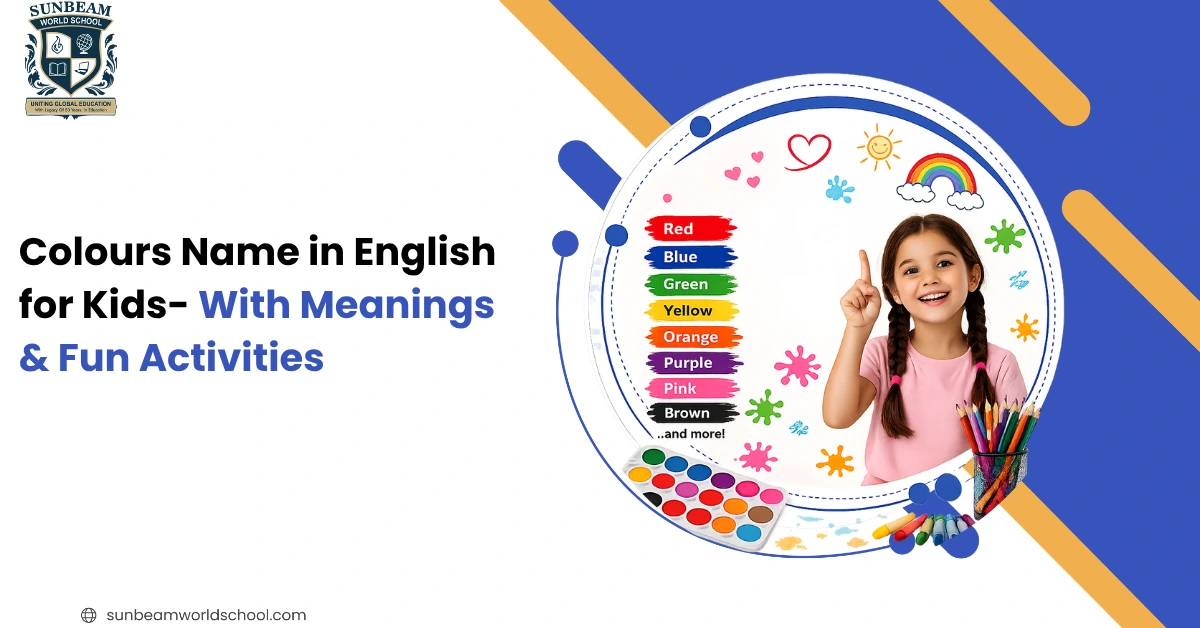
The 10 basic colours name in English are Red, Blue, Yellow, Green, Orange, Purple, Pink, Brown, Black, and White. This guide covers 100+ colour names A to Z in English, Hindi, Spanish, and French, along with pictures, HEX codes, a printable colour chart, and fun learning activities for kids.
Children love spotting bright colours around them, whether it is in toys, rainbows, fruits, flowers, or cartoons. Learning colour names is one of the first steps in building vocabulary, creativity, observation skills, and communication skills for kids in pre-primary school and beyond.
Both "colour" and "color" refer to the same thing. "Colour" is the standard spelling in British English, used in India, UK, Canada, and Australia, while "color" is the American English spelling used in the USA. Whether you searched for "colours name" or "colors name," this complete list covers everything from basic colour names to 100+ advanced shades in multiple languages.
Did you know?Both “Color” and “Colour” mean the same thing. The difference is only in spelling.
| Word | Used In |
| Color | American English (USA) |
| Colour | British English (UK, India, Canada, Australia) |
What Are the 10 Basic Colours Name in English?
The 10 basic colours name that every child learns first are Red, Blue, Yellow, Green, Orange, Purple, Pink, Brown, Black, and White. These are the most common colours found in everyday objects, and they form the foundation for learning all other colour names.
| # | Colour Name | Found In |
|---|---|---|
| 1 | Red | Apples, roses, strawberries |
| 2 | Blue | Sky, ocean, blueberries |
| 3 | Yellow | Sunflowers, bananas, sunshine |
| 4 | Green | Grass, leaves, frogs |
| 5 | Orange | Oranges, carrots, pumpkins |
| 6 | Purple | Grapes, eggplant, lavender |
| 7 | Pink | Flamingos, roses, candy |
| 8 | Brown | Chocolate, wood, soil |
| 9 | Black | Night sky, tyres, coal |
| 10 | White | Snow, milk, clouds |
Most children can identify and name these 10 colours between the ages of 2 and 4. Teachers and parents often start with these basic colour names because they are easy to spot in fruits, toys, clothes, and classroom objects around the house or school.
List Of 100 Colours Name A to Z
| Red | Blue | Yellow | Green | Orange |
| Purple | Pink | Brown | Black | White |
| Grey | Cyan | Magenta | Scarlet | Crimson |
| Indigo | Violet | Lavender | Lilac | Maroon |
| Navy | Teal | Turquoise | Coral | Peach |
| Beige | Ivory | Gold | Silver | Bronze |
| Copper | Amber | Emerald | Ruby | Sapphire |
| Jade | Olive | Lime | Mint | Mustard |
| Saffron | Cerulean | Azure | Cobalt | Denim |
| Sky Blue | Aqua | Plum | Rose | Fuchsia |
| Salmon | Wheat | Pearl | Quartz | Slate |
| Tan | Khaki | Ochre | Umber | Russet |
| Charcoal | Ebony | Cream | Chocolate | Coffee |
| Mocha | Sand | Apricot | Tangerine | Vermillion |
| Burgundy | Wine | Blush | Mauve | Periwinkle |
| Orchid | Amethyst | Fern | Sage | Pistachio |
| Sea Green | Forest Green | Neon Green | Baby Blue | Royal Blue |
| Midnight Blue | Ice Blue | Steel Blue | Lemon | Canary Yellow |
| Sunflower | Honey | Rust | Brick Red | Cherry |
| Watermelon | Snow | Smoke | Xanadu | Zaffre |
Basic Color Names in English, Hindi, Spanish & French for Kids
| English | Hindi | Spanish | French |
| Red | लाल (Laal) | Rojo | Rouge |
| Blue | नीला (Neela) | Azul | Bleu |
| Green | हरा (Hara) | Verde | Vert |
| Yellow | पीला (Peela) | Amarillo | Jaune |
| Black | काला (Kaala) | Negro | Noir |
| White | सफेद (Safed) | Blanco | Blanc |
| Pink | गुलाबी (Gulabi) | Rosa | Rose |
| Orange | नारंगी (Narangi) | Naranja | Orange |
| Purple | बैंगनी (Baingani) | Morado | Violet |
| Brown | भूरा (Bhura) | Marrón | Marron |
Understanding Types of Colors
Colors are grouped into different categories based on how they are created and how they appear together
Primary Colors
Primary colors are the most important colors in basic color theory because they cannot be created by mixing any other colors together. These colors form the base for creating many additional shades and combinations. Children are usually introduced to primary colors first because they are simple, bright, and easy to recognize.
Primary colors are widely used in art, painting, classroom activities, design, and everyday learning. Understanding these colors helps children develop creativity and understand how different shades are formed.
Red
Red is a bright and energetic color often associated with love, excitement, power, and courage. Common red objects include apples, roses, strawberries, and stop signs.
Blue
Blue is a calm and peaceful color connected with the sky, oceans, and water. It often represents trust, intelligence, and relaxation.
Yellow
Yellow is a cheerful and bright color that reminds children of sunshine, happiness, bananas, and sunflowers.
Primary colors are important because many other colors can be created by mixing them together.
Secondary Colors
Secondary colors are formed when two primary colors are mixed together. Learning secondary colors helps children understand how colors interact and blend to create new shades.
These colors are commonly seen in nature, art, toys, clothes, and school projects. Teaching secondary colors improves creativity, observation skills, and basic artistic understanding among children.
Green
Green is created by mixing blue and yellow. It is commonly associated with nature, trees, grass, freshness, and growth.
Orange
Orange is made by mixing red and yellow. It is a vibrant and energetic color often linked with oranges, pumpkins, carrots, and autumn.
Purple
Purple is formed by mixing red and blue. It is often connected with creativity, royalty, imagination, and luxury.
Learning secondary colors helps children improve creativity and understand basic color theory in art and everyday life.
Tertiary Colours
Tertiary colours are created by mixing one primary colour with one secondary colour that sits next to it on the colour wheel. There are six main tertiary colours: Red-Orange, Yellow-Orange, Yellow-Green, Blue-Green, Blue-Violet, and Red-Violet.
These colours produce softer and more specific shades compared to primary and secondary colours, and they are commonly used in painting, interior design, and fashion. Teaching children about tertiary colours helps them understand how the full spectrum of shades is formed through simple colour mixing.
How Many Colours Are There in the World?
The human eye can see approximately 10 million different colour shades, but the number of named colours depends on the system being used. In everyday English, around 100 to 150 colour names are commonly used in conversation, writing, and education. Digital colour systems like CSS and HTML support 140 named colours, while professional systems like Pantone define over 2,100 named shades.
For children who are just starting to learn, beginning with the 10 basic colours and gradually expanding to 30, 50, and then 100 colour names is the most effective and enjoyable approach.
List of A–Z color names with HEX code
| # | Color Name | Hex Code | Description |
| 1 | Amber | #F59E0B | Warm golden-yellow color often associated with sunlight, honey, and fossilized tree resin. |
| 2 | Beige | #D4B896 | Soft sandy-brown shade commonly used in fashion, home interiors, and minimalist designs. |
| 3 | Bronze | #CD7F32 | Metallic brown-gold color inspired by the famous copper and tin alloy metal. |
| 4 | Burgundy | #800020 | Rich deep red shade inspired by the famous Burgundy wine region in France. |
| 5 | Cerulean | #2A9FD6 | Bright sky-blue color representing clear skies, calmness, and freshness in nature. |
| 6 | Chartreuse | #7FFF00 | Vibrant yellow-green shade named after the famous French herbal liqueur. |
| 7 | Cobalt | #0047AB | Strong vivid blue color named after the cobalt mineral and often used in art. |
| 8 | Coral | #FF7F50 | Warm pink-orange shade inspired by colorful coral reefs found in oceans. |
| 9 | Crimson | #DC143C | Rich dark red color historically made from the kermes insect dye. |
| 10 | Cyan | #00BCD4 | Bright blue-green shade used as a primary color in CMYK printing. |
| 11 | Denim | #1560BD | Medium-dark blue color inspired by classic indigo denim fabric. |
| 12 | Ebony | #555D50 | Very dark greyish-brown shade named after dense ebony wood. |
| 13 | Emerald | #50C878 | Bright gemstone green color associated with luxury and nature. |
| 14 | Fuchsia | #FF00FF | Vibrant pink-purple color inspired by the beautiful Fuchsia flower. |
| 15 | Gold | #FFD700 | Metallic golden-yellow color connected with royalty, luxury, and wealth. |
| 16 | Hazel | #8B6914 | Warm brown shade with green and golden undertones like hazel nuts. |
| 17 | Indigo | #4B0082 | Deep blue-purple shade and one of the seven rainbow colors. |
| 18 | Ivory | #FFFFF0 | Soft off-white shade with warm yellow undertones inspired by ivory. |
| 19 | Jade | #00A86B | Rich green color inspired by the precious jade gemstone. |
| 20 | Khaki | #C3B091 | Dusty yellow-brown shade commonly used in uniforms and fashion. |
| 21 | Lavender | #B57EDC | Light purple shade inspired by fragrant lavender flowers. |
| 22 | Lilac | #C8A2C8 | Pale pink-purple color inspired by lilac flower clusters. |
| 23 | Magenta | #FF00FF | Bright pink-red shade named after the historic Battle of Magenta. |
| 24 | Maroon | #800000 | Dark reddish-brown color inspired by the French word for chestnut. |
| 25 | Mustard | #FFDB58 | Deep yellow shade similar to mustard sauce and mustard seeds. |
| 26 | Navy | #001F5B | Very dark blue shade commonly used in naval uniforms. |
| 27 | Ochre | #CC7722 | Earthy yellow-brown color and one of the oldest natural pigments. |
| 28 | Olive | #808000 | Dark yellowish-green shade inspired by ripe olives. |
| 29 | Peach | #FFDAB9 | Soft pinkish-yellow color inspired by peach fruit skin. |
| 30 | Pearl | #EAE0C8 | Pale creamy-white shade with a soft shiny appearance like pearls. |
| 31 | Plum | #8E4585 | Dark purple-red shade resembling the skin of ripe plums. |
| 32 | Quartz | #F0E6EF | Pale pinkish-white shade inspired by rose quartz crystals. |
| 33 | Rose | #FF007F | Bright pink-red color inspired by the beautiful rose flower. |
| 34 | Ruby | #9B1B30 | Deep luxurious red color inspired by the ruby gemstone. |
| 35 | Russet | #80461B | Warm reddish-brown shade historically linked with homespun cloth. |
| 36 | Saffron | #F4A300 | Rich orange-yellow color inspired by the valuable saffron spice. |
| 37 | Sage | #87AE73 | Soft greyish-green shade inspired by sage herb leaves. |
| 38 | Salmon | #FA8072 | Pinkish-orange shade inspired by salmon fish flesh color. |
| 39 | Sapphire | #0F52BA | Deep royal blue color inspired by sapphire gemstones. |
| 40 | Scarlet | #FF2400 | Bright red shade with orange tones historically used in luxury fabrics. |
| 41 | Sienna | #A0522D | Brownish-orange earth tone named after Siena city in Italy. |
| 42 | Silver | #C0C0C0 | Metallic light grey color inspired by the precious silver metal. |
| 43 | Slate | #708090 | Blue-grey shade inspired by natural slate rock surfaces. |
| 44 | Tan | #D2B48C | Pale brown color often associated with leather and sand tones. |
| 45 | Teal | #008080 | Deep blue-green shade inspired by the teal bird’s eye stripe. |
| 46 | Turquoise | #40E0D0 | Bright blue-green gemstone shade inspired by turquoise stones. |
| 47 | Umber | #635147 | Dark earthy brown pigment named after the Umbria region in Italy. |
| 48 | Vermillion | #E34234 | Bright red-orange shade historically created using mercury sulphide. |
| 49 | Violet | #8F00FF | Bright blue-purple spectral color found in rainbows and flowers. |
| 50 | Wheat | #F5DEB3 | Soft pale yellow color inspired by dried wheat crops. |
| 51 | White | #F9FAFB | Pure light color representing cleanliness, peace, and simplicity. |
| 52 | Xanadu | #738678 | Muted greyish-green shade named after the famous poetic city Xanadu. |
| 53 | Yellow | #EAB308 | Bright cheerful primary color associated with sunshine and happiness. |
| 54 | Zaffre | #0818A8 | Deep cobalt-blue pigment traditionally made from roasted cobalt ore. |
Common Everyday Colours Name
- Pink
- Brown
- Black
- White
- Grey
- Sky Blue
- Navy Blue
- Maroon
- Peach
- Beige
- Cream
- Gold
- Silver
- Violet
- Lavender
- Turquoise
- Indigo
- Coral
- Magenta
- Mustard
- Olive Green
- Mint Green
- Chocolate Brown
- Aqua Blue
- Ruby Red
- Lemon Yellow
- Charcoal
- Ivory
- Scarlet
- Teal
- Cyan
- Amber
- Burgundy
- Copper
- Bronze
- Plum
- Sapphire
- Emerald
- Lime Green
- Baby Pink
- Rose Gold
- Pearl White
- Sand Brown
- Smoke Grey
- Cherry Red
- Ice Blue
- Forest Green
30 Colours Name in Hindi and English
Here is an expanded list of 30 colours name in Hindi and English for children who want to learn colour vocabulary in both languages.
| # | English | Hindi | # | English | Hindi |
|---|---|---|---|---|---|
| 1 | Red | लाल (Laal) | 16 | Beige | गेहुँआ (Gehuaa) |
| 2 | Blue | नीला (Neela) | 17 | Gold | सुनहरा (Sunehra) |
| 3 | Yellow | पीला (Peela) | 18 | Silver | चांदी (Chaandi) |
| 4 | Green | हरा (Hara) | 19 | Coral | मूंगा (Moonga) |
| 5 | Orange | नारंगी (Narangi) | 20 | Lavender | लैवेंडर (Lavender) |
| 6 | Purple | बैंगनी (Baingani) | 21 | Teal | हरिनील (Harineel) |
| 7 | Pink | गुलाबी (Gulabi) | 22 | Cyan | हल्का नीला (Halka Neela) |
| 8 | Brown | भूरा (Bhura) | 23 | Peach | आड़ू (Aadoo) |
| 9 | Black | काला (Kaala) | 24 | Cream | मलाई (Malai) |
| 10 | White | सफेद (Safed) | 25 | Olive | जैतून (Jaitoon) |
| 11 | Grey | धूसर (Dhusar) | 26 | Magenta | गहरा गुलाबी (Gehra Gulabi) |
| 12 | Navy Blue | गहरा नीला (Gehra Neela) | 27 | Crimson | किरमिज़ी (Kirmizi) |
| 13 | Maroon | भूरा लाल (Bhura Laal) | 28 | Amber | अम्बर (Ambar) |
| 14 | Turquoise | फ़िरोज़ा (Firoza) | 29 | Emerald | पन्ना (Panna) |
| 15 | Indigo | जामुनी (Jamuni) | 30 | Ivory | हाथी दांत (Haathi Daant) |
Learning colour names in both Hindi and English helps children build bilingual vocabulary, improve pronunciation in regional languages, and connect classroom learning with everyday conversations at home.
Spanish Color Names for Kids and Beginners
Here is a basic guide to colors in Spanish to make learning Los colores easy.
| English | Spanish |
| Red | Rojo |
| Blue | Azul |
| Green | Verde |
| Yellow | Amarillo |
| White | Blanco |
| Black | Negro |
| Orange | Naranja |
| Purple | Morado |
| Pink | Rosa |
| Brown | Marrón |
| Grey | Gris |
| Golden | Dorado |
| Silver | Plateado |
| Sky Blue | Celeste |
| Dark Green | Verde Oscuro |
What Are Colours Name in French?
French colour names change form based on whether the noun they describe is masculine or feminine. Here are the most common colours name in French that children and beginners can start with.
| English | French |
| Red | Rouge |
| Blue | Bleu |
| Green | Vert |
| Yellow | Jaune |
| White | Blanc |
| Black | Noir |
| Orange | Orange |
| Purple | Violet |
| Pink | Rose |
| Brown | Marron |
| Grey | Gris |
| Golden | Doré |
| Silver | Argent |
| Sky Blue | Bleu Ciel |
| Dark Green | Vert Foncé |
Rainbow Colours Name
The rainbow has 7 beautiful colors, best remembered with the acronym VIBGYOR: Violet, Indigo, Blue, Green, Yellow, Orange, Red.
| English | Hindi | Spanish | French |
| Violet | बैंगनी (Baingani) | Violeta | Violet |
| Indigo | जामुनी (Jamuni) | Índigo | Indigo |
| Blue | नीला (Neela) | Azul | Bleu |
| Green | हरा (Hara) | Verde | Vert |
| Yellow | पीला (Peela) | Amarillo | Jaune |
| Orange | नारंगी (Narangi) | Naranja | Orange |
| Red | लाल (Laal) | Rojo | Rouge |
Why Learning Colors Is Important for Children
Learning colors is one of the earliest educational milestones for children. Colors help kids recognize objects, improve communication skills, and understand their environment. Teaching color names also supports emotional development, creativity, and early language learning.
Improves Visual Recognition Skills
Children learn to identify and differentiate objects by color. This strengthens observation skills and helps improve attention to detail from an early age.
Supports Language Development
Learning color names expands vocabulary and improves pronunciation. Children also become better at describing objects, emotions, and surroundings.
Encourages Creativity and Imagination
Colors play an important role in art, drawing, painting, and creative activities. Kids use colors to express ideas, emotions, and imagination.
Builds Memory and Cognitive Skills
Recognizing and remembering colors helps improve memory retention, categorization skills, and cognitive development.
Strengthens Communication Skills
Children use colors in daily conversations while identifying toys, fruits, clothes, animals, and classroom objects.
Introduces Multilingual Learning
Learning color names in English, Hindi, Spanish, and French helps children develop an interest in multiple languages and improves cultural awareness.
Helps Children Understand the Real World
Colors are connected with nature, traffic signals, emotions, seasons, festivals, art, and everyday life. Understanding colors helps children connect learning with real-world experiences.
Interesting Fun Facts About Colors for Kids
Colors are everywhere around us and each color has unique meanings, emotions, and uses. Learning fun facts about colors makes education more engaging and memorable for children.
Red is Often Used for Warning Signs
Red is a strong color that quickly grabs attention. That is why stop signs, danger symbols, and traffic lights use red.
Blue is the World's Favorite Color
Many people around the world choose blue as their favorite color because it feels calm, peaceful, and relaxing.
Green Represents Nature
Green is commonly connected with plants, forests, grass, and environmental awareness.
Yellow Improves Attention
Bright yellow colors are often used in classrooms, toys, and educational materials because they attract attention easily.
Purple Was Once a Royal Color
In ancient times, purple dye was expensive and rare, so kings and queens often wore purple clothes.
Black Absorbs More Heat
Dark colors like black absorb more sunlight and heat compared to lighter colors like white.
White Represents Peace and Cleanliness
White is often associated with peace, simplicity, cleanliness, and honesty in many cultures. White doves, white flags, and white clothing in many traditions represent purity and new beginnings.
Colors Can Affect Emotions
Different colors can make people feel different emotions. For example:
- Blue can feel calming
- Yellow can feel cheerful
- Red can feel energetic
- Green can feel relaxing
- Red is often associated with love, energy, and excitement.
- Blue is known as a calming color.
- Green is connected with nature and freshness.
- Yellow represents happiness and sunshine.
- White symbolizes peace and cleanliness.
- Black is often linked with power and elegance.
- Purple was once considered a royal color.
Best Color Learning Activities and Games for Kids
Interactive activities and games make color learning more exciting for children. These activities improve memory, observation skills, creativity, and language development while keeping learning fun.
Game 1: Color Hunt Game
Ask children to find objects of specific colors around the classroom or home.
Example:
- Find 3 red objects
- Find something blue
- Find a yellow fruit
This activity improves observation and object recognition skills.
Game 2: Rainbow Sorting Activity
Give children colorful blocks, toys, or paper pieces and ask them to sort them according to color groups.
Benefits:
- Improves categorization skills
- Enhances color recognition
- Develops early logical thinking
Game 3: Color Mixing Experiment
Children can mix paints to discover secondary colors.
Examples:
- Red + Yellow = Orange
- Blue + Yellow = Green
- Red + Blue = Purple
This activity introduces basic art and science concepts.
Game 4: Flashcard Memory Game
Show colorful flashcards to children for a few seconds and ask them to remember the colors.
This game strengthens:
- Memory skills
- Attention span
- Quick recognition ability
Game 5: Coloring and Drawing Competition
Encourage children to draw flowers, animals, fruits, or landscapes using different colors.
This helps improve:
- Creativity
- Hand-eye coordination
- Artistic expression
Game 6: Online Color Quiz Games
Teachers and parents can create simple quizzes using colorful pictures and objects to make learning more engaging.
Game 7: Pass the Colour Ball
Children pass colourful balls to each other while music plays. When the music stops, each child must identify the colour of the ball they are holding and say its name out loud. This simple game builds quick colour recognition and makes group learning fun.
Game 8: Colour Bingo
Teachers create bingo sheets with different coloured squares instead of numbers. As the teacher calls out colour names, children mark the matching square on their sheet. The first child to complete a full row or column wins. This game strengthens listening skills and colour vocabulary at the same time.
Color Quiz Questions for Kids
Easy Color Quiz
1. What color is the sky?
2. What color is grass?
3. Which color do you get by mixing red and yellow?
4. What color are bananas?
5. Which color is often connected with love?
Medium Level Color Quiz
6. Which primary colors make purple?
7. What color is commonly associated with nature?
8. Which color absorbs the most heat?
9. Which color is created by mixing blue and yellow?
10. What color are most pumpkins?
Advanced Fun Quiz
11. Which color is often linked with royalty?
12. Which color is commonly used in stop signs?
13. What color symbolizes peace in many cultures?
14. Which two colors create green?
15. Which color is most commonly connected with the ocean?
Answer Key
- Blue
- Green
- Orange
- Yellow
- Red
- Red and Blue
- Green
- Black
- Green
- Orange
- Purple
- Red
- White
- Blue and Yellow
- Blue
Interactive Classroom Color Games
Game 1: Pass the Color Ball
Children pass colorful balls while music plays. When the music stops, they must identify the color they are holding.
Game 2: Color Bingo
Teachers create bingo sheets with different colors. Kids mark the colors as they are called out.
Game 3: Guess the Color Challenge
Describe an object and ask children to guess its color.
Example:
- I am the color of strawberries. Who am I?
Answer: Red
Game 4: Build a Rainbow Activity
Children arrange colors in rainbow order:
Red, Orange, Yellow, Green, Blue, Indigo, Violet.
Game 5: Color Match Puzzle
Kids match objects with the correct colors using cards or worksheets.
These games make learning colors enjoyable while improving communication, teamwork, and memory skills.
Game 6: Color Hunt Game
Ask children to find objects of specific colors around the classroom or home.
Game 7: Rainbow Drawing Activity
Encourage kids to draw rainbows using different color shades.
Game 8: Flashcard Learning
Use colorful flashcards with color names in multiple languages.
Game 9: Color Sorting Game
Sort toys, blocks, or objects based on colors.
Game 10: Coloring Worksheets
Printable worksheets help children remember colors faster.
Conclusion
Learning colours name is one of the earliest and most enjoyable milestones in a child's education, and this guide gives parents and teachers everything they need to help children master colour vocabulary through structured lists, multilingual tables, and hands-on activities. For more vocabulary-building resources, explore our guides on fruit names in English, vegetables names, and animals name for kids.
At Sunbeam World School, interactive and multilingual learning is built into every grade, from nursery to primary school, helping children develop creativity, confidence, and stronger foundational skills from an early age.

Frequently Asked Questions
What are the seven colors of the rainbow?
-The seven colors of the rainbow are red, orange, yellow, green, blue, indigo, and violet. These colors appear when sunlight passes through water droplets after rain and creates a beautiful natural spectrum visible across the sky.
Which color is best for children's learning?
+At what age do children learn colors?
+Why are colors important in early childhood education?
+How can parents teach colors to kids at home?
+What are primary and secondary colors?
+Which colors improve focus and concentration?
+Why should children learn color names in different languages?
+What are warm and cool colors?
+Which activities help children learn colors faster?
+What are the basic color names for kids?
+Why should children learn colors in different languages?
+What is red called in Spanish and French?
+What is blue called in Hindi?
+Which activities help children learn colors quickly?
+How many colours are there in the world?
+What are the 12 colours name in English?
+What are 50 colours name?
+What is the difference between colour and color?
+What is the rarest colour name?
+
In this article
Share this post:


Press and Blogs
Stay updated with our press releases, educational blogs, and more.

Quick Summary Animal sounds are the noises animals make to communicate, warn of danger and...
Quick Summary The area of rectangle equals its length multiplied by its width (A =...
Quick Summary Sympathy means feeling sorry for someone from your own point of view. Empathy...