
 Kids Learning
Direct and Indirect Speech (Reported Speech): Rules, Examples & Exercises
Direct speech repeats a speaker's exact words inside quotation marks ("I am happy"). Indirect speech, also called reported speech or narration change, restates the meaning in the reporter's own words without quotation marks (She said that she was happy). Both are tested in CBSE, ICSE, and competitive exams from Class 6 onward.
Direct and indirect speech are two ways of reporting what someone has said. They appear in every CBSE, ICSE, Cambridge IGCSE and NIOS English paper from Class 6 onward, and they are equally useful in everyday conversation, written communication and storytelling. In many Indian school boards, this topic is also called narration or narration change. Whether your textbook calls it reported speech, indirect speech, or narration change, the rules are exactly the same, and this guide covers all of them.
This guide gives you clear definitions, all the major rules with tables, common mistakes that cost students marks, and 50+ direct and indirect speech exercises with answer keys including dedicated practice sets for Class 9, Class 10, and MCQ format questions. Solve them on paper, check your answers, and walk into your exam fully prepared.
What Is Direct Speech?
Direct speech is when we repeat the exact words spoken by a person, placed inside quotation marks, without changing anything. It is used in stories, dialogues, news quotes, exam questions, and everyday conversations to preserve the speaker's original tone and wording.
Common confusion: "Direct and indirect voice" is a phrase many students search for, but it mixes up two different grammar topics. "Voice" in English grammar refers to active voice and passive voice (how the subject relates to the verb). "Speech" refers to direct speech and indirect speech (how we report what someone said). This guide covers speech, not voice. For active and passive voice, read this guide.
Example: Riya said, “I love reading books.”
The quotation marks show the exact sentence Riya spoke. Direct speech is common in stories, dialogues, news quotes and conversations because it brings life and emotion to writing. Readers feel closer to the speaker’s tone when the original words are preserved.
What Is Indirect Speech?
Indirect speech, also called reported speech or narration change, is when we convey what someone said in our own words without quoting them exactly. It requires changes to tense, pronouns, and time expressions, and it does not use quotation marks. Reporters, teachers, parents and students all rely on indirect speech to pass on information smoothly.
Example: Riya said that she loved reading books.
The meaning stays the same, but the wording, tense and pronouns adjust to fit the context. Indirect speech is widely used in news reports, formal writing, academic answers and everyday conversation because it focuses on what was said rather than the exact words used. Reporters, teachers, parents and students all rely on indirect speech to pass on information smoothly without needing to repeat someone’s words word for word.
Direct vs Indirect Speech: Key Differences
Direct and indirect speech are closely related but not the same. Here is a quick comparison. Also, learn the difference between too and to for better English communication.
The main difference between direct and indirect speech is how the speaker's words are reported. Direct speech uses the exact words inside quotation marks with no changes. Indirect speech restates the meaning in the reporter's words, which requires changing the tense, pronouns, and time expressions. Direct speech preserves the speaker's tone; indirect speech focuses on the content of what was said.
| Feature | Direct Speech | Indirect Speech |
| Definition | Uses the speaker's exact words. | Reports the speaker's words in a different form without quoting exactly. |
| Wording | Speaker's exact words. | Restated in the reporter's own words. |
| Quotation Marks | Uses quotation marks (" "). | Does not use quotation marks. |
| Pronouns | Usually remains the same as spoken. | Often, the change according to the speaker and listener. |
| Verb Tense | Generally remains unchanged. | Usually shifts one step back in tense when reporting past speech. |
| Linking Words | Not required. | Often uses that, if, whether, or wh-words (what, where, why, etc.). |
| Example | She said, "I am happy." | She said that she was happy. |
Direct and Indirect Speech Examples
Looking at side-by-side examples is the fastest way to see how the rules apply. Further boost your confidence with reading Good thoughts in English.
Examples of Direct Speech
- She said, “I am feeling tired.”
- Rohan said, “I love storybooks.”
- The teacher said, “Please complete your homework.”
- He said, “I will call you tomorrow.”
- The Same Sentences in Indirect Speech
- She said that she was feeling tired.
- Rohan said that he loved storybooks.
- The teacher requested the students to complete their homework.
- He said that he would call me the next day.
Notice how the quotation marks disappear, the tense shifts back, and time words like tomorrow become the next day. These are the patterns you will apply in every direct and indirect speech exercise.
What are the rules for direct and indirect speech?
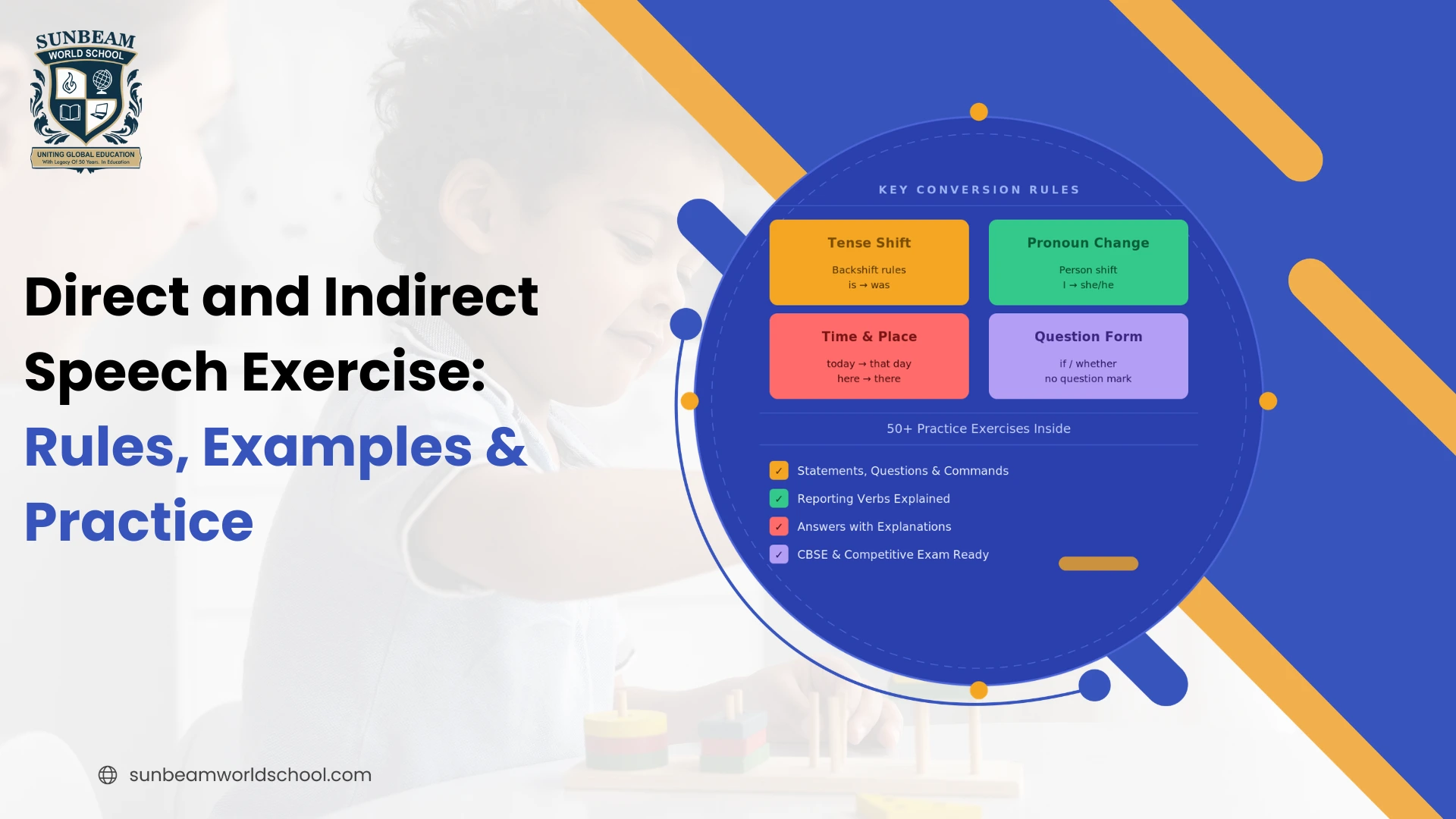
The four main rules for changing direct speech to indirect speech are: (1) shift the verb tense one step back when the reporting verb is past, (2) change pronouns to match the reporter, (3) update time and place words like "today" to "that day" and "here" to "there," and (4) change modal verbs (can to could, will to would, may to might).
1. Change of Verb Tense (most important)
If the reporting verb is in the past (said, told, asked), the tense of the reported clause shifts one step back.
| Direct Speech Tense | Indirect Speech Tense |
| Simple Present (I work) | Simple Past (he worked) |
| Present Continuous (I am working) | Past Continuous (he was working) |
| Present Perfect (I have worked) | Past Perfect (he had worked) |
| Simple Past (I worked) | Past Perfect (he had worked) |
| Past Continuous (I was working) | Past Perfect Continuous (he had been working) |
| Present Perfect Continuous (I have been working) | Past Perfect Continuous (he had been working) |
| Simple Future (I will work) | Conditional (he would work) |
| Future Continuous (I will be working) | Conditional Continuous (he would be working) |
| Future Perfect (I will have worked) | Conditional Perfect (he would have worked) |
Important exception: The tense does not change for universal truths, scientific facts, or habitual actions. Example: The teacher said that the sun rises in the east.
2. Change of Pronouns
Pronouns adjust to match the new speaker and listener. The simple rule: pronouns of the subject change as per the speaker, pronouns of the object change as per the listener, and third-person pronouns stay the same.
Example: Ravi said to Meera, “I will help you.” → Ravi told Meera that he would help her.
3. Change of Time and Place Words
| Direct Speech | Indirect Speech |
| now | then |
| today | that day |
| tomorrow | the next day / the following day |
| yesterday | the previous day / the day before |
| this | that |
| these | those |
| here | there |
| ago | before |
4. Change of Modal Verbs
can → could
may → might
will → would
shall → should
must → had to
could, would, should, might, ought to → no change
Direct And Indirect Speech Rules for Different Types of Sentences
Every sentence you convert falls into one of these types. Each follows the rules above but uses a different reporting verb and auxiliary verbs.
a) Statements (Assertive or Declarative Sentences)
Use the conjunction that after the reporting verb. The word that can sometimes be dropped in spoken English. Declarative sentences are the most common type tested in direct and indirect speech exercises.
Direct — She said, “I am learning English.”
Indirect — She said that she was learning English.
b) Yes/No Questions (Interrogative Sentences)
Replace said with asked or enquired. Use if or whether as the linker. Drop the question mark and use statement word order. Interrogative-sentence questions are very common in Class 8, 9 and 10 papers.
Direct — She asked, “Do you like pizza?”
Indirect — She asked if I liked pizza.
c) Wh-Questions (Interrogative Sentences)
Keep the wh-word (what, where, when, why, how, who) as the linker. No question mark, statement order.
Direct — He asked, “Where are you going?”
Indirect — He asked where I was going.
d) Commands, Requests and Advice (Imperative Sentences)
Use a reporting verb that matches the tone — ordered, told, requested, advised, urged — followed by an object and a to-infinitive. Negative commands use not to + verb.
Direct — The teacher said, “Finish your homework.”
Indirect — The teacher told us to finish our homework.
Direct — Mother said, “Do not waste food.”
Indirect — Mother told me not to waste food.
e) Exclamations (Exclamatory Sentences)
Use reporting verbs like exclaimed with joy, exclaimed with sorrow, exclaimed with surprise or wished. Convert the exclamation into a statement.
Direct — She said, “Wow! What a beautiful view!”
Indirect — She exclaimed with joy that the view was very beautiful.
How Do You Choose the Right Reporting Verb in Indirect Speech?
The reporting verb is the word that introduces the indirect speech, and choosing the correct one can be the difference between full marks and lost marks in an exam. A reporting verb does more than just signal that someone spoke. It tells the reader whether the speaker was giving an order, making a polite request, offering advice, or expressing surprise. Using "said" for everything is grammatically acceptable but loses meaning, and examiners expect students to pick the verb that best matches the speaker's tone and intention.
Here is a complete list of reporting verbs organized by sentence type, with guidance on when to use each one.
Reporting Verbs for Statements
| Reporting Verb | When to Use It | Example |
|---|---|---|
| said | General use. Works for any statement. The safest choice when you are unsure. | She said that she was tired. |
| told | When the listener is mentioned. Always followed by an object (told me, told him, told the class). | He told me that the shop was closed. |
| mentioned | When the speaker brought up a topic casually, not as the main point of conversation. | She mentioned that her brother was visiting. |
| stated | When the speaker made a formal or official declaration. Common in news reports and legal writing. | The minister stated that new guidelines would be issued. |
| declared | When the speaker announced something with authority or strong conviction. | The captain declared that the team was ready. |
| informed | When the speaker gave specific information to someone. Slightly more formal than "told." | The principal informed the parents that the exam dates had changed. |
| explained | When the speaker gave a reason or made something clearer. | The teacher explained that fractions work like division. |
| remarked | When the speaker made a casual or passing comment, often an observation. | He remarked that the weather had been unusually cold. |
| admitted | When the speaker confessed something they had been reluctant to share. | She admitted that she had forgotten to submit the assignment. |
| denied | When the speaker rejected a claim or said something was not true. | He denied that he had broken the window. |
| claimed | When the speaker stated something that may or may not be true. Often used in news reports. | The company claimed that its product was the safest on the market. |
| promised | When the speaker gave an assurance about the future. | She promised that she would return the book by Monday. |
| agreed | When the speaker expressed consent or accepted a suggestion. | They agreed that the plan needed more work. |
| added | When the speaker contributed extra information after an earlier statement. | He added that the meeting had been rescheduled to Friday. |
Reporting Verbs for Questions
| Reporting Verb | When to Use It | Example |
|---|---|---|
| asked | General use for all questions. The safest and most common choice. | She asked if I had finished my homework. |
| enquired / inquired | Slightly more formal than "asked." Used for polite or official questions. | The officer enquired whether I had a valid ticket. |
| wanted to know | When the speaker was curious or eager for information. Slightly informal. | He wanted to know why the class had been cancelled. |
| wondered | When the speaker was thinking aloud or expressing mild curiosity, not necessarily expecting an immediate answer. | She wondered whether the library would be open on Saturday. |
| demanded | When the speaker asked forcefully, with authority or impatience. | The customer demanded to know why the delivery was late. |
| questioned | When the speaker asked in a challenging or investigative way. | The lawyer questioned whether the witness was telling the truth. |
Reporting Verbs for Commands and Orders
| Reporting Verb | When to Use It | Example |
|---|---|---|
| told | General use. Works for most commands. Always followed by object + to-infinitive. | The teacher told the students to open their textbooks. |
| ordered | When the speaker had authority and expected obedience. Stronger than "told." | The captain ordered the soldiers to stand at attention. |
| commanded | Very strong authority. Usually military, police, or situations of absolute power. | The king commanded the guards to close the gates. |
| instructed | When the speaker gave clear, step-by-step directions. Common in professional and educational contexts. | The examiner instructed the candidates to write only in blue ink. |
| directed | When the speaker guided someone toward a specific action. Formal. | The judge directed the jury to disregard the last statement. |
| forbade | When the speaker prohibited something. The past form of "forbid." | The doctor forbade him to eat sweets. |
Reporting Verbs for Requests
| Reporting Verb | When to Use It | Example |
|---|---|---|
| requested | Polite and formal. The standard choice for requests in exam answers. | She requested me to close the door. |
| begged | When the speaker was pleading desperately or emotionally. | The boy begged his mother to let him go to the party. |
| urged | When the speaker strongly encouraged someone to do something important. | The teacher urged the students to revise before the exam. |
| pleaded | Similar to "begged" but slightly more formal. Often used in serious or legal contexts. | The accused pleaded with the judge to reduce the sentence. |
| implored | Very strong emotional appeal. Formal and literary. | She implored her friend not to leave. |
Reporting Verbs for Advice
| Reporting Verb | When to Use It | Example |
|---|---|---|
| advised | General use for giving guidance. The standard exam-safe choice. | The doctor advised him to take rest for a week. |
| suggested | When the speaker offered an idea or option rather than a firm instruction. | She suggested that we take the shorter route. |
| recommended | When the speaker endorsed a specific course of action based on experience or knowledge. | The librarian recommended that I read the original edition. |
| warned | When the speaker alerted someone about a danger or negative consequence. | The guard warned the children not to go near the edge. |
| cautioned | Similar to "warned" but slightly less urgent. Often used for general care. | The teacher cautioned the students against copying from the internet. |
| reminded | When the speaker brought up something the listener already knew but might have forgotten. | Mother reminded me to carry my umbrella. |
Reporting Verbs for Exclamations
| Reporting Verb | When to Use It | Example |
|---|---|---|
| exclaimed with joy | When the speaker expressed happiness or excitement. | She exclaimed with joy that they had won the competition. |
| exclaimed with sorrow | When the speaker expressed sadness or grief. | He exclaimed with sorrow that his pet had passed away. |
| exclaimed with surprise | When the speaker expressed shock or disbelief. | They exclaimed with surprise that the results were already out. |
| wished | When the speaker expressed a desire or hope for someone. | She wished that he would recover soon. |
| cried out | When the speaker shouted or spoke with strong emotion. | He cried out that the building was on fire. |
| applauded / praised | When the speaker expressed admiration. | The coach praised the team, saying that their performance had been outstanding. |
Quick-Reference Summary Table
For quick revision before an exam, use this single table:
| Sentence Type | Default Verb (Safe Choice) | Stronger Alternatives |
|---|---|---|
| Statements | said, told | mentioned, stated, declared, informed, explained, remarked, admitted, denied, claimed, promised, agreed, added |
| Questions | asked | enquired, wanted to know, wondered, demanded, questioned |
| Commands | told (+ object + to) | ordered, commanded, instructed, directed, forbade |
| Requests | requested | begged, urged, pleaded, implored |
| Advice | advised | suggested, recommended, warned, cautioned, reminded |
| Exclamations | exclaimed with joy/sorrow/surprise | wished, cried out, applauded, praised |
How to Pick the Right Verb in an Exam
When you are converting direct speech to indirect speech in a board exam or competitive exam, follow this 3-step process:
Step 1: Identify the sentence type. Is the speaker making a statement, asking a question, giving a command, making a request, offering advice, or expressing strong emotion? The sentence type narrows your options immediately.
Step 2: Read the tone. Is the speaker being polite, forceful, desperate, casual, or formal? The tone tells you which specific verb to pick from the list. "Please help me" is a request (use "requested" or "begged"), not a command (do not use "ordered").
Step 3: When in doubt, use the default. If you cannot decide between "warned" and "cautioned," or between "told" and "instructed," use the default verb for that sentence type ("said" for statements, "asked" for questions, "told" for commands, "requested" for requests, "advised" for advice, "exclaimed" for exclamations). The default verb is never wrong. A more specific verb earns slightly better marks if correct, but a wrong specific verb loses marks.
Common exam trap: Students sometimes use "said" for commands ("She said to close the door"). While not grammatically wrong in casual English, examiners expect "told" + object + to-infinitive for commands ("She told me to close the door"). Using "said" for a command in a board exam answer will cost you marks even though native speakers do it in conversation.
Common Mistakes to Avoid In Reported Speech
The most common mistakes students make in reported speech are forgetting the tense shift, changing pronouns incorrectly, keeping quotation marks or question marks in the indirect form, using 'that' after 'asked' in reported questions, not updating time and place words, and backshifting universal truths that should stay in present tense. Here are six errors that cost the most marks in exams, with the correct form shown for each.
- Forgetting the tense shift. Writing He said that he is busy instead of He said that he was busy. If the reporting verb is past, the inner clause must shift too.
- Wrong pronoun changes. Always identify the speaker and the listener first, then adjust the pronouns accordingly.
- Keeping “that” in reported questions. After asked, never use that. Use if, whether or the wh-word.
- Leaving the question mark. The reported question is no longer a direct question, so the sentence ends with a full stop.
- Not updating time and place words. Words like today, tomorrow, yesterday, here, now must change to that day, the next day, the previous day, there, then.
- Backshifting a universal truth. The sun rises in the east never becomes rose in the east. Scientific and habitual truths stay in the present tense.
Direct Indirect Speech Exercises
The best way to master direct and indirect speech is to practice converting sentences yourself before checking the answer key. The 50+ exercises below cover all sentence types (statements, questions, commands, requests, and exclamations), both directions of conversion (direct to indirect and indirect to direct), and include dedicated sets for Class 9, Class 10, and MCQ format. They are aligned with CBSE, ICSE, and competitive exam patterns.
̌Exercise 1: Basic Practice
Convert each sentence from direct to indirect speech.
- She said, “I am going to the market.”
- He said, “I will call you tomorrow.”
- They said, “We are watching a movie.”
- Rahul said, “I have finished my homework.”
- The boy said, “I cannot solve this sum.”
- Mother said, “I cooked your favourite dish.”
- He said, “I bought this bag yesterday.”
- She said, “I will meet you here tomorrow.”
- The teacher said, “Honesty is the best policy.”
- Karan said, “I am feeling much better today.”
Answer Key — Exercise 1
- She said that she was going to the market.
- He said that he would call me the next day.
- They said that they were watching a movie.
- Rahul said that he had finished his homework.
- The boy said that he could not solve that sum.
- Mother said that she had cooked my favourite dish.
- He said that he had bought that bag the previous day.
- She said that she would meet me there the next day.
- The teacher said that honesty is the best policy. (universal truth — no shift)
- Karan said that he was feeling much better that day.
Exercise 2: Mixed Sentence Types
This set mixes statements, questions, commands and exclamations.
- He said to me, “Are you coming with us?”
- The teacher said, “Where is your notebook?”
- Mother said to me, “Wash your hands.”
- The doctor said to him, “Do not eat oily food.”
- He said, “Hurrah! We have won the match.”
- She said, “Alas! I have lost my purse.”
- He said to her, “Please help me with this work.”
- The boy said, “Why are you laughing?”
- The principal said to the students, “Be on time.”
- She said, “I have been waiting for two hours.”
Answer Key — Exercise 2
- He asked me if I was coming with them.
- The teacher asked where my notebook was.
- Mother told me to wash my hands.
- The doctor advised him not to eat oily food.
- He exclaimed with joy that they had won the match.
- She exclaimed with sorrow that she had lost her purse.
- He requested her to help him with that work.
- The boy asked why I was laughing.
- The principal told the students to be on time.
- She said that she had been waiting for two hours.
Exercise 3: Indirect to Direct Speech
Now reverse the process. Convert each indirect sentence back into direct speech.
- He said that he was watching a film.
- She told me that she had bought a new dress the previous day.
- The teacher asked the boy where he had been.
- Mother told me to wash my hands before eating.
- He exclaimed with joy that he had got the first prize.
Answer Key — Exercise 3
- He said, “I am watching a film.”
- She said to me, “I bought a new dress yesterday.”
- The teacher said to the boy, “Where have you been?”
- Mother said to me, “Wash your hands before eating.”
- He said, “Hurrah! I have got the first prize.”
Tips to Master Reported Speech
- Spot the reporting verb first. If it is in the past, expect a tense backshift; if it is in the present or future, almost nothing changes.
- Underline pronouns and time words in the direct sentence so you do not skip any change.
- Match the reporting verb to the sentence type — said/told for statements, asked for questions, ordered/told for commands, requested for requests, advised for advice, exclaimed for exclamations.
- Practice mixed sets daily. Five sentences a day for two weeks is enough to make the rules automatic before your exam.
Conclusion
Direct and indirect speech is a fundamental part of English grammar that become easier with regular practice and a clear understanding of the rules. By learning how to change tenses, pronouns, reporting verbs, and time expressions correctly, you can confidently transform statements, questions, commands, and exclamations from one form to another.
Practice direct and indirect exercises in this guide to communicate effectively in both spoken and written English. Remember, consistent practice is the key to mastering reported speech.
For students looking to build strong English language skills alongside academic excellence, Sunbeam World School provides a supportive learning environment that emphasizes grammar, communication, critical thinking, and overall language development.

Frequently Asked Questions
What is direct and indirect speech?
-Direct speech reports the speaker’s exact words inside quotation marks, while indirect speech (also called reported speech) restates the meaning in the reporter’s own words without quotation marks and usually with a backshifted tense.
What are the main rules for changing direct to indirect speech?
+Does the tense always change in indirect speech?
+How do you convert a yes-or-no question into indirect speech?
+How do commands and requests change in indirect speech?
+Do modal verbs change in reported speech?
+What are common time word changes in indirect speech?
+What is the difference between reported speech and indirect speech?
+Which class studies direct and indirect speech?
+How do exclamatory sentences change in indirect speech?
+What is the best way to practice direct and indirect speech?
+Can the word “that” be dropped in indirect speech?
+What is narration change in English grammar?
+
In this article
Share this post:


Press and Blogs
Stay updated with our press releases, educational blogs, and more.

Quick Summary Animal sounds are the noises animals make to communicate, warn of danger and...

Quick Summary The area of rectangle equals its length multiplied by its width (A =...

Quick Summary Sympathy means feeling sorry for someone from your own point of view. Empathy...