 CBSE
Prepositions In, On, At: Rules, Difference and Examples
Quick Summary Use in for enclosed spaces and long periods of time, on for surfaces and specific days or dates, and at for exact points and exact times. The easiest way to remember the three is to move from biggest to smallest: in India, on Lanka Road, at the school gate, and in 2026, on 5 March, at 7 o'clock.
What Is a Preposition?
A preposition is a word placed before a noun or pronoun to show its relationship with the rest of the sentence, telling you where something is, when it happens or which way it moves.
Definition Preposition: a word used before a noun or pronoun to show a relationship of place, time or direction. In the sentence "the book is on the table", the preposition on links the book to the table by telling you where the book is.
English has dozens of prepositions, and they fall into three main groups. Prepositions of place tell you where something is, as in in the bag, on the shelf and under the bench. Prepositions of time tell you when something happens, as in at 7 o'clock, on Monday and before lunch. Prepositions of direction tell you which way something moves, as in to school, into the room and across the road.
What Are the Prepositions In, On and At?
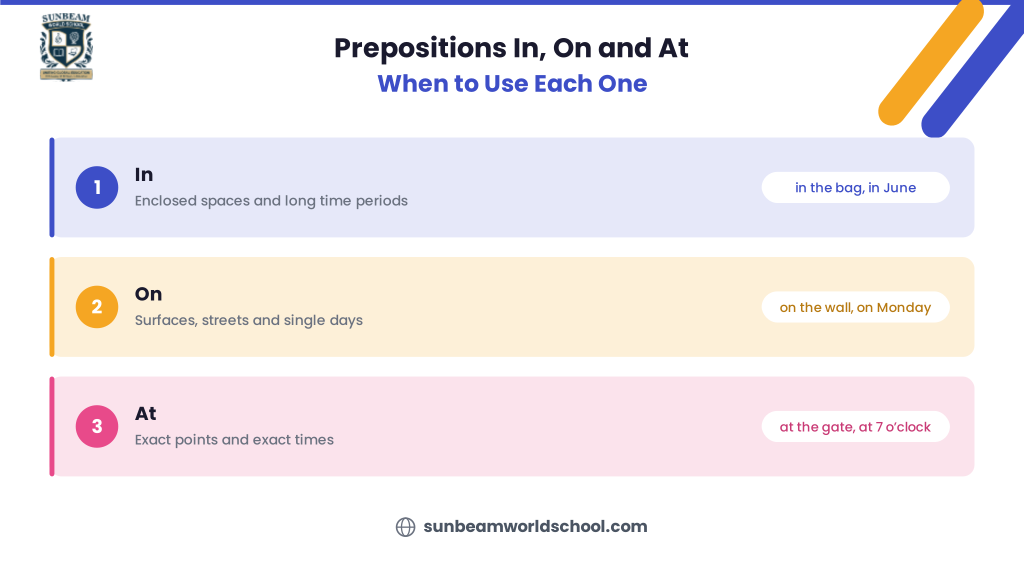
In, on and at run from the widest space down to the smallest point, and the same order works for time.
In, on and at are the three most used prepositions in English, and also the three most confused, because each of them belongs to two groups at once. Most students find them easier once they treat the whole thing as one question about the difference between at, in and on rather than as three separate rules to learn.
All three work as prepositions of place, telling you where something is, and all three work as prepositions of time, telling you when something happens. A student who has learnt that "at" means an exact spot can still get stuck when the same word turns up before a clock time, and that overlap is what this guide clears up.
Prepositions of time and place are introduced in CBSE English between Class 3 and Class 6, and they keep appearing in grammar sections right through middle school, much like synonyms and antonyms do. Getting the three sorted early saves a lot of silent corrections later.
How Do You Know When to Use In, On or At?
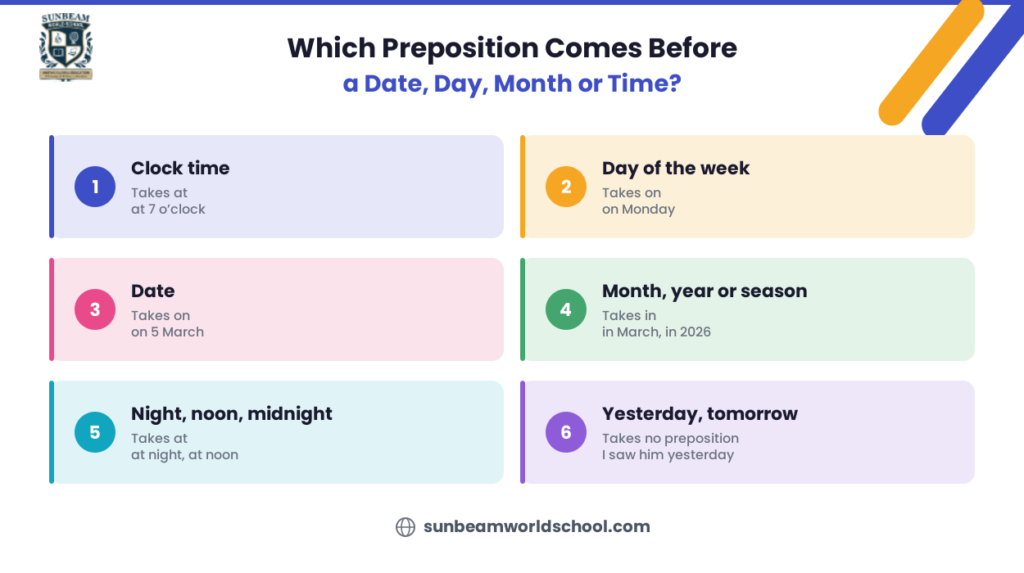
A quick lookup for every kind of time expression, including the ones that take no preposition at all.
Choose your preposition by size: in for the biggest space or the longest stretch of time, on for something in between, and at for the smallest, most exact point. This single rule settles most sentences correctly.
Picture it as a funnel. You live in a country, on a street inside that country, and at a house number on that street. The same funnel works for time, since you were born in a year, on a date inside that year, and the ceremony started at an exact hour on that date. A quick way to hold it in your head is that at is a point, on is a surface or a line, and in is a box or an area.
| In | On | At | |
|---|---|---|---|
| Place | enclosed space or large area | surface, line or street | exact point or address |
| Example (place) | in the classroom | on the wall | at the gate |
| Time | long period | a day or date | an exact time |
| Example (time) | in June | on Monday | at 8 o'clock |
What Is the Use of In?
Use in for anything inside an enclosed space or within a large area, and for long stretches of time such as months, years, seasons and centuries.
In for Places: Rooms, Cities and Countries
In works whenever something sits inside a boundary, whether that boundary is small or very large. Rooms, bags, boxes and buildings all take in, and so do cities, states, countries and continents, since you are inside their limits even though you cannot see the walls.
It is also the right choice for water and open land, which is why we say in the river, in the sea, in the mountains and in the countryside. Cars and taxis take in as well, because you are enclosed inside them, and that one detail is the source of a very common mistake we will come back to later.
In for Time: Months, Years and Seasons
In covers long periods of time, which means months, years, decades, centuries and seasons. It also covers the parts of a day, so we say in the morning, in the afternoon and in the evening.
The same preposition handles stretches of time ahead of you or behind you, as in "the bus leaves in ten minutes", "in the past" or "in the last few weeks". If the time you are describing has length rather than a single sharp moment, in is almost always correct.
Example Sentences with In
Each of these ten examples of the in preposition puts the rule to work, moving from small spaces to wide areas and then on to time.
- The textbooks are in my bag.
- She is waiting in the classroom.
- My cousin lives in Varanasi.
- We stayed in a hotel near the ghats.
- The children are swimming in the river.
- Our annual day falls in December.
- The school was founded in 1972.
- It gets very hot here in summer.
- I finish my homework in the evening.
- Please be ready, the van arrives in five minutes.
Reading a set of sentences aloud fixes a preposition faster than memorising a rule, which is why a bank of simple English sentences for kids is such a useful thing to keep at hand.
Meaning of In in Hindi
In का अर्थ है में या के अंदर, और in ka use किसी चीज़ के अंदर होने या किसी लंबे समय के लिए होता है. In se sentence बनाने के लिए ऊपर दिए गए दस उदाहरण देखें. For example, "The pen is in the box" means "पेन डिब्बे में है", and "in January" means "जनवरी में".
What Is the Use of On?
Use on for anything touching or resting on a surface, and for specific days and dates.
On for Places: Surfaces, Streets and Transport
On describes contact with a surface, so books sit on a table, pictures hang on a wall, and a child sits on the floor. Floors of a building follow the same logic, which gives us "our classroom is on the second floor".
Lines and long thin places also take on, covering streets, rivers, coasts, borders and islands, as in "the school is on Lanka Road" or "Varanasi is on the Ganga". Public transport is the one that catches people out, since buses, trains and planes take on because you walk about on their floor, while a car or taxi takes in. We also use on for screens and pages, as in on the board, on the internet and on page 42.
On for Time: Days, Dates and Festivals
On marks a single day, so it goes before days of the week, calendar dates, birthdays and named days. We say on Monday, on 5 March, on my birthday and on Republic Day.
When you name a day and then narrow it down to a part of that day, on still leads, which is why we say on Monday morning rather than in Monday morning. The day is doing the main work in that phrase, so it keeps its own preposition.
Example Sentences with On
Every sentence for on below follows one of the two rules above, half of them about place and half about time, so you can hear the pattern rather than memorise it.
- The chalk is on the table.
- There are charts on the classroom wall.
- Our library is on the first floor.
- She left her water bottle on the bus.
- The bookshop is on Lanka Road.
- The test is on Monday.
- His birthday falls on 14 August.
- We get a holiday on Diwali.
- The answers are printed on page 60.
- We will meet on Friday evening.
Meaning of On in Hindi
Preposition use in Hindi is often the fastest way for a younger student to lock the rule in, because the two languages line up neatly here. On का अर्थ है पर या के ऊपर, और इसका प्रयोग किसी सतह पर रखी चीज़ के लिए होता है. For example, "The book is on the table" means "किताब मेज़ पर है", and "on Monday" means "सोमवार को".
What Is the Use of At?
Use at for an exact point in a place and an exact point in time, which makes it the sharpest and narrowest of the three prepositions. Knowing when to use at is the easiest of the three to settle, because at is used for a single spot or a single moment and never for anything wider.
At for Places: Exact Points, Addresses and Events
Where to use at for a place comes down to a single test, since at marks a precise spot rather than an area, which is why we wait at the gate, stand at the bus stop, sit at a desk and meet at the corner. Full addresses take at too, as in "they live at 15 Lanka Road".
At also goes before events, which is why we say at a party, at a wedding and at a concert, since the event is treated as a single point you are present at. The third group is places defined by the activity that happens there, giving us at school, at work and at home. In these phrases, the words point at what the person is doing rather than at a building, so "she is at school" tells you she is studying, not simply that she is standing inside a particular structure.
At for Time: Clock Times, Night and Festivals
At is the preposition for clock times, so we say at 7 o'clock, at 9.30 and at 4 p.m. It also covers the sharp moments of a day such as at noon, at midnight, at dawn and at dusk.
Mealtimes take at as well, as in at breakfast and at lunchtime, and so does the word night, which is worth noting because the other parts of the day take in. We say in the morning but at night. Festivals treated as a short season also take at, giving us at Diwali, at Holi and at Christmas. One difference worth knowing is that British English says at the weekend while American English says on the weekend, and both are correct in their own regions.
At Sentence Examples: Use of At in a Sentence
The use of at in English becomes clear once you read a run of sentences together, so here are twelve examples of the at preposition covering both place and time.
- I will wait for you at the school gate.
- The bus stops at the crossing near our house.
- She is sitting at her desk.
- They live at 15 Lanka Road.
- We met his parents at a wedding.
- My brother is at school right now.
- My mother is at work till five.
- The assembly begins at 8 o'clock.
- The train leaves at 9.45.
- We eat together at lunchtime.
- The streets are quiet at night.
- The whole family comes home at Diwali.
Meaning of At in Hindi
At का अर्थ है पर, और at ka prayog किसी निश्चित जगह या निश्चित समय के लिए होता है. For example, "at the gate" means "गेट पर", and "at 5 o'clock" means "5 बजे". Seeing the same idea in both languages helps, which is why practising with simple English to Hindi sentences makes prepositions click for many students.
What Is the Difference Between In and On?
In means inside something, while on means touching its surface. For time, in covers long periods such as months and years, while on marks a single day or date. Knowing when to use in and on comes down to a single question, which is whether the thing sits inside or rests on top. That one question settles it whether you are describing a place or a time, so once the on and in difference clicks for one of them, it clicks for both.
The clearest way to settle when to use in or on is to put the two side by side in the same sentence shape. There is a difference between the pen being in the box, which means inside it, and on the box, which means resting on its lid. The in and on difference runs through the time rules in the same way, since "in June" is the whole month while "on 5 June" is one day inside it, and "in the morning" is a stretch of hours while "on Monday morning" is tied to a named day.
| In | On |
|---|---|
| in the box (inside) | on the box (on top) |
| in the car | on the bus |
| in June | on 5 June |
| in the morning | on Monday morning |
| in the wall (built inside) | on the wall (hanging) |
What Is the Difference Between In and At?
In treats a place as an area you are inside, while at treats the same place as a single point on a map. In and at usage overlaps more than any other pair here, because the in and at difference is rarely about which word is correct, since both often are, and much more about which picture of the place you want to give your listener.
In or At for a Place: Cities, Buildings and Exact Points
People often ask whether to use in or at for a place, and the answer depends on whether you mean an area or a point. Move up the ladder from exact point to wide area and the choice makes itself. You live at 15 Lanka Road, in Varanasi, in Uttar Pradesh and in India, because the house number is a point while the city, state and country are all areas with you somewhere inside them.
The school pair is the most useful one to learn, since "she is at school" means she is attending school as a student, while "she is in the school" means she is physically inside the building, perhaps as a visitor. Stations work the same way, because "I am at the station" suggests a point on a journey with a train still to catch, while "I am in the station" puts you inside the building, sheltering from the rain. Neither sentence is wrong, so the question to ask yourself is whether you mean a point or a space.
What Is the Difference Between On and At?
On is for a surface or a whole day, while at is for an exact point or an exact time. The on and at difference is one of width, because on is the broader of the two in both its place and its time uses.
The pairs below show how much the meaning shifts with the preposition. Sitting on the table means sitting on its surface, while sitting at the table means sitting in a chair beside it, ready to eat. In the same way, "on Monday" gives the whole day while "at 9 o'clock" gives one moment, and "on the corner" describes a shop occupying that corner while "at the corner" is where you stand waiting.
| On | At |
|---|---|
| on the table (surface) | at the table (seated beside it) |
| on Monday (whole day) | at 9 o'clock (exact moment) |
| on the corner (located there) | at the corner (standing there) |
| on the weekend (American English) | at the weekend (British English) |
Which Preposition Comes Before a Date, Day, Month or Time?
Use on before a day or a date, in before a month, year or season, and at before a clock time. If you are stuck on whether to use in or on before a date, pick on, and if you are weighing at or on for time, pick at for clock times. A month always takes in, never on.
The table below answers every version of this question in one place.
| Time expression | Preposition | Example |
|---|---|---|
| Clock time | at | at 7 o'clock |
| Day of the week | on | on Monday |
| Date | on | on 5 March |
| Month | in | in March |
| Year | in | in 2026 |
| Season | in | in summer |
| Part of the day | in | in the morning |
| Night, noon, midnight | at | at night |
| Festival | at | at Diwali |
| Weekend | at (British), on (American) | at the weekend |
| Deadline phrase | on or before | on or before Friday |
| Yesterday, today, tomorrow | none | I saw him yesterday |
Two rows deserve a second look. The last row catches almost everybody, because words like yesterday, today, tomorrow, next week and last month take no preposition at all, so "I met her yesterday" is correct and "on yesterday" is not. The deadline row is different again, since "on or before" is a fixed phrase used in notices and forms, as in "submit the form on or before Friday", and it should be learnt whole rather than broken into parts. If dates and months still feel slippery, running through the 12 months name in English alongside the in rule makes the pattern stick.
What Are the Exceptions and Fixed Phrases with In, On and At?
Some phrases ignore the rules completely and simply have to be learnt as fixed expressions, because usage settled them long before the rules were written down.
At night, but in the morning. Every other part of the day takes in, and night is the lone exception.
On the bus, train and plane, but in the car and taxi. The large vehicles take on because you can stand and walk inside them, while a car encloses you, so it takes in.
In bed, at home, at work, at school. These drop the word "the" and are used as set phrases, so we say "she is in bed" rather than "in the bed" unless we mean the piece of furniture itself.
In time versus on time. These two look similar but mean different things, since arriving in time means arriving with minutes to spare before something starts, while arriving on time means arriving exactly at the appointed hour. A student who reaches class at 8.55 for a 9 o'clock period is in time, and one who walks in as the bell rings is on time.
In the street versus on the street. British English leans towards in the street, American English towards on the street, and both are understood everywhere.
What Are the Common Mistakes Students Make with In, On and At?
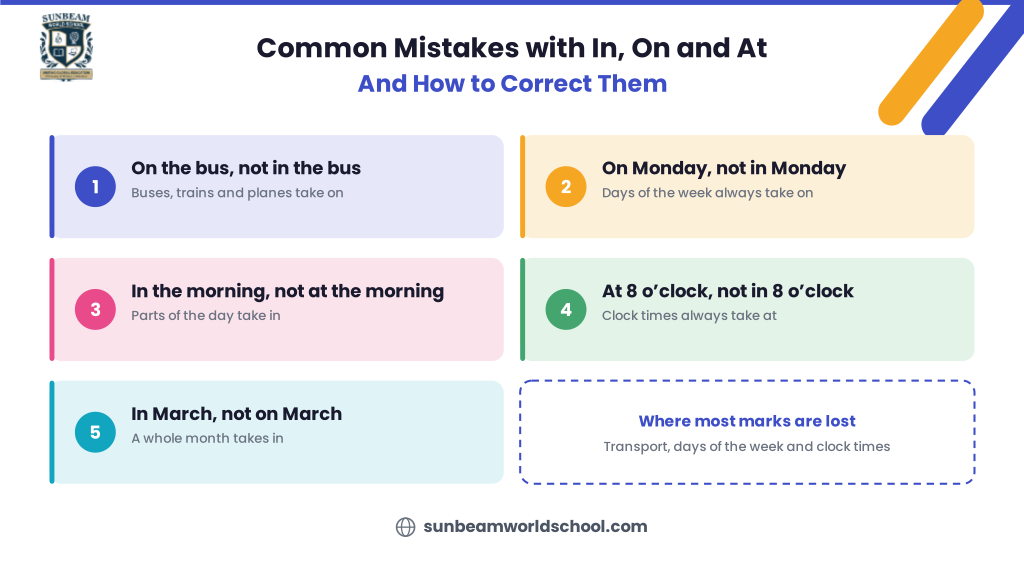
Five errors that turn up most often in classwork, each with the correction and the rule behind it.
The most common mistake is using in where on or at belongs, especially with public transport, days of the week and clock times. The corrections below cover the errors that show up most often in classwork.
"I came in the bus" should be "I came on the bus." Buses, trains and planes take on, while only cars and taxis take in.
"The test is in Monday" should be "The test is on Monday." Days of the week always take on.
"I study at the morning" should be "I study in the morning." Parts of the day take in, and night is the only exception.
"School starts in 8 o'clock" should be "School starts at 8 o'clock." Clock times take at, without exception.
"My birthday is on March" should be "My birthday is in March." A whole month takes in, while a date inside it takes on.
"Our class is in the second floor" should be "Our class is on the second floor." Floors are treated as surfaces, so they take on.
"We discussed about the chapter" should be "We discussed the chapter." Some verbs take no preposition at all, and discuss is one of them.
Pairs of words that sound close but behave differently are worth studying together rather than separately, which is the same reason to vs too vs two trips up so many students until they see the three side by side.
In, On, At Fill in the Blanks Exercise with Answers
Work through the five exercises below and check your answers at the end of each set. Together they cover place, time, fixed phrases and the mistakes that cost the most marks in class tests.
Exercise 1: Fill in the Blanks with In, On or At (Place)
- The keys are ______ the drawer.
- My grandparents live ______ Lucknow.
- Please wait for me ______ the main gate.
- There is a map ______ the classroom wall.
- She left her umbrella ______ the train.
- The bookshop is ______ Lanka Road.
- We met her parents ______ a wedding.
- The fish are swimming ______ the pond.
- Our classroom is ______ the third floor.
- He is sitting ______ his desk.
- They have been living ______ India for ten years.
- I read about the festival ______ the internet.
Answers: 1. in, 2. in, 3. at, 4. on, 5. on, 6. on, 7. at, 8. in, 9. on, 10. at, 11. in, 12. on
Exercise 2: Fill in the Blanks with In, On or At (Time)
- The shop opens ______ 9 o'clock.
- We have our sports day ______ 12 January.
- The flowers bloom ______ spring.
- We visit our village ______ Holi.
- He reads the newspaper ______ the morning.
- The school was founded ______ 1972.
- The test is ______ Monday.
- The streets are quiet ______ night.
- My birthday falls ______ 14 August.
- The bus leaves ______ ten minutes.
- We will meet ______ Friday evening.
- Lunch is served ______ noon.
Answers: 1. at, 2. on, 3. in, 4. at, 5. in, 6. in, 7. on, 8. at, 9. on, 10. in, 11. on, 12. at
Exercise 3: Choose the Correct Preposition
- She is waiting (in / on / at) the bus stop.
- I keep my books (in / on / at) the shelf.
- We went to Delhi (in / on / at) December.
- He came to school (in / on / at) the bus.
- The meeting starts (in / on / at) 11 a.m.
- My brother studies (in / on / at) school.
- There is some milk (in / on / at) the fridge.
- The photograph hangs (in / on / at) the wall.
- We get a holiday (in / on / at) Republic Day.
- My sister was born (in / on / at) 2015.
Answers: 1. at, 2. on, 3. in, 4. on, 5. at, 6. at, 7. in, 8. on, 9. on, 10. in
Exercise 4: Correct the Mistake
Each sentence below has one wrong preposition. Rewrite it correctly.
- I came to school in the bus.
- The exam is in Monday.
- We play cricket at Saturday evening.
- School starts in 8 o'clock.
- My birthday is on March.
- Our flat is in the fourth floor.
- I study at the morning.
- He is waiting in the gate.
- We discussed about the lesson.
- I met my cousin on yesterday.
Answers: 1. on the bus, 2. on Monday, 3. on Saturday evening, 4. at 8 o'clock, 5. in March, 6. on the fourth floor, 7. in the morning, 8. at the gate, 9. discussed the lesson, no preposition, 10. met my cousin yesterday, no preposition
Exercise 5: Mixed Practice Paragraph
Fill each numbered blank with in, on or at.
Every morning I wake up (1) ______ six o'clock. I keep my uniform (2) ______ a chair beside my bed and my books (3) ______ my school bag. My school is (4) ______ Lanka Road, so my sister and I travel (5) ______ the bus. Classes begin (6) ______ eight, and our first period (7) ______ Monday is English. (8) ______ the afternoon we play (9) ______ the playground, and our annual day falls (10) ______ December.
Answers: 1. at, 2. on, 3. in, 4. on, 5. on, 6. at, 7. on, 8. In, 9. in, 10. in
A score of forty or more out of fifty-six means the funnel rule has taken hold. Anything lower usually points at one particular group rather than a general weakness, most often public transport, clock times or floors of a building, so go back to that one section instead of starting again from the top.
Conclusion
Understanding the difference between in, on, and at becomes easier with regular practice and the right guidance. As students learn to identify areas, surfaces, and specific points, they can use these prepositions more confidently in everyday communication. At Sunbeam World School, we make grammar learning engaging through interactive lessons, personalised guidance, and practical exercises that help students build strong English language skills.

Frequently Asked Questions
What are prepositions and their types?
-Prepositions are words placed before a noun or pronoun to show a relationship of place, time or direction. The three main types are prepositions of place such as in and under, prepositions of time such as at, and prepositions of direction such as across
What is the difference between in, on and at?
+Is "at" a preposition?
+When do we use "at" in a sentence?
+Do you say "in the car" or "on the car"?
+Do we use in or on before a date?
+Is it "on Monday" or "in Monday"?
+Is it "in 2026" or "on 2026"?
+What is the use of in and on in English grammar?
+What is "in", "on" and "at" in Hindi?
+
In this article
Share this post:


Press and Blogs
Stay updated with our press releases, educational blogs, and more.

Quick Summary CBSE Date Sheet 2027 for Class 10 and Class 12 has not been...

Quick Summary The area of a circle is equal to πr², where r is the...

Quick Summary Common words that start with V include very, visit, voice, value, vase, van,...