
 Kids Learning
To vs Too vs Two: What Is the Difference?
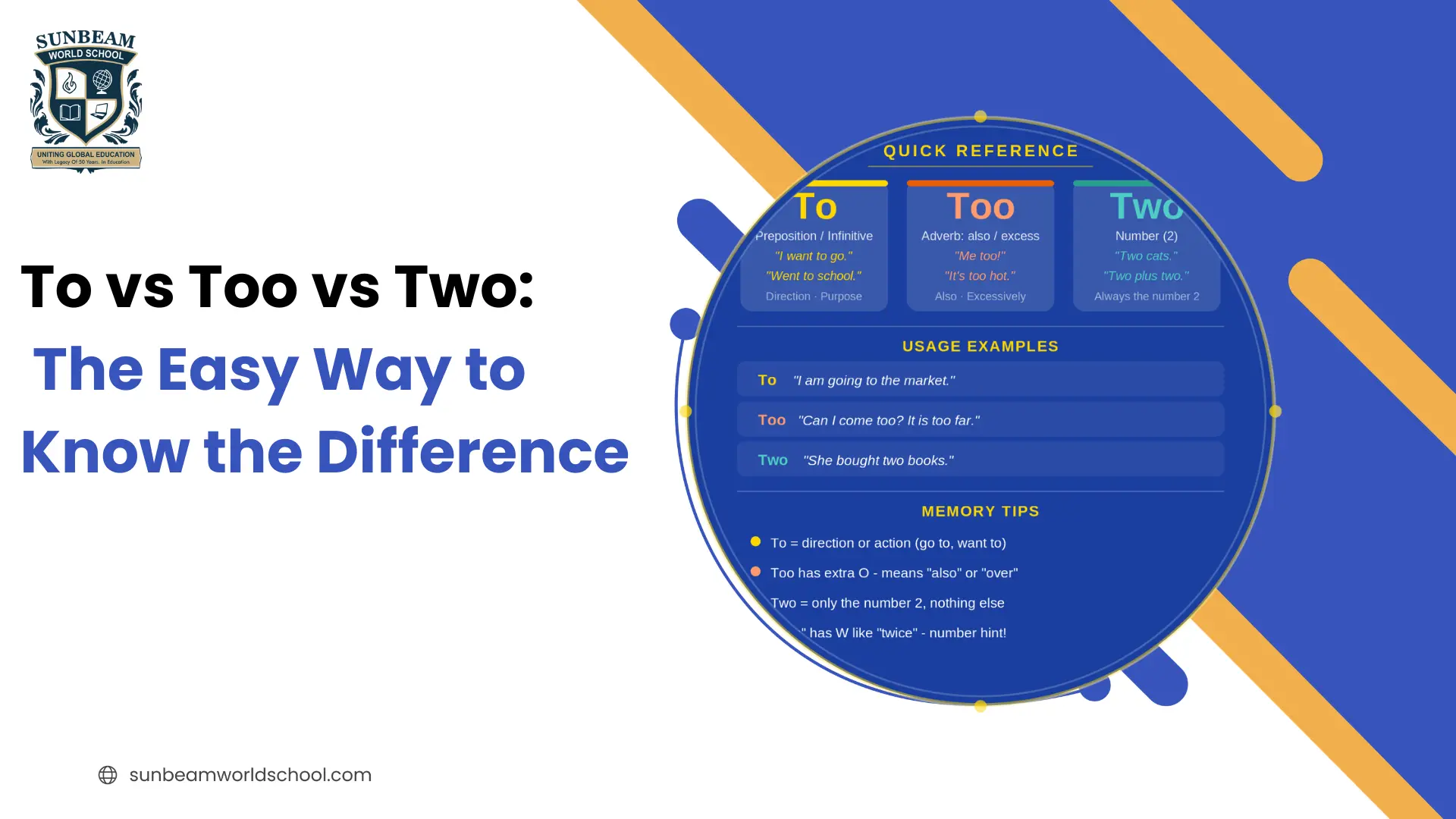
| Quick answer: To is a preposition that shows direction or forms infinitive verbs (I'm going to the market; I want to learn). Too is an adverb meaning "also" or "excessively" (I am tired too; it is too hot). Two is the number 2 (She has two cats). The fastest test: if you can replace the word with "also" or "very" without changing the meaning, write too. If it is the number 2, write two. Otherwise, write to. |
The words to, too, and two sound exactly alike, making them one of the most commonly confused word groups in English. All three are homophones, which means they are pronounced the same way but have completely different meanings and spellings.
To is a preposition or infinitive marker (go to school, want to learn). Too is an adverb meaning "also" or "excessively" (I am hungry too, it is too hot). Two is simply the number 2 (two apples). Learning the difference between to and too, along with two, helps learners improve their writing, speaking, and grammar skills at every level.
In this guide, you will find clear definitions, side-by-side comparisons, example sentences, confusing-phrase corrections, a practice quiz, and simple memory tricks to remember when to use each word. This is also a helpful companion to understanding auxiliary verbs like is, am, are, was, were, which form the backbone of English sentence structure.
What is the difference between ‘to’ and ‘too’?
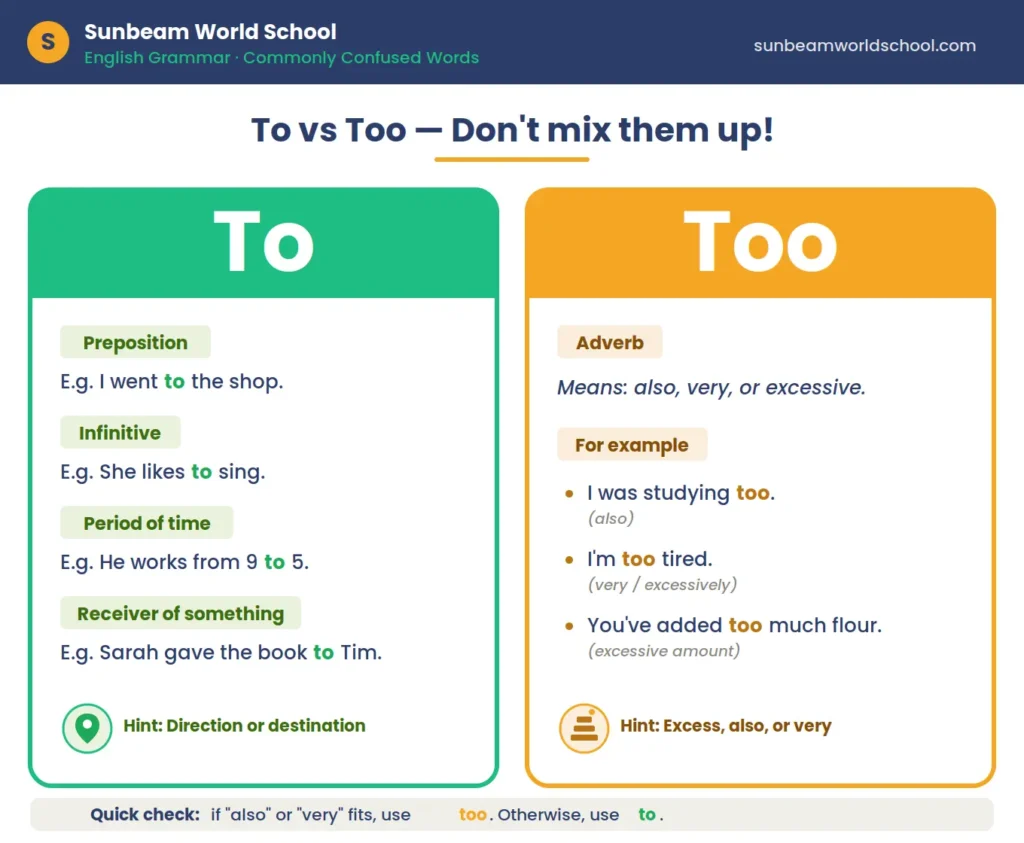
The difference between ‘to’ and ‘too’ is grammatical role. ‘To’ is a preposition or an infinitive marker — it links words and points in a direction (go to school) or sits before a verb (want to sleep). ‘Too’ is an adverb meaning also, as well, or excessively — it adds extra meaning to another word (I am hungry too; this is too spicy).
To vs Too vs Two- Easy Rules for Kids
Because they sound identical, the only way to choose the right one is by meaning, not by sound. Try mentally swapping the word with also or very. If the swap works, you need too. If it doesn’t, you need to.
Definition of “to”
‘To’ is one of the most-used words in English. It has two main grammatical roles:
1. “To” as a preposition
As a preposition, to shows a relationship between two words — usually direction, movement, location, or a recipient. It answers the question where or to whom.
Examples of “to” as a preposition:
|
2. “To” as an infinitive marker
The second job of to is to mark the infinitive form of a verb. The infinitive is the base, dictionary form of a verb — like to run, to eat, to study.
Examples of infinitive “to”:
|
Quick check: If your word is followed by a noun, a pronoun, or a place — or by the base form of a verb — it is almost certainly to, not too.
Definition of “too”
‘Too’ is an adverb. Adverbs modify verbs, adjectives, or other adverbs — they add information about how much, how often, or also. Too has two main meanings:
1. “Too” meaning also / as well
This is the most common everyday use. It signals that something applies to an additional person, thing, or situation.
Examples of “too” meaning also:
|
2. “Too” meaning excessively / more than needed
This use carries a sense of more than is desirable. It usually modifies an adjective or another adverb.
Examples of “too” meaning excessively:
|
To vs Too: Quick Comparison Table
| Feature | To | Too |
| Part of Speech | Preposition or infinitive marker | Adverb |
| Main Meaning | Shows direction, recipient, destination, or purpose (“in order to”) | Means also, as well, or excessively/very |
| Can Be Replaced By | Toward, until, for (depending on context) | Also, as well, very, overly |
| Usually Comes Before | A noun, pronoun, place, or base verb | An adjective, adverb, or at the end of a clause |
| Example | I’m going to the park. | It is too sunny. |
| Hindi Equivalent (Closest) | “को (ko)”, “पर (par)”, “तक (tak)” depending on the sentence | “भी (bhi)” or “बहुत ज़्यादा (bahut zyada)” |
| Question to Ask | Does it show direction, purpose, or connection? | Does it mean also or more than needed? |
| Memory Trick | To has one “o” and often points in one direction. | Too has an extra “o” because it means extra or also. |
When Should You Use To vs Too?
Use "to" when the sentence involves direction, a recipient, or a verb in its base form. Use "too" only when the meaning is "also" or "excessively." Here is a simple decision guide:
Step 1: Does the word mean "also" or "as well"? If yes, write "too." (I want one too. She speaks French too.)
Step 2: Does the word mean "excessively" or "more than needed"? If yes, write "too." (It is too hot. You are walking too fast. This is too expensive.)
Step 3: Is the word followed by a verb in its base form? Then write "to." (I want to eat. She needs to study. He forgot to call.)
Step 4: Is the word showing direction, destination, or a recipient? Then write "to." (Go to school. Give it to her. From Monday to Friday.)
Step 5: Is it the number 2? Then write "two." (Two apples. Two sisters. Two plus two.)
If none of these fit, it is almost always "to."
Is It "To Late" or "Too Late"?
The correct form is "too late." Here, "too" means excessively, as in past the acceptable or ideal time. For example: "We arrived too late for the movie" means we arrived after the movie had already started. "It is too late to change your answer" means the deadline has passed.
The phrase "to late" is not standard English on its own. However, the words "to" and "late" can appear next to each other in rare sentences like "from early morning to late evening," where "to" shows a range and "late" describes the time of evening. In every other case, if you mean "past the right time," the correct spelling is always "too late."
The Easiest Memory Trick to Remember “Too”“Too” has an extra O — and it means “extra.”This single trick removes nearly all confusion: Extra also? → too (I want one too = I want one also) Extra much? → too (It is too hot = It is excessively hot) Plain direction or verb? → to (Walk to the door; I want to sleep) If the word in your sentence is adding something extra — an extra person, an extra amount — spell it with the extra O. |
To, too, and two are homophones, meaning they are pronounced the same way but have completely different meanings and spellings. English has many sets of homophones (there/their/they're, hear/here, write/right), and to/too/two is one of the most commonly confused sets. Practising with similar-sounding word pairs builds stronger spelling and vocabulary skills, which is something explored in more depth in our guide on singular and plural words where regular and irregular patterns often trip up learners in similar ways.
25 Example Sentences Using “To”
Read through these and notice how to always points somewhere (direction, recipient) or sits in front of a verb (infinitive).
- We go to school every weekday.
- She handed her notebook to the teacher.
- Listen to your parents.
- From north to south, the country is huge.
- He is married to a doctor.
- I have been to Goa twice.
- It is a quarter to nine.
- The score is three to one.
- Please reply to my email today.
- This belongs to Aarav.
- I would love to visit Japan.
- She started to cry.
- He forgot to lock the door.
- We are trying to save money.
- It is important to drink water.
- I am ready to leave.
- She refused to answer the question.
- It takes time to learn a new language.
- Allow me to introduce my friend.
- I cannot wait to meet you.
- The teacher asked us to stand up.
- It is dangerous to cross without looking.
- Add sugar to taste.
- He gave the gift to his mother.
- I have decided to join the chess club.
25 Example Sentences Using “Too”
Read these aloud. In every sentence, you can replace too with also or very/excessively without breaking the meaning.
- I want to come too.
- This soup is too salty.
- She is too young to drive.
- That movie was funny too.
- You are walking too slowly.
- It is too early to call her.
- He sings, and he plays guitar too.
- The shoes are too tight.
- I am hungry too.
- That is too much information.
- The bag is too small for all my books.
- She speaks French and Spanish too.
- It is too noisy in here.
- I love chocolate ice cream too.
- The exam was too difficult for most students.
- He is too kind to refuse.
- That joke was funny, but too long.
- My brother got a new bike, and I want one too.
- The water is too cold for swimming.
- She arrived too late for the meeting.
- This shirt is too big — I need a smaller size.
- I have a question too, sir.
- The mountain is too high to climb in one day.
- You worry too much.
- “I love you.” — “I love you too.”
Confusing Phrases: “Love you too”, “Way too”, “Me too” & More
These are the specific pairs that trip people up the most. Here is the correct form for each, with a quick explanation.
| Confusing Pair | Correct Form | Why |
| Love you to or too? | Love you too | You mean “I love you also.” |
| Me to or me too? | Me too | You are agreeing — “me also.” |
| You to or you too? | You too (as a reply) | “Have a great day!” → “You also!” |
| Way to or way too? | Way too (when you mean “excessively”) | “Way too expensive” = excessively expensive. |
| Too easy or to easy? | Too easy | “Too” modifies the adjective “easy.” |
| Too good or to good? | Too good | “Too” modifies the adjective “good.” |
| Too big or to big? | Too big | “Too” modifies the adjective “big.” |
| Happy to or happy too? | Both possible (depends on meaning) | “Happy to help” = infinitive; “happy too” = also happy. |
| Go to or go too? | Both possible | “Go to the shop” (direction); “I want to go too” (also). |
| Have to or have too? | Have to | “Have to” means “must” and is followed by a base verb. |
| Want to or want too? | Want to (most cases) | “Want” takes an infinitive: want to eat, want to go. |
| I had to or I had too? | I had to | “Had to” means “was required/obliged to.” |
| Nice to meet you or nice too meet you? | Nice to meet you | “To” is part of the infinitive phrase to meet. |
| To much or too much? | Too much | “Too” means more than necessary. |
| To many or too many? | Too many | “Too” means an excessive number. |
| To late or too late? | Too late | “Too” modifies the adjective “late.” |
| To far or too far? | Too far | “Too” means excessively far. |
| To bad or too bad? | Too bad | Expression meaning unfortunate or disappointing. |
| To hot or too hot? | Too hot | “Too” means excessively hot. |
| To tired or too tired? | Too tired | “Too” means excessively tired to do something. |
The pattern: if the next word is an adjective (easy, big, hot, late, expensive), you almost always want too. If the next word is a place, person, or base verb, you want to.
What Does "Two" Mean? (To vs Too vs Two)
Two is the cardinal number 2. It is a noun or adjective used for counting. Unlike to and too, two is never a preposition or an adverb. It exists only to represent a quantity of exactly 2.
Definition of “two”
‘Two’ is a cardinal number — it simply means the number 2. It is used for counting and quantity. It is never a preposition, never an adverb — only a number.
Examples of “two”:There are two apples on the table. She has two sisters. I will be back in two minutes. The match ended in a two-all draw. Two plus two equals four. All three in one sentence You can fit all three homophones into a single sentence to see the difference clearly: |
“The two friends went to the park, and their dog came too.”
Two = the number (2 friends)
To = preposition showing direction (toward the park)
Too = adverb meaning “also” (the dog also went)
How Do You Spell the Number 2?
The number 2 is spelled T-W-O in English. This is one of the most common spelling questions because to, too, and two all sound identical. A helpful way to remember: "two" has a W in it, and W looks like two V shapes placed together, just like the number 2 is made of two equal parts. If you are writing about a quantity or counting something, the correct spelling is always "two."
| Learning commonly used English words and their meanings helps children avoid such mistakes. Explore our list of fruits names and vegetable names in English for kids to expand vocabulary and improve language skills. |
Common Mistakes to Avoid
Watch out for these specific errors — they appear in school essays, work emails, and social media posts every day.
- I love you to. → I love you too. (You mean “also.”)
- It is to hot today. → It is too hot today. (You mean “excessively.”)
- She is to young to drive. → She is too young to drive.
- Me to. → Me too.
- I have too go now. → I have to go now. (Infinitive verb — never use too.)
- Going too school. → Going to school. (Direction — never use too.)
- There are too apples. → There are two apples. (You mean the number 2.)
Pro tip: Before you send any important message, scan it for the words to and too. Mentally replace each one with also. If it still makes sense, the correct spelling is too. If it doesn’t, you need to.
Practice Quiz (with Answers)
Fill in the blank with to, too, or two.
- He told me he was going ____ the store.
- There was way ____ much food at the party.
- She collected ____ medals at the Olympics.
- This is ____ cool!
- They were going ____ and fro.
- He said he would meet me on the way ____ the office.
- She was the proud owner of ____ cats.
- Is he going ____ come here?
- I want to go to the football match, ____.
- You worry ____ much about small things.
- We have ____ exams left this week.
- It is ____ early ____ wake up the children.
- Please give the keys ____ your father.
- “Have a nice weekend!” — “You ____!”
- I love mangoes, and my sister loves them ____.
Answer Box:
Scoring: 14–15 correct = excellent, you have mastered it. 10–13 = good, but re-read the comparison table. Below 10 = bookmark this page and review the memory trick. |
Conclusion
The difference between to, too, and two comes down to meaning: to shows direction or forms infinitives, too means "also" or "excessively," and two is the number 2. Remember the extra O trick and you will get it right every time.
At Sunbeam World School, grammar is taught through clear explanations, real examples, and interactive activities that build confident English skills at every level.

Frequently Asked Questions
What is the difference between to and too?
-To is a preposition or infinitive marker: I'm going to school, I want to learn. Too is an adverb meaning "also" or "excessively": I am tired too, it is too hot. Two is the number 2: she has two cats. If the word can be swapped with "also" or "very," use too. If it is the number 2, use two. Otherwise, use to.
When should you use too?
+When should you use to?
+Is it “love you too” or “love you to”?
+Is it “you too” or “you to”?
+Is it “me too” or “me to”?
+Is it “way too” or “way to”?
+Is it “too easy” or “to easy”?
+Is it “happy to” or “happy too”?
+What part of speech is “too”?
+What part of speech is “to”?
+Is “too” a preposition?
+What is the easiest trick to remember to vs too?
+Can “to” and “too” be used in the same sentence?
+What is the difference between to, too, and two?
+Is it "to late" or "too late"?
+How do you spell the number 2 in English?
+When should you use "to" instead of "too" in a sentence?
+
In this article
Share this post:


Press and Blogs
Stay updated with our press releases, educational blogs, and more.

Quick Summary Animal sounds are the noises animals make to communicate, warn of danger and...
Quick Summary The area of rectangle equals its length multiplied by its width (A =...
Quick Summary Sympathy means feeling sorry for someone from your own point of view. Empathy...