
Quick Summary A CBSE Class 9 Maths paper carries 80 theory marks over three hours, with 20 marks of internal assessment. For 2026-27 the prescribed book is Ganita Manjari, and Geometry carries the highest weightage at 25 marks, followed by Algebra at 20. CBSE has discontinued Maths Basic, and students can now add an optional one-hour Advanced paper of 25 marks.
CBSE Class 9 Maths sample papers are the practice papers students write to prepare for the half yearly and annual exams, and this year the unit weightage has shifted enough that older papers can mislead. The move to Ganita Manjari changed both the chapter structure and the marks each unit carries, so a paper built on the previous syllabus will over-prepare some units and under-prepare others. This page sets out the current marks distribution, the question paper design, what the new Advanced paper asks for, and how to practise so the marks actually follow.
CBSE Class 9 Maths 2026-27 at a Glance
| Item | Detail |
|---|---|
| Prescribed book | Ganita Manjari, published in two parts |
| Theory paper | 80 marks, 3 hours |
| Internal assessment | 20 marks |
| Highest weightage unit | Geometry, 25 marks |
| Maths Basic | Discontinued from 2026-27 |
| Advanced paper | Optional, 25 marks, 1 hour |
| Passing marks | 33% of the combined 100 |
CBSE Class 9 Maths Sample Paper 2026-27 PDF Download
Download the Sunbeam World School Class 9 Maths sample paper below. It is a full 80-mark paper of 38 questions across five sections, built on the 2026-27 Ganita Manjari unit weightage and the official question paper design, and it comes with a complete marking scheme. The file is free and needs no sign-up.
| Paper | What is inside | Download |
|---|---|---|
| Class 9 Maths Sample Paper 2026-27, Set 1 | 38 questions, 80 marks, 3 hours, five sections, with marking scheme | Download PDF |
Print it, write it in one sitting of three hours with the book closed, then mark it yourself from the scheme at the end. Working through the marking scheme afterwards is where most of the learning happens, because it shows you where method marks were available on questions you only half finished.
Sample papers for the other subjects are linked from our CBSE Class 9 sample papers hub.
What Is the Unit-Wise Marks Distribution for Class 9 Maths?
The Class 9 Maths theory paper divides its 80 marks across six units, with Geometry carrying 25 marks and Algebra 20, which together account for 45 of the 80. A student who starts revision with these two units is working on more than half the paper before touching anything else.
| Unit | Unit name | Marks |
|---|---|---|
| I | Number System | 7 |
| II | Algebra | 20 |
| III | Coordinate Geometry | 4 |
| IV | Geometry | 25 |
| V | Mensuration | 14 |
| VI | Statistics and Probability | 10 |
| Total | 80 |
Two of these numbers changed with the new syllabus and catch people out. Statistics and Probability rose to 10 marks, and Number System fell to 7, while Geometry came down slightly from its earlier share. If a practice paper gives Number System 10 marks and Statistics 6, it was written for the previous syllabus and the balance of your revision will be wrong.
Algebra is also broader than it used to be. It now takes in polynomials, algebraic identities, linear equations in two variables and the newly expanded Sequences and Progressions, so the unit covers more ground for the same 20 marks. Our explainers on algebra equations and the a plus b whole cube formula cover two of the places students most often lose easy marks in this unit.
How Is the Class 9 Maths Question Paper Designed?
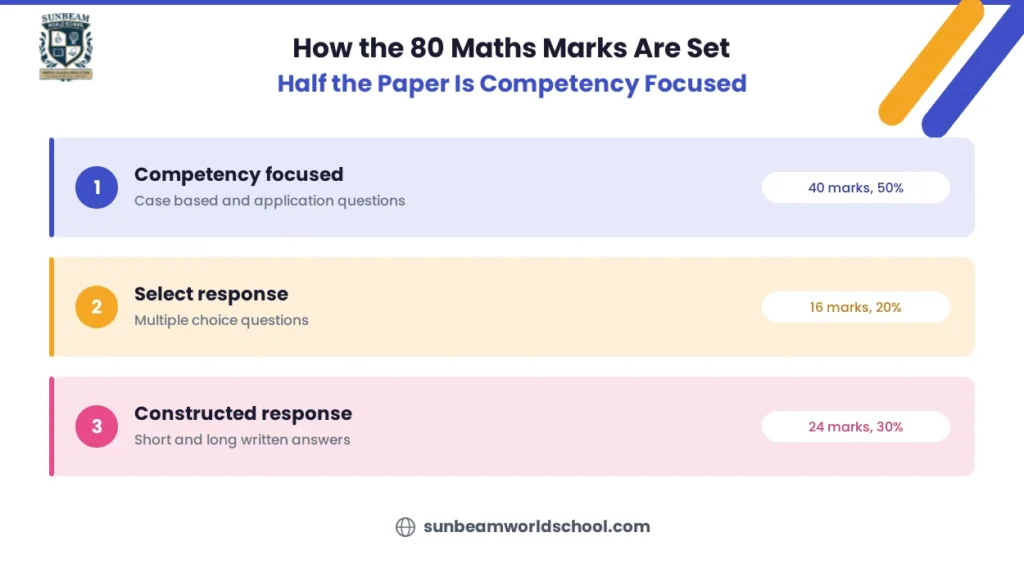
The paper follows CBSE's question paper design of 50% competency focused questions, 20% select response questions and 30% constructed response questions, which works out to 40, 16 and 24 marks respectively. The practical effect is that roughly half the paper puts a concept into a situation the student has not seen before, rather than asking for a formula to be reproduced.
| Question type | Share | Marks out of 80 |
|---|---|---|
| Competency focused, including case based and source based | 50% | 40 |
| Select response, multiple choice | 20% | 16 |
| Constructed response, short and long answer | 30% | 24 |
This is why working through solved examples alone stops paying off at a certain point. A student who can solve every exercise in the chapter can still lose marks on a case based question that wraps the same mathematics in a paragraph about a water tank or a cricket score. Practice needs to include unfamiliar framings, which is what NCERT exemplar problems are useful for.
What Is the Maths Advanced Paper in Class 9?
The Maths Advanced paper is an optional one-hour paper of 25 marks introduced from 2026-27, written in addition to the compulsory 80-mark Standard paper. Its marks do not enter the overall aggregate, and a student who scores 50% or more has the advanced qualification noted separately on the marksheet, so attempting it carries no risk to the main result.
CBSE has also discontinued the older Mathematics Basic and Mathematics Standard choice, so every Class 9 student now studies the same course from the same book, with Advanced as an addition rather than a different track. Students who opt in should treat it as a separate kind of practice. A full three-hour mock builds stamina and coverage, while the Advanced paper is a short, dense hour in which a handful of harder questions carry everything, so the useful preparation is a set of genuinely difficult problems rather than another complete paper.
How Many Marks Is Internal Assessment in Class 9 Maths?
Internal assessment in Maths carries 20 marks, awarded by the school through the year rather than in one exam, across pen and paper tests, multiple assessment, portfolio and the maths lab practical. Each component is worth 5 marks, and schools sometimes report the first two together as a single 10-mark periodic assessment.
- Pen and paper tests, 5 marks: the periodic tests held through the session.
- Multiple assessment, 5 marks: quizzes, oral work, class discussion and similar activities.
- Portfolio, 5 marks: classwork, assignments and overall subject record.
- Maths lab practical, 5 marks: the prescribed lab activities, assessed on the record and the work.
The lab practical is the component students most often leave until it is too late, and it is the easiest 5 marks in the subject. The activities are hands-on and repeatable, and the marks go on the record rather than resting on one exam afternoon.
Class 9 Maths Periodic Test and Half Yearly Paper
A Class 9 Maths periodic test is a short written test, usually of 20 marks and scaled down to 5 for internal assessment, covering only the units taught up to that point. The half yearly paper is longer, often set for 80 marks or a reduced total, and covers roughly the first half of the course.
Both are set by the school rather than by CBSE, which is why their format varies between schools far more than the annual paper does. The most reliable guide to either is your own school's papers from previous years, so it is worth asking the subject teacher for them. A periodic test rewards accuracy on a narrow portion, while the annual paper rewards coverage and pacing, and students who practise only one of the two are often surprised by the other.
Which Chapters Carry the Most Marks in Class 9 Maths?
Geometry chapters carry the most marks, at 25 of the 80, which makes triangles, quadrilaterals and circles the highest-return topics in the subject. Mensuration follows at 14 marks, and it is the unit where careless formula substitution costs the most.
Mensuration is also the unit students can prepare fastest, because the formulas are few and the question types repeat. If area and surface area need shoring up, our guides to the area of a circle, the area of a triangle and the area of a parallelogram each work through the derivation rather than just stating the result, which is what makes the formula stick under exam pressure.
How Should a Class 9 Student Practise Maths Sample Papers?
A Class 9 student should write three to five full Maths papers before the annual exam, each in one timed three-hour sitting, and spend the following day correcting mistakes rather than starting another paper. Marks in Maths are lost to presentation and pacing at least as often as to not knowing the method, and only a timed paper exposes which of the two is happening.
Show every step, because method marks are real
Steps that are skipped cannot be awarded marks even when the final answer is correct, so a student who works mentally and writes only the answer is giving away marks they have earned. The conventions that protect those marks are the same ones that matter in the board exam two years later, and they are worth learning now rather than in Class 10. Our guide to writing a maths paper in a board exam sets out how examiners read a script.
Keep rough work out of the answer
Rough work belongs in a clearly marked margin or at the end of the answer sheet, never threaded through the solution, because an examiner following a proof should not have to decide which lines are part of it. Units go in every numerical answer, and the final answer gets a single underline rather than a box or a highlighter.
Use the first ten minutes to read, not to write
Reading the whole paper before starting prevents the most common pattern of loss, which is spending too long on one long-answer question and leaving easy marks unattempted at the end. Marking the questions you are confident about, then writing in the paper's own order, keeps the script in sequence for the examiner and keeps your own timing honest.
Where Can I Get the Official Class 9 Maths Syllabus and Marks Scheme?
The official Class 9 Maths curriculum document, which contains the unit-wise marks and the question paper design, is published by CBSE on its Curriculum 2026-27 page under Secondary Curriculum Part-I. It is the most authoritative guide to the paper available, because every school builds its Maths paper from exactly this design.
For practice material, the NCERT exemplar problems for Class 9 Maths are the closest thing to an official question bank, and the chapter-wise Ganita Manjari PDFs on the NCERT portal let you confirm the current chapter list before trusting any practice paper. The full set of official Class 9 material is listed in our guide to CBSE Class 9 sample papers.
Conclusion
Geometry and Algebra decide this paper, and the marks go to the student who shows the working rather than the one who knows the most. Write a few full papers under the clock, correct them properly, and the annual exam stops being a surprise. For live Maths classes and regular mock papers through Class 9, book a free demo session with the Sunbeam World School team.