
 Online Education
Hindi Alphabet
Quick Summary The Hindi alphabet, known as Varnamala, is written in the Devanagari script and consists of 13 vowels (Swar) and 33 to 36 consonants (Vyanjan), depending on whether newer additions are included. Hindi is one of the most phonetic languages in the world, which means every letter makes exactly one sound, and every sound has exactly one letter. This makes it significantly easier to read and pronounce than English once you learn the basic characters. Below you will find the complete Hindi alphabet chart, pronunciation guide, English translations, writing tips, and resources for kids and beginners.
Hindi is the third most spoken language in the world after English and Mandarin, with over 600 million speakers globally. The Hindi alphabet forms the foundation of the language, and learning it is the first step for anyone starting to read, write, or speak Hindi. Understanding why learning Hindi matters helps parents and students appreciate the value of mastering this alphabet early.
Whether you are a parent introducing your child to Hindi letters at home, a student preparing for school exams, or an adult learning a second language, this guide covers everything you need. From the complete A to Z Hindi alphabet chart to individual vowel and consonant breakdowns, pronunciation tips, writing practice advice, and kid-friendly resources, every section is designed to make learning Hindi letters simple and structured.
What Is the Complete Hindi Alphabet Chart?
The complete Hindi alphabet chart contains 10 vowels (Swar), 33 standard consonants (Vyanjan), 6 extra characters, and a set of matras (vowel marks). Some sources count up to 52 characters when all variations are included. Below is the full Hindi alphabet in order, exactly as taught in schools, with English transliteration for every letter.
Vowels (Swar):
| अ | a | आ | aa | इ | i | ई | ii | उ | u |
|---|---|---|---|---|---|---|---|---|---|
| ऊ | uu | ए | e | ऐ | ai | ओ | o | औ | au |
Consonants (Vyanjan):
| क | ka | ख | kha | ग | ga | घ | gha | ङ | nga |
|---|---|---|---|---|---|---|---|---|---|
| च | cha | छ | chha | ज | ja | झ | jha | ञ | nya |
| त | ta | थ | tha | द | da | ध | dha | न | na |
| ट | ṭa | ठ | ṭha | ड | ḍa | ढ | ḍha | ण | ṇa |
| प | pa | फ | pha | ब | ba | भ | bha | म | ma |
| व | va | र | ra | ल | la | ड़ | ṛa | ढ़ | ṛha |
| श | sha | ष | ṣa | स | sa | ह | ha | य | ya |
Matras (Vowel Marks):
| क | ka | का | kaa |
|---|---|---|---|
| कि | ki | की | kii |
| कु | ku | कू | kuu |
| को | ko | कौ | kau |
| के | ke | कै | kai |
| कं | kan | कँ | ka (nasal) |
Extra Characters:
| ज़ | za | फ़ | fa |
|---|---|---|---|
| श्र | shra | क्ष | ksha |
| ज्ञ | gya | त्र | tra |
This chart covers the complete Hindi Varnamala as taught in most CBSE and ICSE schools. The total number of letters varies slightly depending on the source because some systems count matras and extra characters separately while others include them in the main alphabet count.
What Are the Vowels (Swar) in Hindi?
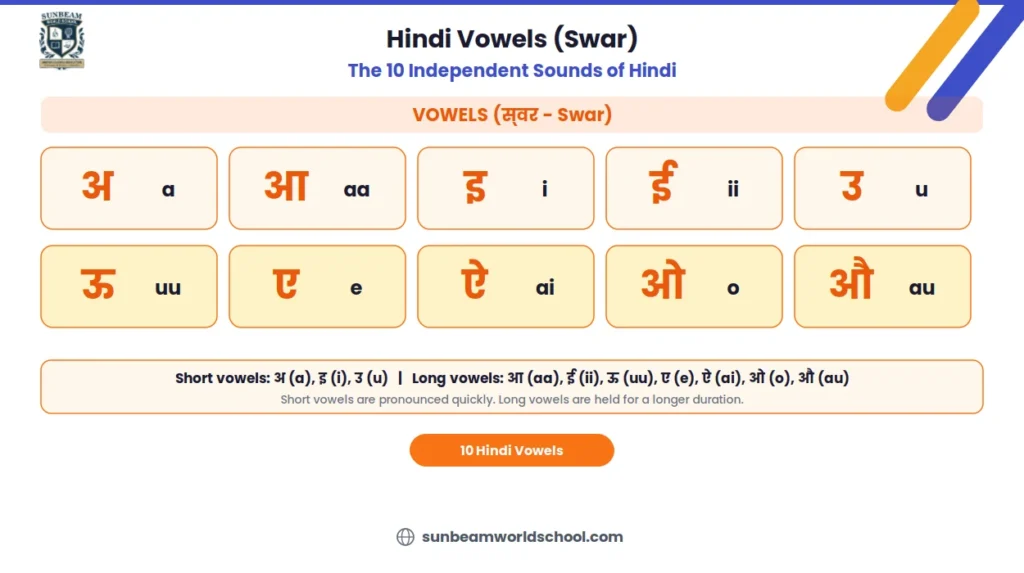
The 10 Hindi vowels (Swar): अ, आ, इ, ई, उ, ऊ, ए, ऐ, ओ, औ
Hindi has 10 standard vowels, called Swar (स्वर), which are independent sounds that can be pronounced on their own without the help of any consonant. Vowels form the foundation of Hindi pronunciation because every consonant in Hindi carries an inherent "a" (अ) sound, and all other vowel sounds are added to consonants using special marks called matras.
| Hindi | English | Sound | Type |
|---|---|---|---|
| अ | a | as in "up" | Short (Hrasva) |
| आ | aa | as in "father" | Long (Deergha) |
| इ | i | as in "it" | Short (Hrasva) |
| ई | ii | as in "feet" | Long (Deergha) |
| उ | u | as in "put" | Short (Hrasva) |
| ऊ | uu | as in "food" | Long (Deergha) |
| ए | e | as in "aim" | Long (Deergha) |
| ऐ | ai | as in "air" | Long (Deergha) |
| ओ | o | as in "old" | Long (Deergha) |
| औ | au | as in "out" | Long (Deergha) |
Hindi vowels are divided into two types based on pronunciation length. Short vowels (Hrasva Swar) include अ, इ, and उ, which are pronounced quickly. Long vowels (Deergha Swar) include आ, ई, ऊ, ए, ऐ, ओ, and औ, which are held for a longer duration. Understanding this distinction helps learners pronounce words correctly and is a common topic in Hindi grammar exams.
Some charts also include two additional sounds: अं (anusvara, a nasal sound) and अः (visarga, a breathy sound). These are technically not vowels but are often listed alongside them in the Varnamala because they modify vowel sounds. Traditional schools may count 13 vowels including these and ऋ (ri), while the modern standard count is 10.
What Are the Consonants (Vyanjan) in Hindi?
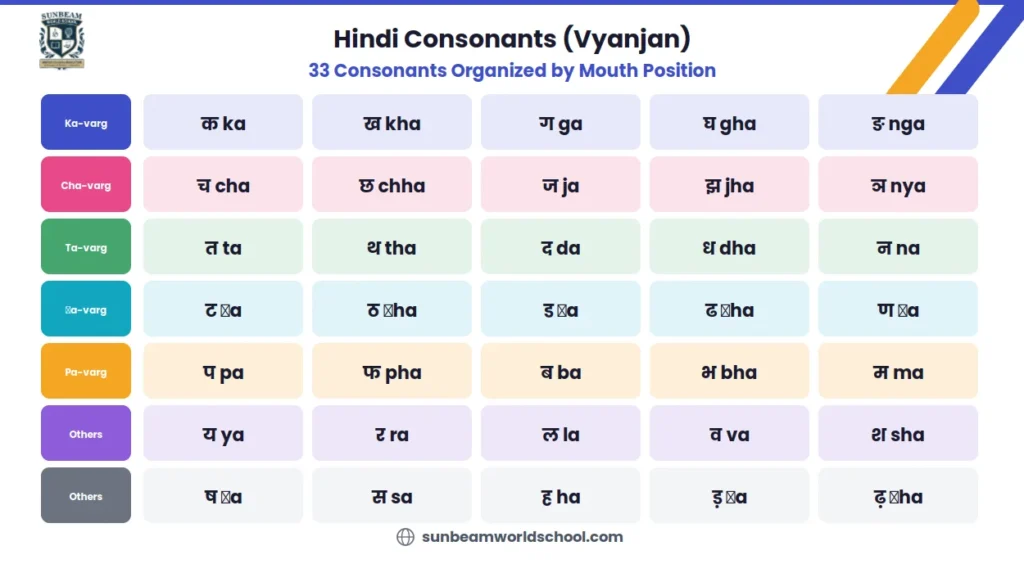
All 33 Hindi consonants (Vyanjan) organized by mouth position
Hindi has 33 standard consonants, called Vyanjan (व्यंजन), which are sounds that cannot be pronounced without the support of a vowel. Every Hindi consonant carries the inherent vowel sound "a" (अ) unless a halant (्) mark is added to remove it or a different matra is attached to change it.
The consonants are organized into groups called Vargs based on where and how the sound is produced in the mouth:
| Group | Letters | Sound Origin |
|---|---|---|
| Ka-varg | क (ka), ख (kha), ग (ga), घ (gha), ङ (nga) | Throat (Kanthya) |
| Cha-varg | च (cha), छ (chha), ज (ja), झ (jha), ञ (nya) | Palate (Taalvya) |
| Ta-varg (dental) | त (ta), थ (tha), द (da), ध (dha), न (na) | Teeth (Dantya) |
| Ta-varg (retroflex) | ट (ṭa), ठ (ṭha), ड (ḍa), ढ (ḍha), ण (ṇa) | Roof of mouth (Murdhanya) |
| Pa-varg | प (pa), फ (pha), ब (ba), भ (bha), म (ma) | Lips (Oshthya) |
The remaining consonants that do not fit into the five main groups are:
| Type | Letters |
|---|---|
| Antastha Vyanjan (Semi-vowels) | य (ya), र (ra), ल (la), व (va) |
| Ushma Vyanjan (Sibilants) | श (sha), ष (ṣa), स (sa), ह (ha) |
| Conjunct sounds | ड़ (ṛa), ढ़ (ṛha) |
This organized grouping system is unique to Indian languages and makes Hindi consonants systematic and logical to learn. Each group of five consonants moves progressively from the back of the mouth to the front (throat to lips), which is why the Ka-group comes first and the Pa-group comes last. Unlike the apparently random order of the English alphabet, the Hindi consonant order follows the science of phonetics.
What Are Matras in Hindi?
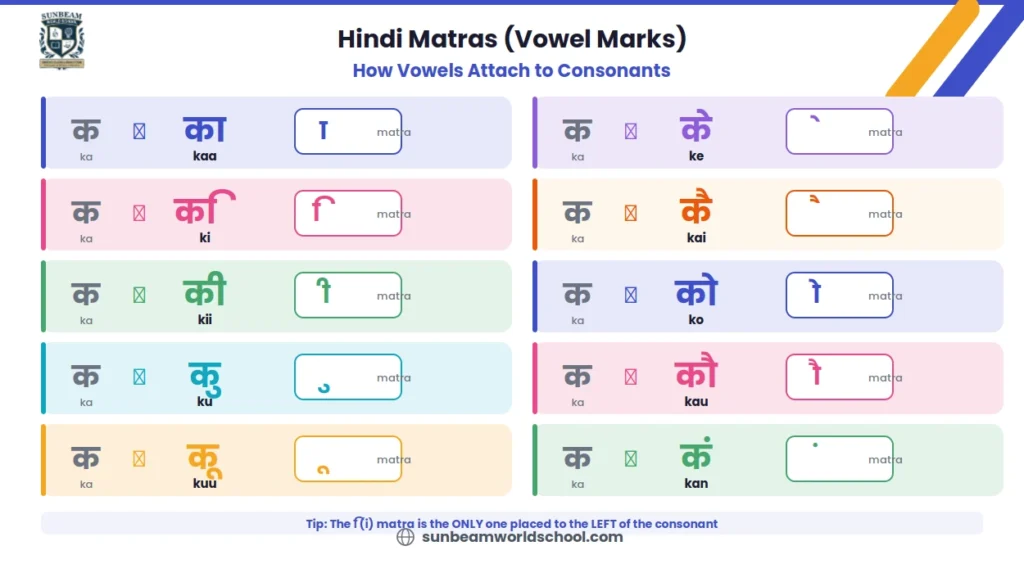
Hindi matras (vowel marks) explained
Matras are the vowel marks that attach to consonants to change their inherent "a" sound to a different vowel sound. They are one of the most important elements of the Hindi writing system and are essential for reading and writing any Hindi word beyond the most basic level.
Each vowel has a corresponding matra form that is added above, below, before, or after a consonant. The table below uses the consonant क (ka) to show how each matra changes its sound:
| Base | Sound | With Matra | New Sound | Matra Position |
|---|---|---|---|---|
| क | ka | का | kaa | Right side (ा) |
| क | ka | कि | ki | Left side (ि) |
| क | ka | की | kii | Right side (ी) |
| क | ka | कु | ku | Below (ु) |
| क | ka | कू | kuu | Below (ू) |
| क | ka | के | ke | Above (े) |
| क | ka | कै | kai | Above (ै) |
| क | ka | को | ko | Right side (ो) |
| क | ka | कौ | kau | Right side (ौ) |
| क | ka | कं | kan | Above as dot (ं) |
| क | ka | कँ | ka (nasal) | Above as moon-dot (ँ) |
Matras are not separate letters but are attached forms of the vowels. A child learning Hindi must first memorize the vowels in their full form (अ, आ, इ, ई...) and then learn the corresponding matra form of each one. Once matras are understood, the student can combine any consonant with any vowel sound, which unlocks the ability to read and write thousands of Hindi words. This is why matras are introduced immediately after the basic vowels and consonants in most Hindi textbooks.
Other important Hindi symbols include the halant (्), which removes the inherent vowel from a consonant entirely, and the chandrabindu (ँ), which adds a nasal quality to a vowel. The anusvara (ं) is a dot above a letter that indicates nasalization, and the visarga (ः) represents a breathy "h" sound after a vowel.
What Are the Extra Characters in Hindi?
The Hindi alphabet includes six extra characters that are not part of the original 33 consonants but are widely used in modern Hindi. These fall into two categories: sounds borrowed from other languages and conjunct consonants formed by combining two standard letters.
Borrowed sounds (with nuqta):
| Character | Transliteration | Origin | Example Word |
|---|---|---|---|
| ज़ | za | Persian/Arabic | ज़मीन (zameen, land) |
| फ़ | fa | Persian/Arabic | फ़ोन (phone) |
The characters ज़ and फ़ are formed by adding a small dot (nuqta) below the standard letters ज and फ. They represent sounds that do not exist in traditional Hindi but appear frequently in Urdu-origin words that are now part of everyday Hindi conversation. Many Hindi speakers use ज and फ without the nuqta in informal writing, but the correct form includes the dot when the word originates from Persian, Arabic, or English.
Conjunct consonants (Sanyukt Akshar):
| Character | Transliteration | Formed From | Example Word |
|---|---|---|---|
| श्र | shra | श + र | श्रमिक (shramik, worker) |
| क्ष | ksha | क + ष | क्षमा (kshama, forgiveness) |
| ज्ञ | gya | ज + ञ | ज्ञान (gyaan, knowledge) |
| त्र | tra | त + र | त्रिकोण (trikon, triangle) |
These four conjunct consonants are combinations of two standard consonants joined together. They are so commonly used that they are taught as individual characters alongside the main alphabet in most schools. The character ज्ञ is particularly notable because its pronunciation (gya) does not obviously match the sounds of its component letters (ज + ञ), making it one of the trickiest characters for beginners.
Together, these six extra characters bring the total count of commonly taught Hindi characters to around 49 to 52, depending on the school and textbook.
What Is Barakhadi in Hindi?
Barakhadi (बारहखड़ी) is the complete grid that shows every consonant combined with every vowel sound. The word "Barah" means twelve, and "Khadi" means a standing row, because each consonant traditionally produces 12 sounds when paired with the 10 vowels plus anusvara (ं) and visarga (ः). Barakhadi is taught in schools immediately after students learn the individual vowels and consonants because it is the bridge between knowing individual letters and actually reading Hindi words.
Below is the Barakhadi for the first 10 consonants. The same pattern applies to all 33 consonants:
| अ | आ | इ | ई | उ | ऊ | ए | ऐ | ओ | औ | अं | अः | |
|---|---|---|---|---|---|---|---|---|---|---|---|---|
| क | क | का | कि | की | कु | कू | के | कै | को | कौ | कं | कः |
| ख | ख | खा | खि | खी | खु | खू | खे | खै | खो | खौ | खं | खः |
| ग | ग | गा | गि | गी | गु | गू | गे | गै | गो | गौ | गं | गः |
| घ | घ | घा | घि | घी | घु | घू | घे | घै | घो | घौ | घं | घः |
| च | च | चा | चि | ची | चु | चू | चे | चै | चो | चौ | चं | चः |
| छ | छ | छा | छि | छी | छु | छू | छे | छै | छो | छौ | छं | छः |
| ज | ज | जा | जि | जी | जु | जू | जे | जै | जो | जौ | जं | जः |
| झ | झ | झा | झि | झी | झु | झू | झे | झै | झो | झौ | झं | झः |
| ट | ट | टा | टि | टी | टु | टू | टे | टै | टो | टौ | टं | टः |
| ठ | ठ | ठा | ठि | ठी | ठु | ठू | ठे | ठै | ठो | ठौ | ठं | ठः |
The pattern is consistent across every consonant in the Hindi alphabet. Once a child memorizes the Barakhadi for 4 to 5 consonants, they can predict the pattern for the remaining ones on their own. This is why Barakhadi is considered the single most important exercise in Hindi literacy: it trains the brain to automatically combine any consonant with any vowel, which is exactly what reading Hindi requires.
Parents and teachers can practise Barakhadi by having children read each row aloud, one consonant at a time. Start slowly with the Ka-row, repeat it daily until it flows naturally, then move to Kha, Ga, and so on. Most children can complete the full Barakhadi in 4 to 6 weeks with 10 minutes of daily practice.
What Is the Hindi Varnamala?
The Hindi Varnamala (वर्णमाला), which literally translates to "garland of letters," is the traditional name for the complete Hindi alphabet system. The word "Varna" means letter or sound, and "Mala" means garland or chain, so Varnamala is the garland that strings together all the sounds of the Hindi language. It is also sometimes called Aksharmala (अक्षरमाला), meaning "garland of syllables."
The standard Hindi Varnamala consists of 10 vowels (Swar), 33 consonants (Vyanjan), and 6 extra characters, totalling 49 letters in most teaching systems. The Government of India standardizes the count as 11 vowels and 35 consonants in some official references, while traditional teaching uses a different breakdown. Both systems are correct; the difference comes from how nasal sounds, borrowed characters, and conjuncts are categorized.
The Varnamala is taught to children in a specific order (क, ख, ग, घ...) that groups sounds by their place of articulation in the mouth, moving from the throat forward to the lips. This systematic ordering is one of the most effective approaches to building cognitive skills through language learning, and it makes the Hindi alphabet one of the most logically structured writing systems in the world.
What Are Hindi Letters With Words and Pictures?
Learning Hindi letters alongside words and pictures helps children build vocabulary while memorizing the alphabet. Each letter is best taught with a common word that starts with that sound, paired with a visual that makes the connection memorable.
Here are examples for the first 15 consonants with their associated words:
| Letter | Word | English Meaning |
|---|---|---|
| क | कमल | Lotus |
| ख | खरगोश | Rabbit |
| ग | गाय | Cow |
| घ | घड़ी | Clock |
| ङ | (rare in word-initial position) | -- |
| च | चम्मच | Spoon |
| छ | छाता | Umbrella |
| ज | जहाज | Ship |
| झ | झंडा | Flag |
| ट | टमाटर | Tomato |
| ठ | ठेला | Cart |
| ड | डमरू | Hand drum |
| ढ | ढोलक | Drum |
| ण | (rare in word-initial position) | -- |
| त | तरबूज | Watermelon |
And vowel-picture pairs: अ (अनार, Pomegranate), आ (आम, Mango), इ (इमली, Tamarind), ई (ईख, Sugarcane), उ (उल्लू, Owl), ऊ (ऊन, Wool), ए (एड़ी, Heel), ऐ (ऐनक, Spectacles), ओ (ओखली, Mortar), औ (औरत, Woman).
Parents teaching Hindi at home can create flashcards using pictures from daily life, which makes the learning process both visual and practical. For more vocabulary-building activities using pictures and names, explore our guides on learning fruit names, animal names, and colour names for kids.
What Is the Hindi Alphabet in English Translation?
The Hindi alphabet can be transliterated into English using the Roman script, which helps beginners who can already read English to learn Hindi pronunciation without needing to memorize Devanagari characters first. Below is the Hindi A Aa I Ee sequence with English equivalents.
Vowels in English: a, aa, i, ii, u, uu, e, ai, o, au
Consonants in English (by group): Ka-group: ka, kha, ga, gha, nga Cha-group: cha, chha, ja, jha, nya Ta-group (dental): ta, tha, da, dha, na Ta-group (retroflex): ṭa, ṭha, ḍa, ḍha, ṇa Pa-group: pa, pha, ba, bha, ma Others: ya, ra, la, va, sha, ṣa, sa, ha
One important note for learners: Hindi has sounds that English does not, particularly the distinction between retroflex (hard) and dental (soft) versions of T, Th, D, Dh, and N. In English transliteration, both are often written the same way, which can confuse beginners. Listening to audio pronunciation alongside the written chart is the best way to learn these differences. Once you are comfortable with the alphabet in English, the next step is practising simple English to Hindi sentences to build reading fluency.
How Does the Hindi Alphabet Compare With English?
Hindi and English use completely different writing systems, and understanding the key differences upfront saves beginners from confusion later. The table below highlights the most important contrasts between the two alphabets.
| Feature | Hindi (Devanagari) | English (Roman) |
|---|---|---|
| Total letters | 46 to 52 (vowels + consonants + extras) | 26 (vowels + consonants mixed) |
| Script type | Abugida (consonants carry inherent vowel) | Alphabet (vowels and consonants independent) |
| Phonetic consistency | Almost 100% phonetic (one letter = one sound) | Highly irregular (one letter = multiple sounds) |
| Writing direction | Left to right | Left to right |
| Headline | Shirorekha connects all letters in a word | No connecting line |
| Vowel marks | Matras attach to consonants to change sound | Vowels are separate standalone letters |
| Letter order | Organized by mouth position (throat to lips) | No phonetic order (A-Z is arbitrary) |
| Capital/lowercase | No uppercase or lowercase distinction | Has both (A/a, B/b) |
| Aspirated sounds | Yes (क vs ख, प vs फ) | No (English has no aspirated pairs) |
| Retroflex sounds | Yes (ट, ठ, ड, ढ, ण) | No (English has no retroflex letters) |
The biggest advantage Hindi has over English for learners is phonetic consistency. In English, the word "enough" has silent letters, unexpected sounds, and no obvious logic. In Hindi, every word is spelled exactly the way it sounds and sounds exactly the way it is spelled. This is why children who learn Hindi reading skills first often find it easier to build phonetic awareness that helps with English reading later.
The biggest challenge for English speakers learning Hindi is the aspirated and retroflex sounds, which simply do not exist in English. There is no English equivalent of the difference between त (dental "ta") and ट (retroflex "ṭa"), so learners must train their ears and tongues to hear and produce these new sounds through focused listening and repetition.
How Is the Hindi Alphabet Pronounced?
Hindi is an almost perfectly phonetic language, meaning each letter corresponds to exactly one sound, and that sound does not change depending on context. This is a major advantage over English, where a single letter like "a" can make completely different sounds in words like "cat," "cake," and "call."
To pronounce Hindi letters correctly, focus on these key patterns. Vowels are straightforward: अ sounds like the "u" in "up," आ sounds like the "a" in "father," इ sounds like the "i" in "sit," and ई sounds like the "ee" in "feet." Each vowel pair (short and long) uses the same mouth position but differs in duration.
For consonants, the most important skill is learning the difference between aspirated and unaspirated sounds. An aspirated consonant (like ख kha, घ gha, छ chha) releases a small puff of air when pronounced, while an unaspirated consonant (like क ka, ग ga, च cha) does not. Place your hand in front of your mouth and say "ka" versus "kha" to feel the difference. This distinction does not exist in English but is essential in Hindi.
The retroflex sounds (ट, ठ, ड, ढ, ण) are produced by curling the tongue backward so the underside touches the roof of the mouth. Dental sounds (त, थ, द, ध, न) are produced with the tongue touching the back of the upper front teeth. Practising these two groups side by side is the fastest way to hear and feel the difference.
What Are Common Mistakes When Learning Hindi Letters?
Most beginners make the same 5 to 6 mistakes when learning the Hindi alphabet, and knowing them in advance can save weeks of confusion. Each mistake below comes from real questions posted on Reddit, Quora, and classroom forums by Hindi learners.
Mistake 1: Confusing ब (ba) and व (va) These two letters look similar in many handwriting styles. The key difference is that ब has a complete closed loop at the bottom, while व has an open curve. Practise writing them side by side until the difference becomes automatic.
Mistake 2: Mixing up श (sha), ष (ṣa), and स (sa) All three are sibilant sounds, but they are produced at different positions in the mouth. श (sha) is made at the palate, ष (ṣa) is retroflex (tongue curled back), and स (sa) is dental (tongue near teeth). In everyday Hindi, श and ष sound almost identical, but स is clearly different. Focus on distinguishing स from the other two first.
Mistake 3: Ignoring the difference between retroflex and dental sounds English speakers often treat ट (retroflex) and त (dental) as the same "t" sound. They are not. Retroflex sounds are made with the tongue curled backward to touch the roof of the mouth, while dental sounds are made with the tongue touching the back of the upper front teeth. Saying "tomato" versus "the" in English gives a rough approximation of the tongue position difference.
Mistake 4: Placing the ि (short "i") matra on the wrong side The ि matra is the only matra in Hindi that goes to the LEFT of the consonant, even though it is pronounced after it. Students often write it on the right side out of habit. Remember: कि (ki) has the hook on the left, while की (kii) has the line on the right.
Mistake 5: Forgetting the Shirorekha (headline) Beginners often write Hindi letters as isolated characters without connecting them with the Shirorekha. In proper Hindi writing, all letters in a word must be joined at the top by a continuous horizontal line. Missing the Shirorekha makes Hindi text look incomplete and is marked as incorrect in school exams.
Mistake 6: Pronouncing ज्ञ as "jna" instead of "gya" The conjunct ज्ञ is formed from ज + ञ, which would logically sound like "jna." However, in standard Hindi pronunciation, it is spoken as "gya." This is one of the rare exceptions to Hindi's phonetic consistency, and it trips up nearly every beginner. The word ज्ञान (knowledge) is pronounced "gyaan," not "jnaan."
Awareness of these common errors helps learners correct themselves early, before incorrect habits become deeply ingrained.
How to Practise Hindi Writing?
Hindi writing practice is most effective when done on ruled notebooks designed specifically for Devanagari script. The most common format is the two-line notebook (do-line copy), which has two horizontal lines between which each letter is written. The top line marks the Shirorekha (the horizontal line that runs across the top of Hindi letters), and the bottom line marks the baseline.
For beginners learning how to write Hindi in a 2-line notebook, follow these steps. First, draw the main body of each letter between the two lines. Second, add the Shirorekha (headline) connecting the top of all letters in a word. Third, add any matras above, below, or beside the letter. Fourth, leave a small gap between words but connect all letters within a single word under one continuous Shirorekha.
Four-line notebooks are used for more advanced practice, especially for letters with parts that extend above or below the main writing area. Five-line notebooks are sometimes used in nursery classes for extra-large letter practice. Regardless of the format, consistent daily practice of 10 to 15 minutes is far more effective than occasional long sessions.
How to Teach Hindi Alphabet to Kids and Beginners?
The best way to introduce Hindi letters to kids and beginners is to start with the vowels (Swar) since there are only 10 of them and they form the base for all other sounds. Once a child is comfortable recognizing and saying the vowels, move on to the consonants one group at a time (Ka-group first, then Cha-group, and so on). This gradual approach avoids overwhelm and builds confidence step by step.
For preschoolers (ages 3 to 5), focus on recognition and sound. Use alphabet songs, flashcards with pictures, and tracing sheets. The goal at this stage is not perfect writing but familiarity with shapes and sounds. For kindergarteners (ages 5 to 6), add writing practice on two-line notebooks and begin matching letters with simple words. For early elementary students (ages 6 to 8), introduce matras (vowel marks attached to consonants), simple sentences, and reading exercises.
One effective method is the "letter of the week" approach, where the child focuses on one new letter each week through songs, tracing, colouring, and word games. This gives enough time for the letter to move from recognition to recall without rushing. Parents considering the right age to start structured learning will find that Hindi letter introduction can begin as early as age 3 through play-based activities.
What Are Hindi Symbols and Special Characters?
Beyond the standard vowels, consonants, and matras, Hindi uses several special symbols that appear frequently in written text. Understanding these symbols is necessary for reading Hindi fluently.
| Symbol | Name | Function |
|---|---|---|
| ् | Halant | Removes the inherent "a" vowel from a consonant |
| ं | Anusvara | Adds a nasal sound (written as a dot above) |
| ँ | Chandrabindu | Adds a nasal quality (moon-shaped mark with dot) |
| ः | Visarga | Adds a breathy "h" sound after a vowel |
| ॐ | Om | Sacred syllable used in spiritual and religious text |
| । | Purna Viram | Full stop (equivalent of a period in English) |
| ॥ | Deergha Viram | Double full stop (used in poetry and verse) |
The halant is particularly important because it creates conjunct consonants (Sanyukt Akshar) by joining two consonants together. For example, क + ् + ष = क्ष (ksha). Without the halant, learners cannot understand how compound characters are formed, which limits their ability to read more advanced Hindi text.
What Are Hindi Numbers 1 to 10?
Hindi numbers (Ginti) are written using Devanagari numerals, which look different from the Arabic numerals (1, 2, 3) used in English. Learning the first ten Hindi numbers alongside the alphabet gives children a complete foundation in reading and writing Hindi.
| Number | Hindi Numeral | Hindi Word | Pronunciation |
|---|---|---|---|
| 1 | १ | एक | Ek |
| 2 | २ | दो | Do |
| 3 | ३ | तीन | Teen |
| 4 | ४ | चार | Chaar |
| 5 | ५ | पाँच | Paanch |
| 6 | ६ | छह | Chhah |
| 7 | ७ | सात | Saat |
| 8 | ८ | आठ | Aath |
| 9 | ९ | नौ | Nau |
| 10 | १० | दस | Das |
These numbers appear on Hindi textbooks, government documents, road signs, and currency notes across India. Recognizing them is an essential part of Hindi literacy that goes hand in hand with learning the alphabet.
How Many Letters Are in the Hindi Alphabet?
The standard Hindi alphabet has 10 vowels and 33 consonants, totalling 43 core letters. However, the count varies depending on the source and what is included.
The traditional classroom count used in most CBSE schools is 13 vowels (including अं, अः, and ऋ) and 33 consonants, giving 46. When conjunct consonants like क्ष (ksha), त्र (tra), ज्ञ (gya), and श्र (shra) are added along with borrowed sounds like ज़ (za) and फ़ (fa), the count reaches 49 to 52. The Government of India standard lists 11 vowels and 35 consonants in some official references.
The reason for these different counts is not a disagreement about the language itself but about how to categorize certain sounds. The core writing system remains the same: every student learning Hindi will encounter the same set of characters regardless of whether their textbook says 44, 46, 49, or 52.
What Is the Devanagari Script?
The Devanagari script (देवनागरी) is the writing system used for Hindi, and it is also used for several other Indian languages including Sanskrit, Marathi, and Nepali. The word "Devanagari" comes from "Deva" (divine) and "Nagari" (city), and it has been in use for over a thousand years.
Devanagari is an abugida, which means it is a writing system where consonants carry an inherent vowel sound (in this case, "a") that can be modified by adding vowel marks. This makes it different from the English alphabet, which is a pure alphabet where vowels and consonants are fully independent. Understanding that Hindi uses an abugida rather than a strict alphabet helps learners grasp why matras exist and how consonant clusters work.
The script is written from left to right, like English, and all letters hang from a horizontal line called the Shirorekha. This headline is one of the most visually distinctive features of Devanagari and is what gives Hindi text its characteristic look. Studying the importance of regional languages in education helps students understand why learning to read and write in Devanagari is valuable beyond just Hindi itself.
How Does Hindi Compare With Sanskrit and Urdu?
Hindi, Sanskrit, and Urdu are closely related languages, and understanding how their alphabets compare helps learners see the bigger picture of Indian language systems.
Hindi and Sanskrit both use the Devanagari script, and their alphabets are nearly identical. The main difference is that Sanskrit has a few additional sounds and uses the script in its original, more complex form, while Hindi uses a simplified version adapted for modern everyday use. A student who learns the Hindi alphabet can read Sanskrit text with minimal additional effort.
Hindi and Urdu are even more closely related in terms of spoken language. They share most of their basic vocabulary and grammar, and speakers of one can generally understand the other in conversation. The critical difference is the script: Hindi uses Devanagari (written left to right) while Urdu uses a modified form of the Nastaliq script derived from Arabic and Persian (written right to left). The sounds are largely the same, but the letters look completely different on paper.
This means that a student who learns the Hindi alphabet in Devanagari and the basic grammar of the language can communicate with both Hindi and Urdu speakers, making it one of the most versatile language skills in South Asia.
Fun Hindi Tongue Twisters for Hindi Alphabet Practice
Tongue twisters are one of the most effective and enjoyable ways to improve Hindi pronunciation, especially for sounds that do not exist in English. Each tongue twister below targets a specific set of letters or a common pronunciation challenge. Try saying each one slowly at first, then gradually increase your speed.
1. कच्चा पापड़, पक्का पापड़ (Kachcha Papad, Pakka Papad) Meaning: Raw papad, cooked papad. What it practises: The difference between क/कच (ka/kacha) and प/पक (pa/pakka), plus the aspirated क्क sound. This is the most popular Hindi tongue twister and a perfect starting point for beginners.
2. चंदू के चाचा ने चंदू की चाची को चांदी की चम्मच से चटनी चटाई (Chandu ke chacha ne chandu ki chachi ko chandi ki chammach se chatni chataai) Meaning: Chandu's uncle fed Chandu's aunt chutney with a silver spoon. What it practises: The entire Cha-varg (च, छ). The repeated "ch" sound at speed is challenging even for native speakers.
3. पके पेड़ पर पक्का पपीता, पक्का पपीता पके पेड़ पर (Pake ped par pakka papita, pakka papita pake ped par) Meaning: A ripe papaya on a ripe tree, a ripe papaya on a ripe tree. What it practises: The Pa-varg sounds (प, पक, पे, पर, पपीता) and the retroflex ड़ in पेड़. Excellent for mastering lip-produced consonants.
4. समझ समझ के समझ को समझो, समझ समझना भी एक समझ है (Samajh samajh ke samajh ko samjho, samajh samajhna bhi ek samajh hai) Meaning: Understand understanding with understanding; understanding how to understand is also an understanding. What it practises: The sounds स, म, झ, and the conjunct ज्ञ-adjacent sound झ. This one also teaches a genuine Hindi philosophical proverb.
5. कच्चा गमला, पक्का गमला, कच्चा गमला, पक्का गमला (Kachcha gamla, pakka gamla) Meaning: Raw pot, baked pot. What it practises: The Ka-varg and Pa-varg alternation. Simpler than the papad version, making it ideal for young children just starting to practise consonant groups.
Using tongue twisters as a 2-minute warm-up before any Hindi reading or writing session trains the mouth to move quickly between different sound groups. Children especially enjoy the challenge of saying them faster and faster, which turns pronunciation drill into a game rather than a chore.
Hindi Alphabet Practice Questions With Answers
Practising the Hindi alphabet through questions and exercises is one of the fastest ways to move from recognition to recall. Try answering each question on your own before checking the answer.
Q1. Write the 10 Hindi vowels (Swar) in order.
Answer: अ, आ, इ, ई, उ, ऊ, ए, ऐ, ओ, औ
Q2. Name the 5 consonants in the Ka-varg group.
Answer: क (ka), ख (kha), ग (ga), घ (gha), ङ (nga)
Q3. What is the English transliteration of these letters: झ, ठ, ध, भ?
Answer: झ = jha, ठ = ṭha, ध = dha, भ = bha. All four are aspirated consonants (they release a puff of air).
Q4. Add the correct matra to क to make the sound "kee."
Answer: की (the ी matra is added to the right side of क)
Q5. What is the difference between कु and कू?
Answer: कु is "ku" (short vowel sound) and कू is "kuu" (long vowel sound). The matra below the letter is shorter for कु and longer for कू.
Q6. Write the Hindi word and meaning for these letters: छ, ज, ट.
Answer: छ = छाता (Umbrella), ज = जहाज (Ship), ट = टमाटर (Tomato)
Q7. How many consonant groups (Vargs) are there, and how many letters does each contain?
Answer: There are 5 Vargs (Ka, Cha, Ta, Ta, Pa), and each contains exactly 5 letters, giving 25 consonants in total.
Q8. What are the 6 extra characters in Hindi?
Answer: ज़ (za), फ़ (fa), श्र (shra), क्ष (ksha), ज्ञ (gya), त्र (tra)
Q9. Write the Hindi numeral and word for the numbers 3, 7, and 9.
Answer: 3 = ३ (तीन, Teen), 7 = ७ (सात, Saat), 9 = ९ (नौ, Nau)
Q10. Which matra is placed to the LEFT of a consonant?
Answer: The ि (short "i") matra is the only one placed to the left. For example, कि (ki). All other matras go above, below, or to the right.
Q11. Fill in the blanks: The Ka-varg sounds come from the ______, and the Pa-varg sounds come from the ______.
Answer: The Ka-varg sounds come from the throat (Kanthya), and the Pa-varg sounds come from the lips (Oshthya).
Q12. What is the name of the horizontal line that runs across the top of Hindi letters?
Answer: It is called the Shirorekha. All letters in a Hindi word are connected by this continuous headline, which is one of the most recognizable features of the Devanagari script.
Q13. Match the vowel to its matra form: आ, ई, ऐ, ऊ.
Answer: आ = ा, ई = ी, ऐ = ै, ऊ = ू
Q14. What symbol removes the inherent "a" sound from a consonant?
Answer: The halant (्) removes the inherent "a" sound. For example, क (ka) becomes क् (k) when the halant is added below.
Q15. Write one Hindi word each starting with: ग, प, and म.
Answer: ग = गाय (Gaay, Cow), प = पतंग (Patang, Kite), म = मछली (Machhli, Fish)
Conclusion
The Hindi alphabet is one of the most logically structured writing systems in the world, and learning it opens the door to reading, writing, and truly understanding one of the planet's most widely spoken languages. Start with the vowels, move through one consonant group at a time, master the matras, and practice daily, even for just ten minutes. At Sunbeam World School, Hindi is taught through interactive lessons, structured writing practice, and age-appropriate activities that help every student build confidence in both Devanagari script and spoken Hindi from the very first class.

Frequently Asked Questions
What are the 52 letters in the Hindi alphabet?
-The 52 letters in the Hindi alphabet include 13 vowels (such as अ, आ, इ, ई), 33 standard consonants (such as क, ख, ग, घ), and 6 extra characters: ज़, फ़, श्र, क्ष, ज्ञ, and त्र. Most schools teach 43 to 46 core letters.
What is the Hindi alphabet called in English?
+How can I convert Hindi alphabet into English?
+Which script is used for the Hindi language?
+Is Hindi older than English?
+Is the Sanskrit and Hindi alphabet the same?
+How many vowels and consonants are in the Hindi alphabet?
+Why do people forget Hindi alphabets and how can they remember them?
+Do Hindi letters have names like English letters do?
+Is Hindi a phonetic language?
+How many letters are in the Ka Kha Ga group?
+Should I learn Devanagari script if I already speak Hindi?
+
In this article
Share this post:


Press and Blogs
Stay updated with our press releases, educational blogs, and more.

Quick Summary The area of a triangle equals half the product of its base and...

Quick Summary The most common words that start with X include xylophone, x-ray, xenon, xerox,...

Quick Summary The area of a parallelogram is calculated by multiplying its base by its...