
 Online Education
What Is the Right Age to Start School in India? A Complete Guide to Nursery, LKG, UKG, and Class 1
What is the right age to start school in India?
Here is a quick answer according to updated Age Criteria as per NEP 2020:
| Stage | Age Range |
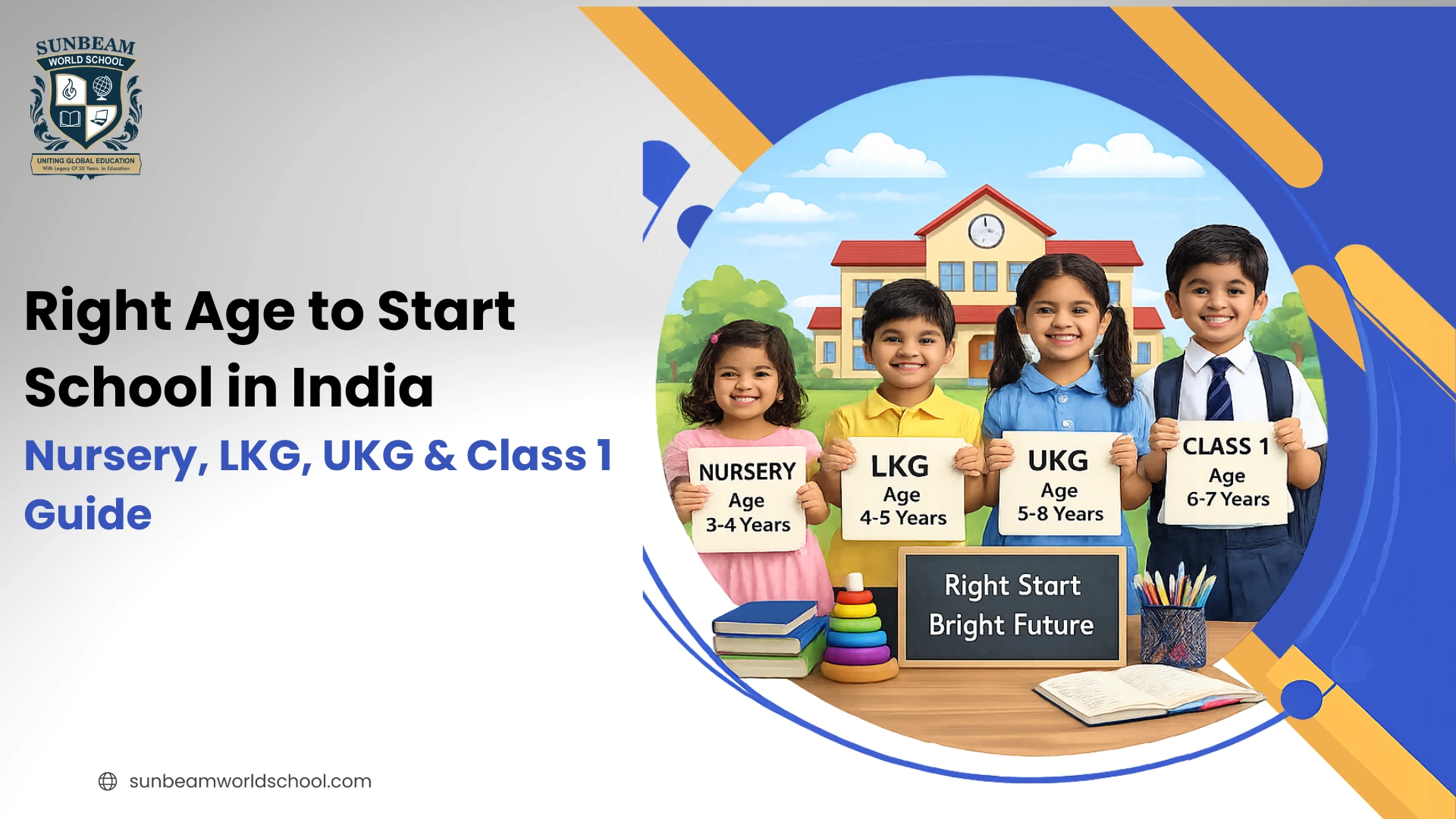
| Playgroup | 2 – 3 years |
| Nursery | 3-4 years |
| LKG | 4-5 years |
| UKG | 5-6 years |
| Class 1 | 6-7 years |
Important Note for Parents:When it comes to the right age for admission in school, here is the part most parents miss: Cut-off dates are decided by the states. That means your child’s eligibility doesn’t depend only on age; it also depends on the official cut-off date your state or school follows, such as: 31st March Even a few days’ difference in your child’s birthdate can determine whether they qualify this year or next for school admission. |
Let’s be honest—almost every parent has Googled this at some point:
“What is the right age to start school in India?”
And the answers? Confusing, inconsistent, and often stressful.
One school says 2.5 years is perfect for Nursery. Another suggests waiting. Relatives compare timelines. Other parents seem “ahead.” And suddenly, a simple decision starts to feel like a high-stakes race.
But here’s the truth, most people don’t say clearly enough:
There is no single “perfect” age, only the right age for your child.
Yes, policies like NEP 2020 give us structure. Yes, schools follow age criteria.
But school readiness isn’t decided by a birth certificate alone, it’s shaped by emotional readiness, social comfort, and developmental pace.
Let us simplify everything for you!
The Official Age Criteria for Each Class Admission in India
India's National Education Policy 2020 brought meaningful clarity to early childhood education. It introduced a structured, age-based framework that aligns what children are expected to learn with where they actually are developmentally.
Here is the age breakdown that most Indian schools now follow:
| Programme / Class | Recommended Entry Age | Primary Focus |
| Playgroup | 2 – 3 years | Sensory play, first social interactions |
| Nursery | 3-4 years | Motor skills, colours, shapes, adjustment |
| LKG (Lower Kindergarten) | 4-5 years | Pre-literacy, pre-numeracy, creativity |
| UKG (Upper Kindergarten) | 5-6 years | Reading readiness, writing, school preparation |
| Class 1 | 6-7 years | Formal academics begin (as per NEP 2020) |
| NEP 2020 Mandate
The Ministry of Education has made it mandatory that a child be at least 6 years old at the time of Class 1 admission. This is not a recommendation — it is a firm national policy directive. Before NEP 2020, many schools admitted 4.5 to 5-year-olds into Class 1. That era is now officially over. |
For 2026–27, the Department of Education in Delhi specifies that a child must be at least 3 years old by March 31st of the admission year for Nursery eligibility. Private schools may offer a 30-day age relaxation at their discretion. If you are in another state, check with your state's Department of Education, as some states like Karnataka have also made minor local adjustments.
NEP 2020's Foundational Stage: Why It Changes Everything
Under NEP 2020, the earliest years of schooling — from Nursery all the way to Class 2 — are grouped together as the Foundational Stage, covering ages 3 to 8. This is one of the most significant conceptual shifts in Indian education policy in decades.
What this means in practice: the policy formally recognises that children between 3 and 8 years are in a critical phase of brain development. During this window, approximately 90% of a child's brain development occurs. The neural connections formed in these years shape memory, language, emotional regulation, creativity, and social behaviour — all of which determine how a child learns for the rest of their life.
Rather than rushing children into rote learning and worksheets, NEP 2020 mandates that the Foundational Stage be play-based and activity-oriented. This is not about going easy on children. It is about teaching the right things, in the right way, at the right time.
What the Foundational Stage CoversNursery to UKG: Three years of pre-primary education focused on play, exploration, creativity and social interaction. Class 1 and Class 2: Transition into structured learning while maintaining a hands-on, experiential approach that builds naturally on the foundations laid in preschool. |
What Happens at Each Stage: Nursery, LKG & UKG Explained
Parents often ask, " What is the actual difference between Nursery, LKG, and UKG?” They are not all the same. Each stage has a distinct developmental purpose, and confusing them is one of the most common reasons parents feel confused about school readiness.
| Programme / Class | Stage Description | Age Group | Learning Focus |
| Nursery | First steps into the world | 2 – 3 years | Adjustment, exploration, basic motor skills, colours, shapes, and peer interaction. No academic pressure — play-based learning forms the foundation. |
| LKG (Lower Kindergarten) | Pre-literacy begins | 3-4 years | Letter recognition, counting up to 20, short phrases, creative activities, and development of fine motor skills for early writing. |
| UKG (Upper Kindergarten) | Bridge to Class 1 | 4-5 years | Simple sentence reading, phonics, writing letters and numbers, basic arithmetic, show-and-tell, and introduction to school routines. |
| Class 1 | Formal learning begins | 5-6 years | Structured subjects, reading comprehension, written work, and mathematics built on a strong foundational base. |
| 6-7 years |
Nursery (Age 2-3 years)
Nursery is a child's first experience of a world outside home. The entire focus is adjustment and exploration — not academics. At a good nursery, your child will learn to separate from you without extreme distress, develop basic motor skills (holding a crayon, stacking blocks, stringing beads), begin using language to interact with peers, get introduced to colours, shapes, and basic concepts — and build their very first friendships.
| Red Flag to Watch For
If a nursery is sending home worksheets, testing letter recognition, or expecting 3-year-olds to sit quietly for extended periods — that is a warning sign. Brain science is clear: play is the work of early childhood. A good nursery should feel more like a well-designed playground than a tiny classroom. |
LKG Lower Kindergarten (Age 3-4 years)
LKG marks a gentle shift toward pre-literacy and pre-numeracy. Children are now more emotionally settled, socially curious, and capable of following structured activities. They begin recognising letters (not necessarily writing them fluently), count objects up to 20, form short sentences, and engage in creative activities like drawing, craft, and music.
One thing worth knowing: there is a wide range of "normal" at this age. Some 4-year-olds are already reading simple words. Others are just starting to recognise letters. Both are completely fine. The role of LKG is to build curiosity and confidence — not produce tiny scholars.
UKG Upper Kindergarten (Age 4-5 years)
UKG is the bridge between play-based early childhood and formal primary schooling. By this stage, most children have developed the cognitive, social, and emotional foundations needed to handle a more structured learning environment. They work on reading simple sentences, phonics, writing letters and numbers, basic addition and subtraction, general awareness, and meaningful independence skills like packing their own bag and following a daily schedule.
UKG is also when school readiness becomes a meaningful concept. A child who has had a strong Nursery and LKG experience typically transitions to Class 1 with confidence. One who has been pushed ahead without adequate preparation may struggle — not because they are not intelligent, but because they were not given the developmental runway they needed.
The Signs That Tell You Your Child Is Ready for School
Age is a guideline. Readiness is the real factor. These are the indicators that child development experts and experienced early childhood educators consistently look for — and that you can observe at home before you write a single admission form.
Emotional readiness
- Spends time away from you without extreme distress
- Shows some curiosity about new places
- Manages minor frustrations without complete meltdowns
Social readiness
- Shows interest in other children
- Plays alongside peers (parallel play is fine)
- Beginning to understand sharing and turn-taking
Communication
- Expresses basic needs verbally
- Others (not just you) can understand them
- Responds when their name is called
Basic self-care
- Eats independently
- Toilet trained or can communicate the need
- Can follow a simple two-step instruction
If most of these boxes are ticked, your child is likely ready, regardless of whether they are 2.8 years or 3.4 years old. The calendar date of their birthday is far less important than this constellation of developmental readiness.
The Early Starter vs. the Late Starter: What Research Actually Shows
This is perhaps the most hotly debated topic among Indian parents today. Let us look at it honestly, without the school-marketing spin.
The case for starting early
There are genuine benefits to early structured learning — when done correctly. Early exposure to group environments helps children develop social skills faster. Structured routines build a sense of security and discipline. A stimulating preschool environment, rich with books, music, art and interaction, genuinely accelerates language development and cognitive growth. The key phrase is "when done correctly" — a play-based, child-centred nursery for a developmentally ready 2.5-year-old can be enormously beneficial.
The case for waiting
Research consistently shows that pushing children into formal academics before they are developmentally ready produces measurable negative effects. Early academic pressure can create math and reading anxiety that persists into later schooling. Children who start later often catch up quickly, and in some cases surpass early starters by age 7 or 8. Emotional and social development, which requires unhurried time, is a stronger predictor of long-term success than early academic achievement.
| Research Finding
A Stanford University study found that children who started formal schooling at age 6 instead of 5 showed significantly lower rates of inattention and hyperactivity by age 11. One additional year of play-based development made a measurable, lasting difference, not in what they knew, but in how they learned. |
| The Indian parent trap
In India, the pressure to start early is compounded by fear of losing a spot in a good school, comparing your child to others of the same age, confusing academic precocity (reading early) with intelligence, and the deeply held belief that more schooling equals more advantage. None of these fears are unreasonable. But they are worth pausing on — especially when the stakes feel highest. |
Common Mistakes Indian Parents Make With Early Admission
-
- Enrolling based on the birthday, not readiness. The cut-off date is a legal minimum, not a developmental recommendation. A child who just turned 3 and one who is 3 years 8 months are developmentally very different — even if the calendar says they are in the same "cohort."
- Choosing a school based on reputation alone. A school's board exam results tell you nothing about how they treat a 4-year-old. Visit classrooms. Watch how teachers speak to children. Notice the energy in the room — is it rushed or calm? Is the teacher down on the floor with the children or standing at a distance?
- Comparing your child to other children. Every child's developmental timeline is unique. Walking early does not predict reading early. Speaking in full sentences at 2 does not mean the child is ready for a classroom at 2.5. Comparison is the thief of developmental joy.
- Dismissing separation anxiety as something to just "push through." Some separation anxiety is normal and healthy. But if your child spends the entire school day in distress, that is not adjustment — that is a nervous system in overdrive. A good school will help you navigate this gradually, not force it.
- Treating kindergarten as Class 1 preparation. Kindergarten has its own intrinsic value. It is not a waiting room for "real school." Children who are allowed to fully experience and enjoy kindergarten — without being drilled for what comes next — consistently show stronger academic and emotional outcomes downstream.
How to Prepare Your Child for School at Home
The best school preparation happens naturally, through everyday life. You do not need flashcards, structured "learning time," or apps. Here is what genuinely helps:
Build rhythm, not rigidity
Regular mealtimes, a consistent bedtime, and a morning routine help children feel secure and regulated — which is the actual foundation for all learning.
Read together every day
Even 15 minutes of picture books builds vocabulary, comprehension, attention span and a love of stories. This single habit does more for early literacy than any worksheet.
Talk, talk, talk
Narrate your day. Ask open questions. "Why do you think the sky is dark?" Language-rich homes produce confident communicators.
Protect unstructured play
Free play is not wasted time. It is how young children develop creativity, problem-solving, emotional regulation and imagination. It is the work of childhood.
Practise gentle independence
Let your child pour water, put on their shoes, tidy their toys. The micro-frustrations of these small tasks build the resilience they will need in a classroom.
Normalise school in conversation
Talk about school the way you talk about the park — a place where fun things happen. Children absorb the emotional tone of the adults around them.
How LKG and UKG at Sunbeam World School Prepare Children for School
At Sunbeam World School, the kindergarten years are treated with the seriousness and warmth they deserve, not as a waiting period before "real" schooling begins, but as the most important years in a child's educational journey.
The LKG and UKG programs are designed around the NEP 2020 Foundational Stage framework, which means learning is structured, purposeful, and deeply rooted in play, exploration and hands-on experience. Children do not simply sit and listen; they explore, create, question, and build.
Child-first classrooms
Rooms designed at a child's scale, accessible shelves, color-rich learning corners, movement spaces, and quiet areas. The physical environment is itself a teacher.
Integrated learning
Rather than siloed subjects, children encounter literacy, numeracy, science, art and social skills through connected experiences. A story about a garden becomes a lesson in five things at once.
Early childhood specialists
LKG and UKG teachers are trained specifically in early childhood development — not generalist classroom teachers. They know the difference between a child who is struggling and one who simply needs more time.
Gradual transition support
A structured induction process — including parent orientation, shorter initial school hours, and attentive one-on-one teacher time — ensures every child's transition from home to classroom is calm and confident.
Progress over performance
Assessment in the early years is observational and developmental, not test-based. Parents receive regular, meaningful feedback on how their child is growing across all dimensions — not just academic.
Parent as partner
We at Sunbeam World School treat parents as active participants in early education, not just recipients of report cards. Regular workshops, open classrooms, and direct teacher access are part of the culture.
The bottom line
The right age to start school is not a single number. It’s a balance between NEP 2020 guidelines, your child’s individual development, and the learning environment you choose. Avoid enrolling your child in any structured programme before 3 years. Starting Nursery at around 3 to 4 years works well for most children. Ultimately, trust your child more than the calendar—they’ll show you when they’re truly ready.
If you are exploring early years admissions and want to see what a genuinely child-first kindergarten looks like in practice, Sunbeam World School welcomes you for an online visit.

Frequently Asked Questions
Can my child start Nursery at 2 years old?
-Most schools recommend waiting until at least 2.5 years. At age 2, most children are still in a sensitive attachment phase and may not be emotionally ready for group separation. A playgroup at 2 can be a much gentler starting point — and is often a better fit for this stage.
What if my child's birthday falls after the cut-off date?
+My child is not speaking much yet. Can they still start Nursery?
+My child seems very bright. Can they skip a stage?
+How do I know if a school's kindergarten programme is genuinely good?
+What is the NEP 2020 rule for Class 1 admission?
+
In this article
Share this post:


Press and Blogs
Stay updated with our press releases, educational blogs, and more.

Quick Summary Student success motivational quotes are short, memorable lines that can help students stay...
Quick Summary The area of a square is A = s² (side × side). A...

Quick Summary The Hindi alphabet, known as Varnamala, is written in the Devanagari script and...