 Online Education
Food Chain: Definition, Levels, Types and Examples
Quick Summary A food chain is the order in which energy and nutrients pass from one living thing to another through food, starting with the Sun and green plants and moving through herbivores and carnivores to decomposers. A simple example is grass → grasshopper → frog → snake → eagle, and most food chains stop at four or five levels because about 90% of the energy is lost at every step. Many connected food chains together form a food web.
Every living thing needs food for energy, and a food chain shows who eats whom in nature, step by step, from the grass in a field to the eagle flying above it. Learning about the food chain helps students understand how plants, animals, and tiny decomposers depend on one another, and it is a natural next step after learning wild animal names and where those animals live.
This guide covers the food chain definition and meaning, how a food chain works, producers, consumers and decomposers, trophic levels, why food chains are limited to 5 levels, the types of food chain, food chain examples from forests, grasslands, ponds, oceans and deserts, food chain pictures and a diagram, the difference between a food chain and food web, fun facts and how to make a food chain of your own.
What Is a Food Chain?
A food chain is a single, straight sequence of living things in which each one eats the one before it, passing energy and nutrients from producers to decomposers. For example, in grass → deer → tiger, the deer gets its energy from grass and the tiger gets its energy from the deer.
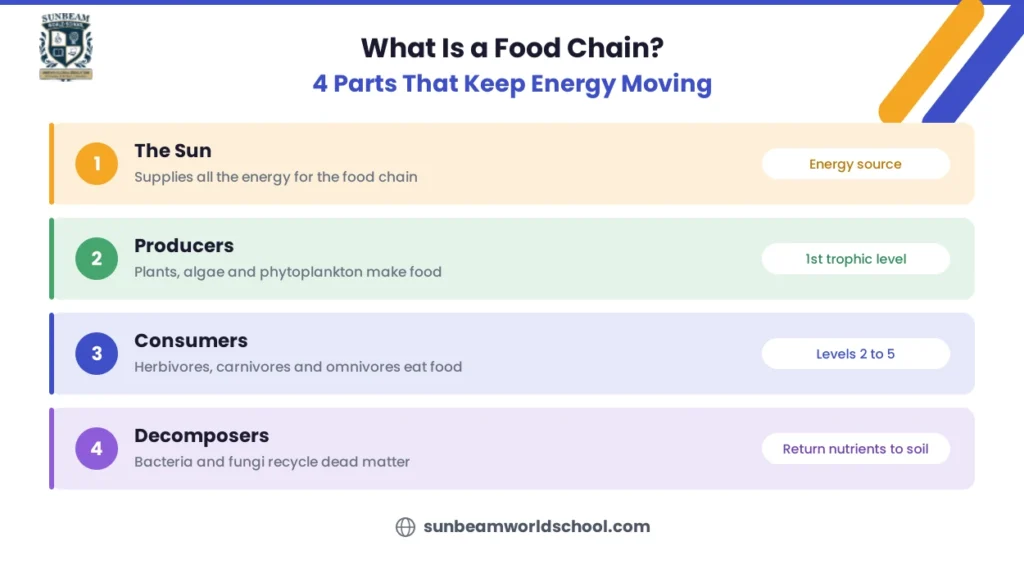
The 4 parts of a food chain that keep energy moving
The arrows in a food chain always point from the food to the animal that eats it, so they show the direction in which energy flows, not who hunts whom. Each step in the chain is called a link or a trophic level, and most chains have three to five links. The idea was made popular by the British ecologist Charles Elton in his 1927 book Animal Ecology, although writers had described animals feeding on one another in a chain for centuries before that. Elton also used the term food cycle for a group of linked food chains, which is what scientists now call a food web.
Food Chain Definition (Biology and Science)
In biology, a food chain is defined as the transfer of food energy from producers through a series of organisms, each eating the one below it, within an ecosystem. Every food chain therefore begins with an organism that makes its own food and ends with one that is not usually eaten by anything else.
To define food chain in biology or general science, a simple food chain definition for exams is: "A food chain is a sequence of organisms through which energy and nutrients pass as one organism eats another." Writing the definition with the words sequence, energy and eats covers the three ideas teachers look for.
Meaning of Food Chain in Simple Words
The meaning of food chain in simple words is "who eats whom" in nature. Plants make food from sunlight, animals eat the plants, bigger animals eat those animals, and when anything dies, tiny decomposers break it down and return its nutrients to the soil.
Think of it like passing a packet of energy along a line of people, where each person keeps most of the packet for themselves and hands on only a small part. That is why the line can never be very long, an idea explained in detail further below.
How Does the Food Chain Work?
The food chain works by moving energy one way, from the Sun to plants, then to plant eaters and meat eaters, with each organism using most of it to live. Decomposers then recycle the nutrients from dead plants and animals so that plants can use them again.
Plants capture sunlight through photosynthesis and store the energy as sugars in their leaves, stems, roots and fruits. When a grasshopper eats a leaf, it takes in that stored energy, but it spends most of it on moving, breathing, keeping warm and growing. When a frog eats the grasshopper, it receives only the small share of energy that was stored in the grasshopper's body, and the same pattern repeats at every link.
What Do Food Chains Start With?
Food chains start with the Sun as the source of energy and a producer, such as a green plant, algae or phytoplankton, as the first living link. Producers are the only organisms that can turn sunlight into food, which is why every grazing food chain begins with them.
There is one interesting exception, since deep-sea food chains near hydrothermal vents start with bacteria that make food from chemicals such as hydrogen sulfide instead of sunlight. This process is called chemosynthesis, and it shows that the first link is always an organism that makes its own food, whatever its energy source.
What Travels Through a Food Chain or Food Web?
Energy and nutrients (matter) travel through a food chain or food web, passing from one organism to the next as food is eaten. Energy flows in one direction only and is lost as heat at each step, while nutrients such as carbon and nitrogen are recycled again and again.
This is the key difference between the two. The Sun has to keep supplying fresh energy every day, while the same atoms of carbon, nitrogen and phosphorus can move from soil to plant to animal and back to soil many times through the work of decomposers.
What Are the Components of a Food Chain?
The components of a food chain are the Sun, producers, consumers and decomposers, and each one plays a fixed role in moving energy and nutrients. Producers make food, consumers eat it, and decomposers break down dead matter so its nutrients return to the soil.
| Component | Role | Examples |
|---|---|---|
| Sun | Supplies energy | Sunlight |
| Producers | Make their own food by photosynthesis | Grass, trees, algae, phytoplankton |
| Primary consumers | Eat producers | Deer, rabbit, grasshopper, cow |
| Secondary consumers | Eat primary consumers | Frog, fox, small fish, sparrow |
| Tertiary consumers | Eat secondary consumers | Snake, hawk, large fish |
| Apex predators | Top of the chain, few or no natural enemies | Tiger, lion, eagle, shark |
| Decomposers | Break down dead plants and animals | Bacteria, fungi |
What Is the Producer of a Food Chain?
The producer of a food chain is a living thing that makes its own food, usually a green plant, algae or phytoplankton using sunlight. Producers are also called autotrophs, which means "self-feeders", and they form the first trophic level of every grazing food chain.
On land, the main producers are grasses, shrubs, crops and trees, while in ponds, rivers and oceans they are algae and tiny floating organisms called phytoplankton. Phytoplankton are so small that most cannot be seen without a microscope, yet they make a huge share of the oxygen on Earth and feed almost every ocean food chain. Every producer in food chain diagrams sits on the far left, and without producers, no other living thing in a food chain would get any energy at all.
In a Food Chain, What Is a Consumer?
In a food chain, a consumer is a living thing that cannot make its own food and must eat plants or other animals to get energy. Consumers are also called heterotrophs, and they are grouped by what they eat and their position in the chain.
Primary Consumers (Herbivores)
Primary consumers are herbivores that eat producers directly, such as cows, deer, rabbits, caterpillars, grasshoppers and zooplankton. They form the second trophic level and are the only link that carries plant energy to the meat eaters above them. Primary consumers are also called first level consumers, and they are the answer to the question "what eats producers?" in any food chain.
Secondary Consumers (Carnivores and Omnivores)
Secondary consumers eat primary consumers, and they are usually small carnivores such as frogs, lizards and spiders, or omnivores such as birds and bears that eat plants and animals. They form the third trophic level.
Tertiary Consumers and Apex Predators
Tertiary consumers eat secondary consumers, such as a snake eating a frog, and they form the fourth trophic level. An apex predator, such as a tiger, lion, eagle, orca or great white shark, sits at the very top and is rarely hunted by any other animal once it is fully grown.
What Are Decomposers and Scavengers in a Food Chain?
Decomposers are bacteria and fungi that break down dead plants and animals into simple nutrients, which go back into the soil for producers to use. Scavengers, such as vultures, hyenas and crows, eat the bodies of dead animals but do not fully break them down.
Detritivores, such as earthworms, millipedes and woodlice, sit between these two groups because they eat pieces of dead leaves and waste and help speed up decomposition. Decomposers work at every level of the food chain, which is why they are often drawn at the side of a food chain diagram with arrows coming in from every organism. Without them, dead matter would pile up and the soil would run out of the nutrients that plants need to grow. A simple food chain of decomposers is dead leaves → fungi → springtails → spiders, where tiny springtails feed on the fungi growing on fallen leaves.
What Are Trophic Levels in a Food Chain?
Trophic levels are the feeding positions in a food chain, numbered from producers at level one to top predators at level four or five. The word trophic comes from the Greek word for nourishment, so each level shows how an organism gets its food, and the terms food chain levels and trophic levels mean the same thing.
| Trophic Level | Who Is There | Example (Grassland) |
|---|---|---|
| 1st | Producers | Grass |
| 2nd | Primary consumers (herbivores) | Grasshopper |
| 3rd | Secondary consumers | Frog |
| 4th | Tertiary consumers | Snake |
| 5th | Quaternary consumers or apex predators | Eagle |
One animal can sit at different trophic levels in different food chains. A bear is a primary consumer when it eats berries and a secondary or tertiary consumer when it eats fish, which is why omnivores make food chains more complicated than they first look.
What Is the First Trophic Level?
The first trophic level is made up of producers, such as plants, algae and phytoplankton, which make their own food from sunlight. This level holds the most energy in any food chain, since every other level depends on the energy that producers store.
Food Chain With 4 Trophic Levels
A food chain with 4 trophic levels has a producer, a primary consumer, a secondary consumer and a tertiary consumer, such as grass → grasshopper → frog → snake. This is also the answer to the common exam question "Describe a food chain with at least four links."
Other food chains with four trophic levels include plants → caterpillar → sparrow → hawk on land and algae → mosquito larva → small fish → kingfisher in a pond. Adding an eagle that eats the snake would turn the first chain into a five-level food chain, also called a food chain of 5 organisms.
What Is at the Top of the Food Chain?
Apex predators, such as tigers, lions, eagles, orcas and great white sharks, are at the top of the food chain because no other animal regularly hunts them as adults. They sit at the fourth or fifth trophic level and receive the least energy of any link.
Because so little energy reaches the top, apex predators are always fewer in number than the animals they eat, and each one needs a large area to find enough food. An adult tiger, for example, may need to hunt many deer in a year, which is why a forest supports only a few tigers but thousands of deer. Removing apex predators often causes the number of herbivores to rise sharply, which can damage the plants that the whole ecosystem depends on.
Are Humans at the Top of the Food Chain?
Humans are not true apex predators in the ecological sense, because most people eat a large amount of plant food along with meat. A 2013 scientific study estimated the average human trophic level at about 2.2, which is similar to an anchovy and far below a tiger or orca.
Humans can still sit at any level, since a person eating rice is a primary consumer, a person drinking milk from a grass-fed cow is a secondary consumer, and a person eating a large fish such as tuna can be a fourth- or fifth-level consumer.
What Is at the Bottom of the Food Chain?
Producers, such as green plants, algae and phytoplankton, are at the bottom of the food chain because they make their own food and are eaten by everything above them. They form the first trophic level and hold the largest amount of energy in the chain.
Decomposers are sometimes also described as being at the bottom, because they feed on dead matter from every level and return nutrients to the soil. Both answers can be accepted, but in most school exams the expected answer is producers.
Why Are Food Chains Limited to 5 Levels?
Food chains are limited to 4 or 5 levels because only about 10% of the energy at one level passes to the next, leaving too little energy for another level.
The other 90% is used by each organism for breathing, moving, digesting and staying warm, and much of it escapes as heat. Some energy also stays locked in parts that are not eaten, such as bones, roots and fur. By the time energy reaches the fifth level, only about 0.01% of what the plants first captured is left, so a sixth-level predator would need an impossibly large area to find enough food.
What Is the 10% Energy Rule?
The 10% energy rule says that only about 10% of the energy at one trophic level passes to the next, while about 90% is used up or lost as heat. This rule, also called the ten percent law, was proposed by the American ecologist Raymond Lindeman in 1942.
| Trophic Level | Organism | Energy Available |
|---|---|---|
| 1st | Grass | 10,000 J |
| 2nd | Grasshopper | 1,000 J |
| 3rd | Frog | 100 J |
| 4th | Snake | 10 J |
| 5th | Eagle | 1 J |
The real figure varies between about 5% and 20% depending on the animals and the ecosystem, but 10% is a good average and the value used in school exams. This rule also explains why eating plants directly feeds more people than eating animals that were fed on plants, since the energy passes through one link instead of two.
How Does a Food Pyramid Show Energy Loss?
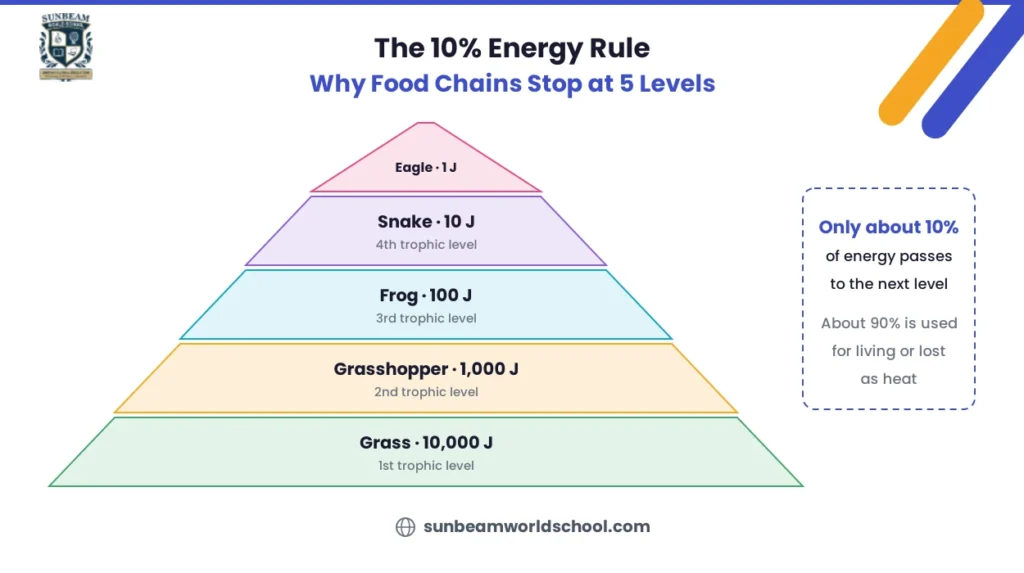
Only about 10% of energy passes to the next level, which is why food chains stop at 5 levels
A food pyramid, also called an energy pyramid, shows energy loss by drawing each trophic level as a layer that gets smaller towards the top. The wide base shows producers with the most energy, and the narrow tip shows top predators with the least.
[Image: energy-pyramid-food-chain.webp, energy pyramid with grass, grasshopper, frog, snake and eagle and energy values at each level. Alt text: "Energy pyramid showing the 10 percent rule in a food chain"]
An energy pyramid can never be turned upside down, because no level can ever have more energy than the level it feeds on. Pyramids of numbers can sometimes be inverted, such as one tree supporting thousands of insects, but an energy pyramid always keeps its upright shape.
What Are the Types of Food Chain?
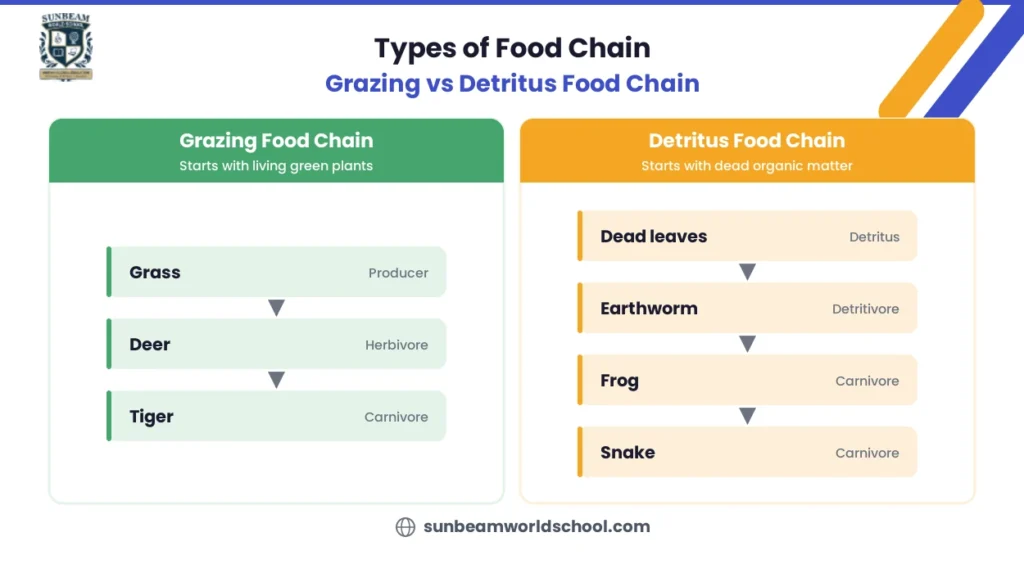
Grazing food chains start with living plants, while detritus food chains start with dead matter
There are two main types of food chain, the grazing food chain and the detritus food chain. Food chains can also be grouped by how energy moves, into predator, parasitic and saprophytic chains, or by habitat, into terrestrial and aquatic chains.
[Image: types-of-food-chain.webp, side-by-side grazing and detritus food chains with examples. Alt text: "Types of food chain: grazing food chain and detritus food chain"]
What Are the 2 Main Types of Food Chain?
The 2 main types of food chain are the grazing food chain, which starts with living green plants, and the detritus food chain, which starts with dead organic matter. Both types are linked in nature, since dead plants and animals from a grazing chain become food for a detritus chain.
Grazing Food Chain
A grazing food chain starts with living green plants and passes energy to herbivores and then to carnivores, such as grass → deer → tiger. It gets its energy directly from sunlight captured by producers, and it is the type of food chain most people picture first.
Grazing food chains are common in grasslands, forests, farms and the open ocean, where plants or phytoplankton are eaten while they are still alive. Energy moves quickly through this type of chain, because herbivores feed directly on fresh plant material.
Detritus Food Chain
A detritus food chain starts with dead plants, dead animals and waste, called detritus, and passes energy to detritivores and decomposers and then to the animals that eat them. An example is dead leaves → earthworm → frog → snake.
Detritus food chains are very important in forests, where a thick layer of fallen leaves covers the ground, and in mangroves and the deep sea, where little sunlight reaches. In many forests, more energy flows through the detritus food chain than through the grazing food chain, since most leaves are never eaten while they are alive.
Difference Between Grazing and Detritus Food Chain
The difference between grazing and detritus food chains is their starting point, since a grazing chain begins with living plants while a detritus chain begins with dead organic matter.
| Feature | Grazing Food Chain | Detritus Food Chain |
|---|---|---|
| Starts with | Living green plants | Dead plants, animals and waste |
| Energy source | Sunlight, directly through producers | Energy stored in dead organic matter |
| First consumers | Herbivores | Detritivores and decomposers |
| Main organisms | Plants, herbivores, carnivores | Bacteria, fungi, earthworms, insects |
| Speed of energy flow | Fast | Slow |
| Example | Grass → deer → tiger | Dead leaves → earthworm → frog → snake |
What Are the Other Types of Food Chain?
The other types of food chain are the predator, parasitic and saprophytic food chains, grouped by how energy passes from one organism to the next. These are useful for understanding special feeding relationships in nature.
Predator Food Chain
A predator food chain moves energy from smaller animals to larger animals that hunt and eat them, such as plants → caterpillar → lizard → hawk. Each predator is usually bigger and fewer in number than its prey, which is the pattern seen in most grazing food chains.
Parasitic Food Chain
A parasitic food chain moves energy from a large host to smaller organisms that live on or inside it, such as dog → flea → protozoan. Unlike a predator chain, each link is usually smaller but more numerous than the one before it, since many parasites can live on a single host.
Saprophytic Food Chain
A saprophytic food chain moves energy from dead organic matter to fungi and bacteria that absorb nutrients from it, such as a fallen tree → mushrooms and other fungi. Saprophytes digest food outside their bodies and then absorb it, which makes them the main recyclers in every ecosystem.
What Are the Types of Food Chain Based on Habitat?
Food chains based on habitat are divided into terrestrial (land) food chains and aquatic (water) food chains, depending on where the organisms live. Land chains usually start with plants, while water chains usually start with algae or phytoplankton.
Terrestrial (Land) Food Chain
A terrestrial food chain, also called a land food chain, links organisms that live on land, such as forests, grasslands and deserts. An example is grass → rabbit → fox → eagle, where the producers are grasses, shrubs or trees.
Aquatic Food Chain
An aquatic food chain links organisms that live in water, such as ponds, rivers, lakes and oceans, and it usually starts with phytoplankton or algae. An example is phytoplankton → zooplankton → small fish → tuna → shark.
Aquatic food chains are often longer than land food chains, since phytoplankton are eaten by tiny zooplankton, which adds an extra link before the first fish.
What Is an Example of a Food Chain?
An example of a food chain is grass → grasshopper → frog → snake → eagle, where grass is the producer and the eagle is the apex predator. The food chain examples below cover every major habitat.
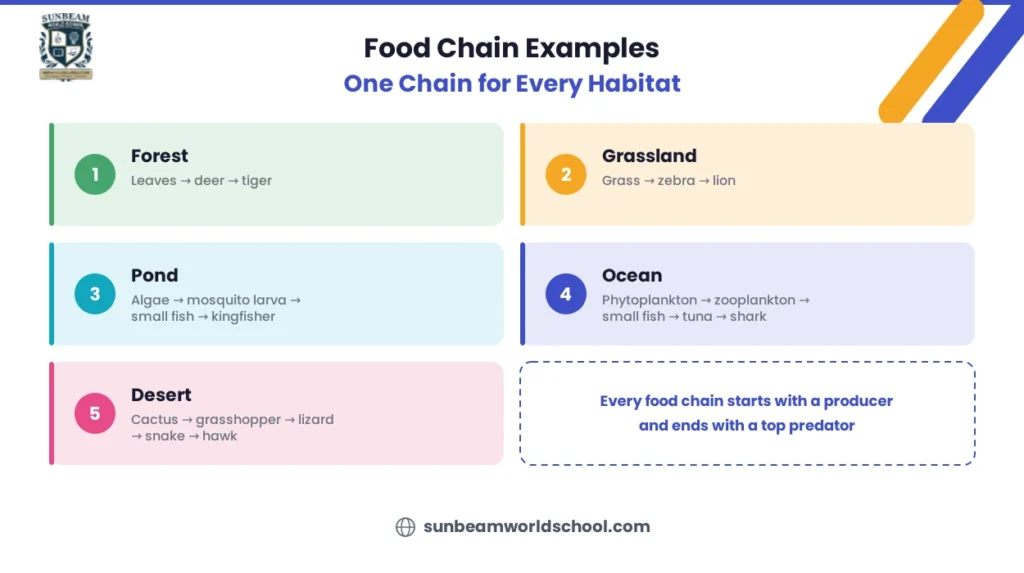
A grassland food web, where many food chains link together
These food chain images can be printed as picture cards, and real photos of food chain animals from a zoo visit or nature book work just as well for younger children.
Simple and Sample Food Chain Examples
Simple food chain examples have just three or four links, which makes each sample food chain easy for young children to understand and draw as a basic food chain.
- Grass → cow → human
- Grass → goat → lion
- Plants → rabbit → fox
- Leaves → caterpillar → bird
- Seeds → mouse → owl
- Flower nectar → butterfly → spider
Animal Food Chain
An animal food chain shows how animals depend on plants and each other for energy, such as grass → rabbit → fox → eagle. A farm example is grain and insects → chicken → fox. Most animals in a food chain are herbivores, carnivores, omnivores or scavengers.
Animals and the food chain are closely linked, since an animal's teeth, claws and body shape often show its place in the chain. Herbivores such as cows have flat teeth for grinding plants, while carnivores such as tigers have sharp teeth for tearing meat, and learning these animal names in English alongside their foods helps children place each animal correctly.
Food Chain of a Forest Ecosystem
A food chain of a forest ecosystem is tree leaves → deer → tiger, where trees and shrubs are the producers and the tiger is the apex predator. A longer forest food chain is leaves → caterpillar → sparrow → snake → eagle.
Forests in India, such as those in Jim Corbett and Ranthambore, support food chains such as grass → chital deer → tiger and fruits → langur monkey → leopard. The thick leaf litter on the forest floor also supports large detritus food chains, with earthworms, millipedes and fungi feeding on fallen leaves.
Grassland Food Chain
A grassland food chain is grass → zebra → lion on the African savanna, where grasses are the producers and lions are the apex predators. A smaller grassland food chain is grass → grasshopper → frog → snake → hawk.
Grasslands have fewer trees, so most of the energy is captured by grasses and passed on to large herds of grazing animals such as zebras, antelopes and bison.
Pond and Ocean Food Chain
A pond food chain is algae → mosquito larva → small fish → kingfisher, while an ocean food chain is phytoplankton → zooplankton → small fish → tuna → shark. Both start with tiny water producers rather than large land plants.
In the cold Antarctic Ocean, a short but very important food chain is phytoplankton → krill → blue whale, where the largest animal on Earth feeds on tiny shrimp-like krill.
What Is a Food Chain for the Desert?
A food chain for the desert is cactus or desert shrubs → grasshopper → lizard → snake → hawk. Desert plants such as cacti store water in their thick stems, and they are the producers that support every other desert animal.
In the Thar Desert of India, a common food chain is desert grass → gerbil → desert snake → eagle. Desert food chains are usually short because so few plants can grow there, which limits how much energy enters the chain.
Food Chain of Humans
A food chain of humans is wheat → human when people eat plant foods, and grass → cow → human when people drink milk or eat dairy products. Humans are omnivores, so they appear as primary, secondary or tertiary consumers depending on the food.
A longer human food chain is phytoplankton → small fish → tuna → human, which places a person at the fourth level. This also means humans can take in more harmful chemicals from long food chains, an idea explained in the section on biomagnification below.
Food Chain Diagram
A food chain diagram shows organisms in a line, joined by arrows pointing from the food to the eater, with the Sun at the start and decomposers below. Labelling each organism's trophic level makes the diagram clear and exam-ready.
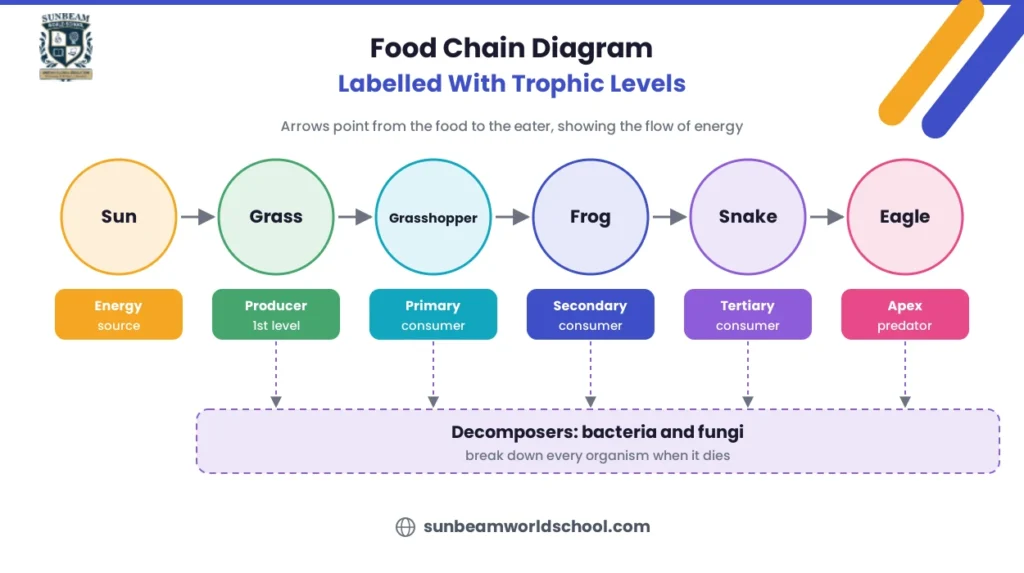
A labelled food chain diagram, with arrows pointing from the food to the eater
When drawing a simple food chain diagram, write the producer on the left, add each consumer to its right, and draw arrows pointing towards the eater, so the arrows follow the flow of energy. Add a small box for decomposers underneath, with dotted arrows from every organism, to show that all living things are broken down when they die.
What Is the Difference Between a Food Chain and a Food Web?
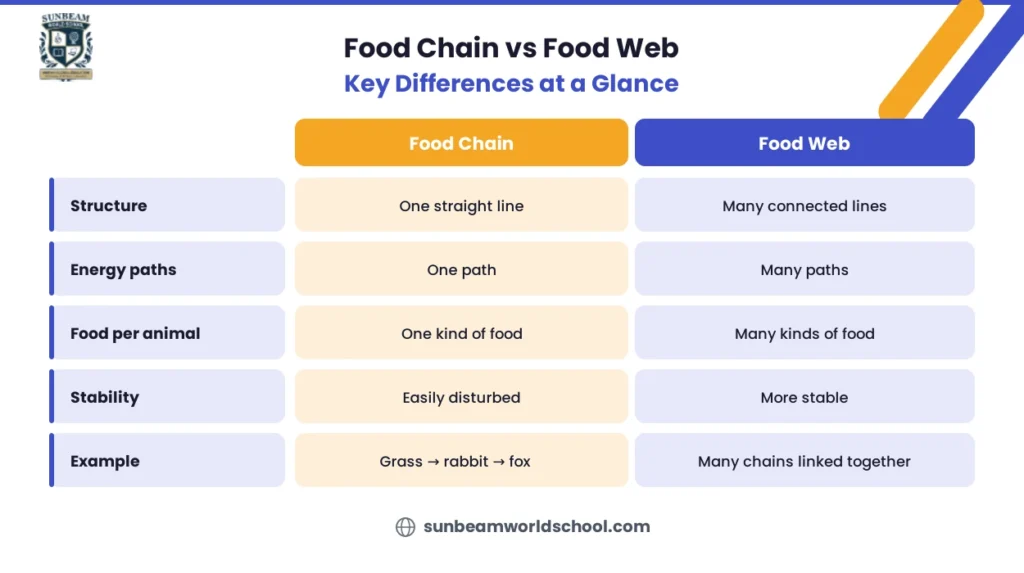
Food chain vs food web: the key differences at a glance
A food chain is a single straight path of energy from one organism to the next, while a food web is many food chains joined together in one ecosystem. Food webs are closer to real life, since most animals eat more than one kind of food.
| Feature | Food Chain | Food Web |
|---|---|---|
| Structure | One straight line | Many connected lines |
| Number of paths | One path for energy | Many paths for energy |
| Food per animal | Each animal eats one kind of food | Each animal can eat many kinds of food |
| Stability | Easily disturbed if one link is lost | More stable, since animals can switch food |
| Example | Grass → rabbit → fox | Grass eaten by rabbits, deer and insects, which are eaten by foxes, snakes and birds |
Removing one link from a food chain can break the whole chain, but in a food web an animal can usually switch to another food source. This is why ecosystems with many species and complex food webs tend to recover better from changes such as disease or drought.
What Is a Food Web?
A food web is a network of many connected food chains in one ecosystem, showing every feeding link between its producers, consumers and decomposers. In biology, a food web is defined as all the interlinked food chains in an ecological community.
A food web in an ecosystem shows that energy can reach a top predator through many different paths, which is why food webs are a more realistic picture of nature than a single food chain.
Food Web Example
A food web example with 10 organisms is a grassland made of grass, grasshoppers, rabbits, mice, frogs, sparrows, snakes, foxes, eagles and fungi, all linked by many feeding paths.
- Grasshoppers, rabbits and mice eat grass.
- Frogs and sparrows eat grasshoppers.
- Snakes eat frogs and mice.
- Foxes eat rabbits and mice.
- Eagles eat snakes, sparrows and rabbits.
- Fungi break down the remains of all of them when they die.
Each of these links is part of a separate food chain, and together they form one food web.
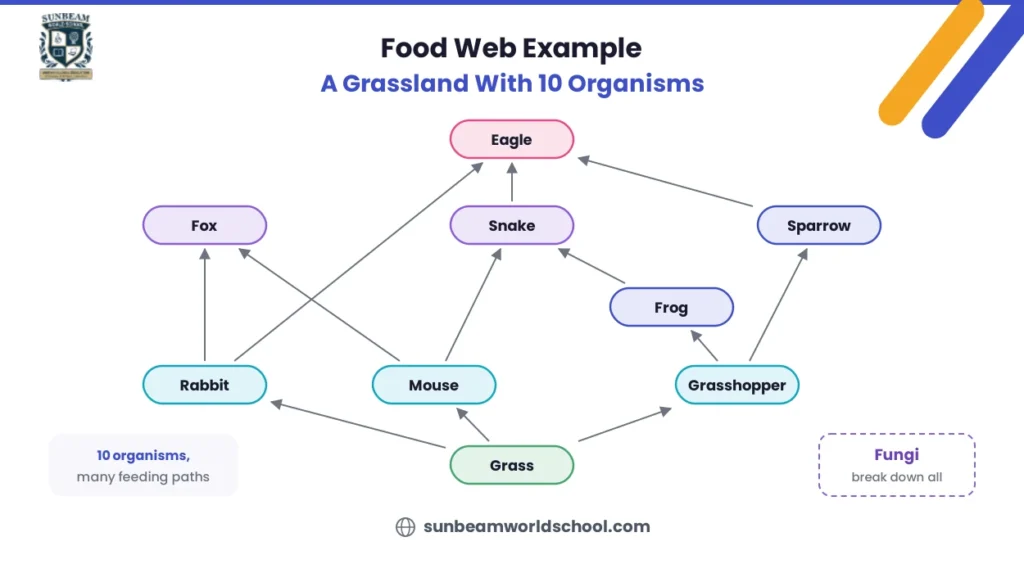
A grassland food web, where many food chains link together
Why Are Food Chains Important?
Food chains are important because they show how energy and nutrients move through an ecosystem and how a change at one level affects every other level. They also help scientists protect wildlife and track pollution.
In short, a food chain shows who eats whom and which way energy flows, and the purpose of a food chain as a science model is to make these feeding links easy to see and study.
Food chains keep the number of each species in balance, since predators stop herbivores from eating all the plants, and plants decide how many herbivores an area can support. Farmers, fishery managers and wildlife officers use food chain knowledge to decide how many fish can be caught safely, how to control pests without harmful sprays and why protecting a top predator such as the tiger also protects its whole forest.
What Is the Role of a Food Chain in an Ecosystem?
The role of a food chain in an ecosystem is to move energy from producers to consumers and to recycle nutrients through decomposers, keeping every population in balance. Each ecosystem food chain links plants, animals and microbes into one working system.
A food chain in an ecosystem such as a forest, pond or grassland also controls how many animals can live there, since the amount of plant growth at the bottom sets the limit for every level above it.
What Happens When One Link Is Removed?
When one link is removed from a food chain, the animals that ate it lose food and may decline, while the organisms it ate may grow out of control. This chain reaction is called a trophic cascade, and it can change an entire ecosystem.
A famous example comes from the Pacific coast of North America, where sea otters eat sea urchins, and sea urchins eat kelp. When sea otters were hunted almost to extinction, sea urchin numbers exploded and ate the kelp forests, which destroyed the home of many fish. When sea otters returned, the urchins were controlled and the kelp forests grew back. A species like the sea otter, whose role is far bigger than its numbers, is called a keystone species.
How Do Harmful Chemicals Build Up in a Food Chain?
Harmful chemicals build up in a food chain through biomagnification, where a chemical the body cannot break down becomes more concentrated at every higher trophic level. Top predators therefore carry the highest levels of these chemicals.
The pesticide DDT is the best-known example, since it washed into water, was absorbed by plankton, passed to small fish, then to bigger fish and finally to fish-eating birds such as eagles and ospreys. In these birds, DDT made eggshells so thin that they broke during nesting, and populations fell sharply until DDT was banned for farm use in many countries. Mercury in large ocean fish such as swordfish and shark builds up in the same way, which is one reason health guides advise limiting how often these fish are eaten.
How to Make a Food Chain?
You make a food chain by choosing a habitat, starting with a producer, adding consumers that eat each previous link and drawing arrows from food to eater. Label each trophic level at the end, and the activity takes about 15 minutes at home or in class.
- Choose a habitat. Pick one place, such as a forest, pond, garden or desert, so all the organisms live together.
- Start with a producer. Write or draw a plant, algae or phytoplankton on the left side of the page.
- Add a primary consumer. Choose an animal that eats the producer, such as a caterpillar for leaves.
- Add secondary and tertiary consumers. Add an animal that eats the previous one, such as a bird, and then one that eats the bird, such as a snake or hawk.
- Draw arrows towards the eater. Each arrow points from the food to the animal that eats it, showing the flow of energy.
- Label the trophic levels. Write producer, primary consumer, secondary consumer and so on under each organism.
- Add decomposers. Draw bacteria and fungi at the bottom, with arrows from every organism.
Children can make a food chain with picture cards, paper plates joined by string or a garden walk where they spot real producers and consumers, and hands-on projects like these fit easily into homeschooling with an online school. Once students can build one chain, they can join several chains from the same habitat into a food web.
In Which Class Do Students Learn About the Food Chain?
CBSE students study food chains in detail in the Class 10 Science chapter Our Environment, after first meeting them in middle school, and again in Class 12 Biology. The Class 10 chapter covers trophic levels, the 10% law and biomagnification, while the Class 12 chapter Ecosystem adds ecological pyramids and energy flow in more depth.
Board exam questions on this topic often ask students to draw a food chain with four trophic levels, calculate energy at each level using the 10% law or explain why food chains are short. Learning these as diagrams and small tables, and then testing yourself by redrawing them from memory, is one of the habits that sets apart a top 1% student.
What Are Some Fun Facts About Food Chains?
Fun facts about food chains show how surprising nature can be, from ocean plankton that make much of Earth's oxygen to deep-sea food chains that run without any sunlight.
- Tiny producers, huge impact: ocean phytoplankton produce roughly half of the oxygen on Earth, and they are the first link in almost every ocean food chain.
- The biggest animal has one of the shortest chains: the blue whale feeds mostly on krill, which feed on phytoplankton, so its food chain has just three links.
- Food chains without sunlight: near deep-sea hydrothermal vents, bacteria make food from chemicals, supporting tube worms, crabs and fish in total darkness.
- Plants that eat animals: the Venus flytrap and pitcher plant are producers that make food by photosynthesis, yet they also trap insects for extra nutrients.
- Orcas can hunt sharks: killer whales have been recorded hunting great white sharks, which shows that even an apex predator can have a bigger predator.
- Very little energy reaches the top: out of 10,000 joules captured by grass, only about 1 joule reaches an eagle at the fifth level.
Conclusion
A food chain is simply energy passed from plant to animal to decomposer, losing about 90% at every step, which is why chains stay short and every link matters. Students who want to explore science topics like this with a live teacher at their own pace can learn through personalized learning at Sunbeam World School.

Frequently Asked Questions
What is a food chain in simple words?
-A food chain in simple words is the order of who eats whom in nature. Plants make food from sunlight, animals eat the plants, bigger animals eat those animals, and decomposers break everything down when it dies, returning nutrients to the soil.
What do food chains start with?
+What is the producer in a food chain?
+What is at the top of the food chain?
+Why are food chains limited to 5 levels?
+What is the difference between a food chain and a food web?
+What are the different types of food chain?
+Can there be a food chain without herbivores and carnivores?
+What role do humans play in a food chain?
+What is a food chain with four links?
+
In this article
Share this post:


Press and Blogs
Stay updated with our press releases, educational blogs, and more.
Quick Summary There are 25 prime numbers from 1 to 100: 2, 3, 5, 7,...
Quick Summary An algebra equation is a maths statement that sets two expressions equal using...
Quick Summary The area of rectangle equals its length multiplied by its width (A =...