
 Kids Learning
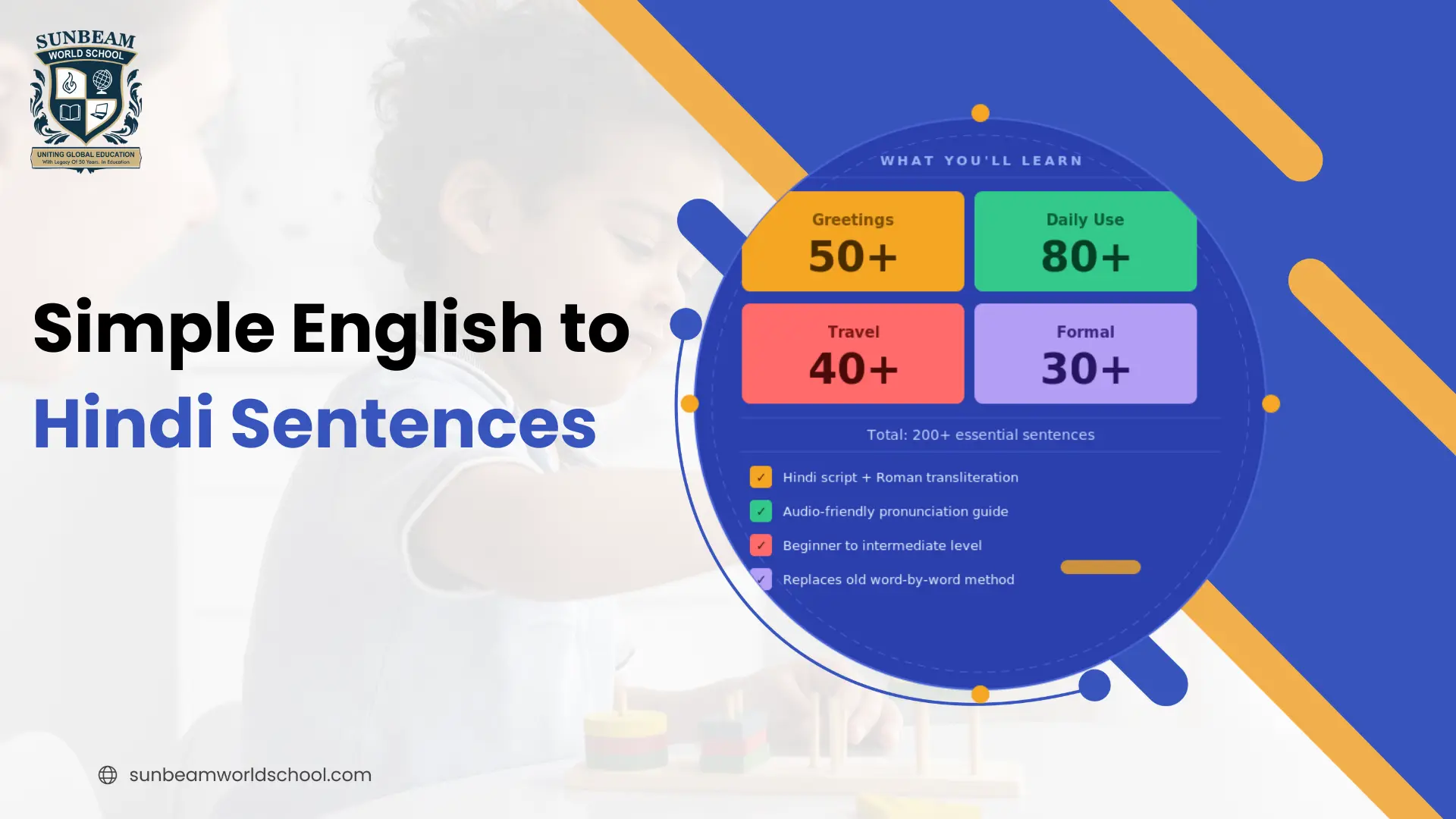
200+ Simple English to Hindi Sentences
| Learning a daily use sentence Hindi to English is one of the quickest ways to improve spoken communication and language fluency. Rather than memorising isolated words, practicing complete sentences helps learners understand vocabulary, grammar, pronunciation, and real-world context simultaneously. Common daily use sentences cover greetings, introductions, school conversations, family interactions, shopping, travel, health, emotions, and everyday questions.
To translate English sentences into Hindi, remember that Hindi typically follows a Subject-Object-Verb (SOV) structure, unlike English's Subject-Verb-Object (SVO) pattern. Verbs also change according to gender and number, while words such as है (hai), हैं (hain), and हूँ (hoon) are used to complete sentences correctly. Understanding these basic rules makes it easier to create new sentences independently. |
Want to speak confidently in both Hindi and English? Learning a daily use sentence Hindi to English is one of the fastest and most effective ways to improve communication skills. Instead of memorising individual words, practicing complete sentences helps you understand vocabulary, grammar, pronunciation, and real-life usage all at once.
In this comprehensive guide, you'll find 200+ daily use sentence Hindi to English examples organised into practical categories such as greetings, school conversations, family discussions, shopping, travel, food, emotions, health, and more. Whether you're a student, parent, beginner language learner, or someone looking to strengthen spoken English and Hindi skills, these sentences will help you communicate naturally in everyday situations.
Along with sentence examples, you'll also learn simple Hindi grammar rules, sentence-building techniques, and memory tips that make language learning easier and more enjoyable.
Why Learn English to Hindi Sentences?
Learning sentences — not isolated words — is the proven fastest path to spoken fluency. A single sentence teaches you vocabulary, grammar, pronunciation and context all at once. For Indian students, NRI families, language learners, and anyone working with Hindi-speaking communities, a strong stock of daily use sentences is the difference between hesitating and speaking with confidence.
This guide is built differently from typical sentence lists. Instead of 20 random examples, you get themed sets covering greetings, school, home, shopping, travel, doctor visits, emotions and more — the actual situations you face every day.
How to Make Sentences in Hindi from English Words
Before the sentence lists, here is the simple grammar framework that lets you build your own Hindi sentences from any English words. Master this section and you will not need to memorise every sentence — you will create them yourself.
1. Hindi follows Subject-Object-Verb (SOV) order
English is Subject-Verb-Object: I (S) eat (V) food (O). Hindi flips the verb to the end: मैं खाना खाता हूँ। (Main khaana khaata hoon — literally "I food eat am.") Once you internalise this single rearrangement, most short sentences translate mechanically.
2. Verbs change with gender and number
Hindi verbs agree with the subject's gender. A male speaker says main jaata hoon (I go), a female says main jaati hoon. Plural subjects use -te endings: hum jaate hain (we go). The chart below covers the three forms you will use 90% of the time.
| English | हिंदी (male) | हिंदी (female) | Roman |
| I go | मैं जाता हूँ | मैं जाती हूँ | Main jaata / jaati hoon |
| You go (formal) | आप जाते हैं | आप जाती हैं | Aap jaate / jaati hain |
| He/She goes | वह जाता है | वह जाती है | Woh jaata / jaati hai |
| We go | हम जाते हैं | हम जाती हैं | Hum jaate / jaati hain |
3. Three levels of formality: tu / tum / aap
Aap (आप) is formal and respectful — use it with strangers, elders, teachers, customers. Tum (तुम) is friendly — use with friends, classmates, siblings. Tu (तू) is intimate or rude depending on context — use only with very close friends or family. When in doubt, always use aap.
4. The "to be" forms: hai, hain, hoon
These three little words attach to almost every sentence. Hoon (हूँ) for "I", hai (है) for he/she/it, hain (हैं) for we, you (formal), they.
The 4-step method to translate any English sentence into Hindi
- Identify the subject, object and verb in English.
- Reorder as Subject → Object → Verb.
- Adjust the verb to match gender and number.
- Add the correct hai/hain/hoon at the end.
Example: "She reads a book." → Subject (she) + Object (book) + Verb (reads). → वह किताब पढ़ती है। (Woh kitaab padhti hai.) That is the entire process.
Further, if you want to build the vocabulary of your child then, with our list of wild animal names in English with Hindi meaning and pictures. It is going to be a perfect learning for Class 1–5 bilingual learners.
20 Daily Use Sentence Hindi to English Examples
Bookmark this table — these 20 are the most-searched daily use sentence Hindi to English pairings that cover the bulk of everyday Indian conversation.
| English | हिंदी | Roman |
| Hello, how are you? | नमस्ते, आप कैसे हैं? | Namaste, aap kaise hain? |
| I am fine, thank you. | मैं ठीक हूँ, धन्यवाद। | Main theek hoon, dhanyavaad. |
| What is your name? | आपका नाम क्या है? | Aapka naam kya hai? |
| My name is Rahul. | मेरा नाम राहुल है। | Mera naam Rahul hai. |
| Nice to meet you. | आपसे मिलकर अच्छा लगा। | Aapse milkar achha laga. |
| Where do you live? | आप कहाँ रहते हैं? | Aap kahaan rehte hain? |
| I am from India. | मैं भारत से हूँ। | Main Bharat se hoon. |
| I do not understand. | मुझे समझ नहीं आया। | Mujhe samajh nahin aaya. |
| Please speak slowly. | कृपया धीरे बोलिए। | Kripya dheere boliye. |
| Could you repeat that? | क्या आप फिर से कह सकते हैं? | Kya aap phir se keh sakte hain? |
| Thank you very much. | बहुत-बहुत धन्यवाद। | Bahut-bahut dhanyavaad. |
| Please excuse me. | कृपया मुझे माफ़ कीजिए। | Kripya mujhe maaf kijiye. |
| I love this place. | मुझे यह जगह बहुत पसंद है। | Mujhe yeh jagah bahut pasand hai. |
| What time is it? | कितने बज रहे हैं? | Kitne baj rahe hain? |
| I am hungry. | मुझे भूख लगी है। | Mujhe bhookh lagi hai. |
| I am tired. | मैं थक गया हूँ। | Main thak gaya hoon. |
| How much does this cost? | यह कितने का है? | Yeh kitne ka hai? |
| I will see you later. | मैं आपसे बाद में मिलूँगा। | Main aapse baad mein milunga. |
| Take care of yourself. | अपना ख्याल रखिए। | Apna khayaal rakhiye. |
| Goodbye, see you tomorrow. | अलविदा, कल मिलते हैं। | Alvida, kal milte hain. |
Greetings, Introductions and Small Talk
Greetings are the first impression — getting them right opens doors. These 15 sentences cover formal and informal hellos, introductions, and the kind of polite small talk that fills the first minute of any conversation.
| English | हिंदी | Roman |
| Good morning! | सुप्रभात! | Suprabhat! |
| Good evening! | शुभ संध्या! | Shubh sandhya! |
| How is everything? | सब कैसा है? | Sab kaisa hai? |
| Long time no see! | बहुत दिनों बाद मिले! | Bahut dino baad mile! |
| How is your family? | परिवार कैसा है? | Parivaar kaisa hai? |
| Everyone is well, thanks. | सब ठीक हैं, धन्यवाद। | Sab theek hain, dhanyavaad. |
| Please come in. | कृपया अंदर आइए। | Kripya andar aaiye. |
| Have a seat, please. | कृपया बैठिए। | Kripya baithiye. |
| This is my friend Anu. | यह मेरी दोस्त अनु है। | Yeh meri dost Anu hai. |
| I am a student. | मैं एक छात्र हूँ। | Main ek chhaatra hoon. |
| I work in Bhopal. | मैं भोपाल में काम करता हूँ। | Main Bhopal mein kaam karta hoon. |
| What do you do? | आप क्या करते हैं? | Aap kya karte hain? |
| How old are you? | आपकी उम्र क्या है? | Aapki umar kya hai? |
| Welcome to our home. | हमारे घर में आपका स्वागत है। | Hamaare ghar mein aapka swaagat hai. |
| It was lovely meeting you. | आपसे मिलकर बहुत खुशी हुई। | Aapse milkar bahut khushi hui. |
Daily Routine Sentences: Morning to Night
From waking up to going to sleep, these are the sentences you actually use at home every day. Further, get inspiration for daily reflection with good thoughts in English with Hindi meaning.
| English | हिंदी | Roman |
| I woke up early today. | मैं आज जल्दी उठा। | Main aaj jaldi utha. |
| I am brushing my teeth. | मैं दाँत साफ़ कर रहा हूँ। | Main daant saaf kar raha hoon. |
| I am having tea. | मैं चाय पी रहा हूँ। | Main chai pee raha hoon. |
| What is for breakfast? | नाश्ते में क्या है? | Naashte mein kya hai? |
| I am going to school. | मैं स्कूल जा रहा हूँ। | Main school jaa raha hoon. |
| I will be back at six. | मैं छह बजे वापस आऊँगा। | Main chhah baje vapas aaunga. |
| Let's have lunch together. | चलिए साथ में दोपहर का खाना खाते हैं। | Chaliye saath mein dopahar ka khana khaate hain. |
| I need a short nap. | मुझे थोड़ी नींद चाहिए। | Mujhe thodi neend chaahiye. |
| I am going for a walk. | मैं टहलने जा रहा हूँ। | Main tahalne jaa raha hoon. |
| Dinner is ready. | रात का खाना तैयार है। | Raat ka khana taiyaar hai. |
| Please switch off the light. | कृपया लाइट बंद कर दीजिए। | Kripya light band kar dijiye. |
| I am going to sleep. | मैं सोने जा रहा हूँ। | Main sone jaa raha hoon. |
| Good night, sweet dreams. | शुभ रात्रि, मीठे सपने। | Shubh raatri, meethe sapne. |
| Set the alarm for seven. | सात बजे का अलार्म लगा दो। | Saat baje ka alarm laga do. |
| Wake me up early. | मुझे जल्दी जगा देना। | Mujhe jaldi jaga dena. |
English Sentences To Be Used At School
Useful for Class 1 to Class 10 students, parents helping with homework, and anyone in a classroom setting.
| English | हिंदी | Roman |
| May I come in, ma'am? | क्या मैं अंदर आ सकता हूँ? | Kya main andar aa sakta hoon? |
| I forgot my notebook. | मैं अपनी कॉपी भूल गया। | Main apni copy bhool gaya. |
| May I go to the washroom? | क्या मैं वॉशरूम जा सकता हूँ? | Kya main washroom jaa sakta hoon? |
| Please explain it again. | कृपया फिर से समझाइए। | Kripya phir se samjhaaiye. |
| I have a doubt. | मुझे एक सवाल है। | Mujhe ek sawaal hai. |
| The homework is too hard. | गृहकार्य बहुत कठिन है। | Grihkaarya bahut kathin hai. |
| I got 90 out of 100. | मुझे 100 में से 90 अंक मिले। | Mujhe 100 mein se 90 ank mile. |
| The exam is next week. | परीक्षा अगले हफ़्ते है। | Pareeksha agle hafte hai. |
| I love science. | मुझे विज्ञान बहुत पसंद है। | Mujhe vigyaan bahut pasand hai. |
| Maths is my favourite subject. | गणित मेरा पसंदीदा विषय है। | Ganit mera pasandida vishay hai. |
| I will study tonight. | मैं आज रात पढ़ूँगा। | Main aaj raat padhunga. |
| The teacher is very kind. | शिक्षक बहुत दयालु हैं। | Shikshak bahut dayalu hain. |
| Open your books to page 12. | किताब के पन्ना 12 खोलिए। | Kitaab ke panna 12 kholiye. |
| I will do my best. | मैं पूरी कोशिश करूँगा। | Main poori koshish karoonga. |
| School is over. | स्कूल की छुट्टी हो गई। | School ki chhutti ho gayi. |
At Home and With Family English Sentences
| English | हिंदी | Roman |
| Please pass the salt. | कृपया नमक दीजिए। | Kripya namak dijiye. |
| The food is delicious. | खाना बहुत स्वादिष्ट है। | Khaana bahut swaadisht hai. |
| I will wash the dishes. | मैं बर्तन धो दूँगा। | Main bartan dho doonga. |
| The TV is too loud. | टीवी की आवाज़ बहुत तेज़ है। | TV ki aawaaz bahut tez hai. |
| I miss my grandparents. | मुझे अपने दादा-दादी की याद आती है। | Mujhe apne dada-dadi ki yaad aati hai. |
| Call me when you reach. | पहुँचने पर मुझे फ़ोन कीजिए। | Pahunchne par mujhe phone kijiye. |
| My mother is cooking. | मेरी माँ खाना बना रही हैं। | Meri maa khaana bana rahi hain. |
| Help me clean the room. | कमरा साफ़ करने में मेरी मदद कीजिए। | Kamra saaf karne mein meri madad kijiye. |
| The electricity is out. | बिजली चली गई है। | Bijli chali gayi hai. |
| I need to charge my phone. | मुझे अपना फ़ोन चार्ज करना है। | Mujhe apna phone charge karna hai. |
| Lock the door, please. | कृपया दरवाज़ा बंद कर दीजिए। | Kripya darwaaza band kar dijiye. |
| I love my family. | मुझे अपने परिवार से प्यार है। | Mujhe apne parivaar se pyaar hai. |
Shopping, Money and the Market
| English | हिंदी | Roman |
| How much is this? | यह कितने का है? | Yeh kitne ka hai? |
| That is too expensive. | यह बहुत महँगा है। | Yeh bahut mehnga hai. |
| Can you reduce the price? | क्या आप दाम कम कर सकते हैं? | Kya aap daam kam kar sakte hain? |
| I will take two. | मैं दो लूँगा। | Main do loonga. |
| Do you accept UPI? | क्या आप यूपीआई लेते हैं? | Kya aap UPI lete hain? |
| Please give me a receipt. | कृपया रसीद दे दीजिए। | Kripya raseed de dijiye. |
| This is not what I wanted. | यह वह नहीं है जो मुझे चाहिए था। | Yeh woh nahin hai jo mujhe chaahiye tha. |
| Can I exchange this? | क्या मैं इसे बदल सकता हूँ? | Kya main ise badal sakta hoon? |
| Is there a discount? | क्या कोई छूट है? | Kya koi chhoot hai? |
| Show me another colour. | मुझे दूसरा रंग दिखाइए। | Mujhe doosra rang dikhaaiye. |
| I am just looking, thanks. | मैं बस देख रहा हूँ, धन्यवाद। | Main bas dekh raha hoon, dhanyavaad. |
| Where is the billing counter? | बिलिंग काउंटर कहाँ है? | Billing counter kahaan hai? |
Travel, Directions and Transport
| English | हिंदी | Roman |
| Where is the railway station? | रेलवे स्टेशन कहाँ है? | Railway station kahaan hai? |
| How do I get to the airport? | हवाई अड्डा कैसे पहुँचूँ? | Hawaai adda kaise pahunchoon? |
| Please take me to this address. | कृपया मुझे इस पते पर ले चलिए। | Kripya mujhe is pate par le chaliye. |
| How far is it? | वह कितनी दूर है? | Woh kitni door hai? |
| Turn left here. | यहाँ बाएँ मुड़िए। | Yahaan baayen mudiye. |
| Turn right at the signal. | सिग्नल पर दाएँ मुड़िए। | Signal par daayen mudiye. |
| Go straight, please. | सीधे जाइए। | Seedhe jaaiye. |
| Stop here. | यहाँ रोक दीजिए। | Yahaan rok dijiye. |
| What time is the train? | ट्रेन कितने बजे है? | Train kitne baje hai? |
| The bus is late. | बस देर से आ रही है। | Bus der se aa rahi hai. |
| I have lost my way. | मैं रास्ता भूल गया हूँ। | Main raasta bhool gaya hoon. |
| Please call a taxi. | कृपया टैक्सी बुलाइए। | Kripya taxi bulaaiye. |
Restaurant and Food
| English | हिंदी | Roman |
| A table for two, please. | दो लोगों के लिए मेज़, कृपया। | Do logon ke liye mez, kripya. |
| Please bring the menu. | कृपया मेनू लाइए। | Kripya menu laaiye. |
| What do you recommend? | आप क्या सुझाते हैं? | Aap kya sujhaate hain? |
| Not too spicy, please. | ज़्यादा तीखा नहीं, कृपया। | Zyaada teekha nahin, kripya. |
| I am a vegetarian. | मैं शाकाहारी हूँ। | Main shaakaahaari hoon. |
| The food was excellent. | खाना बहुत बढ़िया था। | Khana bahut badhiya tha. |
| One more plate, please. | कृपया एक और प्लेट। | Kripya ek aur plate. |
| The bill, please. | बिल, कृपया। | Bill, kripya. |
| Keep the change. | बाकी पैसे रखिए। | Baaki paise rakhiye. |
| I will come again. | मैं फिर आऊँगा। | Main phir aaunga. |
Health, Doctor and the Hospital
| English | हिंदी | Roman |
| I am not feeling well. | मेरी तबियत ठीक नहीं है। | Meri tabiyat theek nahin hai. |
| I have a fever. | मुझे बुख़ार है। | Mujhe bukhaar hai. |
| I have a headache. | मेरे सिर में दर्द है। | Mere sir mein dard hai. |
| I need a doctor. | मुझे डॉक्टर की ज़रूरत है। | Mujhe doctor ki zaroorat hai. |
| Where is the nearest hospital? | सबसे पास का अस्पताल कहाँ है? | Sabse paas ka aspataal kahaan hai? |
| I am allergic to peanuts. | मुझे मूँगफली से एलर्जी है। | Mujhe moongphali se allergy hai. |
| Please take this medicine. | कृपया यह दवा लीजिए। | Kripya yeh dawa lijiye. |
| Drink plenty of water. | खूब पानी पीजिए। | Khoob paani pijiye. |
| Take rest. | आराम कीजिए। | Aaraam kijiye. |
| Get well soon. | जल्दी ठीक हो जाइए। | Jaldi theek ho jaaiye. |
Emotions, Feelings and Reactions
| English | हिंदी | Roman |
| I am very happy today. | मैं आज बहुत खुश हूँ। | Main aaj bahut khush hoon. |
| I feel sad. | मुझे दुख हो रहा है। | Mujhe dukh ho raha hai. |
| Don't worry. | चिंता मत कीजिए। | Chinta mat kijiye. |
| I am proud of you. | मुझे आप पर गर्व है। | Mujhe aap par garv hai. |
| This is surprising. | यह आश्चर्यजनक है। | Yeh aashcharyajanak hai. |
| I am bored. | मुझे बोरियत हो रही है। | Mujhe boriyat ho rahi hai. |
| That is wonderful news. | यह बहुत अच्छी ख़बर है। | Yeh bahut achhi khabar hai. |
| I am sorry to hear that. | यह सुनकर मुझे दुख हुआ। | Yeh sunkar mujhe dukh hua. |
| You did a great job. | आपने बहुत अच्छा काम किया। | Aapne bahut achha kaam kiya. |
| I trust you completely. | मुझे आप पर पूरा भरोसा है। | Mujhe aap par poora bharosa hai. |
Asking Questions in English with Hindi Meaning
| English | हिंदी | Roman |
| Who is that? | वह कौन है? | Woh kaun hai? |
| What happened? | क्या हुआ? | Kya hua? |
| When will you come? | आप कब आएँगे? | Aap kab aayenge? |
| Where is your office? | आपका दफ़्तर कहाँ है? | Aapka daftar kahaan hai? |
| Why are you late? | आप देर से क्यों आए? | Aap der se kyon aaye? |
| How did this happen? | यह कैसे हुआ? | Yeh kaise hua? |
| How many do you want? | आपको कितने चाहिए? | Aapko kitne chaahiye? |
| Which one is yours? | कौन सा आपका है? | Kaun sa aapka hai? |
| Can you help me? | क्या आप मेरी मदद कर सकते हैं? | Kya aap meri madad kar sakte hain? |
| Are you sure? | क्या आप पक्के हैं? | Kya aap pakke hain? |
Common One-Line Sentences and Polite Phrases
These are the short power-phrases that fill 60% of everyday conversation.
| English | हिंदी | Roman |
| No problem. | कोई बात नहीं। | Koi baat nahin. |
| It's okay. | ठीक है। | Theek hai. |
| Of course. | ज़रूर। | Zaroor. |
| I don't know. | मुझे नहीं पता। | Mujhe nahin pata. |
| Maybe. | शायद। | Shaayad. |
| Definitely. | बिल्कुल। | Bilkul. |
| Be careful. | सावधान रहिए। | Saavdhaan rahiye. |
| Take your time. | आराम से लीजिए। | Aaraam se lijiye. |
| Good luck! | शुभकामनाएँ! | Shubhkaamnaayen! |
| Well done! | शाबाश! | Shaabaash! |
| I agree. | मैं सहमत हूँ। | Main sehmat hoon. |
| That's true. | यह सच है। | Yeh sach hai. |
| Let me think. | मुझे सोचने दीजिए। | Mujhe sochne dijiye. |
| Hurry up! | जल्दी कीजिए! | Jaldi kijiye! |
| Let's go. | चलिए। | Chaliye. |
"About To" Sentences in Hindi
"About to" means something will happen very soon. In Hindi, the rule is simple: use "वाला / वाली / वाले" followed by "हूँ / है / हैं" matching the subject's gender and number.
Example: I am about to leave → मैं जाने वाला हूँ। (Main jaane waala hoon.)
| English | हिंदी | Roman |
| I am about to leave. | मैं जाने वाला हूँ। | Main jaane waala hoon. |
| She is about to come. | वह आने वाली है। | Woh aane waali hai. |
| The train is about to arrive. | ट्रेन आने वाली है। | Train aane waali hai. |
| The movie is about to start. | फ़िल्म शुरू होने वाली है। | Film shuru hone waali hai. |
| It is about to rain. | बारिश होने वाली है। | Baarish hone waali hai. |
| The class is about to begin. | क्लास शुरू होने वाली है। | Class shuru hone waali hai. |
| We are about to finish. | हम ख़त्म करने वाले हैं। | Hum khatm karne waale hain. |
| I was about to call you. | मैं तुम्हें फ़ोन करने ही वाला था। | Main tumhein phone karne hi waala tha. |
| The shop is about to close. | दुकान बंद होने वाली है। | Dukaan band hone waali hai. |
| Summer is about to end. | गर्मियाँ ख़त्म होने वाली हैं। | Garmiyaan khatm hone waali hain. |
"Going To" and "Today I Am Going to Home" in Hindi
A quick grammar note: the common phrase "Today I am going to home" is actually incorrect in English — the right form is "Today I am going home" (no "to"). In Hindi, it becomes आज मैं घर जा रहा हूँ। (Aaj main ghar jaa raha hoon.)
"Going to" expresses a plan or current action. Use "जा रहा / रही / रहे हूँ / है / हैं" for ongoing action, or "वाला हूँ" for near-future intention.
| English | हिंदी | Roman |
| Today I am going home. | आज मैं घर जा रहा हूँ। | Aaj main ghar jaa raha hoon. |
| I am going to the market. | मैं बाज़ार जा रहा हूँ। | Main baazaar jaa raha hoon. |
| She is going to school. | वह स्कूल जा रही है। | Woh school jaa rahi hai. |
| We are going for dinner. | हम डिनर पर जा रहे हैं। | Hum dinner par jaa rahe hain. |
| I am going to study now. | मैं अब पढ़ने जा रहा हूँ। | Main ab padhne jaa raha hoon. |
| He is going to work. | वह काम पर जा रहा है। | Woh kaam par jaa raha hai. |
| I am going to Delhi tomorrow. | मैं कल दिल्ली जा रहा हूँ। | Main kal Delhi jaa raha hoon. |
| I am going to call my friend. | मैं अपने दोस्त को फ़ोन करने वाला हूँ। | Main apne dost ko phone karne waala hoon. |
| We are going to celebrate. | हम जश्न मनाने वाले हैं। | Hum jashn manaane waale hain. |
| I am going to try harder. | मैं और मेहनत करने वाला हूँ। | Main aur mehnat karne waala hoon. |
"For Example" in Hindi
"For example" has three correct Hindi translations:
- उदाहरण के लिए (udaaharan ke liye) — formal, written
- जैसे (jaise) — conversational, most common
- मसलन (maslan) — slightly literary
| English | हिंदी | Roman |
| For example, I like apples. | उदाहरण के लिए, मुझे सेब पसंद हैं। | Udaaharan ke liye, mujhe seb pasand hain. |
| For example, this book is useful. | जैसे, यह किताब उपयोगी है। | Jaise, yeh kitaab upyogi hai. |
| For example, he is very smart. | मसलन, वह बहुत समझदार है। | Maslan, woh bahut samajhdaar hai. |
| For example, fruits are healthy. | उदाहरण के लिए, फल स्वस्थ होते हैं। | Udaaharan ke liye, phal swasth hote hain. |
| For example, you can use this app. | जैसे, आप यह ऐप इस्तेमाल कर सकते हैं। | Jaise, aap yeh app istemaal kar sakte hain. |
| For example, water is essential. | मसलन, पानी ज़रूरी है। | Maslan, paani zaroori hai. |
| For example, he speaks three languages. | उदाहरण के लिए, वह तीन भाषाएँ बोलता है। | Udaaharan ke liye, woh teen bhashaayen bolta hai. |
| For example, daily practice helps. | जैसे, रोज़ अभ्यास से मदद मिलती है। | Jaise, roz abhyaas se madad milti hai. |
Easy Sentences for Class 1 and Class 2 Students
Short 3–6 word sentences perfect for primary students. Each line is easy to read, copy and memorise.
| English | हिंदी | Roman |
| This is a book. | यह एक किताब है। | Yeh ek kitaab hai. |
| I have an apple. | मेरे पास एक सेब है। | Mere paas ek seb hai. |
| The sky is blue. | आसमान नीला है। | Aasmaan neela hai. |
| I love my mother. | मुझे अपनी माँ से प्यार है। | Mujhe apni maa se pyaar hai. |
| The cat is small. | बिल्ली छोटी है। | Billi chhoti hai. |
| I can run fast. | मैं तेज़ दौड़ सकता हूँ। | Main tez daud sakta hoon. |
| I like ice cream. | मुझे आइसक्रीम पसंद है। | Mujhe ice cream pasand hai. |
| My school is near. | मेरा स्कूल पास है। | Mera school paas hai. |
| I go to school daily. | मैं रोज़ स्कूल जाता हूँ। | Main roz school jaata hoon. |
| I love my teacher. | मुझे अपनी शिक्षिका से प्यार है। | Mujhe apni shikshika se pyaar hai. |
7 Proven Tips to Memorise These Sentences Fast
- Learn 10 sentences a day, not 100. Spaced repetition beats cramming. Pick one themed section daily and master it before moving on.
- Say each sentence aloud five times. Reading silently builds recognition; speaking builds production. Your tongue and brain need to coordinate.
- Write them in a notebook. Physical writing activates a different memory pathway than typing. Use three columns: English, Devanagari, Roman.
- Use 2–3 in real conversation the same day. A single real-world use locks the sentence in far better than 50 silent re-reads.
- Record yourself. Use your phone's voice recorder, play it back, and notice pronunciation gaps you cannot hear while speaking.
- Group by theme, not by random list. Your brain stores information by category. Learning 15 "restaurant" sentences together is far more effective than 15 random ones.
- Revise every Sunday. A weekly 30-minute review moves sentences from short-term to long-term memory.
Pro tip: Pair this list with a daily 5-minute Hindi or English conversation with a friend. Pure reading gives ~30% retention after a week. Adding speaking pushes it past 80%. Also, learn about rhyming words for easier learning of English words.
Final Words
Mastering a daily use sentence Hindi to English collection is one of the simplest ways to build fluency, improve confidence, and communicate effectively in real-life situations. By practicing a few sentences every day and using them in conversations, learners can quickly develop stronger speaking, reading, and comprehension skills in both languages.
At Sunbeam World School, we believe language learning should be practical, engaging, and accessible for every student. Regular practice with a daily use sentence Hindi to English list helps children and adults strengthen their vocabulary, understand sentence structures, and become more confident communicators.
Keep revising, keep speaking, and turn these everyday sentences into lifelong language skills.

Frequently Asked Questions
What is a daily use sentence Hindi to English example?
-A daily use sentence Hindi to English example is a short, high-frequency sentence used in everyday conversation — like Aap kaise hain? / How are you?, Mujhe bhookh lagi hai / I am hungry, or Yeh kitne ka hai? / How much is this? The most useful daily use sentence list covers greetings, requests, questions, food, travel and emotions. See our 20 daily use sentence Hindi to English quick set for the full starter list.
How do I make sentences in Hindi from given English words?
+What does "for example" mean in Hindi?
+What is the use of "about to" in Hindi?
+How do you say "Today I am going to home" in Hindi?
+What are 20 daily use sentences in Hindi to English?
+How long does it take to learn 500 English-Hindi sentences?
+Should I learn Devanagari first or Roman transliteration?
+Are these sentences suitable for Class 1 students?
+Why does Hindi use SOV order while English uses SVO?
+
In this article
Share this post:


Press and Blogs
Stay updated with our press releases, educational blogs, and more.

Quick Summary There are 25 prime numbers from 1 to 100: 2, 3, 5, 7,...

Quick Summary Roman numerals 1 to 1000, also called Roman numbers, use seven letters: I...

Quick Summary Animal sounds are the noises animals make to communicate, warn of danger and...