 Online Learning
What Is Alternative Education? Types, Methods, and Examples
Alternative education is any approach to learning that works differently from mainstream, standardized schooling. Instead of moving every child through the same curriculum at the same pace, it adapts the method, environment, or philosophy to the individual learner, and it favors personalized, student-centered, hands-on learning over rote memorization and a rigid timetable.
The term covers everything from Montessori, Waldorf, and Reggio Emilia to democratic schools, homeschooling, unschooling, and accredited online school. This guide explains what alternative education means, how it differs from mainstream schooling, its main types, what an "alternative school" actually is, who it suits, what the evidence says, and whether it is recognized.
What Is Alternative Education?
Alternative education is education that departs from the conventional school model in order to fit the learner rather than the system. Where mainstream schooling moves a whole class through a fixed syllabus at one pace, alternative education adapts the pace, methods, setting, or underlying philosophy to how a particular child learns best.
It is not one method. It is an umbrella term for many approaches that share a single belief: there is more than one way to educate a child well. Most of them prioritize personalized and student-centered learning, holistic development, and learning by doing over memorization and standardized testing. In that sense it sits alongside the formal, informal, and non-formal categories described in our guide to the types of education.
How Does Alternative Education Differ From Mainstream Schooling?
Alternative education differs from mainstream schooling in who sets the pace, where learning happens, what the teacher does, and how progress is measured. Mainstream schooling is built for a class; alternative education is built around a child.
|
Aspect |
Mainstream (Traditional) Education |
Alternative Education |
|
Curriculum |
One curriculum for the whole class |
Tailored to the learner's needs and interests |
|
Pace |
Fixed; the class moves together |
Flexible; the child moves at their own speed |
|
Environment |
Large, age-grouped classrooms |
Varied: home, small or mixed-age groups, outdoors, or online |
|
Teacher's role |
Instructor delivering from the front |
Guide, mentor, and facilitator |
|
Learning style |
Largely textbook and lecture based |
Hands-on, project-based, experiential |
|
Assessment |
Mainly standardised exams |
Often projects, portfolios, observation, or a mix |
|
Best suited to |
Learners who do well with set structure |
Learners who need a different pace, setting, or approach |
The difference is not about quality. It is about fit. Mainstream schooling suits a great many children very well, and alternative education can be a far better fit for others, a point explored in is online school better than in-person.
What Makes an Education "Alternative"?
An education is usually called alternative when it differs from the standard classroom in one or more clear ways. Most alternative approaches share these features:
- Learner-centred. The child's needs, interests, and pace shape the learning, rather than a fixed timetable.
- A different environment. Learning may happen at home, in small or mixed-age groups, outdoors, or online instead of in a large classroom.
- The teacher as a guide. Adults facilitate and mentor rather than lecture from the front.
- Learning by doing. Hands-on materials, projects, play, and real experience are used in place of memorisation wherever possible.
- A distinct philosophy. Many approaches rest on a clear idea about how children learn, such as learning through play, discovery, or self-direction.
What Are the Main Types of Alternative Education?
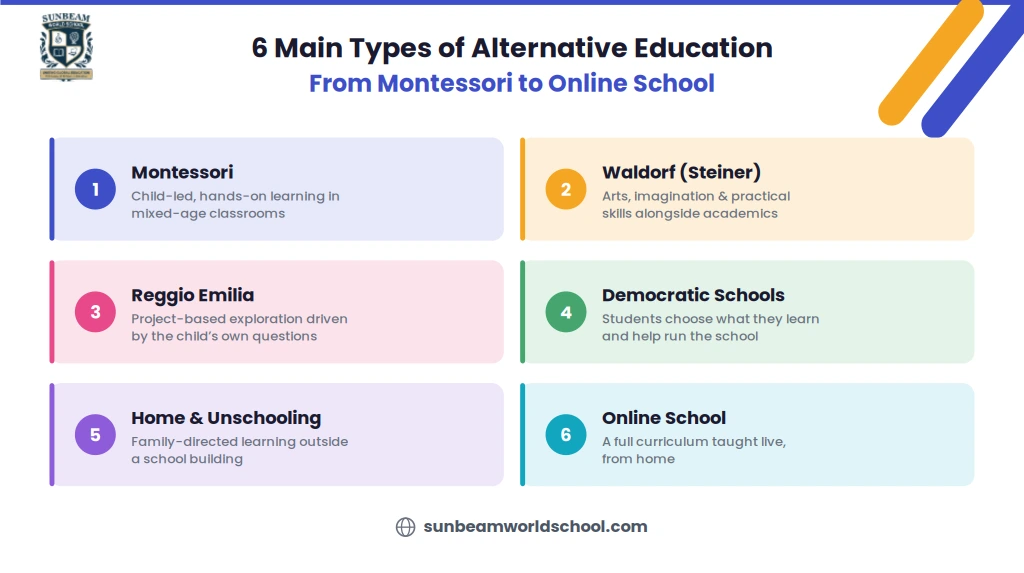
6 Main Types of Alternative Education: From Montessori to Online School.
Alternative education takes many forms, and a child may experience more than one over the years. These are the most common types.
Montessori
Montessori is a child-led approach in which children choose their own activities within a carefully prepared environment and learn at their own pace using hands-on materials. Classrooms are usually mixed-age, work periods are long and uninterrupted, and the teacher acts as a guide rather than a lecturer. It is most strongly associated with the early years and the primary stage.
Waldorf (Steiner)
Waldorf education emphasizes holistic development, integrating the arts, practical skills, and imaginative play alongside academics. It follows the child's developmental stages, introduces formal academics more gradually than a conventional school, and typically limits screen use in the early years. Storytelling, music, movement, and craft are central rather than optional.
Reggio Emilia
Reggio Emilia is an early-childhood philosophy built around child-led, project-based exploration. Children's own questions drive the learning, the environment is treated as a "third teacher," and adults document the children's work to plan what comes next. It is used mostly in preschool and kindergarten settings.
Democratic and Free Schools
Democratic and free schools, such as those following the Sudbury model, give students genuine autonomy over their time and a real say in how the school is run. Students choose what and how they learn, and take part in school governance, often with an equal vote alongside staff. The belief behind it is that children learn best when they choose their own path.
Homeschooling and Unschooling
Homeschooling and unschooling are home-based approaches where learning happens outside a school building and is directed by the family. Homeschooling follows a chosen curriculum; unschooling is guided by the child's natural curiosity rather than a fixed syllabus, with adults supporting rather than directing. Many families pair either route with an online homeschool programme or an open board so their child still earns a recognised certificate.
Online and Virtual School
Online school is a modern form of alternative education delivered over the internet through live and recorded classes. When it is run by an accredited school, it combines the flexibility of home-based learning with a full, certified curriculum and trained teachers, which is why it has become one of the fastest-growing alternatives. You can read more in what is an online school.
Other Forms of Alternative Education
Alternative education also includes charter and magnet schools with a specialized focus, forest and outdoor schools, microschools and hybrid programs, vocational and skill-based training, gifted programs, and special and inclusive education for learners with additional needs.
What Is an Alternative School, and Is It The Same As Alternative Education?
"Alternative school" can mean two quite different things, and confusing them is the most common mistake parents make when researching this topic.
- A school built on an alternative philosophy. A Montessori, Waldorf, Reggio-inspired, democratic, or accredited online school that families actively choose because they prefer its approach.
- A separate programme for students who are not succeeding in a mainstream school. In the United States, Canada, and some other systems, an "alternative school" often refers to a public programme with smaller classes and specially trained staff, intended for students facing behavioural difficulties, attendance problems, exclusion, or unmet learning needs. Placement is frequently by referral rather than by choice.
Both are genuinely forms of alternative education, but they serve very different purposes, and quality in the second category varies enormously from one district to another. If a school describes itself as "alternative," the useful question is simply: alternative in what sense, and who is it designed for? Parents comparing options should ask about the teaching philosophy, the staff's training, class size, and what qualification the school leads to.
What Are the Alternative Schooling Methods Used in India?
India has a long and unusually rich tradition of alternative schooling, and most of the world's major approaches are now available here in some form.
- Montessori. Widely established at pre-primary and primary level across almost every Indian city.
- Waldorf and Steiner schools. Found in cities including Bengaluru, Hyderabad, Chennai, Pune, and Mumbai, and increasingly popular with parents looking for an arts-led, low-pressure early education.
- Philosophy-led Indian schools. Krishnamurti Foundation schools such as Rishi Valley, along with Gandhian, Aurobindo-inspired, and rural experiments in learning-by-doing, represent a distinctly Indian strand of alternative education.
- Democratic and free schools. A small but growing number of self-directed learning communities and unschooling groups, particularly around Bengaluru, Pune, and Goa.
- Homeschooling with an open board. Indian law is framed around formal schooling and does not expressly recognise homeschooling, but families do homeschool, and most register their child with NIOS or an international board such as Cambridge so the qualification is recognised.
- Accredited online school. The fastest-growing option, because it gives families the flexibility of home-based learning with a full curriculum, live teachers, and a recognised board certificate.
Who Is Alternative Education Best For?
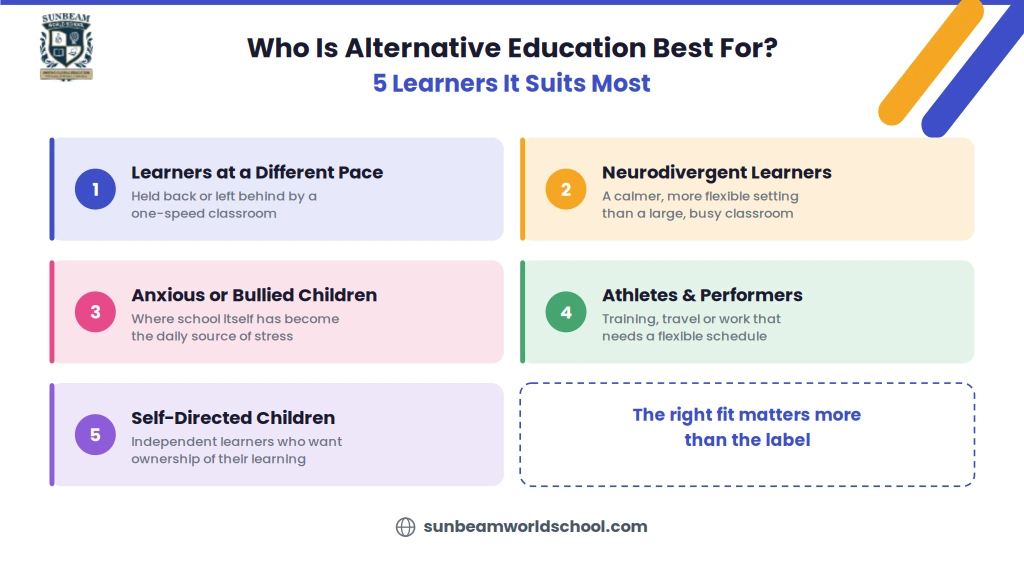
Who Is Alternative Education Best For? Five types of learners who thrive in flexible learning environments.
Alternative education tends to suit children who do not thrive in a standard classroom, though with the right fit it can benefit almost any learner. It is often a strong choice for:
- Children who learn at a different pace. Those who feel held back or left behind by a one-speed classroom.
- Neurodivergent and highly sensitive learners. Children who find a large, busy classroom overwhelming and do better in a calmer, more flexible setting.
- Students struggling with the school environment itself. Where anxiety, bullying, or exclusion has made school a daily source of stress, a change of setting often matters more than a change of syllabus.
- Athletes, performers, and travelling families. Children whose commitments need a genuinely flexible schedule.
- Curious, self-directed children. Independent learners who thrive when given more ownership of their learning.
Whether a specific model fits a particular child is explored in who online school is best for.
What Are the Benefits of Alternative Education?
The main benefit of alternative education is a better fit between the child and how they learn, which usually brings several advantages with it:
- Personalised learning. Teaching adapts to the child's pace, interests, and strengths instead of the class average.
- A calmer, safer environment. Smaller or home-based settings reduce stress, overstimulation, and bullying.
- Deeper engagement. Learning through projects, play, or real interests improves motivation and understanding, not just recall.
- Flexibility. Families can fit learning around health, travel, sport, therapy, or other commitments.
- Independence and life skills. Many approaches deliberately build self-direction, curiosity, and confidence that outlast school itself.
Does Alternative Education Actually Work?
Alternative education works well when flexibility is paired with structure, and less well when it is not. The evidence depends heavily on the model and the child, so it is worth being honest about what research suggests.
Studies of instruction consistently find that beginners learning something new benefit from explicit, well-guided teaching, and that leaving novices to discover everything unaided tends to produce weaker results. That is a real caution against the most unstructured end of the spectrum. It is not, however, an argument against alternative education as a whole, because the strongest alternative models are not unguided: Montessori has a carefully sequenced curriculum and materials, Waldorf follows a defined developmental arc, and a good online school delivers a full board curriculum with trained teachers and live instruction.
The practical takeaway for parents is that the label matters far less than four things: is there a clear curriculum, are the teachers trained, is progress actually checked, and does the route lead to a recognized qualification? Where those four hold, alternative education can outperform a poor mainstream fit by a wide margin.
What Should You Consider Before Choosing Alternative Education?
Alternative education is not automatically the right choice for every family, and a few things are worth weighing honestly before deciding.
- Recognition. Make sure the path leads to a recognised qualification if your child will need one for college or work.
- Structure and self-discipline. Flexible models ask more of the child and the family in terms of routine and motivation.
- Social contact. Some approaches need deliberate effort to build friendships and social skills.
- Quality varies. "Alternative" is a description, not a standard. Two schools using the same label can be very different, so visit, ask about teacher training, and talk to current parents.
- Cost and support. Private alternative schools can be expensive, and home-based routes need real parental time.
- Moving back. If your child may return to a mainstream school later, check how the curriculum and records will transfer.
Is Alternative Education Recognized and Valid?
Yes, Alternative education is recognized and valid when it is properly accredited or leads to a recognized board qualification. The mode or method does not reduce a certificate's value; what matters is that the school or board behind it is recognized.
An accredited alternative school, or an accredited online school following a board such as NIOS or Cambridge, awards the same recognized certificate as a traditional school, and universities and employers treat it the same way. The one thing to avoid is an unaccredited program that leads to no formal qualification. The recognition question is covered in detail in is online school valid in India.
How Does Online School Fit Into Alternative Education?
Online school is one of the most popular and practical forms of alternative education today, because it combines the flexibility families want with the structure and recognition they need. Learning happens at home over live and recorded classes; the pace can be adapted to the child, and class sizes are small, but the curriculum, teachers, and final certificate are the same as those of a physical school.
That combination is why online school has grown faster than any other alternative route: it removes the classroom without removing the qualification.
Is Sunbeam World School an Alternative School?
Yes, Sunbeam World School is a form of alternative education, specifically an accredited global online school, but it is not an "alternative school" in the remedial sense of a placement for struggling students. It is a school families choose because they want a different way of learning, not one they are referred to.
- What makes it alternative. Children learn from home through live and recorded classes, at a pace suited to them, in small groups with one-on-one support, and with teachers who act as mentors. It works well for neurodivergent learners, anxious or bullied children, young athletes and performers, and families who travel.
- What keeps it mainstream. It teaches a full curriculum, follows recognised boards, employs trained subject teachers, tracks progress properly, and awards the same certificate as a physical school.
In short, it is alternative in method and mainstream in outcome, which is the combination most parents are actually looking for. You can see how it works on the learning approach page or book a free demo class.
Conclusion: Is Alternative Education the Right Choice for Your Child?
Alternative education is simply education that fits the learner instead of the system. It spans many approaches, from Montessori, Waldorf, and Reggio Emilia to democratic schools, homeschooling, unschooling, and online school, all united by the idea that children learn in different ways and deserve a setting that suits them.
- It is about fit, not quality. Alternative education is not better or worse than mainstream schooling; it is a different, usually more personalized, way to learn.
- Structure still matters. The models that work best pair flexibility with a real curriculum and trained teachers.
- Recognition still matters. Choose Sunbeam World School, an accredited route, if your child will need a recognized qualification.

Frequently Asked Questions
Are alternative schools only for students with behavioural or learning difficulties?
-No, alternative schools are not only for students with behavioural or learning difficulties. Some public "alternative schools" are designed specifically for students who are not succeeding in mainstream education, but most alternative education, including Montessori, Waldorf, democratic schools, homeschooling, and online school, is chosen freely by families who simply prefer a different approach.
Do alternative schools give homework?
+Is homeschooling legal in India?
+Is alternative education recognised by universities and employers?
+
In this article
Share this post:


Press and Blogs
Stay updated with our press releases, educational blogs, and more.
Quick Summary An algebra equation is a maths statement that sets two expressions equal using...
Quick Summary The area of rectangle equals its length multiplied by its width (A =...
Quick Summary Sympathy means feeling sorry for someone from your own point of view. Empathy...