 Online Education
Types of Education: A Complete Guide
Education is generally categorized into three main types: formal, informal, and non-formal. These are the three basic forms of education, and each serves a distinct purpose in a person's development. Beyond them, education is also classified by level, from pre-primary through higher education, by mode of delivery, such as traditional, online, distance, homeschooling, and blended learning, and by teaching approach, such as Montessori or Waldorf. This guide explains every type clearly, with examples and a comparison, so you can see how they differ and where a modern option like online school fits in.
What Are the Main Types of Education?
How many types of education are there? At its simplest, three. Formal education is the structured, curriculum-based learning that happens in schools, colleges, and universities and leads to recognized certificates. Informal education is the unstructured, lifelong learning we absorb from family, experiences, and the world around us. Non-formal education is organized but flexible learning that sits outside the formal system, such as vocational courses, adult literacy programs, and short online courses. Everything else- the levels, the modes of delivery, and the teaching approaches- is a way of organizing these three.
The Three Main Types of Education
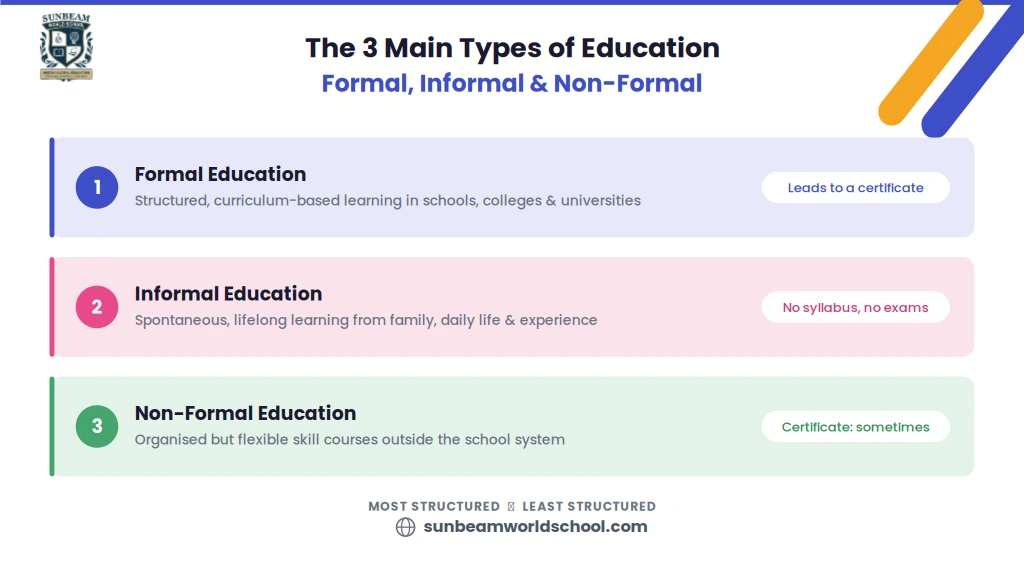
The 3 Main Types of Education: Formal, Informal & Non-Formal Explained
These three categories are the foundation of how educators classify learning. Understanding them makes every other label easier to place.
Formal Education
Formal education is structured, institutionalized learning that follows a specific curriculum and leads to recognized degrees or diplomas. It progresses hierarchically from primary school to university, is taught by certified teachers, and is graded by level, leading to qualifications such as a Class 10 or 12 certificate, a diploma, or a bachelor's degree. It is the backbone of a child's academic journey, and its defining feature is that it is planned, sequential, and certified.
Informal Education
Informal education is unstructured, spontaneous, and lifelong learning that happens organically through daily experiences, conversations, and observations. There are no set objectives, exams, or certified teachers: learning to cook a family recipe, picking up social etiquette from peers, or teaching yourself a skill from a video are all informal education. It has no syllabus and no certificate, but it never stops and shapes a person as powerfully as any classroom.
Non-Formal Education
Non-formal education is organized and intentional learning that occurs outside the traditional school system. It is highly flexible, tailored to specific skill-building goals, and rarely offers formal degrees: community workshops, vocational and skill-training programs, adult literacy classes, recreational sports classes, and many short online courses all fall into this category. It is planned around the learner's needs rather than a fixed grade structure, and it may or may not lead to a certificate.
Types of Education by Level
Formal education is organized into stages, each building on the last. These levels are the same whether a child learns in a physical school or online.
Pre-Primary Education
The earliest stage, covering nursery, kindergarten, and preschool, focused on play-based learning, early language, motor skills, and social development for children roughly aged three to five.
Primary Education
The foundation years, usually Grades 1 to 5, where children build core literacy, numeracy, and general knowledge along with the habits of structured learning.
Secondary Education
The middle and secondary years, roughly Grades 6 to 10, where subjects deepen and specialize, culminating in the first major board examination at Class 10.
Senior Secondary Education
Grades 11 and 12, where students choose a stream or subject specialization and sit the Class 12 board exam that shapes university and career options.
Higher and Tertiary Education
Undergraduate and postgraduate study at colleges and universities, along with professional and vocational qualifications, where learning becomes specialized and career-focused.
Types of Education by Mode of Delivery
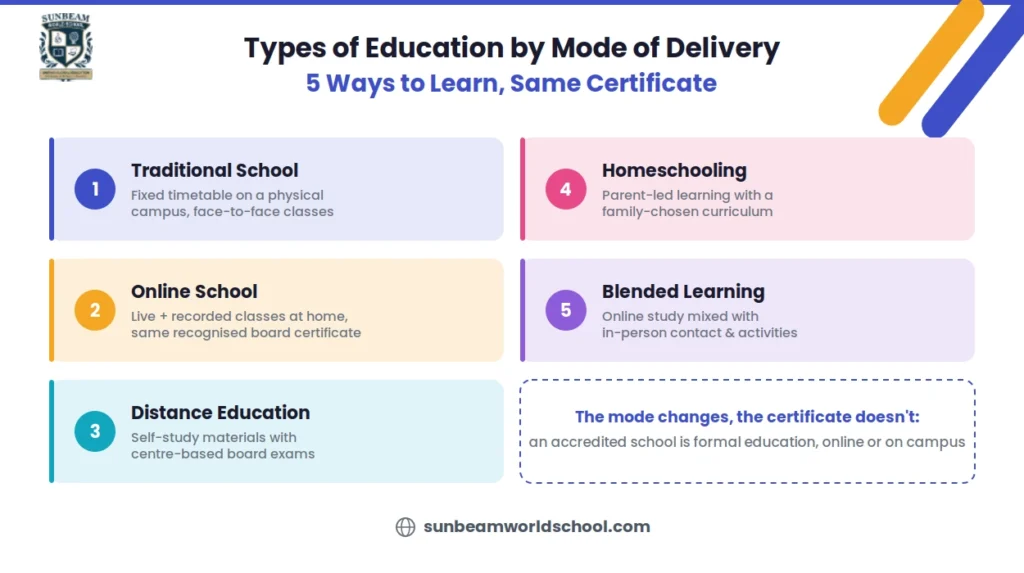
Types of Education by Mode of Delivery: 5 Ways to Learn, Same Recognized Certificate
Beyond levels, education is also classified by how it is delivered. The mode is separate from the type: an accredited school leads to formal, certified education whether it is taught in a building or online.
Traditional (In-Person) Education
The familiar model where students attend a physical campus, learn face to face with teachers and peers, and follow a fixed daily timetable. Its strengths are in-person interaction, hands-on facilities, and built-in structure.
Online Education
Learning delivered over the internet through live and recorded classes, digital resources, and an online platform. When run by an accredited school, it is a fully formal education delivered online, leading to the same board certificate as a physical school. The model is explained in what is an online school, and its sub-types in the different types of online education.
Distance Education
A long-established mode where students learn remotely, historically through posted or downloadable materials and self-study, with periodic contact and center-based exams. Open boards and open universities are classic examples, and modern online school is its live, interactive evolution.
Homeschooling
Education directed by parents at home, outside a formal school, with the family choosing the curriculum and pace. Many homeschooling families pair it with an open board or an online homeschool programme to gain structure and a recognised certificate.
Blended and Hybrid Education
A mix of online and in-person learning, combining the flexibility of digital study with some face-to-face contact for activities, labs, or socialising. It aims to capture the benefits of both modes.
Types of Education by Teaching Approach
Education is also shaped by teaching philosophy, and several well-known approaches offer alternatives to the conventional classroom. These are the alternative education systems families most often research.
Montessori Education
A child-led approach where children choose activities within a carefully prepared environment and learn at their own pace through hands-on materials, with the teacher acting as a guide rather than a lecturer. It is most associated with the early years and primary stage.
Waldorf (Steiner) Education
An approach that emphasises creativity, imagination, the arts, and hands-on activity alongside academics, following the child's developmental stages and introducing formal academics more gradually than a conventional school.
Reggio Emilia Approach
An early-childhood philosophy built around child-led, project-based exploration, where children's own interests drive the learning and the environment itself is treated as a teacher.
Homeschooling and Unschooling
Home-based approaches where learning is directed by the family. Homeschooling follows a chosen curriculum, while unschooling is more child-led and interest-driven, with adults supporting rather than directing. Many families pair these with an online homeschool program or an open board for structure and a recognized certificate.
Other Important Types of Education
A few specialized types sit alongside the mainstream categories and matter greatly to the families they serve.
Special Education
Education adapted for children with disabilities, learning differences, or additional needs, delivered by trained specialists with individualized support. It can be provided in dedicated settings or, increasingly, through inclusive mainstream and online special education programs.
Vocational Education
Practical, skill-focused education that prepares learners for a specific trade or profession, such as technology, design, healthcare, or the trades, often combining classroom learning with hands-on training.
Adult Education
Learning opportunities designed for adults, from basic literacy to professional upskilling and lifelong learning, usually delivered flexibly to fit around work and family.
Formal vs Informal vs Non-Formal Education
The three main types are easiest to tell apart side by side. This is the distinction most people are really asking about.
|
Aspect |
Formal |
Informal |
Non-formal |
|
Structure |
Highly structured and graded |
Unstructured and spontaneous |
Organised but flexible |
|
Setting |
Schools, colleges, universities |
Home, daily life, environment |
Training centres, online courses, community |
|
Curriculum |
Fixed curriculum and syllabus |
No set curriculum |
Planned around learner needs |
|
Certification |
Certificates, diplomas, degrees |
None |
Sometimes, not always |
|
Examples |
School, board exams, degrees |
Learning from family, reading, life |
Adult literacy, vocational and skill courses |
In practice, a child experiences all three at once: formal education at school, informal education at home and in the world, and non-formal education through the clubs, courses, and skills they pick up along the way. The three complement rather than compete.
Where Does Online Education Fit?
Online education is a mode of delivery, not a separate category, and this is where many parents get confused. An accredited online school delivers formal education online: it follows a full curriculum, is taught by qualified teachers, is graded by level, and leads to the same recognised board certificate as a physical school.
A short online course, by contrast, is usually non-formal; the full breakdown of these models is in the types of online education. So online school is not a lesser type of education; it is mainstream formal education taught through a screen, and whether it is right for a family is explored in is online school better than in-person and is online school valid in India.
Which Type of Education Is Best?
There is no single best type of education, and anyone who claims otherwise is usually selling something. The best type depends on the child's age, personality, and goals, and on the family's circumstances. A structured classroom suits a child who thrives on routine and in-person contact; a child-led approach like Montessori suits a curious early learner; online school suits an independent learner, an athlete, or a family that needs flexibility. Many families even mix approaches across the years, for example a play-based early stage, a traditional primary school, and online or blended learning in the higher grades.
What matters most is not the label but the fit: does this type of education keep your child engaged, supported, and moving toward a recognised qualification? For any route meant to lead to college or a career, choosing a formal, accredited option, in person or online, ensures the certificate is respected. Beyond that, the right answer is simply the one that matches your particular child.
How to Choose the Right Type of Education for Your Child
With so many types, the decision comes down to your child and your circumstances rather than to any single mode being best. A few questions help.
- What does your child need most? Structure and in-person contact point toward traditional school; flexibility, safety, or a personalised pace point toward online or home-based learning.
- What certificate matters? For university and jobs, choose a formal, accredited route, whether in person or online, so the qualification is recognised.
- What are your circumstances? Travel, health, location, sport, or a curriculum not available locally can make online or blended learning the practical choice.
- What suits how your child learns? Independent, self-motivated learners often thrive online, while those who rely on external structure may prefer a classroom. This fit is explored in who online school is best for.
How Sunbeam World School Delivers Formal Education Online
Sunbeam World School is a clear example of formal education delivered online: mainstream, certified schooling with the flexibility of learning from home. As an accredited global online school, it brings the structure of a traditional school into a digital classroom.
Accredited, Certified Formal Education
It teaches a full, graded curriculum through live and recorded classes led by qualified teachers, and it certifies students through recognised boards, so the qualification carries the same weight as a physical school's. This is formal education in every sense, simply delivered online.
A Choice of Curricula
Families can follow the Indian, British, or American curriculum, so a child learns on the pathway that best matches their goals and can change pathway as those goals evolve.
Live Teaching with Real Flexibility
Live teacher-led classes keep the structure and interaction of a real classroom, while recorded lessons and a flexible pace give back the time and freedom that draw families to online learning. The teaching model is on the learning approach page.
Inclusive Support for Every Learner
Small classes, one-on-one support, and trained special educators mean the model works for a wide range of learners, not just the most independent, so no child is left to cope alone.
The easiest way to see formal online education in action is to book a free demo class.
The Bottom Line
Education comes in three main types, formal, informal, and non-formal, and is further organized by level, by mode of delivery, and by teaching approach. Formal education is the structured, certified route through schools and universities; informal education is the lifelong learning of everyday life; and non-formal education is the flexible, skills-focused learning that sits in between.
Online school shows how these ideas come together: it is mainstream formal education, delivered flexibly through a screen, leading to the same certificate as a campus. To see what that looks like in practice, you can book a free demo class or read what is an online school.
Frequently Asked Questions
What are the three main types of education?
-The three main types of education are formal, informal, and non-formal education. Formal education is structured, curriculum-based learning in schools and colleges that leads to recognised qualifications. Informal education is the unstructured, lifelong learning we absorb from family, experience, and surroundings. Non-formal education is organised but flexible learning outside the formal system, such as vocational courses and adult literacy programmes.
What is the difference between formal, informal, and non-formal education?
+What are the types of education by level?
+Is online education formal or non-formal?
+What is the best type of education?
+How many types of education are there?
+What are the alternative types of education?
+
In this article
Share this post:


Press and Blogs
Stay updated with our press releases, educational blogs, and more.
Quick Summary Animal sounds are the noises animals make to communicate, warn of danger and...
Quick Summary An algebra equation is a maths statement that sets two expressions equal using...
Quick Summary Essential Repeat (ER) in CBSE means a student has not met the passing...