Simple Online Application
The application takes a few minutes online from anywhere in Seoul and needs only your child's basic details and the previous school's latest marksheet.

Give your child access to a world of learning with Sunbeam World School, an accredited online school in Seoul offering classes from Nursery to Grade 12. Explore live interactive lessons, six curriculum pathways, and flexible learning options designed to help students thrive academically from home.
Accredited online school in Seoul, recognised by leading national and international education organisations, ensuring trusted academic standards, global credibility, and quality online learning for students worldwide.


Sunbeam World School offers families in Seoul a complete online school: live classes for Nursery to Grade 12, six curriculum pathways and one published fee. Online school admission in Seoul is open all year, so a family in Gangnam, Seocho, Yongsan, Mapo or Songdo can start without waiting for an international school place to come free.
Sunbeam World School has taught for over 54 years and now runs an online school for 100K+ students in 135+ countries, which is the point in a city where international school eligibility can turn on a passport: a virtual online school open to the child wherever the family goes next. See the eligibility criteria and school timings for the available batches.
Your details are private and never shared.
Admission takes four steps, all from home in Seoul: apply online, a counselling call within 24 hours, documents and fee, then orientation. Admissions are open all year, including mid-year, for Nursery to Grade 12.
The application takes a few minutes online from anywhere in Seoul and needs only your child's basic details and the previous school's latest marksheet.
An academic advisor calls within 24 hours to match your child's grade, curriculum pathway and batch timing to their strengths and your family's schedule.
Every pathway ends in a recognised certificate: NIOS or BOSSE for the CBSE-aligned route, Cambridge IGCSE and A Level, a Cognia accredited American diploma, or the Australian Curriculum certificate.
Enrolment and fee payment are completed online in one sitting, and your child can join live classes within days of registration.
A dedicated academic coordinator and a technical support team stay with each Seoul family through the academic year, from orientation to board exam registration.
Certified teachers run every live class, and students get recordings, digital study material and an AI-enabled learning management system from day one.
A virtual online school with six pathways from Nursery to Grade 12, all taught live from Seoul. Grade-wise pages: Pre-Primary, Primary, Middle, Secondary and Senior Secondary.
Cambridge, IGCSE and A / AS Levels, global recognition, Grades 6-12
Australian curriculum standards, Foundation to Year 12
US K-12 Common Core standards, Cognia accredited
CBSE-aligned curriculum based on NCERT, NEP 2020 and NCF 2023
National Institute of Open Schooling under the Ministry of Education, Government of India
Board of Open Schooling and Skill Education, established by the Government of Sikkim
Our academic counsellors will guide you through a free consultation, and the full grade-wise fee structure is published upfront.
Seoul schooling is competitive, long and expensive, and international places come with eligibility rules of their own. Parents weighing the best online schools in Seoul usually switch for five reasons.
One batch slot with doubt-clearing built into the timetable, rather than a school day followed by hours at a cram school.
Foreign school places in Seoul turn on nationality and years spent abroad. Admission here turns on the previous school's reports.
Most grades run 13:30 to 19:00 Korean time, which leaves the whole morning for training, rehearsal or a language institute.
Moving mid-course out of a Korean or foreign school is hard to land well. This enrolment travels.
Printed grade by grade before you apply, with nothing added through the year.
Book a free demo class for your child's grade and meet the teacher who would take the batch.
Book a Free Demo ClassThe same five steps for every grade, Nursery to Grade 12. Mid-year admission is open all year.
Complete our online application with your child's basic details. This is all we need to open the file and connect you with an advisor.
Our advisors connect with you to understand your child's learning needs and help select the right grade level, curriculum pathway and batch timing.
Finalise admission by submitting the required documents and the fee online. Our team is available to assist you at every step.
Parents and students receive access to the learning management system, where students attend classes, interact with teachers and appear for exams, and parents track progress and attendance.
Your child starts live online classes with interactive tools and ongoing teacher support, all from a safe and flexible home environment in Seoul.
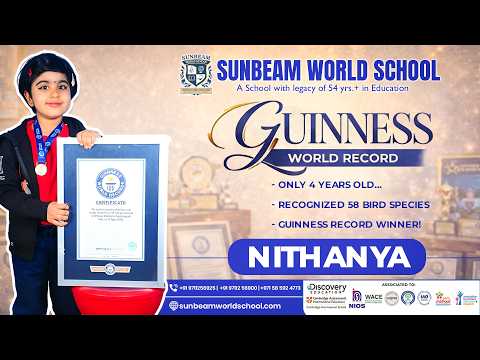
Featured on JioHotstar's Future Schools. Home to a Guinness World Records holder. Founder and student stories below.

Online nursery admissions in Seoul start at age 3. The online primary school covers ages 5 to 10, and the online high school covers Grades 9 to 12. Find your child's age band and the stage it maps to in each pathway. Confirm placement on the eligibility criteria page.
| Age | Indian Curriculum | Cambridge Curriculum (UK) | American Curriculum | Australian Curriculum |
|---|---|---|---|---|
| 3 to 5 | Pre-Primary School | Early Years School | Kindergarten School | Early Years / Kindergarten |
| 5 to 10 | Primary School | Primary School | Elementary School | Primary School |
| 10 to 13 | Middle School | Lower Secondary | Middle School | Middle School |
| 13 to 16 | Secondary School | Upper Secondary School | High School | Lower Secondary / Year 10 |
| 16 to 18 | Senior Secondary | AS and A Levels | High School Diploma / AP | Senior Secondary (Years 11 to 12) |
NIOS and BOSSE open school pathways are available for Grade 10 and Grade 12 board certification.
Straight answers for families in Seoul: how Korean compulsory attendance applies and where it stops, what the class times mean in Korean hours, which curricula are offered, and what the fee covers.
Korean compulsory attendance covers children aged 7 to 15, which is the elementary and middle school years. High school is not mandated, so Grades 10 to 12 sit outside the requirement entirely. Within the compulsory years, home education in Korea is not separately regulated, so families confirm their own position with their district education office before enrolling. A counsellor will talk you through how other families here have arranged it.
On both the legal and the practical measure, yes. Grades 10 to 12 fall outside Korean compulsory attendance, and they are also the grades whose class times land best here, running to about 19:00 Korean time. The younger Cambridge groups sit later in the evening, and families with a seven-year-old should look at that timetable carefully before committing.
Korea runs three and a half hours ahead of the published India timetable and keeps one clock all year. The India morning batch lands at 13:30 to 17:00 Korean time, with Grade 12 running to about 19:00, which is a normal afternoon here. The Cambridge primary and lower secondary groups fall at roughly 17:00 to 19:30, which is late for a young child and is the one thing to check first.
Households that cannot get into, or do not want, the places Seoul offers them. That includes families who fail a foreign school's eligibility rules, those arriving mid-year, students in the high school years who want a different shape of day, athletes and performers on heavy training schedules, and families returning to India. A counselling call establishes quickly whether it fits your family.
Six: Cambridge, American, Australian, CBSE-aligned, NIOS and BOSSE, covering a UK, US, Australian or Indian destination between them. A counsellor confirms on the first call whether your child's intended route is among them, so no time is spent on an application that was never going to fit.
A Cambridge international online school in Seoul runs IGCSE in Grades 6 to 10 and AS and A Levels in Grades 11 and 12 with Cambridge certified teachers. For a Seoul household the attraction is usually that it has no eligibility gate: a child who cannot take a place at a foreign school here for passport reasons can still take the same syllabus and the same examination series.
Generally, and the earlier the paperwork is seen the better. The counsellor works from the Seoul school's reports subject by subject, establishes how far each ran and confirms in writing what can be continued before any payment. Where a subject carries a practical component the examination route is checked at the same time, since that is the usual sticking point.
These are the years this page suits best. A Levels run in Grades 11 and 12 with Cambridge certified teachers, timetabled into the Korean afternoon and finishing by about 19:00, and the grades sit outside compulsory attendance. The combination is confirmed before Grade 11, together with the examination route, because private candidate entry narrows the subjects available.
As a private candidate, arranged months ahead of each series rather than in the term it runs, and with the subject list checked first. Subjects carrying practical, coursework or oral components are not always available on that route, which can shape the combination a student takes at Grade 11. Put the question at Grade 9 subject choice, when there is still room to change course.
A Seoul foreign school gives a child a campus, a cohort and an examination entry handled for them, and restricts who may enrol. A British curriculum online school in Seoul follows the same Cambridge syllabus with no eligibility rule, no commute across the city and no entrance fee, and hands the examination entry back to the family. Where a child qualifies for a local place and wants the campus life, the local place is usually better.
For a family heading to the United States it is the cleanest of the options, because it runs on US K-12 Common Core standards under Cognia accreditation and is assessed continuously, which avoids the private candidate question altogether. Ask exactly which records arrive at the end of Grade 12 and put them to the receiving district before you commit, since districts differ.
Seoul has no Indian-curriculum school, so a family posted here normally changes board twice, once on arrival and once on return. The CBSE-aligned pathway avoids both, running NCERT textbooks and CBSE-pattern assessment from Grade 1 to 12 with NIOS or BOSSE certifying Grades 10 and 12. Registration arrangements from Korea are settled with a counsellor ahead of the series.
Each Korean university sets its own admission route for applicants holding foreign qualifications, and many run a separate track for students educated overseas with its own documentation requirements. Those requirements decide the answer rather than the school does, and they can turn on how many years a student studied outside the Korean system. Check them before Grade 11 subject selection.
Twenty, with a class teacher and an assistant subject teacher, as published on the fee page. Seoul parents are used to small cram school groups and large school classes, so the useful test in a demo is not the number but whether a student is expected to speak, or can sit through an hour without being asked anything.
Seoul households are used to counting school fees alongside cram school bills that arrive monthly, so the useful comparison here is that there is one annual figure per grade and no second stream behind it. It covers the live classes, the material, the assessments, the platform and the co-curricular sessions. What sits outside it is board registration, overseas examination fees, Australian attestation and courier on books. Nothing is refundable once paid.
The timetable is unusually well suited to it. Mornings are completely free here, which is exactly when Seoul's language institutes run, so a local Korean class in the morning and school in the afternoon is the pattern most families settle into. Ask the counsellor which language subjects your child's pathway offers as well.
From online yoga to competitive coding, Nursery through Grade 12.
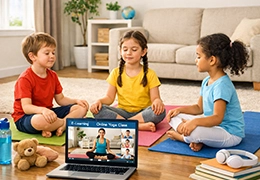
All grades, certified instructors
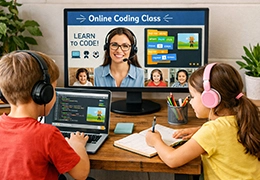
Grades 3-12, Python, Scratch and more
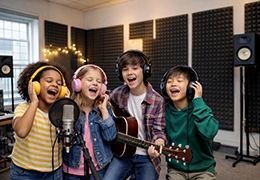
All ages, guitar, keyboard, singing

All grades, classical and contemporary

Grades 2-12, beginner to advanced

Grades 5-12, builds confidence

Grades 1-12, DIY lab at home
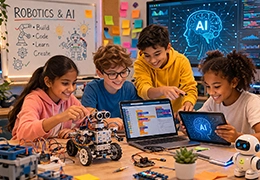
Grades 5-12, future tech skills
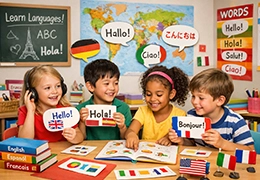
French, Spanish, German and more
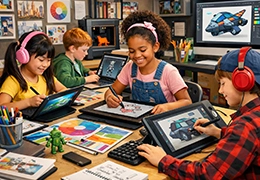
Grades 5-12, Canva, illustration
Accreditation, board exams, fees, timings, devices and the questions parents raise on forums. More on our FAQ page.
It holds IAO and Cognia accreditation, Cambridge certification for IGCSE and A Level, and NIOS or BOSSE for the Indian pathways, each checkable on the issuing body's own website. These are international credentials, which is what a family applying to universities outside Korea needs. A family planning to re-enter the Korean system should check that school's entry requirements early, as they set their own.
There is no assessment and no interview. Seoul families are used to competitive entry from an early age, and this works differently: a counselling call, a short form and a start in whichever month suits. Nursery begins at three, below the age at which Korean compulsory attendance starts, with short activity-led sessions.
Teaching is in English throughout, so a child who arrives without Korean is not held back in subjects while the language comes. The thing to weigh is the hour rather than the language: the primary groups on the Cambridge pathway sit in the early evening Korean time, which suits some households and not others.
That is the direction it points, through Cambridge A Levels, the Cognia-accredited American pathway or the Indian pathways, with university pathway support. These grades are also the ones that work best in Korea, falling outside compulsory attendance and inside a workable afternoon slot. A family aiming at a Korean university should check that institution's overseas track early.
Enrolment runs in any month, which matters because the Korean academic year starts in March and most arrivals do not. Placement comes from the previous school's reports, the gap topics are listed, and recordings cover what was taught before the join date. A child who lands in Seoul in October starts in October.
Live, every timetabled period, with a subject teacher present and attendance recorded, and recordings behind that for revision. For a Seoul family used to the intensity of a cram school, the honest comparison is that this is taught instruction with a named teacher and tracked attendance, built around understanding the material rather than drilling for a single test.
One batch slot, with the length per grade published beforehand, which against a Seoul day that often runs into the evening at a cram school is the main difference families notice. Younger grades sit shorter periods with breaks, a good share of the work happens off screen, eye exercises run during class and the school issues blue-light guidance.
Nothing a Seoul flat does not already have. A laptop, tablet or smartphone and a stable connection, with headphones and a webcam recommended rather than required, and no paid software beyond a browser and a PDF reader. Korean home internet is far beyond what the platform needs, so the real question is a quiet room at an evening hour.
Through the same twenty classmates each day, and through Seoul in the mornings, which is the unusual part here. Because classes run in the afternoon, the free block is the morning, so sport, music and language institutes have to be chosen from what runs at that hour. Families with a young child should plan that deliberately rather than assume.
SEND trained educators work to an individualised plan covering dyslexia, ADHD, autism and speech, language and sensory processing needs, priced separately from the annual fee. Assessments carried out in another country are read and used, which matters for families who arrive in Korea with reports in English and no wish to start the process again.
The class teacher is the first person to raise it with, then the academic coordinator, then a counsellor, with SEND trained educators available where a learning need is involved. A child who has left an intense Seoul routine often needs a few months simply to adjust to a lighter day, and telling the class teacher that background at the start makes a real difference.
A parent app and portal update as work is marked, which in a city where parents are used to detailed reporting from cram schools is the baseline rather than a feature. Attendance, assignments and assessment results appear as recorded, and a teacher with a concern raises it directly rather than saving it for a scheduled meeting.
It does not. The Korean academic year starts in March and this one does not, so the breaks will not line up at either end. Families take the weeks they want as planned absences and use the recordings, which needs thinking about if siblings are in a Korean school and the family wants to travel together.
Parents do not teach. Grades 1 to 5 need an adult available for logins and focus, and because those classes fall in the late afternoon and early evening in Korea, that adult is usually home from work by then, which is easier than it would be on a morning timetable. From the middle grades a student manages alone.
Your child's age first, because that decides whether compulsory attendance applies, then the pathway, the class times in Korean hours with the evening question raised honestly, and the examination route. The published fee for the grade comes with it, and a demo class can be booked in the same call.
Feedback from students and parents across India who trust Sunbeam World School for quality online education. More on our reviews page.
 4.8Trusted by students across 135+ countries

"I really like how teachers encourage us to speak confidently and take part in class. Online school feels so supportive."
"The lessons are engaging, the teachers are responsive, and my daughter feels confident learning from home."
"The flexibility here is a blessing. I can revise recorded lectures anytime."
"The virtual activities and projects are my favorite. I made new friends even while studying from home!"
"Online classes are super fun and interactive. I especially love the science experiments and quizzes."
"At first I was nervous about online school, but now I actually enjoy attending classes."
Sunbeam World School has received the Best E-School award from Brainfeed Magazine, the CBSE Chairperson Best School for Skill Education award, the Bharat Vibhushan Puraskar, and awards for Best Contribution in International Education and Best in Online Education.


An academic counsellor reviews your child's grade, subjects, learning needs and goals in a free call and recommends the right pathway and batch for your family in Seoul.
Talk to a CounsellorA free demo class shows you a live lesson, the teacher who would take your child's batch and the learning platform before you enrol.
Book a Free DemoThe same live school, six pathways and three batches, in every city below.
Nursery to Grade 12, live teacher-led classes, six boards, fee published upfront. Book a free demo class or download the brochure.