Simple Online Application
The application takes a few minutes online from anywhere in Myanmar and needs only your child's basic details and the previous school's latest marksheet.

Give your child access to a world of learning with Sunbeam World School, an accredited online school in Myanmar offering classes from Nursery to Grade 12. Explore live interactive lessons, six curriculum pathways, and flexible learning options designed to help students thrive academically from home.
Accredited online school in Myanmar, recognised by leading national and international education organisations, ensuring trusted academic standards, global credibility, and quality online learning for students worldwide.


Sunbeam World School runs a complete online school for families in Myanmar: live classes from Nursery to Grade 12, six curriculum pathways and one published fee per grade. Online school admission in Myanmar is open every month, so a household in Bahan, Yankin or Mayangone in Yangon, Chanmyathazi in Mandalay or Nay Pyi Taw enrols on the same terms.
Sunbeam World School has taught for over 54 years and now runs a virtual online school for 100K+ students in 135+ countries. Myanmar is the closest time fit of any of them: the whole timetable, senior grades included, sits inside the local working day with no evening sessions. See the eligibility criteria and school timings for the available batches.
Your details are private and never shared.
Admission takes four steps, all from home in Myanmar: apply online, a counselling call within 24 hours, documents and fee, then orientation. Admissions are open all year, including mid-year, for Nursery to Grade 12.
The application takes a few minutes online from anywhere in Myanmar and needs only your child's basic details and the previous school's latest marksheet.
An academic advisor calls within 24 hours to match your child's grade, curriculum pathway and batch timing to their strengths and your family's schedule.
Every pathway ends in a recognised certificate: NIOS or BOSSE for the CBSE-aligned route, Cambridge IGCSE and A Level, a Cognia accredited American diploma, or the Australian Curriculum certificate.
Enrolment and fee payment are completed online in one sitting, and your child can join live classes within days of registration.
A dedicated academic coordinator and a technical support team stay with each Myanmar family through the academic year, from orientation to board exam registration.
Certified teachers run every live class, and students get recordings, digital study material and an AI-enabled learning management system from day one.
A virtual online school with six pathways from Nursery to Grade 12, all taught live from Myanmar. Grade-wise pages: Pre-Primary, Primary, Middle, Secondary and Senior Secondary.
Cambridge, IGCSE and A / AS Levels, global recognition, Grades 6-12
Australian curriculum standards, Foundation to Year 12
US K-12 Common Core standards, Cognia accredited
CBSE-aligned curriculum based on NCERT, NEP 2020 and NCF 2023
National Institute of Open Schooling under the Ministry of Education, Government of India
Board of Open Schooling and Skill Education, established by the Government of Sikkim
Our academic counsellors will guide you through a free consultation, and the full grade-wise fee structure is published upfront.
Myanmar families looking outside the local school system have usually had to choose between a seat in Yangon and nothing at all. Parents comparing the best online schools in Myanmar switch for five reasons.
Every grade is taught live between about 11:00 and 17:30 Myanmar time, senior years included.
The same teachers and curriculum reach Mandalay, Nay Pyi Taw and Taunggyi as reach Yangon.
Cambridge, American, Australian and three Indian routes without changing school.
Classes begin late morning, so the first hours of the day belong to the family.
A single figure per grade published up front rather than quoted after an enquiry.
Book a free demo class for your child's grade and meet the teacher who would take the batch.
Book a Free Demo ClassThe same five steps for every grade, Nursery to Grade 12. Mid-year admission is open all year.
Complete our online application with your child's basic details. This is all we need to open the file and connect you with an advisor.
Our advisors connect with you to understand your child's learning needs and help select the right grade level, curriculum pathway and batch timing.
Finalise admission by submitting the required documents and the fee online. Our team is available to assist you at every step.
Parents and students receive access to the learning management system, where students attend classes, interact with teachers and appear for exams, and parents track progress and attendance.
Your child starts live online classes with interactive tools and ongoing teacher support, all from a safe and flexible home environment in Myanmar.
Featured on JioHotstar's Future Schools. Home to a Guinness World Records holder. Founder and student stories below.


Online nursery admissions in Myanmar start at age 3. The online primary school covers ages 5 to 10, and the online high school covers Grades 9 to 12. Find your child's age band and the stage it maps to in each pathway, then confirm placement on the eligibility criteria page.
| Age | Indian Curriculum | Cambridge Curriculum (UK) | American Curriculum | Australian Curriculum |
|---|---|---|---|---|
| 3 to 5 | Pre-Primary School | Early Years School | Kindergarten School | Early Years / Kindergarten |
| 5 to 10 | Primary School | Primary School | Elementary School | Primary School |
| 10 to 13 | Middle School | Lower Secondary | Middle School | Middle School |
| 13 to 16 | Secondary School | Upper Secondary School | High School | Lower Secondary / Year 10 |
| 16 to 18 | Senior Secondary | AS and A Levels | High School (Grades 11 to 12) | Senior Secondary (Years 11 to 12) |
NIOS and BOSSE open school pathways are available for Grade 10 and Grade 12 board certification.
Practical answers for families in Myanmar: exactly when classes run locally, what to check about your own connection, who teaches, and what the fee covers.
Myanmar sits one hour ahead of the published India timetable, which is the closest fit of any market the school teaches into. Every grade lands between roughly 11:00 and 17:30 locally, and Grades 10 to 12 run about 11:00 to 14:30. No grade needs an early start or an evening session. Confirm your child's exact slot in writing before paying.
One full class window on your own line, at the hour your child's grade is actually taught. Connectivity varies more between neighbourhoods in Myanmar than the headline speed suggests, so a test at the right time of day tells you more than a speed check. Keep a mobile data backup, and ask the counsellor how a dropped session is handled before you commit.
Private educational institutions in Myanmar are regulated under the Private Education Law, and home education has no established registration route. That makes this a question for the Ministry of Education and a local education lawyer rather than for a school's website. Settle your own family's position before you enrol anywhere, including here.
That depends on the university and the certificate, and the only reliable answer comes from the institutions themselves. Ask the Myanmar universities your child might apply to what they accept, in writing, and ask the same of any overseas universities on the list. Do it at Grade 9, while the subject combination can still be shaped around the answer.
The timetable follows the Indian academic week, so Monday to Friday broadly matches Myanmar while the term dates and public holidays do not. Thingyan in April and the other local holidays will usually be teaching days. Ask for your grade's teaching days and the term dates together, then set them against the Myanmar calendar before you decide.
Households whose schooling has to work from wherever they are. That covers families outside Yangon with little choice nearby, those on postings that may rotate, Myanmar's long-established Indian community planning a return, and students who need a shorter day. A counselling call establishes quickly whether it suits yours.
Qualified subject specialists, and the distinction that matters is live teaching against supervised study. Here a teacher is present and teaching for the whole period, with an assistant subject teacher working alongside them, and Cambridge pathway teachers carry Cambridge certification for their syllabus. A demo class shows you which of those two models you are actually buying.
A learning kit is dispatched to the student, and the question worth asking from Myanmar is dispatch timing rather than contents: ask when it ships, how it ships, and what to do if it is slow. Subject material itself is downloadable, so teaching does not wait on the post. Practical requirements at Grades 10 to 12 vary by board, so a counsellor confirms them per subject.
Digitally first, and physically where a pathway includes printed books. Cambridge e-books are provided at no extra charge, and content books are downloadable, so a household with a working connection has the material regardless of post. Where physical hardbooks are sent outside India, courier is charged separately. Ask the counsellor what arrives digitally and what arrives by post.
Read the school's own policies on this rather than a page summary of them. The questions that get at the substance: who can enter a live classroom and how entry is controlled, whether a child must have the camera on, who holds the recordings and for how long, and who a parent contacts about another student's behaviour. The admissions team issues the current policies on request.
Six pathways, each with a clear destination. Cambridge leads to IGCSE and A Levels. The American pathway is Cognia accredited and built for US admission. The Australian Curriculum is certified by that board. CBSE-aligned, NIOS and BOSSE lead to Indian board certificates. Those six are the full list; the International Baccalaureate, Edexcel and ICSE are not taught here.
Myanmar's Indian community goes back generations, and the practical problem has always been that seats teaching NCERT material sit in Yangon or nowhere. The CBSE-aligned pathway reaches any address in the country and runs on NCERT textbooks with CBSE-pattern assessment from Grade 1 to Grade 12. NIOS or BOSSE certify Grades 10 and 12, and the certificate is accepted for CUET, JEE and NEET registration.
The structure runs IGCSE through Grades 6 to 10 and AS and A Levels in Grades 11 and 12, with 70+ IGCSE subjects open at the choosing stage. Because Myanmar is only an hour ahead of the timetable, none of it lands at an awkward hour, which is the usual catch with a Cambridge pathway taught from another country.
Usually, with subject availability as the real limit. The counsellor reads the previous school's reports, works out which subjects ran and how far each got, and confirms in writing what continues before any payment is taken. Practical subjects are checked against the examination route at the same time, because that is where a mid-course transfer most often fails.
A Levels run in Grades 11 and 12 with Cambridge certified teachers, timetabled roughly 11:00 to 14:30 Myanmar time, which is the part that makes the senior years workable from here rather than theoretical. The subject combination and the examination route are confirmed together before Grade 11.
Geography is the difference that matters here. A British curriculum online school in Myanmar reaches a family in Mandalay, Taunggyi or Mawlamyine on exactly the terms it reaches one in Yangon, where a campus reaches only the households that can get to it. What a campus does provide is its own laboratories and examination entry for its pupils, and a child set on practical sciences should weigh that carefully.
Assessment is what makes it worth a look from Myanmar. Grades are built up continuously across the year against US K-12 Common Core standards under Cognia accreditation, so the whole result does not rest on one external sitting. Settle the paperwork question early: ask which records the school issues at Grade 12 and put them to the receiving institution yourself.
The fee page publishes a 2:20 ratio, and the practical consequence in Myanmar is visibility. In a group of twenty with two teachers, a student who drops off the call is noticed within the lesson rather than at the end of the week, and the second teacher is usually the one who catches it. Ask in the demo class how that is handled.
Most families arrange it locally, and the late start leaves room. Classes begin in the late morning, so the first part of the day is free for a Myanmar language tutor or a local class, which is when many of them run anyway. Ask the counsellor which language subjects your child's pathway offers so you know what to add.
From online yoga to competitive coding, Nursery through Grade 12.

All grades, certified instructors
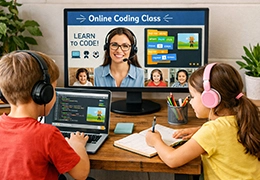
Grades 3-12, Python, Scratch and more

All ages, guitar, keyboard, singing

All grades, classical and contemporary

Grades 2-12, beginner to advanced

Grades 5-12, builds confidence

Grades 1-12, DIY lab at home

Grades 5-12, future tech skills

French, Spanish, German and more

Grades 5-12, Canva, illustration
Accreditation, board exams, fees, timings, devices and the questions parents raise on forums. More on our FAQ page.
Accreditation is the one claim a parent in Myanmar can check without leaving the house, so check it. IAO and Cognia accredit the school, Cambridge certifies the IGCSE and A Level pathway, and NIOS or BOSSE certify the Indian pathways. Each of those four bodies publishes its own list. Ask for the registration numbers and look them up before any payment.
Nothing local is required. Nursery begins at age 3 and admission runs in any month. Sessions sit in the early afternoon on Myanmar time, which suits a three-year-old better than a morning start, and they are short and activity led with an adult nearby. A learning kit is sent out for play away from the screen.
Two things make it work at this age. The NCERT books carry over, so a child coming off a CBSE roll is not learning a new syllabus on top of a new routine. And the primary slots fall in the Myanmar afternoon, which is a better hour for an eight-year-old than an early start. Live periods are short, with most of the work off the screen.
Senior grades sit at roughly 11:00 to 14:30 Myanmar time, which is the middle of the local day and the best senior-grade fit of any country on this site. Cambridge, the Cognia-accredited American pathway, the Australian Curriculum and the Indian pathways all run to Grade 12 with university pathway support.
Admission follows the move rather than a fixed intake. The counsellor maps what the child has already covered, places them and lists the gaps, and recordings cover whatever was taught before the join date. A family arriving in March or October starts at the same point in the process as one arriving in June.
Live, in every timetabled period, with a subject teacher present and attendance recorded. Recordings sit behind that for revision and for a session missed, which is worth knowing in a household where a connection occasionally drops: the lesson is not lost, and the student picks it up from the recording the same day.
One batch slot, finishing by late afternoon at the latest, with the exact length per grade published beforehand. Because classes start late morning rather than at dawn, the freed hours fall at the start of the day instead of the end, which most families find easier to use. Eye exercises run during classes.
A laptop, tablet or smartphone will do, with headphones and a webcam recommended rather than required and no paid software beyond a browser and a PDF reader. Since a phone is enough, the practical question is not the device but whether the connection holds through the class window, so test that before anything else.
Through the same twenty classmates every day, and through whatever already exists locally in the free mornings. Because the school day starts late, morning sport, music and language classes are all reachable, which is unusual for an online school. Online clubs, competitions and group projects run alongside across 135+ countries.
The starting point is whatever assessment a family already holds, because arranging a new one locally takes time. An existing report is read and built on rather than set aside, and SEND trained educators then write an individualised plan covering dyslexia, ADHD, autism and speech, language and sensory processing needs. The plan is priced separately from the annual fee.
The class teacher first, then the academic coordinator, then a counsellor. There are no clinical psychologists on staff and none are claimed, so clinical care is arranged locally where it is needed. Ask the counsellor what the school can carry and what it cannot, so you know what to put in place alongside it.
A parent app and portal update as work is marked, and both are readable from a phone, which is how most parents here will use them. Attendance, assignments and assessment results appear as they are recorded, and teachers raise concerns directly rather than waiting for a report at the end of term.
It runs its own published calendar, which will not match the Myanmar one. Expect teaching days during local holidays, Thingyan included, and breaks while local schools are open. Read the calendar before enrolling and set it against your own year, because the mismatch catches most families out.
Parents do no teaching at any stage. Grades 1 to 5 need an adult available to help with logins and keep a young child on task, and because classes fall in the early afternoon here, that is often easier to cover than a morning slot would be. From the middle grades the student runs the timetable themselves.
Four things, in this order: your position under local rules, the pathway that fits where your child is likely to study next, the class times and teaching days in Myanmar hours, and the published fee for the grade. The connection question is worth raising in the same call. A demo class can be booked there and then.
Feedback from students and parents across India who trust Sunbeam World School for quality online education. More on our reviews page.
 4.8Trusted by students across 135+ countries

"I really like how teachers encourage us to speak confidently and take part in class. Online school feels so supportive."
"The lessons are engaging, the teachers are responsive, and my daughter feels confident learning from home."
"The flexibility here is a blessing. I can revise recorded lectures anytime."
"The virtual activities and projects are my favorite. I made new friends even while studying from home!"
"Online classes are super fun and interactive. I especially love the science experiments and quizzes."
"At first I was nervous about online school, but now I actually enjoy attending classes."
Sunbeam World School has received the Best E-School award from Brainfeed Magazine, the CBSE Chairperson Best School for Skill Education award, the Bharat Vibhushan Puraskar, and awards for Best Contribution in International Education and Best in Online Education.


An academic counsellor reviews your child's grade, subjects, learning needs and goals in a free call and recommends the right pathway and batch for your family in Myanmar.
Talk to a CounsellorA free demo class shows you a live lesson, the teacher who would take your child's batch and the learning platform before you enrol.
Book a Free DemoThe same live school, six pathways and three batches, in every city below.
Nursery to Grade 12, live teacher-led classes, six boards, fee published upfront. Book a free demo class or download the brochure.