 Kids Learning
Prime Numbers 1 to 100: List, Chart and Easy Tricks
Quick Summary There are 25 prime numbers from 1 to 100: 2, 3, 5, 7, 11, 13, 17, 19, 23, 29, 31, 37, 41, 43, 47, 53, 59, 61, 67, 71, 73, 79, 83, 89 and 97. A prime number has exactly two factors, 1 and itself, so 2 is the only even prime and 1 is not a prime number.
Prime numbers 1 to 100 are one of the first big ideas children meet in maths, and they come back again in factors, HCF and LCM, fractions and even computer security. This guide gives you the full list of prime numbers from 1 to 100, a chart, a simple way to find them, easy tricks to remember them, practice questions with answers and a few fun games to play at home, which work just as well in a classroom as they do for families homeschooling with an online school.
What Is a Prime Number?
A prime number is a whole number greater than 1 that has exactly two factors, 1 and the number itself. For example, 7 is prime because only 1 × 7 makes 7, but 8 is not prime because 2 × 4 also makes 8.
The prime number definition comes down to counting factors, where a factor is a number that divides another number exactly, with nothing left over. Counting them is the clearest way to decide: exactly two factors means prime, more than two means composite, and the number 1, with only one factor, is neither. Common examples of prime numbers are 2, 3, 5, 7, 11 and 13, and the table shows how factors decide this for the numbers 1 to 12.
| Number | Factors | Number of factors | Type |
|---|---|---|---|
| 1 | 1 | 1 | Neither |
| 2 | 1, 2 | 2 | Prime |
| 3 | 1, 3 | 2 | Prime |
| 4 | 1, 2, 4 | 3 | Composite |
| 5 | 1, 5 | 2 | Prime |
| 6 | 1, 2, 3, 6 | 4 | Composite |
| 7 | 1, 7 | 2 | Prime |
| 8 | 1, 2, 4, 8 | 4 | Composite |
| 9 | 1, 3, 9 | 3 | Composite |
| 10 | 1, 2, 5, 10 | 4 | Composite |
| 11 | 1, 11 | 2 | Prime |
| 12 | 1, 2, 3, 4, 6, 12 | 6 | Composite |
Key Properties of Prime Numbers
Prime numbers share five simple properties that make them easy to recognise.
- Always greater than 1: the smallest prime number is 2.
- Only one even prime: 2 is prime, but every other even number divides by 2, so all other primes are odd.
- Cannot form a rectangle: 7 dots can only be laid out in a single line, while 6 dots also make 2 rows of 3, which is a neat way to picture a prime.
- Building blocks of numbers: every whole number above 1 is either a prime or can be made by multiplying primes, such as 12 = 2 × 2 × 3.
- They never run out: there are infinitely many prime numbers, as the Greek mathematician Euclid proved over 2,000 years ago.
What Are the Prime Numbers from 1 to 100?
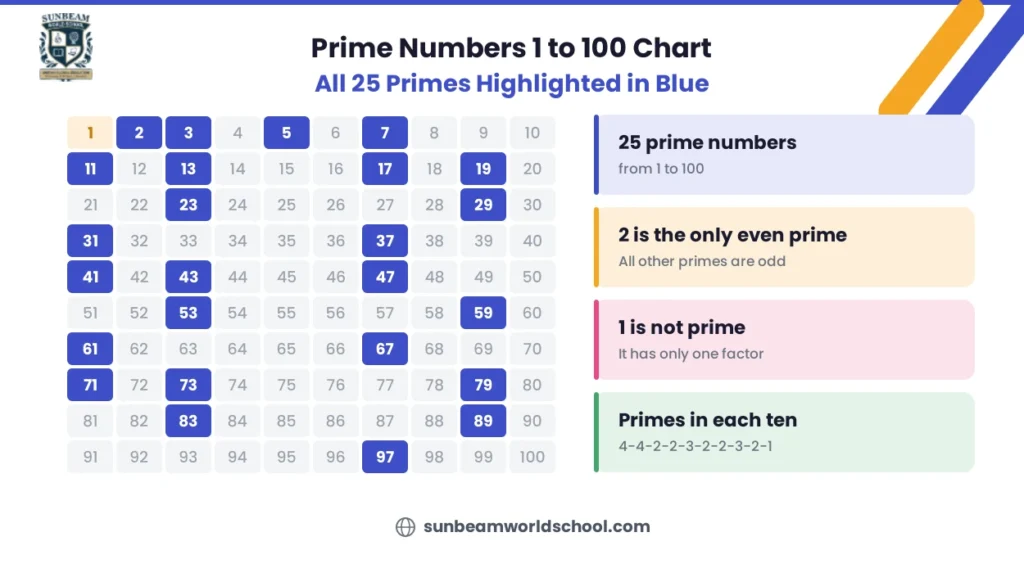
All 25 prime numbers from 1 to 100, highlighted in blue
The prime numbers from 1 to 100 are the 25 numbers from 2 to 97 that have exactly two factors, starting with 2, 3, 5 and 7. The table groups this list of prime numbers by tens, so each range is easy to read.
| Range | Prime numbers |
|---|---|
| 1 to 10 | 2, 3, 5, 7 |
| 11 to 20 | 11, 13, 17, 19 |
| 21 to 30 | 23, 29 |
| 31 to 40 | 31, 37 |
| 41 to 50 | 41, 43, 47 |
| 51 to 60 | 53, 59 |
| 61 to 70 | 61, 67 |
| 71 to 80 | 71, 73, 79 |
| 81 to 90 | 83, 89 |
| 91 to 100 | 97 |
Prime Numbers 1 to 100 Chart
The prime numbers 1 to 100 chart below shows every number from 1 to 100, with all the prime numbers up to 100 in bold.
| 1 | 2 | 3 | 4 | 5 | 6 | 7 | 8 | 9 | 10 |
| 11 | 12 | 13 | 14 | 15 | 16 | 17 | 18 | 19 | 20 |
| 21 | 22 | 23 | 24 | 25 | 26 | 27 | 28 | 29 | 30 |
| 31 | 32 | 33 | 34 | 35 | 36 | 37 | 38 | 39 | 40 |
| 41 | 42 | 43 | 44 | 45 | 46 | 47 | 48 | 49 | 50 |
| 51 | 52 | 53 | 54 | 55 | 56 | 57 | 58 | 59 | 60 |
| 61 | 62 | 63 | 64 | 65 | 66 | 67 | 68 | 69 | 70 |
| 71 | 72 | 73 | 74 | 75 | 76 | 77 | 78 | 79 | 80 |
| 81 | 82 | 83 | 84 | 85 | 86 | 87 | 88 | 89 | 90 |
| 91 | 92 | 93 | 94 | 95 | 96 | 97 | 98 | 99 | 100 |
[Image: Prime numbers 1 to 100 chart with primes highlighted. Alt text: "Prime numbers 1 to 100 chart"]
How Many Prime Numbers Are There from 1 to 100?
There are 25 prime numbers between 1 and 100, with 15 of them from 1 to 50 and 10 from 51 to 100. The count in each group of ten follows the pattern 4, 4, 2, 2, 3, 2, 2, 3, 2, 1, which is an easy way to check that none are missing.
| Range | 1–10 | 11–20 | 21–30 | 31–40 | 41–50 | 51–60 | 61–70 | 71–80 | 81–90 | 91–100 |
|---|---|---|---|---|---|---|---|---|---|---|
| Primes | 4 | 4 | 2 | 2 | 3 | 2 | 2 | 3 | 2 | 1 |
That leaves 74 composite numbers from 1 to 100, because 100 numbers minus 25 primes minus the number 1 gives 74.
How Do You Find Prime Numbers from 1 to 100?
You find prime numbers from 1 to 100 by crossing out the multiples of 2, 3, 5 and 7, and the numbers left, apart from 1, are prime. This method is called the Sieve of Eratosthenes, and 2, 3, 5 and 7 themselves stay on the list.
The Sieve of Eratosthenes
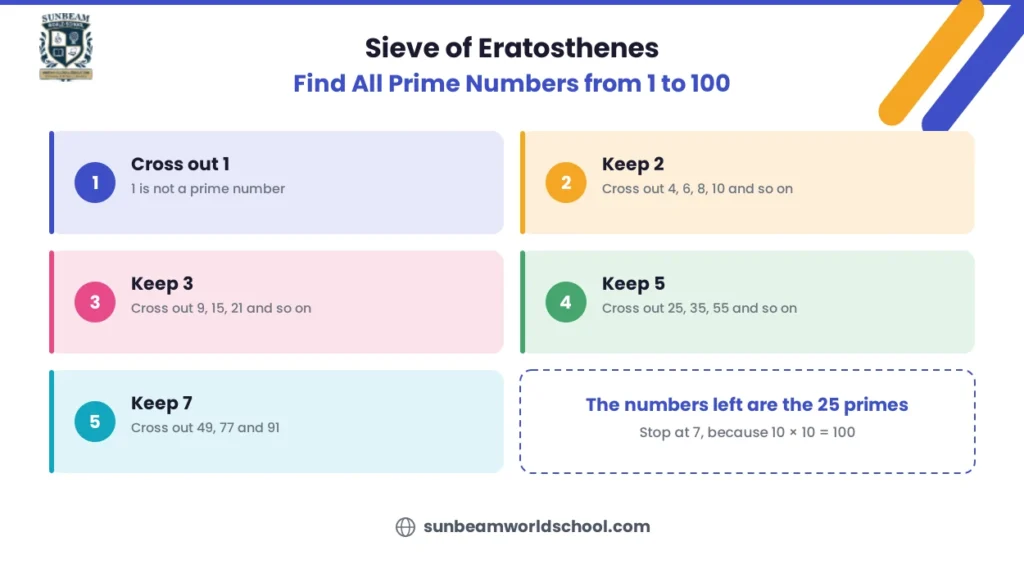
Five simple steps to find every prime number from 1 to 100
The Sieve of Eratosthenes finds all 25 primes in five steps on a 1 to 100 grid.
- Cross out 1, because it is not prime.
- Circle 2, then cross out every other multiple of 2 (4, 6, 8 and so on).
- Circle 3, then cross out every multiple of 3 that is still left (9, 15, 21 and so on).
- Circle 5, then cross out its remaining multiples (25, 35, 55 and so on).
- Circle 7, then cross out its remaining multiples (49, 77 and 91).
Every number still standing is prime. You can stop at 7 because 10 × 10 = 100, so any composite number up to 100 must have at least one factor of 10 or less, and the only primes below 10 are 2, 3, 5 and 7.
Checking Any Number Step by Step
To check if a number up to 100 is prime, divide it by 2, 3, 5 and 7, and if none divides it exactly, it is prime. You never need a bigger divisor, because 10 × 10 = 100, so any composite number up to 100 has a factor smaller than 10.
These quick divisibility tests make it easy to identify prime numbers:
- By 2: the number is even, so it ends in 0, 2, 4, 6 or 8.
- By 3: the digits add up to a multiple of 3, such as 8 + 7 = 15 for 87.
- By 5: the number ends in 0 or 5.
- By 7: divide directly, or use the 7 times table up to 7 × 14 = 98.
| Number | Divides by 2? | Divides by 3? | Divides by 5? | Divides by 7? | Result |
|---|---|---|---|---|---|
| 77 | No | No (7 + 7 = 14) | No | Yes, 7 × 11 | Not prime |
| 87 | No | Yes, 3 × 29 | No | No | Not prime |
| 89 | No | No (8 + 9 = 17) | No | No (7 × 12 = 84, 5 left over) | Prime |
| 91 | No | No (9 + 1 = 10) | No | Yes, 7 × 13 | Not prime |
| 97 | No | No (9 + 7 = 16) | No | No (7 × 13 = 91, 6 left over) | Prime |
What Are Easy Tricks to Remember Prime Numbers?
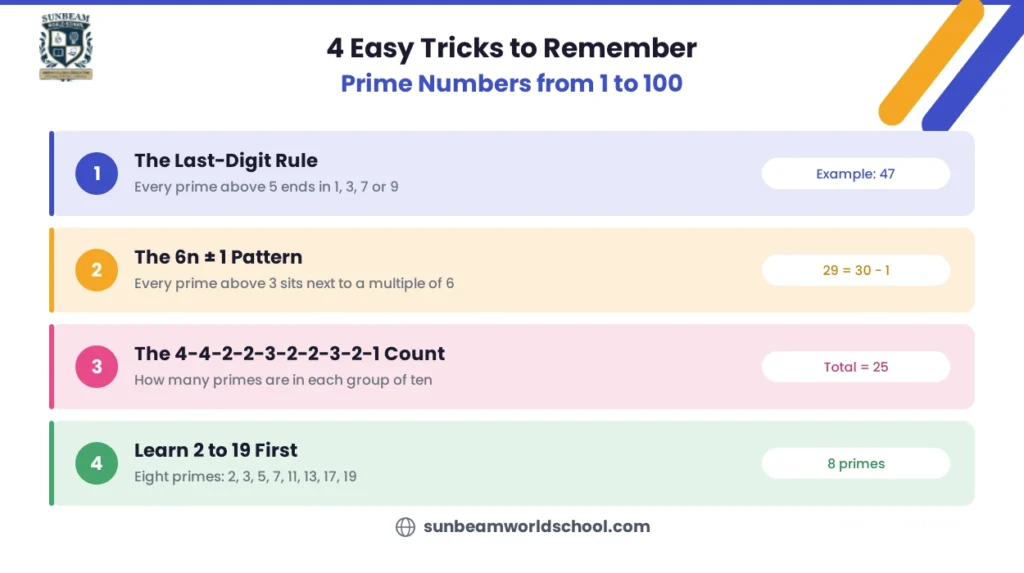
Four simple tricks that make prime numbers easy to remember
The easiest tricks to remember prime numbers are the last-digit rule, the 6n ± 1 pattern and the 4-4-2-2-3-2-2-3-2-1 count. Together they help you spot almost any prime from 1 to 100 without the full list.
The Last-Digit Rule
Every prime number above 5 ends in 1, 3, 7 or 9, so any number ending in 0, 2, 4, 5, 6 or 8 can be ruled out straight away. This rule only narrows the search, since 21, 27 and 49 also end in these digits but are not prime.
The 6n ± 1 Pattern
Every prime number above 3 is exactly one more or one less than a multiple of 6. For example, 29 is 30 − 1 and 37 is 36 + 1, but not every number next to a multiple of 6 is prime, because 25 and 35 also fit the pattern.
The 4-4-2-2-3-2-2-3-2-1 Count
The number of primes in each group of ten, from 1 to 10 up to 91 to 100, is 4, 4, 2, 2, 3, 2, 2, 3, 2, 1. Remembering this sequence tells you how many primes to look for in each row of the chart, which makes gaps easy to spot.
Learn 2 to 19 First
Learning the eight primes from 2 to 19 by heart gives you a strong base, since every prime after that follows the rules above. After that, notice that the 30s and 60s each have two primes ending in 1 and 7 (31, 37, 61 and 67), while the 90s have only one prime, 97.
Which Numbers Look Prime but Are Not?
Numbers like 51, 57, 87 and 91 look prime because they are odd and do not end in 5, but each one has a hidden factor, usually 3 or 7. These are the numbers students most often get wrong.
| Number | Why it is not prime |
|---|---|
| 21 | 3 × 7 = 21 |
| 27 | 3 × 9 = 27 |
| 33 | 3 × 11 = 33 |
| 39 | 3 × 13 = 39 |
| 49 | 7 × 7 = 49 |
| 51 | 3 × 17 = 51 |
| 57 | 3 × 19 = 57 |
| 63 | 3 × 21 = 63 |
| 69 | 3 × 23 = 69 |
| 77 | 7 × 11 = 77 |
| 81 | 3 × 27 = 81 |
| 87 | 3 × 29 = 87 |
| 91 | 7 × 13 = 91 |
| 93 | 3 × 31 = 93 |
| 99 | 3 × 33 = 99 |
What Is the Difference Between Prime and Composite Numbers?
Prime numbers have exactly two factors, while composite numbers have more than two factors. From 1 to 100 there are 25 prime numbers, 74 composite numbers and the number 1, which is neither.
| Feature | Prime numbers | Composite numbers |
|---|---|---|
| Number of factors | Exactly 2 | More than 2 |
| Smallest one | 2 | 4 |
| Examples | 2, 3, 5, 7, 11 | 4, 6, 8, 9, 10 |
| Count from 1 to 100 | 25 | 74 |
| Can be split into smaller factors? | No | Yes, such as 12 = 3 × 4 |
What Is Prime Factorisation?
Prime factorisation means writing a composite number as a product of prime numbers only, such as 60 = 2 × 2 × 3 × 5. Every composite number has exactly one set of prime factors, which is why primes are called the building blocks of numbers.
The easiest way to find prime factors is a factor tree. Split the number into any two factors, then keep splitting each factor until only primes are left. For 60, you can split it into 6 × 10, then 6 into 2 × 3 and 10 into 2 × 5, which gives 2 × 2 × 3 × 5. Starting with 4 × 15 instead still ends at the same primes.
| Number | Prime factorisation |
|---|---|
| 12 | 2 × 2 × 3 |
| 30 | 2 × 3 × 5 |
| 60 | 2 × 2 × 3 × 5 |
| 84 | 2 × 2 × 3 × 7 |
| 100 | 2 × 2 × 5 × 5 |
Prime factorisation is used in Classes 6 to 8 to find the HCF and LCM of numbers and to simplify fractions, so knowing the primes up to 100 makes these chapters much faster.
What Are the Types of Prime Numbers?
The main types of prime numbers students meet are twin primes, mirror primes and the only even prime, 2, along with the related idea of co-prime numbers.
Twin Primes
Twin primes are pairs of prime numbers that differ by exactly 2. There are 8 twin prime pairs from 1 to 100: (3, 5), (5, 7), (11, 13), (17, 19), (29, 31), (41, 43), (59, 61) and (71, 73).
Mirror Primes
Mirror primes stay prime when their digits are reversed. Below 100 these are 13 and 31, 17 and 71, 37 and 73, and 79 and 97, while 11 reads the same both ways. A fun fact many students remember is that 37 is the 12th prime number and 73 is the 21st, so even their positions are mirrored.
The Only Even Prime
2 is the only even prime number, because every other even number can be divided by 2 and so has at least three factors. This makes 2 the smallest prime and the only prime that is not odd.
Co-Prime Numbers
Co-prime numbers are two numbers whose only common factor is 1, such as 8 and 15. They are not a type of prime, since neither number has to be prime, but any two different prime numbers, like 5 and 7, are always co-prime.
Where Are Prime Numbers Used in Real Life?
Prime numbers are used in online security, computer science and even nature, because they cannot be broken down into smaller factors. Here are four places you will find them.
Keeping Online Payments Safe
Prime numbers protect online banking and shopping through encryption. Computers multiply two very large primes to create a code, which is easy to do but extremely hard to reverse, so even powerful computers cannot work out the original primes in a reasonable time.
Cicadas in Nature
Some cicadas in North America stay underground for exactly 13 or 17 years before coming out, and both numbers are prime. Scientists think these prime cycles help the insects avoid predators whose life cycles repeat every 2, 3 or 4 years, since a prime number rarely lines up with them.
Computers and Coding
Programmers often use prime numbers to spread data evenly in storage systems, and finding primes is one of the first problems many students solve when learning to code. The largest known prime numbers, which have millions of digits, were all found by computers.
School Maths
In school maths, primes are used to find HCF and LCM, simplify fractions and solve number puzzles, and they are taught alongside other number topics such as Roman numerals 1 to 1000, so they appear in tests from primary classes through to Class 10.
What Mistakes Do Students Make with Prime Numbers?
The most common mistakes are calling 1 a prime, thinking every odd number is prime, and forgetting that 2 is prime. The table shows each mistake and the correct idea.
| Mistake | Why it is wrong | Correct idea |
|---|---|---|
| "1 is a prime number" | 1 has only one factor | 1 is neither prime nor composite |
| "2 is not prime because it is even" | 2 has only the factors 1 and 2 | 2 is the only even prime |
| "All odd numbers are prime" | 9, 15, 21 and 51 are odd but composite | Check every odd number for factors |
| "Numbers ending in 1, 3, 7 or 9 are always prime" | 21, 27, 49 and 81 break this rule | The last digit only rules numbers out |
| Starting a list of primes at 3 | 2 gets forgotten because it is even | Every list of primes starts at 2 |
What Are Some Interesting Facts About Prime Numbers?
The most interesting prime number facts are that 2 is the only even prime, 97 is the largest below 100, and all 25 primes add up to 1060.
- Smallest prime number: 2.
- Largest prime number less than 100: 97.
- First 10 prime numbers: 2, 3, 5, 7, 11, 13, 17, 19, 23, and 29.
- Sum of all primes from 1 to 100: 1060.
- Odd prime numbers: every prime except 2 is odd, so 24 of the 25 primes up to 100 are odd.
- Primes up to 1000: there are 168 prime numbers from 1 to 1000.
- Goldbach's idea: every even number above 2 seems to be the sum of two primes, such as 20 = 7 + 13, but nobody has proved it yet.
What Are Some Prime Numbers Practice Questions?
Good prime numbers practice questions test spotting primes, listing them and using them in sums. The 20 below move from 6 easy to 7 challenge-level questions, with worked answers.
Level 1: Easy
Level 1 questions test the definition and the primes up to 20.
- Is 17 a prime number?
- Is 21 a prime number?
- What is the smallest prime number?
- List the prime numbers from 1 to 10.
- How many prime numbers are there from 1 to 20?
- Is 1 a prime number?
Level 2: Medium
Level 2 questions test tricky numbers and ranges up to 100.
- Is 87 a prime number?
- Is 91 a prime number?
- List the prime numbers between 50 and 60.
- List the prime numbers between 80 and 100.
- What is the largest two-digit prime number?
- Find the twin primes between 40 and 50.
- Which is the odd one out: 23, 29, 33, 37?
Level 3: Challenge
Level 3 questions test sums, averages and reasoning with primes.
- Find the sum of all prime numbers from 1 to 20.
- Write 30 as the sum of two prime numbers in three different ways.
- Find the average of the first five prime numbers.
- Multiply the smallest prime number by the largest prime number below 100.
- How many composite numbers are there from 1 to 100?
- To check whether 97 is prime, which numbers do you need to test, and is it prime?
- Find the only set of three prime numbers in a row that each differ by 2.
Answers
Each answer shows the working, so you can see exactly where a mistake happened.
Level 1: Easy
- 17 divides only by 1 and 17, so yes, 17 is prime.
- 21 = 3 × 7, so no, 21 is composite.
- 2 is the smallest prime number.
- 2, 3, 5 and 7.
- 2, 3, 5, 7, 11, 13, 17 and 19, so 8 primes.
- 1 has only one factor, so no, 1 is not prime.
Level 2: Medium 7. 8 + 7 = 15, which divides by 3, and 87 = 3 × 29, so 87 is not prime. 8. 91 = 7 × 13, so 91 is not prime. 9. 53 and 59. 10. 83, 89 and 97. 11. 97 is the largest two-digit prime. 12. 41 and 43 differ by 2, so the twin primes are (41, 43). 13. 33 = 3 × 11, while the others are prime, so 33 is the odd one out.
Level 3: Challenge 14. 2 + 3 + 5 + 7 + 11 + 13 + 17 + 19 = 77. 15. 7 + 23, 11 + 19 and 13 + 17, which all make 30. 16. (2 + 3 + 5 + 7 + 11) ÷ 5 = 28 ÷ 5 = 5.6. 17. 2 × 97 = 194. 18. 100 − 25 primes − 1 = 74 composite numbers. 19. Since 10 × 10 = 100, test only 2, 3, 5 and 7. None divide 97, so 97 is prime. 20. 3, 5 and 7, because in any other set of three numbers that differ by 2, one of them divides by 3.
What Are Some Fun Prime Number Games for Kids?
Fun prime number games like sieve colouring, prime bingo and a "Prime or Not?" card race help kids learn all 25 primes through play instead of memorising. Each game takes 10 to 15 minutes and needs only paper, cards or dice.
Sieve Colouring Race
In the sieve colouring race, children colour the multiples of 2, 3, 5 and 7 on a 1 to 100 grid, and every uncoloured number except 1 is prime. The first child to finish with all 25 primes correct wins, and the game teaches the Sieve of Eratosthenes without feeling like a lesson.
Prime or Not? Card Game
In Prime or Not?, write the numbers 1 to 100 on cards, shuffle them and flip one card at a time while players shout "Prime!" or "Not!". A player who is right keeps the card, and a player who is wrong must name one factor of the number, which builds quick recognition of tricky numbers like 51, 57 and 91.
Prime Number Bingo
In prime number bingo, children mark numbers on a 5 × 5 card as the caller reads clues like "the only even prime". Clues such as "the largest prime below 100" work well too, the first full line wins, and the game helps children remember prime facts as well as the numbers.
Prime Dice Challenge
In the prime dice challenge, players roll two dice and make a two-digit number, so a 3 and a 7 can become 37 or 73. A prime scores one point, and if both versions are prime, like 37 and 73 or 13 and 31, the player scores double.
Prime Hopscotch
In prime hopscotch, chalk a hopscotch grid outdoors with a mix of numbers, and children may only land on prime numbers. Stepping on a composite number means you are out, which makes it a great game for active learners who find sitting still hard, and quick wins like these build the confidence and self esteem children need to enjoy maths.
Goldbach Sum Puzzle
In the Goldbach sum puzzle, older children race to write an even number from 4 to 100 as the sum of two primes, such as 30 = 13 + 17. The player who finds the most pairs wins, and it introduces Goldbach's conjecture, a famous idea that every even number above 2 is the sum of two primes, which nobody has ever proved.
Playing one game a day for a week is usually enough for children to know every prime up to 100, since short daily practice works far better than one long session, which is the core idea behind learning how to study effectively.
Conclusion
Prime numbers 1 to 100 are easy to master: a prime has exactly two factors, 1 and itself, and there are 25 of them from 2 to 97.
Here is a simple plan to learn them in one week:
- Day 1: Learn what a prime number is, and why 1 is not prime.
- Day 2: Learn the 8 primes from 2 to 19 by heart.
- Day 3: Use the Sieve of Eratosthenes on a 1 to 100 grid.
- Day 4: Practise the last-digit rule and the 4-4-2-2-3-2-2-3-2-1 count.
- Day 5: Learn the numbers that look prime but are not, like 51, 57 and 91.
- Day 6: Play one of the prime number games above.
- Day 7: Solve the 20 practice questions and check your answers.
If your child needs extra help with maths, Sunbeam World School offers live classes at their own pace through personalized learning.

Frequently Asked Questions
Is 1 a prime number?
-No, 1 is not a prime number, because a prime must have exactly two different factors and 1 has only one factor, itself. Mathematicians also leave 1 out so that every whole number has only one way to be written as a product of primes. For example, 6 is always 2 × 3, but if 1 were prime, 6 could also be written as 1 × 2 × 3 or 1 × 1 × 2 × 3, and that rule would break.
Is 2 a prime number?
+Is 0 a prime number?
+Is 1 prime or composite?
+Why is 51 not a prime number?
+Is 29 a prime number?
+Is 73 a prime number?
+What are the prime numbers from 1 to 50?
+What are the prime numbers from 1 to 20 and 1 to 10?
+What are the prime numbers between 50 and 100?
+What is the largest prime number between 1 and 100?
+Is there a formula for prime numbers?
+How many prime numbers are there from 1 to 1000?
+What is mul sankhya or abhajya sankhya in English?
+
In this article
Share this post:


Press and Blogs
Stay updated with our press releases, educational blogs, and more.
Quick Summary Roman numerals 1 to 1000, also called Roman numbers, use seven letters: I...

Quick Summary Animal sounds are the noises animals make to communicate, warn of danger and...
Quick Summary An algebra equation is a maths statement that sets two expressions equal using...