
 CBSE
CBSE
CBSE Curriculum Changes 2026-27: Complete Guide for Parents
Quick Answer CBSE is introducing major curriculum changes for the 2026-27 academic year, in line with India's National Education Policy (NEP) 2020. Most of the changes begin with Class 9, while Class 10, 11, and 12 remain largely unchanged for now.
The key changes include a new Class 9 subject structure, a new citizenship-focused subject, changes to Maths, compulsory AI and computational thinking, three-language learning, greater subject flexibility, an integrated Social Science curriculum, and more importance given to projects and everyday schoolwork.
You may have heard people talk about the "new CBSE curriculum" without knowing exactly what it means. That's normal, since a lot of separate changes are landing at the same time, and some of what you read online is actually about exam evaluation, not the curriculum itself.
This guide walks through each real curriculum change in plain language, one at a time, with enough detail that you'll know exactly what applies to your child and why CBSE made the change.
What Is the CBSE New Curriculum 2026-27?
The new CBSE curriculum is a new approach to what students learn and how they learn it. It is based on the goals of NEP 2020, which encourages schools to move beyond rote memorisation and focus more on understanding, practical skills, critical thinking, and holistic development.
The National Curriculum Framework (NCF) 2023 provides the framework for putting these ideas into practice across different subjects. Many of these changes begin in the 2026-27 academic year, with Class 9 seeing the biggest shift because students entering this grade experience the new structure from the beginning.
What Are the Main Changes in the CBSE Curriculum?
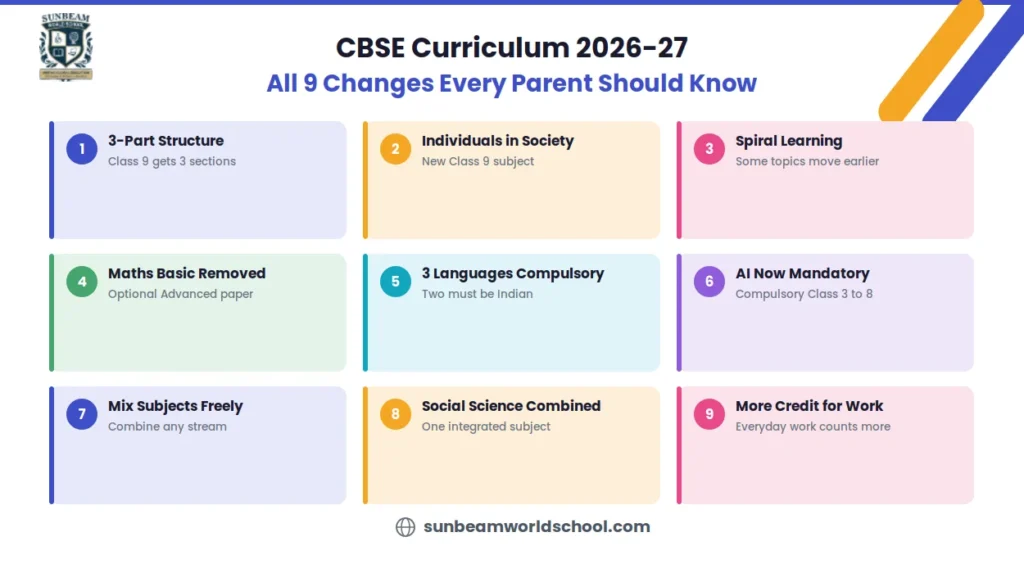
All 9 CBSE curriculum changes for 2026-27, at a glance
Here are the nine main changes, explained one by one, with details on what each one means day to day.
Change 1: Class 9 Now Has Three Parts
The Class 9 curriculum is organised into three broad areas:
- Part 1: Languages: Reading, writing, speaking, and communication skills
- Part 2: Academics: Mathematics, Science, and Social Science
- Part 3: Cross-Curricular Areas: Vocational Education, Arts, Physical Education, and Interdisciplinary Areas
Class 9 subjects are grouped into three connected parts instead of one long list of subjects. Part 1 is Language, covering reading, writing, and speaking skills across the languages a student studies. Part 2 is Academics, covering Maths, Science, and Social Science, the subjects most parents think of as "core" school subjects. Part 3 is Cross-Curricular Areas, covering Vocational Education, Arts, Physical Education, and a new area called Interdisciplinary Areas, which blends skills from more than one subject into a single project or activity. This grouping matters because it puts art, sport, and hands-on skills on the same level as Maths and Science in how the school year is planned, rather than treating them as extra time filled in around the main subjects.
Change 2: A New Subject Called Individuals in Society
Class 9 students will study a new subject called Individuals in Society.
The subject focuses on:
- Rights and responsibilities
- Constitutional values
- Social issues
- Community awareness
- Responsible citizenship
Class 9 students now study a subject called Individuals in Society. It teaches about personal rights, responsibilities, constitutional values, and how to think about social issues that affect communities. There is no board exam for this subject at all. Instead, teachers grade it through classroom work, discussions, and projects across the year. CBSE has framed this as an attempt to raise thoughtful citizens, not just exam-passers, so expect the subject to feel more like a discussion class than a textbook-and-test subject.
Change 3: Some Maths Topics Move to an Earlier Class
Some topics that were previously introduced in Class 10 are now being moved to Class 9.
These include topics such as:
- Arithmetic progressions
- Pairs of linear equations
A few Maths topics that used to appear in Class 10 are now taught in Class 9 instead. Two clear examples are arithmetic progressions and pairs of linear equations, both of which used to be introduced a year later. This approach is called spiral learning, and it works a bit like getting better at a video game level. Instead of learning a topic once and moving on for good, students meet it early in a simple form, then return to the same topic later in more depth. Over time, this is meant to build stronger number sense and reduce the sudden jump in difficulty that many students used to feel in Class 10.
Change 4: Maths Basic Is Being Removed
CBSE is removing the Maths Basic paper, starting with the Class 9 cohort in the 2026-27 session. In its place, there is a brand new, fully optional Advanced Maths paper, along with a separate optional Advanced Science paper. Each of these papers is worth 25 marks, takes about an hour, and focuses on harder, real-world style questions rather than direct formula-based ones.
The marks from these optional papers are never added to a student's overall total, so there's genuinely no risk in attempting one. Students who score 50% or higher get a special mention on their Class 10 marksheet, which colleges and coaching institutes can recognise later, and a student is free to attempt Advanced Maths, Advanced Science, both, or neither, entirely based on their own interest and confidence.
Change 5: Three Languages Are Now Compulsory
Every CBSE student must now study three languages at school, labeled R1, R2, and R3 to keep track of which is which. At least two of the three must be Indian languages, and English can still be studied, usually taken as the third language if two Indian languages are already covered.
CBSE has widened the list of language choices too, adding Santhali, Maithili, Dogri, and Konkani, which brings the total number of languages offered at the secondary level up to 44. This rule becomes compulsory from Class 6 starting this year, and it will apply gradually up through Class 10 over the next few years, so a student's very first board exam under the full three-language rule depends on which class they're in right now.
Change 6: AI and Computational Thinking Are Now Mandatory
Starting this year, every student from Class 3 to Class 8 learns the basics of Artificial Intelligence and computational thinking as a required part of school, not as an optional extra. For younger students in Class 3 to 5, this isn't a separate subject at all, it's built directly into everyday lessons in Maths, Science, and Social Studies, using simple activities like spotting patterns or following logical steps.
Students in Class 6 to 8 go a level further, exploring how AI actually works through hands-on, interactive projects rather than theory alone. From the 2027-28 school year, AI becomes its own proper subject in Class 9 and 10, and it later turns into an elective in Class 11 and 12 for students who want to study it in more depth, eventually becoming a fully board-examined subject from 2029 onward. The curriculum itself was built with input from experts at IIT Madras, MNIT Jaipur, NITTTR Bhopal, and Azim Premji University, which is worth knowing if you're wondering how carefully this was planned.
Change 7: Students Can Now Mix Subjects Across Streams
In the past, a student had to pick one stream, Science, Commerce, or Arts, around the age of fifteen or sixteen, and stay locked into it for the rest of school. Now, students can combine subjects from completely different streams based on their own interests rather than a fixed track. A student could study Physics alongside History, Mathematics alongside Music, or Commerce alongside Psychology, mixing and matching in a way that simply wasn't allowed before.
This kind of flexibility matters most for students who are genuinely torn between two very different interests, and it's especially relevant for anyone weighing subject choices against future exams like JEE or NEET, since a student no longer has to give up a personal interest just to keep a competitive-exam subject.
Change 8: Social Science Becomes One Combined Subject
History, Geography, Political Science, and Economics used to be taught as four separate, mostly unconnected subjects. Under the new curriculum, they're taught together as one integrated Social Science subject, with lessons built around how these topics actually connect in the real world.
For example, a lesson on a historical event might also cover its geography and economic impact in the same class, rather than splitting that story across three different textbooks. There's also a much stronger focus now on the Indian Knowledge System, which covers India's own traditional knowledge, culture, and historical achievements, treated as core content rather than a small side chapter.
Change 9: More Credit for Projects and Everyday Schoolwork
Beyond subject content, CBSE is also changing how much everyday schoolwork counts toward a student's overall record. Projects, class participation, and consistent effort across the year are being given more weight, rather than almost everything riding on one final exam.
Through something called the National Credit Framework, students can even earn recognised credit for time spent on sports, arts, or vocational training outside the usual classroom subjects. Together, these changes are meant to build what CBSE calls a Holistic Progress Card, a fuller picture of a student's abilities than a single mark sheet has ever captured before.
When Do These Changes Apply to Your Child?
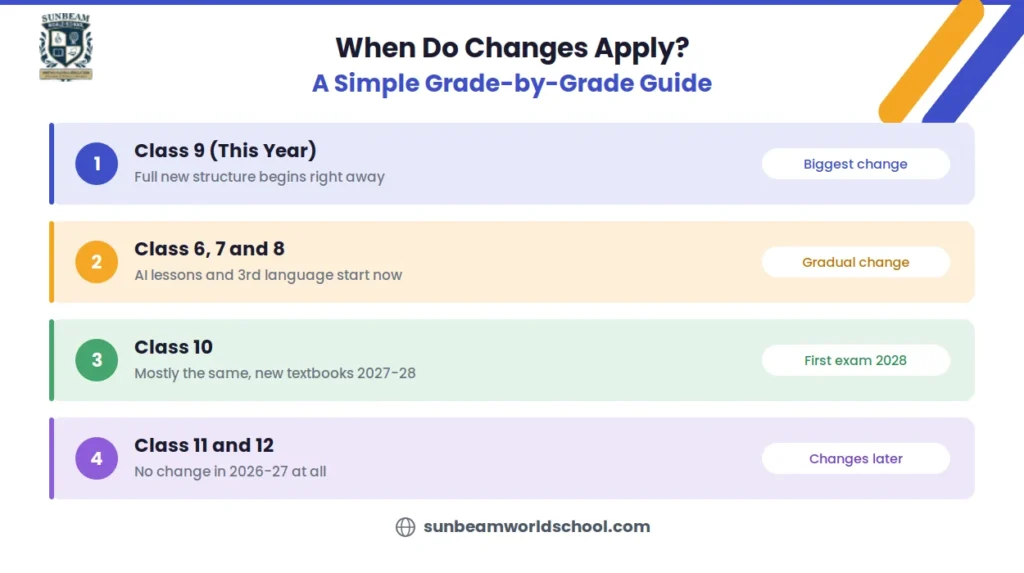
A simple grade-by-grade guide to when CBSE's 2026-27 curriculum changes actually apply
Not every class changes at the same time, or by the same amount. Here's a simple breakdown by grade.
Class 9 and Younger Students See the Changes First
Students starting Class 9 this year get the full set of new changes right away, including the new subject structure, the Maths Basic change, and spiral learning. Students in Class 6, 7, and 8 already have the new AI lessons this year, and the three-language rule starts from Class 6 as well. So younger students are absorbing these changes gradually, one piece at a time, rather than facing everything at once the way this year's Class 9 students are.
What About Classes 10, 11, and 12?
Class 11 and Class 12 do not change at all for the 2026-27 session. Class 10 also stays mostly on the previous system for now, since the first board exam that fully reflects the new structure only happens in 2028, once today's Class 9 students move up. Students currently in Class 10 and 11 can expect new NCERT textbooks from the 2027-28 school year, and if your child is already deep into board-exam prep, it's worth checking whether NCERT alone is still enough for competitive exams once those revised books arrive.
Are CBSE Curriculum Changes the Same as Exam Changes?
No, Curriculum changes and examination changes are different. Some information circulating online under the heading "CBSE 2026 changes" relates to how answer sheets are evaluated or how examinations are conducted rather than what students learn in the classroom.
For example, digital evaluation and changes related to examination attempts fall under exam rules, not the curriculum itself. Keeping these two categories separate makes it easier for parents to understand which changes actually affect their child's subjects and classroom learning.
What Should Parents Do About the New CBSE Curriculum?
The best first step is to ask your child's school exactly which of these nine changes apply to their specific grade this year, since schools don't all move at the same pace even under the same CBSE rules. It also helps to see skill-based and vocational learning as a genuine opportunity rather than extra pressure, since this kind of learning now counts as real, recognised schoolwork instead of something separate from academics.
If your child is starting Class 9 this year, encourage steady, daily practice in Maths and languages rather than last-minute cramming, since both spiral learning and the three-language rule are built to reward consistency over time.
Conclusion
The CBSE curriculum is changing in several important ways, but not every change applies to every student immediately. Class 9 sees the biggest shift in 2026-27, while Classes 10, 11, and 12 remain largely unchanged for now.
At Sunbeam World School, we believe parents and students benefit from understanding exactly what is changing and when it will affect them. A clear understanding of the new curriculum can help families make better academic decisions without unnecessary confusion.
If you want to understand how these curriculum changes connect with your child's grades and report card, that is a useful next step.

Frequently Asked Questions
What is the CBSE new curriculum 2026-27?
-The CBSE new curriculum 2026-27 reorganises how students learn, built around India's NEP 2020 policy. It brings nine major changes, with Class 9 seeing the most, including a new subject structure, mandatory AI lessons, and a stricter three-language rule.
What's new for Class 9 under the 2026-27 curriculum?
+Should my child attempt the Advanced Maths or Science paper?
+Are there new CBSE rules for Class 10 in 2026-27?
+Will Class 10 syllabus change again in 2027-28?
+Will Class 11 and 12 syllabus change in 2026-27?
+When will Class 12 see new curriculum rules?
+How will the new CBSE curriculum impact students?
+Is the CBSE AI curriculum compulsory for all students?
+Will the AI curriculum just become another subject to memorise?
+Which languages are mandatory under the new three-language rule?
+
In this article
Share this post:


Press and Blogs
Stay updated with our press releases, educational blogs, and more.
Quick Answer CBSE On-Screen Marking (OSM) is a digital evaluation system where scanned copies of answer...
Quick Summary 300+ essay topics for students, sorted by grade from Class 3 to Class...
Quick Summary Activity-Based Learning (ABL) is a teaching approach in which children learn concepts through...