
 Online Education
What Is the CBSE Third Language (R3) Rule?
The CBSE third language (R3) rule requires every student to study three languages, of which at least two must be Bhartiya Bhashas, or native Indian languages. It took effect from the 2026-27 session, and for the batches currently in school, the third language is assessed internally rather than through a board exam.
The confusion comes from two things: the rule applies differently to every batch, and two CBSE communications appear to contradict each other on what happens if a child fails. This guide sets out which batch your child falls into, whether a board exam applies, who is exempt, and what to do if your child is being told to drop French or German, including how language choices work in an accredited online school. Everything below comes from CBSE's own circulars and press releases.
What Is the CBSE Third Language (R3) Rule?
The CBSE third language rule makes the study of three languages compulsory at the secondary stage, with at least two of them required to be native Indian languages. The third language is referred to as R3, and it is assessed internally by the school for the batches currently moving through Classes 6 to 10.
CBSE introduced the rule to align its scheme of studies with the National Education Policy 2020 and the National Curriculum Framework for School Education 2023, both of which recommend that students learn three languages with at least two native to India.
The key documents are CBSE Circular Acad-33/2026 dated 15 May 2026, which made three languages compulsory for Class 9 from 1 July 2026, the CBSE press release dated 29 June 2026 setting out batch-wise guidelines, and implementation guidelines dated 10 July 2026 clarifying the certification requirement. Because the rule is being challenged in the Supreme Court, parents should treat the position as current rather than final.
Is the Third Language Compulsory?
Yes, the third language is compulsory for students in Classes 6 to 9 from the 2026-27 session onward. It is not optional, and a school cannot waive it except in the specific exemption categories set out below.
What is not compulsory is a board examination in it, for the batches currently in school. This is the distinction that causes most of the confusion. The subject is mandatory; the board exam is not, at least for now.
Students in Class 10 during 2026-27 are the one exception. That batch continues with the old two-language system and does not need to take a third language at all.
What Do R1, R2 and R3 Mean?
R1, R2 and R3 are simply CBSE's labels for a student's first, second and third language. The rule is not about which specific language sits in which slot, but about the overall combination, since at least two of the three must be Bhartiya Bhashas.
| Label | What it is | Rule that applies |
|---|---|---|
| R1 | First language | Usually the medium of instruction or mother tongue |
| R2 | Second language | Must be different from R1 |
| R3 | Third language | Must be different from R1 and R2 |
CBSE's press release works through three situations for Class 9 students, which are the clearest guide to what your child can actually choose:
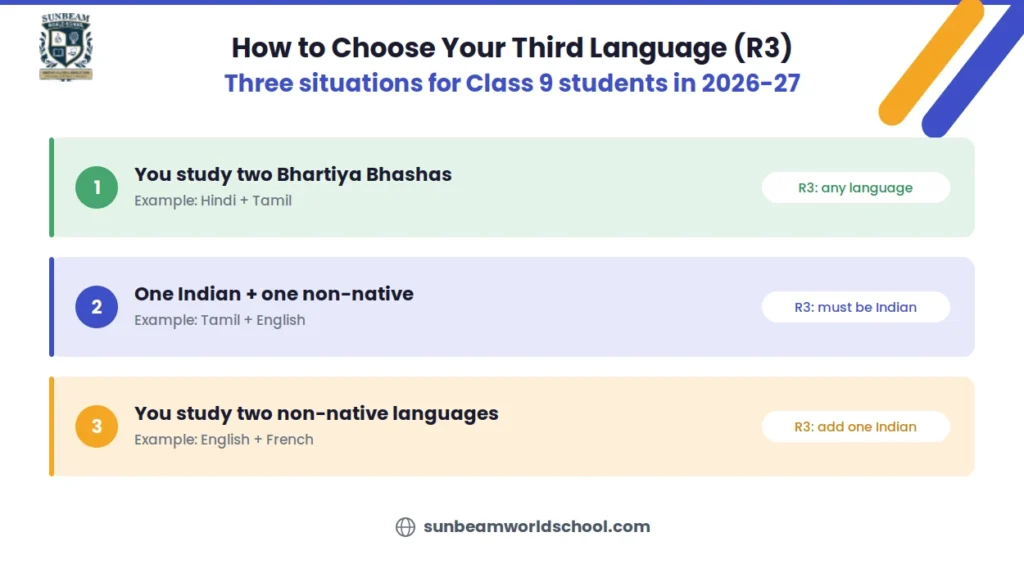
The CBSE Third Language (R3) requirement depends on the combination of languages a student studies in Class 9 under the 2026–27 curriculum.
- If your child already studies two Bhartiya Bhashas, for example Hindi and Tamil, R3 can be either another Indian language or a non-native language such as English or French.
- If your child studies one Bhartiya Bhasha and one non-native language, for example Tamil and English, R3 must be a Bhartiya Bhasha.
- If your child studies two non-native languages, for example English and French, a one-time relaxation applies for students already in Class 9 during 2026-27. They may continue both and add one Bhartiya Bhasha as R3.
Which Languages Count as Bhartiya Bhashas?
Bhartiya Bhashas are the native Indian languages, and CBSE's examples include Hindi, Sanskrit, Tamil, Telugu, Kannada, Malayalam, Marathi, Bengali, Punjabi, Gujarati, Odia and Assamese. Dedicated R3 textbooks are being made available in 22 scheduled Indian languages through NCERT.
English does not count as a Bhartiya Bhasha. CBSE lists it alongside French, German, Arabic and Spanish as a non-native language, and this holds true even in schools where English is the medium of instruction.
This single point causes more confusion than anything else in the policy, and it is worth being precise about it. If your child studies in an English-medium school and takes Hindi as a second language, English and Hindi together give only one Bhartiya Bhasha. A second Indian language is therefore required, which is why so many English-medium schools have introduced Sanskrit as R3.
If your family speaks a regional language at home, this is a genuine opportunity to formalize it. Many families choose a mother tongue such as Bengali, Marathi or Telugu as R3 rather than defaulting to whatever the school offers, and regional language classes can support that where a school cannot.
Which Batch Does the R3 Rule Apply To?
The R3 rule applies differently to every batch, and this is the most important table in this article. Find your child's class in the 2026-27 session and read across.
| Class in 2026-27 | Third language required? | Board exam in R3? |
|---|---|---|
| Class 6 | Yes, two of three must be Indian languages | Yes, when this batch reaches Class 10 |
| Class 7 | Yes, continues through Classes 9 and 10 | No |
| Class 8 | Yes, continues through Classes 9 and 10 | No |
| Class 9 | Yes, from 1 July 2026 | No, internal assessment only |
| Class 10 | No, continues with two languages | Not applicable |
The Class 6 row is the one most parents have not been told about. CBSE states that when the Class 6 batch of 2026-27 and subsequent batches reach Class 10, they shall take the board examination in R3. Reports place the first such exam around 2031.
So if you have a child in Class 6 and another in Class 9, the same policy affects them very differently. The younger one faces an eventual board exam in the third language. The older one does not.
Is There a Board Exam for the Third Language?
There is no CBSE board examination in the third language for students currently in Classes 7, 8 and 9. For these batches, R3 is assessed entirely through internal, school-based assessment, and the result appears on the CBSE certificate.
CBSE was explicit that this was done to keep the focus on learning and reduce undue pressure on students. Schools conduct the assessment themselves, and there is no centralized paper.
The exception is the Class 6 batch of 2026-27 and every batch after it. Those students will sit a board examination in R3 when they reach Class 10.
What Happens If My Child Fails the R3 Assessment?
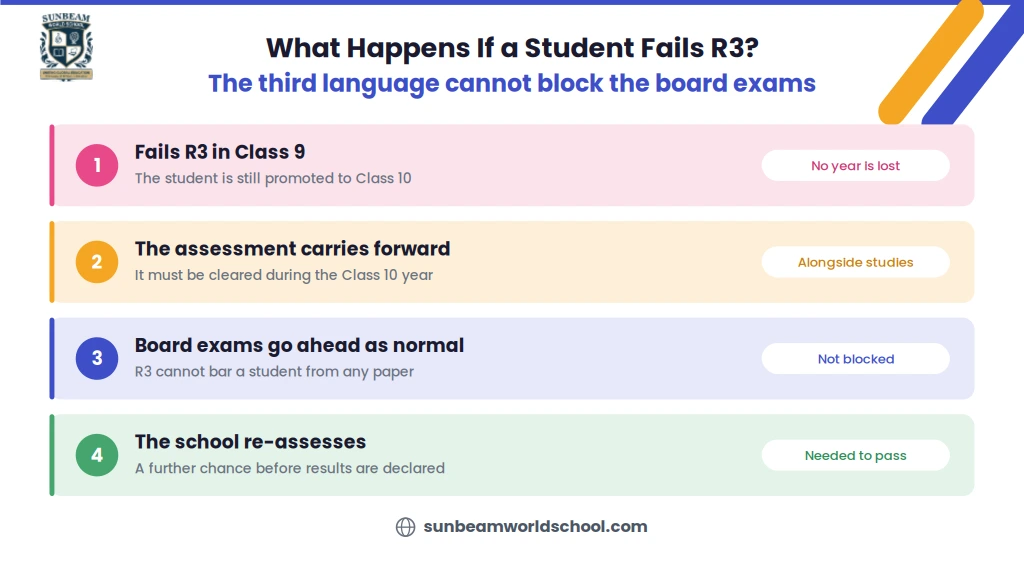
Failing the CBSE Third Language (R3) assessment does not block board exams, but students must clear the language requirement during Class 10.
If a child does not clear the R3 assessment in Class 9, they are still promoted to Class 10 and must clear the pending assessment during the following academic year. If they do not clear it in Class 10, the school must provide a re-assessment before Class 10 results are declared.
Here is where two CBSE statements need to be read together, because taken separately they appear to contradict each other.
The May circular said that no student would be barred from appearing in the Class 10 board examinations because of R3. That remains true. A pending third language does not stop a child from sitting Mathematics, Science or any other board paper.
The July implementation guidelines then clarified that clearing the school-based R3 assessment is mandatory for the award of the Secondary School Examination Pass Certificate. That is also true.
Both statements hold at once. Your child cannot be stopped from sitting the board exams because of R3, but they do need to clear the school assessment to receive the pass certificate, and the school must give them a further opportunity before results are published. Several widely read explainers still carry only the first half of this, which is why some parents believe R3 carries no consequence at all.
Can My Child Continue French, German or Spanish?
Yes, in most cases a child can continue studying French, German or Spanish, and many parents have been told otherwise. CBSE permits a foreign language as R3 provided R1 and R2 are both native Indian languages, and where that condition is not met, the foreign language may be taken as an additional fourth language instead.
This matters because of what has happened in practice. Reports from Delhi, Noida and other cities describe English-medium schools defaulting to Sanskrit as the only R3 option and discontinuing French, German and Spanish altogether. Parents whose children have studied a foreign language for years have understandably been upset.
Two routes are worth raising with your school:
- Make the language combination work. If your child takes two Indian languages as R1 and R2, for example Hindi and a regional language, then French or German can legitimately be R3.
- Keep it as a fourth language. Where the combination does not allow it, CBSE's own circular provides for the foreign language to continue as an additional subject rather than being dropped.
Whether a school can offer either route depends on its staffing. Where it cannot, foreign language classes taken outside school are a practical way for a child to keep the language going rather than losing years of progress.
Which Students Are Exempt from the Third Language?
CBSE has granted exemptions to three categories: children with special needs, CBSE schools situated outside India, and foreign students returning to India.
- Children with Special Needs (CwSN). Relaxations and exemptions from the compulsory third language are granted under the Rights of Persons with Disabilities Act, 2016. Families of children with diagnosed learning difficulties should raise this with the school directly, and special education support can help document the case.
- CBSE schools outside India. Full exemption from the requirement of a native Indian language as R3 applies to all CBSE-affiliated schools situated overseas. Families living abroad are frequently unaware of this, and it is worth reading alongside our update on CBSE board exams in the Middle East.
- Foreign students returning to India. Case-by-case exemption from studying a native Indian language as R3.
There is also a provision for families who move. If parents or guardians migrate to another state, the student may continue with the language combination they had chosen as R3 in the middle stage, and schools are required to provide adequate resources to support that choice.
How Are Schools Handling the Change?
Many schools are struggling with the change, chiefly because of shortages of language teachers and the absence of dedicated textbooks. CBSE has acknowledged both and issued interim measures rather than delaying the rollout.
On textbooks, Class 9 students are to use the 2026-27 edition of the Class 6 R3 textbooks until secondary-stage materials are ready, on the basis that core language competencies overlap substantially between the two stages.
On staffing, CBSE has allowed flexible arrangements including engaging existing teachers with functional proficiency, retired teachers and postgraduates, sharing resources through Sahodaya school clusters, and using virtual or hybrid teaching.
This is one of several changes CBSE has made to the Class 10 structure recently, alongside the new rules for Class 10 board exams covering answer-sheet format.
The Supreme Court is also hearing petitions on the policy, brought largely over teacher shortages, textbook availability and the timing of the rollout mid-session. The court has issued notice to CBSE but has not stayed the policy, and it has indicated it would protect teachers from action taken against them over implementation difficulties. Until that concludes, the rule stands and schools are expected to comply.
How Does Sunbeam World School Handle the Three-Language Requirement?
At Sunbeam World School, language choice is not limited by which teachers happen to be available on one campus, which is the constraint forcing many schools to offer a single R3 option.
- A genuine choice of Indian languages. Regional language classes cover Hindi, Tamil, Telugu and others, so a family can choose a mother tongue as R3 rather than accepting whatever a school can staff.
- Foreign languages continue. French, Spanish and German remain available, whether as R3 where the combination permits it or as an additional language alongside the required Indian ones.
- Support for exempt categories. Students with additional needs are taught by trained special educators, and families outside India fall within CBSE's overseas exemption.
- More than one board. Alongside our CBSE-aligned pathway, we offer NIOS, Cambridge, American and Australian curriculum programs, which carry different language requirements. For a family where the third language is a genuine obstacle, that choice is worth understanding before making any decision.
If you are weighing options for the coming session, you can book a free demo class and speak to our academic team about language combinations before committing.
Conclusion: What Should Parents Do Now?
The CBSE third language rule is settled enough to plan around, even though the litigation continues. For most families, it is far less disruptive than the early coverage suggested.
- Find your child's batch first. A Class 6 student and a Class 9 student face materially different requirements, and the Class 10 batch of 2026-27 is unaffected.
- Ask the school which R3 options it actually offers, and ask early. Schools had to register their language profiles with CBSE, so the answer exists.
- Do not accept that a foreign language must be dropped without asking about the combination route or the additional fourth language route.
- Check whether an exemption applies, particularly for children with special needs and families based outside India.
- Treat R3 as a real subject. It is not board-examined for most current batches, but clearing the school assessment is required for the Class 10 pass certificate.

Frequently Asked Questions
What is the new rule for three languages in CBSE?
-The new CBSE rule requires students to study three languages, R1, R2 and R3, with at least two of them being Bhartiya Bhashas or native Indian languages. It applies from the 2026-27 academic session and was introduced to align CBSE's scheme of studies with NEP 2020 and NCFSE 2023. For the batches currently in Classes 7, 8 and 9, the third language is assessed internally by the school with no board examination. Students entering Class 6 in 2026-27 and later batches will face a board examination in the third language when they reach Class 10.
Is R3 compulsory in CBSE?
+Is the third language compulsory in CBSE Class 9 in 2026-27?
+Will there be a board exam for the third language?
+What happens if a student fails the third language assessment?
+Is English counted as an Indian language under the policy?
+Can my child study French or German under the new rule?
+Who is exempt from the CBSE third language requirement?
+
In this article
Share this post:


Press and Blogs
Stay updated with our press releases, educational blogs, and more.

Quick Summary An algebra equation is a maths statement that sets two expressions equal using...

Quick Summary Essential Repeat (ER) in CBSE means a student has not met the passing...
Quick Summary The area of rectangle equals its length multiplied by its width (A =...