
 CBSE
CBSE
Has vs. Have: What’s the Difference?
Quick Summary:
The main difference in has vs. have is the subject. Has is used with he, she, it, and singular nouns, while have is used with I, you, we, they, and plural nouns. Both words are forms of “to have.”Example:
- She has a new book.(Singular subject)
- They have new books.(Plural subject)
Has vs. have is one of the most searched grammar questions in English, and for good reason, since these two small words trip up young learners more than almost any other pair. Some people search it as has vs have, others as have vs has, but the difference between has and have comes down to one core rule, plus a handful of exceptions.
So, let's get started and cover each rule for understanding has vs have with simple definitions, clear tables, real examples, and a practice quiz at the end.
What Do Has and Have Mean?
Has and have both come from the same verb, "to have," and the has definition and have definition are actually the same thing: to own, hold, or experience something. When people search has meaning or have meaning separately, this is what they are usually looking for. The only difference between them is which subject they are paired with, not their meaning. When a child says "I have a bike" or "She has a bike," both sentences mean the same thing, owning a bike, just with a different subject doing the owning.
Has and have do not always describe real, literal possession, though. They also show up inside common expressions like "she has a heart of gold" or "he has a heart of stone," where nobody is actually holding anything. These are examples of metaphors, a way of describing one thing by calling it something else.
Has and Have as Main Verbs vs. Helping Verbs
Both has and have can play two different jobs in a sentence: sometimes they stand alone to show possession, and sometimes they team up with another verb. A common question is has a verb or a helping verb, and the answer is both, depending on the sentence. Is have a helping verb? Yes, when it pairs with a past participle. Is has an auxiliary verb? Also yes, in exactly the same situation. The table below makes the difference easy to see side by side.
| Word | Job | What It Does | Example |
|---|---|---|---|
| Has | Main verb | Shows possession on its own | He has a red pencil. |
| Has | Helping verb | Pairs with a past participle to build the present perfect tense | He has finished his homework. |
| Have | Main verb | Shows possession on its own | They have a new puppy. |
| Have | Helping verb | Pairs with a past participle to build the present perfect tense | They have finished their homework. |
In the helping verb examples, has and have are not showing ownership at all, they are simply helping the main action word (finished) form the present perfect tense. Has and have always follow this same pattern, the only thing that changes is which subject they are paired with.
What Are the Rules for Using Has and Have?
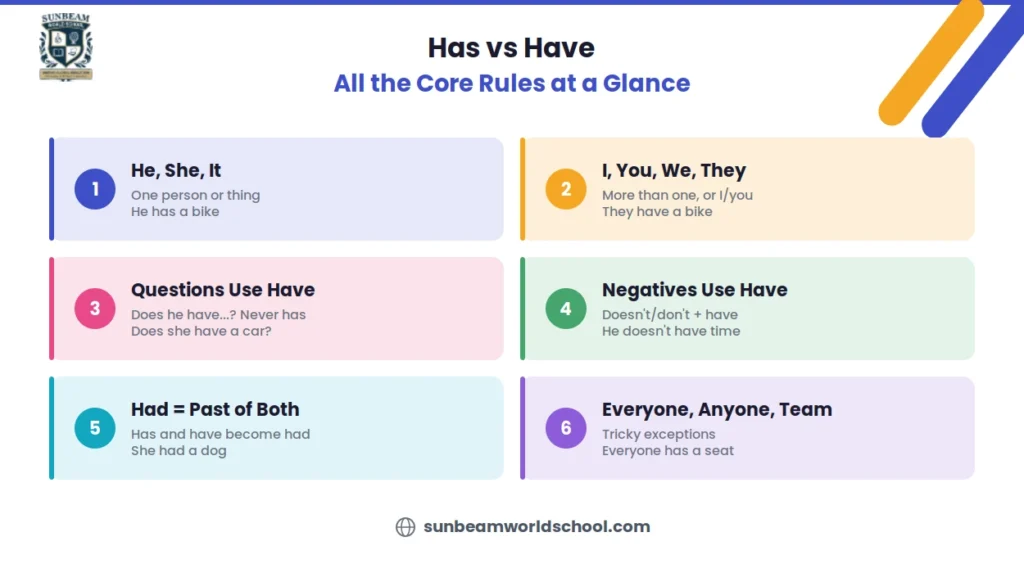
The complete has vs have rule chart, from pronouns to tricky exceptions like everyone and team
The core rule is simple: use has with he, she, it, or one person or thing, and use have with I, you, we, they, or more than one person or thing. The seven rules below walk through that core idea and how it applies to names, nouns, questions, negatives, and helping verbs.
Rule 1: Has and Have by Pronoun
He, she, and it always take has, while I, you, we, and they always take have. A related question that comes up often is who has or who have, and the answer depends on what "who" is replacing in that sentence. This table makes it easy to see at a glance.
| Pronoun | Verb | Example Sentence |
|---|---|---|
| I | have | I have a red backpack. |
| You | have | You have a great smile. |
| We | have | We have a picnic planned. |
| They | have | They have two kittens. |
| He | has | He has a new bicycle. |
| She | has | She has a blue umbrella. |
| It | has | It has a long tail. |
Has in a Sentence
Examples:
- He has a pet parrot.
- She has curly hair.
- It has four wheels.
- Who has the answer key?
Every one of these subjects can be replaced with he, she, or it, which is a helpful clue that has is the correct choice.
Have in a Sentence
Examples:
- I have a favorite storybook.
- You have great handwriting.
- We have a football match today.
- They have a treehouse in the garden.
In each of these, the subject can be replaced with I, you, we, or they, confirming that have is correct.
Rule 2: Named Subjects and Nouns Follow the Same Rule
A named subject like John or Priya follows the exact same rule as he, she, and it, because a single name can always be swapped for one of those three pronouns. If a sentence says "John has a bicycle," a child can test it by silently replacing John with "he," and since "he has a bicycle" sounds right, has is correct. The same trick works with more than one name: "Chika and Ebuka have a book" uses have because Chika and Ebuka together can be replaced with "they."
| Named Subject | Swap Test | Verb | Example |
|---|---|---|---|
| John | he | has | John has a bicycle. |
| Priya | she | has | Priya has a bicycle. |
| Chika and Ebuka | they | have | Chika and Ebuka have a book. |
| My teacher | she or he | has | My teacher has a red pen. |
Rule 3: Has and Have with Singular and Plural Nouns
A singular noun, meaning just one person or thing, takes has, while a plural noun, meaning more than one, takes have. This is really just another way of learning singular and plural verbs in English. "The dog has a bone" uses has because there is one dog. "The dogs have a bone" uses have because there is more than one dog. This same swap test works here too: one dog becomes "it," and more than one dog becomes "they." Some learners search for the plural of has or the plural of have to describe this exact pattern, though grammatically it is simpler to think of it as a subject match rather than true singular and plural forms of the same word. Thinking of have as the plural of has helps some learners, though it is really more accurate to say has is simply what have becomes for one person or thing.
| Subject Type | Example | Verb |
|---|---|---|
| Singular noun | The cat | has |
| Plural noun | The cats | have |
| Singular noun | My teacher | has |
| Plural noun | My teachers | have |
Rule 4: Questions Always Use Have
Questions formed with "does" always use the base form have, never has, even when the subject is singular. This confuses many learners, so it deserves its own clear rule. In a sentence like "Does he have a pencil?", the word "does" already shows that the subject is singular, so the main verb stays in its plain form, have, instead of changing to has.
| Wrong Question | Right Question |
|---|---|
| Does he has a pencil? | Does he have a pencil? |
| Does she has a car? | Does she have a car? |
| Does John has a dog? | Does John have a dog? |
Rule 5: Negatives with Has and Have
Negatives follow the same pattern as questions, always pairing with the base form have after doesn't or don't. "He doesn't have a pen" is correct, while "He doesn't has a pen" is not, because doesn't already carries the singular meaning for the sentence.
| Wrong Negative | Right Negative |
|---|---|
| He doesn't has a pen. | He doesn't have a pen. |
| She doesn't has time. | She doesn't have time. |
| They don't has a car. | They don't have a car. |
Rule 6: Had Is the Past Tense of Both
Had is the one word that replaces both has and have once a sentence moves into the past tense, which is what makes it feel like a shortcut once a child learns it. This is the simplest way to think about had vs have and had vs has at the same time.
| Present | Past |
|---|---|
| She has a dog. | She had a dog. |
| They have a dog. | They had a dog. |
| I have a bike. | I had a bike. |
| He has a cat. | He had a cat. |
Rule 7: Has and Have as Helping Verbs in the Present Perfect
As helping verbs, has and have combine with a past participle, which is usually a verb ending in -ed or an irregular past form, to build the present perfect tense, a tense used for actions that happened at an unspecified time or that connect the past to now. This is closely related to how other helping verbs work in English, which is explored further in this guide to using is, am, are, was, and were correctly.
| Subject | Helping Verb | Past Participle | Example |
|---|---|---|---|
| She | has | eaten | She has eaten breakfast. |
| They | have | eaten | They have eaten breakfast. |
| He | has | finished | He has finished his homework. |
| We | have | finished | We have finished our homework. |
When Do Everyone, Anyone, and Team Use Has or Have?
Everyone, anyone, someone, each, and neither always take has, even though they can feel like they mean more than one person. This is one of the trickiest parts of the has vs have rule, and questions like everyone has or have, anyone has or have, and team has or have or family has or have are some of the most commonly searched exceptions, since they trip up even confident learners.
Indefinite Pronouns Always Take Has
Words like everyone, anyone, someone, nobody, each, and neither are grammatically treated as one single, unknown person, which is why they always pair with has, not have. "Everyone has a pencil" is correct because everyone is being treated as one unit, not as a group. The same logic applies to "Anyone has the right to ask a question," "Each of you has a task to finish," and "Neither of them has arrived yet."
| Indefinite Pronoun | Verb | Example Sentence |
|---|---|---|
| Everyone | has | Everyone has a seat. |
| Anyone | has | Anyone has the right to try. |
| Someone | has | Someone has left their bag. |
| Each | has | Each of you has a role. |
| Neither | has | Neither has finished yet. |
Collective Nouns Like Team and Family
In everyday American English, collective nouns like team, family, and group are treated as one unit and take has, though British English often treats them as a group of individuals and uses have instead. "The team has won the match" is standard in American English, while "The team have won the match" is common in British English, since both versions are treating the team either as one thing or as many players. For most schoolwork and writing, sticking with has for collective nouns is the safer and more widely accepted choice.
When Do "Have To" and "Has To" Show Obligation, Not Possession?
Have to and has to switch away from ownership and start showing obligation, meaning something a person needs or is required to do, and they follow the exact same subject rule as the possession use of has and have. "I have a bike" shows ownership, but "I have to leave" shows a requirement, even though the verb looks identical. The subject rule carries over unchanged: he, she, and it pair with has to, while I, you, we, and they pair with have to.
| Subject | Obligation Form | Example Sentence |
|---|---|---|
| I | have to | I have to finish my homework. |
| You | have to | You have to wear your uniform. |
| We | have to | We have to leave by six. |
| They | have to | They have to practice every day. |
| He | has to | He has to clean his room. |
| She | has to | She has to submit the form today. |
| It | has to | It has to be charged overnight. |
How Can You Tell Obligation "Have To" Apart from Possession "Have"?
The clearest test is whether a second verb follows right after have or has. In "I have a book," have stands alone and shows ownership, but in "I have to read a book," have is immediately followed by to and another verb, read, which signals a requirement instead. "She has a dentist appointment" describes something she owns or holds on her schedule, while "She has to go to the dentist" describes something she is required to do. Once a child spots that second verb tucked after to, the obligation meaning becomes easy to recognize.
How Do Has and Have Work with Compound Subjects, Companies, and Time?
A few advanced cases confuse even adult writers and are common questions on forums like Reddit and Quora, including compound subjects joined by and, company names, and expressions of time or money. These are grouped together here because they build directly on the collective noun rule above, just applied in slightly trickier situations.
Two Subjects Joined by And
Yes, when two subjects are joined by "and," they are treated as a combined plural unit and always take have, even if each subject on its own would normally take has. "The hard work of our employees and the trust of our customers have earned us this award" uses have because there are two separate things joined together, not one. The same rule applies to a simple sentence like "My brother and my sister have a shared bedroom," where each person alone would take has, but combined with and, they take have.
Company and Organization Names
In American English, a company or organization is treated as one single entity and takes has, while British English often treats it as a group of people and uses have. "Google has released a new update" is standard American usage, while "Google have released a new update" is common in British publications, since the company is being viewed either as one business or as the people who run it. This is the same reasoning behind the British "have" often heard with sports teams and brands, and it explains why both versions show up correctly depending on which style guide a writer is following.
Time, Money, and Distance as a Single Unit
When an amount of time, money, or distance is being described as one complete block, it takes has, but when the individual units are being counted separately, it takes have. "Nine months has passed since the project began" treats nine months as a single stretch of time, while "Nine months have passed, and each one felt different" treats the months as separate, countable units. This same logic applies to money and distance, such as "Ten dollars has always been the entry fee" versus "Ten dollars have gone missing from the till, one at a time."
What Are the Forms of Has: v1, v2, v3?
Have is the base form, had is the past form, and had is also the past participle form, while has is simply the third person singular present form rather than a separate principal form. In grammar terms, verbs are often listed as v1 (base), v2 (past), and v3 (past participle), and for the verb "to have," that list looks like have, had, had. Has does not get its own slot in that list because it is just what have becomes when the subject is he, she, or it in the present tense.
What Is the Difference Between Have and Have Got?
Have got means exactly the same thing as have, and it is mostly a matter of style rather than a separate rule, with have got being more common in British and informal English. This is why so many people search have vs have got, expecting a bigger difference than there actually is. "I have a car" and "I have got a car" (often shortened to "I've got a car") both mean the same thing. American English tends to prefer the simple have, while British English speakers often add got for a more casual, spoken feel, so both versions are correct depending on the setting.
What Are Some Exceptions and Special Cases with Has and Have?
A few situations do not fit neatly into the basic has vs have rule, including comparisons with had, the phrase has been vs have been, and contractions like hasn't and haven't. These exceptions are grouped together here so they do not get mixed up with the core rule above.
Had vs Has vs Have
Has and have are both present tense, showing something is true right now, while had is the past tense form used for both of them once the action has moved into the past. "She has a dog" and "She had a dog" describe the same ownership, just at different points in time, present versus past. The same shift applies to have: "They have a dog" becomes "They had a dog" in the past tense.
Has Been vs Have Been: When to Use Each
Has been pairs with he, she, and it, while have been pairs with I, you, we, and they, following the exact same pattern as has and have on their own. People often search this as has and have been or has vs have been, but it is really the same rule just extended with the word been. "She has been to Paris" and "They have been to Paris" both describe a past experience connected to the present, differing only by subject. This pattern of pairing a helping verb with been to describe ongoing or completed experiences is closely related to how verb tenses work more broadly, a topic covered in more depth in this guide to active and passive voice.
Hasn't vs Haven't
Hasn't is the contraction of has not, used with he, she, and it, while haven't is the contraction of have not, used with I, you, we, and they. Whether it is written as haven't or hasn't, the choice always follows the same subject rule as the full words. "He hasn't finished his lunch" and "They haven't finished their lunch" both express the same idea, that something has not happened yet, using the contraction that matches their subject. Who has contraction questions come up too, and the short answer is who's, though it always needs to be read in context since who's can also mean who is.
Easy Memory Tricks for Has vs. Have
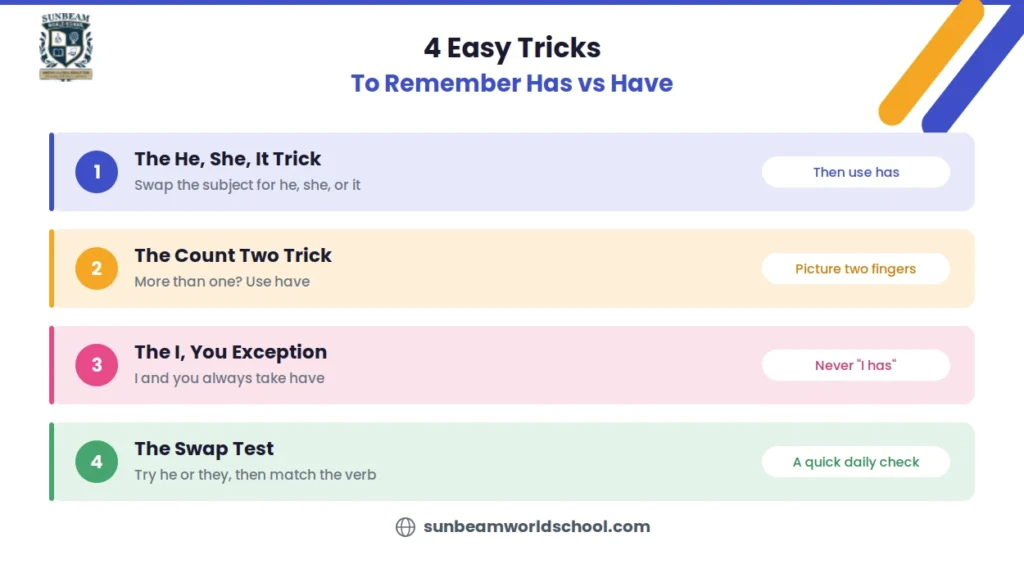
Four simple tricks that make has vs have easy to remember for kids
A handful of simple mental tricks can make the has vs have rule almost automatic, even for a young learner who is still getting comfortable with grammar terms. These tricks work best when practiced out loud with real sentences rather than memorized as abstract rules.
| Trick | How It Works | Example |
|---|---|---|
| The He, She, It Trick | If the subject can be swapped for he, she, or it, the answer is always has. Works for pronouns, names, and singular nouns. | "Priya has a bike" → "she has a bike" |
| The Count Two Trick | If there is more than one person or thing, or the subject is I, you, we, or they, the answer is always have. Picture counting the subject on more than one finger. | "The boys have a bike" → more than one, so have |
| The I, You Exception | I and you always take have, even though they refer to a single person. Remember them as a fixed pair that never changes. | "I have," "you have," never "I has" |
| The Swap Test | Mentally swap the subject for he or they and see which sounds natural, then use the matching verb. | If "he" sounds right, use has; if "they" sounds right, use have |
Common Mistakes with Has and Have
The most common mistakes happen when a subject and verb do not match, especially with third person singular subjects and with questions or negatives that already contain "does" or "doesn't." Catching these patterns early prevents them from becoming a habit.
| Wrong | Right |
|---|---|
| She have a cat. | She has a cat. |
| Does he has a pencil? | Does he have a pencil? |
| They has a new house. | They have a new house. |
| He doesn't has time. | He doesn't have time. |
Mixing up commonly confused word pairs is a normal part of learning English, and has vs have is far from the only pair that causes this kind of confusion, as shown in this guide comparing to, too, and two.
What Are Some Synonyms for Has and Have?
Depending on the sentence, has and have can sometimes be replaced with words like owns, possesses, or holds, though these alternatives tend to sound more formal. If a child is searching for another word for has or a synonym for has, owns and possesses are usually the best fit. "She has a car" could become "She owns a car," and "They have a large collection" could become "They possess a large collection." These synonyms are useful for older students working on varying their vocabulary, though has and have remain the simplest and most natural choice for everyday writing and speech.
Has vs Have Practice: 20 Questions To Master Has and Have
This 20 question practice set works as both a has vs have quiz and a has vs have worksheet, covering pronouns, names, common mistakes, and the has been vs have been rule for a complete review of everything in this guide. Each question is built from real has vs have sentences, similar to the structured drills in this collection of direct and indirect speech exercises, which is what turns a grammar rule into a habit. Try to answer each one before checking the answer key at the end.
Questions 1 to 8: Fill in the Blank with Pronouns
- I ___ a new pencil case.
- She ___ a spelling test today.
- They ___ a big backyard.
- He ___ two younger sisters.
- We ___ a class trip next week.
- It ___ a very loud bark.
- You ___ a wonderful singing voice.
- Who ___ the last piece of cake?
Questions 9 to 14: Fill in the Blank with Names and Nouns
- Priya ___ a new bicycle.
- The teachers ___ a meeting after school.
- My brother ___ a collection of comic books.
- The children ___ a science project due tomorrow.
- Ravi and Sam ___ a football match on Saturday.
- The cat ___ soft grey fur.
Questions 15 to 18: Spot the Mistake
- "She have a red kite." Is this correct or incorrect?
- "Does he has a dog?" Is this correct or incorrect?
- "They has a big house." Is this correct or incorrect?
- "He doesn't has a phone." Is this correct or incorrect?
Questions 19 and 20: Has Been, Have Been, Had, Has, or Have
- She ___ been to London three times. (has / have)
- Last year, they ___ a small puppy, but now it has grown up. (has / had / have)
Answer Key
- have
- has
- have
- has
- have
- has
- have
- has
- has
- have
- has
- have
- have
- has
- Incorrect, it should be "She has a red kite."
- Incorrect, it should be "Does he have a dog?"
- Incorrect, it should be "They have a big house."
- Incorrect, it should be "He doesn't have a phone."
- has
- had
Conclusion
The difference between has and have comes down to one simple rule: he, she, and it use has, while everyone else uses have, with just a few exceptions like has or have with everyone, has been vs have been, and had vs has vs have to keep in mind. Once a child practices this has vs have rule with real sentences and a little repetition, it becomes second nature rather than a source of confusion.
At Sunbeam World School, building this kind of strong English grammar foundation is part of everyday learning, and families exploring a structured homeschooling approach can find the same steady support for grammar alongside every other subject.

Frequently Asked Questions
Does John have or has?
-The answer to "does John have or has" is have, because questions starting with does always use the plain word have, even for one person like John. We say "Does John have a bicycle?" and never "Does John has a bicycle?"
Does she have or has a car?
+What are the forms of has, known as v1, v2, and v3?
+What does have mean?
+Is have singular or plural?
+What is the difference between has, have, and had?
+Is "my house has" or "my house have" correct?
+Why do British people say have instead of has for a company?
+Is it "nine months has" or "have" elapsed?
+
In this article
Share this post:


Press and Blogs
Stay updated with our press releases, educational blogs, and more.

Quick Summary Animal sounds are the noises animals make to communicate, warn of danger and...
Quick Summary An algebra equation is a maths statement that sets two expressions equal using...

Quick Summary Essential Repeat (ER) in CBSE means a student has not met the passing...