
 Exam
Exam
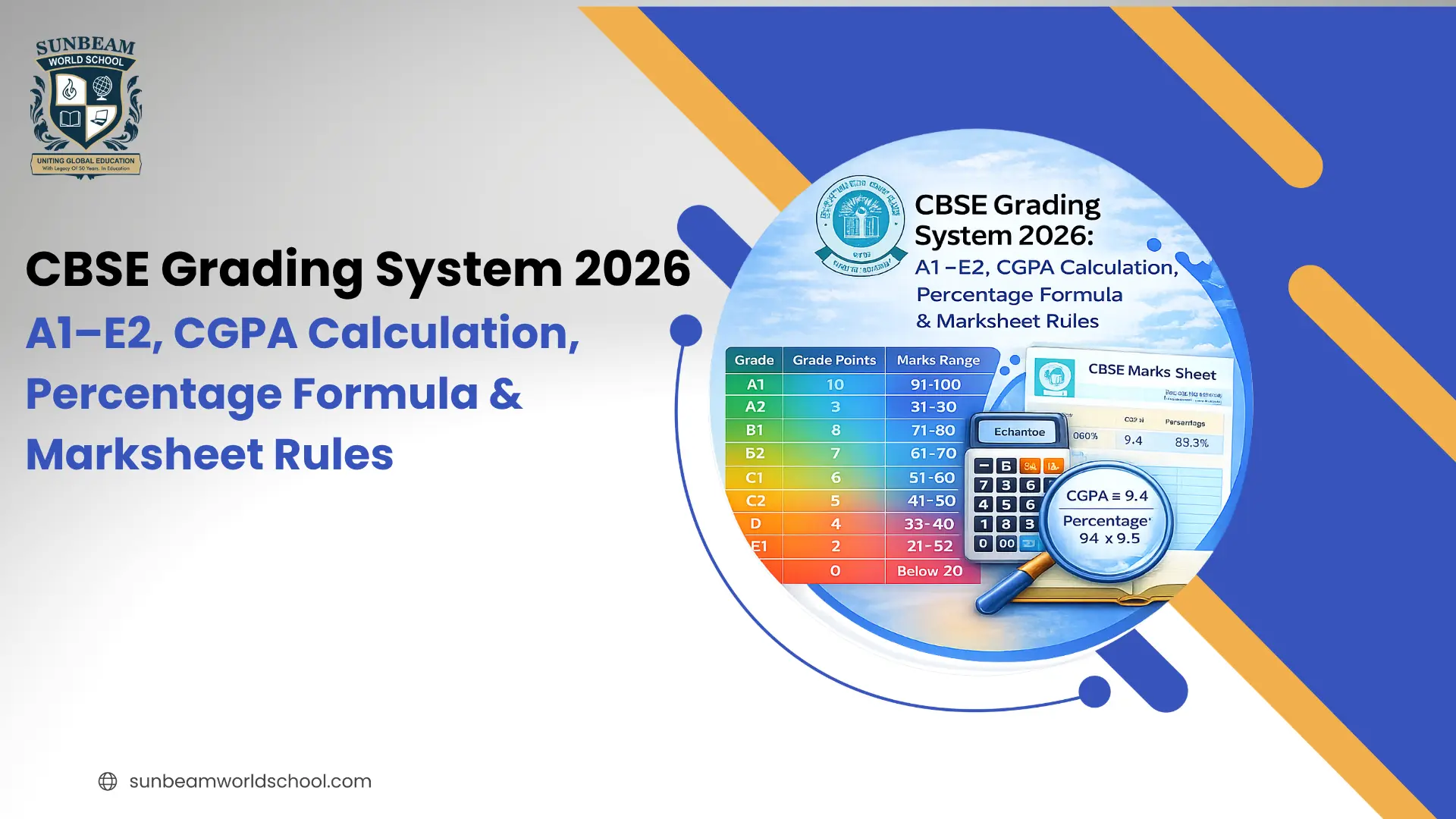
CBSE Grading System 2026: A1–E2, CGPA Calculation, Percentage Formula & Marksheet Rules
| The CBSE grading system 2026 uses a 9-point scale from A1 (highest) to E2 (fail), with grade points ranging from 10 to 4 for passing grades. It groups students into performance bands instead of exact marks to reduce pressure.
CGPA Formula:CGPA=Sum of Grade Points in 5 Subjects5CGPA = \frac{\text{Sum of Grade Points in 5 Subjects}}{5}CGPA=5Sum of Grade Points in 5 Subjects Percentage Formula:Percentage=CGPA×9.5\text{Percentage} = \text{CGPA} \times 9.5Percentage=CGPA×9.5 Students must score at least 33% in each subject to pass, with separate passing in theory and practicals. Class 10 marksheets show CGPA, while Class 12 requires manual calculation. |
Every year, millions of students across India receive their CBSE marksheet, and many stare at it, wondering what their grades actually mean. What is the difference between A1 and A2? Is a B1 good enough for the college I want? How do I tell my relatives my CGPA in percentage? Why doesn't CBSE just print a percentage?
These are not silly questions. The CBSE grading system is genuinely different from how most people instinctively think about marks, and understanding it properly can make a real difference — both in how students approach their preparation and how they present their results for admissions.
This guide covers everything with precision. We start with the system's logic, move to the grade table, explain CGPA step by step, give you a live calculator, break down Class 10 vs Class 12 differences, and end with practical advice most guides skip entirely.
Why Does CBSE Use Grades Instead of Marks?
This is worth understanding before anything else, because it changes how you should think about your result.
CBSE introduced the grading system to address a real problem: when results were reported as exact marks, students and parents would obsess over single-mark differences. A student scoring 89 and one scoring 90 would be treated very differently — even though there is barely any meaningful academic difference between them. The pressure to chase the highest exact mark contributed significantly to exam anxiety, rote learning, and a culture of ranking over learning.
The grading system fixes this by grouping students with similar performance together. Someone who scores 91 and someone who scores 99 both receive A1. They are in the same performance band. This reduces hyper-competitive comparison without hiding the distinction between genuinely different performance levels.
CBSE also deliberately does not print the overall percentage or aggregate on marksheets, and does not declare toppers, to further reduce unhealthy competition. Students who need a percentage equivalent (for college applications, scholarships, or competitive exams) calculate it themselves using the official CGPA formula.
The CBSE 9-Point Grading Scale: A1 to E2 Explained
CBSE's grading system uses nine levels, each with a letter grade and a corresponding grade point (GP). The grade is determined by which marks range a student falls into. Here is the complete table:
| Marks Range | Grade | Grade Points (GP) | What It Means | Status |
| 91 – 100 | A1 | 10 | Top 1/8th of all passing students | Pass |
| 81 – 90 | A2 | 9 | Next 1/8th of passing students | Pass |
| 71 – 80 | B1 | 8 | Next 1/8th of passing students | Pass |
| 61 – 70 | B2 | 7 | Next 1/8th of passing students | Pass |
| 51 – 60 | C1 | 6 | Next 1/8th of passing students | Pass |
| 41 – 50 | C2 | 5 | Next 1/8th of passing students | Pass |
| 33 – 40 | D | 4 | Bottom passing band — minimum threshold | Pass |
| 21 – 32 | E1 | — | Below minimum — compartment required | Fail |
| 0 – 20 | E2 | — | Well below minimum — compartment required | Fail |
Important about E1 and E2: These grades carry no grade points and are considered a fail. Students receiving E1 or E2 in any subject must appear for the CBSE Compartment Examination (typically held in June–July) and must secure at least a D grade (33 marks) to pass. Missing the compartment exam means the student cannot progress to the next class.
| One detail that surprises many students A1 is a positional grade, not just a mark threshold. Technically, A1 is awarded to the top 1/8th (12.5%) of all passing candidates in a subject, which typically corresponds to 91+ marks, but the exact cutoff can vary slightly based on the performance distribution of the entire cohort that year. This makes the system partially relative, not purely absolute. |
What Is CGPA and How Is It Calculated?
CGPA stands for Cumulative Grade Point Average. It is the average of the grade points a student earns across their five main subjects. CBSE uses five subjects (not six) for CGPA calculation — if a student has opted for an additional sixth subject, it is excluded from the CGPA unless its inclusion improves the average.
The CGPA Formula
CGPA = (Sum of Grade Points of 5 Main Subjects) ÷ 5
Step-by-Step Example
Say a student received the following grades:
| Subject | Marks | Grade | Grade Points |
| English | 85 | A2 | 9 |
| Mathematics | 92 | A1 | 10 |
| Science | 78 | B1 | 8 |
| Social Science | 67 | B2 | 7 |
| Hindi | 82 | A2 | 9 |
Step 1: Add all grade points: 9 + 10 + 8 + 7 + 9 = 43
Step 2: Divide by 5: 43 ÷ 5 = CGPA 8.6
Step 3 (optional): Convert to percentage: 8.6 × 9.5 = 81.7%
The CGPA to Percentage Formula, Why 9.5?
The official CBSE formula is simply:
Percentage = CGPA × 9.5
Example: CGPA 8.6 × 9.5 = 81.7%
The multiplier 9.5 was not arbitrary. CBSE arrived at it by analysing years of actual student data. Students who earned an A1 grade (91–100 marks) had an average score of approximately 95 marks. Dividing that average (95) by the A1 grade point (10) gives exactly 9.5 — which then anchors the entire scale consistently.
This means the formula works as an average estimate across the grade band, not an exact reverse-calculation of your specific marks. A student who scored exactly 91 and one who scored 99 both received A1 (GP: 10), so their estimated percentage from CGPA would be the same: 95%. This is why it is called an indicative percentage.
CGPA to Percentage Ready-Reckoner Table
Save this for quick reference, no calculator needed:
| CGPA | Calculation | Percentage | CGPA | Calculation | Percentage |
| 10.0 | = 10.0 × 9.5 | 95.0% | 7.0 | = 7.0 × 9.5 | 66.5% |
| 9.8 | = 9.8 × 9.5 | 93.1% | 6.8 | = 6.8 × 9.5 | 64.6% |
| 9.5 | = 9.5 × 9.5 | 90.25% | 6.5 | = 6.5 × 9.5 | 61.75% |
| 9.2 | = 9.2 × 9.5 | 87.4% | 6.0 | = 6.0 × 9.5 | 57.0% |
| 9.0 | = 9.0 × 9.5 | 85.5% | 5.5 | = 5.5 × 9.5 | 52.25% |
| 8.8 | = 8.8 × 9.5 | 83.6% | 5.0 | = 5.0 × 9.5 | 47.5% |
| 8.5 | = 8.5 × 9.5 | 80.75% | 4.5 | = 4.5 × 9.5 | 42.75% |
| 8.2 | = 8.2 × 9.5 | 77.9% | 4.0 | = 4.0 × 9.5 | 38.0% |
| 8.0 | = 8.0 × 9.5 | 76.0% | — | — | — |
| Note for college applications with 6 subjectsIf you opted for a sixth subject, CBSE calculates CGPA using only the best 5 subjects. However, some colleges may ask for a percentage calculated across all six subjects. Always confirm which calculation the institution requires before submitting your form. |
Class 10 vs Class 12: How the Grading Works Differently
The 9-point grade scale is the same for both, but the way results are presented and assessed differs significantly. This matters for how you read your marksheet and how colleges interpret it.
| Criteria | Class 10 | Class 12 |
| Marksheet shows | Subject-wise grades + CGPA printed on the marksheet | Subject-wise marks and grades — CGPA not printed |
| Assessment split | 80 marks theory + 20 marks internal assessment | 70–80 marks theory + 20 marks internal + 30 marks practical (if applicable) |
| Passing criteria | Min. 33% in each subject (theory + internal combined) | Min. 33% separately in theory AND practical |
| Practical subjects | Assessed by internal teachers | Conducted by external examiners (CBSE-appointed) |
| 2026 update | Two board exam attempts possible per academic year | Single board exam per session (two-exam rule applies only to Class 10) |
| CGPA printed? | Yes — CGPA appears directly on the marksheet | No — students calculate it manually using subject grades |
| Class 12 critical rule: For subjects with practical components (Physics, Chemistry, Biology, Computer Science, etc.), you must score at least 33% in the theory paper AND 33% in the practical/internal assessment independently. Scoring 60% overall does not help if you scored below 33 in the theory component alone — you will still be placed in the compartment category for that subject. |
Internal Assessment: The 20 Marks You Control
Every CBSE subject is assessed out of 100 marks total — but not all 100 come from the board exam. 20 marks come from internal assessment conducted by your school throughout the academic year. These marks are fully within your control and should never be neglected.
Internal assessment comprises four components for most subjects:
- Periodic tests — typically 3 tests per year; the best 2 are counted (10 marks)
- Notebook submission — regularity and quality of notes and assignments (5 marks)
- Subject enrichment activities — subject-specific activities, practicals, projects (5 marks)
- Portfolio — some subjects require a portfolio of work submitted over the year
These marks are uploaded to CBSE by the school on the same day they are assessed, with strict guidelines on documentation and transparency. Missing tests, skipping practicals, or submitting incomplete notebooks directly reduces these marks — and since the final grade is based on total marks out of 100, a low internal score requires a correspondingly higher board exam performance to maintain the same grade.
| Practical tip: Many students who score 88 in the board theory exam end up with an A2 (not A1) because they lost 3–4 internal marks. The students who consistently secure A1 are almost always those who maximised their 20 internal marks first, then focused on the board exam. |
What's New in the CBSE Grading System for 2026?
The core 9-point grading scale remains unchanged for 2026. But several important structural updates affect how students are assessed and how results are handled:
Two board exams for Class 10
CBSE is introducing a bi-annual exam structure for Class 10 students in the next academic session. This means students who perform poorly in the February exam will have another attempt in May. This policy does not currently apply to Class 12.
Increased competency-based questions: Approximately 50% of questions in 2026 board papers test real-world application and analysis, not just recall. This is part of CBSE's alignment with NEP 2020 and its push away from rote memorisation.
Strict practical exam protocols
Practicals for Class 10 are conducted between January and February. Marks must be uploaded to CBSE on the day of the exam. Class 12 practical exams require external examiners appointed by CBSE.
Provisional Class 11 admission: Students who appear in the February Class 10 exam can receive provisional admission to Class 11 based on those results. Final admission is confirmed after the May result.
Co-scholastic activities graded on 5-point scale
Art Education, Health and Physical Education, and Work Experience are graded on a separate A–E scale (not the 9-point system) with no grade points contributing to CGPA.
No toppers, no percentages on marksheets: CBSE continues its policy of not declaring toppers or printing aggregate percentages on official marksheets, maintaining the focus on learning over ranking.
What Your Grade Means for College Admissions
Grades look clean on paper. But when you are filling college entrance application forms or scholarship portals, you need to know how they translate in the real world:
- For JEE Main / NEET eligibility: You need to have passed Class 12 with Physics, Chemistry, and Mathematics/Biology. The grading system does not set a minimum CGPA for eligibility, but many programmes require 60% (approximately CGPA 6.3) for general category and 55% for reserved categories. JEE Advanced requires 75% (CGPA ~7.9) for general category.
- For DU / Central University admissions via CUET: Colleges primarily assess you on CUET scores. However, they typically require a minimum Class 12 percentage (or CGPA equivalent) for eligibility. Use your CGPA × 9.5 to compute this.
- For scholarship applications: Most government and private scholarship portals ask for percentage. Use the official CBSE formula: CGPA × 9.5 for your overall percentage, and Grade Point × 9.5 for individual subject percentage.
- For individual subject percentage: Multiply the Grade Point of that specific subject by 9.5. Example: B1 in Physics (GP 8) → 8 × 9.5 = 76% in Physics.
- International college applications: Most global universities will request your official CBSE transcript. They compute your performance themselves using the grade points — you do not typically need to submit a converted percentage for international applications.
Conclusion
Understanding the CBSE grading system is not just about decoding marks; it’s about making smarter academic decisions, reducing unnecessary stress, and presenting your performance confidently for college admissions. Once you understand how grades, CGPA, and percentage conversion work, you gain clarity that most students lack.
Sunbeam World School is India's leading AI-powered online school, serving students from Nursery to Grade 12 across 30+ countries. Our CBSE-aligned curriculum combines structured board exam preparation with flexible, concept-driven learning.

Frequently Asked Questions
What is the CBSE 9-point grading system?
-The CBSE 9-point grading system assigns grades from A1 (91–100 marks, Grade Point 10) down to E2 (0–20 marks, no grade point). Each grade represents a performance band rather than an exact mark. Grades A1 through D are passing grades; E1 and E2 are failing grades requiring a compartment exam. The system is used for Classes 9–12 across all CBSE-affiliated schools in India.
How do I convert CBSE CGPA to percentage?
+What is the passing grade in CBSE in 2026?
+Is the CBSE grading system relative or absolute?
+Does CBSE Class 12 marksheet show CGPA?
+What is a good CGPA in CBSE?
+
In this article
Share this post:


Press and Blogs
Stay updated with our press releases, educational blogs, and more.

Quick Summary The area of rectangle equals its length multiplied by its width (A =...

Quick Summary Student success motivational quotes are short, memorable lines that can help students stay...

Quick Summary The area of a square is A = s² (side × side). A...