
 CBSE
CBSE
CBSE On-Screen Marking (OSM): Complete Guide for Parents
Quick Answer CBSE On-Screen Marking (OSM) is a digital evaluation system where scanned copies of answer books are marked by trained examiners on a computer screen instead of on paper. Starting with the 2026 board examinations, CBSE has introduced OSM for Class 12 answer books only, while Class 10 continues with physical evaluation. The system aims to reduce calculation errors, mask student identity for fairer marking, and speed up result declaration.
Board exams are stressful enough for parents and students without wondering how the evaluation itself works behind the scenes. With CBSE rolling out On-Screen Marking for Class 12 in 2026, many families are hearing the term for the first time just as their child prepares for one of the exams that shapes what comes next after school.
Don't worry, we will help you understand what OSM actually changes, what stays the same for your child, and what the shift means once results are declared.
What Is CBSE On-Screen Marking (OSM)?
CBSE On-Screen Marking is the board's name for digital evaluation of answer sheets, a method in which physical answer books written by students are scanned and uploaded to a secure online portal, where trained examiners check and mark them on screen instead of on paper.
Rather than transporting bundles of answer scripts between evaluation centres, the board digitises each script so examiners can log in, view the scanned pages, and enter marks directly into the system. This shift does not change how your child writes the exam. Students still receive physical answer books and write their responses by hand in the exam hall, and the digital process begins only after the papers are collected.
Why Did CBSE Introduce On-Screen Marking in 2026?
CBSE introduced OSM to modernise evaluation at a scale that manual checking struggles to handle efficiently, since the board conducts exams for close to 46 lakh students across India and 26 countries every year. The change was formally announced through a circular dated February 9, 2026, with CBSE's Examination Controller stating that the move reflects the board's continuous effort to improve efficiency and transparency in how answer books are assessed.
Manual evaluation involves physically moving scripts between schools and evaluation centres, coordinating thousands of examiners, and manually totalling marks, all of which introduce delays and room for error. Ahead of the rollout, CBSE also ran examiner training sessions and a dry run evaluation in January 2026, followed by a mass mock evaluation across affiliated schools in February, so that teachers were prepared for the new portal before real evaluation began.
Does On-Screen Marking Apply to Class 10 Too?
On-Screen Marking currently applies only to Class 12 board examinations, and Class 10 answer books continue to be evaluated through the traditional physical method for now. This distinction matters for parents of younger students, since it means the process described in this guide is specific to Class 12 boards in 2026 and does not change how Class 10 papers are checked this year. CBSE has not indicated a fixed timeline for extending OSM to Class 10, so families with children in both grades should expect the two evaluation systems to run differently until further notice.
How Does the CBSE OSM Evaluation Process Work?
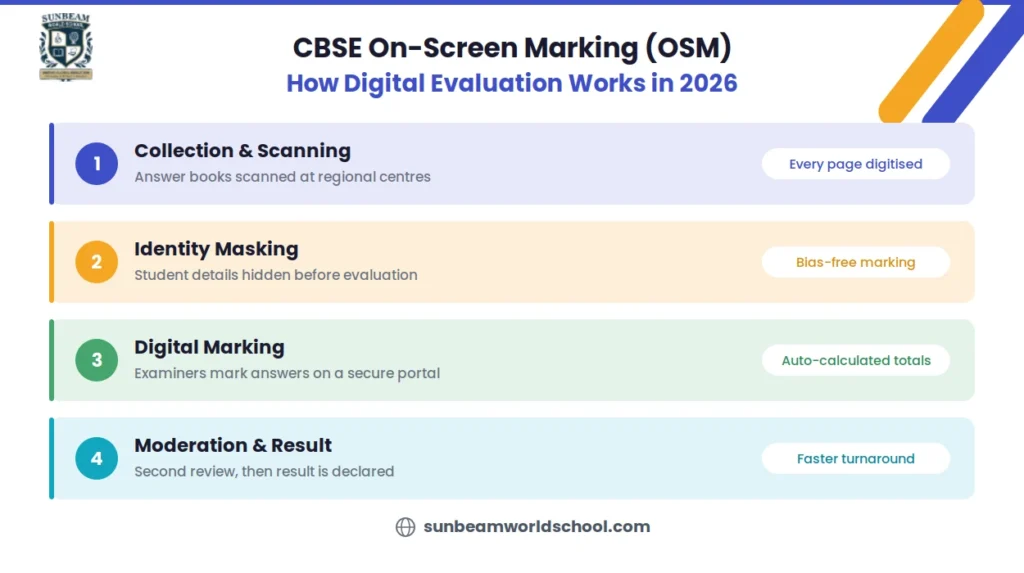
How CBSE's On-Screen Marking evaluates Class 12 answer books in 2026
The OSM process moves an answer book from the exam hall to a declared result through several structured digital stages, each designed to reduce manual handling and human error along the way.
Collection and Scanning of Answer Books
After the exam concludes, answer books are collected from exam centres and sent to CBSE's regional offices, where secrecy procedures are completed before scanning begins. Each script is then digitised using high-resolution scanners at these regional locations, with quality checks carried out both during and after scanning to make sure every page is captured clearly, including diagrams, rough work, and any handwritten corrections. Once verified, the scanned images are uploaded to CBSE's secure evaluation portal for examiners to access.
Masking of Student Identity Before Evaluation
Before an examiner ever sees a script, the system removes any details that could reveal the student's identity or school, so evaluation proceeds without bias. This anonymisation happens automatically during digitisation, which means examiners are working purely from the content of the answer, not the name or background of the student who wrote it. For parents who have worried about subjectivity creeping into evaluation based on a student's school or handwriting style, this built-in masking is one of the more meaningful safeguards OSM adds.
Digital Marking by Trained Examiners
Examiners log into the evaluation portal using individual credentials and mark answers directly on screen according to a predefined marking scheme, the same scheme that would apply under physical evaluation. They can reference the model answers and question paper on the same screen, add comments on specific responses, and use tools to mark blank pages so they are not spending time reviewing pages with no content. The system totals marks automatically once an examiner finishes a script, which removes the manual addition step that has historically been a common source of scoring errors.
Moderation and Quality Checks on Evaluated Scripts
Once an examiner completes marking, a sample of scripts is routed to a moderator for a second, independent review, with the first examiner's marks masked so the moderation stays unbiased. This two-tier structure mirrors how spot evaluation worked earlier, but the digital format makes masking and reassignment much faster than the manual process of physically covering marks by hand. Any inconsistencies flagged during moderation are addressed before results are compiled and released.
What Changes for Students Writing Their Board Exams?
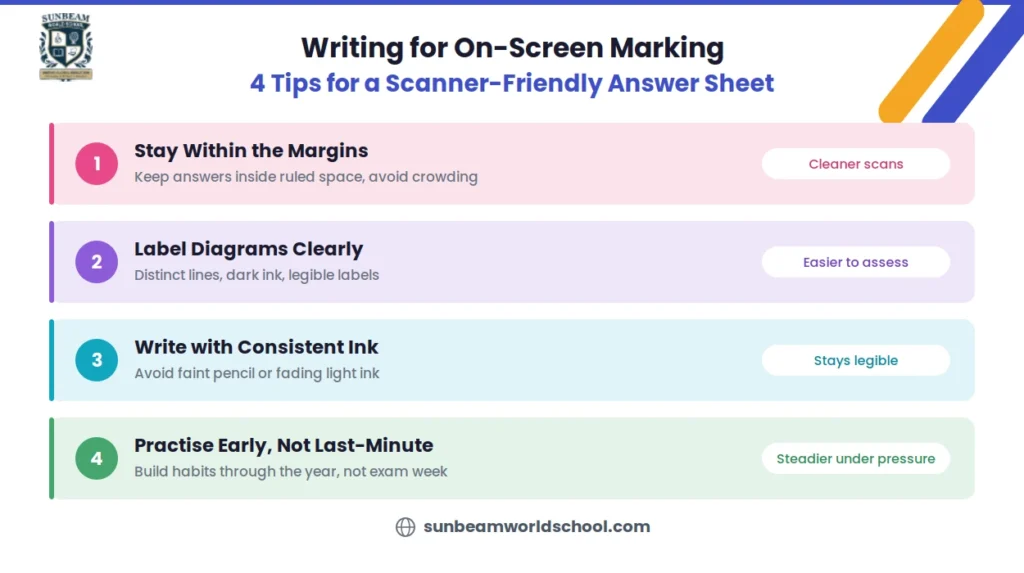
4 presentation tips to help Class 12 answer sheets scan clearly under CBSE OSM
Nothing changes about how students write their Class 12 board exams under OSM, since they still receive physical answer books and write by hand exactly as before. What matters now is that every page eventually becomes a scanned image an examiner reads on a screen, so a little extra care in presentation can help that image come through as clearly as the original.
Writing Within Margins and Keeping Pages Uncluttered
Answer books are scanned page by page, so content written too close to the edge or squeezed into margins runs a higher risk of being cropped or harder to read on screen. Keeping answers within the ruled space, leaving a visible gap between questions, and avoiding overlapping corrections or crossed-out text spilling into the next answer all make a script easier to scan cleanly and easier for an examiner to follow without losing their place.
Presenting Diagrams, Graphs, and Rough Work Clearly
CBSE has confirmed that scanned scripts capture all content clearly, including rough work, so students do not need to change how they approach a question with a diagram or graph. What helps is drawing these elements distinctly from surrounding text, labelling axes and parts legibly, and using a pencil or pen dark enough that fine lines do not fade when digitised. A diagram that is technically correct but faint or cramped is still harder for an examiner to assess quickly on a screen than one that is clearly separated and well labelled.
Using Legible Handwriting and Consistent Ink
Very light pencil marks, pale ink, or handwriting that trails off toward the bottom of a page can lose clarity once converted into a digital image, even though the same page would be perfectly readable on paper. Writing with a consistent, reasonably dark pen and keeping letter formation steady through the length of an answer, rather than rushing and compressing writing near the end, reduces the chance that an examiner has to work harder than necessary to follow the response. None of this changes what a correct answer looks like, it simply makes sure the answer is read exactly as the student intended.
Building Presentation Habits Well Before Exam Day
Presentation habits are much easier to build gradually through the year than to correct in the final weeks before boards, since rushed handwriting and cramped diagrams tend to resurface under exam pressure regardless of how well a student knows the material. Practising full-length answers under timed conditions, reviewing rough work for clarity rather than just correctness, and working on a child's handwriting and written expression as part of everyday learning, rather than an exam-week fix, all help a student's answer book scan and read the way it's meant to. It tends to pay off well beyond how a single script scans under OSM.
Is On-Screen Marking More Accurate Than Manual Checking?
On-Screen Marking reduces several of the most common sources of error in manual evaluation, though the underlying marking scheme and academic standards remain exactly the same. Automatic totalling removes the risk of addition mistakes that can occur when an examiner manually adds marks across dozens of questions, and identity masking removes any possibility of bias based on a student's name, school, or handwriting familiarity.
The two-level moderation process adds another layer of consistency checking that would be slower and more cumbersome to coordinate under the physical system. None of this changes what counts as a correct or complete answer, since OSM is a change in how evaluation happens, not in what is being evaluated.
What Happens to Re-Evaluation and Post-Result Verification Under OSM?
CBSE has discontinued the standalone post-result verification of marks process for Class 12 under OSM, reasoning that the system's automatic totalling and mandatory entry checks already eliminate the arithmetic and omission errors that verification was originally designed to catch.
Re-evaluation, where a student requests that specific answers be reassessed rather than just re-checked for totalling errors, continues to be available and is expected to move faster given that scripts are already in digital form. Parents whose children end up considering a compartment exam after results should treat this as a meaningfully different process from before, since digitised scripts make the underlying records easier to trace.
How Can Parents Support Their Child During This Transition?
The most useful thing a parent can do during this first year of OSM is to reassure their child that the exam-writing experience itself has not changed, since the shift happens entirely after the answer book leaves the exam hall. It also helps to stay informed about how marks eventually translate into grades under CBSE's CGPA and grading structure, since digital evaluation feeds directly into the same system CBSE has used in recent years.
Beyond the mechanics of evaluation, this is also a good moment to have a broader conversation about whether board exams themselves are changing under NEP 2020, since OSM is one of several reforms reshaping assessment right now. Keeping the focus on preparation and presentation, rather than anxiety about a new evaluation method, will serve most students better than worrying about a process that is largely invisible to them.
Conclusion
CBSE's On-Screen Marking system changes how Class 12 answer books are evaluated, not how students write their exams, and its biggest benefits, faster results and reduced calculation errors, happen entirely behind the scenes. We believe students do their best when they can focus on what they know rather than how it gets marked, and a clearer, more consistent evaluation process only supports that.
If you're weighing how board exam changes like this fit into your child's overall academic path, Sunbeam World School's Grade 12 programme is built around CBSE's current evaluation and grading structure from day one. Choose Sunbeam World School and let your child grow with confidence, learn at their own pace, and prepare for the future with the right academic support.

Frequently Asked Questions
What is CBSE On-Screen Marking (OSM)?
-CBSE On-Screen Marking is a digital evaluation system where scanned copies of answer books are marked by trained examiners on a computer screen. It replaces physical checking for Class 12 board exams starting in 2026, while the exam-writing process for students remains unchanged.
Does OSM apply to Class 10 board exams?
+Will handwriting or diagrams be evaluated fairly under OSM?
+Can students still request re-evaluation after OSM?
+How does OSM reduce errors compared to manual marking?
+When did CBSE start using On-Screen Marking?
+Is CBSE On-Screen Marking stricter than manual checking?
+What is the CBSE On-Screen Marking portal?
+
In this article
Share this post:


Press and Blogs
Stay updated with our press releases, educational blogs, and more.
Quick Summary 300+ essay topics for students, sorted by grade from Class 3 to Class...
Quick Summary Activity-Based Learning (ABL) is a teaching approach in which children learn concepts through...
Quick Summary The 12 months name in English are January, February, March, April, May, June,...