
 Exam
Exam
What is TOC in NIOS? Eligibility, Process, Fees & Key Dates
Quick Answer
TOC in NIOS means Transfer of Credit. It lets a student carry forward the marks they already passed in certain subjects from a previous board (CBSE, ICSE, or a state board) directly into their NIOS record, instead of re-appearing for those subjects. A student can transfer up to two subjects if coming from another board for the first time, or up to four subjects if re-registering with NIOS after their earlier five-year validity expired. The TOC fee is Rs. 230 per subject, and the single most important step is mailing your original marksheet to your NIOS Regional Centre, since skipping this is the top reason TOC applications get rejected.
If you've failed a subject or two in your board exams and are switching to NIOS to complete your Class 10 or 12, you've probably come across this term. Here's the good news: it can save you a full year of unnecessary re-studying, but only if you understand the rules correctly, since one missed step at the documentation stage is where most students go wrong.
This guide covers what TOC means, who qualifies, how many subjects you can carry forward, the step-by-step application process, the exact fee, important dates, common myths, and how TOC affects competitive exam eligibility like JEE and NEET.
What Does TOC Mean in NIOS?
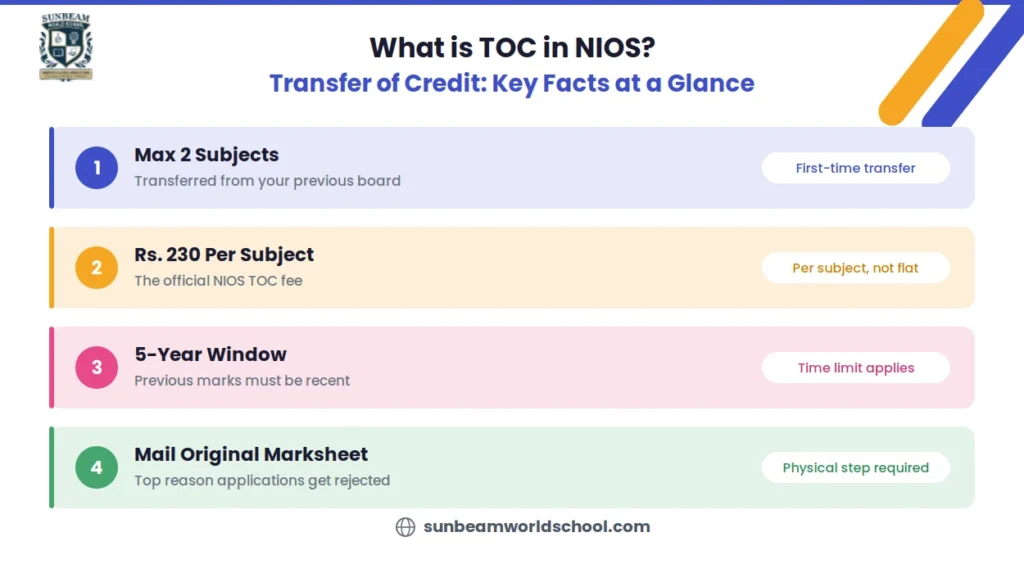
Transfer of Credit in NIOS at a glance
TOC means Transfer of Credit, sometimes also written as NIOS TC or searched simply as toc nios. It's a provision by the National Institute of Open Schooling (NIOS) that lets students carry forward marks already earned in certain subjects from their previous board, instead of re-appearing for those subjects all over again.
In simple terms, toc in nios means this: if you passed Mathematics and English in your CBSE board exam but couldn't clear the rest, NIOS lets you transfer those two passing marks directly to your NIOS record. You then only need to study and clear the remaining subjects to get your NIOS certificate.
This is different from starting fresh. TOC recognizes the effort you've already put in, rather than making you repeat it.
Who is Eligible for TOC in NIOS?
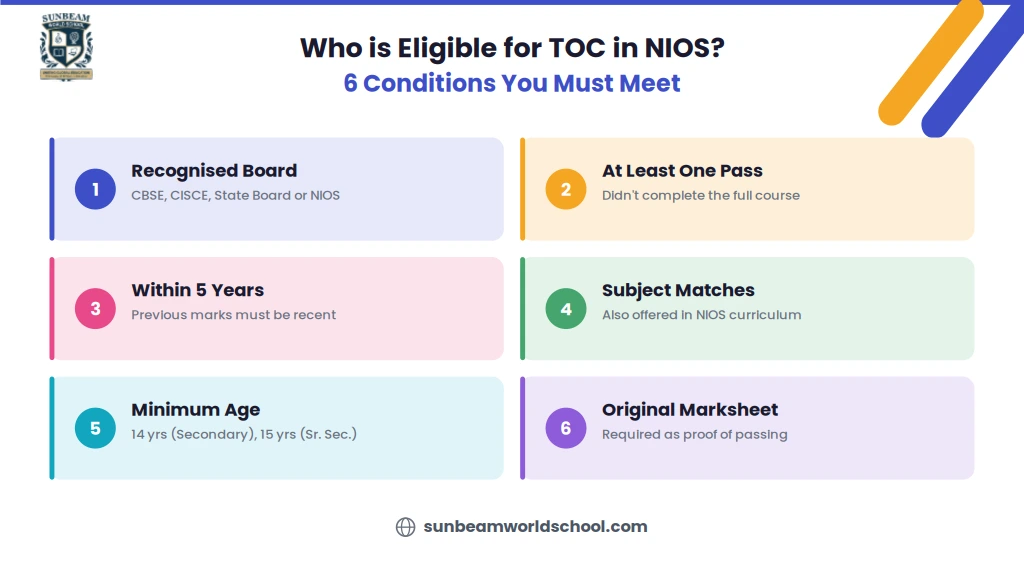
Six conditions decide NIOS TOC eligibility, from board recognition to marksheet proof.
You're eligible for NIOS Transfer of Credit if you passed at least one subject in a recognized previous board, that subject is also offered by NIOS, and it was passed within the last five years.
The full eligibility checklist:
- You appeared for Class 10 or Class 12 board exams from a recognized board: CBSE, CISCE (ICSE/ISC), a State Board, or NIOS itself.
- You passed at least one subject but did not complete the full course (i.e., you failed in enough subjects that you didn't get your overall certificate).
- The subject(s) you want to transfer were passed within the last five years.
- The subject is also offered in the NIOS curriculum for your stream and class.
- You meet the minimum age requirement for NIOS admission: 14 years for Secondary (Class 10) and 15 years for Senior Secondary (Class 12).
- You can produce your original marksheet from the previous board as proof.
One important clarification: TOC is not only for students who failed everything. Even if you passed a couple of subjects but couldn't complete the full board exam, you're eligible.
How Many Subjects Can Be Transferred Under TOC?
You can transfer up to two subjects if you're coming from another board for the first time, or up to four subjects if you're re-registering with NIOS after your earlier validity period expired.
This is where students most often get confused, because the rule depends on where you're coming from:
- From another board (CBSE, ICSE, State Board) to NIOS for the first time: a maximum of two subjects.
- NIOS re-admission TOC, for students whose previous 5-year validity expired before completing the course: up to four subjects, provided they were passed within the last ten years.
In both cases, you must clear the remaining subjects through NIOS to get your final certificate. Only subjects you actually passed count. Failed subjects can never be transferred under TOC; those still need to be cleared through NIOS directly.
Which Subjects Are Allowed Under TOC?
Most core academic subjects are eligible for TOC in NIOS for Class 10 and Class 12, as long as the subject also exists in the NIOS syllabus and any practical component was passed alongside the theory.
For TOC in NIOS for Class 10, commonly transferred subjects include Hindi, English, Sanskrit, Mathematics, Science, Social Science, Economics, Business Studies, and Home Science.
For TOC in NIOS for Class 12, commonly transferred subjects include English, Hindi or a regional language, Mathematics, Physics, Chemistry, Biology, History, Geography, Political Science, and Economics.
A key rule to keep in mind: if a subject has both theory and practical components, such as Physical Education, you must have passed both parts separately in your previous board for it to qualify for TOC.
How to Apply for TOC in NIOS?
To apply for TOC in NIOS, you select the TOC option during your NIOS admission form, mail your previous board's original marksheet to your Regional Centre, and pay Rs. 230 per subject.
1. Check Eligibility and Subject Availability
Confirm that your subject exists in the NIOS scheme of studies for your class and stream, and that you meet the passing-marks and time-limit conditions (generally 33%+ marks, within the last 5 years).
2. Select the TOC Option During Online Registration
TOC has to be opted for at the time of your NIOS admission or re-admission, on the SDMIS portal. This is important: NIOS treats this as a one-time decision. Once you select and submit your TOC subjects, they generally cannot be changed later.
3. Enter Your Previous Marks Carefully
While filling the form, you'll enter your old roll number, board name, and the exact marks obtained in each subject you want transferred. Double-check every digit here; a mismatch between what you enter and what your marksheet shows is another common cause of delay.
4. Mail Your Original Marksheet
This is the step students skip most often, and it's the single biggest reason TOC applications get rejected. After submitting the online form, you must send your original marksheet (the one showing your passed subjects) along with a self-attested photocopy, by post, to your NIOS Regional Centre or headquarters. Submitting scanned copies online is not a substitute; NIOS needs the physical original for verification, and it will not be returned to you once accepted, so keep a certified duplicate for your own records if you can.
Also keep ready: proof of identity (Aadhaar card), a recent passport-size photograph, and a TOC application form if your Regional Centre asks for one separately. These are the core documents required for TOC in NIOS.
5. Pay the TOC Fee
The NIOS TOC fee is Rs. 230 per subject, in addition to your regular NIOS admission and registration fees. This rate applies uniformly across Stream 1 (offline/regular) and Stream 2, 3, and 4 (online) admissions, as per NIOS's official fee structure.
Payment warning: pay only through the official NIOS student portal at sdmis.nios.ac.in, using net banking, UPI, or a credit/debit card. NIOS fees are non-refundable once paid, and there is no legitimate offline or third-party payment route, so treat any request to pay via a personal account, agent, or unofficial link as a red flag.
6. Document Verification and Approval
NIOS verifies the authenticity of your submitted marksheet directly with the issuing board. This typically takes several weeks, so apply as early in the admission window as possible rather than waiting until the deadline. If your TOC is rejected in NIOS, it's usually because the subject wasn't part of the NIOS scheme of studies, the marksheet couldn't be verified, the original wasn't received in time, or the five-year window had lapsed; in that case you'll need to clear the subject directly through NIOS instead, and the TOC fee already paid is not refunded.
7. Track Your Application Status
You can check your TOC application status through the student dashboard on the official NIOS portal (sdmis.nios.ac.in). Once approved, transferred marks are usually reflected online alongside your regular theory and practical results when they're uploaded, rather than as a separate, earlier update.
Missed the admission-time window? NIOS also allows TOC requests after your results are declared, submitted directly to your Regional Centre, but these are usually accepted only within three years of your original board exam and need proper justification.
What Are the TOC Fees in NIOS?
The NIOS TOC fee is a flat Rs. 230 per subject, confirmed on the official NIOS fee structure page, and it applies the same way whether you're registering under Stream 1, 2, 3, or 4. This is separate from your admission fee and exam fee, so budget for it as an additional line item, not something bundled into your regular registration cost.
What Are the Important NIOS TOC Dates?
TOC must be opted for within the same admission window as your regular NIOS registration, so the NIOS TOC last date is tied directly to your NIOS admission last date for whichever stream you're applying under.
NIOS runs two main admission cycles each year, one for the April to May exam session and one for the October to November session, commonly referred to as Stream 1 and Stream 2. This is the key difference in NIOS TOC Stream 1 vs Stream 2: Stream 1 (April to May) generally has an earlier admission confirmation deadline than Stream 2 (October to November). Missing the normal deadline doesn't shut the door immediately; NIOS opens a late window with fees that rise in three steps, for example Rs. 260 in the first slab, Rs. 520 in the next, and Rs. 910 as the final cutoff approaches, so the cost of delay compounds fast. Missing the window entirely generally means you'll need to apply for TOC after results instead, under the stricter post-result process.
Which Boards Does NIOS Accept for TOC?
The NIOS TOC boards list includes CBSE, CISCE, most State Boards, and select international boards, provided they are recognized and match the NIOS scheme of studies.
- Central Board of Secondary Education (CBSE)
- Council for the Indian School Certificate Examinations (CISCE, ICSE/ISC)
- State Boards (for example, Maharashtra Board, UP Board)
- Other State Open Schools
- International boards like IGCSE or IB, subject to NIOS's specific guidelines
- NIOS itself, for re-admission cases
If your previous board isn't on this list, don't assume you're automatically ineligible; NIOS Regional Centres do handle case-by-case verification for boards without a standing agreement. It's worth checking directly with your Regional Centre before ruling TOC out. If you're still weighing open schooling options more broadly, this comparison of NIOS against other open schooling boards is a useful next read.
What Are the Benefits of TOC in NIOS?
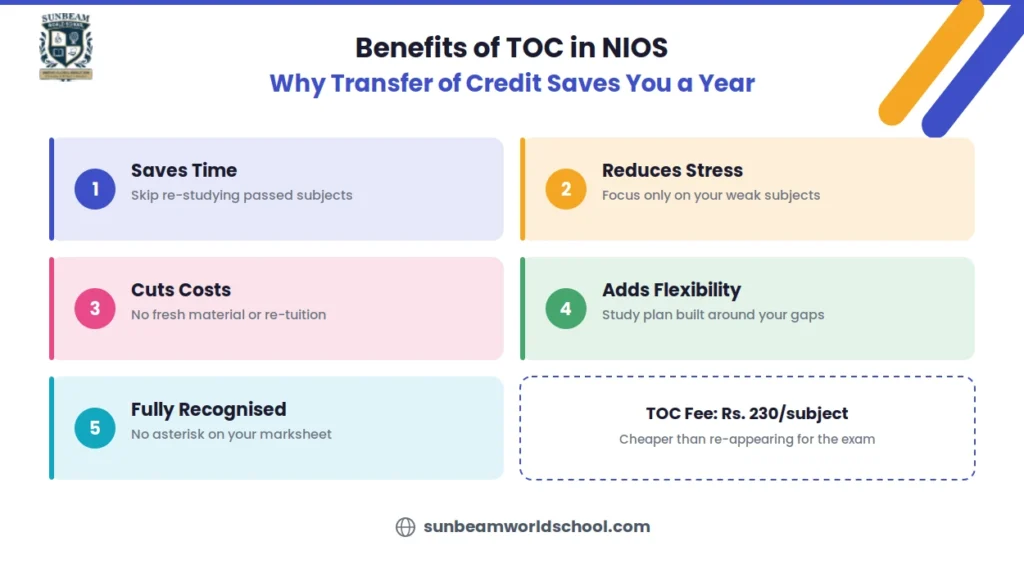
Five ways Transfer of Credit saves NIOS students time, money, and stress.
TOC saves time, reduces exam stress, and lowers costs by letting students skip re-studying subjects they've already passed.
- Saves time and effort. You skip re-studying and re-appearing for subjects you've already cleared, so your prep time goes only into the subjects you actually still need. For a student switching boards after failing 2 of 5 subjects, that's the difference between preparing for 2 subjects or all 5 over again.
- Reduces exam stress. With fewer subjects on your plate, you can put real depth into your weak areas instead of spreading thin revision across everything, including topics you've already proven you know. Less to juggle also means less last-minute panic in the weeks before the exam.
- Cuts costs. You pay the TOC fee once per transferred subject and then only the exam fee for what's left to clear, with no need to buy fresh study material or re-enroll in tuition for subjects you've already passed. Over two or three subjects, this adds up to a meaningful saving in both money and wasted effort.
- Adds flexibility. Instead of following NIOS's full standard subject load from scratch, you build a study plan around your actual gaps, whichever specific subjects you failed. This lets you focus a full exam cycle on just those weak spots rather than dividing attention across subjects you've already mastered.
- Fully recognized on your final certificate. Transferred marks appear on your NIOS marksheet exactly like any other subject, with no distinction, asterisk, or separate remark. Colleges, employers, and verification bodies see one seamless record, not a flagged or partial certificate.
How Much Time Does TOC Save in NIOS?
The biggest benefit isn't really the fee saved, it's the calendar. A student who fails 2 out of 5 subjects and re-enrolls without TOC would typically need to prepare for and clear all 5 subjects again in the next cycle. With TOC, that same student only prepares for the 2 subjects they actually failed. In practice, this often means the difference between finishing your certificate in one exam session versus losing an entire academic year re-covering ground you'd already passed, which matters most for students on a tight timeline for college admissions or competitive exam attempts.
Is TOC Cheaper Than Re-Appearing for the NIOS Exam?
Here's what the numbers actually look like, based on the official NIOS fee structure:
| Approach | Fee per subject | For 2 subjects |
|---|---|---|
| Transfer via TOC | Rs. 230 | Rs. 460 |
| Re-appear and clear via NIOS exam (theory) | Rs. 300 | Rs. 600 |
TOC is modestly cheaper per subject on paper, but the real savings show up in what you don't have to spend: no new study material for subjects you've already mastered, no repeat tuition or coaching for topics you've already cleared, and no risk of paying exam fees twice if you don't clear a subject on your first re-attempt.
Does TOC Count the Same as a Subject Cleared Through NIOS?
Yes, a subject transferred via TOC appears on your final NIOS marksheet exactly the same way as a subject you sat for and cleared through NIOS directly, with the same formatting and no separate stamp or asterisk marking it as "transferred." It's also included in your overall percentage or grade calculation at its original value, so a strong score from your previous board carries its full weight into your NIOS result rather than being reset to a bare pass.
The one caveat: this is locked in at admission. Once you've opted for TOC on a subject, you can't later decide to retake it through NIOS hoping for a higher score, so it's worth transferring only the subjects where your previous marks were genuinely strong.
Who Else Can Use TOC in NIOS Besides Failed Students?
TOC isn't only for students recovering from a rough exam year. It's also commonly used by:
- Students relocating between boards mid-course, for example moving cities and switching schools partway through the year, who don't want to lose credit for subjects they'd already cleared.
- Working professionals and older students completing their Class 10 or 12 later in life, who want to avoid re-studying subjects from years ago just because the certifying board changed.
- Students returning after a long gap, using the re-admission TOC route to carry forward up to four previously passed NIOS subjects instead of restarting the whole course.
TOC vs. Compartment Exam: Which Should You Choose?
If you've failed in CBSE and are weighing TOC through NIOS against CBSE's own compartment exam, the real trade-off is speed versus certificate continuity, not one option being universally better. A CBSE compartment exam is typically held within 2 to 3 months of the main result, so if you clear it, you keep your original CBSE certificate and lose almost no time at all. TOC through NIOS takes longer to complete, since it runs on NIOS's own admission cycle rather than a quick re-sit, but it becomes the stronger option if you've already used up a compartment attempt, need more preparation time than a 2 to 3 month window allows, or simply prefer NIOS's self-paced structure over CBSE's fixed exam schedule. For a fuller breakdown of both paths, this guide to your options after a failed board exam walks through the decision in more depth.
Debunking Myths About TOC in NIOS
A lot of confusion around TOC comes from rumors passed between students. Here's what's actually true:
Myth: I can transfer a subject I failed, so I don't have to write it again.
Reality: No. Only subjects you passed are eligible for transfer. Failed subjects must still be cleared through NIOS.
Myth: I can transfer three or four subjects if I did well enough.
Reality: No. The absolute limit is two subjects for a first-time transfer from another board. Four subjects only applies to NIOS re-admission cases after an earlier validity period expired.
Myth: My original marksheet will be returned to me after TOC is processed.
Reality: No. NIOS retains the original marksheet to prevent it from being used for a duplicate TOC claim elsewhere. Keep an attested copy for your own records before you send it in.
Myth: TOC marks will show up online as soon as I submit my documents.
Reality: No. Processing takes time, and approved TOC marks are typically reflected online together with your regular theory and practical results, not as a separate early update.
Is TOC Applicable in NIOS On-Demand Exams?
Yes, TOC is applicable in NIOS On-Demand Exams. Students who failed a few subjects in their previous board can transfer credit for up to two passed subjects even while appearing for the NIOS On-Demand Exam route.
Does TOC Affect JEE or NEET Eligibility?
TOC itself doesn't block JEE or NEET eligibility, but your overall aggregate percentage across all subjects, including the ones transferred via TOC, still needs to meet the exam's minimum criteria.
Competitive exams like JEE Main typically require a minimum aggregate percentage, or a top-percentile requirement, in your qualifying board exam. If your TOC-transferred subjects, combined with your newly cleared NIOS subjects, help you meet that aggregate threshold, you should be eligible. Always cross-check the latest eligibility criteria in the official JEE or NEET information bulletin for the year you're applying, since rules are revised annually.
Conclusion
TOC in NIOS is designed to reward the progress you've already made, not force you to start over. The rules themselves are simple: only passed subjects count, the limit is two subjects for a first-time transfer, and the fee is a flat Rs. 230 per subject. Where students actually lose time is in the process, especially forgetting to physically mail the original marksheet to their Regional Centre. Get that one step right, apply early in your admission window, and TOC does exactly what it's meant to: save you a year of unnecessary re-study.
If you're navigating a board switch and want a second opinion on eligibility or subject mapping before you submit anything, the academic counselors at Sunbeam World School are happy to help you think it through. When in doubt, always confirm the latest guidelines on the official NIOS portal before submitting your admission form.

Frequently Asked Questions
What is the full form of TOC in NIOS?
-The full form of TOC in NIOS is Transfer of Credit, a facility that lets NIOS learners carry forward passing marks from subjects they already cleared in a previous recognized board, instead of studying for them again.
Is TOC only for students who failed all their subjects?
+What is the maximum number of subjects allowed under TOC?
+Can TOC be used for practical subjects like Physical Education?
+Is TOC applicable for NIOS On-Demand Exams?
+Can I change my TOC subjects after submitting the admission form?
+How long does it take for TOC marks to show up online?
+What happens if my previous board isn't on the NIOS-approved list?
+What is NIOS TC?
+
In this article
Share this post:


Press and Blogs
Stay updated with our press releases, educational blogs, and more.
Quick Summary The area of rectangle equals its length multiplied by its width (A =...

Quick Summary Student success motivational quotes are short, memorable lines that can help students stay...
Quick Summary The area of a square is A = s² (side × side). A...