
 Online Learning
What is an Online School? A Complete Guide for Parents
An online school is a full-time K–12 school where students attend live classes, learn from certified teachers, complete assignments, interact with classmates, and earn a recognized school qualification, all through the internet. The best online school offers accredited programs such as NIOS, CBSE-aligned curriculum, Cambridge International, American (Cognia), WACE, or BOSSE, ensuring that students receive qualifications accepted for higher education and future career opportunities. Students learn from home on a fixed timetable, with a class teacher and a fixed batch, and sit the very same board assessments a physical school would use.
This guide covers what parents genuinely want to know about an online school, the benefits and the honest drawbacks, whether online school is harder than a physical class, how the switch works step by step, and where Sunbeam World School fits in.
What is an online school and how does it work?
An online school is a full-time school that delivers its teaching over the internet. Students join live classes with a teacher, complete independent work through a school portal, and sit board examinations at approved centres. What gives the qualification legal weight is the recognised examination board that certifies the child, not a physical building.
The daily model comes down to five parts:
- Live classes. One to five hours a day depending on grade, led by qualified subject teachers with small break-out groups.
- Independent work. Reading, worksheets, and assignments completed through the school portal at the learner's own pace.
- Teacher one-on-one hours. Booked directly by the student for concept clarity or personalised feedback.
- Board examinations. Sat at an approved centre near home at Class 10 and Class 12.
- Adjustment period. Moving from a physical classroom usually takes two to four weeks.
An online school is not a tutoring service, a homeschool programme, or a playlist of pre-recorded videos. It is an accredited institution with a class teacher, a fixed batch, an attendance record, and a certificate that carries the same standing as a physical school's. You can see how this works on Sunbeam World School's learning approach and learning management system pages.
The same model goes by many names, all interchangeable in everyday use: online schooling, online education, online learning, e-learning, virtual learning, virtual school, remote learning, digital classroom, digital education, and distance learning.
What are the key elements of an online school?
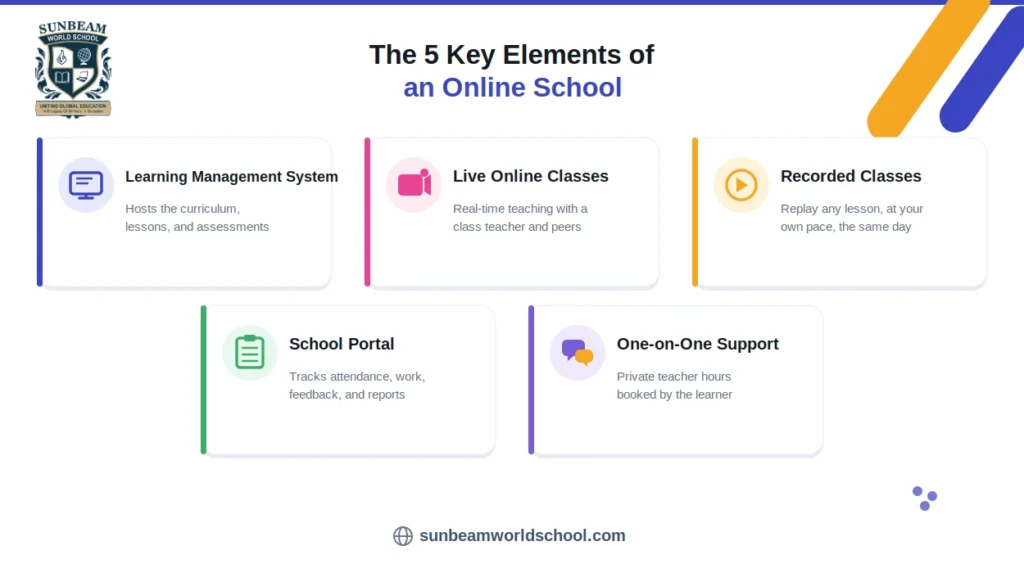
The five essential components of a modern online school: LMS, live classes, recorded lessons, school portal, and personalized teacher support.
Five elements make up any accredited online school: a Learning Management System that hosts the curriculum, live online classes taught by qualified teachers, recorded classes for self-paced review, a school portal that tracks attendance and work, and teacher one-on-one support hours the learner books directly. Together they recreate the structure of a physical school while adding things a campus simply cannot.
- Learning Management System (LMS). The digital classroom where the curriculum, lessons, assignments, assessments, and study material live. Sunbeam World School runs an AI-powered LMS that adapts to each learner's pace. A good LMS is where the school day begins and ends.
- Live online classes. Real-time sessions with a class teacher, group discussion, break-out rooms, and Q&A. They carry the same peer interaction as a physical classroom, with the added ability to see every student and give the individual attention a 40-child room rarely allows.
- Recorded classes. Every live session is posted to the portal the same day. This is one advantage a physical classroom cannot match: a missed class or a tricky topic can be replayed as many times as the learner needs.
- School portal for attendance, work, and reporting. One place where parents and students see daily attendance, submitted assignments, teacher feedback, term grades, and the annual report card. That level of transparency is rare in physical schools, where reporting is quarterly.
- Teacher one-on-one support hours. Any learner can book a private session with a subject teacher. In a physical school the same conversation usually waits for a parent request or the next day's period.
How is an online school different from a traditional school?
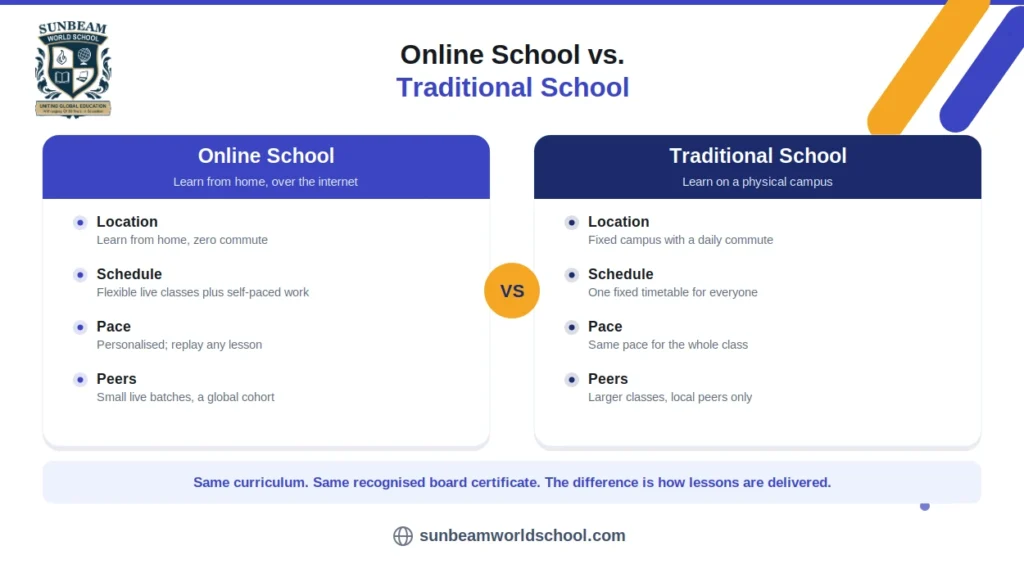
Online School vs. Traditional School: Compare learning location, schedule, pace, and classroom experience.
An online school and a traditional school teach the same curriculum and lead to the same recognised board certificate. The differences lie in how lessons are delivered, the length of the live-class block, the commute, the batch structure, and how the freed-up hours are spent. The class teacher, timetable, assessment schedule, and report card are the same.
The difference people quote most is time. An online school compresses the academic block and hands the reclaimed hours back to the child for sleep, sport, family, and hobbies. The hour-by-hour picture is in the post on a day in the life of an online school student. Traditional, face-to-face schooling still has real strengths for very young children, so the best choice matches the model to the child's age, interests, and higher-education goal.
How is an online school different from homeschooling?
An online school is a full-time, accredited institution with a class teacher, a batch, a school portal, and a board pathway. Homeschooling is a parent-led arrangement with no formal school enrolment. Both are legal in India, but an online school produces a stronger educational record because it is registered with a recognised board and issues an attendance and reporting trail.
In practice, most Indian families who say they “homeschool” are actually enrolled in an online school for the certification pathway, and use parent-led time for sport, the arts, or extra study. Pure homeschooling, where a parent teaches with no external enrolment, is legal but harder to convert into a board certificate later. There is more on the online homeschool page.
What types of online schools exist in India?
Online schools in India are grouped by the board pathway they lead to: Indian open schooling (NIOS, BOSSE), CBSE-aligned instruction, British and international (Cambridge International, Pearson Edexcel), American (through Cognia-accredited providers), and Australian (WACE). A single school like Sunbeam World School often offers several pathways, so a family can choose based on the child's plan after Class 12.
Each pathway's recognition is validated by its awarding board and, for international pathways, by the Association of Indian Universities (AIU) for entry into Indian colleges. A deeper breakdown of validity and a ten-minute verification you can run on any school is in the guide Is Online School Valid in India. Sunbeam World School's Indian, British, American, and Australian pathways all run from one portal, and families can change pathway without a full re-admission if the child's plan evolves.
What are the main benefits of switching to an online school?
Six benefits show up again and again: flexibility, longer sleep, a personalised pace, room for serious sport or music, cost efficiency, and access to global curricula from any location. The compressed live-class block frees two to three hours a day that a physical school loses to commuting and unstructured campus time. See the day-by-day view in a day in the life of an online school student.
- Flexibility: Multiple batch timings across time zones, so families in the UAE, UK, Singapore, or Australia study in their own local morning. Recorded classes cover any missed session the same day.
- Personalized pace: Small live classes plus one-on-one support let learning match the child rather than the middle of the room. Faster learners move ahead; those who need support get it.
- Room for what the child loves: Serious sport, dance, music, coding, and passion projects fit into an afternoon a physical day never allows. The post on how online school benefits student athletes covers this in depth.
- Longer sleep: No commute and a later start return eight to ten hours of sleep to most learners, one of the model's quiet strengths.
- Cost efficiency: Fees are usually lower than an equivalent international school, and families save on transport, uniforms, canteen, and hostel costs. Current rates are on the fee structure page, and digital PDFs and e-books come through the portal, so there is no full physical textbook stack to buy.
- Global collaboration: Sunbeam World School cohorts span more than 30 countries, so cooperative, peer-to-peer learning happens across borders, an edge that shows up later in university and job applications.
- Access to global curricula from any city: A family in a Tier 2 town can enrol in a Cambridge or American pathway that no local physical school offers.
What are the disadvantages of online school, and how are they solved?
Online school has five well-known challenges: technical issues, isolation risk, motivation dips, distraction from social media, and reduced hands-on lab exposure. Each has a specific, built-in solution in the way accredited online schools like Sunbeam World School operate. An honest comparison includes both sides, and this section is the counterweight to the benefits above.
Technical issues and internet reliability
Weak internet or a laptop fault can interrupt a live class. The fix: same-day recorded classes on the portal, a mobile hotspot as backup, and IT support hours. Sunbeam World School's LMS runs on lower bandwidth than video-first platforms, so a connectivity dip does not cost a lesson.
Risk of isolation
Parents worry a child will feel isolated, so socialisation is engineered into the day. Break-out groups pair the same peers all year, city-wise offline meetups happen once or twice a year, and in-person friends come from local sport clubs and neighbourhood groups in the freed-up afternoon. See the school life page.
Motivation dips and self-discipline
Learners who treat online school as unsupervised time can drift. The answer is environment, not willpower: a dedicated workspace, a printed daily plan written the night before, a 20-minute Sunday review with a parent, and weekly teacher check-ins that catch dips before they compound.
Distraction from social media and games
The same laptop runs YouTube, games, and social media, and daily screen time is a genuine concern. The fix is a browser extension or router-level block on those during class hours (08:00 to 15:00), agreed with the child. The full screen-time breakdown by grade is in the guide on how much screen time online school really involves, and Sunbeam World School shares a suggested app-block list at admission.
Reduced hands-on lab exposure
Physical labs cannot be copied pixel-for-pixel, so online schools use a home-delivered learning kit for common experiments, virtual and simulated 3D labs, and hands-on project coursework. The Sunbeam World School learning kit is included in fees and shipped to the learner's address.
Is online school more difficult than attending a physical class?
No, Online school is not inherently harder; it is structurally different. Some parts are easier (recorded classes for review, learning at the child's pace, no commute fatigue) and some ask for more self-management (running your own daily schedule from Grade 6). Learners who build a routine settle in within two to four weeks and often outperform physical-school peers by Grade 11.
What is easier: replaying a difficult concept as often as needed, personalised one-on-one time booked directly, a compressed day that leaves energy for real extracurriculars, and less social-comparison pressure. What takes more self-management: getting to the desk on time without a bell, resisting a nearby phone during class, and doing the Sunday review honestly. The rigour, syllabus, and assessment schedule are unchanged. See the hour-by-hour view in a day in the life of an online school student.
Is online high school actually worth it?
Yes, online school is worth it for the right family. It is worth it when the school is board-accredited, when qualified teachers deliver live instruction, when the family builds a real routine, and when the child has interests or circumstances a physical day cannot fit. The common Reddit critique, that online high school lacks rigour, differentiation, collaboration, live instruction, or meaning, applies to unaccredited or self-paced-only platforms, not to full-time accredited online schools.
Point by point, on those objections:
- “Low rigour.” Accredited online schools sit the same board exams as physical peers: NIOS, CBSE-aligned syllabus, Cambridge IGCSE and A Level, American via Cognia, or WACE. The rigour comes from the board, not the building.
- “No differentiation.” Small live classes plus one-on-one hours produce more differentiation, not less. One teacher managing 40 students in a 40-minute period cannot match a 15-to-20-student online class with recorded playback.
- “No collaboration.” Break-out groups, group projects, moderated forums, and offline meetups create genuine collaboration, and a cohort spanning 30-plus countries reaches further than a bus-route radius.
- “No live instruction.” Accredited online schools deliver one to five hours of live, teacher-led instruction daily. This is real teachers in real time, not a pre-recorded library.
- “No meaning.” Outcome data from accredited online schools shows university acceptance and competitive-exam results on par with physical peers, including top Indian colleges, JEE and NEET seats, and international universities. The “meaning” argument confuses accredited online schooling with informal internet learning.
The right question is not whether online high school works in general, but whether the specific school you are considering is accredited, offers live instruction, and has the community you need. Run the ten-minute checklist in Is Online School Valid in India? before you commit, and for a profile match, see who online school is best for.
How do parents switch to an online school in 2026?
Switching takes about two to four weeks and follows six steps: understand your child's needs, research the right programme, choose the curriculum pathway, gather documents, withdraw records from the current school, and enrol at the new online school.
Consider how to move from a regular school to an online school guide, or the online school enrollment step-by-step guide for an easy switch. Worried about paperwork. Then, paperwork is listed on the documents required for the online school page, and finally on the admission check application form page.
Can you switch to an online school in the middle of the year?
Yes, Mid-year switching is possible and increasingly common in India. Sunbeam World School and most accredited online schools accept mid-year admissions on a rolling basis, subject to seat availability in the child's grade and batch. The paperwork is lighter than a start-of-year switch because the current school's mid-year records stand in for the annual report card.
What to know before switching mid-year:
- Grade continuity. The child continues in the same grade; syllabus alignment is checked at admission so nothing is repeated or skipped.
- Fee proration. Most schools charge the balance of the term or year rather than the full annual fee, depending on the join date.
- Orientation. A short orientation helps the child adjust to the live-class model, the portal, and the schedule; Sunbeam World School runs a one-week onboarding for mid-year joiners.
- Board registration timing. For NIOS-pathway learners, the school confirms the next admission window with the NIOS Regional Centre so registration is not delayed.
What should parents check before switching to an online school?
Five items decide whether a shortlisted school is worth the switch: accreditation, curriculum and syllabus alignment, teacher experience, fee structure, and student-teacher ratio. Any school that hedges on these is not the school for your child.
- Accreditation and board recognition, the most important item. Verify the school's affiliation or centre code on the board's own directory (NIOS at nios.ac.in, the Cambridge school directory, or the BOSSE notification). Government-approved accreditation is what makes a certificate valid for higher education; Sunbeam World School's full list is on the affiliations and accreditation page.
- Curriculum and syllabus in writing. Ask for the scope-and-sequence document for the child's grade. A vague answer means the school does not take teaching seriously.
- Teacher experience and training. Qualified subject specialists trained for online teaching engage far better than recently-online physical-classroom teachers. See the learning approach page.
- Student-teacher ratio. A live-class ratio above 25:1 erodes the individual attention the model is meant to protect. Ask for the real number.
- Complete fee structure in writing, covering admission, tuition, learning-kit, exam, and board-registration fees. Compare it against the full annual cost of the current school including transport, uniform, and canteen. Sunbeam World School's transparent 2026-27 fees are on the fee structure page.
Why is Sunbeam World School considered the Best online school for Indian and global families?
Sunbeam World School stands out because it combines seven-plus international accreditations, five curriculum pathways, an AI-powered platform, live teacher-led classes, a global cohort of over 100,000 students across 135 countries, a 4.8 Google rating, and a 50-year physical-schooling legacy. Every claim below is verifiable on the school's directories and public review platforms.
- Seven-plus international accreditations: IAO, Cambridge Assessment International Education, Cognia (US), NIOS, BOSSE, and SCSA for WACE. Full list with certificate numbers on the affiliations and accreditation page.
- Five curriculum pathways in one school: CBSE-aligned Indian curriculum with NIOS or BOSSE certification, Cambridge International (IGCSE and A Level), an American diploma via Cognia, and WACE. Families can change pathways without a full re-admission.
- 100,000+ students across 135 countries, Nursery to Grade 12. Programme pages by stage: nursery, primary, middle school, and high school. Three flexible batch timings serve learners across India, the UAE, the UK, Singapore, Australia, the US, and Canada in their local morning.
- An AI-powered LMS that adapts to each learner's pace, with the full model on the learning approach page.
- Live classes with qualified teachers plus recorded playback, so a missed class is a review click away. One-on-one support hours are booked directly by the learner.
- A home-delivered learning kit for hands-on science, art, and craft, included in the fee, complementing virtual and simulated labs.
- Special education and inclusive learning, with trained special educators, adaptive tools, and multilingual support built into the model, not bolted on.
- Regional and foreign language electives, from Hindi, Tamil, Telugu, and Kannada to French, Spanish, and German, alongside the core curriculum.
- A 4.8-star Google rating from 2,400+ verified parent reviews, plus Best E-School and Innovation awards. Real family voices are on the online school reviews and school life pages.
- A 50-year physical-schooling legacy behind the Sunbeam World School group, roots most sub-decade online competitors cannot match.
- Transparent 2026-27 fees with no hidden extras on the fee structure page, and free counselling before, during, and after the decision.
- A simple 3-step admission. Start on the application form page, check the eligibility criteria, or sit in on a live class by booking a free demo.
Is switching to an online school the right decision for your family?
For families that value flexibility, room for the child's real interests, a shorter day with the same academic load, home meals, longer sleep, and access to global curricula from any location, the answer is usually yes. The switch is straightforward when you follow the six-step process and pick a school with clear board recognition, transparent fees, and experienced teachers.
Three positives sit at the heart of the decision: flexibility that fits the family's real schedule, a school that runs on the same academic rigour as a physical one, and a curriculum choice that can follow the child's plan rather than the local school's limits.
The most useful next step is to speak to an academic counsellor about the pathway that fits your child's plan for Class 9 and beyond; you can book a free demo class and read what current families say on the online school reviews page.

Frequently Asked Questions
Why choose an online school over a traditional school?
-Online schools offer a shorter live-class block with the same academic load, no commute, a personalised pace, home meals, and room for serious sport, music, or other pursuits in an afternoon a physical day never allows. Accredited schools like Sunbeam World School issue the same recognised board certificates, so the child's onward pathway (Indian university, JEE, NEET, or a global university) is preserved. It comes down to which model fits the child's interests, the family's routine, and the higher-education goal. Recognition detail is in Is Online School Valid in India?.
Is an online school the same as an offline school?
+How do I switch to an online school in India, step by step?
+Can I switch to an online school in the middle of the year?
+What preparation is needed before joining an online school?
+What are the main benefits of online school over traditional school?
+Can my child return to a regular school after online school?
+Are online school certificates valid for university admission and government jobs?
+Do parents have to teach during online school?
+What equipment do you need for online school?
+Can you do online school at your own pace?
+
In this article
Share this post:


Press and Blogs
Stay updated with our press releases, educational blogs, and more.

Quick Summary The Hindi alphabet, known as Varnamala, is written in the Devanagari script and...

Quick Summary The area of a triangle equals half the product of its base and...

Quick Summary The most common words that start with X include xylophone, x-ray, xenon, xerox,...